Unit – III
SOFTWARE DESIGN
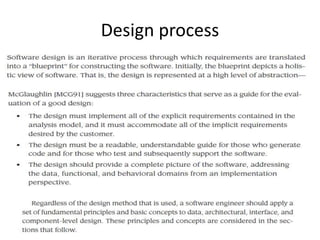
Design process
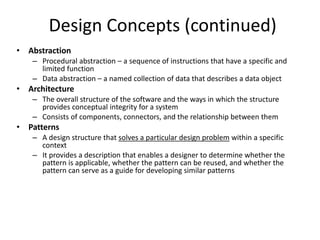
Design Concepts (continued)
• Abstraction
– Procedural abstraction – a sequence of instructions that have a specific and
limited function
– Data abstraction – a named collection of data that describes a data object
• Architecture
– The overall structure of the software and the ways in which the structure
provides conceptual integrity for a system
– Consists of components, connectors, and the relationship between them
• Patterns
– A design structure that solves a particular design problem within a specific
context
– It provides a description that enables a designer to determine whether the
pattern is applicable, whether the pattern can be reused, and whether the
pattern can serve as a guide for developing similar patterns
Design Concepts (continued)
• Modularity
– Separately named and addressable components (i.e., modules) that are
integrated to satisfy requirements (divide and conquer principle)
– Makes software intellectually manageable so as to grasp the control paths, span
of reference, number of variables, and overall complexity
• Information hiding
– The designing of modules so that the algorithms and local data contained within
them are inaccessible to other modules
– This enforces access constraints to both procedural (i.e., implementation) detail
and local data structures
• Functional independence
– Modules that have a "single-minded" function and an aversion to excessive
interaction with other modules
– High cohesion – a module performs only a single task
– Low coupling – a module has the lowest amount of connection needed with
other modules
Design Concepts
• Stepwise refinement
– Development of a program by successively refining levels of procedure
detail
– Complements abstraction, which enables a designer to specify procedure
and data and yet suppress low-level details
• Refactoring
– A reorganization technique that simplifies the design (or internal code
structure) of a component without changing its function or external
behavior
– Removes redundancy, unused design elements, inefficient or
unnecessary algorithms, poorly constructed or inappropriate data
structures, or any other design failures
• Design classes
– Refines the analysis classes by providing design detail that will enable the
classes to be implemented
– Creates a new set of design classes that implement a software
infrastructure to support the business solution
6
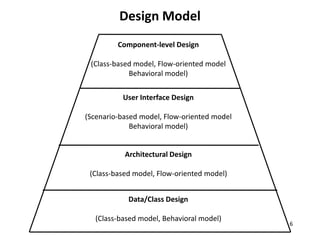
Data/Class Design
(Class-based model, Behavioral model)
Architectural Design
(Class-based model, Flow-oriented model)
User Interface Design
(Scenario-based model, Flow-oriented model
Behavioral model)
Component-level Design
(Class-based model, Flow-oriented model
Behavioral model)
Design Model
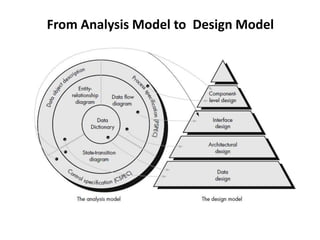
From Analysis Model to Design Model
8
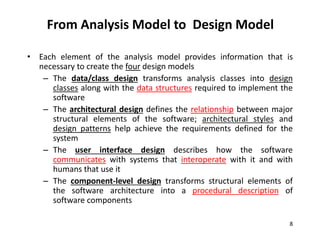
• Each element of the analysis model provides information that is
necessary to create the four design models
– The data/class design transforms analysis classes into design
classes along with the data structures required to implement the
software
– The architectural design defines the relationship between major
structural elements of the software; architectural styles and
design patterns help achieve the requirements defined for the
system
– The user interface design describes how the software
communicates with systems that interoperate with it and with
humans that use it
– The component-level design transforms structural elements of
the software architecture into a procedural description of
software components
From Analysis Model to Design Model
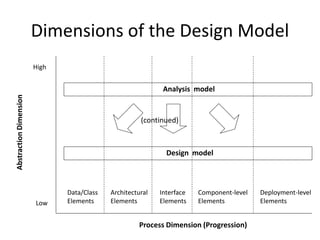
Process Dimension (Progression)
AbstractionDimension
Data/Class
Elements
Interface
Elements
Architectural
Elements
Component-level
Elements
Deployment-level
Elements
Dimensions of the Design Model
Analysis model
Design model
Low
High
(continued)
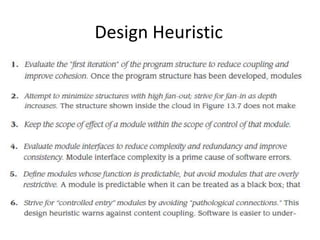
Design Heuristic

Unit iii(part a- design process model)

  • 1.
  • 2.
  • 3.
    Design Concepts (continued) •Abstraction – Procedural abstraction – a sequence of instructions that have a specific and limited function – Data abstraction – a named collection of data that describes a data object • Architecture – The overall structure of the software and the ways in which the structure provides conceptual integrity for a system – Consists of components, connectors, and the relationship between them • Patterns – A design structure that solves a particular design problem within a specific context – It provides a description that enables a designer to determine whether the pattern is applicable, whether the pattern can be reused, and whether the pattern can serve as a guide for developing similar patterns
  • 4.
    Design Concepts (continued) •Modularity – Separately named and addressable components (i.e., modules) that are integrated to satisfy requirements (divide and conquer principle) – Makes software intellectually manageable so as to grasp the control paths, span of reference, number of variables, and overall complexity • Information hiding – The designing of modules so that the algorithms and local data contained within them are inaccessible to other modules – This enforces access constraints to both procedural (i.e., implementation) detail and local data structures • Functional independence – Modules that have a "single-minded" function and an aversion to excessive interaction with other modules – High cohesion – a module performs only a single task – Low coupling – a module has the lowest amount of connection needed with other modules
  • 5.
    Design Concepts • Stepwiserefinement – Development of a program by successively refining levels of procedure detail – Complements abstraction, which enables a designer to specify procedure and data and yet suppress low-level details • Refactoring – A reorganization technique that simplifies the design (or internal code structure) of a component without changing its function or external behavior – Removes redundancy, unused design elements, inefficient or unnecessary algorithms, poorly constructed or inappropriate data structures, or any other design failures • Design classes – Refines the analysis classes by providing design detail that will enable the classes to be implemented – Creates a new set of design classes that implement a software infrastructure to support the business solution
  • 6.
    6 Data/Class Design (Class-based model,Behavioral model) Architectural Design (Class-based model, Flow-oriented model) User Interface Design (Scenario-based model, Flow-oriented model Behavioral model) Component-level Design (Class-based model, Flow-oriented model Behavioral model) Design Model
  • 7.
    From Analysis Modelto Design Model
  • 8.
    8 • Each elementof the analysis model provides information that is necessary to create the four design models – The data/class design transforms analysis classes into design classes along with the data structures required to implement the software – The architectural design defines the relationship between major structural elements of the software; architectural styles and design patterns help achieve the requirements defined for the system – The user interface design describes how the software communicates with systems that interoperate with it and with humans that use it – The component-level design transforms structural elements of the software architecture into a procedural description of software components From Analysis Model to Design Model
  • 9.
  • 10.