FIRE SAFETY
⦁ A process in which substances combine
chemically with oxygen from the air and
typically give out bright light, heat, and
smoke; combustion or burning.
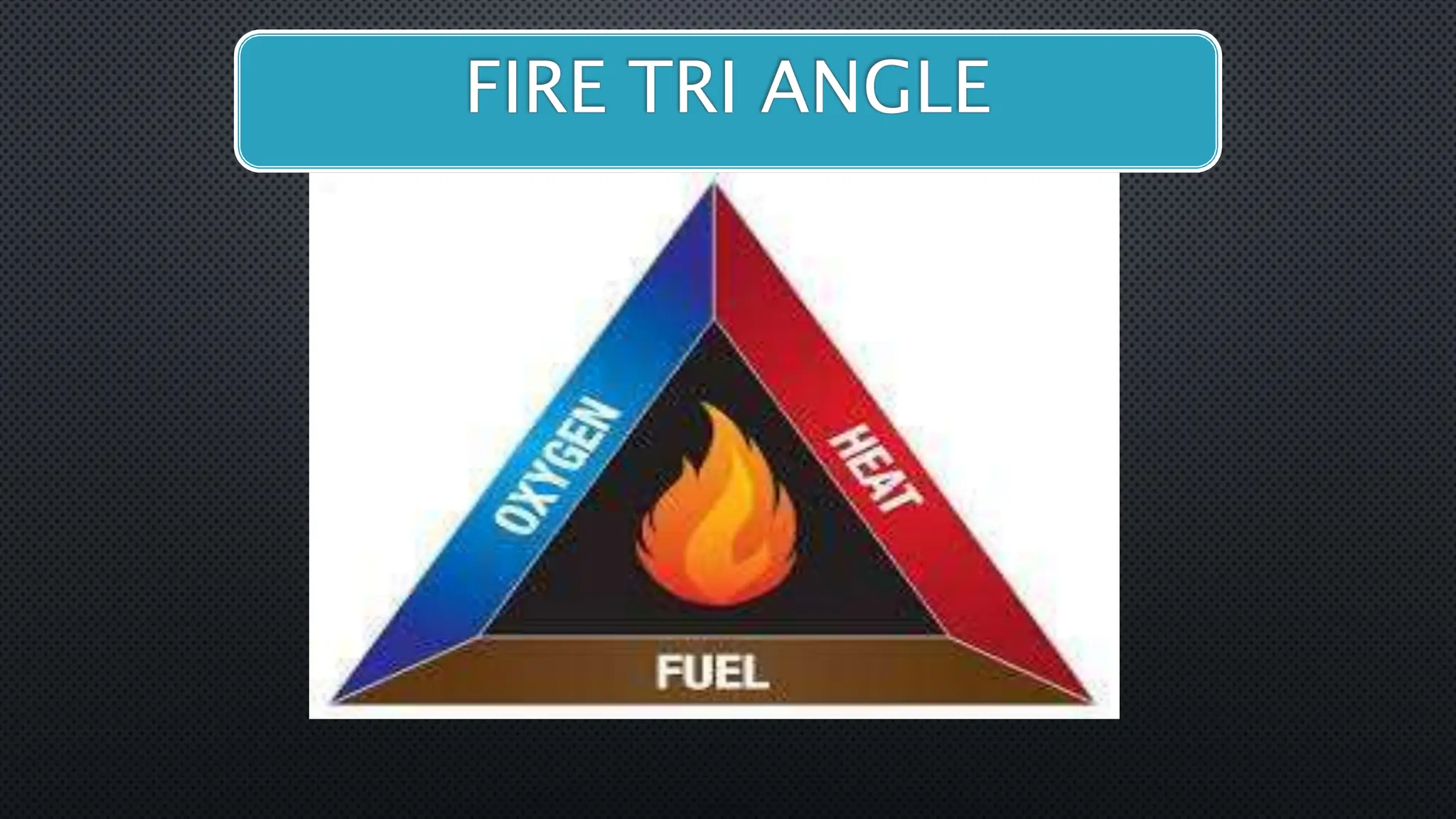
⦁ Fire Triangle
FIRE TRI ANGLE
CLASSES OF
FIRE
CLASS B
FLAMMABLE OR COMBUSTIBLE LIQUIDS SUCH AS
GASOLINE, KEROSENE,
paint, paint thinners and propane
Class C
Energized electrical equipment, such as appliances,
switches, panel boxes and power tools.
Class D
Certain combustible metals, such as magnesium, titanium,
potassium, and sodium
TYPES OF REMOVING
FIRE
COOLING
Removal of heat.
(Best cooling media is water
SMOTHERING
Reducing % of oxygen. Cutting off the
supply of oxygen. (Blanketing, Use foam
STARVATION
Removal of fuel or removal of
combustible material near by
TYPES OF FIRE
EXTINGUISHERS
WATER TYPE
EXTINGUISHER
⦁ Aring or pin on the handle stops the fire extinguisher from being
set off by accident. It also acts as a tamper-proof seal: if the ring is
broken or missing, you know the extinguisher needs to be
checked.
⦁ Inside the sturdy steel case, there's a canister containing high-
pressure gas (orange with blue hashing).
⦁ Most of the extinguisher is filled with water (blue).
⦁ Atube runs right up the inside of the tube to a nozzle outside
(gray).
⦁ The nozzle often ends in a piece of bendy plastic so you can easily
direct it toward the base of a fire.
⦁ To operate the extinguisher, you pull the ring and press the handle.
⦁ Pressing the handle opens a valve (shown here as a green arrow)
that releases the pressurized gas from the canister.
⦁ The gas immediately expands and fills the inside of the
extinguisher, pushing the water downward
⦁ As the water is pushed down, it rises up the tube
⦁ Ajet of water emerges from the nozzle.
POWDERTYPE ( DCP )
EXTINGUISHER
FOAM
EXTINGUISHER
CO2
EXTINGUISHER
CO2
EXTINGUISH
ER
⦁ These consist basically of a pressure cylinder with a valve for releasing the gas
and a discharge horn. The gas is maintained in liquid form at a pressure of 50 bars
(750 psi).
⦁ The discharge horn allows the gas to expand at a ratio of 450:1 and when it is
directed into the fire, prevents air from being pulled along entrainment by
reducing the velocity of gas.
⦁ The average discharge time is 16 – 30 seconds.
Advantages:
⦁ i. Rapid in action, independent of atmospheric temperature.
⦁ Ii. It is an inert gas which quickly disperses, leaving no trace.
⦁ iii. It is a non-conductor of electricity.
⦁ iv. Can be used in the incipient (first) stage of highly flammable
liquid fires.
⦁ v. Penetrates inaccessible places
⦁ Disadvantages:
⦁ i. The total weight in relation to the contents is considerable
⦁ ii. There is no visible way to check the contents
•
Hydrant System Hose Reel Drum
Hose Box Single Hydrant
FIRE HYDRANT SYSTEM :
Smothering Method Fire Blanket
PASS METHOD OF FIRE
FIGHTING
In case of Fire there will be enormous smoke which will fade our vision , to
over come that we have to crawl down to save our life . Always remember
Fire kills slowly but …. “Smoke will kill Immediately & Instantly”
⦁ Car parking area in front of Time Office.
⦁ Two wheeler parking in between “A & B”
blocks.
⦁ Near OUT GATE.
⦁ In front of OP Pharmacy in the Ground floor.
•
•
•
•
•
•
•
•
•
•
•
•
•
⦁ At SIMS – 7777 (Security), 7676 (Maintenance)
⦁ Fire Control - 101, 112
⦁ Ambulance – 108, 102
⦁ Police Station – 100
⦁ Fire Station CMBT – 044-24792610
⦁ What the fire alarm sound like in your building
⦁ The Escape routes within your building
⦁ If you discover a fire, how to raise the alarm
⦁ What to do if you hear the fire alarm
⦁ Who to call if a fire starts
⦁ How to open fire exit doors
⦁ Why is it important to go to the assembly area?
⦁ Why fire doors should remain closed at all times?
⦁ Why are fire extinguishers provided?

Unit -III - Safety.pptx

  • 1.
  • 2.
    ⦁ A processin which substances combine chemically with oxygen from the air and typically give out bright light, heat, and smoke; combustion or burning. ⦁ Fire Triangle
  • 3.
  • 4.
  • 5.
    CLASS B FLAMMABLE ORCOMBUSTIBLE LIQUIDS SUCH AS GASOLINE, KEROSENE, paint, paint thinners and propane Class C Energized electrical equipment, such as appliances, switches, panel boxes and power tools. Class D Certain combustible metals, such as magnesium, titanium, potassium, and sodium
  • 6.
    TYPES OF REMOVING FIRE COOLING Removalof heat. (Best cooling media is water SMOTHERING Reducing % of oxygen. Cutting off the supply of oxygen. (Blanketing, Use foam STARVATION Removal of fuel or removal of combustible material near by
  • 7.
  • 8.
    WATER TYPE EXTINGUISHER ⦁ Aringor pin on the handle stops the fire extinguisher from being set off by accident. It also acts as a tamper-proof seal: if the ring is broken or missing, you know the extinguisher needs to be checked. ⦁ Inside the sturdy steel case, there's a canister containing high- pressure gas (orange with blue hashing). ⦁ Most of the extinguisher is filled with water (blue). ⦁ Atube runs right up the inside of the tube to a nozzle outside (gray). ⦁ The nozzle often ends in a piece of bendy plastic so you can easily direct it toward the base of a fire. ⦁ To operate the extinguisher, you pull the ring and press the handle. ⦁ Pressing the handle opens a valve (shown here as a green arrow) that releases the pressurized gas from the canister. ⦁ The gas immediately expands and fills the inside of the extinguisher, pushing the water downward ⦁ As the water is pushed down, it rises up the tube ⦁ Ajet of water emerges from the nozzle.
  • 9.
    POWDERTYPE ( DCP) EXTINGUISHER
  • 10.
  • 11.
  • 12.
    CO2 EXTINGUISH ER ⦁ These consistbasically of a pressure cylinder with a valve for releasing the gas and a discharge horn. The gas is maintained in liquid form at a pressure of 50 bars (750 psi). ⦁ The discharge horn allows the gas to expand at a ratio of 450:1 and when it is directed into the fire, prevents air from being pulled along entrainment by reducing the velocity of gas. ⦁ The average discharge time is 16 – 30 seconds. Advantages: ⦁ i. Rapid in action, independent of atmospheric temperature. ⦁ Ii. It is an inert gas which quickly disperses, leaving no trace. ⦁ iii. It is a non-conductor of electricity. ⦁ iv. Can be used in the incipient (first) stage of highly flammable liquid fires. ⦁ v. Penetrates inaccessible places ⦁ Disadvantages: ⦁ i. The total weight in relation to the contents is considerable ⦁ ii. There is no visible way to check the contents
  • 14.
  • 15.
  • 16.
  • 17.
  • 18.
  • 19.
    PASS METHOD OFFIRE FIGHTING
  • 21.
    In case ofFire there will be enormous smoke which will fade our vision , to over come that we have to crawl down to save our life . Always remember Fire kills slowly but …. “Smoke will kill Immediately & Instantly”
  • 24.
    ⦁ Car parkingarea in front of Time Office. ⦁ Two wheeler parking in between “A & B” blocks. ⦁ Near OUT GATE. ⦁ In front of OP Pharmacy in the Ground floor.
  • 25.
  • 26.
    ⦁ At SIMS– 7777 (Security), 7676 (Maintenance) ⦁ Fire Control - 101, 112 ⦁ Ambulance – 108, 102 ⦁ Police Station – 100 ⦁ Fire Station CMBT – 044-24792610
  • 27.
    ⦁ What thefire alarm sound like in your building ⦁ The Escape routes within your building ⦁ If you discover a fire, how to raise the alarm ⦁ What to do if you hear the fire alarm ⦁ Who to call if a fire starts ⦁ How to open fire exit doors ⦁ Why is it important to go to the assembly area? ⦁ Why fire doors should remain closed at all times? ⦁ Why are fire extinguishers provided?