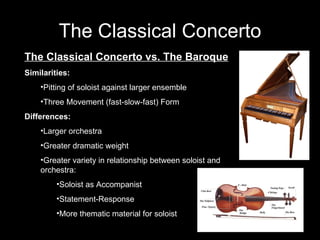
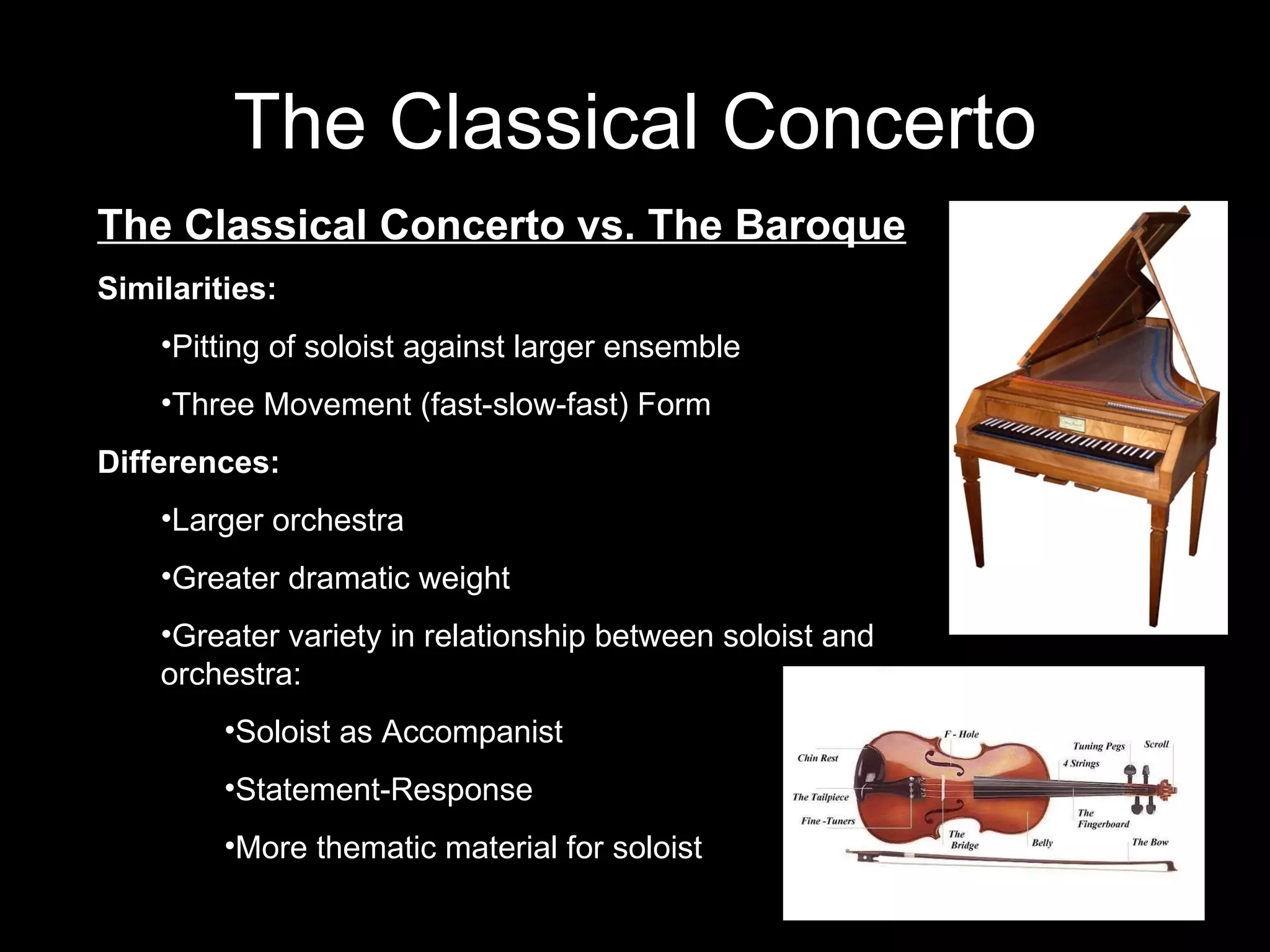
The Classical Concerto The Classical Concerto vs. The Baroque Similarities: Pitting of soloist against larger ensemble Three Movement (fast-slow-fast) Form Differences: Larger orchestra Greater dramatic weight Greater variety in relationship between soloist and orchestra: Soloist as Accompanist Statement-Response More thematic material for soloist
Form in the Classical Concerto First Movement : A combination of traditional ritornello practices with the principles of Sonata Form Part I : Orchestra: Ritornello (somewhat  like an orchestral exposition, but  stays in tonic) Part II : Soloist: Exposition (modulates) Part III : Orchestra: Ritornello (in new key) Part IV : Soloist: Development Part V : Soloist: Recapitulation (all in  tonic) – combines elements from  opening ritornello and solo Part VI : Orchestra: Closing Ritornello  (interrupted by soloist’s cadenza) Second Movement : Slow, same formal conventions available to symphonic slow movement Third Movement : Almost always in Rondo Form
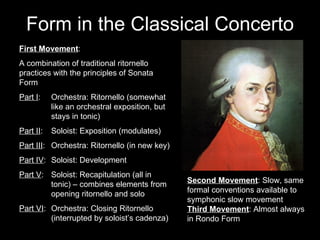
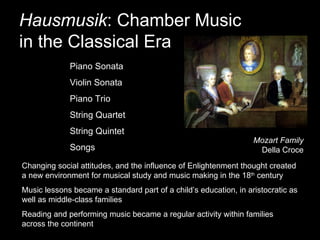
Hausmusik : Chamber Music in the Classical Era Mozart Family  Della Croce Changing social attitudes, and the influence of Enlightenment thought created a new environment for musical study and music making in the 18 th  century Music lessons became a standard part of a child’s education, in aristocratic as well as middle-class families Reading and performing music became a regular activity within families across the continent Piano Sonata Violin Sonata Piano Trio String Quartet String Quintet Songs
The Classical Sonata Versus the Baroque Sonata: The typical Baroque Sonata was a “ Trio Sonata ” (scored for two violins plus continuo) Two sonata-types flourished in the Baroque: Sonata di chiesa  (Church Sonata) – 3 or 4 movements Sonata da camera  ( Chamber Sonata ) – 4 or more movements The popularity of continuo writing waned and the bass began to assert a more independent, melodic role, leading to the practice writing out keyboard parts The Classical Sonata: Instrumentation : Solo Keyboard or Violin and Keyboard Form : Three Movements (Fast[sonata-form]-Slow-Fast)
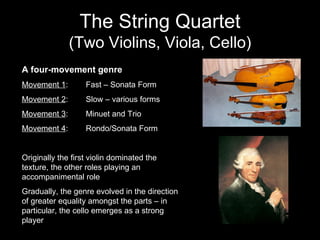
The String Quartet (Two Violins, Viola, Cello) A four-movement genre Movement 1 : Fast – Sonata Form Movement 2 : Slow – various forms Movement 3 : Minuet and Trio Movement 4 : Rondo/Sonata Form Originally the first violin dominated the texture, the other roles playing an accompanimental role Gradually, the genre evolved in the direction of greater equality amongst the parts – in particular, the cello emerges as a strong player
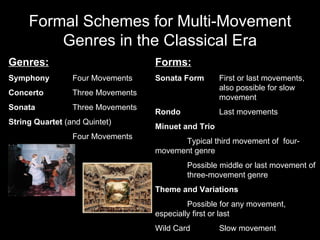
Formal Schemes for Multi-Movement Genres in the Classical Era Genres: Symphony Four Movements Concerto Three Movements Sonata Three Movements String Quartet  (and Quintet) Four Movements Forms: Sonata Form First or last movements,  also possible for slow  movement Rondo Last movements Minuet and Trio Typical third movement of  four- movement genre Possible middle or last movement of  three-movement genre Theme and Variations Possible for any movement,  especially first or last Wild Card Slow movement

UNIT III - Class 18

  • 1.
    The Classical ConcertoThe Classical Concerto vs. The Baroque Similarities: Pitting of soloist against larger ensemble Three Movement (fast-slow-fast) Form Differences: Larger orchestra Greater dramatic weight Greater variety in relationship between soloist and orchestra: Soloist as Accompanist Statement-Response More thematic material for soloist
  • 2.
    Form in theClassical Concerto First Movement : A combination of traditional ritornello practices with the principles of Sonata Form Part I : Orchestra: Ritornello (somewhat like an orchestral exposition, but stays in tonic) Part II : Soloist: Exposition (modulates) Part III : Orchestra: Ritornello (in new key) Part IV : Soloist: Development Part V : Soloist: Recapitulation (all in tonic) – combines elements from opening ritornello and solo Part VI : Orchestra: Closing Ritornello (interrupted by soloist’s cadenza) Second Movement : Slow, same formal conventions available to symphonic slow movement Third Movement : Almost always in Rondo Form
  • 3.
    Hausmusik : ChamberMusic in the Classical Era Mozart Family Della Croce Changing social attitudes, and the influence of Enlightenment thought created a new environment for musical study and music making in the 18 th century Music lessons became a standard part of a child’s education, in aristocratic as well as middle-class families Reading and performing music became a regular activity within families across the continent Piano Sonata Violin Sonata Piano Trio String Quartet String Quintet Songs
  • 4.
    The Classical SonataVersus the Baroque Sonata: The typical Baroque Sonata was a “ Trio Sonata ” (scored for two violins plus continuo) Two sonata-types flourished in the Baroque: Sonata di chiesa (Church Sonata) – 3 or 4 movements Sonata da camera ( Chamber Sonata ) – 4 or more movements The popularity of continuo writing waned and the bass began to assert a more independent, melodic role, leading to the practice writing out keyboard parts The Classical Sonata: Instrumentation : Solo Keyboard or Violin and Keyboard Form : Three Movements (Fast[sonata-form]-Slow-Fast)
  • 5.
    The String Quartet(Two Violins, Viola, Cello) A four-movement genre Movement 1 : Fast – Sonata Form Movement 2 : Slow – various forms Movement 3 : Minuet and Trio Movement 4 : Rondo/Sonata Form Originally the first violin dominated the texture, the other roles playing an accompanimental role Gradually, the genre evolved in the direction of greater equality amongst the parts – in particular, the cello emerges as a strong player
  • 6.
    Formal Schemes forMulti-Movement Genres in the Classical Era Genres: Symphony Four Movements Concerto Three Movements Sonata Three Movements String Quartet (and Quintet) Four Movements Forms: Sonata Form First or last movements, also possible for slow movement Rondo Last movements Minuet and Trio Typical third movement of four- movement genre Possible middle or last movement of three-movement genre Theme and Variations Possible for any movement, especially first or last Wild Card Slow movement