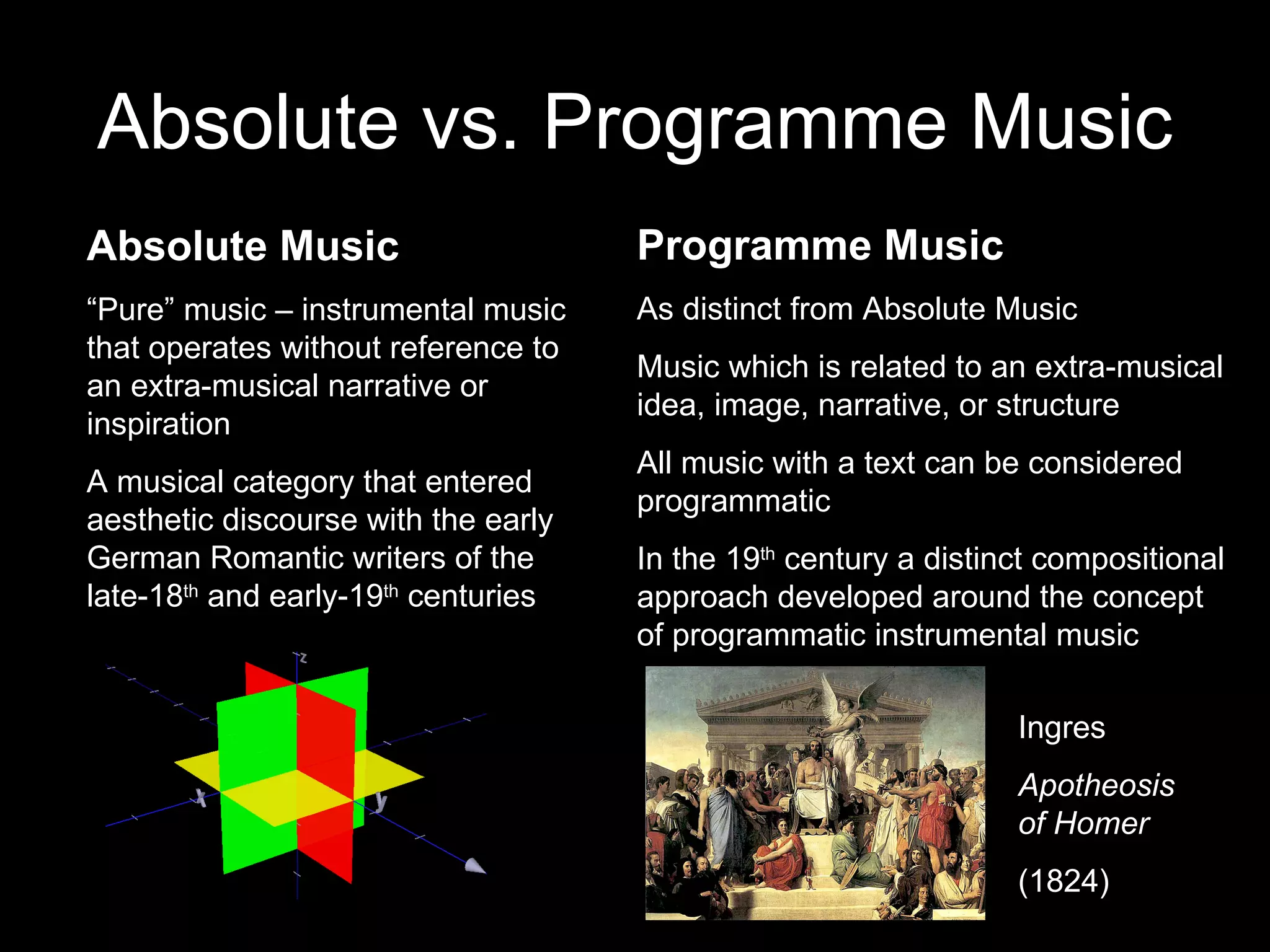
Absolute vs. Programme Music Absolute Music “ Pure” music – instrumental music that operates without reference to an extra-musical narrative or inspiration A musical category that entered aesthetic discourse with the early German Romantic writers of the late-18 th  and early-19 th  centuries Programme Music As distinct from Absolute Music Music which is related to an extra-musical idea, image, narrative, or structure All music with a text can be considered programmatic In the 19 th  century a distinct compositional approach developed around the concept of programmatic instrumental music Ingres Apotheosis of Homer (1824)
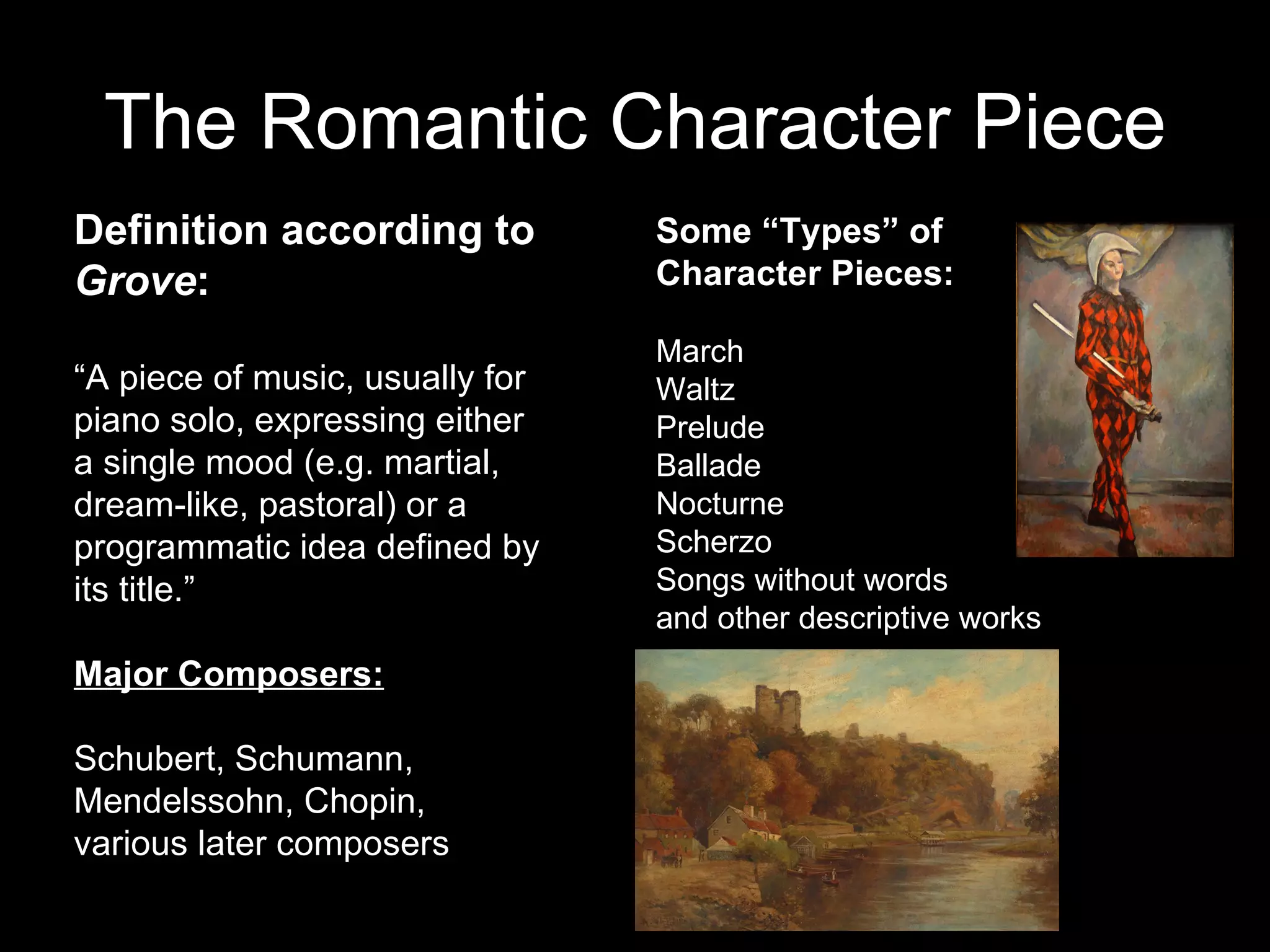
The Romantic Character Piece Definition according to  Grove : “ A piece of music, usually for piano solo, expressing either a single mood (e.g. martial, dream-like, pastoral) or a programmatic idea defined by its title.” Major Composers: Schubert, Schumann, Mendelssohn, Chopin, various later composers  Some “Types” of  Character Pieces: March Waltz Prelude Ballade Nocturne Scherzo Songs without words  and other descriptive works
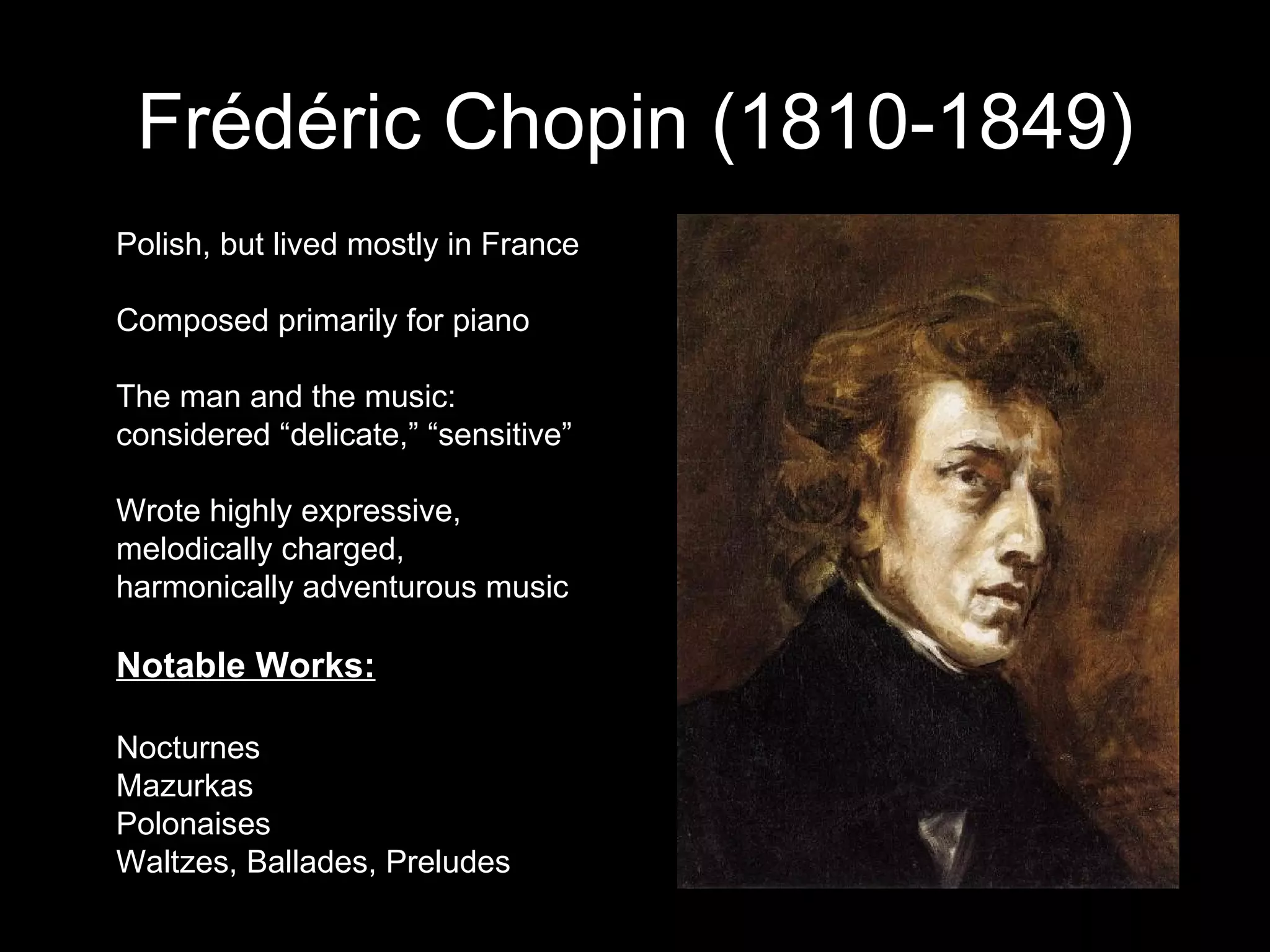
Frédéric Chopin (1810-1849) Polish, but lived mostly in France Composed primarily for piano The man and the music: considered “delicate,” “sensitive” Wrote highly expressive, melodically charged, harmonically adventurous music Notable Works: Nocturnes Mazurkas Polonaises Waltzes, Ballades, Preludes
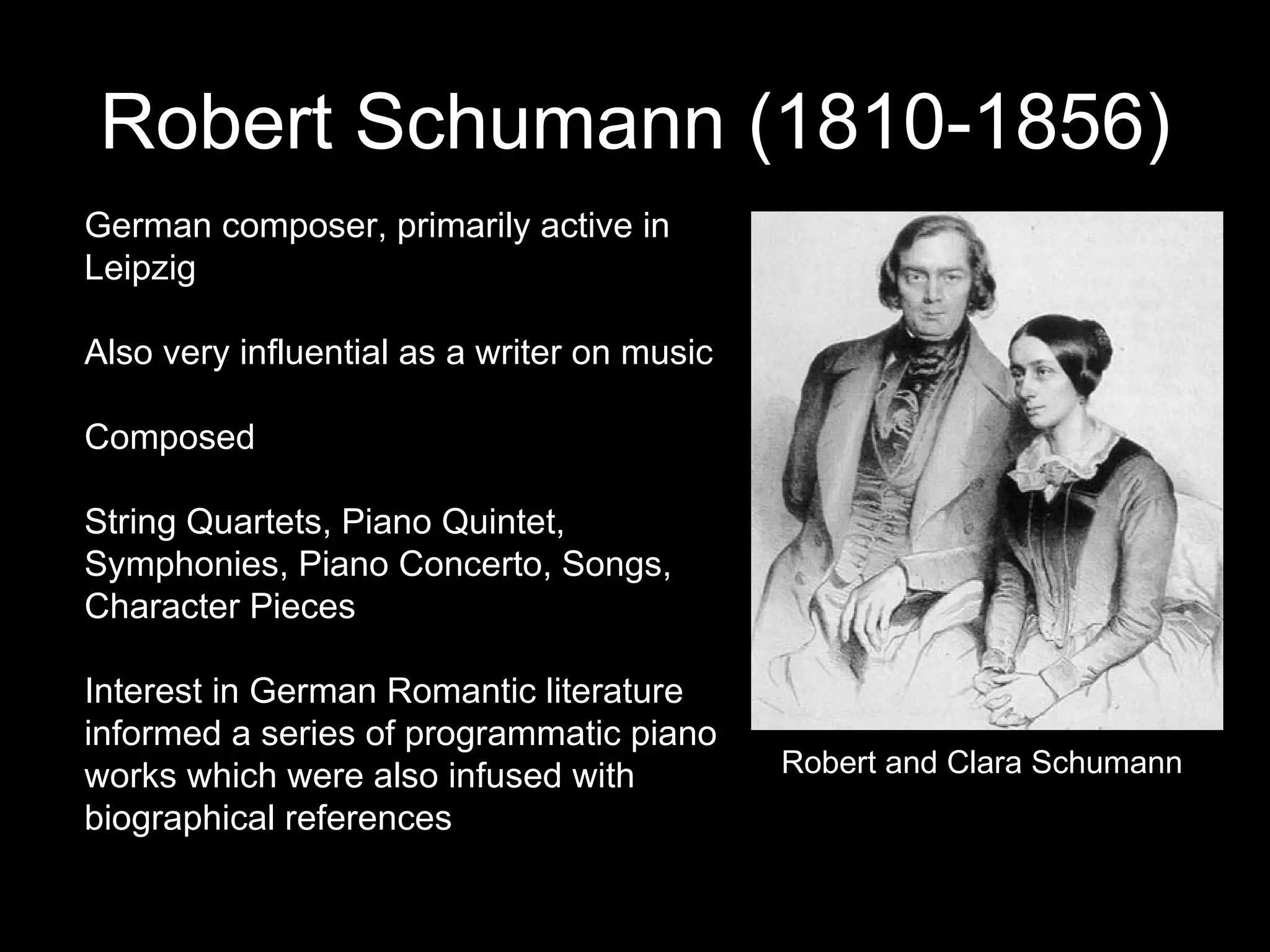
Robert Schumann (1810-1856) German composer, primarily active in Leipzig Also very influential as a writer on music Composed String Quartets, Piano Quintet, Symphonies, Piano Concerto, Songs, Character Pieces Interest in German Romantic literature informed a series of programmatic piano works which were also infused with biographical references Robert and Clara Schumann
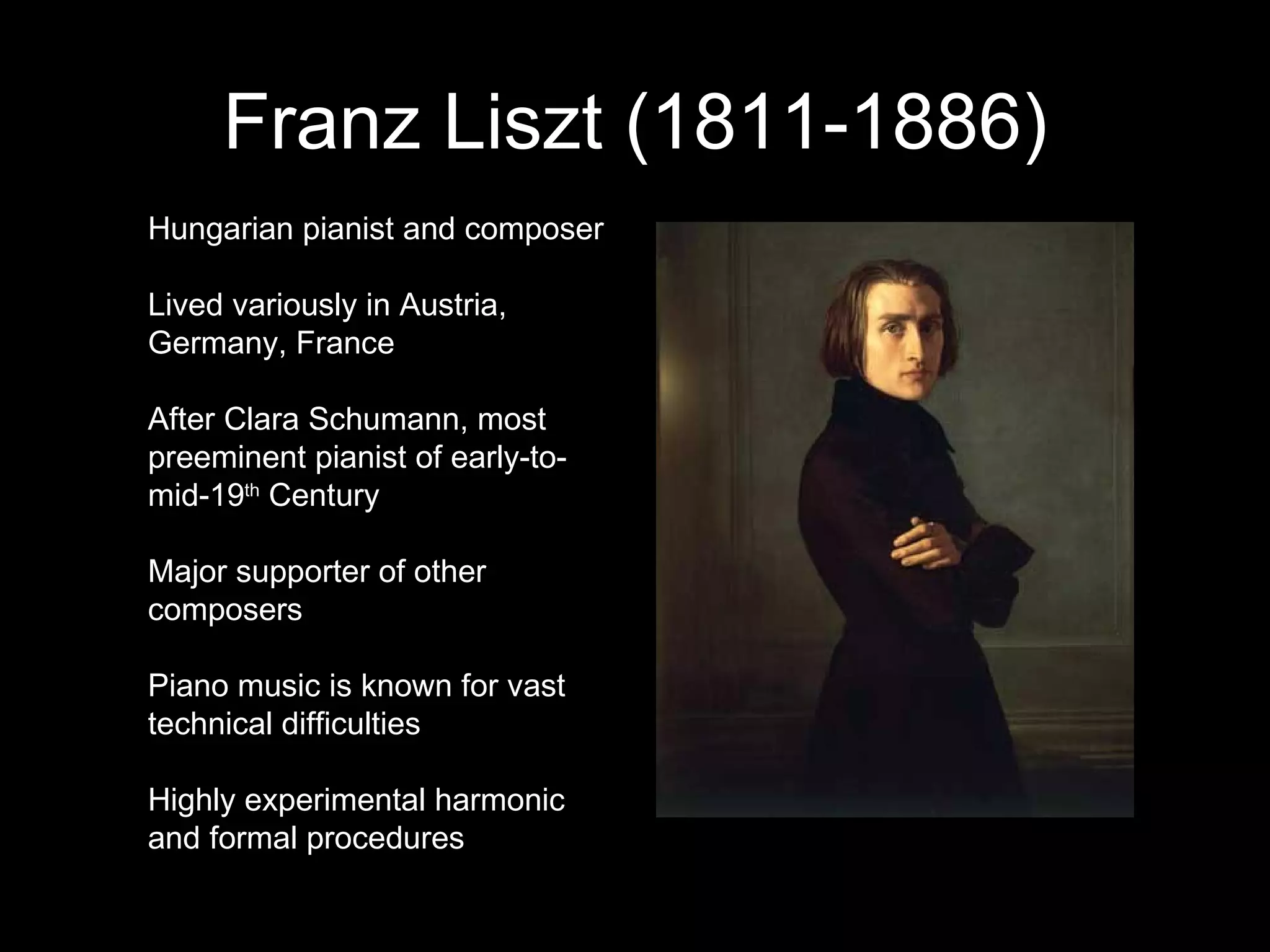
Franz Liszt (1811-1886) Hungarian pianist and composer Lived variously in Austria, Germany, France After Clara Schumann, most preeminent pianist of early-to-mid-19 th  Century Major supporter of other composers Piano music is known for vast technical difficulties Highly experimental harmonic and formal procedures
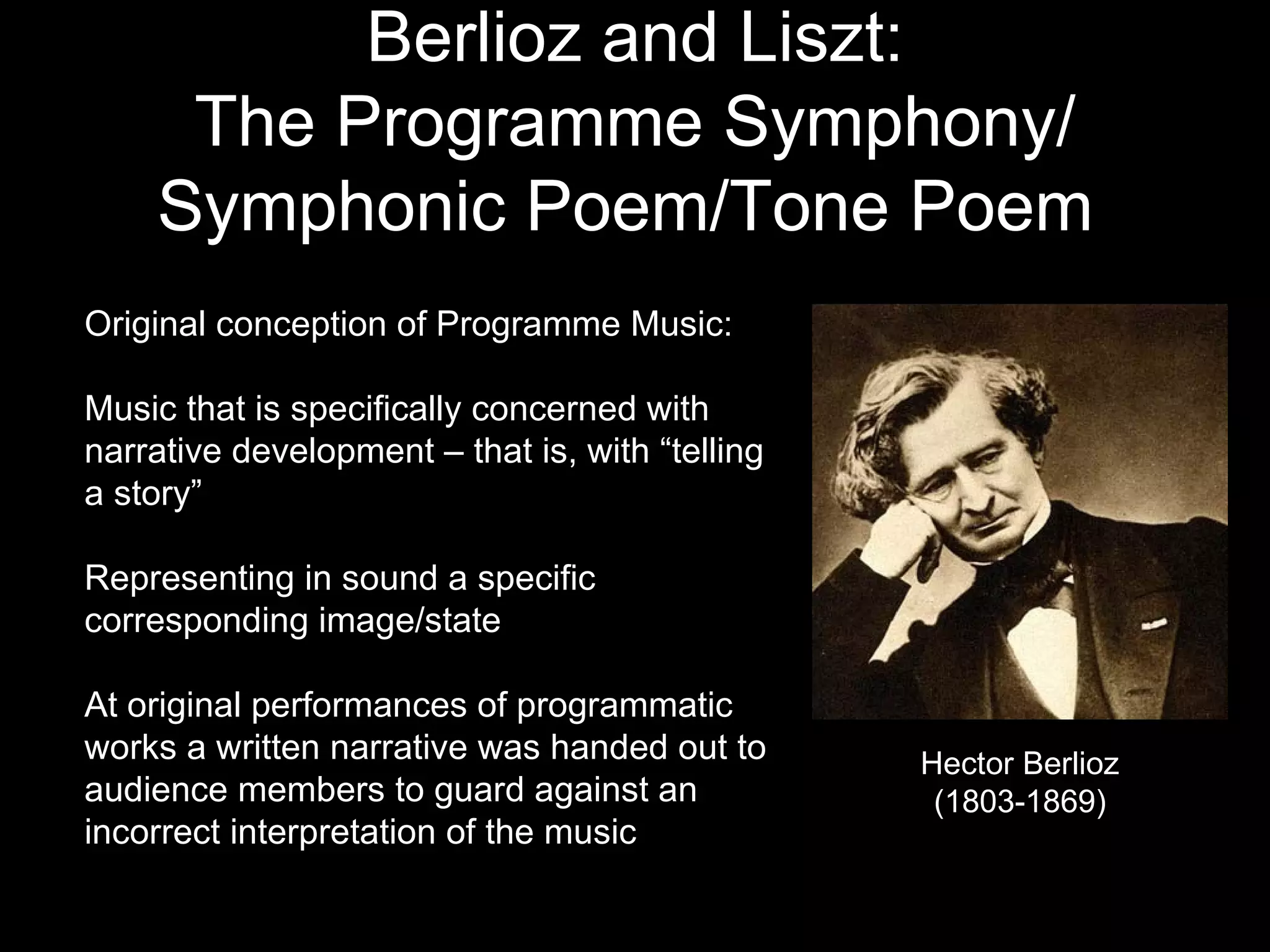
Berlioz and Liszt: The Programme Symphony/ Symphonic Poem/Tone Poem   Original conception of Programme Music: Music that is specifically concerned with narrative development – that is, with “telling a story” Representing in sound a specific corresponding image/state At original performances of programmatic works a written narrative was handed out to audience members to guard against an incorrect interpretation of the music Hector Berlioz (1803-1869)

UNIT IV - Class 24

  • 1.
    Absolute vs. ProgrammeMusic Absolute Music “ Pure” music – instrumental music that operates without reference to an extra-musical narrative or inspiration A musical category that entered aesthetic discourse with the early German Romantic writers of the late-18 th and early-19 th centuries Programme Music As distinct from Absolute Music Music which is related to an extra-musical idea, image, narrative, or structure All music with a text can be considered programmatic In the 19 th century a distinct compositional approach developed around the concept of programmatic instrumental music Ingres Apotheosis of Homer (1824)
  • 2.
    The Romantic CharacterPiece Definition according to Grove : “ A piece of music, usually for piano solo, expressing either a single mood (e.g. martial, dream-like, pastoral) or a programmatic idea defined by its title.” Major Composers: Schubert, Schumann, Mendelssohn, Chopin, various later composers Some “Types” of Character Pieces: March Waltz Prelude Ballade Nocturne Scherzo Songs without words and other descriptive works
  • 3.
    Frédéric Chopin (1810-1849)Polish, but lived mostly in France Composed primarily for piano The man and the music: considered “delicate,” “sensitive” Wrote highly expressive, melodically charged, harmonically adventurous music Notable Works: Nocturnes Mazurkas Polonaises Waltzes, Ballades, Preludes
  • 4.
    Robert Schumann (1810-1856)German composer, primarily active in Leipzig Also very influential as a writer on music Composed String Quartets, Piano Quintet, Symphonies, Piano Concerto, Songs, Character Pieces Interest in German Romantic literature informed a series of programmatic piano works which were also infused with biographical references Robert and Clara Schumann
  • 5.
    Franz Liszt (1811-1886)Hungarian pianist and composer Lived variously in Austria, Germany, France After Clara Schumann, most preeminent pianist of early-to-mid-19 th Century Major supporter of other composers Piano music is known for vast technical difficulties Highly experimental harmonic and formal procedures
  • 6.
    Berlioz and Liszt:The Programme Symphony/ Symphonic Poem/Tone Poem Original conception of Programme Music: Music that is specifically concerned with narrative development – that is, with “telling a story” Representing in sound a specific corresponding image/state At original performances of programmatic works a written narrative was handed out to audience members to guard against an incorrect interpretation of the music Hector Berlioz (1803-1869)