PREPARED BY:
HERO
Republic of the Philippines
Department of Education
Region I
SCHOOLS DIVISION OF ILOCOS NORTE
Bangui National High School
MUSIC 9
Quarter 2:
Vocal and Instrumental Music of the
Classical Period
MELC:
 Describe musical elements of given Classical period pieces (MU9CLIIa-f-1)
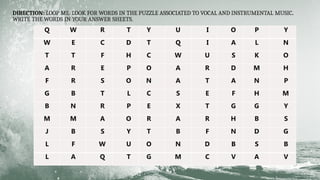
DIRECTION: LOOP ME. LOOK FOR WORDS IN THE PUZZLE ASSOCIATED TO VOCAL AND INSTRUMENTAL MUSIC.
WRITE THE WORDS IN YOUR ANSWER SHEETS.
Q W R T Y U I O P Y
W E C D T Q I A L N
T T F H C W U S K O
A R E P O A R D M H
F R S O N A T A N P
G B T L C S E F H M
B N R P E X T G G Y
M M A O R A R H B S
J B S Y T B F N D G
L F W U O N D B S B
L A Q T G M C V A V
DIRECTION: LOOP ME. LOOK FOR WORDS IN THE PUZZLE ASSOCIATED TO VOCAL AND
INSTRUMENTAL MUSIC. WRITE THE WORDS IN YOUR ANSWER SHEETS.
Processing questions:
1. What are the words that are associated to vocal and
instrumental music?
2. Are you familiar with these words? Where did you
encounter these words?
MUSIC OF THE CLASSICAL PERIOD (1750-1820)
The Classical Era, also called “Age of Reason”, is the period from 1750- 1820. The cultural life was
dominated by the aristocracy, as patrons of musicians and artists generally influenced the arts.
Significant changes in musical forms and styles were made.
In the middle of the 18th century, Europe began to move toward a new style in architecture,
literature and the arts, known as Classicism. It was also pushed forward by changes in the economic
order and in social structure. Instrumental music was patronized primarily by the nobility.
The term classical denotes conformity with the principles and characteristics of ancient Greek
and Roman literature and art which were formal, elegant, simple, freed, and dignified. The same
characteristics may also describe the melodies of classical music. Harmony and texture is homophonic
in general. The dynamics of loud and soft was clearly shown through the extensive use of crescendo and
dimuendo. A style of broken chord accompaniment called Albert Bass was practiced.
MUSIC OF THE CLASSICAL PERIOD (1750-1820)
When one hears the word “Classical,” it connotes several meanings. It could
mean:
 The art and literature of Ancient Greece
 The opposite of Romantic period
 The same as Art music
 The period beginning from 1750 up to 1820
Characteristics of Classical Music
1. An emphasis on elegance and balance
2. Short well balanced melodies and clear-cut question and answer phrases
3. Mainly simple diatonic harmony
4. Mainly homophonic texture
5. Use of contrasting moods.
VOCAL AND INSTRUMENTAL MUSIC
1. Sonata
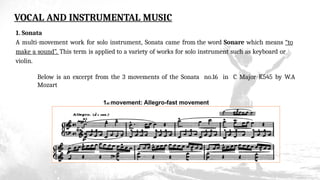
A multi-movement work for solo instrument, Sonata came from the word Sonare which means “to
make a sound”. This term is applied to a variety of works for solo instrument such as keyboard or
violin.
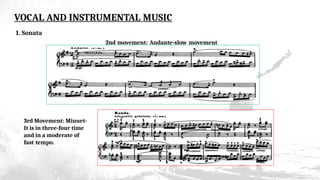
Below is an excerpt from the 3 movements of the Sonata no.16 in C Major K545 by W.A
Mozart
1st movement: Allegro-fast movement
VOCAL AND INSTRUMENTAL MUSIC
1. Sonata
2nd movement: Andante-slow movement
3rd Movement: Minuet-
It is in three-four time
and in a moderate of
fast tempo.
VOCAL AND INSTRUMENTAL MUSIC
2. Sonata Allegro Form
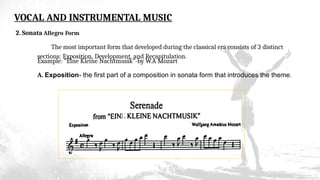
The most important form that developed during the classical era consists of 3 distinct
sections: Exposition, Development, and Recapitulation.
Example: “Eine Kleine Nachtmusik”-by W.A Mozart
A. Exposition- the first part of a composition in sonata form that introduces the theme.
VOCAL AND INSTRUMENTAL MUSIC
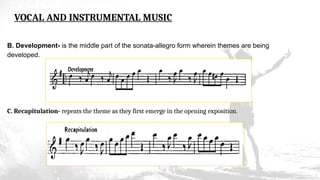
B. Development- is the middle part of the sonata-allegro form wherein themes are being
developed.
C. Recapitulation- repeats the theme as they first emerge in the opening exposition.
VOCAL AND INSTRUMENTAL MUSIC
3. Concerto
A multi-movement work designed for an instrumental soloist and orchestra. It is a classical form
of music intended primarily to emphasize the individuality of the solo instrument and to exhibit
the virtuosity and interpretative abilities of the performer. The solo instruments in classical
concertos include violin, cello, clarinet, bassoon, trumpet, horn and piano. A concerto has three
movements: fast, slow and fast.
1st movement: Fast: Sonata-allegro form with expositions of the orchestra and then by the
soloist.
2nd Movement:Slow: Has more ornamentation than the First movement
3rd Movement: Fast: Finale: Usually in a form of rondo, resembling the last movement of the
symphony and usually a short cadenza is used.
VOCAL AND INSTRUMENTAL MUSIC
4. Symphony
A multi-movement work for orchestra, the symphony is derived from the
word sinfonia which literally means “a harmonious surrounding together.” It
is classical music for the whole orchestra, generally in four movements.
4 movements of the symphony:
 1st movement: Fast: Sonata-allegro form
 2nd movement: Slow: Gentle, lyrical-typical ABAform or theme and
variation
 3rd movement: Medium/Fast: Uses a dance form (Minuet or scerzo)
 4th movement: Fast: Typically Rondo or Sonata form
VOCAL AND INSTRUMENTAL MUSIC
4. Symphony
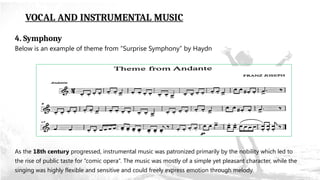
Below is an example of theme from “Surprise Symphony” by Haydn
As the 18th century progressed, instrumental music was patronized primarily by the nobility which led to
the rise of public taste for “comic opera”. The music was mostly of a simple yet pleasant character, while the
singing was highly flexible and sensitive and could freely express emotion through melody.
VOCAL AND INSTRUMENTAL MUSIC
5. Classical Opera
Opera is a drama set to music where singers and musicians perform in
theatrical setting. The two distinct styles of opera, Opera Seria and Opera
Buffa, were developed during Classical Period.
The Opera Seria (serious opera) usually implies heroic or tragic drama
that employs mythological characters, which was inherited from the
Baroque period. “Idomeneo” by Mozart is an example of Opera Seria.
The Opera Buffa (comic opera) from Italy made use of everyday
characters situations and typically employed spoken dialogues, lengthy arias
and was spiced with sight gaga, naughty humor, and social satire. “The
Marriage of Figaro,” “Don Giovanni,” and “The magic Flute” are examples of
popular Opera Buffa by Mozart.
LISTENING ACTIVITY.
1. “Eine Kleine Nachtmusik”
https://youtu.be/oy2zDJPIgwc
2.“F.J Haydn Symphony no. 94 in
G Major “Surprise”
https://youtu.be/tF5kr251BRs
3.“L.V. Beethoven Symphony no.9, Op.
125, D Minor “Choral” Symphony no.9
https://youtu.be/-v8SQRIKntE
ASSESSMENT
Direction: Read the following statements carefully. Choose the letter of the
correct answer. Write your answer in your paper.
1. It is also known as the Age of Reason.
A. Baroque period C. Medieval period
B. Classical period D. Renaissance period
2. The general texture of Classical music.
A. Homophonic C. Heterophonic
B. Monophonic D. Polyphonic
ASSESSMENT
3. Sonata came from the word ______which means to make sound.
A. Allegro C. Concerto
B. Andante D. Sonare
4. Allegro: fast movement ; : slow movement
A. Allegro C. Concerto
B. Andante D. Minuet
5. Allegro: fast movement ; : moderate or fast
A. Allegro C. Concerto
B. Andante D. Minuet
ASSESSMENT
6. What are the three movements of a concerto piece?
A. Fast-slow-fast C. Fast-fast-slow
B. Slow-fast-fast D. Slow-slow-fast
7. It is derived from the word sinfonia which literally means “a harmonious
sounding together”.
A. Concerto C. Opera
B. Sonata D. Symphony
8. A drama set to music where singers and musicians perform in theatrical
setting.
A. Concerto C. Opera
B. Sonata D. Symphony
ASSESSMENT
9. The middle part of the sonata-allegro form wherin themes are being
developed.
A. Development C. Introduction
B. Exposition D. Recapitulation
10. The first part of a composition in sonata form that introduces the theme.
A. Development
B. Exposition
C. Introduction
D. Recapitulation
JACINTO V. MABINI
TEACHER III, BANGUI NHS
THANK YOU FOR
LISTENING!
ANSWER KEY…
1.B 6. A
2. A 7. D
3. D 8. C
4. B 9. A
5. D 10. B

Musiclessonforgrade9brigthstudentd?.pptx

  • 1.
    PREPARED BY: HERO Republic ofthe Philippines Department of Education Region I SCHOOLS DIVISION OF ILOCOS NORTE Bangui National High School MUSIC 9 Quarter 2: Vocal and Instrumental Music of the Classical Period MELC:  Describe musical elements of given Classical period pieces (MU9CLIIa-f-1)
  • 2.
    DIRECTION: LOOP ME.LOOK FOR WORDS IN THE PUZZLE ASSOCIATED TO VOCAL AND INSTRUMENTAL MUSIC. WRITE THE WORDS IN YOUR ANSWER SHEETS. Q W R T Y U I O P Y W E C D T Q I A L N T T F H C W U S K O A R E P O A R D M H F R S O N A T A N P G B T L C S E F H M B N R P E X T G G Y M M A O R A R H B S J B S Y T B F N D G L F W U O N D B S B L A Q T G M C V A V
  • 3.
    DIRECTION: LOOP ME.LOOK FOR WORDS IN THE PUZZLE ASSOCIATED TO VOCAL AND INSTRUMENTAL MUSIC. WRITE THE WORDS IN YOUR ANSWER SHEETS. Processing questions: 1. What are the words that are associated to vocal and instrumental music? 2. Are you familiar with these words? Where did you encounter these words?
  • 4.
    MUSIC OF THECLASSICAL PERIOD (1750-1820) The Classical Era, also called “Age of Reason”, is the period from 1750- 1820. The cultural life was dominated by the aristocracy, as patrons of musicians and artists generally influenced the arts. Significant changes in musical forms and styles were made. In the middle of the 18th century, Europe began to move toward a new style in architecture, literature and the arts, known as Classicism. It was also pushed forward by changes in the economic order and in social structure. Instrumental music was patronized primarily by the nobility. The term classical denotes conformity with the principles and characteristics of ancient Greek and Roman literature and art which were formal, elegant, simple, freed, and dignified. The same characteristics may also describe the melodies of classical music. Harmony and texture is homophonic in general. The dynamics of loud and soft was clearly shown through the extensive use of crescendo and dimuendo. A style of broken chord accompaniment called Albert Bass was practiced.
  • 5.
    MUSIC OF THECLASSICAL PERIOD (1750-1820) When one hears the word “Classical,” it connotes several meanings. It could mean:  The art and literature of Ancient Greece  The opposite of Romantic period  The same as Art music  The period beginning from 1750 up to 1820 Characteristics of Classical Music 1. An emphasis on elegance and balance 2. Short well balanced melodies and clear-cut question and answer phrases 3. Mainly simple diatonic harmony 4. Mainly homophonic texture 5. Use of contrasting moods.
  • 6.
    VOCAL AND INSTRUMENTALMUSIC 1. Sonata A multi-movement work for solo instrument, Sonata came from the word Sonare which means “to make a sound”. This term is applied to a variety of works for solo instrument such as keyboard or violin. Below is an excerpt from the 3 movements of the Sonata no.16 in C Major K545 by W.A Mozart 1st movement: Allegro-fast movement
  • 7.
    VOCAL AND INSTRUMENTALMUSIC 1. Sonata 2nd movement: Andante-slow movement 3rd Movement: Minuet- It is in three-four time and in a moderate of fast tempo.
  • 8.
    VOCAL AND INSTRUMENTALMUSIC 2. Sonata Allegro Form The most important form that developed during the classical era consists of 3 distinct sections: Exposition, Development, and Recapitulation. Example: “Eine Kleine Nachtmusik”-by W.A Mozart A. Exposition- the first part of a composition in sonata form that introduces the theme.
  • 9.
    VOCAL AND INSTRUMENTALMUSIC B. Development- is the middle part of the sonata-allegro form wherein themes are being developed. C. Recapitulation- repeats the theme as they first emerge in the opening exposition.
  • 10.
    VOCAL AND INSTRUMENTALMUSIC 3. Concerto A multi-movement work designed for an instrumental soloist and orchestra. It is a classical form of music intended primarily to emphasize the individuality of the solo instrument and to exhibit the virtuosity and interpretative abilities of the performer. The solo instruments in classical concertos include violin, cello, clarinet, bassoon, trumpet, horn and piano. A concerto has three movements: fast, slow and fast. 1st movement: Fast: Sonata-allegro form with expositions of the orchestra and then by the soloist. 2nd Movement:Slow: Has more ornamentation than the First movement 3rd Movement: Fast: Finale: Usually in a form of rondo, resembling the last movement of the symphony and usually a short cadenza is used.
  • 11.
    VOCAL AND INSTRUMENTALMUSIC 4. Symphony A multi-movement work for orchestra, the symphony is derived from the word sinfonia which literally means “a harmonious surrounding together.” It is classical music for the whole orchestra, generally in four movements. 4 movements of the symphony:  1st movement: Fast: Sonata-allegro form  2nd movement: Slow: Gentle, lyrical-typical ABAform or theme and variation  3rd movement: Medium/Fast: Uses a dance form (Minuet or scerzo)  4th movement: Fast: Typically Rondo or Sonata form
  • 12.
    VOCAL AND INSTRUMENTALMUSIC 4. Symphony Below is an example of theme from “Surprise Symphony” by Haydn As the 18th century progressed, instrumental music was patronized primarily by the nobility which led to the rise of public taste for “comic opera”. The music was mostly of a simple yet pleasant character, while the singing was highly flexible and sensitive and could freely express emotion through melody.
  • 13.
    VOCAL AND INSTRUMENTALMUSIC 5. Classical Opera Opera is a drama set to music where singers and musicians perform in theatrical setting. The two distinct styles of opera, Opera Seria and Opera Buffa, were developed during Classical Period. The Opera Seria (serious opera) usually implies heroic or tragic drama that employs mythological characters, which was inherited from the Baroque period. “Idomeneo” by Mozart is an example of Opera Seria. The Opera Buffa (comic opera) from Italy made use of everyday characters situations and typically employed spoken dialogues, lengthy arias and was spiced with sight gaga, naughty humor, and social satire. “The Marriage of Figaro,” “Don Giovanni,” and “The magic Flute” are examples of popular Opera Buffa by Mozart.
  • 14.
    LISTENING ACTIVITY. 1. “EineKleine Nachtmusik” https://youtu.be/oy2zDJPIgwc 2.“F.J Haydn Symphony no. 94 in G Major “Surprise” https://youtu.be/tF5kr251BRs 3.“L.V. Beethoven Symphony no.9, Op. 125, D Minor “Choral” Symphony no.9 https://youtu.be/-v8SQRIKntE
  • 15.
    ASSESSMENT Direction: Read thefollowing statements carefully. Choose the letter of the correct answer. Write your answer in your paper. 1. It is also known as the Age of Reason. A. Baroque period C. Medieval period B. Classical period D. Renaissance period 2. The general texture of Classical music. A. Homophonic C. Heterophonic B. Monophonic D. Polyphonic
  • 16.
    ASSESSMENT 3. Sonata camefrom the word ______which means to make sound. A. Allegro C. Concerto B. Andante D. Sonare 4. Allegro: fast movement ; : slow movement A. Allegro C. Concerto B. Andante D. Minuet 5. Allegro: fast movement ; : moderate or fast A. Allegro C. Concerto B. Andante D. Minuet
  • 17.
    ASSESSMENT 6. What arethe three movements of a concerto piece? A. Fast-slow-fast C. Fast-fast-slow B. Slow-fast-fast D. Slow-slow-fast 7. It is derived from the word sinfonia which literally means “a harmonious sounding together”. A. Concerto C. Opera B. Sonata D. Symphony 8. A drama set to music where singers and musicians perform in theatrical setting. A. Concerto C. Opera B. Sonata D. Symphony
  • 18.
    ASSESSMENT 9. The middlepart of the sonata-allegro form wherin themes are being developed. A. Development C. Introduction B. Exposition D. Recapitulation 10. The first part of a composition in sonata form that introduces the theme. A. Development B. Exposition C. Introduction D. Recapitulation
  • 19.
    JACINTO V. MABINI TEACHERIII, BANGUI NHS THANK YOU FOR LISTENING!
  • 20.
    ANSWER KEY… 1.B 6.A 2. A 7. D 3. D 8. C 4. B 9. A 5. D 10. B