Classical Music
Classical Music - ErasBaroque (1600-1750) foundation laid for the following 300 years of musical expression modern orchestra was born, along with operaNeo-Classical (1750-1830)introduction of the sonata, concerto, symphony, trio and quarteta near-obsession with structural clarityRomantic (1830-1900)intensity of expressionnationalist schools begin to emergeGershwin-“Rhapsody in Blue”
Classical Music - CategoriesOrchestral Music (string, brass, woodwind, percussion)SymphonyOvertureConcertoBalletChamber Music- music composed for a small ensemble (2-15 players)Opera- a play set to musicBrandenburg Concerto
Johann Sebastian BachGerman   1685-1750 Supreme composer of the Baroque Eracomposer and organist of	 ecclesiastical and secular works20 children“ Revered for his intellectual depth, technical command and artistic beauty”Classical MusicAir for the “G” String
Toccata and Fugue -  Johann Sebastian BachClassical Music
Antonio VivaldiItalian  1678-1741The Four Seasons (1723)  		a set of four concertos for violinwrote sonnets to match each season“Vivaldi's music is joyful, almost playful,  	revealing his own joy of composing”Classical Music “Spring” The Four Seasons
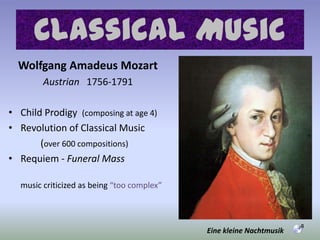
Wolfgang Amadeus MozartAustrian   1756-1791Child Prodigy  (composing at age 4)  Revolution of Classical Music	(over 600 compositions)Requiem - Funeral Massmusic criticized as being “too complex”Classical MusicEine kleine Nachtmusik
Ludwig van BeethovenGerman   1770-1827Leads transition between the 		Classical Era and Romantic Erastarted to go deaf  around age thirty5th Symphony, Für Elise, Moonlight Sonata                       	      and The Ode to JoyClassical MusicFifth Symphony
“Ode to Joy” -  Beethoven’s 9th SymphonyClassical Music
Felix Mendelssohn German   1809-1847Romantic Era composerConverted to Christianity	A Midsummer Night's Dream Classical Music“Wedding March” - A Midsummer Night's Dream
Johann Strauss Austrian   1825-1899“The Waltz King”Extensive Touring – Europe/US“Blue Danube” “Vienna Waltz”			“Emperor Waltz”	Classical Music“ The Blue Danube”
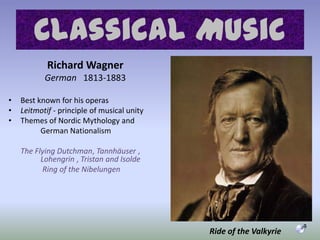
Richard Wagner German   1813-1883Best known for his operasLeitmotif - principle of musical unityThemes of Nordic Mythology and		German NationalismThe Flying Dutchman, Tannhäuser ,   	Lohengrin , Tristan and IsoldeRing of the NibelungenClassical MusicRide of the Valkyrie
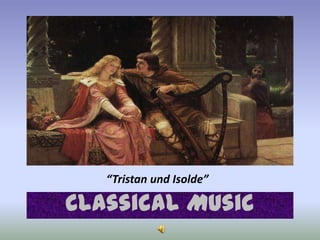
“Tristan und Isolde”Classical Music
Piotr Ilyich TchaikovskyRussian   1840-1893Fused Western classical music with 	Russian nationalism.Famous Ballet scores – foundation of 	20th Century Dance“Swan Lake”, “The Nutcracker”, 	“Sleeping Beauty” “The 1812 Overture”Classical MusicThe 1812 Overture
“Swan Lake”Classical Music
Georges BizetFrench   1838-1875Operas/Dramatic MusicCarmen - one of the most popular operas ever written“Only posthumouslywas his true stature appreciated”Classical MusicCarmen:  Toreador's Song
Carmen:  “Habanera”Classical Music
Orff:  “O Fortuna”Classical Music

Classical music

  • 1.
  • 2.
    Classical Music -ErasBaroque (1600-1750) foundation laid for the following 300 years of musical expression modern orchestra was born, along with operaNeo-Classical (1750-1830)introduction of the sonata, concerto, symphony, trio and quarteta near-obsession with structural clarityRomantic (1830-1900)intensity of expressionnationalist schools begin to emergeGershwin-“Rhapsody in Blue”
  • 3.
    Classical Music -CategoriesOrchestral Music (string, brass, woodwind, percussion)SymphonyOvertureConcertoBalletChamber Music- music composed for a small ensemble (2-15 players)Opera- a play set to musicBrandenburg Concerto
  • 4.
    Johann Sebastian BachGerman 1685-1750 Supreme composer of the Baroque Eracomposer and organist of ecclesiastical and secular works20 children“ Revered for his intellectual depth, technical command and artistic beauty”Classical MusicAir for the “G” String
  • 5.
    Toccata and Fugue- Johann Sebastian BachClassical Music
  • 6.
    Antonio VivaldiItalian 1678-1741The Four Seasons (1723) a set of four concertos for violinwrote sonnets to match each season“Vivaldi's music is joyful, almost playful, revealing his own joy of composing”Classical Music “Spring” The Four Seasons
  • 7.
    Wolfgang Amadeus MozartAustrian 1756-1791Child Prodigy (composing at age 4) Revolution of Classical Music (over 600 compositions)Requiem - Funeral Massmusic criticized as being “too complex”Classical MusicEine kleine Nachtmusik
  • 8.
    Ludwig van BeethovenGerman 1770-1827Leads transition between the Classical Era and Romantic Erastarted to go deaf around age thirty5th Symphony, Für Elise, Moonlight Sonata and The Ode to JoyClassical MusicFifth Symphony
  • 9.
    “Ode to Joy”- Beethoven’s 9th SymphonyClassical Music
  • 10.
    Felix Mendelssohn German 1809-1847Romantic Era composerConverted to Christianity A Midsummer Night's Dream Classical Music“Wedding March” - A Midsummer Night's Dream
  • 11.
    Johann Strauss Austrian 1825-1899“The Waltz King”Extensive Touring – Europe/US“Blue Danube” “Vienna Waltz” “Emperor Waltz” Classical Music“ The Blue Danube”
  • 12.
    Richard Wagner German 1813-1883Best known for his operasLeitmotif - principle of musical unityThemes of Nordic Mythology and German NationalismThe Flying Dutchman, Tannhäuser , Lohengrin , Tristan and IsoldeRing of the NibelungenClassical MusicRide of the Valkyrie
  • 13.
  • 14.
    Piotr Ilyich TchaikovskyRussian 1840-1893Fused Western classical music with Russian nationalism.Famous Ballet scores – foundation of 20th Century Dance“Swan Lake”, “The Nutcracker”, “Sleeping Beauty” “The 1812 Overture”Classical MusicThe 1812 Overture
  • 15.
  • 16.
    Georges BizetFrench 1838-1875Operas/Dramatic MusicCarmen - one of the most popular operas ever written“Only posthumouslywas his true stature appreciated”Classical MusicCarmen: Toreador's Song
  • 17.
  • 18.
    Orff: “OFortuna”Classical Music