Flow and Error Control
Computer Networks(CS31204)
Prof. Sudip Misra
Department of Computer Science and Engineering
Indian Institute of Technology Kharagpur
Email: smisra@sit.iitkgp.ernet.in
Website: http://cse.iitkgp.ac.in/~smisra/
Research Lab: cse.iitkgp.ac.in/~smisra/swan/
1
2
Data link control functions include framing, flow and error control, and software
implemented protocols that provide smooth and reliable transmission of frames
between nodes.
Data Link layer
Prof. Sudip Misra, IIT Kharagpur
3
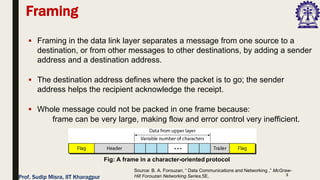
▪ Framing in the data link layer separates a message from one source to a
destination, or from other messages to other destinations, by adding a sender
address and a destination address.
▪ The destination address defines where the packet is to go; the sender
address helps the recipient acknowledge the receipt.
▪ Whole message could not be packed in one frame because:
frame can be very large, making flow and error control very inefficient.
Framing
Fig: A frame in a character-oriented protocol
Source: B. A. Forouzan, “ Data Communications and Networking ,” McGraw-
Hill Forouzan Networking Series,5E.
Prof. Sudip Misra, IIT Kharagpur
4
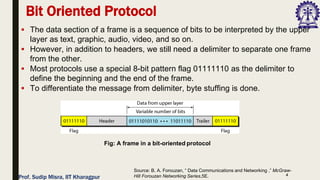
▪ The data section of a frame is a sequence of bits to be interpreted by the upper
layer as text, graphic, audio, video, and so on.
▪ However, in addition to headers, we still need a delimiter to separate one frame
from the other.
▪ Most protocols use a special 8-bit pattern flag 01111110 as the delimiter to
define the beginning and the end of the frame.
▪ To differentiate the message from delimiter, byte stuffing is done.
Bit Oriented Protocol
Fig: A frame in a bit-oriented protocol
Source: B. A. Forouzan, “ Data Communications and Networking ,” McGraw-
Hill Forouzan Networking Series,5E.
Prof. Sudip Misra, IIT Kharagpur
5
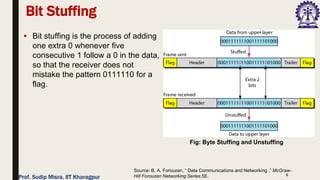
▪ Bit stuffing is the process of adding
one extra 0 whenever five
consecutive 1 follow a 0 in the data,
so that the receiver does not
mistake the pattern 0111110 for a
flag.
Bit Stuffing
Fig: Byte Stuffing and Unstuffing
Source: B. A. Forouzan, “ Data Communications and Networking ,” McGraw-
Hill Forouzan Networking Series,5E.
Prof. Sudip Misra, IIT Kharagpur
6
▪ Flow control coordinates the amount of data that can be sent before
receiving an acknowledgment
▪ One of the most important duties of the data link layer.
▪ In most protocols, flow control is a set of procedures that tells the sender
how much data it can transmit before it must wait for an acknowledgment from
the receiver.
▪ Error control in the data link layer is based on automatic repeat request,
which is the retransmission of data.
Flow and Error Control
Prof. Sudip Misra, IIT Kharagpur
7
▪ What if sender sends the bit pattern too fast? Receiver may not be able to
process the data as fast as the sender is sending it
▪ Receiver can buffer, but buffer has finite size. After that is filled, data is lost
▪ Flow control – technique to control data flow between sender and receiver so
that sender is blocked if receiver cannot accept any more data
▪ Sender must get an acknowledgement from the receiver before it can send
more data
Flow Control
Prof. Sudip Misra, IIT Kharagpur
8
❑ Sender sends a frame
❑ Receiver receives frame & acknowledges it
❑ Sender waits to receive “ack” before sending next frame (If receiver is not
ready to receive another frame it holds back the ack)
❑ One frame at a time is sent over the transmission line
❑ Simple, easy to implement
Stop and Wait Flow Control
Prof. Sudip Misra, IIT Kharagpur
9
Problems:
❑ Works fine if there is only a few large frames to be sent
❑ Usually we want smaller frames
➢ Receiver’s buffer size may be small
➢ If a large frame is transmitted, the entire frame has to be retransmitted if there is an error
➢ Longer the frame, larger the chance of an error
➢ On a shared medium, do not want any one sender to occupy the medium for a long time
❑ With smaller frames, takes too long to send all frames
Stop and Wait Flow Control
Prof. Sudip Misra, IIT Kharagpur
10
❑ Bit Length of link in bits B = maximum possible number of bits that can be simultaneously
present in the link
B = R × (D/V)
R = data rate of link in bps
D = length of link in meters
V = propagation speed in m/sec
❑ So for Stop & Wait, ideally we want frame length to be close to bit length of the link
The sender has enough bits to put out on the link while the earlier bits of the same frame
reach the receiver
Links stays occupied for more time
❑ But we have also argued that we want frame sizes to be small
❑ Results in very poor line/link utilization for Stop & Wait, especially in fast links over longer
distances
B becomes very large, so impractical to have such large frames
Link Efficiency of Stop and Wait Flow Control
Prof. Sudip Misra, IIT Kharagpur
11
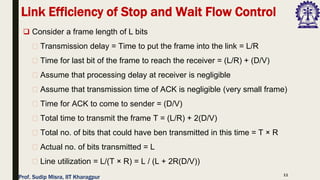
❑ Consider a frame length of L bits
Transmission delay = Time to put the frame into the link = L/R
Time for last bit of the frame to reach the receiver = (L/R) + (D/V)
Assume that processing delay at receiver is negligible
Assume that transmission time of ACK is negligible (very small frame)
Time for ACK to come to sender = (D/V)
Total time to transmit the frame T = (L/R) + 2(D/V)
Total no. of bits that could have ben transmitted in this time = T × R
Actual no. of bits transmitted = L
Line utilization = L/(T × R) = L / (L + 2R(D/V))
Link Efficiency of Stop and Wait Flow Control
Prof. Sudip Misra, IIT Kharagpur
12
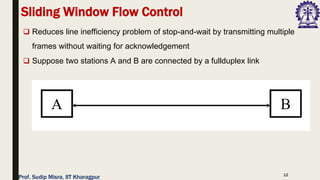
❑ Reduces line inefficiency problem of stop-and-wait by transmitting multiple
frames without waiting for acknowledgement
❑ Suppose two stations A and B are connected by a fullduplex link
Sliding Window Flow Control
Prof. Sudip Misra, IIT Kharagpur
13
❑ Station B allocates buffer space for W frames.
❑ Thus B can accept W frames, and A is allowed to send W frames without waiting for any
acknowledgement
❑ Sender maintains a list of sequence numbers that it is allowed to send (sender window)
❑ Receiver also maintains a list of sequence numbers that it is prepared to receive (receiver
window)
❑ Since the sequence number to be used occupies a field in the frame, it is clearly of bounded size
❑ For a k-bit field, the range of sequence numbers is 0 through 2k–1, and frames are numbered
modulo 2k
❑ Maximum window size = 2k – 1 (why?)
Sliding Window Flow Control
Prof. Sudip Misra, IIT Kharagpur
14
❑ Each frame is labeled with a sequence number
❑ To keep track of the frames which have been acknowledged
❑ B acknowledges a frame by sending an ACK/RR that includes the sequence
number of the next frame expected. This also explicitly announces that B is
prepared to receive the next W frames, beginning with the number specified.
❑ This scheme can be used to acknowledge multiple frames
❑ B could receive frames 2,3,4 but withhold ACK until frame 4 has arrived. By
returning an ACK with sequence number 5, B acknowledges frames 2,3,4 at one
time
Sliding Window Flow Control
Prof. Sudip Misra, IIT Kharagpur
15
❑ The actual window size need not be the maximum possible size for a given
sequence number length
❑ For a 3-bit sequence number, a window size of 5 can also be configured
❑ If two stations exchange data, each need to maintain two windows. To save
communication capacity, a technique called piggybacking is used
❑ Each data frame includes a field that holds the sequence number of that frame
plus a field that holds the sequence number used for ACK
❑ If a station has an ACK but no data to send, it sends a separate ACK frame
Sliding Window Flow Control
Prof. Sudip Misra, IIT Kharagpur
16
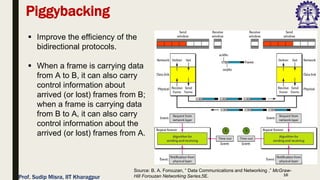
Piggybacking
▪ Improve the efficiency of the
bidirectional protocols.
▪ When a frame is carrying data
from A to B, it can also carry
control information about
arrived (or lost) frames from B;
when a frame is carrying data
from B to A, it can also carry
control information about the
arrived (or lost) frames from A.
Source: B. A. Forouzan, “ Data Communications and Networking ,” McGraw-
Hill Forouzan Networking Series,5E.
Prof. Sudip Misra, IIT Kharagpur
17
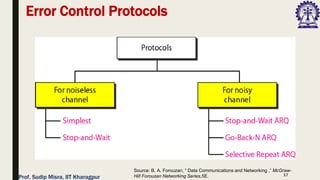
Error Control Protocols
Source: B. A. Forouzan, “ Data Communications and Networking ,” McGraw-
Hill Forouzan Networking Series,5E.
Prof. Sudip Misra, IIT Kharagpur
18
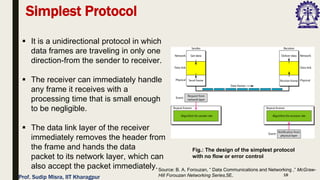
Simplest Protocol
▪ It is a unidirectional protocol in which
data frames are traveling in only one
direction-from the sender to receiver.
▪ The receiver can immediately handle
any frame it receives with a
processing time that is small enough
to be negligible.
▪ The data link layer of the receiver
immediately removes the header from
the frame and hands the data
packet to its network layer, which can
also accept the packet immediately.
Fig.: The design of the simplest protocol
with no flow or error control
Source: B. A. Forouzan, “ Data Communications and Networking ,” McGraw-
Hill Forouzan Networking Series,5E.
Prof. Sudip Misra, IIT Kharagpur
19
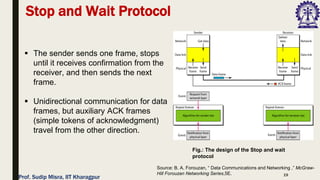
Stop and Wait Protocol
▪ The sender sends one frame, stops
until it receives confirmation from the
receiver, and then sends the next
frame.
▪ Unidirectional communication for data
frames, but auxiliary ACK frames
(simple tokens of acknowledgment)
travel from the other direction.
Fig.: The design of the Stop and wait
protocol
Source: B. A. Forouzan, “ Data Communications and Networking ,” McGraw-
Hill Forouzan Networking Series,5E.
Prof. Sudip Misra, IIT Kharagpur
20
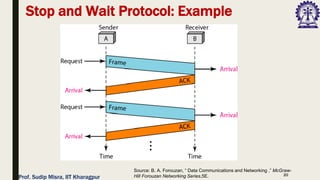
Stop and Wait Protocol: Example
Source: B. A. Forouzan, “ Data Communications and Networking ,” McGraw-
Hill Forouzan Networking Series,5E.
Prof. Sudip Misra, IIT Kharagpur
21
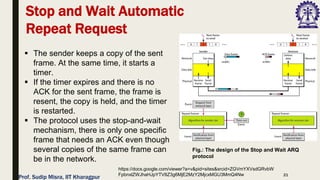
Stop and Wait Automatic
Repeat Request
▪ The sender keeps a copy of the sent
frame. At the same time, it starts a
timer.
▪ If the timer expires and there is no
ACK for the sent frame, the frame is
resent, the copy is held, and the timer
is restarted.
▪ The protocol uses the stop-and-wait
mechanism, there is only one specific
frame that needs an ACK even though
several copies of the same frame can
be in the network.
Fig.: The design of the Stop and Wait ARQ
protocol
https://docs.google.com/viewer?a=v&pid=sites&srcid=ZGVmYXVsdGRvbW
FpbnxlZWJhaHJpYTV8Z3g6MjE2MzY2MjcxMGU3MmQ4Nw
Prof. Sudip Misra, IIT Kharagpur
22
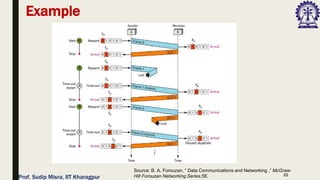
Example
Source: B. A. Forouzan, “ Data Communications and Networking ,” McGraw-
Hill Forouzan Networking Series,5E.
Prof. Sudip Misra, IIT Kharagpur
23
Sequence Number
▪ A field is added to the data frame to hold the sequence number of that frame.
▪ The sequence numbers are wrap around. For example, if the field is m bits
long, the sequence numbers start from 0, go to 2m - 1, and then are repeated.
▪ The sequence numbers are based on modulo-2 arithmetic.
Prof. Sudip Misra, IIT Kharagpur
24
Acknowledgement Number
The acknowledgment numbers always announce the sequence number of
the next frame expected by the receiver.
For example, if frame 0 has arrived safe and sound, the receiver sends an
ACK frame with acknowledgment 1.
If frame 1 has arrived safe and sound, the receiver sends an ACK frame
with acknowledgment 0 (meaning frame 0 is expected).
Prof. Sudip Misra, IIT Kharagpur
25
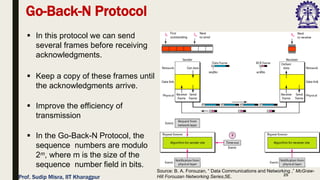
Go-Back-N Protocol
▪ In this protocol we can send
several frames before receiving
acknowledgments.
▪ Keep a copy of these frames until
the acknowledgments arrive.
▪ Improve the efficiency of
transmission
▪ In the Go-Back-N Protocol, the
sequence numbers are modulo
2m, where m is the size of the
sequence number field in bits.
Source: B. A. Forouzan, “ Data Communications and Networking ,” McGraw-
Hill Forouzan Networking Series,5E.
Prof. Sudip Misra, IIT Kharagpur
26
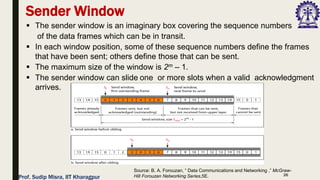
Sender Window
▪ The sender window is an imaginary box covering the sequence numbers
of the data frames which can be in transit.
▪ In each window position, some of these sequence numbers define the frames
that have been sent; others define those that can be sent.
▪ The maximum size of the window is 2m – 1.
▪ The sender window can slide one or more slots when a valid acknowledgment
arrives.
Source: B. A. Forouzan, “ Data Communications and Networking ,” McGraw-
Hill Forouzan Networking Series,5E.
Prof. Sudip Misra, IIT Kharagpur
27
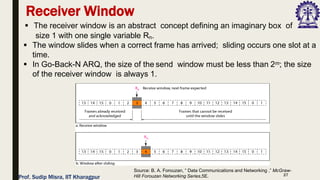
Receiver Window
▪ The receiver window is an abstract concept defining an imaginary box of
size 1 with one single variable Rn.
▪ The window slides when a correct frame has arrived; sliding occurs one slot at a
time.
▪ In Go-Back-N ARQ, the size of the send window must be less than 2m; the size
of the receiver window is always 1.
Source: B. A. Forouzan, “ Data Communications and Networking ,” McGraw-
Hill Forouzan Networking Series,5E.
Prof. Sudip Misra, IIT Kharagpur
28
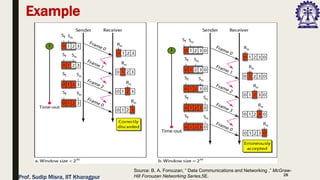
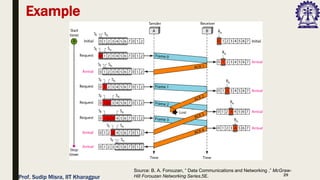
Example
Source: B. A. Forouzan, “ Data Communications and Networking ,” McGraw-
Hill Forouzan Networking Series,5E.
Prof. Sudip Misra, IIT Kharagpur
29
Example
Source: B. A. Forouzan, “ Data Communications and Networking ,” McGraw-
Hill Forouzan Networking Series,5E.
Prof. Sudip Misra, IIT Kharagpur
30
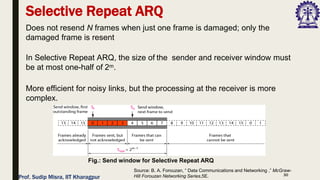
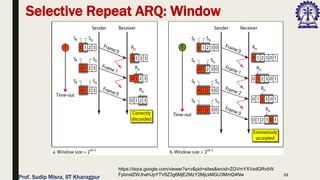
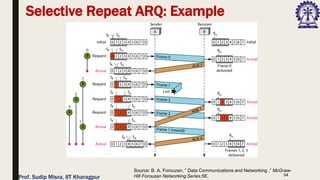
Selective Repeat ARQ
Does not resend N frames when just one frame is damaged; only the
damaged frame is resent
In Selective Repeat ARQ, the size of the sender and receiver window must
be at most one-half of 2m.
More efficient for noisy links, but the processing at the receiver is more
complex.
Fig.: Send window for Selective Repeat ARQ
Source: B. A. Forouzan, “ Data Communications and Networking ,” McGraw-
Hill Forouzan Networking Series,5E.
Prof. Sudip Misra, IIT Kharagpur
31
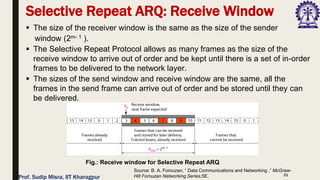
Selective Repeat ARQ: Receive Window
▪ The size of the receiver window is the same as the size of the sender
window (2m- 1 ).
▪ The Selective Repeat Protocol allows as many frames as the size of the
receive window to arrive out of order and be kept until there is a set of in-order
frames to be delivered to the network layer.
▪ The sizes of the send window and receive window are the same, all the
frames in the send frame can arrive out of order and be stored until they can
be delivered.
Fig.: Receive window for Selective Repeat ARQ
Source: B. A. Forouzan, “ Data Communications and Networking ,” McGraw-
Hill Forouzan Networking Series,5E.
Prof. Sudip Misra, IIT Kharagpur
32
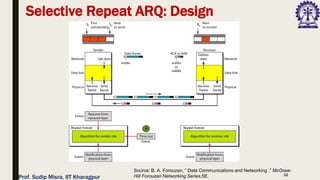
Selective Repeat ARQ: Design
Source: B. A. Forouzan, “ Data Communications and Networking ,” McGraw-
Hill Forouzan Networking Series,5E.
Prof. Sudip Misra, IIT Kharagpur
33
Selective Repeat ARQ: Window
https://docs.google.com/viewer?a=v&pid=sites&srcid=ZGVmYXVsdGRvbW
FpbnxlZWJhaHJpYTV8Z3g6MjE2MzY2MjcxMGU3MmQ4Nw
Prof. Sudip Misra, IIT Kharagpur
34
Selective Repeat ARQ: Example
Source: B. A. Forouzan, “ Data Communications and Networking ,” McGraw-
Hill Forouzan Networking Series,5E.
Prof. Sudip Misra, IIT Kharagpur
Thank You!!!
35

Flow control Cumputer network tropics study

  • 1.
    Flow and ErrorControl Computer Networks(CS31204) Prof. Sudip Misra Department of Computer Science and Engineering Indian Institute of Technology Kharagpur Email: smisra@sit.iitkgp.ernet.in Website: http://cse.iitkgp.ac.in/~smisra/ Research Lab: cse.iitkgp.ac.in/~smisra/swan/ 1
  • 2.
    2 Data link controlfunctions include framing, flow and error control, and software implemented protocols that provide smooth and reliable transmission of frames between nodes. Data Link layer Prof. Sudip Misra, IIT Kharagpur
  • 3.
    3 ▪ Framing inthe data link layer separates a message from one source to a destination, or from other messages to other destinations, by adding a sender address and a destination address. ▪ The destination address defines where the packet is to go; the sender address helps the recipient acknowledge the receipt. ▪ Whole message could not be packed in one frame because: frame can be very large, making flow and error control very inefficient. Framing Fig: A frame in a character-oriented protocol Source: B. A. Forouzan, “ Data Communications and Networking ,” McGraw- Hill Forouzan Networking Series,5E. Prof. Sudip Misra, IIT Kharagpur
  • 4.
    4 ▪ The datasection of a frame is a sequence of bits to be interpreted by the upper layer as text, graphic, audio, video, and so on. ▪ However, in addition to headers, we still need a delimiter to separate one frame from the other. ▪ Most protocols use a special 8-bit pattern flag 01111110 as the delimiter to define the beginning and the end of the frame. ▪ To differentiate the message from delimiter, byte stuffing is done. Bit Oriented Protocol Fig: A frame in a bit-oriented protocol Source: B. A. Forouzan, “ Data Communications and Networking ,” McGraw- Hill Forouzan Networking Series,5E. Prof. Sudip Misra, IIT Kharagpur
  • 5.
    5 ▪ Bit stuffingis the process of adding one extra 0 whenever five consecutive 1 follow a 0 in the data, so that the receiver does not mistake the pattern 0111110 for a flag. Bit Stuffing Fig: Byte Stuffing and Unstuffing Source: B. A. Forouzan, “ Data Communications and Networking ,” McGraw- Hill Forouzan Networking Series,5E. Prof. Sudip Misra, IIT Kharagpur
  • 6.
    6 ▪ Flow controlcoordinates the amount of data that can be sent before receiving an acknowledgment ▪ One of the most important duties of the data link layer. ▪ In most protocols, flow control is a set of procedures that tells the sender how much data it can transmit before it must wait for an acknowledgment from the receiver. ▪ Error control in the data link layer is based on automatic repeat request, which is the retransmission of data. Flow and Error Control Prof. Sudip Misra, IIT Kharagpur
  • 7.
    7 ▪ What ifsender sends the bit pattern too fast? Receiver may not be able to process the data as fast as the sender is sending it ▪ Receiver can buffer, but buffer has finite size. After that is filled, data is lost ▪ Flow control – technique to control data flow between sender and receiver so that sender is blocked if receiver cannot accept any more data ▪ Sender must get an acknowledgement from the receiver before it can send more data Flow Control Prof. Sudip Misra, IIT Kharagpur
  • 8.
    8 ❑ Sender sendsa frame ❑ Receiver receives frame & acknowledges it ❑ Sender waits to receive “ack” before sending next frame (If receiver is not ready to receive another frame it holds back the ack) ❑ One frame at a time is sent over the transmission line ❑ Simple, easy to implement Stop and Wait Flow Control Prof. Sudip Misra, IIT Kharagpur
  • 9.
    9 Problems: ❑ Works fineif there is only a few large frames to be sent ❑ Usually we want smaller frames ➢ Receiver’s buffer size may be small ➢ If a large frame is transmitted, the entire frame has to be retransmitted if there is an error ➢ Longer the frame, larger the chance of an error ➢ On a shared medium, do not want any one sender to occupy the medium for a long time ❑ With smaller frames, takes too long to send all frames Stop and Wait Flow Control Prof. Sudip Misra, IIT Kharagpur
  • 10.
    10 ❑ Bit Lengthof link in bits B = maximum possible number of bits that can be simultaneously present in the link B = R × (D/V) R = data rate of link in bps D = length of link in meters V = propagation speed in m/sec ❑ So for Stop & Wait, ideally we want frame length to be close to bit length of the link The sender has enough bits to put out on the link while the earlier bits of the same frame reach the receiver Links stays occupied for more time ❑ But we have also argued that we want frame sizes to be small ❑ Results in very poor line/link utilization for Stop & Wait, especially in fast links over longer distances B becomes very large, so impractical to have such large frames Link Efficiency of Stop and Wait Flow Control Prof. Sudip Misra, IIT Kharagpur
  • 11.
    11 ❑ Consider aframe length of L bits Transmission delay = Time to put the frame into the link = L/R Time for last bit of the frame to reach the receiver = (L/R) + (D/V) Assume that processing delay at receiver is negligible Assume that transmission time of ACK is negligible (very small frame) Time for ACK to come to sender = (D/V) Total time to transmit the frame T = (L/R) + 2(D/V) Total no. of bits that could have ben transmitted in this time = T × R Actual no. of bits transmitted = L Line utilization = L/(T × R) = L / (L + 2R(D/V)) Link Efficiency of Stop and Wait Flow Control Prof. Sudip Misra, IIT Kharagpur
  • 12.
    12 ❑ Reduces lineinefficiency problem of stop-and-wait by transmitting multiple frames without waiting for acknowledgement ❑ Suppose two stations A and B are connected by a fullduplex link Sliding Window Flow Control Prof. Sudip Misra, IIT Kharagpur
  • 13.
    13 ❑ Station Ballocates buffer space for W frames. ❑ Thus B can accept W frames, and A is allowed to send W frames without waiting for any acknowledgement ❑ Sender maintains a list of sequence numbers that it is allowed to send (sender window) ❑ Receiver also maintains a list of sequence numbers that it is prepared to receive (receiver window) ❑ Since the sequence number to be used occupies a field in the frame, it is clearly of bounded size ❑ For a k-bit field, the range of sequence numbers is 0 through 2k–1, and frames are numbered modulo 2k ❑ Maximum window size = 2k – 1 (why?) Sliding Window Flow Control Prof. Sudip Misra, IIT Kharagpur
  • 14.
    14 ❑ Each frameis labeled with a sequence number ❑ To keep track of the frames which have been acknowledged ❑ B acknowledges a frame by sending an ACK/RR that includes the sequence number of the next frame expected. This also explicitly announces that B is prepared to receive the next W frames, beginning with the number specified. ❑ This scheme can be used to acknowledge multiple frames ❑ B could receive frames 2,3,4 but withhold ACK until frame 4 has arrived. By returning an ACK with sequence number 5, B acknowledges frames 2,3,4 at one time Sliding Window Flow Control Prof. Sudip Misra, IIT Kharagpur
  • 15.
    15 ❑ The actualwindow size need not be the maximum possible size for a given sequence number length ❑ For a 3-bit sequence number, a window size of 5 can also be configured ❑ If two stations exchange data, each need to maintain two windows. To save communication capacity, a technique called piggybacking is used ❑ Each data frame includes a field that holds the sequence number of that frame plus a field that holds the sequence number used for ACK ❑ If a station has an ACK but no data to send, it sends a separate ACK frame Sliding Window Flow Control Prof. Sudip Misra, IIT Kharagpur
  • 16.
    16 Piggybacking ▪ Improve theefficiency of the bidirectional protocols. ▪ When a frame is carrying data from A to B, it can also carry control information about arrived (or lost) frames from B; when a frame is carrying data from B to A, it can also carry control information about the arrived (or lost) frames from A. Source: B. A. Forouzan, “ Data Communications and Networking ,” McGraw- Hill Forouzan Networking Series,5E. Prof. Sudip Misra, IIT Kharagpur
  • 17.
    17 Error Control Protocols Source:B. A. Forouzan, “ Data Communications and Networking ,” McGraw- Hill Forouzan Networking Series,5E. Prof. Sudip Misra, IIT Kharagpur
  • 18.
    18 Simplest Protocol ▪ Itis a unidirectional protocol in which data frames are traveling in only one direction-from the sender to receiver. ▪ The receiver can immediately handle any frame it receives with a processing time that is small enough to be negligible. ▪ The data link layer of the receiver immediately removes the header from the frame and hands the data packet to its network layer, which can also accept the packet immediately. Fig.: The design of the simplest protocol with no flow or error control Source: B. A. Forouzan, “ Data Communications and Networking ,” McGraw- Hill Forouzan Networking Series,5E. Prof. Sudip Misra, IIT Kharagpur
  • 19.
    19 Stop and WaitProtocol ▪ The sender sends one frame, stops until it receives confirmation from the receiver, and then sends the next frame. ▪ Unidirectional communication for data frames, but auxiliary ACK frames (simple tokens of acknowledgment) travel from the other direction. Fig.: The design of the Stop and wait protocol Source: B. A. Forouzan, “ Data Communications and Networking ,” McGraw- Hill Forouzan Networking Series,5E. Prof. Sudip Misra, IIT Kharagpur
  • 20.
    20 Stop and WaitProtocol: Example Source: B. A. Forouzan, “ Data Communications and Networking ,” McGraw- Hill Forouzan Networking Series,5E. Prof. Sudip Misra, IIT Kharagpur
  • 21.
    21 Stop and WaitAutomatic Repeat Request ▪ The sender keeps a copy of the sent frame. At the same time, it starts a timer. ▪ If the timer expires and there is no ACK for the sent frame, the frame is resent, the copy is held, and the timer is restarted. ▪ The protocol uses the stop-and-wait mechanism, there is only one specific frame that needs an ACK even though several copies of the same frame can be in the network. Fig.: The design of the Stop and Wait ARQ protocol https://docs.google.com/viewer?a=v&pid=sites&srcid=ZGVmYXVsdGRvbW FpbnxlZWJhaHJpYTV8Z3g6MjE2MzY2MjcxMGU3MmQ4Nw Prof. Sudip Misra, IIT Kharagpur
  • 22.
    22 Example Source: B. A.Forouzan, “ Data Communications and Networking ,” McGraw- Hill Forouzan Networking Series,5E. Prof. Sudip Misra, IIT Kharagpur
  • 23.
    23 Sequence Number ▪ Afield is added to the data frame to hold the sequence number of that frame. ▪ The sequence numbers are wrap around. For example, if the field is m bits long, the sequence numbers start from 0, go to 2m - 1, and then are repeated. ▪ The sequence numbers are based on modulo-2 arithmetic. Prof. Sudip Misra, IIT Kharagpur
  • 24.
    24 Acknowledgement Number The acknowledgmentnumbers always announce the sequence number of the next frame expected by the receiver. For example, if frame 0 has arrived safe and sound, the receiver sends an ACK frame with acknowledgment 1. If frame 1 has arrived safe and sound, the receiver sends an ACK frame with acknowledgment 0 (meaning frame 0 is expected). Prof. Sudip Misra, IIT Kharagpur

  • 25.
    25 Go-Back-N Protocol ▪ Inthis protocol we can send several frames before receiving acknowledgments. ▪ Keep a copy of these frames until the acknowledgments arrive. ▪ Improve the efficiency of transmission ▪ In the Go-Back-N Protocol, the sequence numbers are modulo 2m, where m is the size of the sequence number field in bits. Source: B. A. Forouzan, “ Data Communications and Networking ,” McGraw- Hill Forouzan Networking Series,5E. Prof. Sudip Misra, IIT Kharagpur
  • 26.
    26 Sender Window ▪ Thesender window is an imaginary box covering the sequence numbers of the data frames which can be in transit. ▪ In each window position, some of these sequence numbers define the frames that have been sent; others define those that can be sent. ▪ The maximum size of the window is 2m – 1. ▪ The sender window can slide one or more slots when a valid acknowledgment arrives. Source: B. A. Forouzan, “ Data Communications and Networking ,” McGraw- Hill Forouzan Networking Series,5E. Prof. Sudip Misra, IIT Kharagpur
  • 27.
    27 Receiver Window ▪ Thereceiver window is an abstract concept defining an imaginary box of size 1 with one single variable Rn. ▪ The window slides when a correct frame has arrived; sliding occurs one slot at a time. ▪ In Go-Back-N ARQ, the size of the send window must be less than 2m; the size of the receiver window is always 1. Source: B. A. Forouzan, “ Data Communications and Networking ,” McGraw- Hill Forouzan Networking Series,5E. Prof. Sudip Misra, IIT Kharagpur
  • 28.
    28 Example Source: B. A.Forouzan, “ Data Communications and Networking ,” McGraw- Hill Forouzan Networking Series,5E. Prof. Sudip Misra, IIT Kharagpur
  • 29.
    29 Example Source: B. A.Forouzan, “ Data Communications and Networking ,” McGraw- Hill Forouzan Networking Series,5E. Prof. Sudip Misra, IIT Kharagpur
  • 30.
    30 Selective Repeat ARQ Doesnot resend N frames when just one frame is damaged; only the damaged frame is resent In Selective Repeat ARQ, the size of the sender and receiver window must be at most one-half of 2m. More efficient for noisy links, but the processing at the receiver is more complex. Fig.: Send window for Selective Repeat ARQ Source: B. A. Forouzan, “ Data Communications and Networking ,” McGraw- Hill Forouzan Networking Series,5E. Prof. Sudip Misra, IIT Kharagpur
  • 31.
    31 Selective Repeat ARQ:Receive Window ▪ The size of the receiver window is the same as the size of the sender window (2m- 1 ). ▪ The Selective Repeat Protocol allows as many frames as the size of the receive window to arrive out of order and be kept until there is a set of in-order frames to be delivered to the network layer. ▪ The sizes of the send window and receive window are the same, all the frames in the send frame can arrive out of order and be stored until they can be delivered. Fig.: Receive window for Selective Repeat ARQ Source: B. A. Forouzan, “ Data Communications and Networking ,” McGraw- Hill Forouzan Networking Series,5E. Prof. Sudip Misra, IIT Kharagpur
  • 32.
    32 Selective Repeat ARQ:Design Source: B. A. Forouzan, “ Data Communications and Networking ,” McGraw- Hill Forouzan Networking Series,5E. Prof. Sudip Misra, IIT Kharagpur
  • 33.
    33 Selective Repeat ARQ:Window https://docs.google.com/viewer?a=v&pid=sites&srcid=ZGVmYXVsdGRvbW FpbnxlZWJhaHJpYTV8Z3g6MjE2MzY2MjcxMGU3MmQ4Nw Prof. Sudip Misra, IIT Kharagpur
  • 34.
    34 Selective Repeat ARQ:Example Source: B. A. Forouzan, “ Data Communications and Networking ,” McGraw- Hill Forouzan Networking Series,5E. Prof. Sudip Misra, IIT Kharagpur
  • 35.