Download free for 30 days
Sign in
Upload
Language (EN)
Support
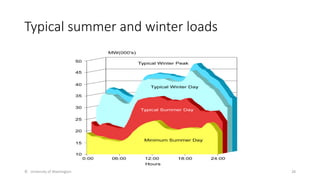
Business
Mobile
Social Media
Marketing
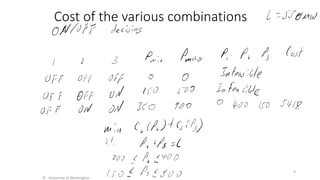
Technology
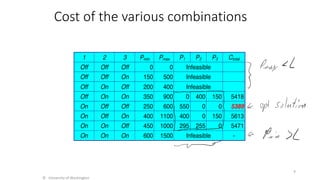
Art & Photos
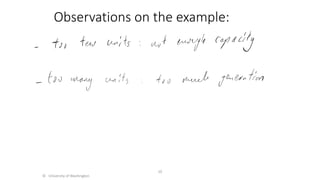
Career
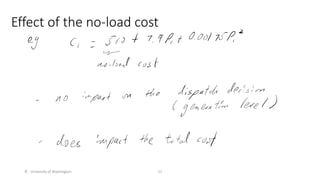
Design
Education
Presentations & Public Speaking
Government & Nonprofit
Healthcare
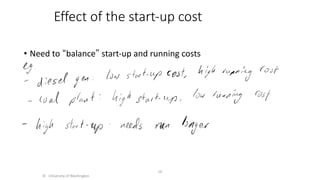
Internet
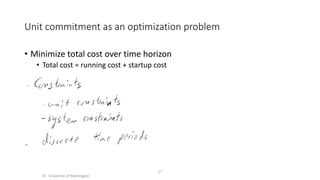
Law
Leadership & Management
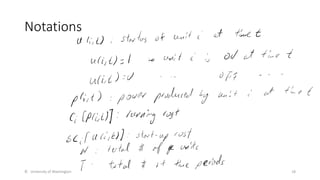
Automotive
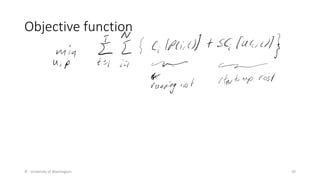
Engineering
Software
Recruiting & HR
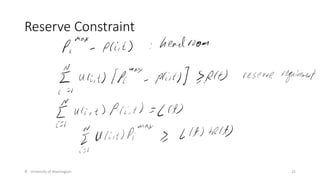
Retail
Sales
Services
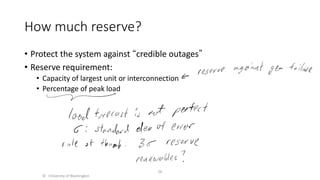
Science
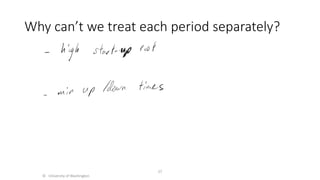
Small Business & Entrepreneurship
Food
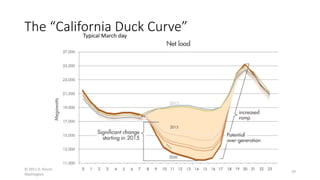
Environment
Economy & Finance
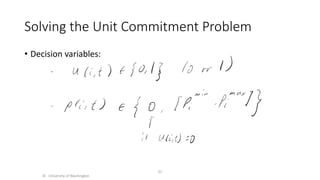
Data & Analytics
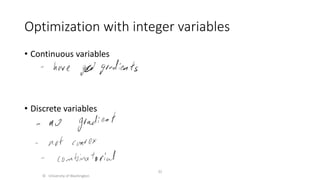
Investor Relations
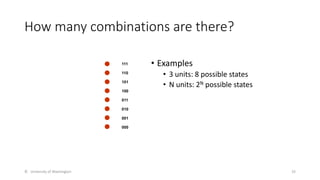
Sports
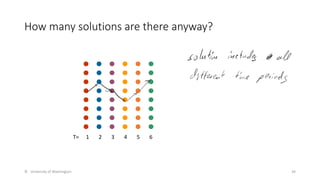
Spiritual
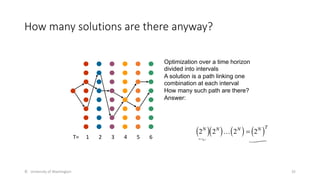
News & Politics
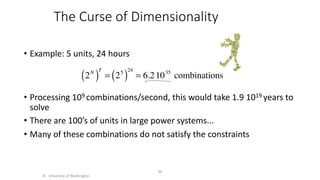
Travel
Self Improvement
Real Estate
Entertainment & Humor
Health & Medicine
Devices & Hardware
Lifestyle
Change Language
Language
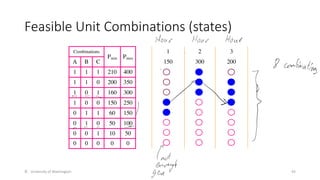
English
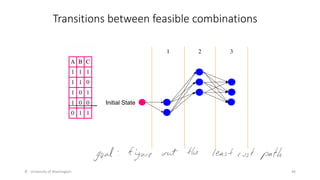
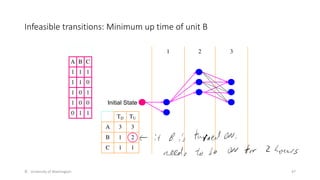
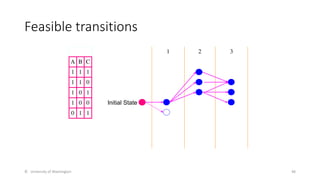
Español
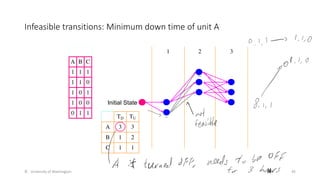
Português
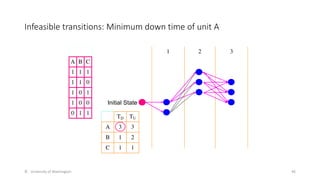
Français
Deutsche
Cancel
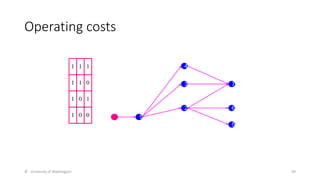
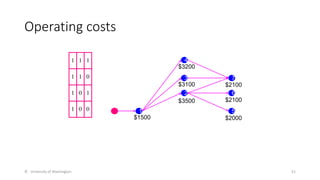
Save
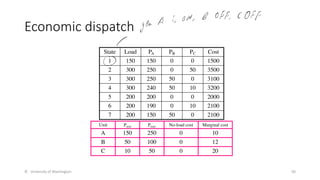
EN
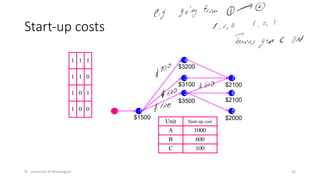
Uploaded by
MarkM72
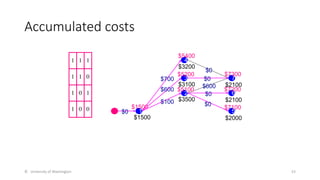
24 views
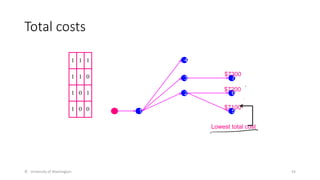
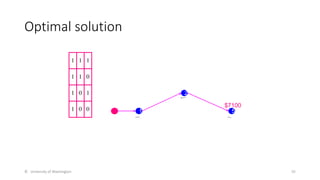
Unit Commitment updated lecture slidesides
unit commit lecture 2
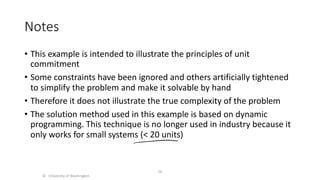
Engineering
◦
Read more
0
Save
Share
Embed
Embed presentation
Download
Download to read offline
1
/ 59
2
/ 59
3
/ 59
4
/ 59
5
/ 59
6
/ 59
7
/ 59
8
/ 59
9
/ 59
10
/ 59
11
/ 59
12
/ 59
13
/ 59
14
/ 59
15
/ 59
16
/ 59
17
/ 59
18
/ 59
19
/ 59
20
/ 59
21
/ 59
22
/ 59
23
/ 59
24
/ 59
25
/ 59
26
/ 59
27
/ 59
28
/ 59
29
/ 59
30
/ 59
31
/ 59
32
/ 59
33
/ 59
34
/ 59
35
/ 59
36
/ 59
37
/ 59
38
/ 59
39
/ 59
40
/ 59
41
/ 59
42
/ 59
43
/ 59
44
/ 59
45
/ 59
46
/ 59
47
/ 59
48
/ 59
49
/ 59
50
/ 59
51
/ 59
52
/ 59
53
/ 59
54
/ 59
55
/ 59
56
/ 59
57
/ 59
58
/ 59
59
/ 59
More Related Content
PPTX
05a-Unit_Commitment.pptx slide presentation
by
HeangLaisiv1
PPTX
BAB 7. UNIT COMMITMENTBAB 7. UNIT COMMITMENT.pptx
by
idoer11
PPTX
BAB 7. UNIT COMMITMENTBAB 7. UNIT COMMITMENT.pptx
by
idoer11
PPTX
Unit commitment in power system
by
Abrar Ahmed
PPTX
[2020.2] PSOC - Unit_Commitment.pptx
by
SintianiPerdanisinti
PDF
Optimal Unit Commitment Based on Economic Dispatch Using Improved Particle Sw...
by
paperpublications3
PPTX
05a-Unit_Commitment-done.pptx PowerPoint
by
HeangLaisiv1
PPT
UNIT-4-PPT UNIT COMMITMENT AND ECONOMIC DISPATCH
by
Sridhar191373
05a-Unit_Commitment.pptx slide presentation
by
HeangLaisiv1
BAB 7. UNIT COMMITMENTBAB 7. UNIT COMMITMENT.pptx
by
idoer11
BAB 7. UNIT COMMITMENTBAB 7. UNIT COMMITMENT.pptx
by
idoer11
Unit commitment in power system
by
Abrar Ahmed
[2020.2] PSOC - Unit_Commitment.pptx
by
SintianiPerdanisinti
Optimal Unit Commitment Based on Economic Dispatch Using Improved Particle Sw...
by
paperpublications3
05a-Unit_Commitment-done.pptx PowerPoint
by
HeangLaisiv1
UNIT-4-PPT UNIT COMMITMENT AND ECONOMIC DISPATCH
by
Sridhar191373
Similar to Unit Commitment updated lecture slidesides
PPTX
Economic operation of Power systems by Unit commitment
by
Pritesh Priyadarshi
PDF
Economic dipatch
by
Doni Wahyudi
PPT
UNIT-4-PPT.ppt
by
Karthik Kathan
PDF
Module-1 Part-2 Unit Commitment and Hydro-Thermal Coordination.pdf
by
MarkM72
PPT
psoc UNIT-4-PPT.ppt anna university PSOC notes
by
pandyselvieee
PDF
power system operation and control unit commitment .pdf
by
ArnabChakraborty499766
PPT
Economic load dispatch
by
vikram anand
PDF
economic load dispatch and unit commitment power_system_operation.pdf
by
ArnabChakraborty499766
PDF
Optimization of Economic Load Dispatch with Unit Commitment on Multi Machine
by
IJAPEJOURNAL
PDF
An Improved Particle Swarm Optimization for Proficient Solving of Unit Commit...
by
IDES Editor
PPTX
ECE476_2016_Lect17.pptx
by
FeehaAreej
PPTX
Optimization of power sytem
by
shawon1981
PDF
The optimal solution for unit commitment problem using binary hybrid grey wol...
by
IJECEIAES
PPTX
Unit 5.pptx
by
Sapna130727
PPT
ECE4762011_Lect16.ppt
by
MuhammadAniqueAslam1
PPTX
Unit commitment
by
Mohammad Abdullah
PPTX
Project on economic load dispatch
by
ayantudu
PDF
IRJET-Comparative Analysis of Unit Commitment Problem of Electric Power Syste...
by
IRJET Journal
PDF
OPTIMAL ECONOMIC LOAD DISPATCH USING FUZZY LOGIC & GENETIC ALGORITHMS
by
IAEME Publication
DOCX
Mr. Bakar Presentation for group discussion.docx
by
CyberMohdSalahShoty
Economic operation of Power systems by Unit commitment
by
Pritesh Priyadarshi
Economic dipatch
by
Doni Wahyudi
UNIT-4-PPT.ppt
by
Karthik Kathan
Module-1 Part-2 Unit Commitment and Hydro-Thermal Coordination.pdf
by
MarkM72
psoc UNIT-4-PPT.ppt anna university PSOC notes
by
pandyselvieee
power system operation and control unit commitment .pdf
by
ArnabChakraborty499766
Economic load dispatch
by
vikram anand
economic load dispatch and unit commitment power_system_operation.pdf
by
ArnabChakraborty499766
Optimization of Economic Load Dispatch with Unit Commitment on Multi Machine
by
IJAPEJOURNAL
An Improved Particle Swarm Optimization for Proficient Solving of Unit Commit...
by
IDES Editor
ECE476_2016_Lect17.pptx
by
FeehaAreej
Optimization of power sytem
by
shawon1981
The optimal solution for unit commitment problem using binary hybrid grey wol...
by
IJECEIAES
Unit 5.pptx
by
Sapna130727
ECE4762011_Lect16.ppt
by
MuhammadAniqueAslam1
Unit commitment
by
Mohammad Abdullah
Project on economic load dispatch
by
ayantudu
IRJET-Comparative Analysis of Unit Commitment Problem of Electric Power Syste...
by
IRJET Journal
OPTIMAL ECONOMIC LOAD DISPATCH USING FUZZY LOGIC & GENETIC ALGORITHMS
by
IAEME Publication
Mr. Bakar Presentation for group discussion.docx
by
CyberMohdSalahShoty
Recently uploaded
PPTX
operating_systems.pptx m,nm,nm,n,nm,n,nm,nikl
by
kirthigaaiml
PPTX
Batch-1(End Semester) Student Of Shree Durga Tech. PPT.pptx
by
rashesw1122s
PDF
Industrial Tools Manufacturers In India : Torso Tools
by
torsotools8
PPTX
ME3592 - Metrology and Measurements - Unit - 1 - Lecture Notes
by
pprakash21252
PDF
Computer Graphics Fundamentals (v0p1) - DannyJiang
by
Danny Jiang
PPT
Integer , Goal and Non linear Programming Model
by
OcheriCyril2
PPTX
traffic safety section seven (Traffic Control and Management) of Act
by
azeRakeshSunariMagar
PPTX
GET 211- Computing and Software Engineering (1).pptx
by
festusdaniel142
PDF
Decision-Support-Systems-and-Decision-Making-Processes.pdf
by
PatankarNikhil
PDF
Shear Strength of Soil (Direct shear test).pdf
by
MahmoodKhalid11
PDF
Rajesh Prasad- Brief Profile with educational, professional highlights
by
Rajesh Prasad
PPTX
ISO 13485.2016 Awareness's Training material
by
PrakashSivan
PDF
Model QP 2025 scheme Q &A- Module 1 and 2.pdf
by
SURESHA V
PDF
Module 4 python programming-1BPLCK105B-2025 by Dr.SV.pdf
by
SURESHA V
PPTX
uADPF Topology_SFP requirements_locked slides.pptx
by
Md Bellal Hossain
PPTX
Unit 1_Importance of modelling(Object oriented concepts).pptx
by
Vidyaranichougule
PDF
CME397 SURFACE ENGINEERING UNIT 2 FULL NOTES
by
karthi keyan
PDF
Ericsson 6230 Training Module Document.pdf
by
Md Bellal Hossain
PDF
NS unit wise unit wise 1 -5 so prepare,.
by
kumaransudhan1512
PPTX
Why TPM Succeeds in Some Plants and Struggles in Others | MaintWiz
by
MaintWiz Technologies Private Limited
operating_systems.pptx m,nm,nm,n,nm,n,nm,nikl
by
kirthigaaiml
Batch-1(End Semester) Student Of Shree Durga Tech. PPT.pptx
by
rashesw1122s
Industrial Tools Manufacturers In India : Torso Tools
by
torsotools8
ME3592 - Metrology and Measurements - Unit - 1 - Lecture Notes
by
pprakash21252
Computer Graphics Fundamentals (v0p1) - DannyJiang
by
Danny Jiang
Integer , Goal and Non linear Programming Model
by
OcheriCyril2
traffic safety section seven (Traffic Control and Management) of Act
by
azeRakeshSunariMagar
GET 211- Computing and Software Engineering (1).pptx
by
festusdaniel142
Decision-Support-Systems-and-Decision-Making-Processes.pdf
by
PatankarNikhil
Shear Strength of Soil (Direct shear test).pdf
by
MahmoodKhalid11
Rajesh Prasad- Brief Profile with educational, professional highlights
by
Rajesh Prasad
ISO 13485.2016 Awareness's Training material
by
PrakashSivan
Model QP 2025 scheme Q &A- Module 1 and 2.pdf
by
SURESHA V
Module 4 python programming-1BPLCK105B-2025 by Dr.SV.pdf
by
SURESHA V
uADPF Topology_SFP requirements_locked slides.pptx
by
Md Bellal Hossain
Unit 1_Importance of modelling(Object oriented concepts).pptx
by
Vidyaranichougule
CME397 SURFACE ENGINEERING UNIT 2 FULL NOTES
by
karthi keyan
Ericsson 6230 Training Module Document.pdf
by
Md Bellal Hossain
NS unit wise unit wise 1 -5 so prepare,.
by
kumaransudhan1512
Why TPM Succeeds in Some Plants and Struggles in Others | MaintWiz
by
MaintWiz Technologies Private Limited
Unit Commitment updated lecture slidesides
1.
Unit Commitment Baosen Zhang
3.
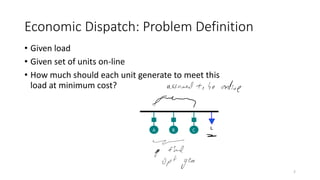
Economic Dispatch: Problem
Definition 2 • Given load • Given set of units on-line • How much should each unit generate to meet this load at minimum cost? A B C L
4.
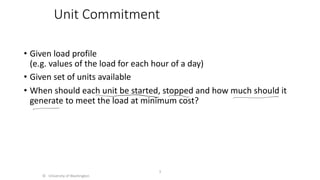
Unit Commitment • Given
load profile (e.g. values of the load for each hour of a day) • Given set of units available • When should each unit be started, stopped and how much should it generate to meet the load at minimum cost? © University of Washington 3
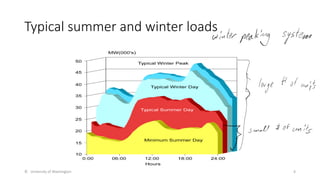
5.
Typical summer and
winter loads © University of Washington 4
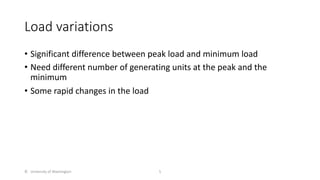
6.
Load variations • Significant
difference between peak load and minimum load • Need different number of generating units at the peak and the minimum • Some rapid changes in the load © University of Washington 5
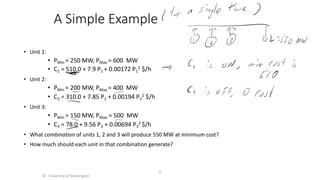
7.
A Simple Example •
Unit 1: • PMin = 250 MW, PMax = 600 MW • C1 = 510.0 + 7.9 P1 + 0.00172 P1 2 $/h • Unit 2: • PMin = 200 MW, PMax = 400 MW • C2 = 310.0 + 7.85 P2 + 0.00194 P2 2 $/h • Unit 3: • PMin = 150 MW, PMax = 500 MW • C3 = 78.0 + 9.56 P3 + 0.00694 P3 2 $/h • What combination of units 1, 2 and 3 will produce 550 MW at minimum cost? • How much should each unit in that combination generate? © University of Washington 6
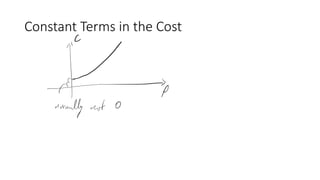
8.
Constant Terms in
the Cost
9.
Cost of the
various combinations © University of Washington 8
10.
Cost of the
various combinations © University of Washington 9 1 2 3 Pmin Pmax P1 P2 P3 Ctotal Off Off Off 0 0 Infeasible Off Off On 150 500 Infeasible Off On Off 200 400 Infeasible Off On On 350 900 0 400 150 5418 On Off Off 250 600 550 0 0 5389 On Off On 400 1100 400 0 150 5613 On On Off 450 1000 295 255 0 5471 On On On 600 1500 Infeasible -
11.
Observations on the
example: © University of Washington 10
12.
Effect of the
no-load cost © University of Washington 11
13.
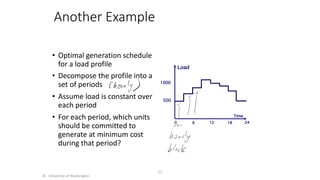
Another Example • Optimal
generation schedule for a load profile • Decompose the profile into a set of periods • Assume load is constant over each period • For each period, which units should be committed to generate at minimum cost during that period? © University of Washington 12 Load Time 12 6 0 18 24 500 1000
14.
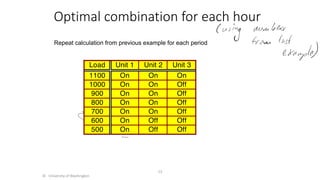
Optimal combination for
each hour Load Unit 1 Unit 2 Unit 3 1100 On On On 1000 On On Off 900 On On Off 800 On On Off 700 On On Off 600 On Off Off 500 On Off Off © University of Washington 13 Repeat calculation from previous example for each period
15.
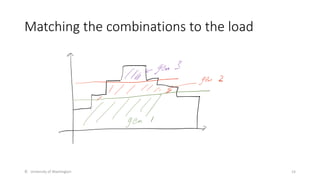
Matching the combinations
to the load © University of Washington 14
16.
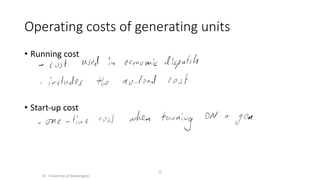
Operating costs of
generating units • Running cost • Start-up cost © University of Washington 15
17.
Effect of the
start-up cost • Need to “balance” start-up and running costs © University of Washington 16
18.
Unit commitment as
an optimization problem • Minimize total cost over time horizon • Total cost = running cost + startup cost © University of Washington 17
19.
Notations © University of
Washington 18
20.
Notations © University of
Washington 19 u(i,t): Status of unit i at period t p(i,t): Power produced by unit i during period t Unit i is ON during period t u(i,t) = 1: Unit i is OFF during period t u(i,t) = 0 : Ci[p(i,t)]: Running cost of unit i during period t SCi[u(i,t)]: Startup cost of unit i during period t N : Number of available generating units T : Number of periods in the optimization horizon
21.
Objective function © University
of Washington 20
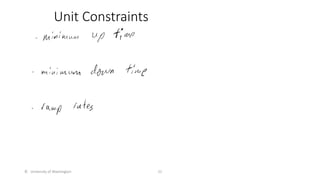
22.
Unit Constraints © University
of Washington 21
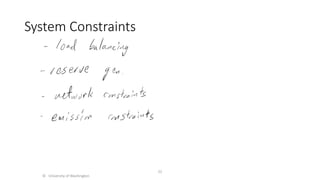
23.
System Constraints © University
of Washington 22
24.
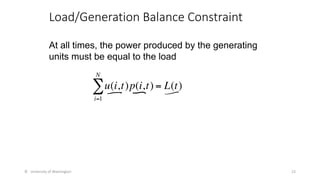
Load/Generation Balance Constraint ©
University of Washington 23 u(i,t)p(i,t) i=1 N ∑ = L(t) At all times, the power produced by the generating units must be equal to the load
25.
Reserve Constraint • Unanticipated
loss of a generating unit or an interconnection causes unacceptable frequency drop if not corrected • Need to increase production from other units to keep frequency drop within acceptable limits • Rapid increase in production only possible if committed units are not all operating at their maximum capacity • Some of the capacity of the generating units must be kept “in reserve” © University of Washington 24
26.
Reserve Constraint © University
of Washington 25
27.
How much reserve? •
Protect the system against “credible outages” • Reserve requirement: • Capacity of largest unit or interconnection • Percentage of peak load © University of Washington 26
28.
Why can’t we
treat each period separately? © University of Washington 27
29.
Typical summer and
winter loads © University of Washington 28
30.
The “California Duck
Curve” © 2011 D. Kirschen and University of Washington 29 Typical March day
31.
Economic Dispatch vs.
Unit Commitment • Generation scheduling or unit commitment is a more general problem than economic dispatch • Economic dispatch is a sub-problem of generation scheduling • Unit commitment must strike a balance between cheaper inflexible units and more expensive flexible units © University of Washington 30
32.
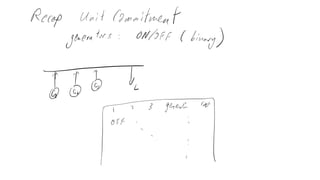
Solving the Unit
Commitment Problem • Decision variables: © University of Washington 31
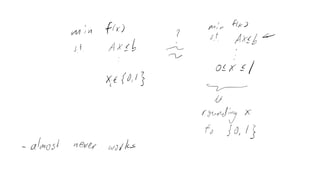
33.
Optimization with integer
variables • Continuous variables • Discrete variables © University of Washington 32
34.
How many combinations
are there? © University of Washington 33 • Examples • 3 units: 8 possible states • N units: 2N possible states 111 110 101 100 011 010 001 000
35.
How many solutions
are there anyway? © University of Washington 34 1 2 3 4 5 6 T=
36.
How many solutions
are there anyway? © University of Washington 35 1 2 3 4 5 6 T= Optimization over a time horizon divided into intervals A solution is a path linking one combination at each interval How many such path are there? Answer: 2N ( ) 2N ( )… 2N ( ) = 2N ( )T
37.
The Curse of
Dimensionality • Example: 5 units, 24 hours • Processing 109 combinations/second, this would take 1.9 1019 years to solve • There are 100’s of units in large power systems... • Many of these combinations do not satisfy the constraints © University of Washington 36 2N ( ) T = 25 ( ) 24 = 6.21035 combinations
38.
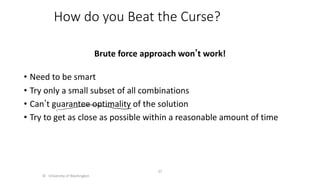
How do you
Beat the Curse? Brute force approach wonʼt work! • Need to be smart • Try only a small subset of all combinations • Canʼt guarantee optimality of the solution • Try to get as close as possible within a reasonable amount of time © University of Washington 37
40.
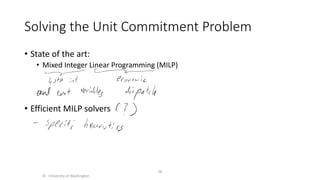
Solving the Unit
Commitment Problem • State of the art: • Mixed Integer Linear Programming (MILP) • Efficient MILP solvers © University of Washington 38
42.
A Simple Unit
Commitment Example
43.
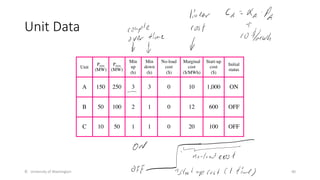
Unit Data © University
of Washington 40 Unit Pmin (MW) Pmax (MW) Min up (h) Min down (h) No-load cost ($) Marginal cost ($/MWh) Start-up cost ($) Initial status A 150 250 3 3 0 10 1,000 ON B 50 100 2 1 0 12 600 OFF C 10 50 1 1 0 20 100 OFF
44.
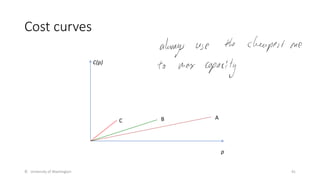
Cost curves © University
of Washington 41 p C(p) A B C
45.
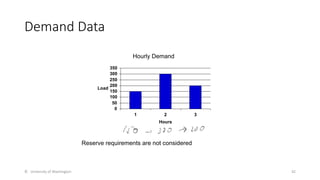
Demand Data © University
of Washington 42 Hourly Demand 0 50 100 150 200 250 300 350 1 2 3 Hours Load Reserve requirements are not considered
46.
Feasible Unit Combinations
(states) © University of Washington 43 Combinations Pmin Pmax A B C 1 1 1 210 400 1 1 0 200 350 1 0 1 160 300 1 0 0 150 250 0 1 1 60 150 0 1 0 50 100 0 0 1 10 50 0 0 0 0 0 1 2 3 150 300 200
47.
Transitions between feasible
combinations © University of Washington 44 A B C 1 1 1 1 1 0 1 0 1 1 0 0 0 1 1 1 2 3 Initial State
48.
Infeasible transitions: Minimum
down time of unit A © University of Washington 45 A B C 1 1 1 1 1 0 1 0 1 1 0 0 0 1 1 1 2 3 Initial State TD TU A 3 3 B 1 2 C 1 1
49.
Infeasible transitions: Minimum
down time of unit A © University of Washington 46 A B C 1 1 1 1 1 0 1 0 1 1 0 0 0 1 1 1 2 3 Initial State TD TU A 3 3 B 1 2 C 1 1
50.
Infeasible transitions: Minimum
up time of unit B © University of Washington 47 A B C 1 1 1 1 1 0 1 0 1 1 0 0 0 1 1 1 2 3 Initial State TD TU A 3 3 B 1 2 C 1 1
51.
Feasible transitions © University
of Washington 48 A B C 1 1 1 1 1 0 1 0 1 1 0 0 0 1 1 1 2 3 Initial State
52.
Operating costs © University
of Washington 49 1 1 1 1 1 0 1 0 1 1 0 0 1 4 3 2 5 6 7
53.
Economic dispatch © University
of Washington 50 State Load PA PB PC Cost 1 150 150 0 0 1500 2 300 250 0 50 3500 3 300 250 50 0 3100 4 300 240 50 10 3200 5 200 200 0 0 2000 6 200 190 0 10 2100 7 200 150 50 0 2100 Unit Pmin Pmax No-load cost Marginal cost A 150 250 0 10 B 50 100 0 12 C 10 50 0 20
54.
Operating costs © University
of Washington 51 1 1 1 1 1 0 1 0 1 1 0 0 1 4 3 2 5 6 7 $1500 $3500 $3100 $3200 $2000 $2100 $2100
55.
Start-up costs © University
of Washington 52 1 1 1 1 1 0 1 0 1 1 0 0 1 4 3 2 5 6 7 $1500 $3500 $3100 $3200 $2000 $2100 $2100 Unit Start-up cost A 1000 B 600 C 100
56.
Accumulated costs © University
of Washington 53 1 1 1 1 1 0 1 0 1 1 0 0 1 4 3 2 5 6 7 $1500 $3500 $3100 $3200 $2000 $2100 $2100 $1500 $5100 $5200 $5400 $7300 $7200 $7100 $0 $0 $0 $0 $0 $600 $100 $600 $700
57.
Total costs © University
of Washington 54 1 1 1 1 1 0 1 0 1 1 0 0 1 4 3 2 5 6 7 $7300 $7200 $7100 Lowest total cost
58.
Optimal solution © University
of Washington 55 1 1 1 1 1 0 1 0 1 1 0 0 1 2 5 $7100
59.
Notes • This example
is intended to illustrate the principles of unit commitment • Some constraints have been ignored and others artificially tightened to simplify the problem and make it solvable by hand • Therefore it does not illustrate the true complexity of the problem • The solution method used in this example is based on dynamic programming. This technique is no longer used in industry because it only works for small systems (< 20 units) © University of Washington 56
Download

![Notations
© University of Washington 19
u(i,t): Status of unit i at period t
p(i,t): Power produced by unit i during period t
Unit i is ON during period t
u(i,t) = 1:
Unit i is OFF during period t
u(i,t) = 0 :
Ci[p(i,t)]: Running cost of unit i during period t
SCi[u(i,t)]: Startup cost of unit i during period t
N : Number of available generating units
T : Number of periods in the optimization horizon](https://image.slidesharecdn.com/unitcommitmentupdated2-250510132408-a8a3dbc5/85/Unit-Commitment-updated-lecture-slidesides-20-320.jpg)


![[2020.2] PSOC - Unit_Commitment.pptx](https://cdn.slidesharecdn.com/ss_thumbnails/2020-230328034214-f9eb2e64-thumbnail.jpg?width=640&height=640&fit=bounds)


