Download free for 30 days
Sign in
Upload
Language (EN)
Support
Business
Mobile
Social Media
Marketing
Technology
Art & Photos
Career
Design
Education
Presentations & Public Speaking
Government & Nonprofit
Healthcare
Internet
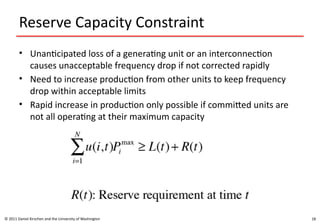
Law
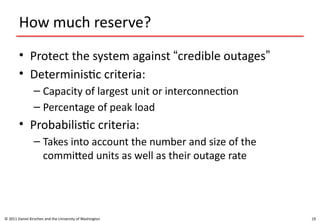
Leadership & Management
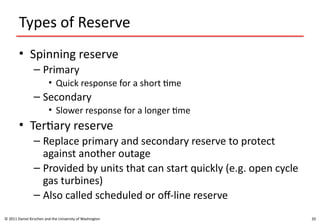
Automotive
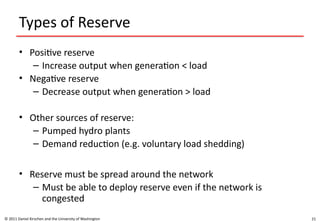
Engineering
Software
Recruiting & HR
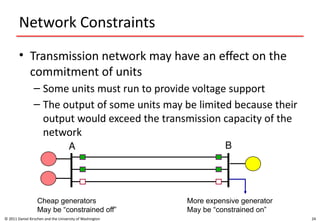
Retail
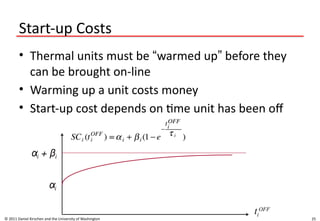
Sales
Services
Science
Small Business & Entrepreneurship
Food
Environment
Economy & Finance
Data & Analytics
Investor Relations
Sports
Spiritual
News & Politics
Travel
Self Improvement
Real Estate
Entertainment & Humor
Health & Medicine
Devices & Hardware
Lifestyle
Change Language
Language
English
Español
Português
Français
Deutsche
Cancel
Save
EN
Uploaded by
HeangLaisiv1
PPTX, PDF
5 views
05a-Unit_Commitment.pptx slide presentation
this is telling you about how to analyze Unit Commitment
Education
◦
Read more
0
Save
Share
Embed
Embed presentation
Download
Download to read offline
1
/ 53
2
/ 53
3
/ 53
4
/ 53
5
/ 53
6
/ 53
7
/ 53
8
/ 53
9
/ 53
10
/ 53
11
/ 53
12
/ 53
13
/ 53
14
/ 53
15
/ 53
16
/ 53
17
/ 53
18
/ 53
19
/ 53
20
/ 53
21
/ 53
22
/ 53
23
/ 53
24
/ 53
25
/ 53
26
/ 53
27
/ 53
28
/ 53
29
/ 53
30
/ 53
31
/ 53
32
/ 53
33
/ 53
34
/ 53
35
/ 53
36
/ 53
37
/ 53
38
/ 53
39
/ 53
40
/ 53
41
/ 53
42
/ 53
43
/ 53
44
/ 53
45
/ 53
46
/ 53
47
/ 53
48
/ 53
49
/ 53
50
/ 53
51
/ 53
52
/ 53
53
/ 53
More Related Content
PPTX
BAB 7. UNIT COMMITMENTBAB 7. UNIT COMMITMENT.pptx
by
idoer11
PPTX
BAB 7. UNIT COMMITMENTBAB 7. UNIT COMMITMENT.pptx
by
idoer11
PPTX
Unit commitment in power system
by
Abrar Ahmed
PPTX
[2020.2] PSOC - Unit_Commitment.pptx
by
SintianiPerdanisinti
PDF
Unit Commitment updated lecture slidesides
by
MarkM72
PPTX
05a-Unit_Commitment-done.pptx PowerPoint
by
HeangLaisiv1
PPTX
Unit commitment
by
Mohammad Abdullah
PPT
UNIT-4-PPT UNIT COMMITMENT AND ECONOMIC DISPATCH
by
Sridhar191373
BAB 7. UNIT COMMITMENTBAB 7. UNIT COMMITMENT.pptx
by
idoer11
BAB 7. UNIT COMMITMENTBAB 7. UNIT COMMITMENT.pptx
by
idoer11
Unit commitment in power system
by
Abrar Ahmed
[2020.2] PSOC - Unit_Commitment.pptx
by
SintianiPerdanisinti
Unit Commitment updated lecture slidesides
by
MarkM72
05a-Unit_Commitment-done.pptx PowerPoint
by
HeangLaisiv1
Unit commitment
by
Mohammad Abdullah
UNIT-4-PPT UNIT COMMITMENT AND ECONOMIC DISPATCH
by
Sridhar191373
Similar to 05a-Unit_Commitment.pptx slide presentation
PPT
UNIT-4-PPT.ppt
by
Karthik Kathan
PDF
Economic dipatch
by
Doni Wahyudi
PDF
Optimal Unit Commitment Based on Economic Dispatch Using Improved Particle Sw...
by
paperpublications3
PDF
Economic load dispatch
by
MANGESHKULKARNI72
PPTX
Optimization of power sytem
by
shawon1981
PDF
Generation and Storage Modeling Presentation
by
Coalesce
PDF
Reliability Constrained Unit Commitment Considering the Effect of DG and DR P...
by
IJECEIAES
PDF
Module-1 Part-2 Unit Commitment and Hydro-Thermal Coordination.pdf
by
MarkM72
PDF
Implementation effects of economics and market operations based model for tra...
by
nooriasukmaningtyas
PPTX
Power_Systemhd_Operation_Overview-1.pptx
by
dnnt30041605
PDF
16 9739 ant lion paper id 0013 (edit a)
by
IAESIJEECS
DOCX
Unit commitment
by
Ahmed M. Elkholy
PDF
OPTIMAL ECONOMIC LOAD DISPATCH USING FUZZY LOGIC & GENETIC ALGORITHMS
by
IAEME Publication
PPT
SCnh hghjjj jjjjjjjjh hghhggggggg hhhUC.ppt
by
ubaid7673
PDF
Unit Commitment Problem in Electrical Power System: A Literature Review
by
IJECEIAES
PPT
Economic load dispatch
by
vikram anand
PDF
Economic_Dispatch_in_power_systems.pdf
by
Universidad Naacional de Loja
PDF
N03430990106
by
ijceronline
PPT
psoc UNIT-4-PPT.ppt anna university PSOC notes
by
pandyselvieee
PPSX
Ctws ocean energy lovely
by
blemon
UNIT-4-PPT.ppt
by
Karthik Kathan
Economic dipatch
by
Doni Wahyudi
Optimal Unit Commitment Based on Economic Dispatch Using Improved Particle Sw...
by
paperpublications3
Economic load dispatch
by
MANGESHKULKARNI72
Optimization of power sytem
by
shawon1981
Generation and Storage Modeling Presentation
by
Coalesce
Reliability Constrained Unit Commitment Considering the Effect of DG and DR P...
by
IJECEIAES
Module-1 Part-2 Unit Commitment and Hydro-Thermal Coordination.pdf
by
MarkM72
Implementation effects of economics and market operations based model for tra...
by
nooriasukmaningtyas
Power_Systemhd_Operation_Overview-1.pptx
by
dnnt30041605
16 9739 ant lion paper id 0013 (edit a)
by
IAESIJEECS
Unit commitment
by
Ahmed M. Elkholy
OPTIMAL ECONOMIC LOAD DISPATCH USING FUZZY LOGIC & GENETIC ALGORITHMS
by
IAEME Publication
SCnh hghjjj jjjjjjjjh hghhggggggg hhhUC.ppt
by
ubaid7673
Unit Commitment Problem in Electrical Power System: A Literature Review
by
IJECEIAES
Economic load dispatch
by
vikram anand
Economic_Dispatch_in_power_systems.pdf
by
Universidad Naacional de Loja
N03430990106
by
ijceronline
psoc UNIT-4-PPT.ppt anna university PSOC notes
by
pandyselvieee
Ctws ocean energy lovely
by
blemon
Recently uploaded
PDF
Tetracycline Class of Antibiotics: SAR, MOA and Uses
by
mominzarinamdnajeeb
PPTX
How to perform product search based on a custom field from the Website Shop p...
by
Celine George
PDF
Family and Marriage __ Sociology __ Jhasketan Kuanar __ NURSING VIBE ONLY .pdf
by
JK NURSING VIBES ONLY JHASKETAN KUANAR
PPTX
How to Create_Generate Engineering Change Orders ECOs in Odoo 18
by
Celine George
PDF
The Sheep and the Goat: Beckett’s Subversion of Divine Justice in Waiting for...
by
sejadchokiya
PPTX
WEEK 2 (2).pptx TLE COOKERY 10 QUARTER 4
by
ResynFayeCortez2
PPTX
How to Add an Icon in Systray in Odoo 18
by
Celine George
PPTX
Greengnorance Toolkit Module 2 Energy saving
by
Karl Donert
PPTX
How to Manage Reservation Method in Odoo 18 Inventory
by
Celine George
PPTX
Overview of How to set priority in Odoo 19 Todo
by
Celine George
PPTX
Problem and Solution (PowerPoint Game Template)
by
acpaulite
PPTX
Renal Physiology- Functional anatomy of Kidney.pptx
by
Disha Soriya
PDF
Structure-of-the-Atom PPT.pdf/CBSE CLASS 11 CHEMISTRY/ PREPARED BY K SANDEEP ...
by
Sandeep Swamy
PDF
PHARMACOLOGY 1 ( BP 404 T) Unit 1 (Cology 1)
by
Chetan Mali
PPTX
Plato's Insight model teaching and learning.pptx
by
NikhitaDS
PPTX
Q4_PPT MUSIC & ARTS 7 week 1-2, matatag curriculum
by
ZEN
PPTX
Methods & Applications of Enzyme Immobilization Technique.pptx
by
Anupkumar Sharma
PDF
java full stack programming and interview questions
by
rajuashokit
PDF
Nursing care plan for Vomiting /B.Sc nsg
by
Dr. Sudhadevi Sadanandan
PDF
How "Raiders of the Lost Ark" and "Ordinary People" Employ Non-Verbal Acting
by
6x5csns4pn
Tetracycline Class of Antibiotics: SAR, MOA and Uses
by
mominzarinamdnajeeb
How to perform product search based on a custom field from the Website Shop p...
by
Celine George
Family and Marriage __ Sociology __ Jhasketan Kuanar __ NURSING VIBE ONLY .pdf
by
JK NURSING VIBES ONLY JHASKETAN KUANAR
How to Create_Generate Engineering Change Orders ECOs in Odoo 18
by
Celine George
The Sheep and the Goat: Beckett’s Subversion of Divine Justice in Waiting for...
by
sejadchokiya
WEEK 2 (2).pptx TLE COOKERY 10 QUARTER 4
by
ResynFayeCortez2
How to Add an Icon in Systray in Odoo 18
by
Celine George
Greengnorance Toolkit Module 2 Energy saving
by
Karl Donert
How to Manage Reservation Method in Odoo 18 Inventory
by
Celine George
Overview of How to set priority in Odoo 19 Todo
by
Celine George
Problem and Solution (PowerPoint Game Template)
by
acpaulite
Renal Physiology- Functional anatomy of Kidney.pptx
by
Disha Soriya
Structure-of-the-Atom PPT.pdf/CBSE CLASS 11 CHEMISTRY/ PREPARED BY K SANDEEP ...
by
Sandeep Swamy
PHARMACOLOGY 1 ( BP 404 T) Unit 1 (Cology 1)
by
Chetan Mali
Plato's Insight model teaching and learning.pptx
by
NikhitaDS
Q4_PPT MUSIC & ARTS 7 week 1-2, matatag curriculum
by
ZEN
Methods & Applications of Enzyme Immobilization Technique.pptx
by
Anupkumar Sharma
java full stack programming and interview questions
by
rajuashokit
Nursing care plan for Vomiting /B.Sc nsg
by
Dr. Sudhadevi Sadanandan
How "Raiders of the Lost Ark" and "Ordinary People" Employ Non-Verbal Acting
by
6x5csns4pn
05a-Unit_Commitment.pptx slide presentation
1.
07/23/2025 1 Unit Commitment Daniel Kirschen
2.
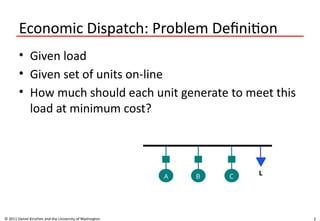
2 Economic Dispatch: Problem
Definition • Given load • Given set of units on-line • How much should each unit generate to meet this load at minimum cost? © 2011 Daniel Kirschen and the University of Washington A B C L
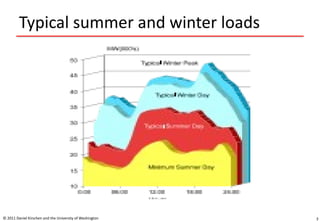
3.
3 Typical summer and
winter loads © 2011 Daniel Kirschen and the University of Washington
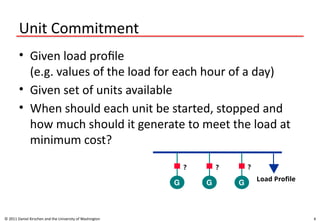
4.
4 Unit Commitment • Given
load profile (e.g. values of the load for each hour of a day) • Given set of units available • When should each unit be started, stopped and how much should it generate to meet the load at minimum cost? © 2011 Daniel Kirschen and the University of Washington G G G Load Profile ? ? ?
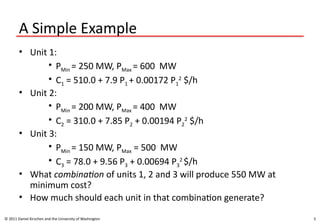
5.
5 A Simple Example •
Unit 1: • PMin = 250 MW, PMax = 600 MW • C1 = 510.0 + 7.9 P1 + 0.00172 P1 2 $/h • Unit 2: • PMin = 200 MW, PMax = 400 MW • C2 = 310.0 + 7.85 P2 + 0.00194 P2 2 $/h • Unit 3: • PMin = 150 MW, PMax = 500 MW • C3 = 78.0 + 9.56 P3 + 0.00694 P3 2 $/h • What combination of units 1, 2 and 3 will produce 550 MW at minimum cost? • How much should each unit in that combination generate? © 2011 Daniel Kirschen and the University of Washington
6.
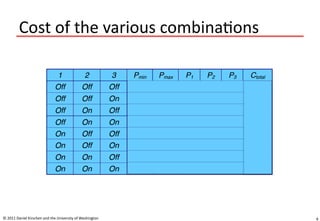
6 Cost of the
various combinations © 2011 Daniel Kirschen and the University of Washington
7.
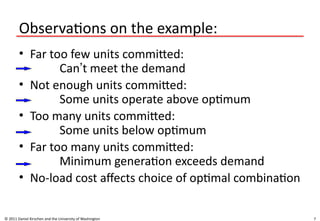
7 Observations on the
example: • Far too few units committed: Can’t meet the demand • Not enough units committed: Some units operate above optimum • Too many units committed: Some units below optimum • Far too many units committed: Minimum generation exceeds demand • No-load cost affects choice of optimal combination © 2011 Daniel Kirschen and the University of Washington
8.
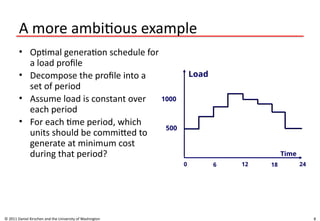
8 A more ambitious
example • Optimal generation schedule for a load profile • Decompose the profile into a set of period • Assume load is constant over each period • For each time period, which units should be committed to generate at minimum cost during that period? © 2011 Daniel Kirschen and the University of Washington Load Time 12 6 0 18 24 500 1000
9.
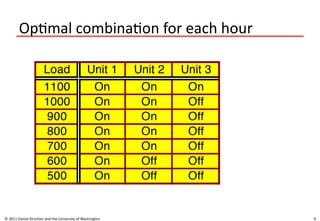
9 Optimal combination for
each hour © 2011 Daniel Kirschen and the University of Washington
10.
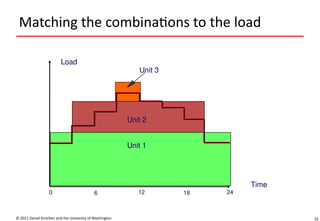
10 Matching the combinations
to the load © 2011 Daniel Kirschen and the University of Washington Load Time 12 6 0 18 24 Unit 1 Unit 2 Unit 3
11.
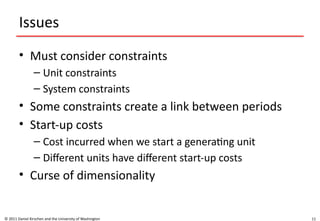
11 Issues • Must consider
constraints – Unit constraints – System constraints • Some constraints create a link between periods • Start-up costs – Cost incurred when we start a generating unit – Different units have different start-up costs • Curse of dimensionality © 2011 Daniel Kirschen and the University of Washington
12.
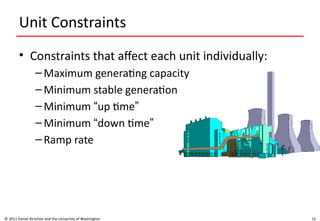
12 Unit Constraints • Constraints
that affect each unit individually: – Maximum generating capacity – Minimum stable generation – Minimum “up time” – Minimum “down time” – Ramp rate © 2011 Daniel Kirschen and the University of Washington
13.
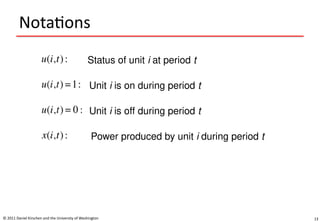
13 Notations © 2011 Daniel
Kirschen and the University of Washington Status of unit i at period t Power produced by unit i during period t Unit i is on during period t Unit i is off during period t
14.
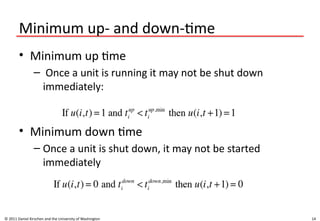
14 Minimum up- and
down-time • Minimum up time – Once a unit is running it may not be shut down immediately: • Minimum down time – Once a unit is shut down, it may not be started immediately © 2011 Daniel Kirschen and the University of Washington
15.
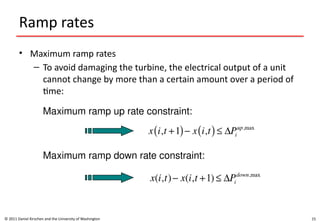
15 Ramp rates • Maximum
ramp rates – To avoid damaging the turbine, the electrical output of a unit cannot change by more than a certain amount over a period of time: © 2011 Daniel Kirschen and the University of Washington Maximum ramp up rate constraint: Maximum ramp down rate constraint:
16.
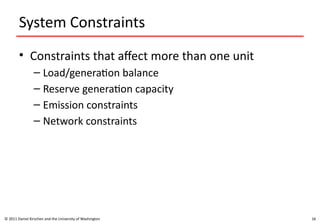
16 System Constraints • Constraints
that affect more than one unit – Load/generation balance – Reserve generation capacity – Emission constraints – Network constraints © 2011 Daniel Kirschen and the University of Washington
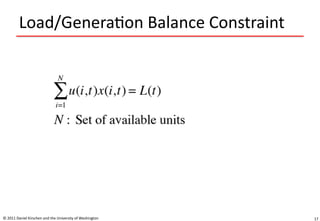
17.
17 Load/Generation Balance Constraint ©
2011 Daniel Kirschen and the University of Washington
18.
18 Reserve Capacity Constraint •
Unanticipated loss of a generating unit or an interconnection causes unacceptable frequency drop if not corrected rapidly • Need to increase production from other units to keep frequency drop within acceptable limits • Rapid increase in production only possible if committed units are not all operating at their maximum capacity © 2011 Daniel Kirschen and the University of Washington
19.
19 How much reserve? •
Protect the system against “credible outages” • Deterministic criteria: – Capacity of largest unit or interconnection – Percentage of peak load • Probabilistic criteria: – Takes into account the number and size of the committed units as well as their outage rate © 2011 Daniel Kirschen and the University of Washington
20.
20 Types of Reserve •
Spinning reserve – Primary • Quick response for a short time – Secondary • Slower response for a longer time • Tertiary reserve – Replace primary and secondary reserve to protect against another outage – Provided by units that can start quickly (e.g. open cycle gas turbines) – Also called scheduled or off-line reserve © 2011 Daniel Kirschen and the University of Washington
21.
21 Types of Reserve •
Positive reserve – Increase output when generation < load • Negative reserve – Decrease output when generation > load • Other sources of reserve: – Pumped hydro plants – Demand reduction (e.g. voluntary load shedding) • Reserve must be spread around the network – Must be able to deploy reserve even if the network is congested © 2011 Daniel Kirschen and the University of Washington
22.
22 Cost of Reserve •
Reserve has a cost even when it is not called • More units scheduled than required – Units not operated at their maximum efficiency – Extra start up costs • Must build units capable of rapid response • Cost of reserve proportionally larger in small systems • Important driver for the creation of interconnections between systems © 2011 Daniel Kirschen and the University of Washington
23.
23 Environmental constraints • Scheduling
of generating units may be affected by environmental constraints • Constraints on pollutants such SO2, NOx – Various forms: • Limit on each plant at each hour • Limit on plant over a year • Limit on a group of plants over a year • Constraints on hydro generation – Protection of wildlife – Navigation, recreation © 2011 Daniel Kirschen and the University of Washington
24.
24 Network Constraints • Transmission
network may have an effect on the commitment of units – Some units must run to provide voltage support – The output of some units may be limited because their output would exceed the transmission capacity of the network © 2011 Daniel Kirschen and the University of Washington Cheap generators May be “constrained off” More expensive generator May be “constrained on” A B
25.
25 Start-up Costs • Thermal
units must be “warmed up” before they can be brought on-line • Warming up a unit costs money • Start-up cost depends on time unit has been off © 2011 Daniel Kirschen and the University of Washington ti OFF αi αi + βi
26.
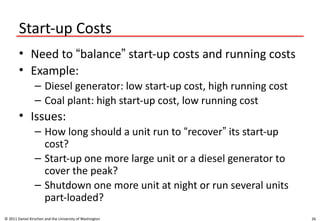
26 Start-up Costs • Need
to “balance” start-up costs and running costs • Example: – Diesel generator: low start-up cost, high running cost – Coal plant: high start-up cost, low running cost • Issues: – How long should a unit run to “recover” its start-up cost? – Start-up one more large unit or a diesel generator to cover the peak? – Shutdown one more unit at night or run several units part-loaded? © 2011 Daniel Kirschen and the University of Washington
27.
27 Summary • Some constraints
link periods together • Minimizing the total cost (start-up + running) must be done over the whole period of study • Generation scheduling or unit commitment is a more general problem than economic dispatch • Economic dispatch is a sub-problem of generation scheduling © 2011 Daniel Kirschen and the University of Washington
28.
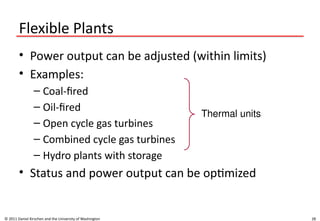
28 Flexible Plants • Power
output can be adjusted (within limits) • Examples: – Coal-fired – Oil-fired – Open cycle gas turbines – Combined cycle gas turbines – Hydro plants with storage • Status and power output can be optimized © 2011 Daniel Kirschen and the University of Washington Thermal units
29.
29 Inflexible Plants • Power
output cannot be adjusted for technical or commercial reasons • Examples: – Nuclear – Run-of-the-river hydro – Renewables (wind, solar,…) – Combined heat and power (CHP, cogeneration) • Output treated as given when optimizing © 2011 Daniel Kirschen and the University of Washington
30.
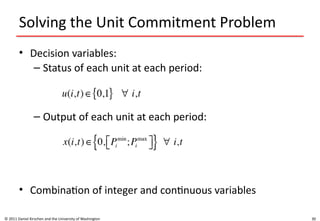
30 Solving the Unit
Commitment Problem • Decision variables: – Status of each unit at each period: – Output of each unit at each period: • Combination of integer and continuous variables © 2011 Daniel Kirschen and the University of Washington
31.
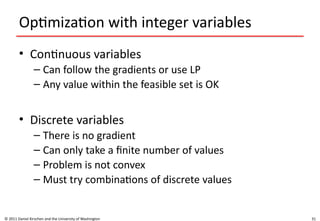
31 Optimization with integer
variables • Continuous variables – Can follow the gradients or use LP – Any value within the feasible set is OK • Discrete variables – There is no gradient – Can only take a finite number of values – Problem is not convex – Must try combinations of discrete values © 2011 Daniel Kirschen and the University of Washington
32.
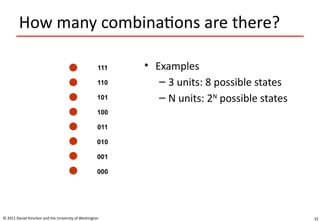
32 How many combinations
are there? © 2011 Daniel Kirschen and the University of Washington • Examples – 3 units: 8 possible states – N units: 2N possible states 111 110 101 100 011 010 001 000
33.
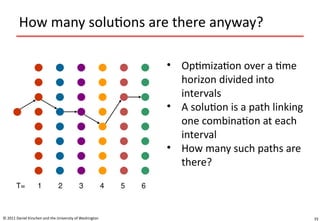
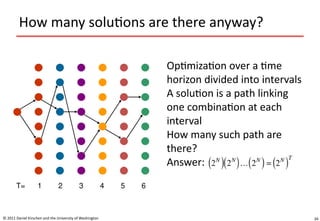
33 How many solutions
are there anyway? © 2011 Daniel Kirschen and the University of Washington 1 2 3 4 5 6 T= • Optimization over a time horizon divided into intervals • A solution is a path linking one combination at each interval • How many such paths are there?
34.
34 How many solutions
are there anyway? © 2011 Daniel Kirschen and the University of Washington 1 2 3 4 5 6 T= Optimization over a time horizon divided into intervals A solution is a path linking one combination at each interval How many such path are there? Answer:
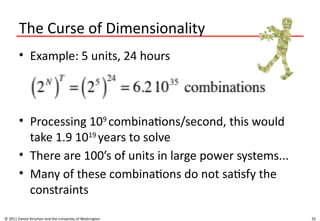
35.
35 The Curse of
Dimensionality • Example: 5 units, 24 hours • Processing 109 combinations/second, this would take 1.9 1019 years to solve • There are 100’s of units in large power systems... • Many of these combinations do not satisfy the constraints © 2011 Daniel Kirschen and the University of Washington
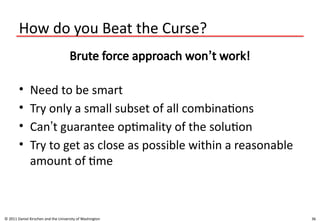
36.
36 How do you
Beat the Curse? Brute force approach won’t work! • Need to be smart • Try only a small subset of all combinations • Can’t guarantee optimality of the solution • Try to get as close as possible within a reasonable amount of time © 2011 Daniel Kirschen and the University of Washington
37.
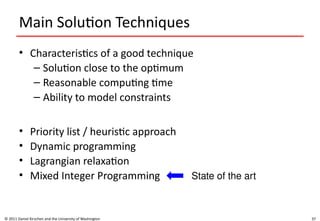
37 Main Solution Techniques •
Characteristics of a good technique – Solution close to the optimum – Reasonable computing time – Ability to model constraints • Priority list / heuristic approach • Dynamic programming • Lagrangian relaxation • Mixed Integer Programming © 2011 Daniel Kirschen and the University of Washington State of the art
38.
38 A Simple Unit
Commitment Example © 2011 Daniel Kirschen and the University of Washington
39.
39 Unit Data © 2011
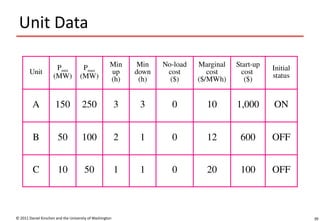
Daniel Kirschen and the University of Washington Unit Pmin (MW) Pmax (MW) Min up (h) Min down (h) No-load cost ($) Marginal cost ($/MWh) Start-up cost ($) Initial status A 150 250 3 3 0 10 1,000 ON B 50 100 2 1 0 12 600 OFF C 10 50 1 1 0 20 100 OFF
40.
40 Demand Data © 2011
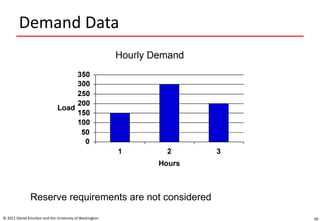
Daniel Kirschen and the University of Washington Reserve requirements are not considered
41.
41 Feasible Unit Combinations
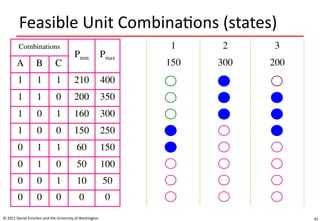
(states) © 2011 Daniel Kirschen and the University of Washington Combinations Pmin Pmax A B C 1 1 1 210 400 1 1 0 200 350 1 0 1 160 300 1 0 0 150 250 0 1 1 60 150 0 1 0 50 100 0 0 1 10 50 0 0 0 0 0 1 2 3 150 300 200
42.
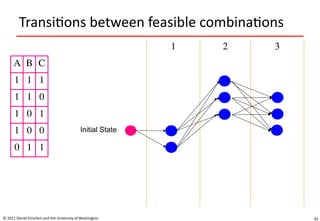
42 Transitions between feasible
combinations © 2011 Daniel Kirschen and the University of Washington A B C 1 1 1 1 1 0 1 0 1 1 0 0 0 1 1 1 2 3 Initial State
43.
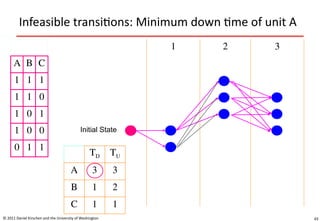
43 Infeasible transitions: Minimum
down time of unit A © 2011 Daniel Kirschen and the University of Washington A B C 1 1 1 1 1 0 1 0 1 1 0 0 0 1 1 1 2 3 Initial State TD TU A 3 3 B 1 2 C 1 1
44.
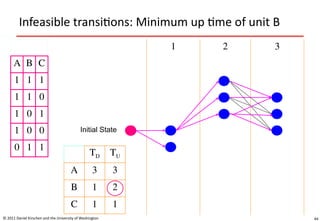
44 Infeasible transitions: Minimum
up time of unit B © 2011 Daniel Kirschen and the University of Washington A B C 1 1 1 1 1 0 1 0 1 1 0 0 0 1 1 1 2 3 Initial State TD TU A 3 3 B 1 2 C 1 1
45.
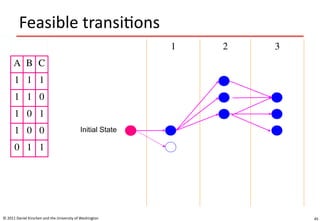
45 Feasible transitions © 2011
Daniel Kirschen and the University of Washington A B C 1 1 1 1 1 0 1 0 1 1 0 0 0 1 1 1 2 3 Initial State
46.
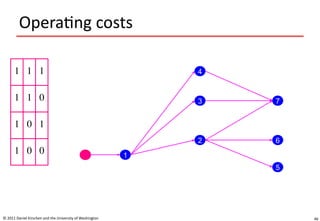
46 Operating costs © 2011
Daniel Kirschen and the University of Washington 1 1 1 1 1 0 1 0 1 1 0 0 1 4 3 2 5 6 7
47.
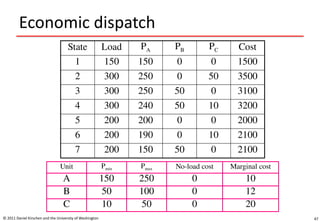
47 Economic dispatch © 2011
Daniel Kirschen and the University of Washington State Load PA PB PC Cost 1 150 150 0 0 1500 2 300 250 0 50 3500 3 300 250 50 0 3100 4 300 240 50 10 3200 5 200 200 0 0 2000 6 200 190 0 10 2100 7 200 150 50 0 2100 Unit Pmin Pmax No-load cost Marginal cost A 150 250 0 10 B 50 100 0 12 C 10 50 0 20
48.
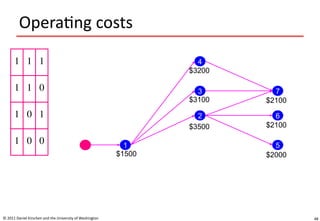
48 Operating costs © 2011
Daniel Kirschen and the University of Washington 1 1 1 1 1 0 1 0 1 1 0 0 1 4 3 2 5 6 7 $1500 $3500 $3100 $3200 $2000 $2100 $2100
49.
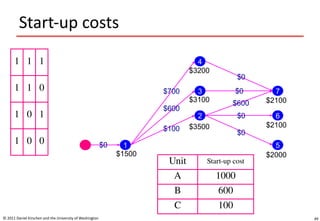
49 Start-up costs © 2011
Daniel Kirschen and the University of Washington 1 1 1 1 1 0 1 0 1 1 0 0 1 4 3 2 5 6 7 $1500 $3500 $3100 $3200 $2000 $2100 $2100 Unit Start-up cost A 1000 B 600 C 100 $0 $0 $0 $0 $0 $600 $100 $600 $700
50.
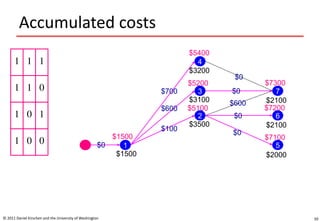
50 Accumulated costs © 2011
Daniel Kirschen and the University of Washington 1 1 1 1 1 0 1 0 1 1 0 0 1 4 3 2 5 6 7 $1500 $3500 $3100 $3200 $2000 $2100 $2100 $1500 $5100 $5200 $5400 $7300 $7200 $7100 $0 $0 $0 $0 $0 $600 $100 $600 $700
51.
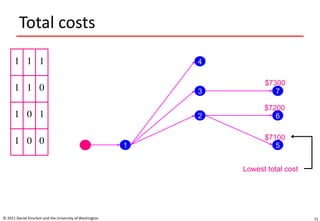
51 Total costs © 2011
Daniel Kirschen and the University of Washington 1 1 1 1 1 0 1 0 1 1 0 0 1 4 3 2 5 6 7 $7300 $7200 $7100 Lowest total cost
52.
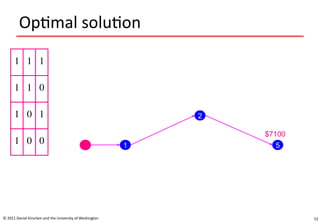
52 Optimal solution © 2011
Daniel Kirschen and the University of Washington 1 1 1 1 1 0 1 0 1 1 0 0 1 2 5 $7100
53.
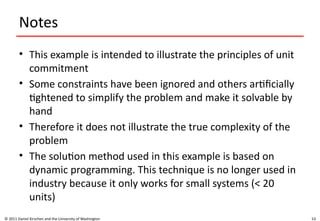
53 Notes • This example
is intended to illustrate the principles of unit commitment • Some constraints have been ignored and others artificially tightened to simplify the problem and make it solvable by hand • Therefore it does not illustrate the true complexity of the problem • The solution method used in this example is based on dynamic programming. This technique is no longer used in industry because it only works for small systems (< 20 units) © 2011 Daniel Kirschen and the University of Washington
Download




![[2020.2] PSOC - Unit_Commitment.pptx](https://cdn.slidesharecdn.com/ss_thumbnails/2020-230328034214-f9eb2e64-thumbnail.jpg?width=640&height=640&fit=bounds)


