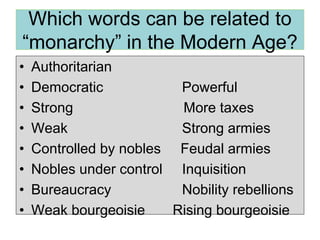
Which words can be related to
“monarchy” in the Modern Age?
• Authoritarian
• Democratic Powerful
• Strong More taxes
• Weak Strong armies
• Controlled by nobles Feudal armies
• Nobles under control Inquisition
• Bureaucracy Nobility rebellions
• Weak bourgeoisie Rising bourgeoisie
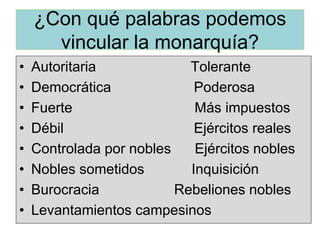
¿Con qué palabras podemos
vincular la monarquía?
• Autoritaria Tolerante
• Democrática Poderosa
• Fuerte Más impuestos
• Débil Ejércitos reales
• Controlada por nobles Ejércitos nobles
• Nobles sometidos Inquisición
• Burocracia Rebeliones nobles
• Levantamientos campesinos
• ¿Qué significa la palabra
“estado nacional”?
• Does everyone speak the same
language?
• ¿Qué significa la palabra
“estado nacional”?
• ¿Hablamos una misma lengua?
• ¿Compartimos un espacio
común?
• ¿Hay un control del territorio
por fuerzas del orden?
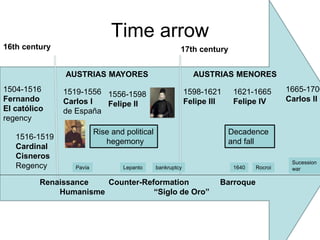
Time arrow
1504-1516
Fernando
El católico
regency
1516-1519
Cardinal
Cisneros
Regency
1519-1556
Carlos I
de España
AUSTRIAS MAYORES
1556-1598
Felipe II
AUSTRIAS MENORES
1598-1621
Felipe III
1621-1665
Felipe IV
1665-1700
Carlos II
Renaissance Counter-Reformation Barroque
Humanisme “Siglo de Oro”
16th century 17th century
Rise and political
hegemony
bankruptcy
Decadence
and fall
Rocroi
Pavía Lepanto 1640
Sucession
war
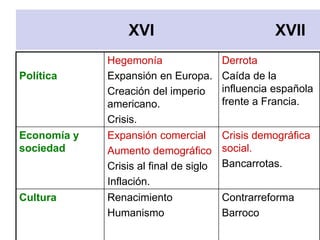
XVI XVII
Política
Hegemonía
Expansión en Europa.
Creación del imperio
americano.
Crisis.
Derrota
Caída de la
influencia española
frente a Francia.
Economía y
sociedad
Expansión comercial
Aumento demográfico
Crisis al final de siglo
Inflación.
Crisis demográfica
social.
Bancarrotas.
Cultura Renacimiento
Humanismo
Contrarreforma
Barroco
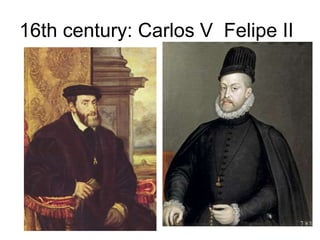
16th century: Carlos V Felipe II
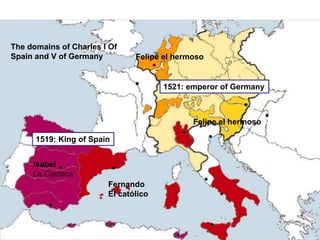
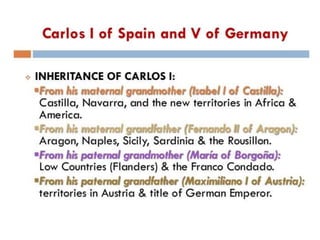
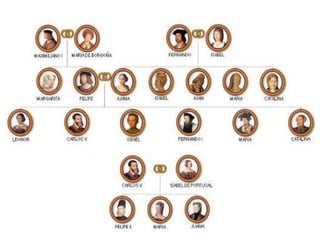
The domains of Charles I Of
Spain and V of Germany
Isabel
La Católica
Fernando
El católico
Felipe el hermoso
Felipe el hermoso
1521: emperor of Germany
1519: King of Spain
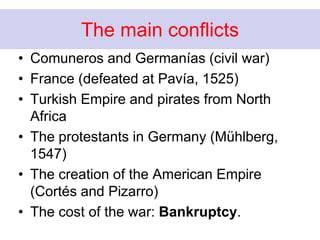
The main conflicts
• Comuneros and Germanías (civil war)
• France (defeated at Pavía, 1525)
• Turkish Empire and pirates from North
Africa
• The protestants in Germany (Mühlberg,
1547)
• The creation of the American Empire
(Cortés and Pizarro)
• The cost of the war: Bankruptcy.
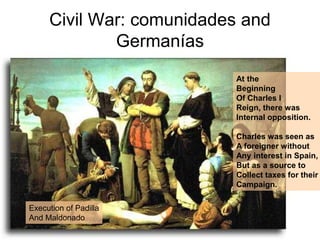
Civil War: comunidades and
Germanías
At the
Beginning
Of Charles I
Reign, there was
Internal opposition.
Charles was seen as
A foreigner without
Any interest in Spain,
But as a source to
Collect taxes for their
Campaign.
Execution of Padilla
And Maldonado
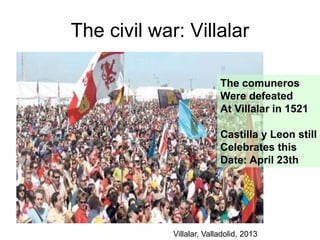
The civil war: Villalar
The comuneros
Were defeated
At Villalar in 1521
Castilla y Leon still
Celebrates this
Date: April 23th
Villalar, Valladolid, 2013
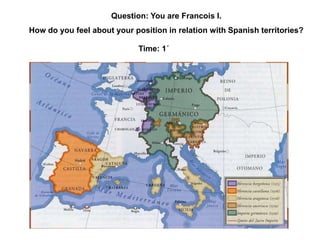
Question: You are Francois I.
How do you feel about your position in relation with Spanish territories?
Time: 1´
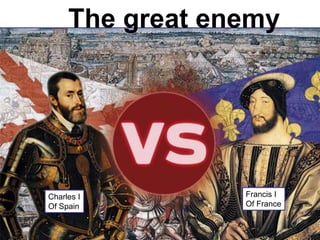
The great enemy
Charles I
Of Spain
Francis I
Of France
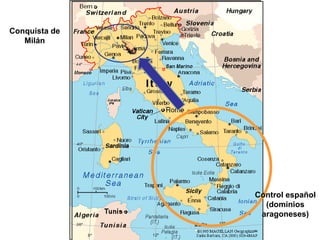
Control español
(dominios
aragoneses)
Conquista de
Milán
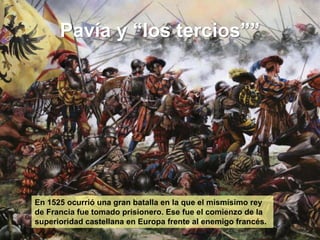
Pavía y “los tercios””
En 1525 ocurrió una gran batalla en la que el mismísimo rey
de Francia fue tomado prisionero. Ese fue el comienzo de la
superioridad castellana en Europa frente al enemigo francés.
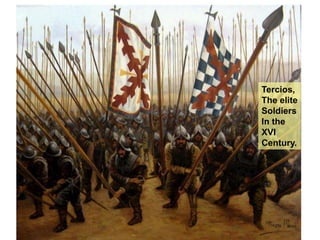
Tercios,
The elite
Soldiers
In the
XVI
Century.
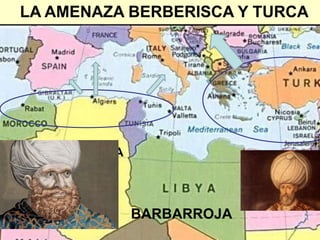
BARBARROJA
BARBARROJA
LA AMENAZA BERBERISCA Y TURCA
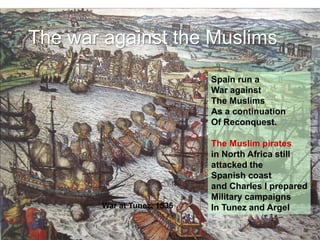
The war against the Muslims
Spain run a
War against
The Muslims
As a continuation
Of Reconquest.
The Muslim pirates
in North Africa still
attacked the
Spanish coast
and Charles I prepared
Military campaigns
In Tunez and Argel
War at Tunez, 1535
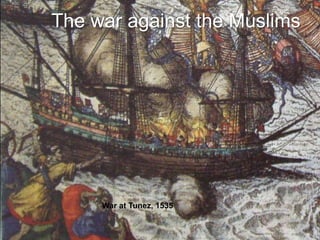
The war against the Muslims
War at Tunez, 1535
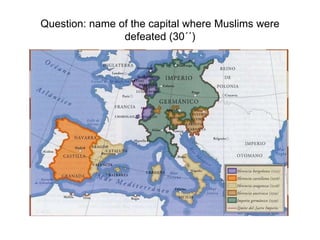
Question: name of the capital where Muslims were
defeated (30´´)
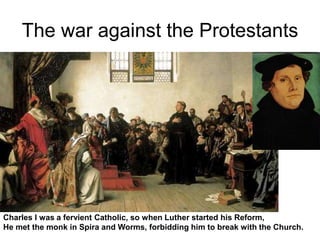
The war against the Protestants
Charles I was a fervient Catholic, so when Luther started his Reform,
He met the monk in Spira and Worms, forbidding him to break with the Church.
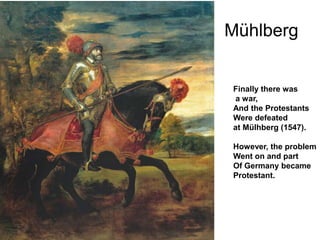
Mühlberg
Finally there was
a war,
And the Protestants
Were defeated
at Mülhberg (1547).
However, the problem
Went on and part
Of Germany became
Protestant.
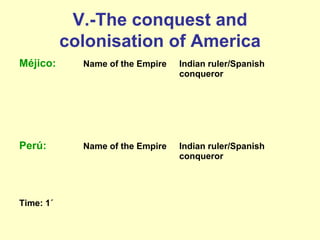
V.-The conquest and
colonisation of America
Méjico: Name of the Empire Indian ruler/Spanish
conqueror
Perú: Name of the Empire Indian ruler/Spanish
conqueror
Time: 1´
The conquest and colonisation
of America
Méjico: Aztecan Empire Moctezuma/Cortés
Perú: Incan Empire Atahualpa /Pizarro
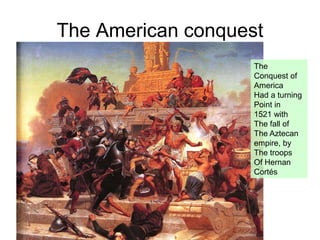
The American conquest
The
Conquest of
America
Had a turning
Point in
1521 with
The fall of
The Aztecan
empire, by
The troops
Of Hernan
Cortés
What did the Castilian people
want to find in America?
Why did Castilian people
migrate to America?
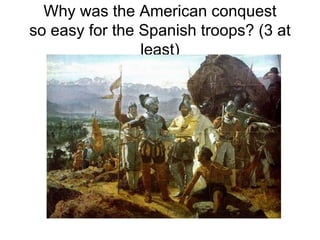
Why was the American conquest
so easy for the Spanish troops? (3 at
least)
1.- The Spanish technological hegemony
(gunpowder, horses, armours).
2.- The ambition of the conquerors.
3.- Internal problems of the Indians (civil wars)
and even tragic epidemics (brought by Europeans).
4.- The religious interest.
Why was the American conquest
so easy for the Spanish troops?
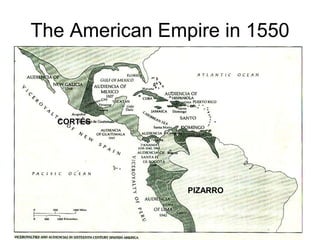
The American Empire in 1550
PIZARRO
CORTÉS
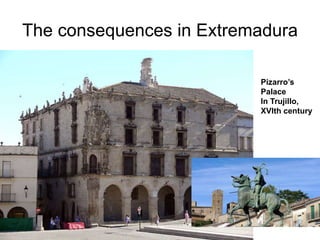
The consequences in Extremadura
Pizarro’s
Palace
In Trujillo,
XVIth century
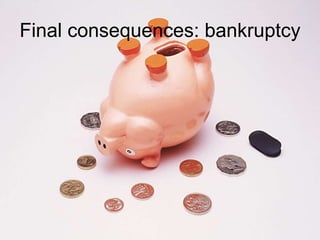
Final consequences: bankruptcy
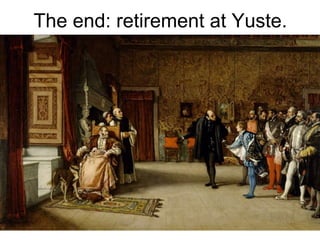
The end: retirement at Yuste.
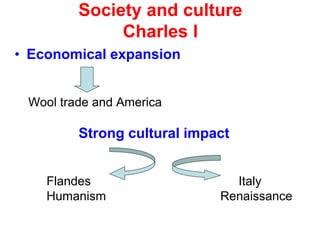
Society and culture
Charles I
• Economical expansion
Wool trade and America
Strong cultural impact
Flandes Italy
Humanism Renaissance
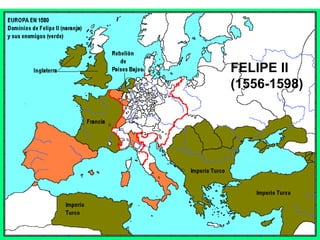
FELIPE II
(1556-1598)
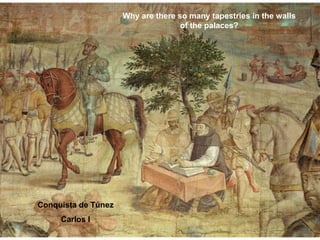
Why are there so many tapestries in the walls
of the palaces?
Conquista de Túnez
Carlos I
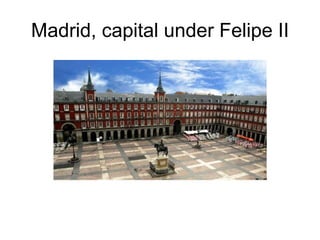
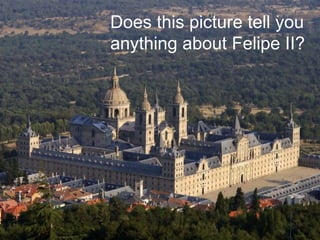
Madrid, capital under Felipe II
Does this picture tell you
anything about Felipe II?
Felipe II, a much more
Spanish ruler
• He was born in Valladolid.
• His native language was Castilian.
• He didn´t become Holy Roman Empire.
• He made Madrid his capital and built El
Escorial as a royal residence.
Felipe II, a much more
Spanish ruler
• He was born in Valladolid.
• His native language was Castilian.
• He didn´t become Holy Roman Empire.
• He made Madrid his capital and built El
Escorial as a royal residence.
Policies in Spain
• Defence of Catholicism (group 1)
• The revolt of the moriscos (group 2)
• Unrest in Aragón (group 3)
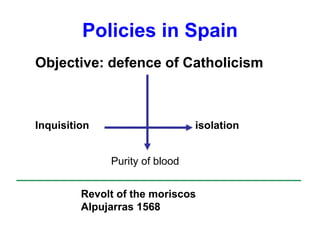
Policies in Spain
Objective: defence of Catholicism
Inquisition isolation
Purity of blood
Revolt of the moriscos
Alpujarras 1568
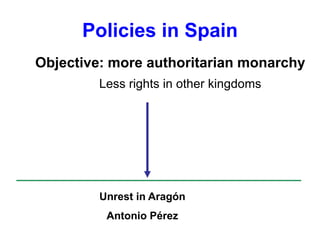
Policies in Spain
Objective: more authoritarian monarchy
Less rights in other kingdoms
Unrest in Aragón
Antonio Pérez
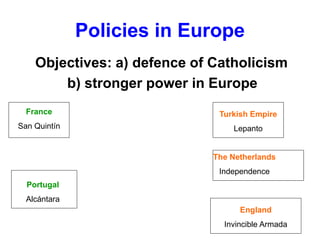
Policies in Europe
Objectives: a) defence of Catholicism
b) stronger power in Europe
France
San Quintín
Turkish Empire
Lepanto
The Netherlands
Independence
England
Invincible Armada
Portugal
Alcántara
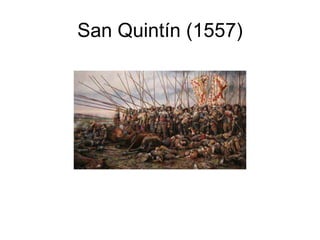
San Quintín (1557)
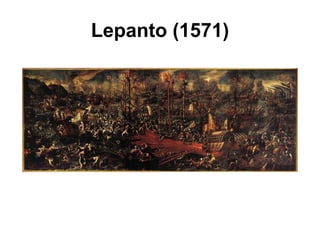
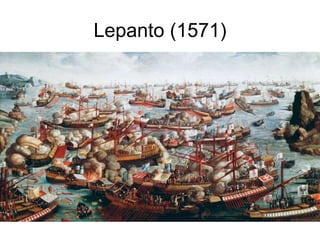
Lepanto (1571)
Lepanto (1571)
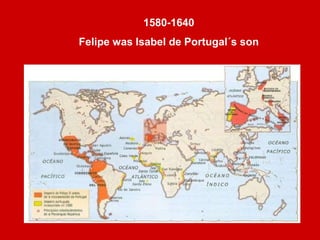
1580-1640
Felipe was Isabel de Portugal´s son
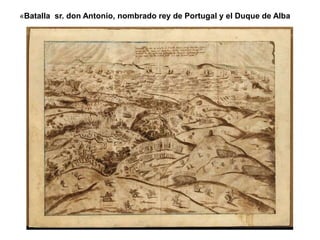
«Batalla sr. don Antonio, nombrado rey de Portugal y el Duque de Alba
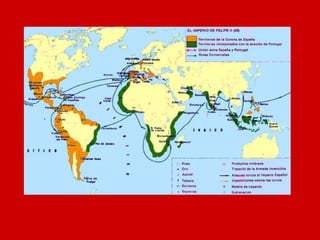
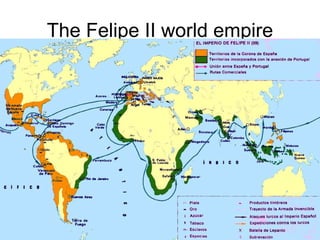
The Felipe II world empire
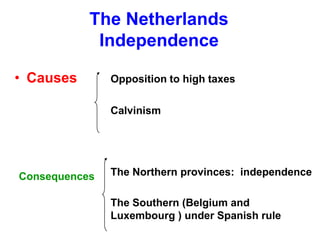
The Netherlands
Independence
• Causes Opposition to high taxes
Calvinism
The Northern provinces: independence
The Southern (Belgium and
Luxembourg ) under Spanish rule
Consequences
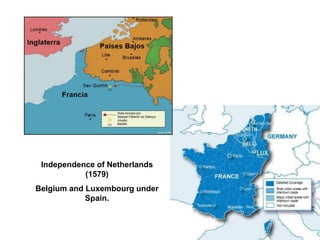
Independence of Netherlands
(1579)
Belgium and Luxembourg under
Spain.
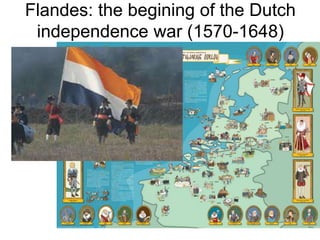
Flandes: the begining of the Dutch
independence war (1570-1648)
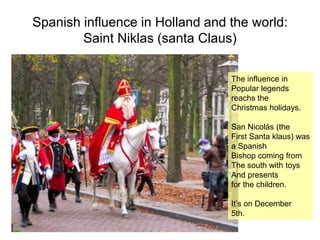
Spanish influence in Holland and the world:
Saint Niklas (santa Claus)
The influence in
Popular legends
reachs the
Christmas holidays.
San Nicolás (the
First Santa klaus) was
a Spanish
Bishop coming from
The south with toys
And presents
for the children.
It’s on December
5th.
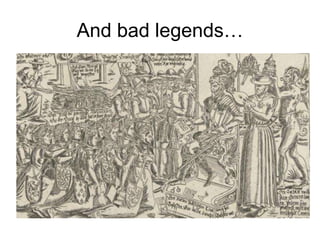
And bad legends…
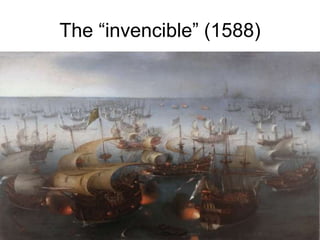
The “invencible” (1588)
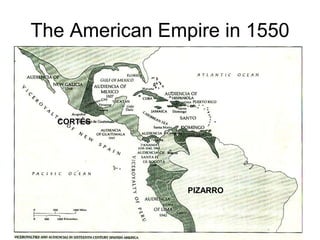
The American Empire in 1550
PIZARRO
CORTÉS
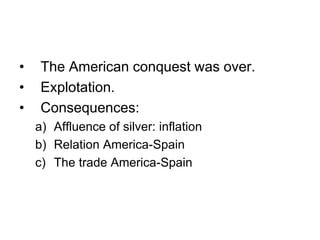
• The American conquest was over.
• Explotation.
• Consequences:
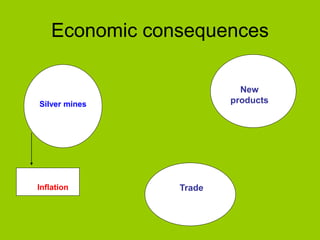
a) Affluence of silver: inflation
b) Relation America-Spain
c) The trade America-Spain
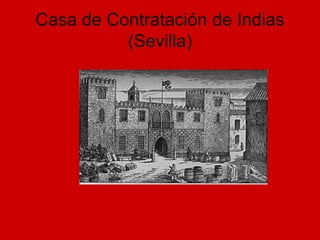
Casa de Contratación de Indias
(Sevilla)
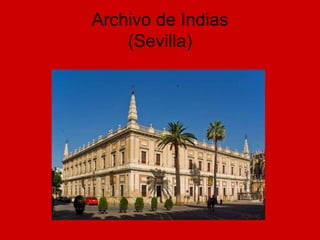
Archivo de Indias
(Sevilla)
Silver mines
Inflation
New
products
Trade
Economic consequences
https://www.ecb.europa.eu/ecb/educational/pricestab/html/index.es.html
Government in America
• Viceroys
• Governors
• Councils: Alcaldes mayores,
Corregidores.
• Audiencias
Two important Istitutions
• Casa de Contratación
• Consejo de Indias.
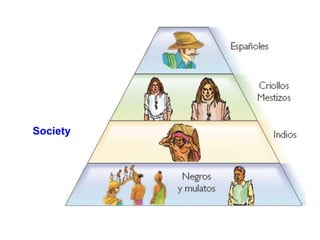
Society
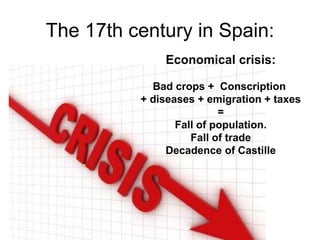
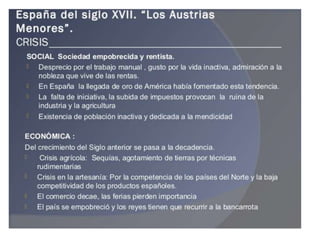
The 17th century in Spain:
Economical crisis:
Bad crops + Conscription
+ diseases + emigration + taxes
=
Fall of population.
Fall of trade
Decadence of Castille
What is the causal order for this
sequence?
• Enfermedades / Emigración / menos
producción agrícola / malas cosechas /
caída del comercio /leva para guerras /
Caída de la población / impuestos
• Fall of population: Why? 4 reasons
• Fall of the trade activity. Why?
Wars: are they positive for the trade?
Inflation? Competition of cheaper
products?
• Social biases: Which one?
• The political context
•http://elrincondequevedo.blogspot.com.es/2012/
04/la-espana-del-siglo-xvii.html
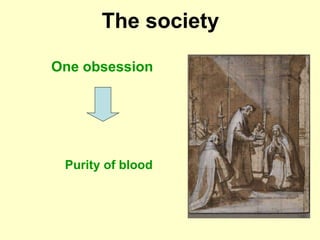
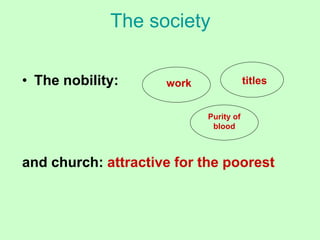
The society
One obsession
Purity of blood
The society
• The nobility:
and church: attractive for the poorest
work titles
Purity of
blood
The society
• The bourgeoisie: wiped out
titles
crisis
The society
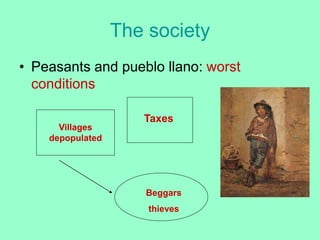
• Peasants and pueblo llano: worst
conditions
Taxes
Villages
depopulated
Beggars
thieves
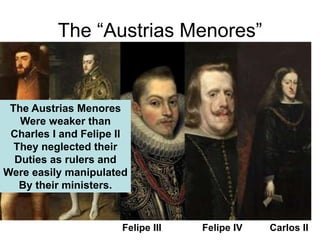
The “Austrias Menores”
Felipe III Felipe IV Carlos II
The Austrias Menores
Were weaker than
Charles I and Felipe II
They neglected their
Duties as rulers and
Were easily manipulated
By their ministers.
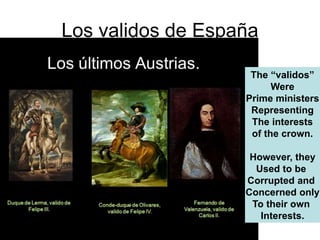
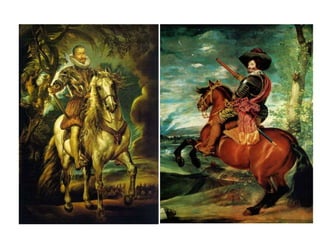
Los validos de España
The “validos”
Were
Prime ministers
Representing
The interests
of the crown.
However, they
Used to be
Corrupted and
Concerned only
To their own
Interests.
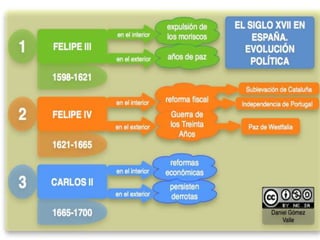
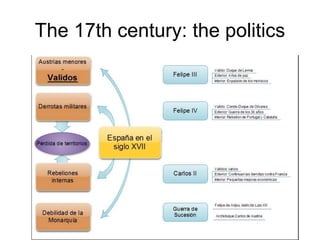
The 17th century: the politics
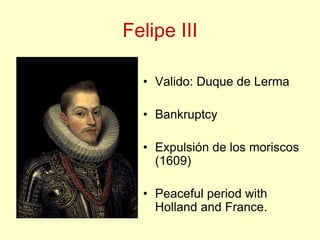
Felipe III
• Valido: Duque de Lerma
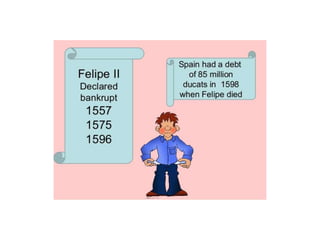
• Bankruptcy
• Expulsión de los moriscos
(1609)
• Peaceful period with
Holland and France.
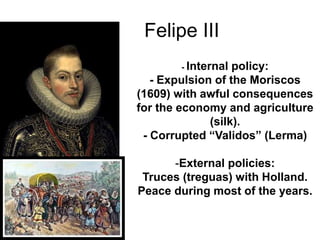
Felipe III
- Internal policy:
- Expulsion of the Moriscos
(1609) with awful consequences
for the economy and agriculture
(silk).
- Corrupted “Validos” (Lerma)
-External policies:
Truces (treguas) with Holland.
Peace during most of the years.
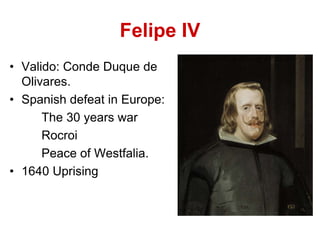
Felipe IV
• Valido: Conde Duque de
Olivares.
• Spanish defeat in Europe:
The 30 years war
Rocroi
Peace of Westfalia.
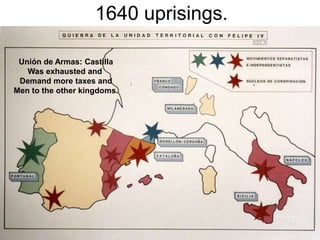
• 1640 Uprising
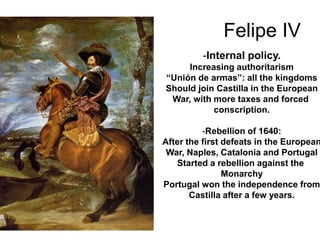
Felipe IV
-Internal policy.
Increasing authoritarism
“Unión de armas”: all the kingdoms
Should join Castilla in the European
War, with more taxes and forced
conscription.
-Rebellion of 1640:
After the first defeats in the European
War, Naples, Catalonia and Portugal
Started a rebellion against the
Monarchy
Portugal won the independence from
Castilla after a few years.
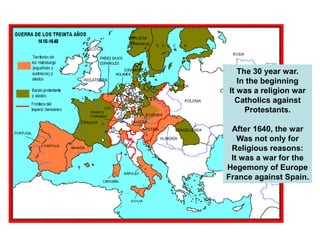
The 30 year war.
In the beginning
It was a religion war
Catholics against
Protestants.
After 1640, the war
Was not only for
Religious reasons:
It was a war for the
Hegemony of Europe
France against Spain.
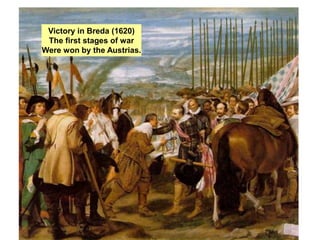
Victory in Breda (1620)
The first stages of war
Were won by the Austrias.
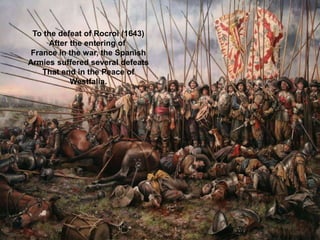
To the defeat of Rocroi (1643)
After the entering of
France in the war, the Spanish
Armies suffered several defeats
That end in the Peace of
Westfalia.
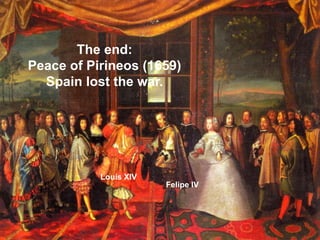
The end:
Peace of Pirineos (1659)
Spain lost the war.
Felipe IV
Louis XIV
http://www.rtve.es/alacarta/videos/mem
oria-de-espana/memoria-espana-
decadencia-politica-siglo-oro/868381/
1640 uprisings.
Unión de Armas: Castilla
Was exhausted and
Demand more taxes and
Men to the other kingdoms.
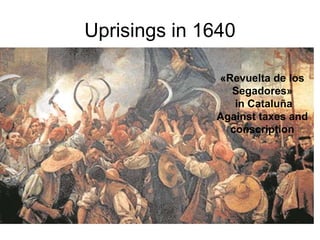
Uprisings in 1640
«Revuelta de los
Segadores»
in Cataluña
Against taxes and
conscription
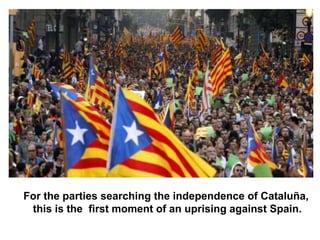
For the parties searching the independence of Cataluña,
this is the first moment of an uprising against Spain.
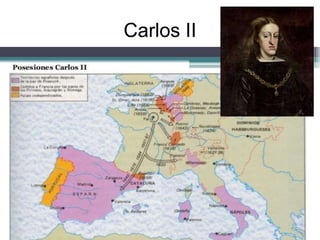
Carlos II
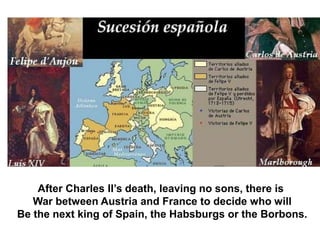
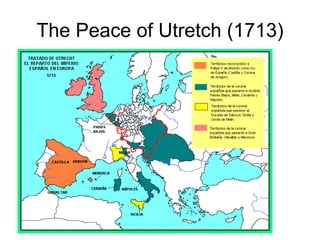
After Charles II’s death, leaving no sons, there is
War between Austria and France to decide who will
Be the next king of Spain, the Habsburgs or the Borbons.
The Peace of Utretch (1713)

Unit 8. the habsburg spain

  • 1.
    Which words canbe related to “monarchy” in the Modern Age? • Authoritarian • Democratic Powerful • Strong More taxes • Weak Strong armies • Controlled by nobles Feudal armies • Nobles under control Inquisition • Bureaucracy Nobility rebellions • Weak bourgeoisie Rising bourgeoisie
  • 2.
    ¿Con qué palabraspodemos vincular la monarquía? • Autoritaria Tolerante • Democrática Poderosa • Fuerte Más impuestos • Débil Ejércitos reales • Controlada por nobles Ejércitos nobles • Nobles sometidos Inquisición • Burocracia Rebeliones nobles • Levantamientos campesinos
  • 3.
    • ¿Qué significala palabra “estado nacional”? • Does everyone speak the same language?
  • 4.
    • ¿Qué significala palabra “estado nacional”? • ¿Hablamos una misma lengua? • ¿Compartimos un espacio común? • ¿Hay un control del territorio por fuerzas del orden?
  • 5.
    Time arrow 1504-1516 Fernando El católico regency 1516-1519 Cardinal Cisneros Regency 1519-1556 CarlosI de España AUSTRIAS MAYORES 1556-1598 Felipe II AUSTRIAS MENORES 1598-1621 Felipe III 1621-1665 Felipe IV 1665-1700 Carlos II Renaissance Counter-Reformation Barroque Humanisme “Siglo de Oro” 16th century 17th century Rise and political hegemony bankruptcy Decadence and fall Rocroi Pavía Lepanto 1640 Sucession war
  • 6.
    XVI XVII Política Hegemonía Expansión enEuropa. Creación del imperio americano. Crisis. Derrota Caída de la influencia española frente a Francia. Economía y sociedad Expansión comercial Aumento demográfico Crisis al final de siglo Inflación. Crisis demográfica social. Bancarrotas. Cultura Renacimiento Humanismo Contrarreforma Barroco
  • 7.
  • 8.
    The domains ofCharles I Of Spain and V of Germany Isabel La Católica Fernando El católico Felipe el hermoso Felipe el hermoso 1521: emperor of Germany 1519: King of Spain
  • 11.
    The main conflicts •Comuneros and Germanías (civil war) • France (defeated at Pavía, 1525) • Turkish Empire and pirates from North Africa • The protestants in Germany (Mühlberg, 1547) • The creation of the American Empire (Cortés and Pizarro) • The cost of the war: Bankruptcy.
  • 13.
    Civil War: comunidadesand Germanías At the Beginning Of Charles I Reign, there was Internal opposition. Charles was seen as A foreigner without Any interest in Spain, But as a source to Collect taxes for their Campaign. Execution of Padilla And Maldonado
  • 14.
    The civil war:Villalar The comuneros Were defeated At Villalar in 1521 Castilla y Leon still Celebrates this Date: April 23th Villalar, Valladolid, 2013
  • 15.
    Question: You areFrancois I. How do you feel about your position in relation with Spanish territories? Time: 1´
  • 16.
    The great enemy CharlesI Of Spain Francis I Of France
  • 17.
  • 18.
    Pavía y “lostercios”” En 1525 ocurrió una gran batalla en la que el mismísimo rey de Francia fue tomado prisionero. Ese fue el comienzo de la superioridad castellana en Europa frente al enemigo francés.
  • 19.
  • 20.
  • 21.
    The war againstthe Muslims Spain run a War against The Muslims As a continuation Of Reconquest. The Muslim pirates in North Africa still attacked the Spanish coast and Charles I prepared Military campaigns In Tunez and Argel War at Tunez, 1535
  • 22.
    The war againstthe Muslims War at Tunez, 1535
  • 23.
    Question: name ofthe capital where Muslims were defeated (30´´)
  • 25.
    The war againstthe Protestants Charles I was a fervient Catholic, so when Luther started his Reform, He met the monk in Spira and Worms, forbidding him to break with the Church.
  • 26.
    Mühlberg Finally there was awar, And the Protestants Were defeated at Mülhberg (1547). However, the problem Went on and part Of Germany became Protestant.
  • 30.
    V.-The conquest and colonisationof America Méjico: Name of the Empire Indian ruler/Spanish conqueror Perú: Name of the Empire Indian ruler/Spanish conqueror Time: 1´
  • 31.
    The conquest andcolonisation of America Méjico: Aztecan Empire Moctezuma/Cortés Perú: Incan Empire Atahualpa /Pizarro
  • 32.
    The American conquest The Conquestof America Had a turning Point in 1521 with The fall of The Aztecan empire, by The troops Of Hernan Cortés
  • 33.
    What did theCastilian people want to find in America? Why did Castilian people migrate to America?
  • 34.
    Why was theAmerican conquest so easy for the Spanish troops? (3 at least)
  • 35.
    1.- The Spanishtechnological hegemony (gunpowder, horses, armours). 2.- The ambition of the conquerors. 3.- Internal problems of the Indians (civil wars) and even tragic epidemics (brought by Europeans). 4.- The religious interest. Why was the American conquest so easy for the Spanish troops?
  • 36.
    The American Empirein 1550 PIZARRO CORTÉS
  • 37.
    The consequences inExtremadura Pizarro’s Palace In Trujillo, XVIth century
  • 38.
  • 39.
  • 41.
    Society and culture CharlesI • Economical expansion Wool trade and America Strong cultural impact Flandes Italy Humanism Renaissance
  • 42.
  • 43.
    Why are thereso many tapestries in the walls of the palaces? Conquista de Túnez Carlos I
  • 44.
  • 45.
    Does this picturetell you anything about Felipe II?
  • 46.
    Felipe II, amuch more Spanish ruler • He was born in Valladolid. • His native language was Castilian. • He didn´t become Holy Roman Empire. • He made Madrid his capital and built El Escorial as a royal residence.
  • 47.
    Felipe II, amuch more Spanish ruler • He was born in Valladolid. • His native language was Castilian. • He didn´t become Holy Roman Empire. • He made Madrid his capital and built El Escorial as a royal residence.
  • 48.
    Policies in Spain •Defence of Catholicism (group 1) • The revolt of the moriscos (group 2) • Unrest in Aragón (group 3)
  • 49.
    Policies in Spain Objective:defence of Catholicism Inquisition isolation Purity of blood Revolt of the moriscos Alpujarras 1568
  • 50.
    Policies in Spain Objective:more authoritarian monarchy Less rights in other kingdoms Unrest in Aragón Antonio Pérez
  • 53.
    Policies in Europe Objectives:a) defence of Catholicism b) stronger power in Europe France San Quintín Turkish Empire Lepanto The Netherlands Independence England Invincible Armada Portugal Alcántara
  • 55.
  • 56.
  • 57.
  • 58.
    1580-1640 Felipe was Isabelde Portugal´s son
  • 60.
    «Batalla sr. donAntonio, nombrado rey de Portugal y el Duque de Alba
  • 61.
    The Felipe IIworld empire
  • 63.
    The Netherlands Independence • CausesOpposition to high taxes Calvinism The Northern provinces: independence The Southern (Belgium and Luxembourg ) under Spanish rule Consequences
  • 64.
    Independence of Netherlands (1579) Belgiumand Luxembourg under Spain.
  • 65.
    Flandes: the beginingof the Dutch independence war (1570-1648)
  • 66.
    Spanish influence inHolland and the world: Saint Niklas (santa Claus) The influence in Popular legends reachs the Christmas holidays. San Nicolás (the First Santa klaus) was a Spanish Bishop coming from The south with toys And presents for the children. It’s on December 5th.
  • 67.
  • 68.
  • 69.
    The American Empirein 1550 PIZARRO CORTÉS
  • 70.
    • The Americanconquest was over. • Explotation. • Consequences: a) Affluence of silver: inflation b) Relation America-Spain c) The trade America-Spain
  • 71.
    Casa de Contrataciónde Indias (Sevilla)
  • 72.
  • 74.
  • 76.
  • 77.
    Government in America •Viceroys • Governors • Councils: Alcaldes mayores, Corregidores. • Audiencias
  • 78.
    Two important Istitutions •Casa de Contratación • Consejo de Indias.
  • 79.
  • 82.
    The 17th centuryin Spain: Economical crisis: Bad crops + Conscription + diseases + emigration + taxes = Fall of population. Fall of trade Decadence of Castille
  • 83.
    What is thecausal order for this sequence? • Enfermedades / Emigración / menos producción agrícola / malas cosechas / caída del comercio /leva para guerras / Caída de la población / impuestos
  • 84.
    • Fall ofpopulation: Why? 4 reasons • Fall of the trade activity. Why? Wars: are they positive for the trade? Inflation? Competition of cheaper products? • Social biases: Which one? • The political context
  • 86.
  • 87.
  • 88.
    The society • Thenobility: and church: attractive for the poorest work titles Purity of blood
  • 89.
    The society • Thebourgeoisie: wiped out titles crisis
  • 90.
    The society • Peasantsand pueblo llano: worst conditions Taxes Villages depopulated Beggars thieves
  • 92.
    The “Austrias Menores” FelipeIII Felipe IV Carlos II The Austrias Menores Were weaker than Charles I and Felipe II They neglected their Duties as rulers and Were easily manipulated By their ministers.
  • 93.
    Los validos deEspaña The “validos” Were Prime ministers Representing The interests of the crown. However, they Used to be Corrupted and Concerned only To their own Interests.
  • 97.
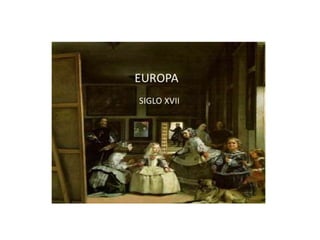
    The 17th century:the politics
  • 98.
    Felipe III • Valido:Duque de Lerma • Bankruptcy • Expulsión de los moriscos (1609) • Peaceful period with Holland and France.
  • 99.
    Felipe III - Internalpolicy: - Expulsion of the Moriscos (1609) with awful consequences for the economy and agriculture (silk). - Corrupted “Validos” (Lerma) -External policies: Truces (treguas) with Holland. Peace during most of the years.
  • 100.
    Felipe IV • Valido:Conde Duque de Olivares. • Spanish defeat in Europe: The 30 years war Rocroi Peace of Westfalia. • 1640 Uprising
  • 101.
    Felipe IV -Internal policy. Increasingauthoritarism “Unión de armas”: all the kingdoms Should join Castilla in the European War, with more taxes and forced conscription. -Rebellion of 1640: After the first defeats in the European War, Naples, Catalonia and Portugal Started a rebellion against the Monarchy Portugal won the independence from Castilla after a few years.
  • 102.
    The 30 yearwar. In the beginning It was a religion war Catholics against Protestants. After 1640, the war Was not only for Religious reasons: It was a war for the Hegemony of Europe France against Spain.
  • 103.
    Victory in Breda(1620) The first stages of war Were won by the Austrias.
  • 104.
    To the defeatof Rocroi (1643) After the entering of France in the war, the Spanish Armies suffered several defeats That end in the Peace of Westfalia.
  • 105.
    The end: Peace ofPirineos (1659) Spain lost the war. Felipe IV Louis XIV
  • 106.
  • 107.
    1640 uprisings. Unión deArmas: Castilla Was exhausted and Demand more taxes and Men to the other kingdoms.
  • 108.
    Uprisings in 1640 «Revueltade los Segadores» in Cataluña Against taxes and conscription
  • 109.
    For the partiessearching the independence of Cataluña, this is the first moment of an uprising against Spain.
  • 110.
  • 111.
    After Charles II’sdeath, leaving no sons, there is War between Austria and France to decide who will Be the next king of Spain, the Habsburgs or the Borbons.
  • 112.
    The Peace ofUtretch (1713)