BUILDING
MATERIALS
Dr. P. Ravikanth Reddy
MVSc, PhD
Guest Faculty
KBR College of Agriculture and Horticulture
Acharya NG Ranga Agricultural University
Dr. YSR Horticulture University
GENERAL TERMS
Importance of Sand -
1. Brick - 1 part Sand + 1 part Clay
2. Mortar - 3 parts Sand + 1 part Cement or
3 parts Sand + 1 part Lime
3. Concrete - 2 parts Sand + 3 parts Gravel + 1 part Cement
Sand mining is destroying India’s rivers
Concrete
Mortar paste
I. FOUNDATION
II. SIDE WALLS
III. FLOOR
IV. ROOF OF THE BUILDING
Include two steps
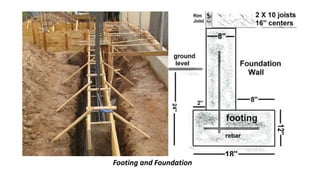
(1) Footing and
(2) Foundation wall
(1) Footing - Cement concrete (Monolithic foundation) - Stronger
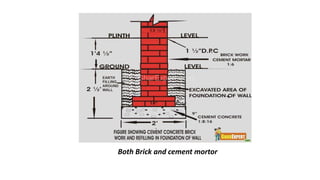
(2) Foundation wall - Brick and cement mortar.
I. FOUNDATION
Footing and Foundation
Concrete foundation
Both Brick and cement mortor
 Bricks, stones, and concrete.
 Washable walls.
 Height of walls up to 4 feet should be finished with smoother and
hard cement plaster for easy washing.
 Corners, sharp edges, and angles should be rounded to prevent
accidents and easy washing.
II. SIDE WALL
Mortar plastering
a) Building bricks
They are made out of brick earth, which are 50 per cent clay and 50 per cent sand.
Well made machine bricks will have standard dimensions of 9" x 4½ " x 3".
They will have uniform shape, colour and texture and will be sharp on angles.
b) Vitrified paving bricks
• These are hard, impervious and durable bricks paving more than 10 per cent of iron
oxide.
• They are heated at very high temperature to the point of vitrification.
• They are grooved on the outer surface and have a strong and hard finish. They are
damp proof.
• They are special bricks made for use as flooring in animal houses.
Bricks
Normal brick Vitrified brick
Vitrified bricks
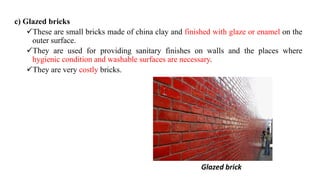
c) Glazed bricks
These are small bricks made of china clay and finished with glaze or enamel on the
outer surface.
They are used for providing sanitary finishes on walls and the places where
hygienic condition and washable surfaces are necessary.
They are very costly bricks.
Glazed brick
Stones
a) Granite
 These are hard and natural stones. They may be black in colour or light
Grey.
 They are durable and weather resistance and are commonly used for the
construction of walls and floors in animal buildings.
 The surface should be of roughened periodically by chipping.
Granite stones
b) Whinstones
 They are also hard rocks but not so durable and weather resistant as
granites.
 They are used for wall constructions and broken stones and are used as
a common ingredient of cement concrete.
Whin stones
c) Sand stones
 These are immature rocks of recent formation. They are not strong and
durable and not used in heavy constructions.
 They are capable of being dressed into different shapes and patterns.
Hence, they are used for architectural works.
Sand stones Sand stones for architecture
Binding Materials
a ) Lime
It is prepared from limestone, which are heated and slacked with water.
The white powder that is produced is called lime.
Lime preparation
Lime stone mining
b ) Lime mortar
It is prepared by mixing one part of lime with three parts of pure sand
adding sufficient quantity of water.
Cement mortar (Replacing cement by lime provides lime mortar)
Polished limestone along with lime mortar Eroded
Lime mortar
c ) Cement
 It is prepared from 70% chalk and 30% clay, which is mixed with water
to form a creamy fluid.
 It is allowed to settle and then the sediment is collected dried and roasted
over kiln and ground into fine powder.
 It is greyish and bluish grey in colour. It is an efficient binding material
used for building bricks, stones and other materials.
d) Cement mortar
•Cement and sand in 1:3 ratios.
e) Cement concrete mixture
Roof
 High insulation value.
 Cheap materials should be used.
Roof Structure
Ridge - The upper line of the roof that joins the 2 roof pitches
Eves - Edges of the roof which overhang the face of a wall
Rafter - The pieces of timber which extends from the eves to the ridge
Purlin - Horizontal beam or bar used for structural support below the roof
RAFTER
EVES
RIDGE
PURLIN
i) Lean type roof
 These are simple roof with single slope adopted for shed type of
buildings.
 Roof ventilation cannot be provided in this pattern.
 In this type of roof one wall is higher than another one to give
necessary slope for roof. It is suitable for maximum space of 2-4
meter.
Lean type or shed type of roof – No ventilation
Battens - Frames for roofing
Rafter – Wooden piece/plates
between ridge and Eaves
Eaves – Overhang
ii) Gable roof
These are coupled roof with two slopes, roof ventilation can be
provided in this pattern the form of continuous ridge opening
protected by louvre board.
Louvre board ventilation
Roofing battens of Gable roof frame with Louvre board ventilation
Gable type of roof
iii) Monitor roof
 The roof has two slopes, but one overlaps other at the ridge of the
roof with a ventilation gap of one feet.
 In this roof ventilation can be provided in between two slopes.
 This also suitable for tropical buildings and it serves the purposes
of ventilating and lighting the building.
iv) Semi monitor roof
 Roof has 2 slopes but one overlap the other at the ridge of roof with
ventilating gap of 1 feet.
Monitor type of roof
v) Gothic arch
 This is an arched roof providing greater roof space used for store
houses.
 Used for storage of feed.
Gothic type of roof
Gothic type of roof
Gambriel type of roof
Roofing materials
1. Tiles
2. Asbestos sheets
3. Aluminium sheets
4. Galvanized iron sheets
5. Thatched roof
6. Reinforced cement concrete
1) Tiles
 They are cheap and easily available in most of the places. It conducts
heat rapidly. Hence it is suitable for hot climate.
 Wind or accident easily damages them. It has to be renewed
periodically. There are two types of tiles.
a) Pan tiles or Mangalore tiles
 These are rectangular tiles with grooves on outer surface
and two nibs on the inner surface.
 They are lied one at the side of the other to cover the roof.
Pan or mangalore tile
Pan or mangalore tiled roof
b) Country tiles
 These are semi-circular tiles of different shape and dimensions.
 They are used by keeping one over other in layers forming numerous
air pockets.
 They conduct less heat.
Country tiled roof
Air pockets
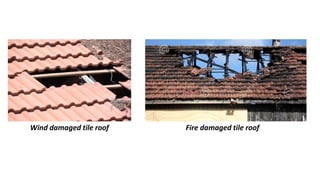
Wind damaged tile roof Fire damaged tile roof
2) Asbestos sheet
 These are commonly used in poultry buildings.
 Asbestos sheets are prepared by mixing cement mixture with
varying quantities of vegetable fibers.
 They are available as sheets of different dimensions with corrugated
surfaces.
 Sheets are easily fixed to roof trusses and more durable than tiles.
But the houses under this roof will be hotter during summer.
Asbestos sheet – Hotter in summer
3) Aluminum Sheets
 Corrugated aluminum sheets of different thickness and dimensions
are available in the market as roof coverings.
 They are 2 ½ feet width and varying length from 8 to 12 feet. They are
very light and can be easily fixed.
 The bright and polished surface of new sheets provides a reflective
insulation and keeps the animal houses cool during summer.
 They are expensive but have a greater resale value. They are rust
proof and therefore they are more durable.
Aluminium sheet – Cooler in summer
4) Galvanized iron sheets
 These are iron sheets, which are galvanized on the surface and provided
with corrugation. They are available in standard dimension of 6 feet x 3
feet.
 Galvanized sheets are commonly used in animal houses but this sheet
keeps the house very hot during summer.
 It is suggested that sheet should be painted white on outer side to avoid
absorption of heat.
 They are strong and may be rusted after long use.
Galvanized Iron sheet – Hotter in summer
5) Thatched roof
 Made of coconut or palmyra leaves
 Hay or straw can also be used
 Cheap and poor conductors of heat
 Keeps house cool in summer
 Non-durable and prone for fire accident
Thatched roof – Fire accident problems
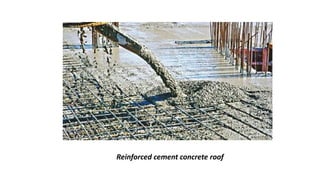
5) Reinforced Cement Concrete
 Mixture of cement, sand, small cresor stones with iron rods
 Very strong and durable
 Reduces heat inside the animal shed
 More expensive
Reinforced cement concrete roof
FLOOR
Design of floor
i) Solid floor
 It is a common floor with solid surface made out of different
materials such as cement concrete, vitrified paving brick, building
brick, stones and gravel.
 Such solid floors should be laid properly for good drainage.
 A slope of 1/40 to 1/60 is desirable towards the dung channel.
 Even surface with impervious quality is necessary to prevent water
stagnation.
 Proper cleaning and disinfection are essential to control diseases.
Concrete floor – corrugations and rough surface to prevent slipping
Building brick floor – Absorbs water and are easily worn out – Not good floor
Vitrified paving bricks – Durable and damp proof - Ideal
Granite flooring – Should be roughened to prevent slipperiness
ii) Deep litter floor
It is made of bedding material as dried layers.
Straw, paddy husk, saw dust, groundnut hulls, dried leaves are
spread on the floor used as litter materials.
It can be spread as layer of 4-6 inches thickness and can be
allowed to accumulate over a period of a month to 1 year.
The litter get mixed with excreta and decomposed.
The dried litter materials absorb the moisture. Hence bacterial
activity is controlled.
Excessive bacterial action in the deep litter is kept controlled by
addition of lime.
Deep litter system – Paddy straw

Unit 8 Building materials.pptx

  • 1.
    BUILDING MATERIALS Dr. P. RavikanthReddy MVSc, PhD Guest Faculty KBR College of Agriculture and Horticulture Acharya NG Ranga Agricultural University Dr. YSR Horticulture University
  • 2.
    GENERAL TERMS Importance ofSand - 1. Brick - 1 part Sand + 1 part Clay 2. Mortar - 3 parts Sand + 1 part Cement or 3 parts Sand + 1 part Lime 3. Concrete - 2 parts Sand + 3 parts Gravel + 1 part Cement Sand mining is destroying India’s rivers
  • 3.
  • 4.
    I. FOUNDATION II. SIDEWALLS III. FLOOR IV. ROOF OF THE BUILDING Include two steps (1) Footing and (2) Foundation wall (1) Footing - Cement concrete (Monolithic foundation) - Stronger (2) Foundation wall - Brick and cement mortar. I. FOUNDATION
  • 5.
  • 6.
  • 7.
    Both Brick andcement mortor
  • 8.
     Bricks, stones,and concrete.  Washable walls.  Height of walls up to 4 feet should be finished with smoother and hard cement plaster for easy washing.  Corners, sharp edges, and angles should be rounded to prevent accidents and easy washing. II. SIDE WALL Mortar plastering
  • 9.
    a) Building bricks Theyare made out of brick earth, which are 50 per cent clay and 50 per cent sand. Well made machine bricks will have standard dimensions of 9" x 4½ " x 3". They will have uniform shape, colour and texture and will be sharp on angles. b) Vitrified paving bricks • These are hard, impervious and durable bricks paving more than 10 per cent of iron oxide. • They are heated at very high temperature to the point of vitrification. • They are grooved on the outer surface and have a strong and hard finish. They are damp proof. • They are special bricks made for use as flooring in animal houses. Bricks
  • 10.
  • 11.
  • 12.
    c) Glazed bricks Theseare small bricks made of china clay and finished with glaze or enamel on the outer surface. They are used for providing sanitary finishes on walls and the places where hygienic condition and washable surfaces are necessary. They are very costly bricks. Glazed brick
  • 13.
    Stones a) Granite  Theseare hard and natural stones. They may be black in colour or light Grey.  They are durable and weather resistance and are commonly used for the construction of walls and floors in animal buildings.  The surface should be of roughened periodically by chipping. Granite stones
  • 14.
    b) Whinstones  Theyare also hard rocks but not so durable and weather resistant as granites.  They are used for wall constructions and broken stones and are used as a common ingredient of cement concrete. Whin stones
  • 15.
    c) Sand stones These are immature rocks of recent formation. They are not strong and durable and not used in heavy constructions.  They are capable of being dressed into different shapes and patterns. Hence, they are used for architectural works. Sand stones Sand stones for architecture
  • 16.
    Binding Materials a )Lime It is prepared from limestone, which are heated and slacked with water. The white powder that is produced is called lime. Lime preparation Lime stone mining
  • 17.
    b ) Limemortar It is prepared by mixing one part of lime with three parts of pure sand adding sufficient quantity of water. Cement mortar (Replacing cement by lime provides lime mortar)
  • 18.
    Polished limestone alongwith lime mortar Eroded Lime mortar
  • 19.
    c ) Cement It is prepared from 70% chalk and 30% clay, which is mixed with water to form a creamy fluid.  It is allowed to settle and then the sediment is collected dried and roasted over kiln and ground into fine powder.  It is greyish and bluish grey in colour. It is an efficient binding material used for building bricks, stones and other materials.
  • 20.
    d) Cement mortar •Cementand sand in 1:3 ratios. e) Cement concrete mixture
  • 21.
    Roof  High insulationvalue.  Cheap materials should be used.
  • 22.
    Roof Structure Ridge -The upper line of the roof that joins the 2 roof pitches Eves - Edges of the roof which overhang the face of a wall Rafter - The pieces of timber which extends from the eves to the ridge Purlin - Horizontal beam or bar used for structural support below the roof RAFTER EVES RIDGE PURLIN
  • 23.
    i) Lean typeroof  These are simple roof with single slope adopted for shed type of buildings.  Roof ventilation cannot be provided in this pattern.  In this type of roof one wall is higher than another one to give necessary slope for roof. It is suitable for maximum space of 2-4 meter.
  • 24.
    Lean type orshed type of roof – No ventilation Battens - Frames for roofing Rafter – Wooden piece/plates between ridge and Eaves Eaves – Overhang
  • 25.
    ii) Gable roof Theseare coupled roof with two slopes, roof ventilation can be provided in this pattern the form of continuous ridge opening protected by louvre board. Louvre board ventilation
  • 26.
    Roofing battens ofGable roof frame with Louvre board ventilation
  • 27.
  • 28.
    iii) Monitor roof The roof has two slopes, but one overlaps other at the ridge of the roof with a ventilation gap of one feet.  In this roof ventilation can be provided in between two slopes.  This also suitable for tropical buildings and it serves the purposes of ventilating and lighting the building. iv) Semi monitor roof  Roof has 2 slopes but one overlap the other at the ridge of roof with ventilating gap of 1 feet.
  • 29.
  • 30.
  • 32.
    v) Gothic arch This is an arched roof providing greater roof space used for store houses.  Used for storage of feed. Gothic type of roof
  • 33.
  • 34.
  • 35.
    Roofing materials 1. Tiles 2.Asbestos sheets 3. Aluminium sheets 4. Galvanized iron sheets 5. Thatched roof 6. Reinforced cement concrete
  • 36.
    1) Tiles  Theyare cheap and easily available in most of the places. It conducts heat rapidly. Hence it is suitable for hot climate.  Wind or accident easily damages them. It has to be renewed periodically. There are two types of tiles. a) Pan tiles or Mangalore tiles  These are rectangular tiles with grooves on outer surface and two nibs on the inner surface.  They are lied one at the side of the other to cover the roof. Pan or mangalore tile
  • 37.
    Pan or mangaloretiled roof
  • 38.
    b) Country tiles These are semi-circular tiles of different shape and dimensions.  They are used by keeping one over other in layers forming numerous air pockets.  They conduct less heat. Country tiled roof Air pockets
  • 39.
    Wind damaged tileroof Fire damaged tile roof
  • 40.
    2) Asbestos sheet These are commonly used in poultry buildings.  Asbestos sheets are prepared by mixing cement mixture with varying quantities of vegetable fibers.  They are available as sheets of different dimensions with corrugated surfaces.  Sheets are easily fixed to roof trusses and more durable than tiles. But the houses under this roof will be hotter during summer.
  • 41.
    Asbestos sheet –Hotter in summer
  • 42.
    3) Aluminum Sheets Corrugated aluminum sheets of different thickness and dimensions are available in the market as roof coverings.  They are 2 ½ feet width and varying length from 8 to 12 feet. They are very light and can be easily fixed.  The bright and polished surface of new sheets provides a reflective insulation and keeps the animal houses cool during summer.  They are expensive but have a greater resale value. They are rust proof and therefore they are more durable.
  • 43.
    Aluminium sheet –Cooler in summer
  • 44.
    4) Galvanized ironsheets  These are iron sheets, which are galvanized on the surface and provided with corrugation. They are available in standard dimension of 6 feet x 3 feet.  Galvanized sheets are commonly used in animal houses but this sheet keeps the house very hot during summer.  It is suggested that sheet should be painted white on outer side to avoid absorption of heat.  They are strong and may be rusted after long use.
  • 45.
    Galvanized Iron sheet– Hotter in summer
  • 46.
    5) Thatched roof Made of coconut or palmyra leaves  Hay or straw can also be used  Cheap and poor conductors of heat  Keeps house cool in summer  Non-durable and prone for fire accident
  • 47.
    Thatched roof –Fire accident problems
  • 48.
    5) Reinforced CementConcrete  Mixture of cement, sand, small cresor stones with iron rods  Very strong and durable  Reduces heat inside the animal shed  More expensive
  • 49.
  • 50.
    FLOOR Design of floor i)Solid floor  It is a common floor with solid surface made out of different materials such as cement concrete, vitrified paving brick, building brick, stones and gravel.  Such solid floors should be laid properly for good drainage.  A slope of 1/40 to 1/60 is desirable towards the dung channel.  Even surface with impervious quality is necessary to prevent water stagnation.  Proper cleaning and disinfection are essential to control diseases.
  • 51.
    Concrete floor –corrugations and rough surface to prevent slipping
  • 52.
    Building brick floor– Absorbs water and are easily worn out – Not good floor
  • 53.
    Vitrified paving bricks– Durable and damp proof - Ideal
  • 54.
    Granite flooring –Should be roughened to prevent slipperiness
  • 55.
    ii) Deep litterfloor It is made of bedding material as dried layers. Straw, paddy husk, saw dust, groundnut hulls, dried leaves are spread on the floor used as litter materials. It can be spread as layer of 4-6 inches thickness and can be allowed to accumulate over a period of a month to 1 year. The litter get mixed with excreta and decomposed. The dried litter materials absorb the moisture. Hence bacterial activity is controlled. Excessive bacterial action in the deep litter is kept controlled by addition of lime.
  • 56.
    Deep litter system– Paddy straw