
Unit-V
Grid Tied Hybrid Renewable Energy
Systems
BY
R.ARULJOTHI
M.Tech( 2nd YEAR)
15EE302
Under the guidance of
DR. N.P. SUBRAMANIAM, M.E.,Ph.D.,
ASSISTANT PROFESSOR
DEPARTMENT OF ELECTRICALAND ELECTRONICS
ENGINEERING
PONDICHERRY ENGINEERING COLLEGE
HYBRID RENEWABLE ENERGY SYSTEMS
• While renewable energy systems are capable of powering houses
and small businesses without any connection to the electricity grid,
many people prefer the advantages that grid-connection offers.
• A grid-connected system allows you to power your home or small
business with renewable energy during those periods (daily as well
as seasonally) when the sun is shining, the water is running, or the
wind is blowing.
• Any excess electricity you produce is fed back into the grid. When
renewable resources are unavailable, electricity from the grid
supplies your needs, eliminating the expense of electricity storage
devices like batteries.
• In addition, power providers (i.e., electric utilities) in most states
allow net metering, an arrangement where the excess electricity
generated by grid-connected renewable energy systems "turns back"
your electricity meter as it is fed back into the grid.
• If you use more electricity than your system feeds into the grid
during a given month, you pay your power provider only for the
difference between what you used and what you produced.
• Some of the things you need to know when thinking about connecting your
home energy system to the electric grid include:
– Equipment required to connect your system to the grid
– Grid-connection requirements from your power provider
– State and community codes and requirements
• A grid-connected photovoltaic power system, or grid-connected PV power
system is an electricity generating solar PV power system that is connected
to the utility grid.
• A grid-connected PV system consists of solar panels, one or several
inverters, a power conditioning unit and grid connection equipment.
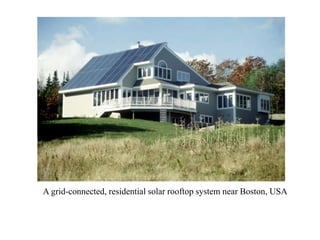
• They range from small residential and commercial rooftop systems to large
utility-scale solar power stations.
• Unlike stand-alone power systems, a grid-connected system rarely includes
an integrated battery solution, as they are still very expensive.
• When conditions are right, the grid-connected PV system supplies the
excess power, beyond consumption by the connected load, to the utility
grid.
A grid-connected, residential solar rooftop system near Boston, USA
OPERATION
• Residential, grid-connected rooftop systems which have a capacity more than 10
kilowatts can meet the load of most consumers.
• They can feed excess power to the grid where it is consumed by other users. The
feedback is done through a meter to monitor power transferred.
• Photovoltaic wattage may be less than average consumption, in which case the
consumer will continue to purchase grid energy, but a lesser amount than
previously.
• If photovoltaic wattage substantially exceeds average consumption, the energy
produced by the panels will be much in excess of the demand.
• In this case, the excess power can yield revenue by selling it to the grid. Depending
on their agreement with their local grid energy company, the consumer only needs
to pay the cost of electricity consumed less the value of electricity generated.
• This will be a negative number if more electricity is generated than consumed.
• Additionally, in some cases, cash incentives are paid from the grid operator to the
consumer.
• Connection of the photovoltaic power system can be done only through an
interconnection agreement between the consumer and the utility company.
• The agreement details the various safety standards to be followed during the
connection.
FEATURES OF HYBRID SYSTEM
• Solar energy gathered by photovoltaic solar panels, intended for delivery to a power
grid, must be conditioned, or processed for use, by a grid-connected inverter.
• Fundamentally, an inverter changes the DC input voltage from the PV to AC
voltage for the grid.
• This inverter sits between the solar array and the grid, draws energy from each, and
may be a large stand-alone unit or may be a collection of small inverters, each
physically attached to individual solar panels.
• The inverter must monitor grid voltage, waveform, and frequency. One reason for
monitoring is if the grid is dead or strays too far out of its nominal specifications,
the inverter must not pass along any solar energy.
• An inverter connected to a malfunctioning power line will automatically disconnect
in accordance with safety rules, for example UL1741, which vary by jurisdiction.
• Another reason for the inverter monitoring the grid is because for normal operation
the inverter must synchronize with the grid waveform, and produce a voltage
slightly higher than the grid itself, in order for energy to smoothly flow outward
from the solar array.
ADVANTAGES
• As it is renewable so it is in abundance and long lasting.
• It is cheap source of energy as hybrid is built among sustainable and
renewable energies. Only solar energy is costly among all these sources.
Research is carrying on this to make it accessible to every layman.
• It emits less rather zero carbon dioxide in the environment.
DIS-ADVANTAGES
• It need special environment like solar energy is not attainable if clouds
drifting on the sky. Solar panels would be ineffective in case of dim
sunlight. Their capacity of producing energy becomes less. Also it is
ineffective in the evening or night hours.
• Hybrid renewable technology is dependent on the region and capacity. It is
not possible to utilize every type of renewable technology where you want.
As there is changing of weather around the year same with the different
continents. Some areas are hot some are cold. So it is not possible to apply
the hybrid of renewable energies. There is need to attach fossil fuel energy
system with either solar, water or wind renewable energies.
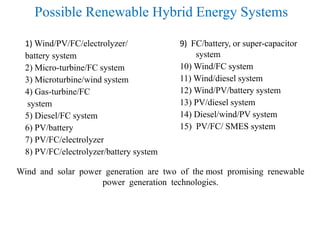
Possible Renewable Hybrid Energy Systems
1) Wind/PV/FC/electrolyzer/
battery system
2) Micro-turbine/FC system
3) Microturbine/wind system
4) Gas-turbine/FC
system
5) Diesel/FC system
6) PV/battery
7) PV/FC/electrolyzer
8) PV/FC/electrolyzer/battery system
9) FC/battery, or super-capacitor
system
10) Wind/FC system
11) Wind/diesel system
12) Wind/PV/battery system
13) PV/diesel system
14) Diesel/wind/PV system
15) PV/FC/ SMES system
Wind and solar power generation are two of the most promising renewable
power generation technologies.
• Every device we use in our day-to-day life such as mobile phone,
computer, induction cookers, washing machines, vacuum cleaners, etc.,
requires electric power supply.
• Thus, the advancement in technology is increasing the electrical and
electronic appliances usage – which, in turn – is increasing the power
demand. Thus, to meet the load demand, different techniques are used for
electric power generation. In the recent times, to avoid pollution and to
conserve non-renewable energy resources like coal, petroleum, etc.,
renewable energy sources like solar, wind, etc., are being preferred for
power generation.
• The combination of renewable energy sources can also be used for
generating power called as hybrid power system.
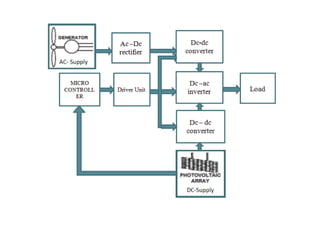
• As a special case, we will discuss about the working of solar-wind hybrid
system.
• Solar and wind hybrid power systems are designed using solar panels and
small wind turbine generators for generating electricity. Generally, these
solar wind hybrid systems are capable of small capabilities.
• The typical power generation capacities of solar wind hybrid systems are in
the range from 1 kW to 10 kW. Before discussing in brief about the solar
and wind hybrid power system, we should know about solar power
generation systems and wind-power generation systems.
Solar Wind Hybrid System
APPLICATIONS
• Remote and rural village
• Electrification
• Residential colonies and apartments’ general lighting
• Street lighting
• Transmission and communication tower
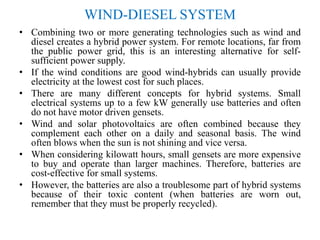
WIND-DIESEL SYSTEM
• Combining two or more generating technologies such as wind and
diesel creates a hybrid power system. For remote locations, far from
the public power grid, this is an interesting alternative for self-
sufficient power supply.
• If the wind conditions are good wind-hybrids can usually provide
electricity at the lowest cost for such places.
• There are many different concepts for hybrid systems. Small
electrical systems up to a few kW generally use batteries and often
do not have motor driven gensets.
• Wind and solar photovoltaics are often combined because they
complement each other on a daily and seasonal basis. The wind
often blows when the sun is not shining and vice versa.
• When considering kilowatt hours, small gensets are more expensive
to buy and operate than larger machines. Therefore, batteries are
cost-effective for small systems.
• However, the batteries are also a troublesome part of hybrid systems
because of their toxic content (when batteries are worn out,
remember that they must be properly recycled).
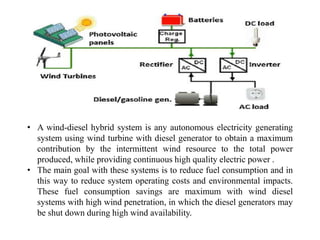
• A wind-diesel hybrid system is any autonomous electricity generating
system using wind turbine with diesel generator to obtain a maximum
contribution by the intermittent wind resource to the total power
produced, while providing continuous high quality electric power .
• The main goal with these systems is to reduce fuel consumption and in
this way to reduce system operating costs and environmental impacts.
These fuel consumption savings are maximum with wind diesel
systems with high wind penetration, in which the diesel generators may
be shut down during high wind availability.
WIND – PV- DIESEL HYBRID SYSTEMS
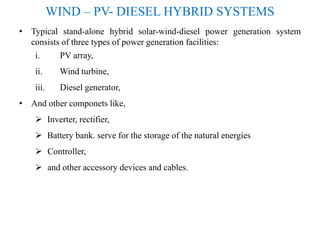
• Typical stand-alone hybrid solar-wind-diesel power generation system
consists of three types of power generation facilities:
i. PV array,
ii. Wind turbine,
iii. Diesel generator,
• And other componets like,
 Inverter, rectifier,
 Battery bank. serve for the storage of the natural energies
 Controller,
 and other accessory devices and cables.
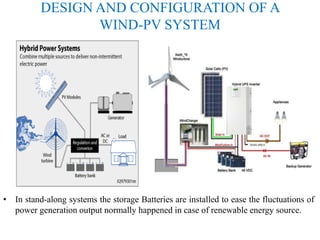
DESIGN AND CONFIGURATION OF A
WIND-PV SYSTEM
• In stand-along systems the storage Batteries are installed to ease the fluctuations of
power generation output normally happened in case of renewable energy source.
Design and configuration of a wind-PV system
• Various combinations of diesel generator, wind turbine, PV array, battery,
and power converter modules can be taken into account towards identifying
an economically viable solution that would meet the required load.
• For commissioning a hybrid system it is initially assume that the site
selected is exposed to reasonable wind speeds as well as good solar
irradiation.
• It is also essential to know the energy demand at that site.
• This allowed for the design of a suitable hybrid power system that would
meet the demands of load at best.
• Climatic conditions determine the availability and magnitude of wind and
solar energy at particular site.
• Pre-feasibility studies are based on weather data (wind speed, solar
insolation) and load requirements for specific site.
• In order to calculate the performance of an existing system, or to predict
energy consumption or energy generated from a system in the design stage,
appropriate weather data is required.
• Climatic conditions determine the availability and magnitude of wind and
solar energy at particular site.
• Pre-feasibility studies are based on weather data (wind speed, solar
insolation) and load requirements for specific site.
• In order to calculate the performance of an existing system, or to predict
energy consumption or energy generated from a system in the design stage,
appropriate weather data is required.
• Feasibility of hybrid PV/wind energy system strongly depends on solar
radiation and wind energy potential available at the site.
• The collected data of the various energy sources is analysed in order to plan
for the structure of the system
• Various feasibility and performance studies are reported to evaluate option
of hybrid PV/wind energy systems
• Photovoltaic array area, number of wind machines, and battery storage
capacity play an important role in operation of hybrid PV/wind–diesel
system while satisfying load.
MAXIMUM POWER POINT TRACKER
• A MPPT, or maximum power point tracker is an electronic DC to DC
converter that optimizes the match between the solar array (PV panels), and
the battery bank or utility grid. To put it simply, they convert a higher
voltage DC output from solar panels (and a few wind generators) down to
the lower voltage needed to charge batteries.
• According to Maximum Power Transfer theorem, the power output of a
circuit is maximum when the Thevenin impedance of the circuit (source
impedance) matches with the load impedance.
• Hence our problem of tracking the maximum power point reduces to an
impedance matching problem.
• In the source side we are using a boost convertor connected to a solar panel
in order to enhance the output voltage so that it can be used for different
applications like motor load.
• By changing the duty cycle of the boost converter appropriately we can
match the source impedance with that of the load impedance.
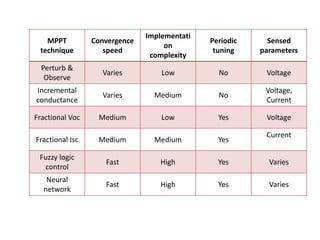
Different MPPT techniques
• There are different techniques used to track the maximum power point.
Few of the most popular techniques are:
 Perturb and Observe (hill climbing method)
 Incremental Conductance method
 Fractional short circuit current
 Fractional open circuit voltage
 Neural networks
 Fuzzy logic
MPPT
technique
Convergence
speed
Implementati
on
complexity
Periodic
tuning
Sensed
parameters
Perturb &
Observe
Varies Low No Voltage
Incremental
conductance
Varies Medium No
Voltage,
Current
Fractional Voc Medium Low Yes Voltage
Fractional Isc Medium Medium Yes
Current
Fuzzy logic
control
Fast High Yes Varies
Neural
network
Fast High Yes Varies
Unit 5

Unit 5

  • 1.
    Unit-V Grid Tied HybridRenewable Energy Systems BY R.ARULJOTHI M.Tech( 2nd YEAR) 15EE302 Under the guidance of DR. N.P. SUBRAMANIAM, M.E.,Ph.D., ASSISTANT PROFESSOR DEPARTMENT OF ELECTRICALAND ELECTRONICS ENGINEERING PONDICHERRY ENGINEERING COLLEGE
  • 2.
    HYBRID RENEWABLE ENERGYSYSTEMS • While renewable energy systems are capable of powering houses and small businesses without any connection to the electricity grid, many people prefer the advantages that grid-connection offers. • A grid-connected system allows you to power your home or small business with renewable energy during those periods (daily as well as seasonally) when the sun is shining, the water is running, or the wind is blowing. • Any excess electricity you produce is fed back into the grid. When renewable resources are unavailable, electricity from the grid supplies your needs, eliminating the expense of electricity storage devices like batteries. • In addition, power providers (i.e., electric utilities) in most states allow net metering, an arrangement where the excess electricity generated by grid-connected renewable energy systems "turns back" your electricity meter as it is fed back into the grid. • If you use more electricity than your system feeds into the grid during a given month, you pay your power provider only for the difference between what you used and what you produced.
  • 3.
    • Some ofthe things you need to know when thinking about connecting your home energy system to the electric grid include: – Equipment required to connect your system to the grid – Grid-connection requirements from your power provider – State and community codes and requirements • A grid-connected photovoltaic power system, or grid-connected PV power system is an electricity generating solar PV power system that is connected to the utility grid. • A grid-connected PV system consists of solar panels, one or several inverters, a power conditioning unit and grid connection equipment. • They range from small residential and commercial rooftop systems to large utility-scale solar power stations. • Unlike stand-alone power systems, a grid-connected system rarely includes an integrated battery solution, as they are still very expensive. • When conditions are right, the grid-connected PV system supplies the excess power, beyond consumption by the connected load, to the utility grid.
  • 4.
    A grid-connected, residentialsolar rooftop system near Boston, USA
  • 5.
    OPERATION • Residential, grid-connectedrooftop systems which have a capacity more than 10 kilowatts can meet the load of most consumers. • They can feed excess power to the grid where it is consumed by other users. The feedback is done through a meter to monitor power transferred. • Photovoltaic wattage may be less than average consumption, in which case the consumer will continue to purchase grid energy, but a lesser amount than previously. • If photovoltaic wattage substantially exceeds average consumption, the energy produced by the panels will be much in excess of the demand. • In this case, the excess power can yield revenue by selling it to the grid. Depending on their agreement with their local grid energy company, the consumer only needs to pay the cost of electricity consumed less the value of electricity generated. • This will be a negative number if more electricity is generated than consumed. • Additionally, in some cases, cash incentives are paid from the grid operator to the consumer. • Connection of the photovoltaic power system can be done only through an interconnection agreement between the consumer and the utility company. • The agreement details the various safety standards to be followed during the connection.
  • 6.
    FEATURES OF HYBRIDSYSTEM • Solar energy gathered by photovoltaic solar panels, intended for delivery to a power grid, must be conditioned, or processed for use, by a grid-connected inverter. • Fundamentally, an inverter changes the DC input voltage from the PV to AC voltage for the grid. • This inverter sits between the solar array and the grid, draws energy from each, and may be a large stand-alone unit or may be a collection of small inverters, each physically attached to individual solar panels. • The inverter must monitor grid voltage, waveform, and frequency. One reason for monitoring is if the grid is dead or strays too far out of its nominal specifications, the inverter must not pass along any solar energy. • An inverter connected to a malfunctioning power line will automatically disconnect in accordance with safety rules, for example UL1741, which vary by jurisdiction. • Another reason for the inverter monitoring the grid is because for normal operation the inverter must synchronize with the grid waveform, and produce a voltage slightly higher than the grid itself, in order for energy to smoothly flow outward from the solar array.
  • 7.
    ADVANTAGES • As itis renewable so it is in abundance and long lasting. • It is cheap source of energy as hybrid is built among sustainable and renewable energies. Only solar energy is costly among all these sources. Research is carrying on this to make it accessible to every layman. • It emits less rather zero carbon dioxide in the environment. DIS-ADVANTAGES • It need special environment like solar energy is not attainable if clouds drifting on the sky. Solar panels would be ineffective in case of dim sunlight. Their capacity of producing energy becomes less. Also it is ineffective in the evening or night hours. • Hybrid renewable technology is dependent on the region and capacity. It is not possible to utilize every type of renewable technology where you want. As there is changing of weather around the year same with the different continents. Some areas are hot some are cold. So it is not possible to apply the hybrid of renewable energies. There is need to attach fossil fuel energy system with either solar, water or wind renewable energies.
  • 8.
    Possible Renewable HybridEnergy Systems 1) Wind/PV/FC/electrolyzer/ battery system 2) Micro-turbine/FC system 3) Microturbine/wind system 4) Gas-turbine/FC system 5) Diesel/FC system 6) PV/battery 7) PV/FC/electrolyzer 8) PV/FC/electrolyzer/battery system 9) FC/battery, or super-capacitor system 10) Wind/FC system 11) Wind/diesel system 12) Wind/PV/battery system 13) PV/diesel system 14) Diesel/wind/PV system 15) PV/FC/ SMES system Wind and solar power generation are two of the most promising renewable power generation technologies.
  • 9.
    • Every devicewe use in our day-to-day life such as mobile phone, computer, induction cookers, washing machines, vacuum cleaners, etc., requires electric power supply. • Thus, the advancement in technology is increasing the electrical and electronic appliances usage – which, in turn – is increasing the power demand. Thus, to meet the load demand, different techniques are used for electric power generation. In the recent times, to avoid pollution and to conserve non-renewable energy resources like coal, petroleum, etc., renewable energy sources like solar, wind, etc., are being preferred for power generation. • The combination of renewable energy sources can also be used for generating power called as hybrid power system. • As a special case, we will discuss about the working of solar-wind hybrid system. • Solar and wind hybrid power systems are designed using solar panels and small wind turbine generators for generating electricity. Generally, these solar wind hybrid systems are capable of small capabilities. • The typical power generation capacities of solar wind hybrid systems are in the range from 1 kW to 10 kW. Before discussing in brief about the solar and wind hybrid power system, we should know about solar power generation systems and wind-power generation systems. Solar Wind Hybrid System
  • 11.
    APPLICATIONS • Remote andrural village • Electrification • Residential colonies and apartments’ general lighting • Street lighting • Transmission and communication tower
  • 12.
    WIND-DIESEL SYSTEM • Combiningtwo or more generating technologies such as wind and diesel creates a hybrid power system. For remote locations, far from the public power grid, this is an interesting alternative for self- sufficient power supply. • If the wind conditions are good wind-hybrids can usually provide electricity at the lowest cost for such places. • There are many different concepts for hybrid systems. Small electrical systems up to a few kW generally use batteries and often do not have motor driven gensets. • Wind and solar photovoltaics are often combined because they complement each other on a daily and seasonal basis. The wind often blows when the sun is not shining and vice versa. • When considering kilowatt hours, small gensets are more expensive to buy and operate than larger machines. Therefore, batteries are cost-effective for small systems. • However, the batteries are also a troublesome part of hybrid systems because of their toxic content (when batteries are worn out, remember that they must be properly recycled).
  • 13.
    • A wind-dieselhybrid system is any autonomous electricity generating system using wind turbine with diesel generator to obtain a maximum contribution by the intermittent wind resource to the total power produced, while providing continuous high quality electric power . • The main goal with these systems is to reduce fuel consumption and in this way to reduce system operating costs and environmental impacts. These fuel consumption savings are maximum with wind diesel systems with high wind penetration, in which the diesel generators may be shut down during high wind availability.
  • 14.
    WIND – PV-DIESEL HYBRID SYSTEMS • Typical stand-alone hybrid solar-wind-diesel power generation system consists of three types of power generation facilities: i. PV array, ii. Wind turbine, iii. Diesel generator, • And other componets like,  Inverter, rectifier,  Battery bank. serve for the storage of the natural energies  Controller,  and other accessory devices and cables.
  • 15.
    DESIGN AND CONFIGURATIONOF A WIND-PV SYSTEM • In stand-along systems the storage Batteries are installed to ease the fluctuations of power generation output normally happened in case of renewable energy source.
  • 16.
    Design and configurationof a wind-PV system • Various combinations of diesel generator, wind turbine, PV array, battery, and power converter modules can be taken into account towards identifying an economically viable solution that would meet the required load. • For commissioning a hybrid system it is initially assume that the site selected is exposed to reasonable wind speeds as well as good solar irradiation. • It is also essential to know the energy demand at that site. • This allowed for the design of a suitable hybrid power system that would meet the demands of load at best. • Climatic conditions determine the availability and magnitude of wind and solar energy at particular site. • Pre-feasibility studies are based on weather data (wind speed, solar insolation) and load requirements for specific site. • In order to calculate the performance of an existing system, or to predict energy consumption or energy generated from a system in the design stage, appropriate weather data is required.
  • 17.
    • Climatic conditionsdetermine the availability and magnitude of wind and solar energy at particular site. • Pre-feasibility studies are based on weather data (wind speed, solar insolation) and load requirements for specific site. • In order to calculate the performance of an existing system, or to predict energy consumption or energy generated from a system in the design stage, appropriate weather data is required. • Feasibility of hybrid PV/wind energy system strongly depends on solar radiation and wind energy potential available at the site. • The collected data of the various energy sources is analysed in order to plan for the structure of the system • Various feasibility and performance studies are reported to evaluate option of hybrid PV/wind energy systems • Photovoltaic array area, number of wind machines, and battery storage capacity play an important role in operation of hybrid PV/wind–diesel system while satisfying load.
  • 18.
    MAXIMUM POWER POINTTRACKER • A MPPT, or maximum power point tracker is an electronic DC to DC converter that optimizes the match between the solar array (PV panels), and the battery bank or utility grid. To put it simply, they convert a higher voltage DC output from solar panels (and a few wind generators) down to the lower voltage needed to charge batteries. • According to Maximum Power Transfer theorem, the power output of a circuit is maximum when the Thevenin impedance of the circuit (source impedance) matches with the load impedance. • Hence our problem of tracking the maximum power point reduces to an impedance matching problem. • In the source side we are using a boost convertor connected to a solar panel in order to enhance the output voltage so that it can be used for different applications like motor load. • By changing the duty cycle of the boost converter appropriately we can match the source impedance with that of the load impedance.
  • 19.
    Different MPPT techniques •There are different techniques used to track the maximum power point. Few of the most popular techniques are:  Perturb and Observe (hill climbing method)  Incremental Conductance method  Fractional short circuit current  Fractional open circuit voltage  Neural networks  Fuzzy logic
  • 20.
    MPPT technique Convergence speed Implementati on complexity Periodic tuning Sensed parameters Perturb & Observe Varies LowNo Voltage Incremental conductance Varies Medium No Voltage, Current Fractional Voc Medium Low Yes Voltage Fractional Isc Medium Medium Yes Current Fuzzy logic control Fast High Yes Varies Neural network Fast High Yes Varies