Hybrid Systems
Introduction
¾As convention fossil fuel energy sources diminish and the
world’s environmental concern about acid deposition and global
warming increases, renewable energy sources (solar, wind, tidal,
biomass and geothermal etc) are attracting more attention as
alternative energy sources.
¾These are all pollution free and one can say eco friendly.
¾These are available at free of cost.
Hybrid Systems-1
¾ In India, there is severe power shortage and associated power
quality problems.
¾ The quality of the grid supply in some places is characterized by
large voltage and frequency fluctuations, scheduled and un
scheduled power cuts and load restrictions.
¾ Load shedding in many cities in India due to power shortage and
faults is a major problem for which there is no immediate
remedy in the near future since the gap between the power
demand and supply is increasing every year.
Hybrid Systems-2
¾ In India wind and solar energy sources are available all over the
year at free of cost whereas tidal and wave are coastal area.
¾ Geothermal is available at specific location.
¾ To meet the demand and for the sake of continuity of power
supply, storing of energy is necessary.
¾ The term hybrid power system is used to describe any power
system combine two or more energy conversion devices, or two
or more fuels for the same device, that when integrated,
overcome limitations inherent in either.
Hybrid Systems-3
¾ Usually one of the energy sources is a conventional one
(which necessarily does not depend on renewable energy
resource) powered by a diesel engine,
¾ while the other(s) would be renewable viz. solar photovoltaic,
wind or hydro.
¾ The design and structure of a hybrid energy system obviously
take into account the types of renewable energy sources
available locally, and the consumption the system supports.
¾ For example, the hybrid energy system presented here is a
small-scale system and the consumption of power takes place
during nights.
Hybrid Systems-4
¾ The wind energy component will make a more significant
contribution in the hybrid system than solar energy.
¾ Although the energy produced by wind during night can be
used directly without storage.
¾ Battery is needed to store solar and wind energy produced
during the day.
¾ In addition to the technical considerations, cost benefit is a
factor that has to be incorporated into the process of
optimizing a hybrid energy system.
Hybrid Systems-5
¾ In general, the use of wind energy is cheaper than that of solar
energy.
¾ In areas where there is a limited wind source, a wind system
has to be over-dimensioned in order to produce the required
power, and this results in higher plant costs.
¾ It has been demonstrated that hybrid energy systems
(renewable coupled with conventional energy source) can
significantly reduce the total life cycle cost of a stand alone
power supplies in many off-grid situations.
Hybrid Systems-6
¾ while at the same time providing a reliable supply of electricity
using a combination of energy sources.
¾ Numerous hybrid systems have been installed across the world,
and expanding renewable energy industry has now developed
reliable and cost competitive systems using a variety of
technologies.
¾ Research in the development of hybrid systems focused on the
performance analysis of demonstration systems and
development of efficient power converters.
Renewable Sources in India
¾ India has a large potential for renewable energy (RE), an
estimated aggregate of more than 100,000 MW.
¾ In addition, the scope for generating power and thermal
applications using solar energy (since most parts of the
country receive sunlight almost throughout the year) is huge.
¾ However, only a fraction of the aggregate potential in
renewable, and particularly solar energy, has been utilized so
far.
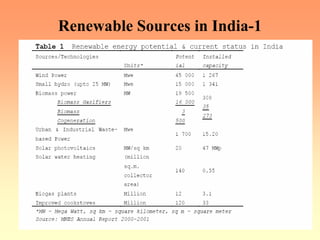
Renewable Sources in India-1
Hybrid System
LOAD DISCRIPTION :
¾ Here for the purpose of analysis a house of middle class family
is taken as the load.
¾ This is around 2kW.All the hybrid system which are going to
discuss is for a house or for the around 10 no of house (for big
system).
Calculation For Power Output From Different Source:
¾ Power out put from PV array: For design of a PV system.
¾ we should know how much solar energy is received at the
concern place.
¾ It is effected by sun position, could covering atmospheric affect
,and the angle at which the collector is placed , called tilt angle
‘β’.
Calculation For Power Output From
Different Source
¾ Normally this angle is equal to the latitude of the concern
place.
¾ The related equation for estimation of the radiation is listed
below [1]:
• Isolation ‘i =Io{ cos ϕ cos δ cos ω + sin ϕ sin δ } kW/m2
• Io = Isc [1 + 0.033 cos (360N/365)] where Isc solar constant.
=1.37 kW/m2
wss
o
wsr
H 'idt
= ∫
ωsr = hour angle when sun rising
ωss = hour angle when sun setting
Calculation For Power Output From
Different Source-1
• = (24/π) Isc [1+ 0.033 cos (360N/365)] {cos ϕ cos δ cos ω
+ sin ϕ sin δ} kWh/m2/day
• HoA= energy falling on the concern place considering
atmospheric effect
= KT Ho kWh/m2/day where KT dearness index.
• KT = A1 + A2 sin (t) + A3 sin (2t) + A4sin (3t) + A5 cos (t)
+ A6 cos (2t) + A7 cos (3t)
t = (2π/365) (N-80) N= 1 for Jan 1st
Calculation For Power Output From
Different Source-2
• Ai = ai1 + ai2 x + ai3 x2 + ai4 w + ai5 w2
Where x = (ϕ - 35)
ϕ = Latitude in deg
w = total perceptible water vapor in atoms gm/cm2
• Ht = energy falling on the tilt surface at the concern place
= RD HoA kWh/m2/d
• RD = tilted factor
for the sizing the PV panel is given by[1]
Wpeak = {1/ hpeak } [ (Wh((load) * No of no sun days / (ηb * no of
discharging .Days)) + Whload(day) + Whload(night)/ ηb)]
• Where: ηb = battery efficiency
• hpeak = no of hours for which peak insolation falls on the
PV cell
Power Output From Wind Source
¾ The speed of wind is a random process; therefore it should be
described in terms of statistical methods.
¾ The wind speed data were recorded near the ground surface.
¾ To upgrade wind speed data to a particular hub height, the
following equation is commonly used [2]
v = vi- (H/Hi)α
• Where: v-wind speed at projected height, H
• vi-wind speed at reference height, Hi
• α- Power-law exponent (- 1/7 for open land).
Power Output From Wind Source-1
Let
¾ m = Mass (in kg) of the air in the hypothetical cylinder which
radius is equal to the vane length
v = the velocity of air in m/s.
So kinetic energy
E = m u2 / 2
Power output Pw = (v2/2) × dm/ dt
= ρ× (v2/2) × dQ /dt
= ρ× (v3/2) ×A
Where:
Q = Au = volume of air
ρ = 1.2 ( kg/m3 ) (at mean sea level)
Power Output From Wind Source-2
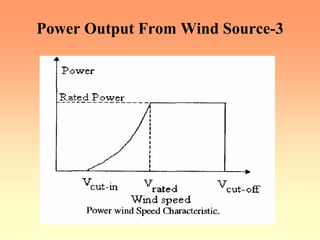
Pw = 0.6 A u3
pa = Pw /A = 0.6u3 = power density (in W/m2) [1]
Pw is the electrical power output of the turbine.
¾ The available wind generator power output is a function of
wind velocity v
( )
( )
3 3
R c1
R ci
3 3
R co
w
R co R
P V V
forV V V
V V
P
P 0 for V V V
⎡ ⎤
−
≥ ≥
⎢ ⎥
−
= ⎢ ⎥
⎢ ⎥
≥ ≥
⎣ ⎦
Power Output From Wind Source-3
Calculation Of The Capacity Of The
Battery Bank
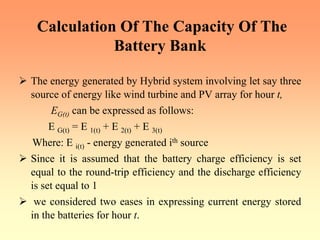
¾ The energy generated by Hybrid system involving let say three
source of energy like wind turbine and PV array for hour t,
EG(t) can be expressed as follows:
E G(t) = E 1(t) + E 2(t) + E 3(t)
Where: E i(t) - energy generated ith source
¾ Since it is assumed that the battery charge efficiency is set
equal to the round-trip efficiency and the discharge efficiency
is set equal to 1
¾ we considered two eases in expressing current energy stored
in the batteries for hour t.
Calculation Of The Capacity Of The
Battery Bank-1
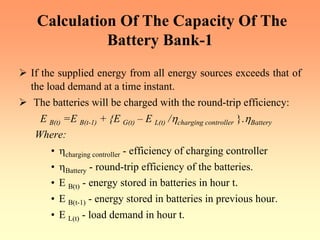
¾ If the supplied energy from all energy sources exceeds that of
the load demand at a time instant.
¾ The batteries will be charged with the round-trip efficiency:
E B(t) =E B(t-1) + {E G(t) – E L(t) /ηcharging controller }.ηBattery
Where:
• ηcharging controller - efficiency of charging controller
• ηBattery - round-trip efficiency of the batteries.
• E B(t) - energy stored in batteries in hour t.
• E B(t-1) - energy stored in batteries in previous hour.
• E L(t) - load demand in hour t.
Calculation Of The Capacity Of The
Battery Bank-2
¾ When the load demand is greater than the available energy
generated,
¾ The batteries will be discharged by the amount that is needed
to cover the deficit. It can be expressed as follows:
E B(t) = E B(t-1) - { E L(t) /η charging controller – E G(t) }
¾ The energy stored in batteries at any hour t is subject to the
following constraint:
E Bmax ≥ E B(t) ≥ EBmin
¾ That means that batteries should not be over discharged or
overcharged at any time. That protects batteries from being
damaged.[2].
Feature of Hybrid System
¾ Hybrid systems can address limitations in terms of fuel
flexibility,efficiency, reliability, emissions and / or economics.
¾ Incorporating heat, power, and highly efficient devices (fuel
cells, advanced materials, cooling systems, etc.) can increase
overall efficiency .
¾ conserve energy for a hybrid system when compared with
individual technologies.
¾ Achieving higher reliability can be accomplished with
redundant technologies and/or energy storage.
Feature of Hybrid System-1
¾ Some hybrid systems typically include both, which can
simultaneously improve the quality and availability of power.
• Hybrid systems can be designed to maximize the use of
renewable.
• Resulting in a system with lower emissions than traditional
fossil-fueled technologies.
• Hybrid systems can be designed to achieve desired attributes at
the lowest acceptable cost, which is the key to market
acceptance
Wind/PV Hybrid System
Wind/PV Hybrid System-1
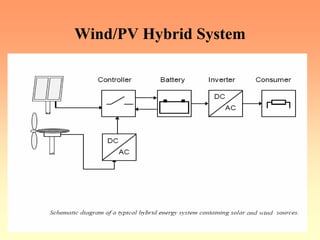
¾ A typical hybrid energy system consists of solar and wind
energy sources.
¾ The principle of an open loop hybrid system of this type is
shown in Figure above.
¾ The power produced by the wind generators is an AC voltage
but have variable amplitude and frequency that can then be
transformed into DC to charge the battery.
¾ The controller protects the battery from overcharging or deep
discharging.
¾ As high voltages can be used to reduce system losses, an
inverter is normally in traduced to transform the low DC
voltage to an AC voltage of 230V of frequency 50 Hz.
Wind/PV Hybrid System-2
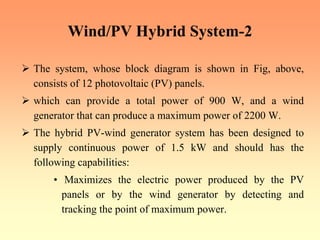
¾ The system, whose block diagram is shown in Fig, above,
consists of 12 photovoltaic (PV) panels.
¾ which can provide a total power of 900 W, and a wind
generator that can produce a maximum power of 2200 W.
¾ The hybrid PV-wind generator system has been designed to
supply continuous power of 1.5 kW and should has the
following capabilities:
• Maximizes the electric power produced by the PV
panels or by the wind generator by detecting and
tracking the point of maximum power.
Wind/PV Hybrid System-3
¾ Stores the electric energy in lead-acid batteries for a stable
repeater operation.
¾ Controls the charge and discharge processes of the batteries.
¾ Protects wind generator from over speeding by connecting a
dummy load to its output.
Wind/PV Hybrid System-4
¾ Initiates the operation of a diesel generator or connects the
system to the electric grid (if available), when the renewable
energy sources fail to produce sufficient electric energy.
¾ Provides continuous and uninterruptible electric power (220
V, 50 Hz) to a 1.5-kW house load.[10]
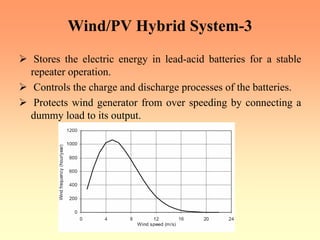
Local solar radiation information: high, low and average
values of daily solar radiation calculated over one year
PV/Hydro Hybrid System
PV/Hydro Hybrid System-1
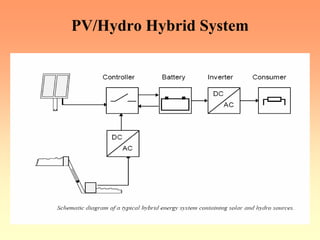
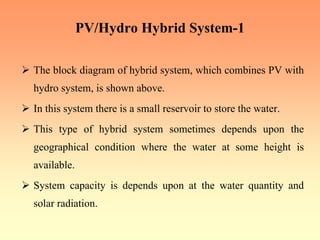
¾ The block diagram of hybrid system, which combines PV with
hydro system, is shown above.
¾ In this system there is a small reservoir to store the water.
¾ This type of hybrid system sometimes depends upon the
geographical condition where the water at some height is
available.
¾ System capacity is depends upon at the water quantity and
solar radiation.
PV/Hydro Hybrid System-2
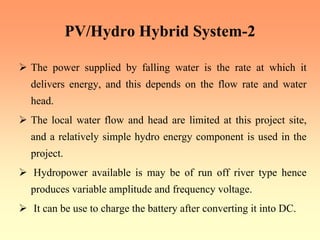
¾ The power supplied by falling water is the rate at which it
delivers energy, and this depends on the flow rate and water
head.
¾ The local water flow and head are limited at this project site,
and a relatively simple hydro energy component is used in the
project.
¾ Hydropower available is may be of run off river type hence
produces variable amplitude and frequency voltage.
¾ It can be use to charge the battery after converting it into DC.
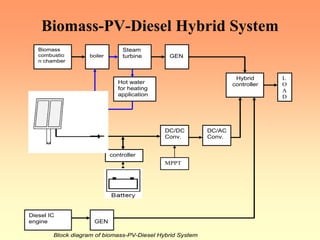
Biomass-PV-Diesel Hybrid System
Biomass
combustio
n chamber
boiler
Steam
turbine GEN
Hot water
for heating
application
controller
DC/DC
Conv.
DC/AC
Conv.
Hybrid
controller
Diesel IC
engine GEN
L
O
A
D
Block diagram of biomass-PV-Diesel Hybrid System
MPPT
Biomass Energy
¾ Biomass is matter usually thought of as garbage. Some of it is
just stuff lying around -- dead trees, tree branches, yard
clippings, leftover crops, wood chips and bark and sawdust
from lumber mills.
¾ It can even include used tires and livestock manure [5].
¾ The waste wood, tree branches and other scraps are gathered
together in big trucks.
¾ The trucks bring the waste from factories and from farms to a
biomass power plant.
¾ Here the biomass is dumped into huge hoppers. This is then fed
into a furnace where it is burned.
Biomass Energy-1
¾ Other application of Biomass is that it can also be tapped right
at the landfill with burning waster products.
¾ When garbage decomposes, it gives off methane gas.
¾ Pipelines are put into the landfills and the methane gas can be
collected.
¾ It is then used in power plants to make electricity. or use it for
street lighting.
¾ This type of biomass is called landfill gas[5].
¾ A similar thing can be done at animal feed lots.
¾ In places where lots of animals are raised, the animals - like
cattle, cows and even chickens - produce manure.
¾ When manure decomposes, it also gives off methane gas similar
to garbage.
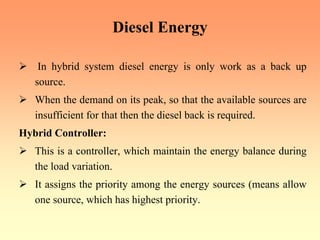
Diesel Energy
¾ In hybrid system diesel energy is only work as a back up
source.
¾ When the demand on its peak, so that the available sources are
insufficient for that then the diesel back is required.
Hybrid Controller:
¾ This is a controller, which maintain the energy balance during
the load variation.
¾ It assigns the priority among the energy sources (means allow
one source, which has highest priority.
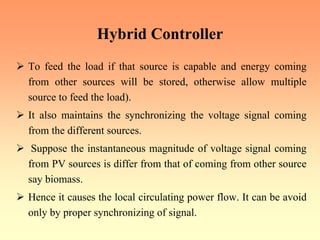
Hybrid Controller
¾ To feed the load if that source is capable and energy coming
from other sources will be stored, otherwise allow multiple
source to feed the load).
¾ It also maintains the synchronizing the voltage signal coming
from the different sources.
¾ Suppose the instantaneous magnitude of voltage signal coming
from PV sources is differ from that of coming from other source
say biomass.
¾ Hence it causes the local circulating power flow. It can be avoid
only by proper synchronizing of signal.
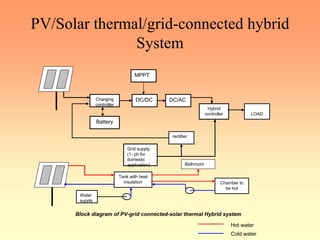
PV/Solar thermal/grid-connected hybrid
System
Battery
Charging
controller
DC/DC
MPPT
DC/AC
Hybrid
controller
Grid supply
(1- ph for
domestic
application)
LOAD
rectifier
Tank with heat
insulation
Bathroom
Chamber to
be hot
Water
supply
Block diagram of PV-grid connected-solar thermal Hybrid system
Hot water
Cold water
About Solar Thermal application
¾ Solar heat is one of the cheapest and most practical forms of
renewable energy.
¾ Here are few of the most common applications:
Solar Hot Water Heaters:
¾ The sun’s light is an excellent source of hot water for home or
commercial use, such as swimming pools, car washes and
Laundromats. [9]
Cooking:
¾ Simple solar ovens and cookers are used around the world in
both commercial kitchens and in people’s homes.
¾ Solar cookers can be made with everyday materials such as
cardboard and tinfoil. [9]
PV-Solar Thermal-Grid Hybrid System
Description
¾ In the above hybrid system PV-electric power grid is used as
the energy source, for the heating application like hot water for
bathing or to heat a room or chamber, solar water heater is
used.
¾ The hybrid controller is work for synchronizing of the
different sources as discussed in sec 7.3
¾ This system are suitable for the places where the solar
radiation is available but other sources like wind, wave etc not
have good potential and other fusil sources are not economic
for generation hence this kind of hybrid system which
involving power grid as back-up energy source is good choice.
Hybrid System Characteristics
¾ Although hybrid energy systems are open, they can have the
characteristics of a closed system if a subsystem with the
function of “monitoring” is introduced as a feedback between
output (consumer) and input (controller).
¾ As inputs of particular hybrid system cannot be changed.
However, the load may be changed.
¾ With a backup system as another energy source (for example a
diesel generator), the system can be designed as a partial
closed-loop feedback system.
Hybrid System Characteristics-1
¾ There are various possibly to make combination of different
energy sources.
¾ Selection of energy source for hybrid system is mainly depends
upon availability at the place where it going to stabilized.
¾ In general in India solar energy is available almost all the places
and infrastructure for power generation is rugged.
¾ Hence need low maintenance so it is smart to choose to have
PV one of the energy sources in hybrid system.
Hybrid System Characteristics-2
¾ Wave and tidal energy available only at sea shore and need large
capital investment and more maintenance, therefore not
compatible for household hybrid system.
¾ But can be use in large power hybrid system.
¾ Corrosion because of seawater is a major drawback.
¾ Wind energy source is also a good choice but more preferable
for open land hybrid system.
¾ And status of wind throughout the year is also important.
Hybrid System Characteristics-3
¾ India has monsoon climate hence has enough potential of wind
energy.
¾ Biomass energy is good option but it needs regular feeding to
continuously operate.
¾ Biomass with grid hybrid system is broadly used in sugar mill
in India.
¾ In residential applications, biomass can be used for space
heating or for cooking.
¾ Businesses and industry use biomass for several purposes
including space heating, hot water heating, and electricity
generation.
Hybrid System Characteristics-4
¾ For the system to be more reliable and have low cost, power
grid should be involve in the hybrid system
¾ All energy sources have an impact on the environment.
¾ Concerns about the greenhouse effect and global warming, air
pollution.
¾ energy security have led to increasing interest and more
development in renewable energy sources such as solar, wind,
geothermal, wave power and hydrogen.

teach_slides10.pdf

  • 1.
    Hybrid Systems Introduction ¾As conventionfossil fuel energy sources diminish and the world’s environmental concern about acid deposition and global warming increases, renewable energy sources (solar, wind, tidal, biomass and geothermal etc) are attracting more attention as alternative energy sources. ¾These are all pollution free and one can say eco friendly. ¾These are available at free of cost.
  • 2.
    Hybrid Systems-1 ¾ InIndia, there is severe power shortage and associated power quality problems. ¾ The quality of the grid supply in some places is characterized by large voltage and frequency fluctuations, scheduled and un scheduled power cuts and load restrictions. ¾ Load shedding in many cities in India due to power shortage and faults is a major problem for which there is no immediate remedy in the near future since the gap between the power demand and supply is increasing every year.
  • 3.
    Hybrid Systems-2 ¾ InIndia wind and solar energy sources are available all over the year at free of cost whereas tidal and wave are coastal area. ¾ Geothermal is available at specific location. ¾ To meet the demand and for the sake of continuity of power supply, storing of energy is necessary. ¾ The term hybrid power system is used to describe any power system combine two or more energy conversion devices, or two or more fuels for the same device, that when integrated, overcome limitations inherent in either.
  • 4.
    Hybrid Systems-3 ¾ Usuallyone of the energy sources is a conventional one (which necessarily does not depend on renewable energy resource) powered by a diesel engine, ¾ while the other(s) would be renewable viz. solar photovoltaic, wind or hydro. ¾ The design and structure of a hybrid energy system obviously take into account the types of renewable energy sources available locally, and the consumption the system supports. ¾ For example, the hybrid energy system presented here is a small-scale system and the consumption of power takes place during nights.
  • 5.
    Hybrid Systems-4 ¾ Thewind energy component will make a more significant contribution in the hybrid system than solar energy. ¾ Although the energy produced by wind during night can be used directly without storage. ¾ Battery is needed to store solar and wind energy produced during the day. ¾ In addition to the technical considerations, cost benefit is a factor that has to be incorporated into the process of optimizing a hybrid energy system.
  • 6.
    Hybrid Systems-5 ¾ Ingeneral, the use of wind energy is cheaper than that of solar energy. ¾ In areas where there is a limited wind source, a wind system has to be over-dimensioned in order to produce the required power, and this results in higher plant costs. ¾ It has been demonstrated that hybrid energy systems (renewable coupled with conventional energy source) can significantly reduce the total life cycle cost of a stand alone power supplies in many off-grid situations.
  • 7.
    Hybrid Systems-6 ¾ whileat the same time providing a reliable supply of electricity using a combination of energy sources. ¾ Numerous hybrid systems have been installed across the world, and expanding renewable energy industry has now developed reliable and cost competitive systems using a variety of technologies. ¾ Research in the development of hybrid systems focused on the performance analysis of demonstration systems and development of efficient power converters.
  • 8.
    Renewable Sources inIndia ¾ India has a large potential for renewable energy (RE), an estimated aggregate of more than 100,000 MW. ¾ In addition, the scope for generating power and thermal applications using solar energy (since most parts of the country receive sunlight almost throughout the year) is huge. ¾ However, only a fraction of the aggregate potential in renewable, and particularly solar energy, has been utilized so far.
  • 9.
  • 10.
    Hybrid System LOAD DISCRIPTION: ¾ Here for the purpose of analysis a house of middle class family is taken as the load. ¾ This is around 2kW.All the hybrid system which are going to discuss is for a house or for the around 10 no of house (for big system). Calculation For Power Output From Different Source: ¾ Power out put from PV array: For design of a PV system. ¾ we should know how much solar energy is received at the concern place. ¾ It is effected by sun position, could covering atmospheric affect ,and the angle at which the collector is placed , called tilt angle ‘β’.
  • 11.
    Calculation For PowerOutput From Different Source ¾ Normally this angle is equal to the latitude of the concern place. ¾ The related equation for estimation of the radiation is listed below [1]: • Isolation ‘i =Io{ cos ϕ cos δ cos ω + sin ϕ sin δ } kW/m2 • Io = Isc [1 + 0.033 cos (360N/365)] where Isc solar constant. =1.37 kW/m2 wss o wsr H 'idt = ∫ ωsr = hour angle when sun rising ωss = hour angle when sun setting
  • 12.
    Calculation For PowerOutput From Different Source-1 • = (24/π) Isc [1+ 0.033 cos (360N/365)] {cos ϕ cos δ cos ω + sin ϕ sin δ} kWh/m2/day • HoA= energy falling on the concern place considering atmospheric effect = KT Ho kWh/m2/day where KT dearness index. • KT = A1 + A2 sin (t) + A3 sin (2t) + A4sin (3t) + A5 cos (t) + A6 cos (2t) + A7 cos (3t) t = (2π/365) (N-80) N= 1 for Jan 1st
  • 13.
    Calculation For PowerOutput From Different Source-2 • Ai = ai1 + ai2 x + ai3 x2 + ai4 w + ai5 w2 Where x = (ϕ - 35) ϕ = Latitude in deg w = total perceptible water vapor in atoms gm/cm2 • Ht = energy falling on the tilt surface at the concern place = RD HoA kWh/m2/d • RD = tilted factor for the sizing the PV panel is given by[1] Wpeak = {1/ hpeak } [ (Wh((load) * No of no sun days / (ηb * no of discharging .Days)) + Whload(day) + Whload(night)/ ηb)] • Where: ηb = battery efficiency • hpeak = no of hours for which peak insolation falls on the PV cell
  • 14.
    Power Output FromWind Source ¾ The speed of wind is a random process; therefore it should be described in terms of statistical methods. ¾ The wind speed data were recorded near the ground surface. ¾ To upgrade wind speed data to a particular hub height, the following equation is commonly used [2] v = vi- (H/Hi)α • Where: v-wind speed at projected height, H • vi-wind speed at reference height, Hi • α- Power-law exponent (- 1/7 for open land).
  • 15.
    Power Output FromWind Source-1 Let ¾ m = Mass (in kg) of the air in the hypothetical cylinder which radius is equal to the vane length v = the velocity of air in m/s. So kinetic energy E = m u2 / 2 Power output Pw = (v2/2) × dm/ dt = ρ× (v2/2) × dQ /dt = ρ× (v3/2) ×A Where: Q = Au = volume of air ρ = 1.2 ( kg/m3 ) (at mean sea level)
  • 16.
    Power Output FromWind Source-2 Pw = 0.6 A u3 pa = Pw /A = 0.6u3 = power density (in W/m2) [1] Pw is the electrical power output of the turbine. ¾ The available wind generator power output is a function of wind velocity v ( ) ( ) 3 3 R c1 R ci 3 3 R co w R co R P V V forV V V V V P P 0 for V V V ⎡ ⎤ − ≥ ≥ ⎢ ⎥ − = ⎢ ⎥ ⎢ ⎥ ≥ ≥ ⎣ ⎦
  • 17.
    Power Output FromWind Source-3
  • 18.
    Calculation Of TheCapacity Of The Battery Bank ¾ The energy generated by Hybrid system involving let say three source of energy like wind turbine and PV array for hour t, EG(t) can be expressed as follows: E G(t) = E 1(t) + E 2(t) + E 3(t) Where: E i(t) - energy generated ith source ¾ Since it is assumed that the battery charge efficiency is set equal to the round-trip efficiency and the discharge efficiency is set equal to 1 ¾ we considered two eases in expressing current energy stored in the batteries for hour t.
  • 19.
    Calculation Of TheCapacity Of The Battery Bank-1 ¾ If the supplied energy from all energy sources exceeds that of the load demand at a time instant. ¾ The batteries will be charged with the round-trip efficiency: E B(t) =E B(t-1) + {E G(t) – E L(t) /ηcharging controller }.ηBattery Where: • ηcharging controller - efficiency of charging controller • ηBattery - round-trip efficiency of the batteries. • E B(t) - energy stored in batteries in hour t. • E B(t-1) - energy stored in batteries in previous hour. • E L(t) - load demand in hour t.
  • 20.
    Calculation Of TheCapacity Of The Battery Bank-2 ¾ When the load demand is greater than the available energy generated, ¾ The batteries will be discharged by the amount that is needed to cover the deficit. It can be expressed as follows: E B(t) = E B(t-1) - { E L(t) /η charging controller – E G(t) } ¾ The energy stored in batteries at any hour t is subject to the following constraint: E Bmax ≥ E B(t) ≥ EBmin ¾ That means that batteries should not be over discharged or overcharged at any time. That protects batteries from being damaged.[2].
  • 21.
    Feature of HybridSystem ¾ Hybrid systems can address limitations in terms of fuel flexibility,efficiency, reliability, emissions and / or economics. ¾ Incorporating heat, power, and highly efficient devices (fuel cells, advanced materials, cooling systems, etc.) can increase overall efficiency . ¾ conserve energy for a hybrid system when compared with individual technologies. ¾ Achieving higher reliability can be accomplished with redundant technologies and/or energy storage.
  • 22.
    Feature of HybridSystem-1 ¾ Some hybrid systems typically include both, which can simultaneously improve the quality and availability of power. • Hybrid systems can be designed to maximize the use of renewable. • Resulting in a system with lower emissions than traditional fossil-fueled technologies. • Hybrid systems can be designed to achieve desired attributes at the lowest acceptable cost, which is the key to market acceptance
  • 23.
  • 24.
    Wind/PV Hybrid System-1 ¾A typical hybrid energy system consists of solar and wind energy sources. ¾ The principle of an open loop hybrid system of this type is shown in Figure above. ¾ The power produced by the wind generators is an AC voltage but have variable amplitude and frequency that can then be transformed into DC to charge the battery. ¾ The controller protects the battery from overcharging or deep discharging. ¾ As high voltages can be used to reduce system losses, an inverter is normally in traduced to transform the low DC voltage to an AC voltage of 230V of frequency 50 Hz.
  • 25.
    Wind/PV Hybrid System-2 ¾The system, whose block diagram is shown in Fig, above, consists of 12 photovoltaic (PV) panels. ¾ which can provide a total power of 900 W, and a wind generator that can produce a maximum power of 2200 W. ¾ The hybrid PV-wind generator system has been designed to supply continuous power of 1.5 kW and should has the following capabilities: • Maximizes the electric power produced by the PV panels or by the wind generator by detecting and tracking the point of maximum power.
  • 26.
    Wind/PV Hybrid System-3 ¾Stores the electric energy in lead-acid batteries for a stable repeater operation. ¾ Controls the charge and discharge processes of the batteries. ¾ Protects wind generator from over speeding by connecting a dummy load to its output.
  • 27.
    Wind/PV Hybrid System-4 ¾Initiates the operation of a diesel generator or connects the system to the electric grid (if available), when the renewable energy sources fail to produce sufficient electric energy. ¾ Provides continuous and uninterruptible electric power (220 V, 50 Hz) to a 1.5-kW house load.[10] Local solar radiation information: high, low and average values of daily solar radiation calculated over one year
  • 28.
  • 29.
    PV/Hydro Hybrid System-1 ¾The block diagram of hybrid system, which combines PV with hydro system, is shown above. ¾ In this system there is a small reservoir to store the water. ¾ This type of hybrid system sometimes depends upon the geographical condition where the water at some height is available. ¾ System capacity is depends upon at the water quantity and solar radiation.
  • 30.
    PV/Hydro Hybrid System-2 ¾The power supplied by falling water is the rate at which it delivers energy, and this depends on the flow rate and water head. ¾ The local water flow and head are limited at this project site, and a relatively simple hydro energy component is used in the project. ¾ Hydropower available is may be of run off river type hence produces variable amplitude and frequency voltage. ¾ It can be use to charge the battery after converting it into DC.
  • 31.
    Biomass-PV-Diesel Hybrid System Biomass combustio nchamber boiler Steam turbine GEN Hot water for heating application controller DC/DC Conv. DC/AC Conv. Hybrid controller Diesel IC engine GEN L O A D Block diagram of biomass-PV-Diesel Hybrid System MPPT
  • 32.
    Biomass Energy ¾ Biomassis matter usually thought of as garbage. Some of it is just stuff lying around -- dead trees, tree branches, yard clippings, leftover crops, wood chips and bark and sawdust from lumber mills. ¾ It can even include used tires and livestock manure [5]. ¾ The waste wood, tree branches and other scraps are gathered together in big trucks. ¾ The trucks bring the waste from factories and from farms to a biomass power plant. ¾ Here the biomass is dumped into huge hoppers. This is then fed into a furnace where it is burned.
  • 33.
    Biomass Energy-1 ¾ Otherapplication of Biomass is that it can also be tapped right at the landfill with burning waster products. ¾ When garbage decomposes, it gives off methane gas. ¾ Pipelines are put into the landfills and the methane gas can be collected. ¾ It is then used in power plants to make electricity. or use it for street lighting. ¾ This type of biomass is called landfill gas[5]. ¾ A similar thing can be done at animal feed lots. ¾ In places where lots of animals are raised, the animals - like cattle, cows and even chickens - produce manure. ¾ When manure decomposes, it also gives off methane gas similar to garbage.
  • 34.
    Diesel Energy ¾ Inhybrid system diesel energy is only work as a back up source. ¾ When the demand on its peak, so that the available sources are insufficient for that then the diesel back is required. Hybrid Controller: ¾ This is a controller, which maintain the energy balance during the load variation. ¾ It assigns the priority among the energy sources (means allow one source, which has highest priority.
  • 35.
    Hybrid Controller ¾ Tofeed the load if that source is capable and energy coming from other sources will be stored, otherwise allow multiple source to feed the load). ¾ It also maintains the synchronizing the voltage signal coming from the different sources. ¾ Suppose the instantaneous magnitude of voltage signal coming from PV sources is differ from that of coming from other source say biomass. ¾ Hence it causes the local circulating power flow. It can be avoid only by proper synchronizing of signal.
  • 36.
    PV/Solar thermal/grid-connected hybrid System Battery Charging controller DC/DC MPPT DC/AC Hybrid controller Gridsupply (1- ph for domestic application) LOAD rectifier Tank with heat insulation Bathroom Chamber to be hot Water supply Block diagram of PV-grid connected-solar thermal Hybrid system Hot water Cold water
  • 37.
    About Solar Thermalapplication ¾ Solar heat is one of the cheapest and most practical forms of renewable energy. ¾ Here are few of the most common applications: Solar Hot Water Heaters: ¾ The sun’s light is an excellent source of hot water for home or commercial use, such as swimming pools, car washes and Laundromats. [9] Cooking: ¾ Simple solar ovens and cookers are used around the world in both commercial kitchens and in people’s homes. ¾ Solar cookers can be made with everyday materials such as cardboard and tinfoil. [9]
  • 38.
    PV-Solar Thermal-Grid HybridSystem Description ¾ In the above hybrid system PV-electric power grid is used as the energy source, for the heating application like hot water for bathing or to heat a room or chamber, solar water heater is used. ¾ The hybrid controller is work for synchronizing of the different sources as discussed in sec 7.3 ¾ This system are suitable for the places where the solar radiation is available but other sources like wind, wave etc not have good potential and other fusil sources are not economic for generation hence this kind of hybrid system which involving power grid as back-up energy source is good choice.
  • 39.
    Hybrid System Characteristics ¾Although hybrid energy systems are open, they can have the characteristics of a closed system if a subsystem with the function of “monitoring” is introduced as a feedback between output (consumer) and input (controller). ¾ As inputs of particular hybrid system cannot be changed. However, the load may be changed. ¾ With a backup system as another energy source (for example a diesel generator), the system can be designed as a partial closed-loop feedback system.
  • 40.
    Hybrid System Characteristics-1 ¾There are various possibly to make combination of different energy sources. ¾ Selection of energy source for hybrid system is mainly depends upon availability at the place where it going to stabilized. ¾ In general in India solar energy is available almost all the places and infrastructure for power generation is rugged. ¾ Hence need low maintenance so it is smart to choose to have PV one of the energy sources in hybrid system.
  • 41.
    Hybrid System Characteristics-2 ¾Wave and tidal energy available only at sea shore and need large capital investment and more maintenance, therefore not compatible for household hybrid system. ¾ But can be use in large power hybrid system. ¾ Corrosion because of seawater is a major drawback. ¾ Wind energy source is also a good choice but more preferable for open land hybrid system. ¾ And status of wind throughout the year is also important.
  • 42.
    Hybrid System Characteristics-3 ¾India has monsoon climate hence has enough potential of wind energy. ¾ Biomass energy is good option but it needs regular feeding to continuously operate. ¾ Biomass with grid hybrid system is broadly used in sugar mill in India. ¾ In residential applications, biomass can be used for space heating or for cooking. ¾ Businesses and industry use biomass for several purposes including space heating, hot water heating, and electricity generation.
  • 43.
    Hybrid System Characteristics-4 ¾For the system to be more reliable and have low cost, power grid should be involve in the hybrid system ¾ All energy sources have an impact on the environment. ¾ Concerns about the greenhouse effect and global warming, air pollution. ¾ energy security have led to increasing interest and more development in renewable energy sources such as solar, wind, geothermal, wave power and hydrogen.