PROGRAMMING LOGIC
CONTROLLERS
Unit 4
Programmable Logic Controllers – Basic Structure
– Input / Output Processing – Programming –
Mnemonics – Timers, Internal relays and counters
– Shift Registers – Master and Jump Controls –
Data Handling – Analogs Input / Output –
Selection of a PLC.
2
Introduction
A Programmable logic controller is a solid
state digital electronic device, designed for
use in an industrial environment.
It is a microprocessor based specialized
computer that carries out control functions of
many functions of many types and levels of
complexity.
3
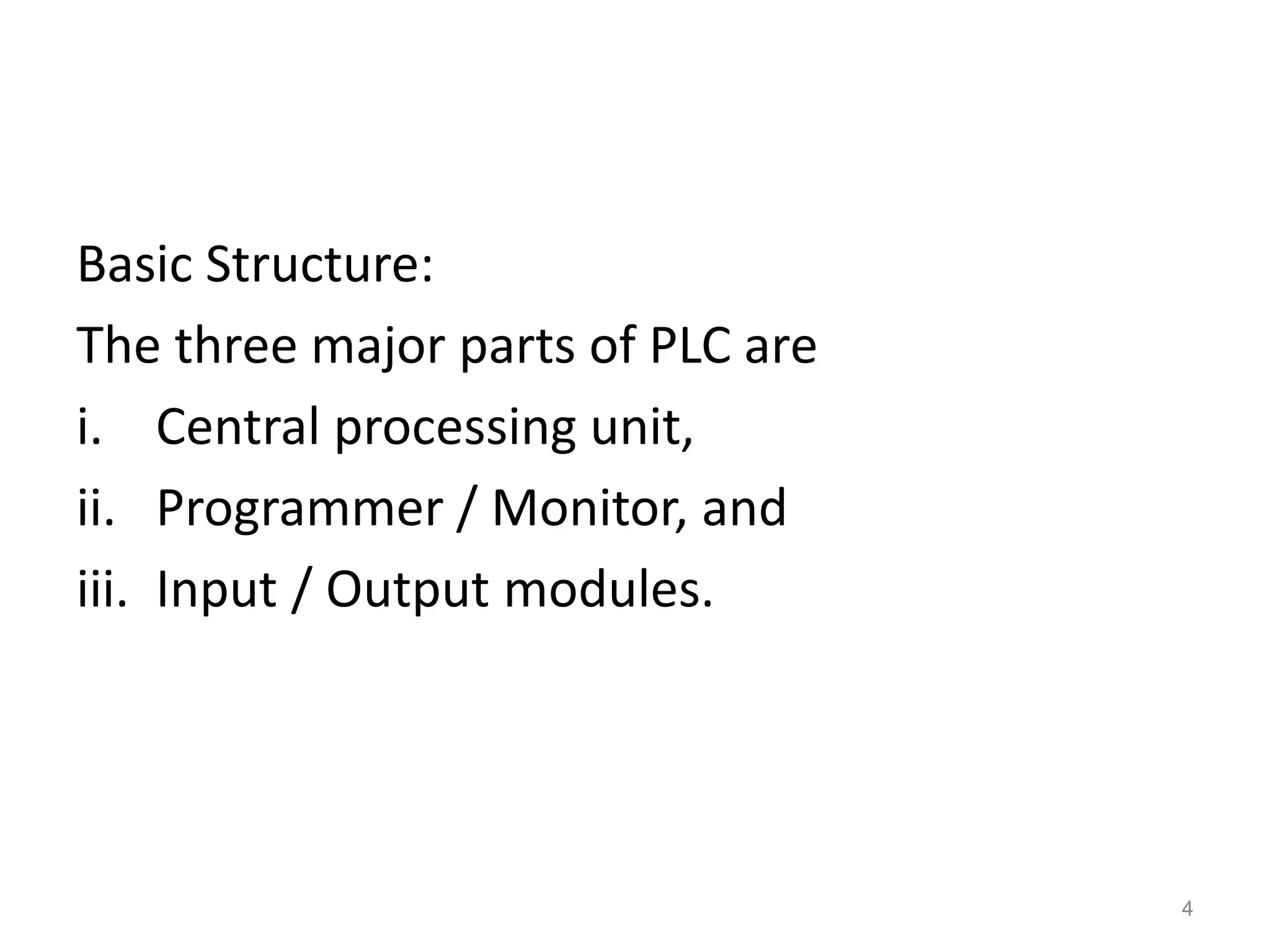
Basic Structure:
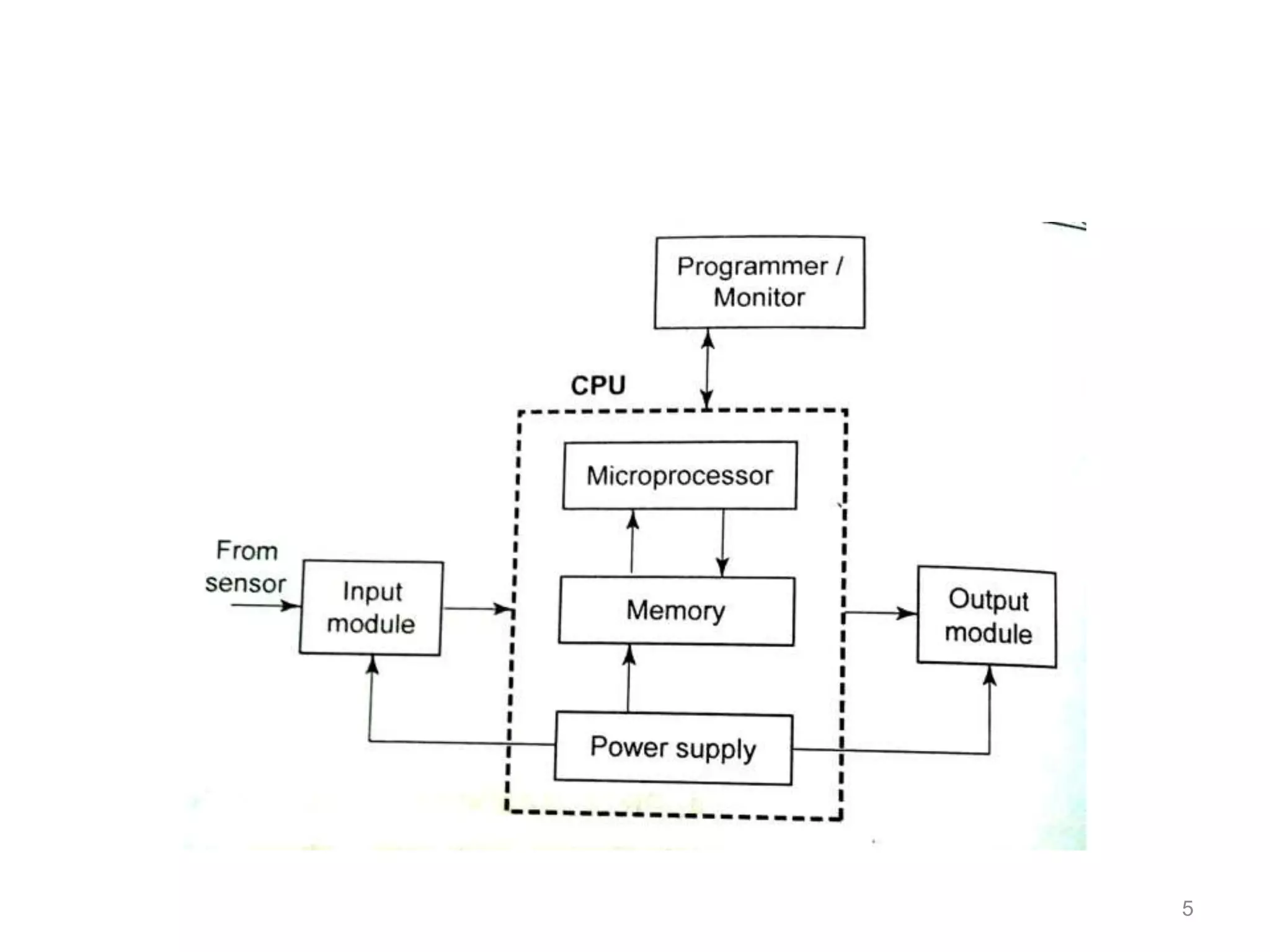
The three major parts of PLC are
i. Central processing unit,
ii. Programmer / Monitor, and
iii. Input / Output modules.
4
5
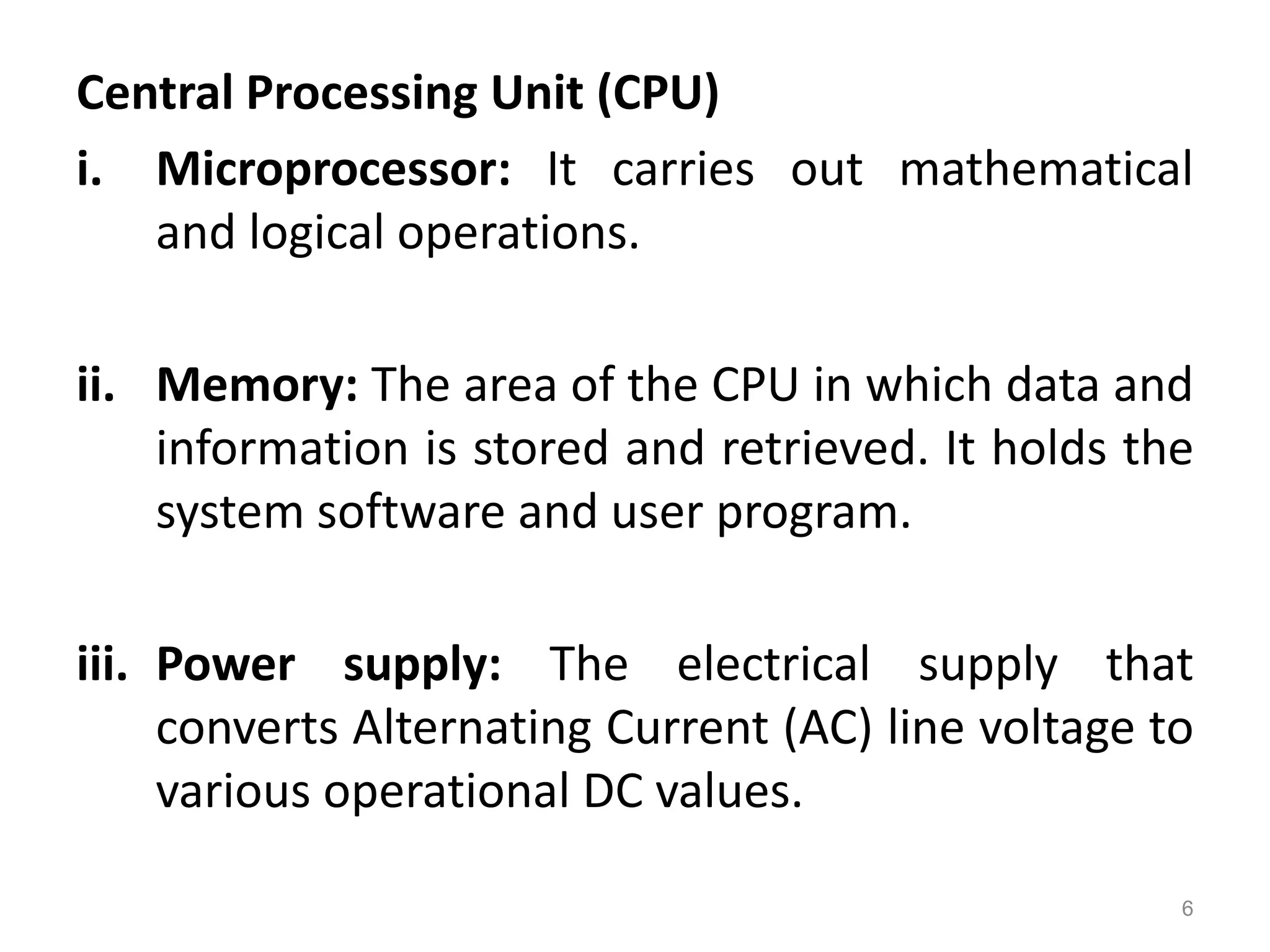
Central Processing Unit (CPU)
i. Microprocessor: It carries out mathematical
and logical operations.
ii. Memory: The area of the CPU in which data and
information is stored and retrieved. It holds the
system software and user program.
iii. Power supply: The electrical supply that
converts Alternating Current (AC) line voltage to
various operational DC values.
6
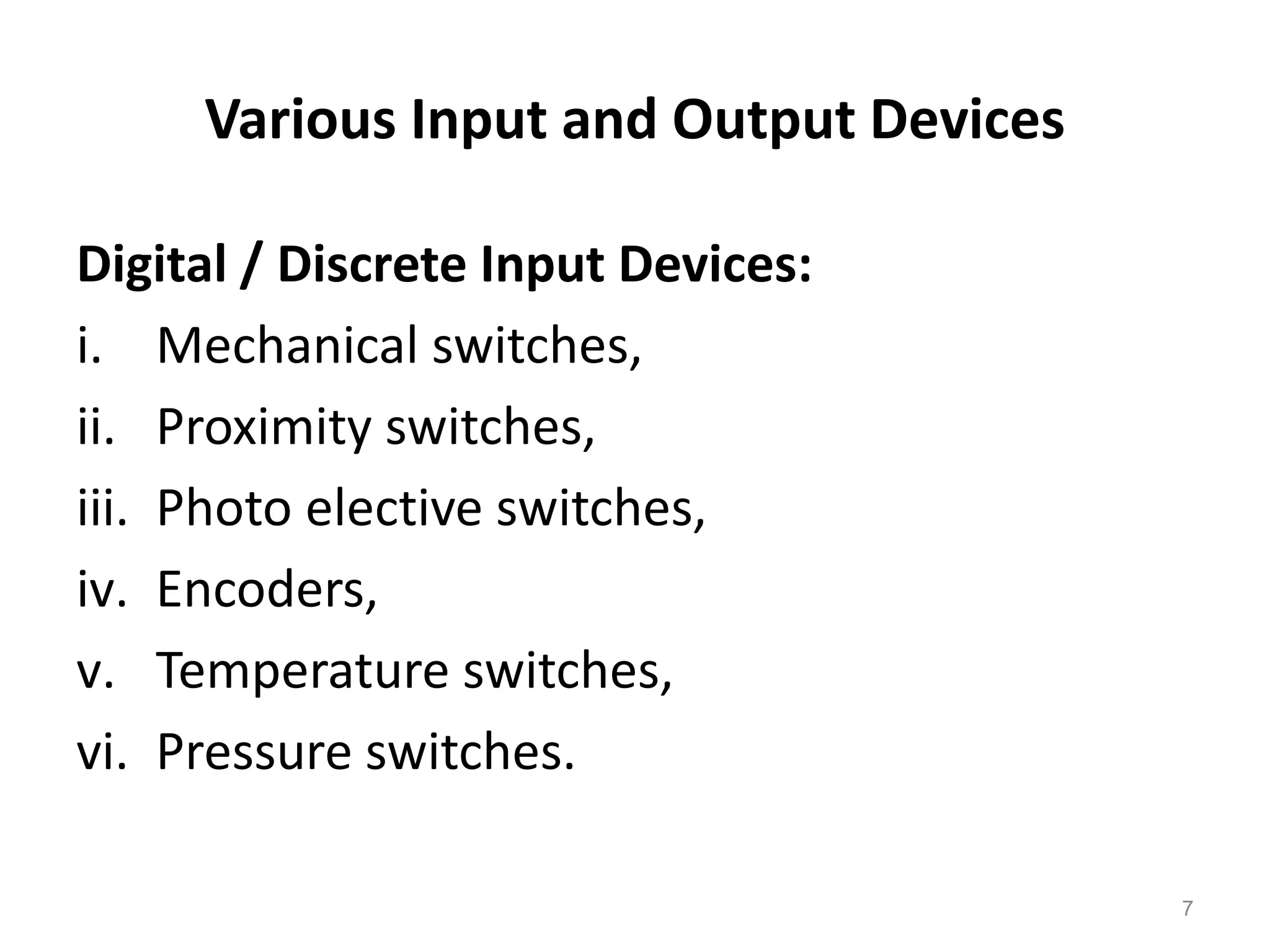
Various Input and Output Devices
Digital / Discrete Input Devices:
i. Mechanical switches,
ii. Proximity switches,
iii. Photo elective switches,
iv. Encoders,
v. Temperature switches,
vi. Pressure switches.
7
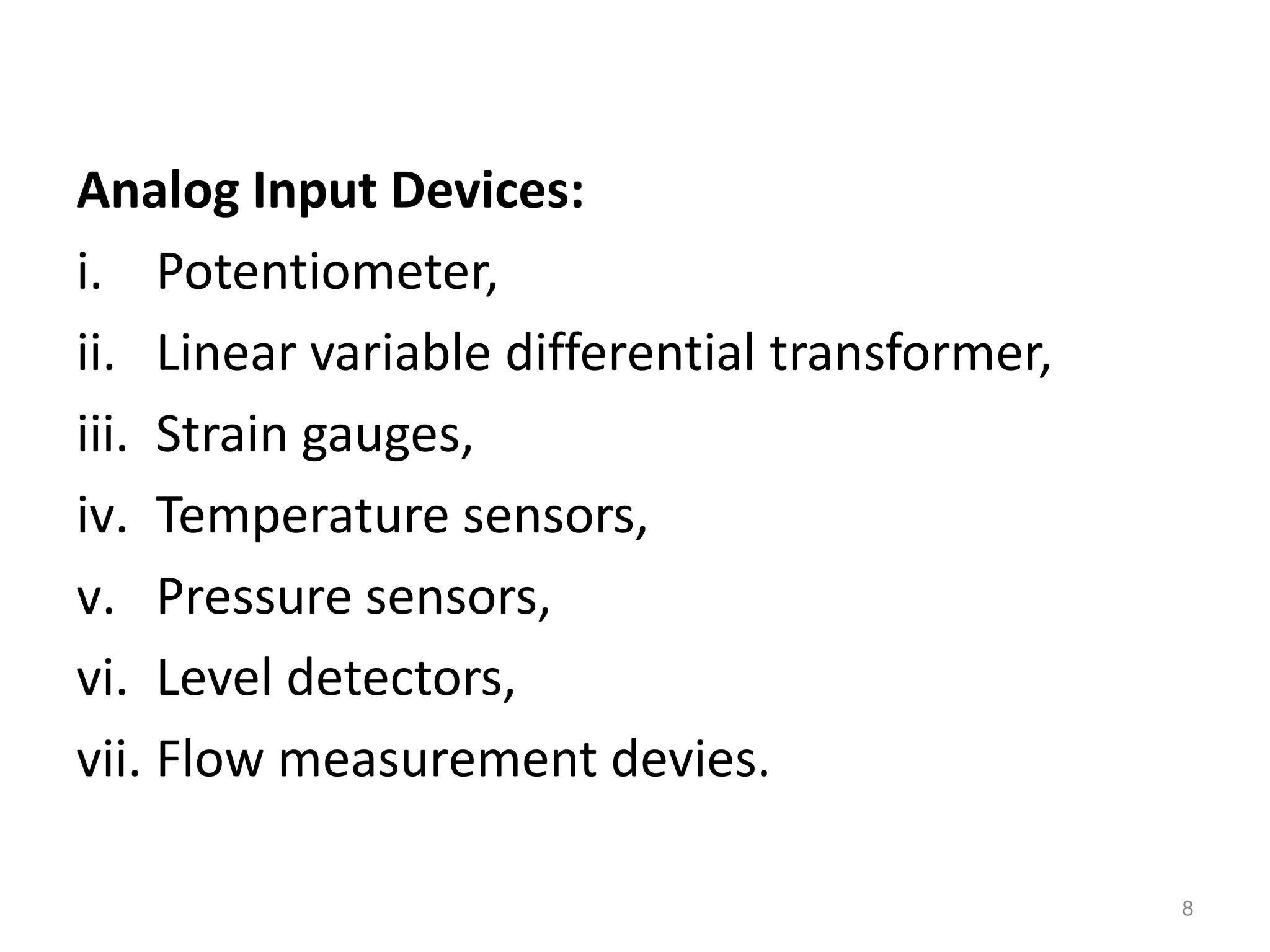
Analog Input Devices:
i. Potentiometer,
ii. Linear variable differential transformer,
iii. Strain gauges,
iv. Temperature sensors,
v. Pressure sensors,
vi. Level detectors,
vii. Flow measurement devies.
8
Output devices:
i. Contactors,
ii. Directional control valves,
iii. Motors, and
iv. Stepper motors.
9
PLCs Vs Computers
i. The application for PLC is for industrial
environment with wide variation in atmosphere
conditions and PLC is very rigid and compact.
ii. PLC programming can be accomplished in the
ladder logic by an electrician and technician
who have no much knowledge hardware and
softwares, whereas the computers will require
person with knowledge of hardware and
software.
10
iii. PLC deal with input/output in the form of sensors,
switches and actuators etc, through appropriate
interface units and computer receives inputs from
keyboard and gives output to a screen or printer.
iv. The power supply in industrial environment is
shared by many devices and therefore there can be
interruption of supply. Such disruption of supply
will normally not affect the program and storage of
data in PLC. In a computers such loss of data could
happen.
11
PLC Programming
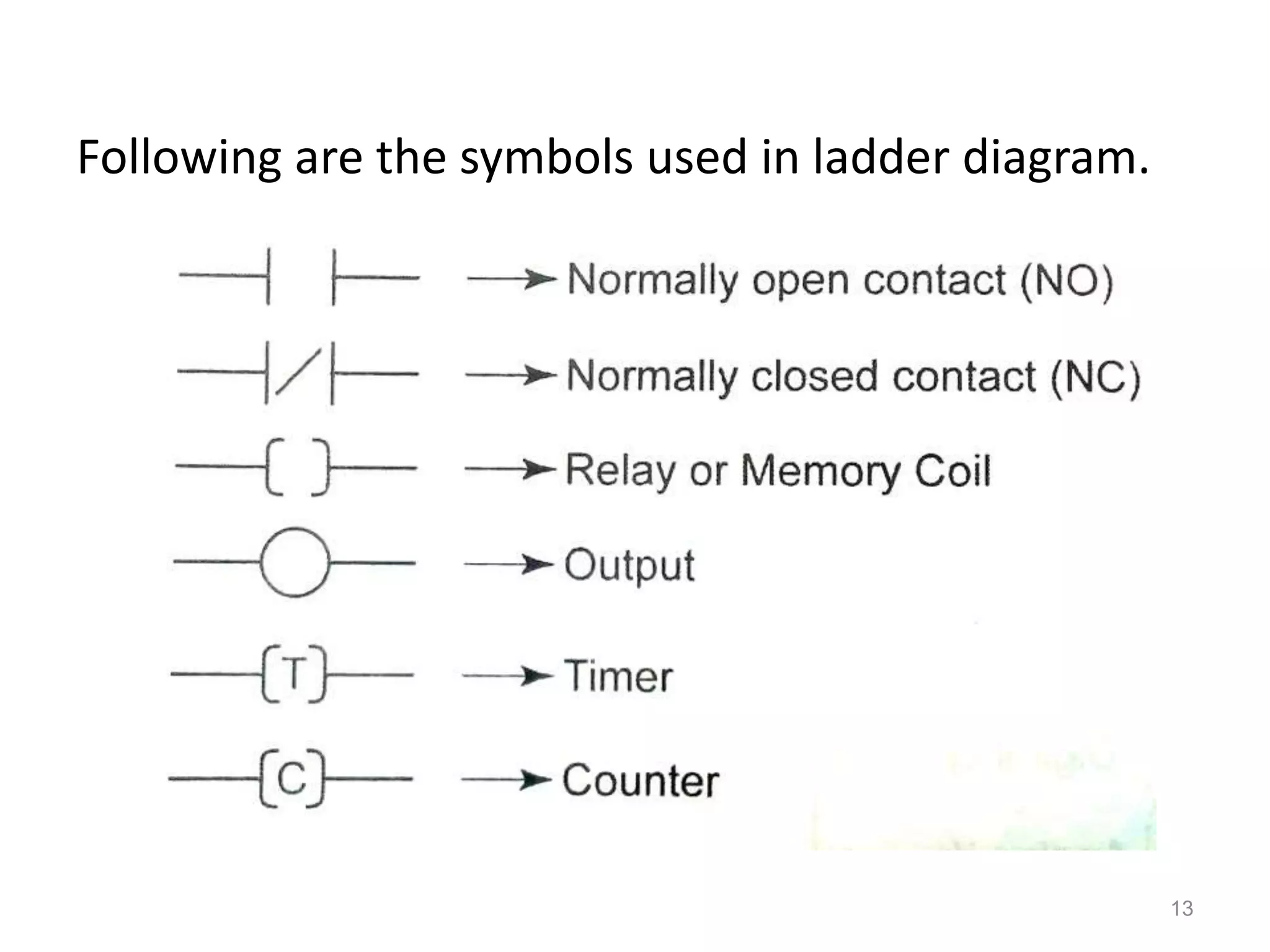
• Ladder diagram is commonly used
programming method evolved from electrical
relay circuits in the form of graphical
language.
• It is a network of contacts and coils are
arranged on rungs between two vertical lines
called rails.
12
Following are the symbols used in ladder diagram.
13
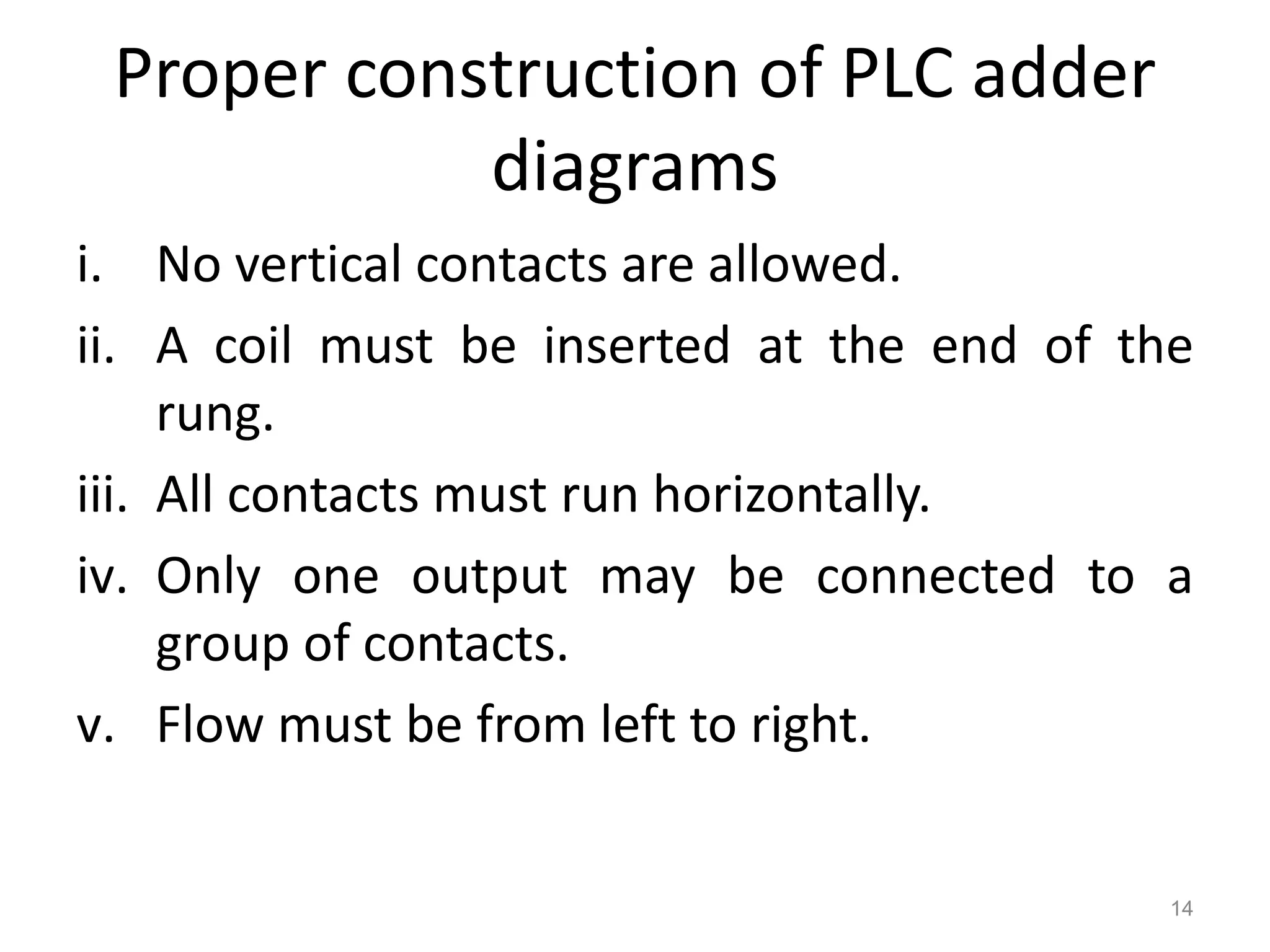
Proper construction of PLC adder
diagrams
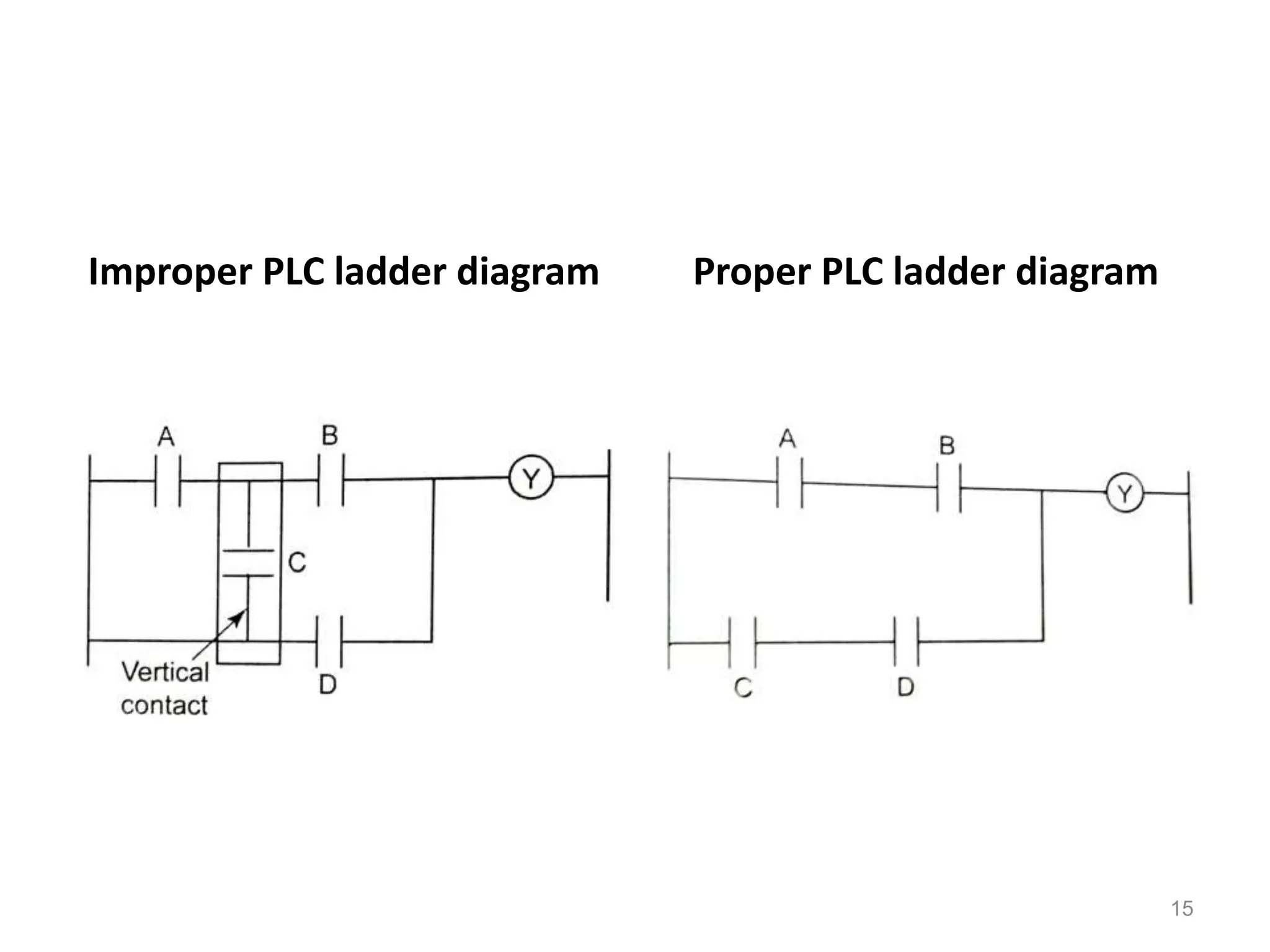
i. No vertical contacts are allowed.
ii. A coil must be inserted at the end of the
rung.
iii. All contacts must run horizontally.
iv. Only one output may be connected to a
group of contacts.
v. Flow must be from left to right.
14
Improper PLC ladder diagram Proper PLC ladder diagram
15
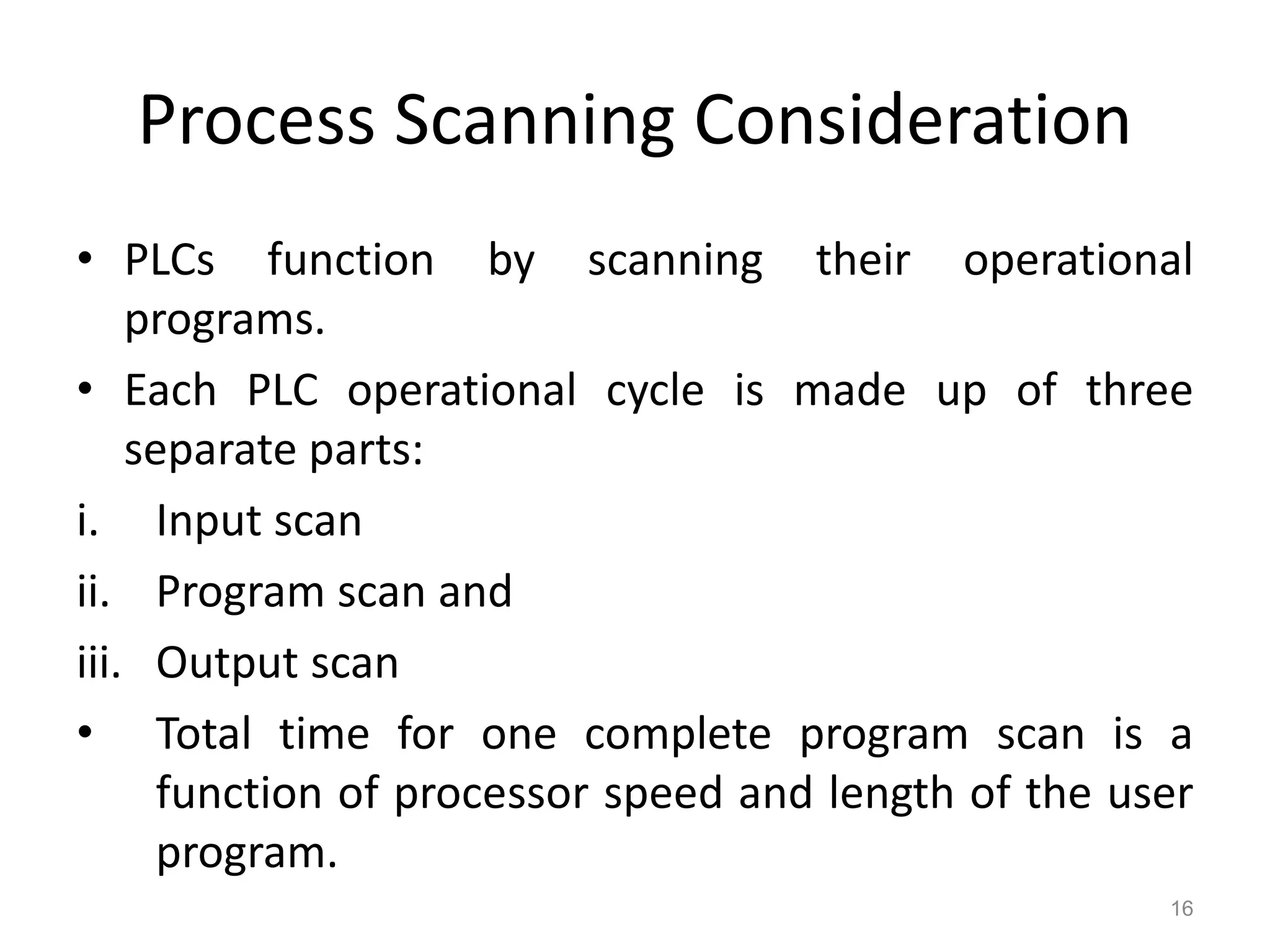
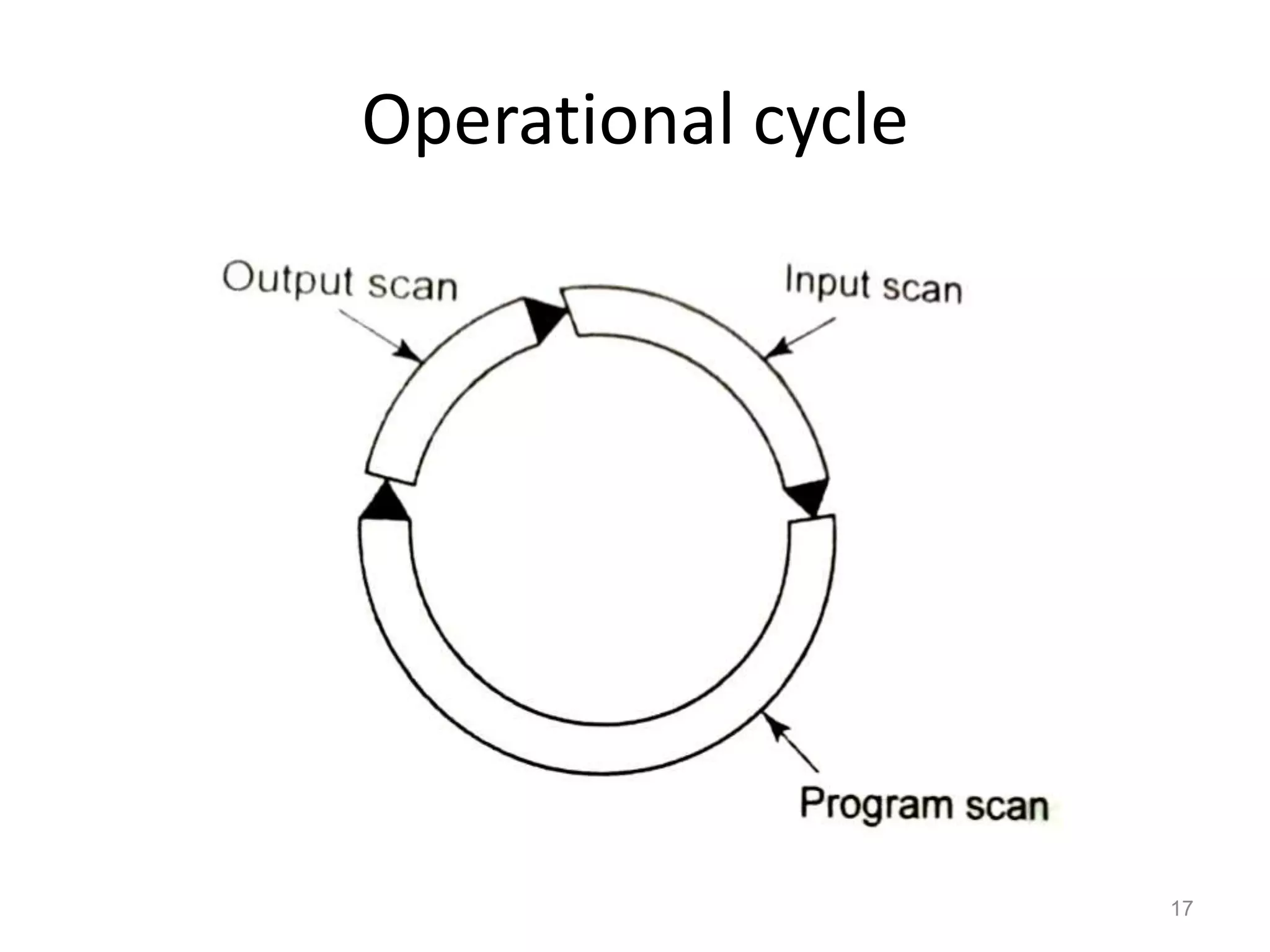
Process Scanning Consideration
• PLCs function by scanning their operational
programs.
• Each PLC operational cycle is made up of three
separate parts:
i. Input scan
ii. Program scan and
iii. Output scan
• Total time for one complete program scan is a
function of processor speed and length of the user
program.
16
Operational cycle
17
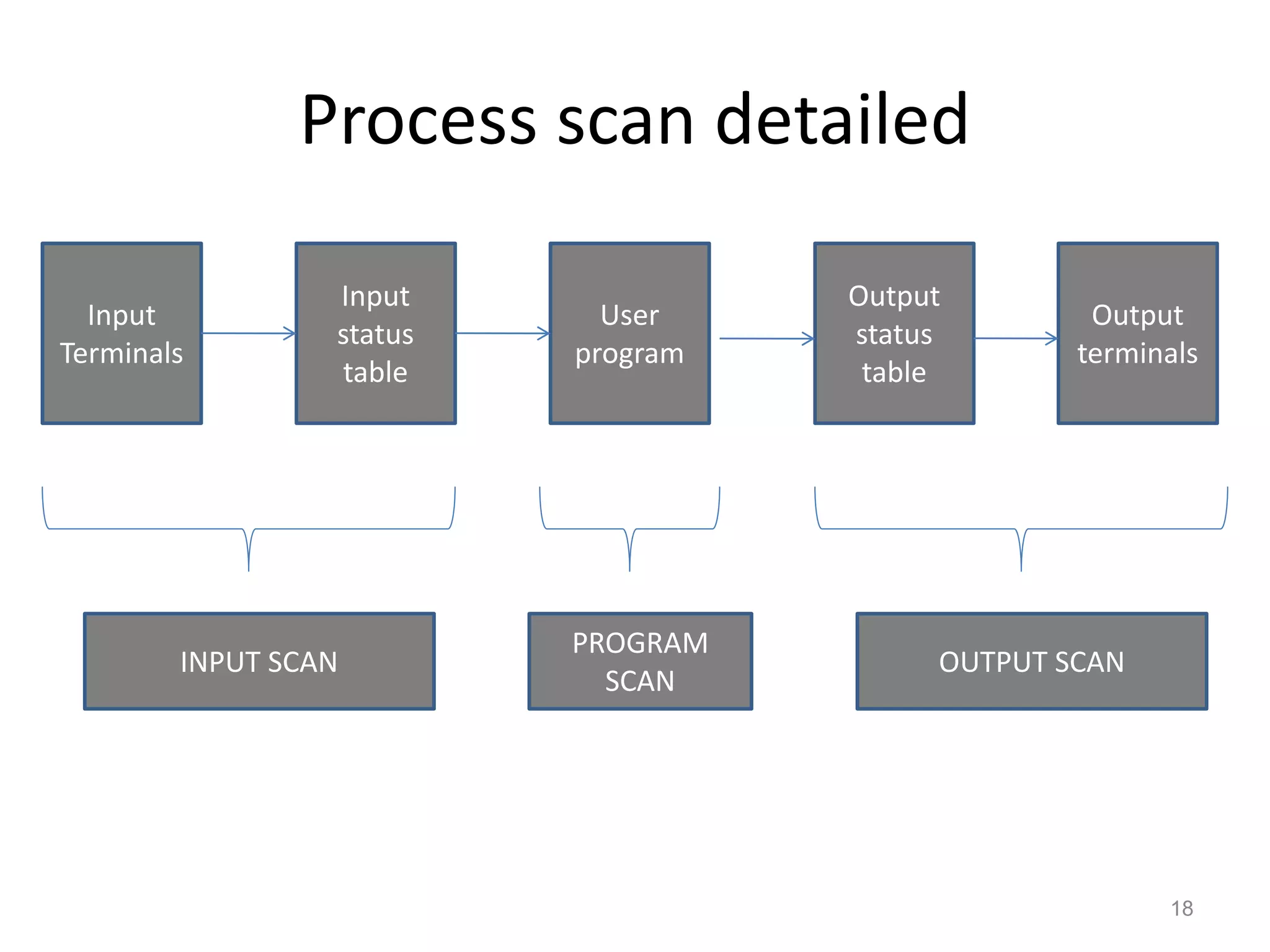
Process scan detailed
Input
Terminals
Input
status
table
User
program
Output
status
table
Output
terminals
INPUT SCAN
PROGRAM
SCAN
OUTPUT SCAN
18
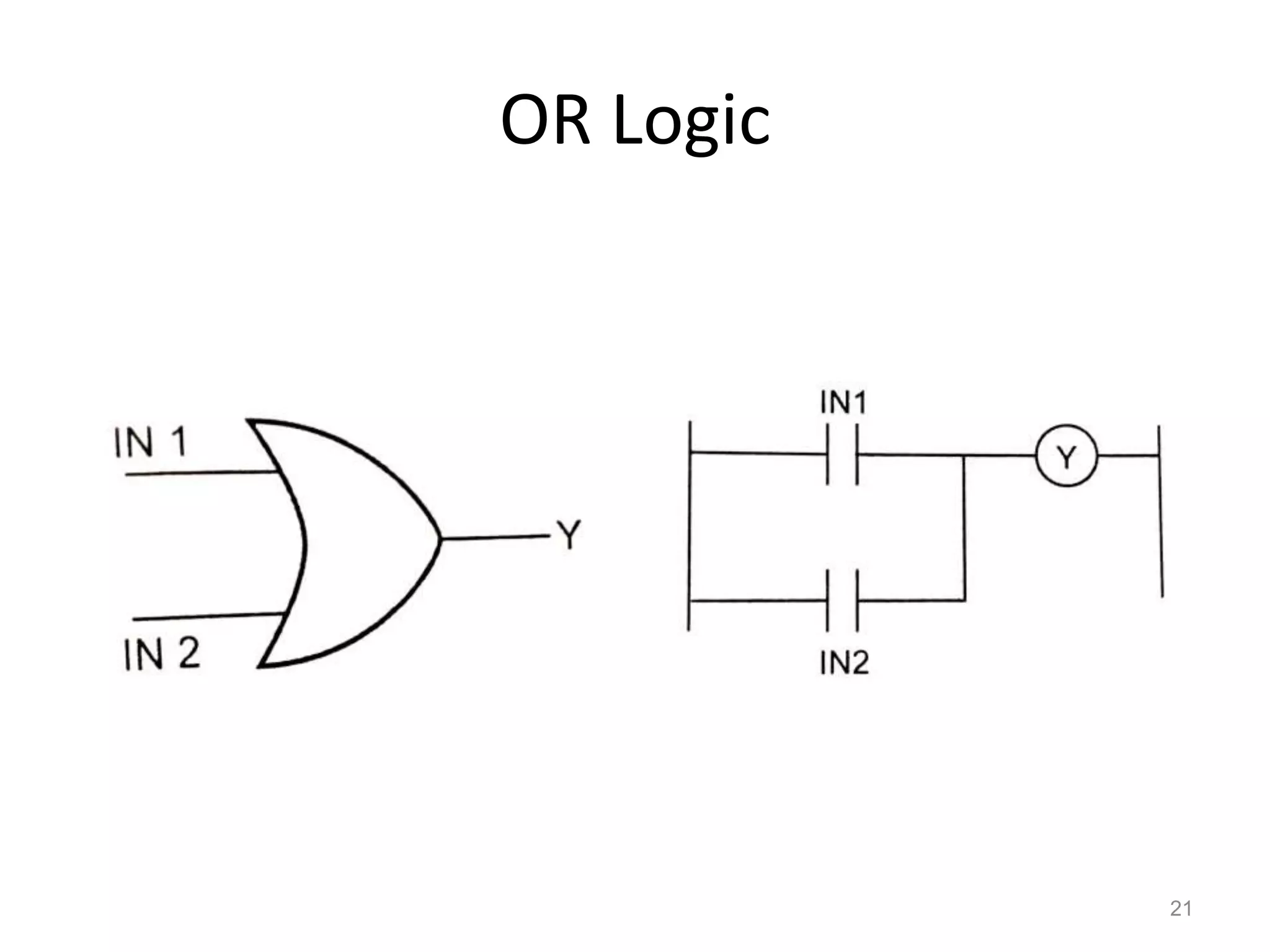
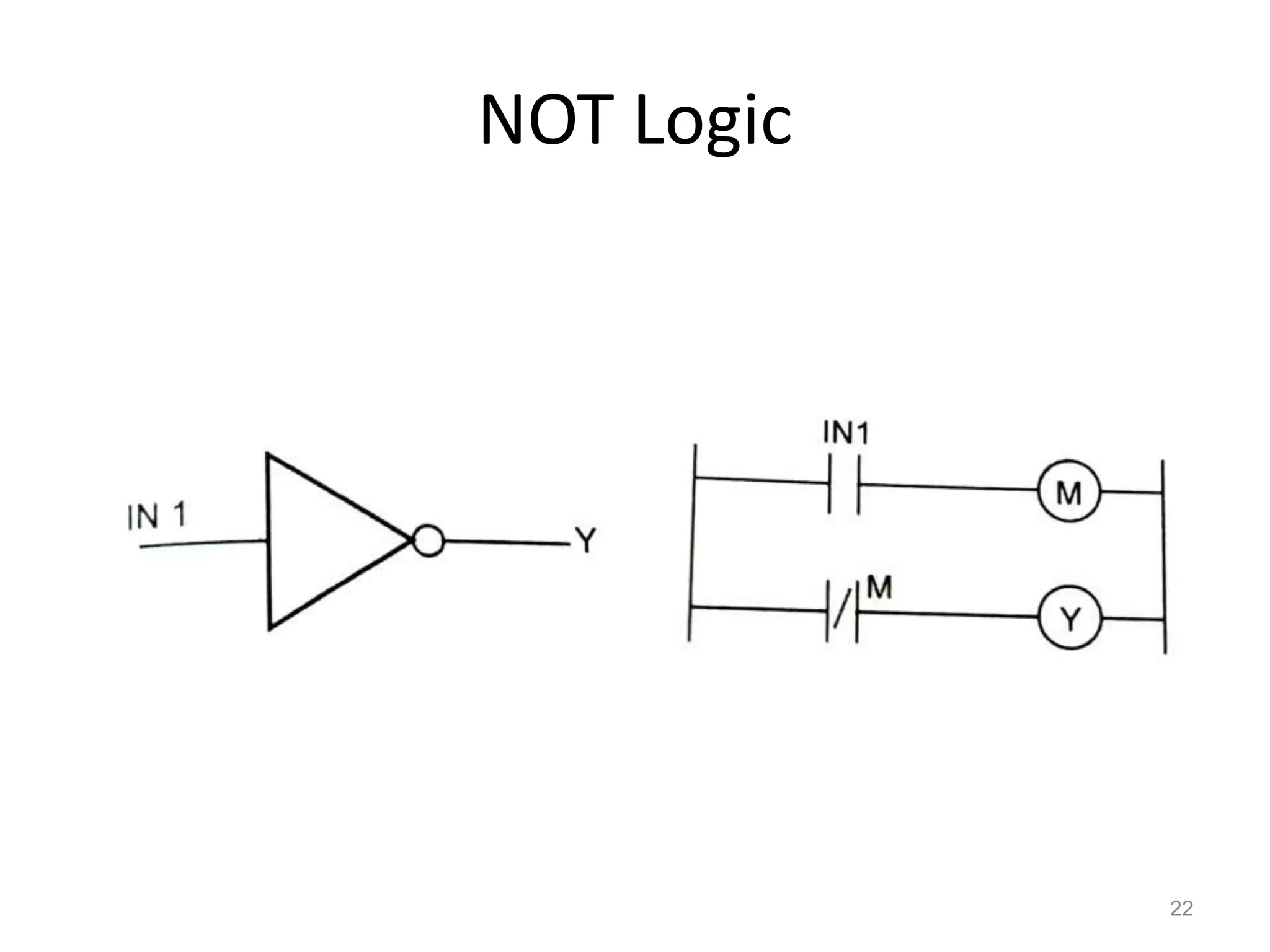
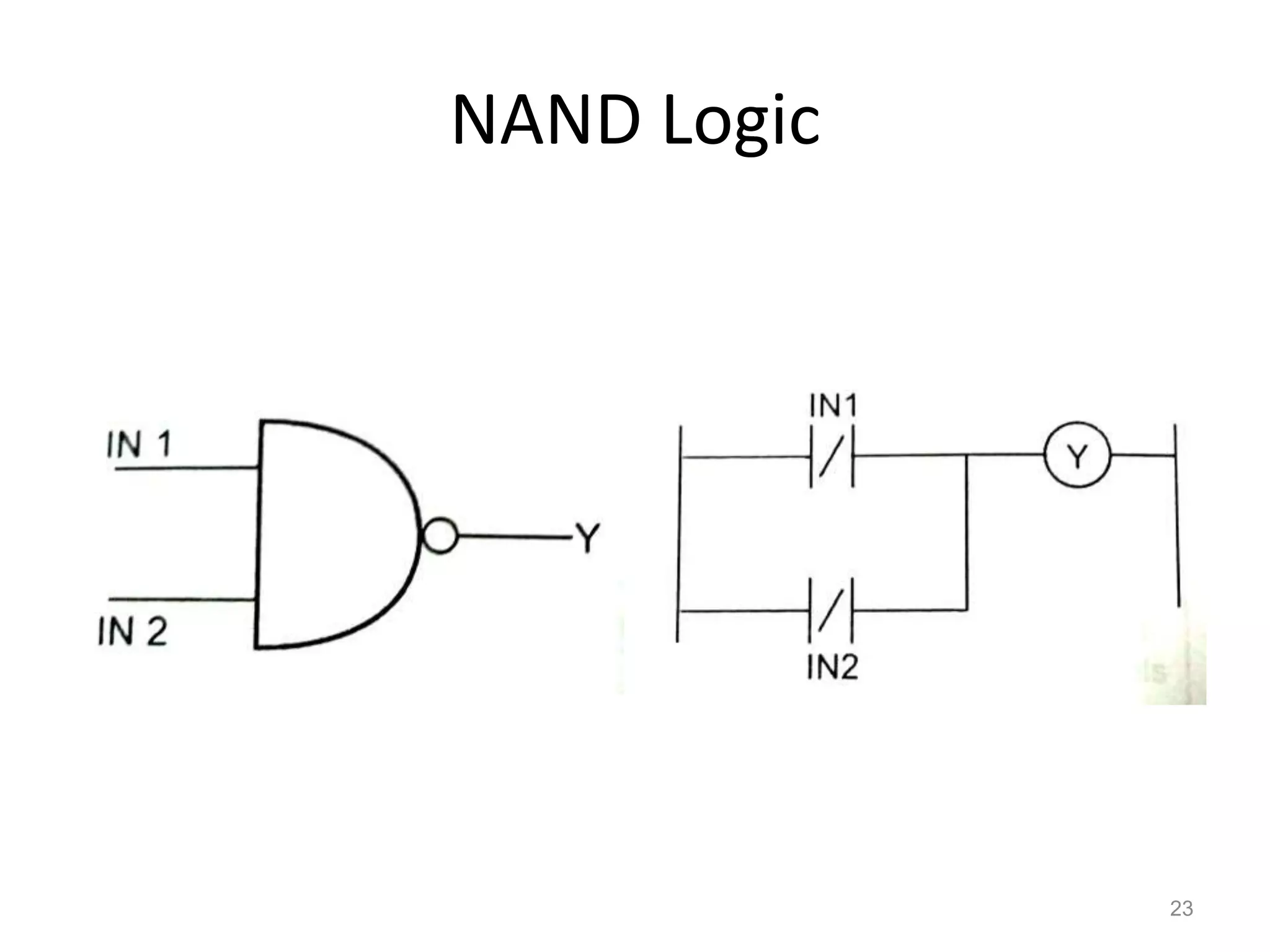
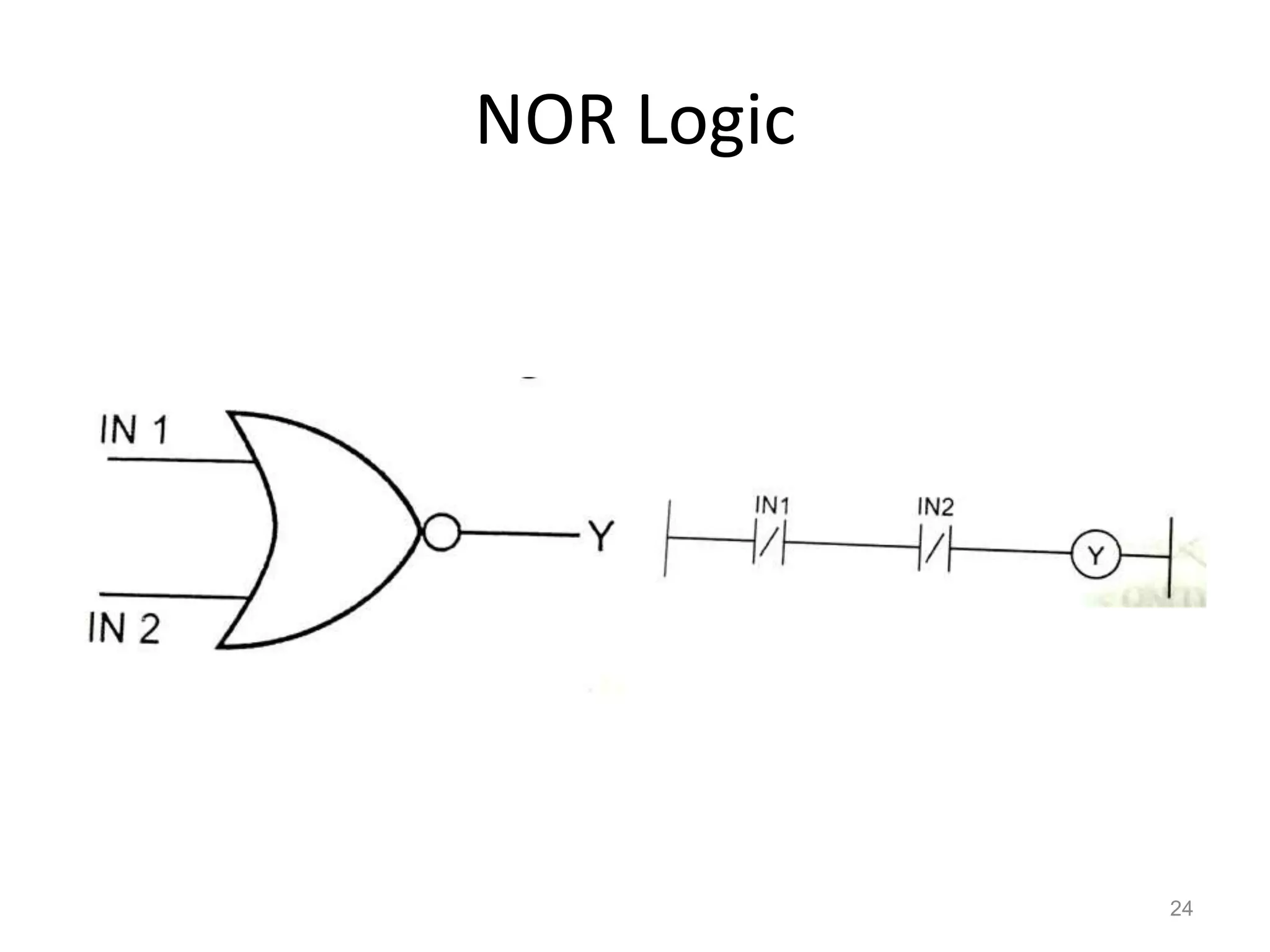
LOGIC GATES
19
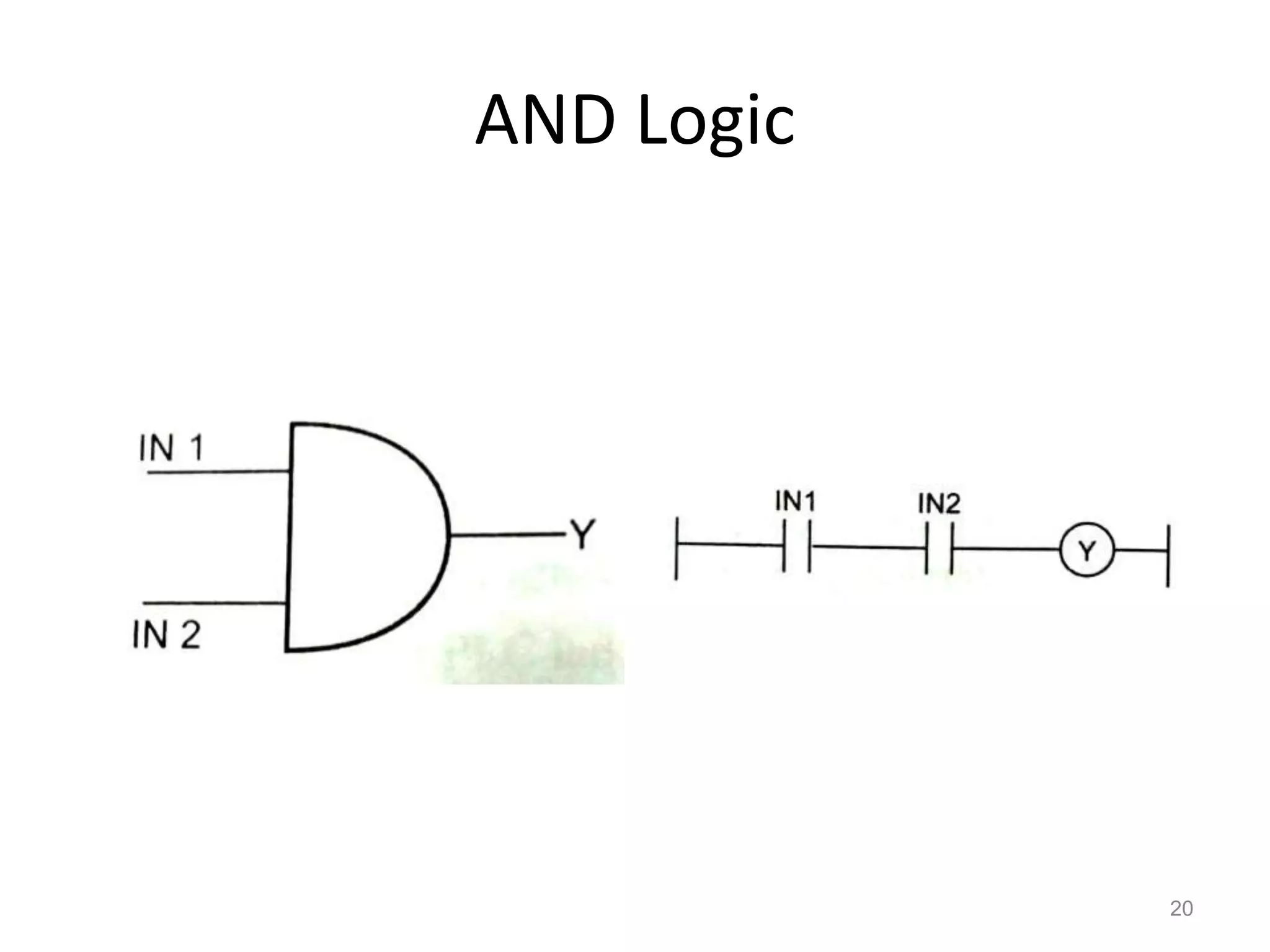
AND Logic
20
OR Logic
21
NOT Logic
22
NAND Logic
23
NOR Logic
24
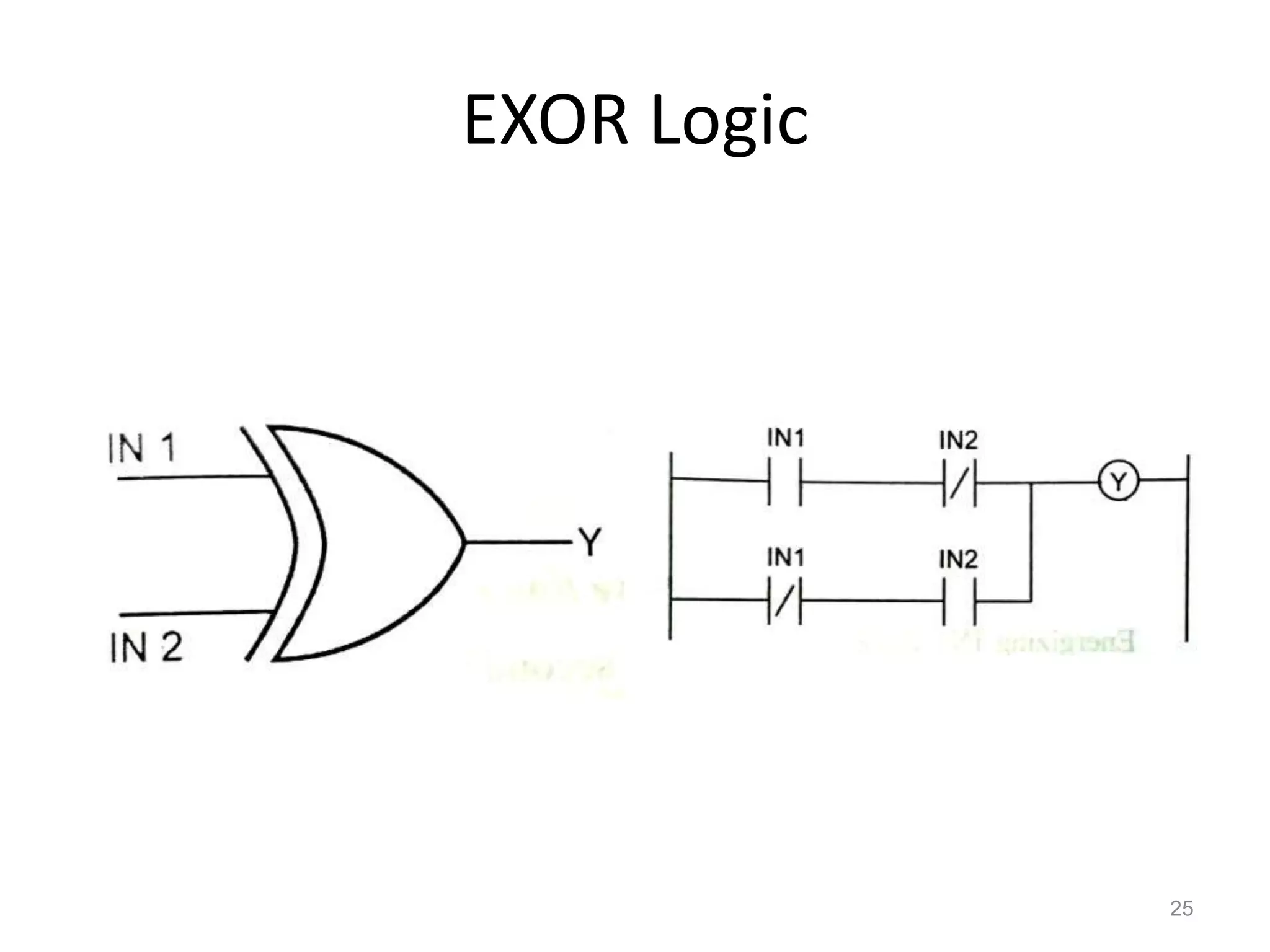
EXOR Logic
25
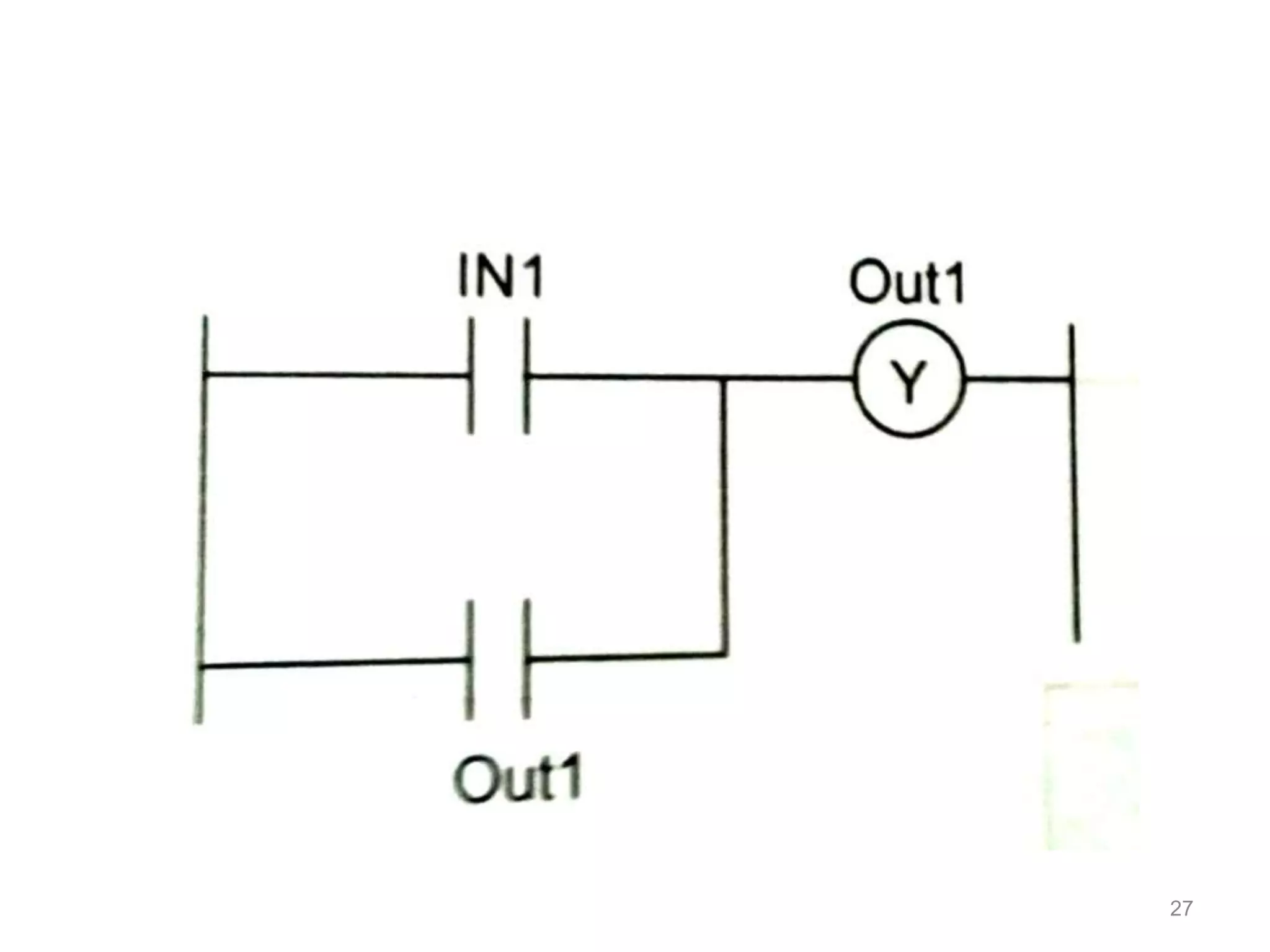
Latch circuit
• A ladder latch circuit facilitates to hold an
output energized, even when the input
ceases.
• The output coil maintains its status until a
different conditions occurs which is used to
reset the coil to OFF.
26
27
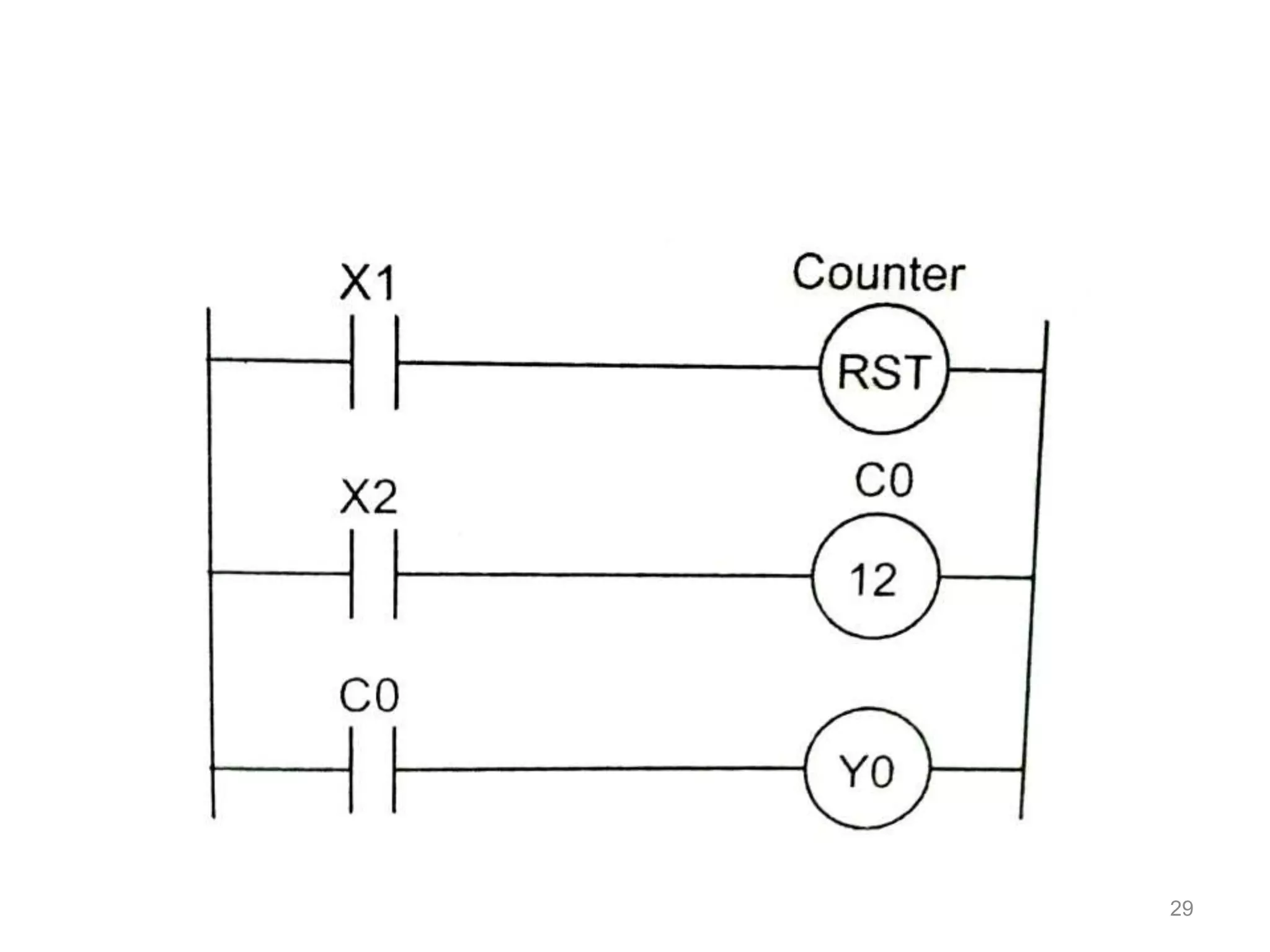
Counters
• Conventional counters replaced by the PLC
counter function include mechanical,
electrical and electronic types.
Types of counters:
1. Up counter
2. Down counter
3. Up/down counter
28
29
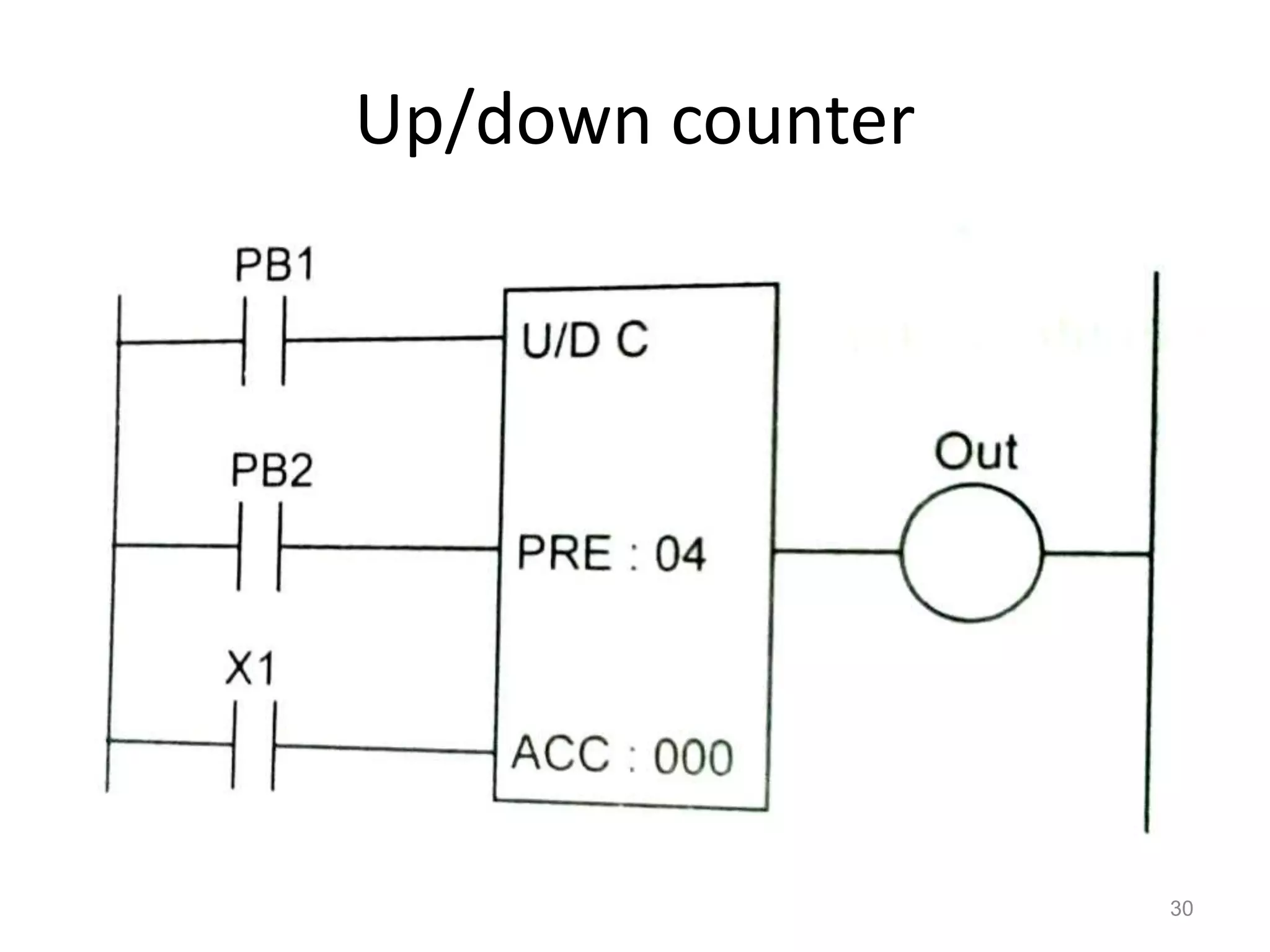
Up/down counter
30

Unit 4.ppt

  • 1.
  • 2.
    Programmable Logic Controllers– Basic Structure – Input / Output Processing – Programming – Mnemonics – Timers, Internal relays and counters – Shift Registers – Master and Jump Controls – Data Handling – Analogs Input / Output – Selection of a PLC. 2
  • 3.
    Introduction A Programmable logiccontroller is a solid state digital electronic device, designed for use in an industrial environment. It is a microprocessor based specialized computer that carries out control functions of many functions of many types and levels of complexity. 3
  • 4.
    Basic Structure: The threemajor parts of PLC are i. Central processing unit, ii. Programmer / Monitor, and iii. Input / Output modules. 4
  • 5.
  • 6.
    Central Processing Unit(CPU) i. Microprocessor: It carries out mathematical and logical operations. ii. Memory: The area of the CPU in which data and information is stored and retrieved. It holds the system software and user program. iii. Power supply: The electrical supply that converts Alternating Current (AC) line voltage to various operational DC values. 6
  • 7.
    Various Input andOutput Devices Digital / Discrete Input Devices: i. Mechanical switches, ii. Proximity switches, iii. Photo elective switches, iv. Encoders, v. Temperature switches, vi. Pressure switches. 7
  • 8.
    Analog Input Devices: i.Potentiometer, ii. Linear variable differential transformer, iii. Strain gauges, iv. Temperature sensors, v. Pressure sensors, vi. Level detectors, vii. Flow measurement devies. 8
  • 9.
    Output devices: i. Contactors, ii.Directional control valves, iii. Motors, and iv. Stepper motors. 9
  • 10.
    PLCs Vs Computers i.The application for PLC is for industrial environment with wide variation in atmosphere conditions and PLC is very rigid and compact. ii. PLC programming can be accomplished in the ladder logic by an electrician and technician who have no much knowledge hardware and softwares, whereas the computers will require person with knowledge of hardware and software. 10
  • 11.
    iii. PLC dealwith input/output in the form of sensors, switches and actuators etc, through appropriate interface units and computer receives inputs from keyboard and gives output to a screen or printer. iv. The power supply in industrial environment is shared by many devices and therefore there can be interruption of supply. Such disruption of supply will normally not affect the program and storage of data in PLC. In a computers such loss of data could happen. 11
  • 12.
    PLC Programming • Ladderdiagram is commonly used programming method evolved from electrical relay circuits in the form of graphical language. • It is a network of contacts and coils are arranged on rungs between two vertical lines called rails. 12
  • 13.
    Following are thesymbols used in ladder diagram. 13
  • 14.
    Proper construction ofPLC adder diagrams i. No vertical contacts are allowed. ii. A coil must be inserted at the end of the rung. iii. All contacts must run horizontally. iv. Only one output may be connected to a group of contacts. v. Flow must be from left to right. 14
  • 15.
    Improper PLC ladderdiagram Proper PLC ladder diagram 15
  • 16.
    Process Scanning Consideration •PLCs function by scanning their operational programs. • Each PLC operational cycle is made up of three separate parts: i. Input scan ii. Program scan and iii. Output scan • Total time for one complete program scan is a function of processor speed and length of the user program. 16
  • 17.
  • 18.
  • 19.
  • 20.
  • 21.
  • 22.
  • 23.
  • 24.
  • 25.
  • 26.
    Latch circuit • Aladder latch circuit facilitates to hold an output energized, even when the input ceases. • The output coil maintains its status until a different conditions occurs which is used to reset the coil to OFF. 26
  • 27.
  • 28.
    Counters • Conventional countersreplaced by the PLC counter function include mechanical, electrical and electronic types. Types of counters: 1. Up counter 2. Down counter 3. Up/down counter 28
  • 29.
  • 30.