UNIT4 PLANNINGOFWATERSHED
PROJECTS
Structure
4.0 Objectives
4.1 Introduction
4.2 Participatory Watershed Management
4.3 InstitutionalArrangement
4.3.1 National Level
4.3.2 State Level
4.3.3 District Level
4.3.4 Panchayati Raj Institutions (PRIs)
4.3.5 Project Implementation Agency (PIA)
4.4 Participatory Rural Appraisal (PRA)
4.5 Natural Resource Survey
4.6 Watershed Management Planning
4.7 InformationlData Needed
4.8 Integrated Watershed Management
4.9 Let Us Sum Up
4.10 Keywords
4.11 Suggested Reading
4.12 Model Answers to Check Your Progress
4.0 OBJECTIVES
After going through this unit, you should be able to:
• apply the concept of participatory watershed management;
• outline the approach of Participatory Rural Appraisal (PRA);
• undertake the survey of natural resources in watershed area;
• describe the steps of watershed management planning; and
• acquaint yourself with the integrated watershed management system.
4.1 INTRODUCTION
16
illthe previous unit, the concept of watershed management, its present scenario in
respect of India, approach and goals of watershed management have been
elaborately dealt with.
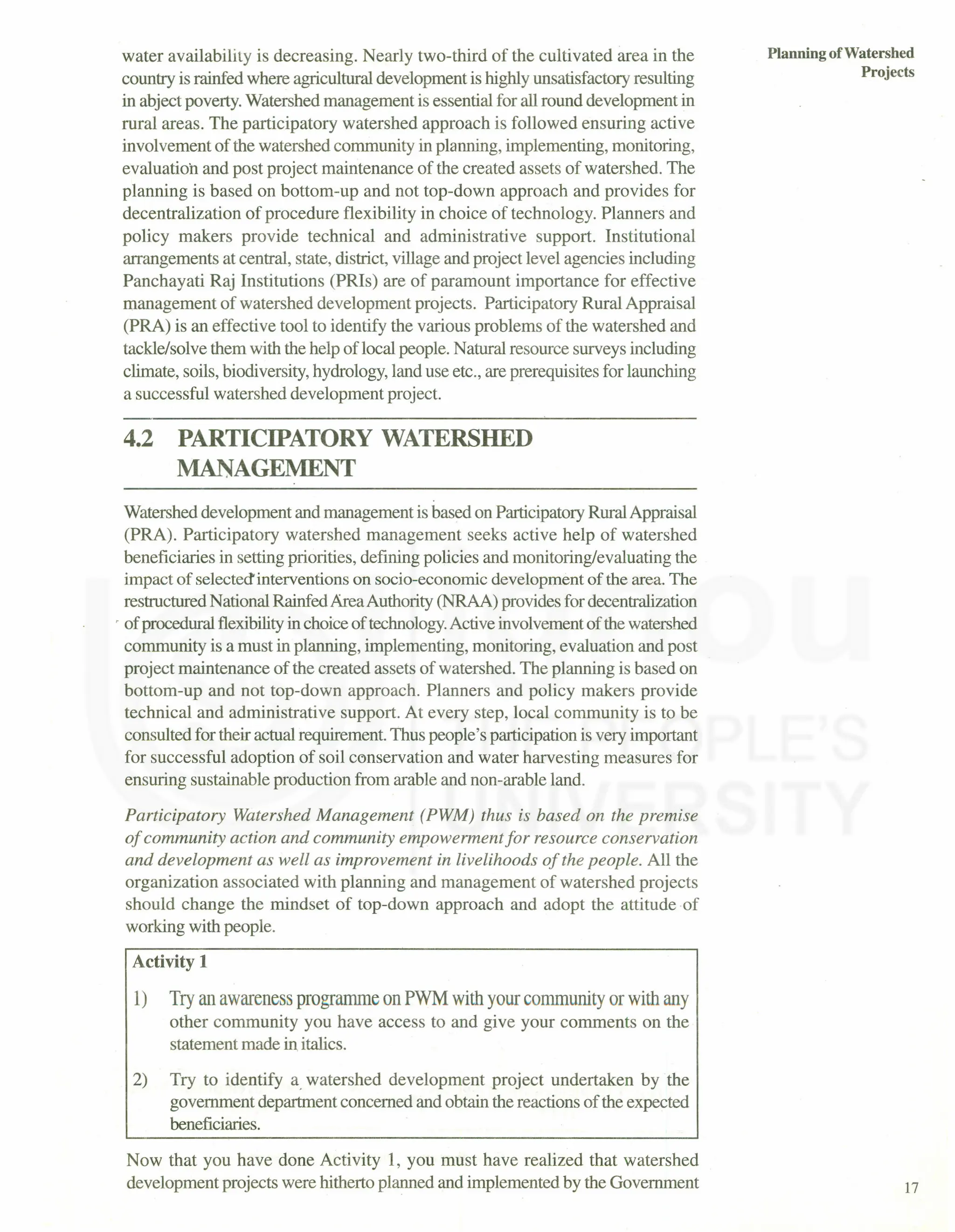
About half of our geographical area is affected by land degradation and soil
erosion. Due to land fragmentation and increasing population, per capita land and
water availability is decreasing. Nearly two-third of the cultivated area in the
country is rainfed where agricultural development is highly unsatisfactory resulting
in abject poverty. Watershed management is essential for all round development in
rural areas. The participatory watershed approach is followed ensuring active
involvement of the watershed community in planning, implementing, monitoring,
evaluatioh and post project maintenance of the created assets of watershed. The
planning is based on bottom-up and not top-down approach and provides for
decentralization of procedure flexibility in choice of technology. Planners and
policy makers provide technical and administrative support. Institutional
arrangements at central, state, district, village and project level agencies including
Panchayati Raj Institutions (PRIs) are of paramount importance for effective
management of watershed development projects. Participatory Rural Appraisal
(PRA) is an effective tool to identify the various problems of the watershed and
tackle/solve them with the help of local people. Natural resource surveys including
climate, soils, biodiversity, hydrology, land use etc., are prerequisites for launching
a successful watershed development project.
4.2 PARTICIPATORY WATERSHED
MANAGEMENT
Watershed development and management is based on Participatory Rural Appraisal
(PRA). Participatory watershed management seeks active help of watershed
beneficiaries in setting priorities, defining policies and monitoring/evaluating the
impact of selected' interventions on socio-economic development of the area. The
restructured National Rainfed Area Authority (NRAA) provides for decentralization
, of procedural flexibilityin choice of technology.Active involvement of the watershed
community is a must in planning, implementing, monitoring, evaluation and post
project maintenance of the created assets of watershed. The planning is based on
bottom-up and not top-down approach. Planners and policy makers provide
technical and administrative support. At every step, local community is to be
consulted for their actual requirement. Thus people's participation is very important
for successful adoption of soil conservation and water harvesting measures for
ensuring sustainable production from arable and non-arable land.
Participatory Watershed Management (PWM) thus is based on the premise
of community action and community empowerment for resource conservation
and development as well as improvement in livelihoods of the people. All the
organization associated with planning and management of watershed projects
should change the mindset of top-down approach and adopt the attitude of
working with people.
Activity 1
1) Try an awareness programme on PWM with your community or with any
other community you have access to and give your comments on the
statement made in italics.
2) Try to identify a. watershed development project undertaken by the
government department concerned and obtain the reactions of the expected
beneficiaries.
Now that you have done Activity 1, you must have realized that watershed
development projects were hitherto planned and implemented by the Government
Planning ofWatershed
Projects
17
Watershed Management
18
Department without active participation of people. This practice has not given the
long term and sustainable results. After the withdrawal of departmental functionaries
from the watershed area on completion of proposed works or period, there used
to be no one to pursue further development and maintain the created assets.
The development of natural resources and maintenance of the created assets on a
continuous basis is possible only through the active participation of the beneficiaries,
living in the area. To create the feeling of belongingness and to be financially
capable even after the project period, it is emphasized that the watershed community
should plan and implement the watershed development programme and make
donations and contribution for the individual and community works/activities in the
form of cash, material or labour.
In this programme, emphasis is ~so laid on mobilizing the community and organizes
it into functional groups and making them responsible for planning and
implementation of choice activities related to individuals and the entire community.
It is further stressed to form institution of stakeholders of watershed area for
systematic participatory planning, implementation and maintenance of developmental
works and to handle the financial transactions. Thus, Community organization is a
crux of participatory watershed development. It not only facilitates the people
coming together physically and emotionally but also helps in putting their social,
intellectual and material resources for unified action. This calls for mobilization and
organization of community.
4.3 INSTITUTIONAL ARRANGEMENT
Now you will learn about the institutional arrangements at the national, state,
district and village levels for effective implementation of watershed programmes as
shown in Fig. 4.1. The following sub-section on will enrich your knowledge about
the community organization.
National Rainfed Area Authority
(NRAA) at the national level
! f
State Level Nodal Agency
(SLNA)
! t
District Watershed Development Unit
(DWDU)
~ f
Panchayati Raj Institutions
(PRIs)
, i
Project Implementation Agency
+- Watershed Development Team
(PIA) (WDT)
Fig. 4.1: Block diagram of institutional arrangement
4.3.1 National Level
The National Rainfed Area Authority (NRAA), a nodal agency at the central level
facilitates budgetary allocation and smooth flow of funds from different projects of
Government of India to the District Watershed Development Units (DWDU)
for speedy and successful implementation of these watershed development
projects. It acts as an effective coordinating mechanism between different
ministries, organizations and departments undertaking watershed development
programmes. It is also responsible for supporting the process of preparing strategic
plans for watershed development projects at the state and district levels keeping
in view specific agro-climatic and socio-economic conditions. It also supports
state level nodal agencies in identifying resource organizations and establishing
capacity building arrangements. The professional multi-disciplinary experts in the
field of agriculture, water management, institution and capacity building etc.,
constitute the nodal agency.
4.3.2 State Level
A State Level Nodal Agency (SLNA) is empowered to oversee all watershed
projects in the state sanctioned based on the approved perspective and strategic
plan. The SLNA is headed by the Development Commissioner/Additional Chief
Secretary/Agricultural Production CommissionerlPrincipal Secretary and comprises
of one representative from NABARD, one representative each from the state
department of rural development, agriculture, animal husbandry and allied sectors,
one representative from ground water board, one representative from voluntary
organization and two experts from research institute/state universities, the
representative from National Rural Employment Guarantee Schemes (NREGS),
Backward Regions Grand Fund (BRGF) and other related implementing agencies
are also represented. A team of four to seven professional experts-in the field of
agriculture, water management, capacity building, social science, information
technology, administration, accounts etc., assist the SLNA which provides technical
s.upports to DWDU It also prepares perspective and strategic plans of watershed
for the state on the basis of plans prepared at block and district levels. It also sets
the expected outputs and financial outlays based on which approval of central
nodal agencies is sought. It also establishes monitoring and evaluation of the
watershed projects.
4.3.3 District Level
District Watershed Development Unit (DWDU) is established to oversee the
implementation of watershed projects in each district with separate accounts. It
functions in close coordination with District Planning Committee (DPC) with a
representative each of NRGA and BRGF at the district level. The DWDU
comprising of a full time project manager and three to four experts on agriculture,
water management, social science, management and accounts and is responsible
..for identifying potential Project Implementing Agencies (PIAs). It also facilitates
preparation of district strategic and action plans including capacity building and
ensures smooth flow of funds to the projects and timely submission of required
documents to SLNA. It also facilitates coordination with relevant programmes of
agriculture, horticulture, rural development, animal husbandry, etc., with the
watershed projects for enhancement of productivity and livelihood.
Planning of Watershed
, Projects
19
Watershed Management
20
4.3.4 Panchayati Raj Institutions (PRIs)
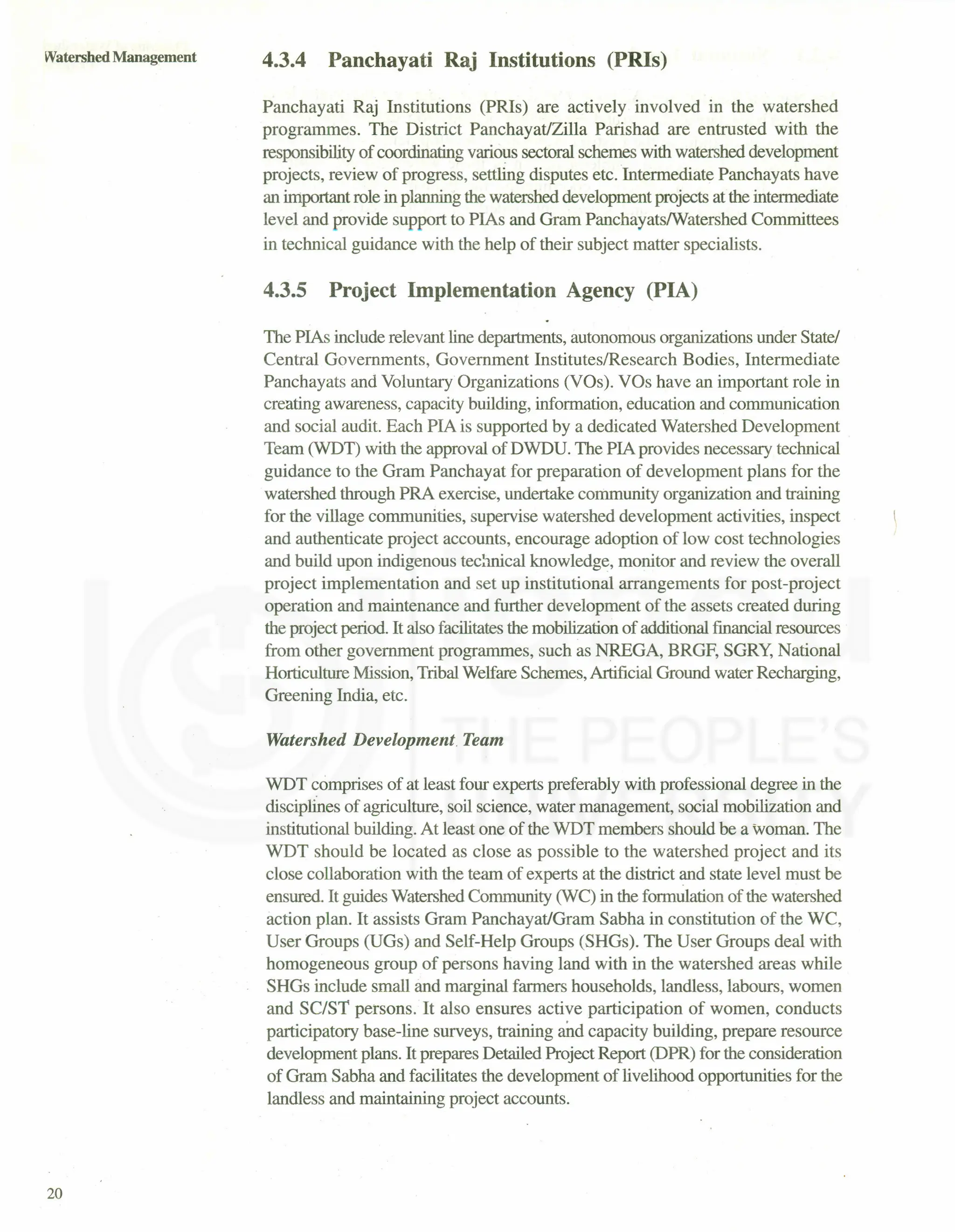
Panchayati Raj Institutions (PRIs) are actively involved in the watershed
programmes. The District PanchayatJZilla Parishad are entrusted with the
responsibility of coordinating various sectoral schemes with watershed development
projects, review of progress, settling disputes etc. Intermediate Panchayats have
an important role in planning the watershed development projects at the intermediate
level and provide support to PIAs and Gram PanchayatslWatershed Committees
in technical guidance with the help of their subject matter specialists.
4.3.5 Project Implementation Agency (PIA)
The PIAs include relevant line departments, autonomous organizations under State/
Central Governments, Government Institutes/Research Bodies, Intermediate
Panchayats and Voluntary Organizations (VOs). VOs have an important role in
creating awareness, capacity building, information, education and communication
and social audit. Each PIA is supported by a dedicated Watershed Development
Team (WDT) with the approval of DWDU. The PIA provides necessary technical
guidance to the Gram Panchayat for preparation of development plans for the
watershed through PRA exercise, undertake community organization and training
for the village communities, supervise watershed development activities, inspect
and authenticate project accounts, encourage adoption of low cost technologies
and build upon indigenous technical knowledge, monitor and review the overall
project implementation and set up institutional arrangements for post-project
operation and maintenance and further development of the assets created during
the project period. It also facilitatesthe mobilization of additional financial resources
from other government programmes, such as NREGA, BRGF, SGRY, National
Horticulture Mission, Tribal Welfare Schemes, Artificial Ground water Recharging,
Greening India, etc.
Watershed Development Team
WDT comprises of at least four experts preferably with professional degree in the
disciplines of agriculture, soil science, water management, social mobilization and
institutional building. At least one of the WDT members should be a woman. The
WDT should be located as close as possible to the watershed project and its
close collaboration with the team of experts at the district and state level must be
ensured. It guides Watershed Community (WC) in the formulation of the watershed
action plan. It assists Gram PanchayatJGram Sabha in constitution of the WC,
User Groups (UGs) and Self-Help Groups (SHGs). The User Groups deal with
homogeneous group of persons having land with in the watershed areas while
SHGs include small and marginal farmers households, landless, labours, women
and SC/S! persons. It also ensures active participation of women, conducts
participatory base-line surveys, training and capacity building, prepare resource
development plans. It prepares Detailed Project Report (DPR) for the consideration
of Gram Sabha and facilitates the development of livelihood opportunities for the
landless and maintaining project accounts.
Check Your Progress 1
Note: a) Compare your answers with those given at the end of unit. .
b) Use the space below for your answers.
1) What is Participatory Watershed Management?
................................................................................................... ; .
• ••••••••••• •• •• •••••• • •• ••••••• • • •• ~ ••••••••••••••••••• " •••••••••••••••••••••••••••••••••••••••••••••••••••••••• 0"0 •••••••••••••••••••••••••••••••••
.•...•.••...•.•.•........•............•..........•......•.•.................•......•.•.....••.•.....• ! .....•.....
2) What are the functions of District Watershed Committee?
.......................................... ; .
3) Define User Group (UG) and Self-Help Group (SHG) .
.....................................................................•............................................
I
4) Explain thy role of1anChayati Raj Institutions?
···························:··1······················· .
5) How many experts constitute a WDT? Write their disciplines also.
......... ·.·······.·········1.··············· _IL •••••••••••••••••••••••••••••
............... ~ :--' .
6) Write the full form bf the following
i) SLNA .
ii) PIA
l/ " ......................................•..•...........
iii) NABARD .
iv) DWDU !.~ .
v) DPR : .
I i ./ .
Now that you have dorte he Check Your Progress 1, we may go over to/study
about Participatory Rural ppraisal, .
Planning ofWatershed
'Projects
)
21
Watershed Management
22
4.4 PARTICIPATORY RURAL APPRAISAL (PRA)
Participatory Rural Appraisal is the method ofknowinglor determining the living
conditions of local rural people by establishing rapport with village community. It
helps to identify various problems of the watershed and tackle/solve them ~ith the
help of local people. The principle of PRA is based on listening and learning from
the people of the local areas. It is the informal way of learning from local people
about various problems and seeks solutions from them only.As all the communities
are involved, there is no bias or favour towards any section of people. As local
people and grass-root workers are directly involved, planning and execution of
various activities do not face bureaucratic problems. There is no discrimination of
gender as women participation is very essential and it should be ensured. It is
essential to gain the confidence of local people in conducting the survey of the
watershed and subsequently planning and execution of watershed activities.
Extension educations methods should be adopted to approach and convince the
farmers. Following fundamental points should be kept in mind for carrying out
PRA exercise:
• Decision regarding date, time and venue of the meeting should be taken in
consultation with the farmers;
• Introduce yourself (watershed workers) to the farmers;
• Approach villagers as a friend and mentor;
• Explain the purpose of your visit;
• Discuss various issues in friendly environment without any tension or fear;
• Listen to them carefully and be patient;
• Do not criticize, interrupt in discussion;
• Respect social customs;
• Give equal opportunity to all in discussion;
• Discussion should be focused on the major issues;
• Identify various persons for different tasks; and
• End the meeting with thanks.
After the meeting, all the members of the watershed team should review the
various points discussed in the meeting.
Meeting of Gram Sabha (Village Society) should be held for preparation of blue
print of the plan/project Physiographic exercise should be taken up with the
villagers to discuss following points:
a) Name of watershed
b) Location of headquarters if there are 3-4 villages
c) Major priorities
The village maps, Venn diagrams should be prepared after conducting the survey.
A workshop involving farmers should be organized for open and frank discussion
on various issues.
Check Your Progress 2
Note: a) Compare your answers with those given at the end of unit.
,
b) Use the space below for your answers.
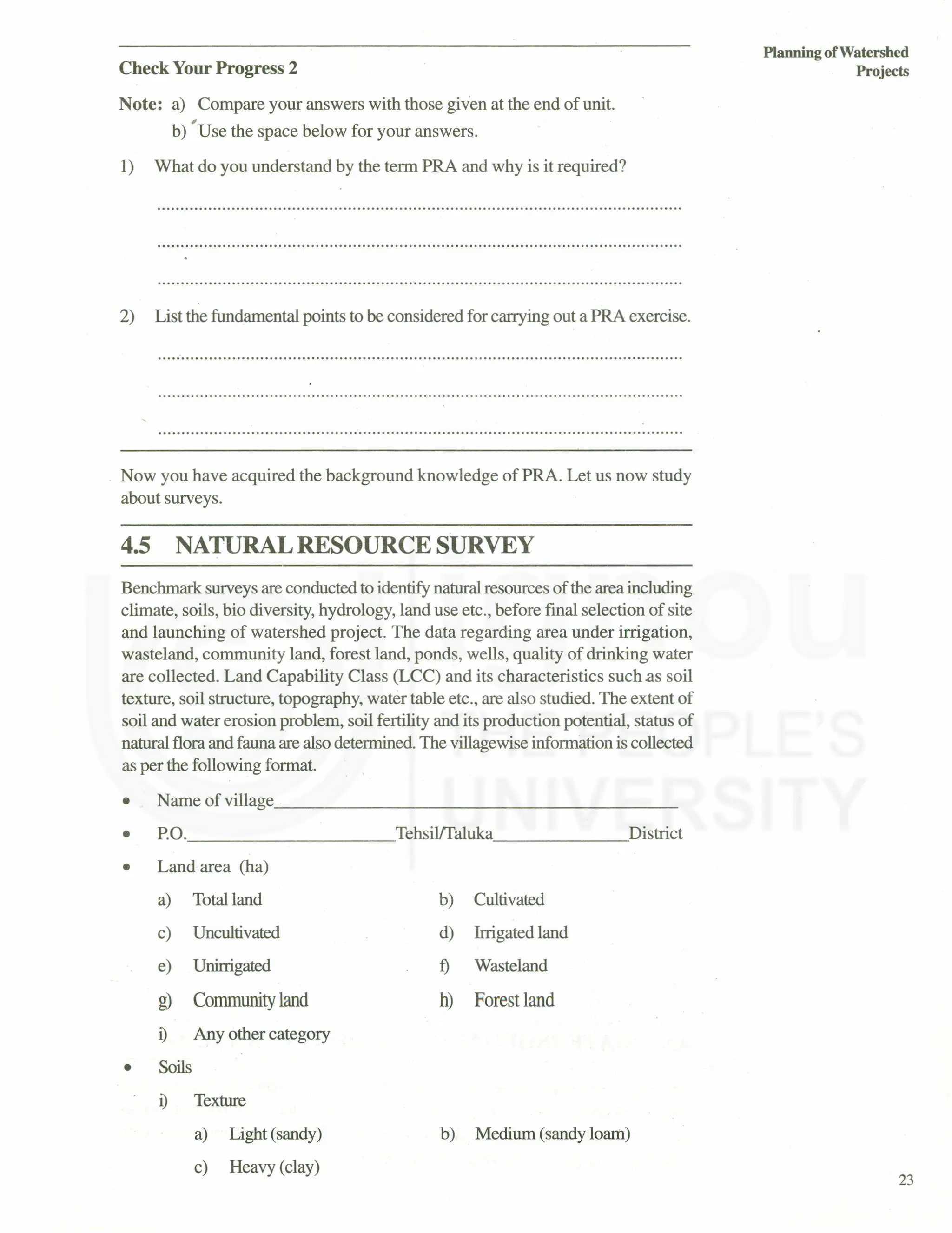
1) What do you understand by the term PRA and why is it required?
2) List the fundamental points to be considered for carrying out a PRA exercise.
..................................................................................................................
Now you have acquired the background knowledge of PRA. Let us now study
about surveys.
4.5 NATURAL RESOURCE SURVEY
Benchmark surveys are conducted to identify natural resources of the area including
climate, soils, bio diversity, hydrology, land use etc., before final selection of site
and launching of watershed project. The data regarding area under irrigation,
wasteland, community land, forest land, ponds, wells, quality of drinking water
are collected. Land Capability Class (LCC) and its characteristics such.as soil
texture, soil structure, topography, water table etc., are also studied. The extent of
soil and water erosion problem, soil fertility and its production potential, status of
natural flora and fauna are also determined. The villagewise information is collected
as per the following format.
• Name of village , _
• P'O. Tehsil!faluka~ District
• Land area (ha)
•
a) Total land
c) Uncultivated
e) Unirrigated
g) Community land
i) Any other category
Soils
b) Cultivated
d) Irrigated land
t) Wasteland
h) Forest land
i) Texture
a) Light (sandy)
c) Heavy (clay)
b) Medium (sandy loam)
Planning of Watershed
Projects
23
Watershed Management
/
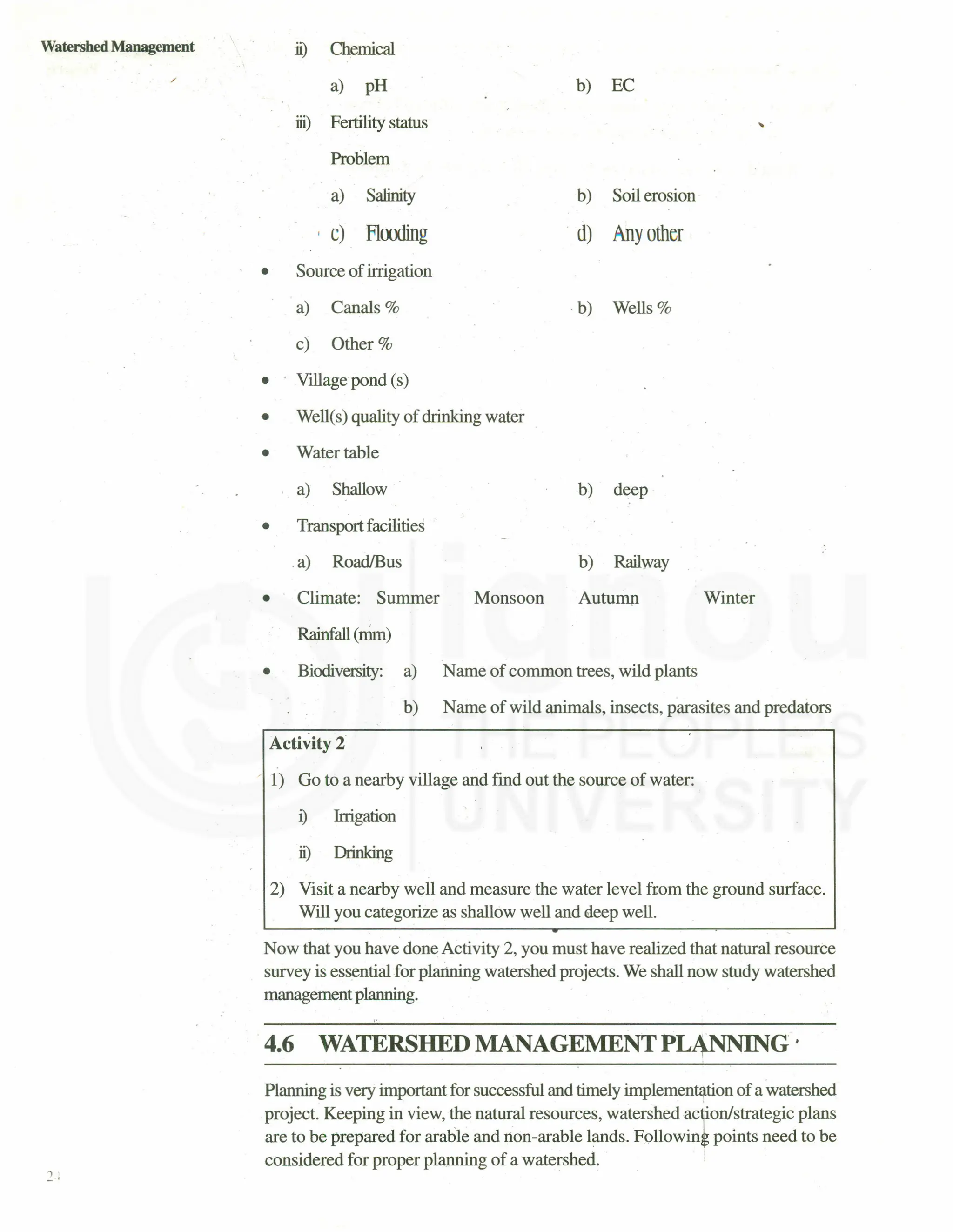
ii) Chemical
a) pH
iii) Fertility status
Problem
a) Salinity
, C) Flmling
.. Source of irrigation
a) Canals %
c) Other %
b) EC
.•
b) Soil erosion
.d) 1nyotller
.b) Wells %
• Village pond (s)
• Well(s) quality of drinking water
• Water table
a) Shallow b) deep
• Transport facilities
.a) RoadfBus b) Railway
• Climate: Summer Autumn Winter
Monsoon
Rainfall(mm)
• Bicx:liversity: a) Name of common trees, wild plants
b) Name of wild animals, insects, parasites and predators
Activity 2
/ I) Go to a nearby village and find out the source of water:
i) Irrigation
it) Drinking
2) Visit a nearby well and measure the water level from the ground surface.
Will you categorize as shallow well and deep well.
Now that you have done Activity 2, you must have realized that natural resource
survey is essential for planning watershed projects. We shall now study watershed
management planning.
4.6 WATERSHED MANAGEMENT PL~G '
Planning is very important for successful and timely implemen~tion of a watershed
project. Keeping in view, ~e natural resources, waters.hed ac,ion/strategic plans
are to be prepared for arable and non-arable lands. Following points need to be
considered for proper planning of a watershed.
• Development of natural resources (Private and common land, water).
• Increase in production productivity of land based enterprises such as
agriculture, horticulture/forestry, livestock, fisheries etc.
• Budget estimate for each component.
• Expected contribution from the participants.
• Various modalities of implementation such as review, monitoring, auditing etc.
• Proper care and support of non-land based enterprise.
• Time frame for completion of various activities.
• Withdrawal strategy and post project management.
Indigenous Traditional Knowledge (ITK) of the farmers with slight modifications
will be very useful as compared to high cost technology. The budget provided in
the watershed project should be used as per the norms given below:
• The account should be opened in nationalized bank or cooperative bank.
• Withdrawal of the amount should be also as per norms.
• The accounts record should be properly maintained.
• Audit should be got done on regular basis.
• Corpus Fund is also created which should be 1% of the total budget for
maintenance of the assets. Another 1% should be contributory from the
beneficiaries or from the StateGovemment.
• There should be proper monitoring and evaluation of progress in the meetings
.of various committees.
Construction of water harvesting structures with their design should be included in
the action plan. Low cost technology and local raw material should be used to
minimize the cost. Vegetative storage structures may be given preference over
very high cost cement/iron machinery involved invarious water harvesting structures.
4.7 INFORMATIONIDATANEEDED
This inventory of the watershed includes the human population and male and
female ratio including scheduled castes and backward classes population, location
of primary health centre, hospital, school and other institutions, post office, banks.
The type and quality of roads, transport, power supply, grain, fruit and vegetable
market for selling the products, agriculture inputs cooperative society are also
other important components which play a major role in effective implementation
of watershed projects. This helps in proper planning and studying the problems
and opportunities. The help from village Patwari (land revenue official), Village
Pradhan (Village head) may be sought. The information regarding other line
departments viz.; revenue, agriculture, animal husbandry, irrigation, forest, health,
govt. and semi govt. agencies, Non-government Agencies (NGOs) working in
that particular area is also vital. For detailed inventory, the following format may
be used:
Planning ofW,.tershed
Projects
25
Watershed Management Village
• Name of Village
• Household families
• Human population
a) Male b) Female
• Literacy (%)
a) Male b) Female
• Scheduled castes/tribes Families
a) Balmikies b) Ravidasia
c) Any other
• Backward class
a) Carpenters b) Blacksmiths
c) Pitcher makers d) Barbers
e) Any other
• Livestock population
a) Milch animals
i) Cows ii) Buffaloes iii) Heifers
b) Draft animals
i) Bullocks ii) He buffaloes iii) Camels/others
'. No. of tractors
• Implements
a) Ploughs b) Harrows c) Cultivators
• Threshers
Area under different crops
a) Major summer crops
b) Major Kharif crops
c) Major Rabi crops
d) Perennial crop if any
• Crop rotation
.. Cropping intensity
• Horticulture
• Area under
a) Fruits b) . Vegetables
26 I c) Floriculture
Individual household Planning of Watershed
Projects
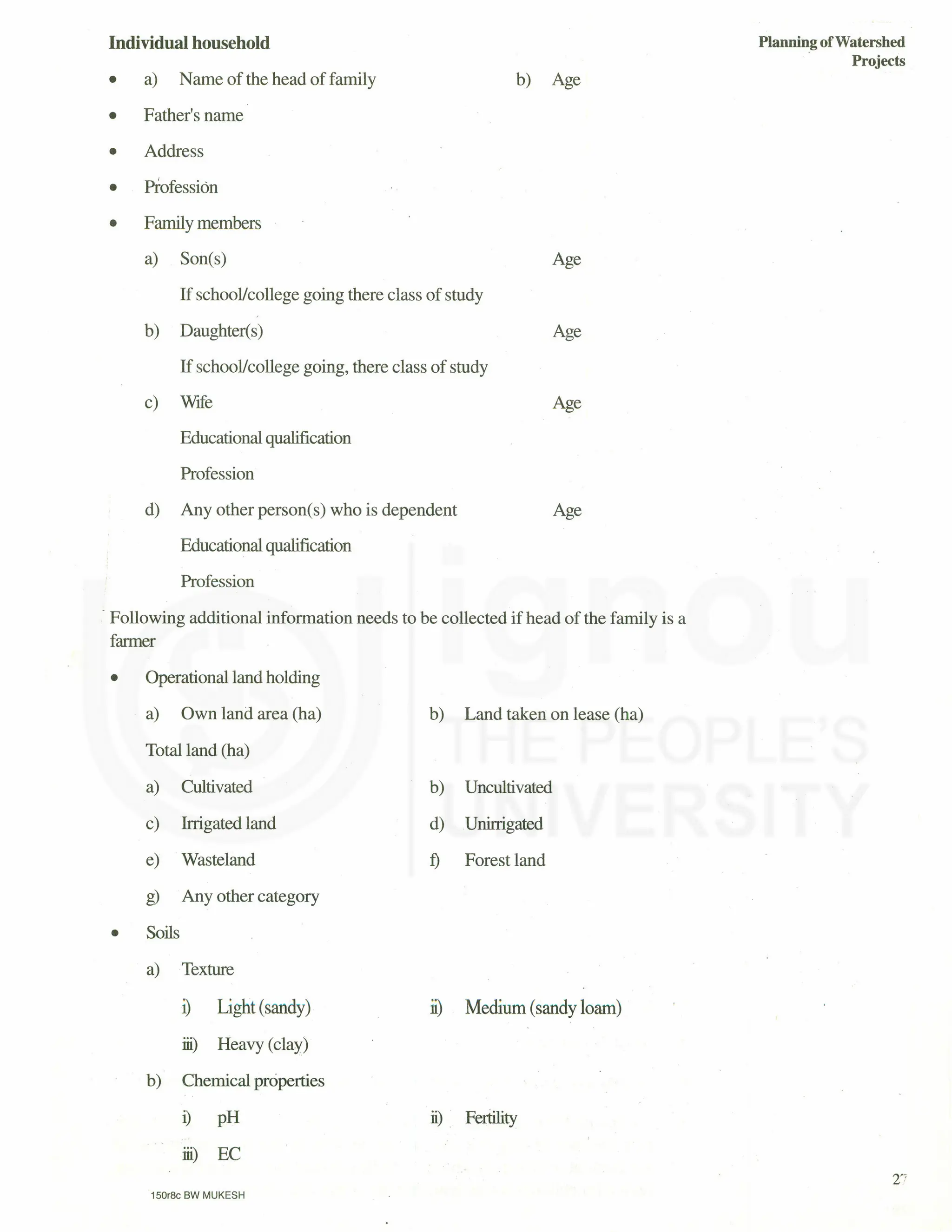
• a) Name of the head offamily b) Age
• Father's name
• Address
• Profession
• Family members
a) Son(s) Age
If school/college going there class of study
b) Daughter(s) Age
If school/college going, there class of study
c) WIfe Age
Educational qualification
Profession
d) Any other person(s) who is dependent Age
Educational qualification
Profession
-Following additional information needs to be collected if head of the family is a
farmer
• Operational land holding
a) Own land area (ha) b) Land taken on lease (ha)
Total land (ha)
a) Cultivated
c) Irrigated land
e) Wasteland
b) Uncultivated
d) Unirrigated
f) Forest land
g) Any other category
• Soils
a) Texture
i) Light (sandy)
iii) Heavy (clay)
b) Chemical properties
i) pH
iii) EC
ii) Medium (sandy loam)
ii) Fertility
150r8c sw MUKESH
Watershed Management
28
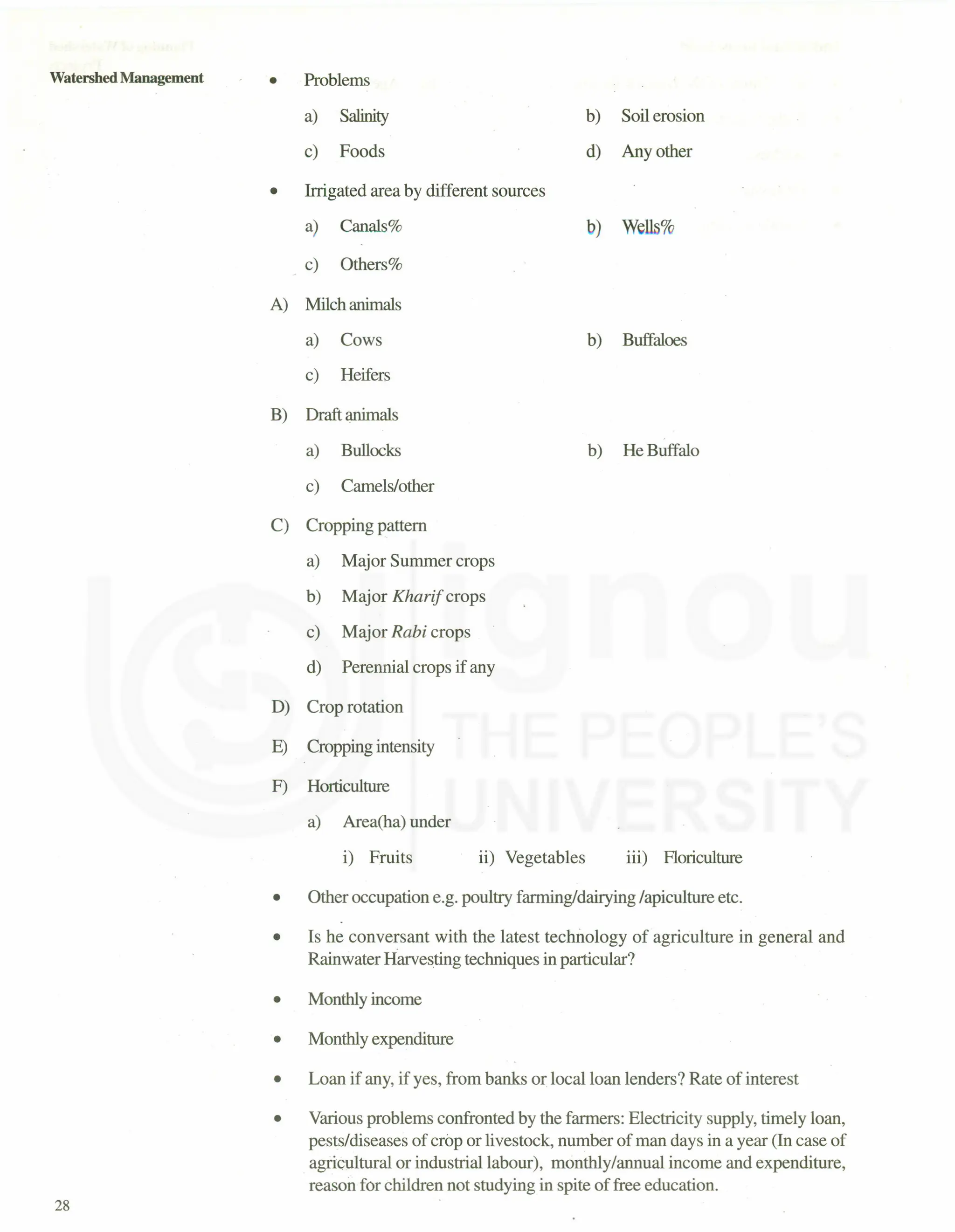
• Problems
a) Salinity
c) Foods
b) Soil erosion
d) Any other
• Irrigated area by different sources
a) Canals%
_ c) Others%
b) Wells%
A) Milch animals
a) Cows
c) Heifers
B) Draft animals
a) Bullocks
c) Camels/other
C) Cropping pattern
a) Major Summer crops
b) Major Kharif crops
c) Major Rabi crops
d) Perennial crops if any
D) Crop rotation
E) Cropping intensity
F) Horticulture
a) Area(ha) under
i) Fruits ii) Vegetables
b) Buffaloes
b) He Buffalo
iii) Floriculture
• Other occupation e.g. poultry farming/dairying /apiculture etc.
• Is he conversant with the latest technology of agriculture in general and
Rainwater Harvesting techniques in particular?
• Monthly income
• Monthly expenditure
• Loan if any, if yes, from banks or local loan lenders? Rate of interest
• Various problems confronted by the farmers: Electricity supply, timely loan,
pests/diseases of crop or livestock, number of man days in a year (In case of
agricultural or industrial labour), monthly/annual income and expenditure,
reason for children not studying in spite of free education.
Check Your Progress 3
Note: a)
b)
Compare your answers with those given at the end of unit.
Use the space below for your answers.
1) What is the importance of benchmark survey in watershed projects?
2) What are major information/data needed for conducting natural resource
survey in watersheds?
3) What important points are to be kept in mind in proper planning?
So far you have been exposed to various facets of watershed management. We
shall now study about its integrated approach.
4.8 INTEGRATED WATERSHED MANAGEMENT
Watershed management is an integral approach for sustainable use of natural
resources, viz., land, water, vegetation, livestock, fisheries and human resources.
In watersheds, integrated farming systems approach is followed. In addition to
low external input sustainable agriculture, it also includes agro-forestry,horticulture,
silvi-pasture, aquaculture, animal husbandry, apiculture, sericulture, lac culture etc.
This ensures full utilization of resources for employment generation and overall
development of the watershed. In agro-forestry system, different species of trees
grown and under different situations such as floods, drought, and landslide, mine
area, saline and alkaline conditions are identified. Some common trees are not
only good for fuel but serve dual/triple purpose of fodder and even medicines,
etc. (Table 4.1).
Table 4.1: Common Species of Trees and their Use
S.No. Botanical Name Common Name Uses
l. Accacia nilotica Babul Fuel, fodder, timber
2. A.tortilis Israelibabul Fuel, fodder
3. Albizzia pro cera Siris Fuel, fodder
4. Azadirachta indica Neem Fuel, medicine
5. Dalbergia sissoo Shisham Timber, fuel
6. Prosopis cineraria Khejri,Jandi Fuel, fodder
Planning of Watershed
Projects
29
Watershed Management
30
Medicinal and Aromatic Plants
InAyuervedic system of medicines and cosmetics, these plants are in great demand.
Extra income can be generated by collecting them or cultivating them from forest.
Aloe vera, Ashvgandha, Ocimum sp. (tulsi), Mint, Palm rose, Vetiver etc., are
some of the examples. Similarly, in floriculture farmers can grow different types of
flowers such as Rose, Jasmine, Carnation, Gladiolus, Marigold to have
supplemental income.
Sericulture, Apiculture and Lac Culture
Rearing of silkworm for production of silk, lac culture (rearing of lac insects and
production of lac), apiculture (rearing of honey bees and honey production) etc.
generate extra income and employment opportunities.
Dairying and Poultry Farming
Due to risk involved in rainfed farming on account of erratic behaviour of monsoon,
farmers should adopt other farming systems e.g. animal husbandry/dairying and
poultry farming for assured income and whole year employment to his family
members also. In severe drought of 1987 kharif and rabi crops could not be
even sown on account of total failure of monsoon in most of the places like
Tosham and Sewani Tehsils of Bhiwani district, adjoining area of Hisar and
Mahinder districts of Haryana under rainfed conditions. Under such situations
Prosopis cineraria (Khejri, landi) came to the rescue of farmers. This tree only
survived on sand dunes which provided fodder for livestock, fuel for domestic use
and for sale also.
Mixed farming systems play a very important role in conserving and improving
environment and overall socio-economic development of watersheds. The by-
products of crop production can be used in animal production, which in turn
returns in the form of manure back to the crop production. The livestock production
system which includes dairy, mutton, buffen (buffalo meat), wool, pork, egg and
broiler are capable of generating enough income. This in combination with crop
production system can provide sustainable nutritional and livelihood security to
watershed beneficiaries.
Check Your Progress 4
Note: a) Compare your answers with those given at the end of unit.
b) Use the space below for your answers.
1) Name viable integrated farmingsystems o
2) Why integrated farming should be adopted in watershed areas?
.................................................................................................................
4.9 LET US SUM UP
Planning of Watershed
Projects
• Land in about half of the total geographical area is degraded.
• There is over exploitation of natural resources viz.; land, water and biodiversity.
• Similarly, two-third cultivated area is rainfed where crop production is not
stable due to erratic behaviour of rainfall.
• Socio-economic conditions of rural people in the rainfed areas are highly
unsatisfactory.
• Various problems confronting the rural people need to be identified and
solution sought on watershed basis.
• Before the implementation of the project, survey of natural resources and
inventory components should be undertaken in order to know the root cause
of the problem.
• For successful completion of the watershed projects, active participation of
the people at every stage and phase i.e. right from planning up to the completion
of the project should be ensured.
• Strong institutional arrangement at the national, state, district and the village
levels plays an important role in successful operation of watershed
development projects.
• Both land and non-land enterprises need to be taken up.
• Integrated watershed management deals with sustainable use of natural
resources, viz., land, water, vegetation, livestock, fisheries and human
resources.
• Emphasis on diversification of cropping pattern and integrated farming system
needs to be laid to generate more employment opportunities and ensure
more income.
4.10 KEYWORDS
BRGF Backward Regions Grand Fund.
DPR Detailed Project Report.
DPS District Planning Committee.
DWDU District Watershed Development Unit.
GramSabha Village Society.
ITK Indigenous Traditional Knowledge.
LCC Land Capability Class.
NABARD National Bank for Agriculture and Rural Development.
NGO Non-Government Organization.
NRAA National Rainfed Area Authority.
3)
Watershed Management NREGS National Rural Employment Guarantee Schemes.
Project Implementing Agency.
Participatory Rural Appraisal.
Panchayati Raj Institutions.
Sampoorna Grameen Rojgar Yojna.
PIAs
PRA
PRIs
SGRY
SHGs Self-Help Groups.
SLNA
UGs
State Level Nodal Agency.
User Groups.
A diagram representing a set or sets drawn as circles and
the logical relationships between them.
VoluntaryOrganizations.
Watershed Community.
Watershed is entire geographic area of particular land from
where rainwater as run off is drained out from ridges along
the slopes of land to single particular point/outlet or common
drain point. It is an ideal planning unit for conservation of
major natural resources of soil, water and biodiversity.
Watershed Development Team.
Venn Diagram
VOs
wc
Watershed
WDT
4.11 SUGGESTED READING
Anonymous WARASA-JAN SAHBHAGITA Guidelines for National
Watershed Development Project for Rainfed Areas (NWDPRA). Ministry of
Agriculture, Govt. of India publication.
Bhatia, N. L., Panwar, K. S., Rana,V. S. and Malik, A. C. (1998). Saral
Watershed-A Model for Fragile Environment. Paper presented in 1SI
International Agronomy Congress held at Vigyan Bhawan, New Delhi, November
23-27, 1998.
Dhruv Narain, v.v., Sastry, G. and Pathak, U.S. (1997). Watershed Management,
Published by DIPA, ICAR, New Delhi, pp .•176.
Sarnra, J.S., Sharda, V.N. and Sikka, A. K. (2002). Water Harvesting and Re-
cycling -Indian Experience. Central, Soil & Water Conservation Research and
Training Institute, 218, Kaulagarh, Road, Dehradun, (Uttrakhand), India
Sharda, V.N., Sikka, A.K. and Juyal, G.P. (2006). Participatory Integrated
Watershed Management-A Field Manual Central, Soil & Water Conservation
Research and Training Institute 218, Kaulagarh, Road, Dehradun, (Uttrakhand),
India., pp. 366.
Sharma, Sriniwas and Mishra, P.K. (1995). Watershed Management in Dry
Land Areas-Principles and Practices. In book of Sustainable Development of
Dry land Agriculture by Dr. R. P.Singh. Scientific Publisher, Jodhpur.
Singh, Rajvir (2000). Watershed Planning and Management. Yash Publishing
House, Bikaner, pp. 470.
4.12 MODEL ANSWERS TO CHECK YOUR
PROGRESS
Check Your Progress 1
. 1) In participatory watershed management people participation is very important
in execution of the project. The role of Project Implementation Agency
(PIA) and Panchyat Raj Institutions (PRIs) is crucial. Participatory Rural
Appraisal (PRA) is undertaken with the active participation of local people
to instill confidence in them for taking decision in implementation of the
project.
2) District Watershed Committee is constituted to help and guide all activities in
watershed programme. The committee reviews the progress of watersheds
in the districts. It helps in solving various problems and guides in the
implementation of project. It gives the approval for formation of PIA. It also
identifies various policy issues to be referred to StateINational Watershed
Committees.
3) The User Groups deal with homogeneous group of persons having land.
within the watershed areas while SHGs include small and marginal farmers
households, landless, labours, women and SC/ST persons.
4) Panchayati Raj Institutions (PRIs) are actively involved in the watershed
.programmes and play an important role in planning the watershed development
projects at the intermediate level and provide support to PIAs and Gram
Panchayats/Watershed Committees in technical guidance with the help of
their subject matter specialists.
5) Watershed Development Team comprises of at least four experts preferably
with professional degree in the disciplines of agriculture, soil science, water
management, social mobilization and institutional building.
6) i) State Level Nodal Agency
ii) Project Implementation Agency
iii) National Bank for Agriculture and Rural Development
iv) District Watershed Development Unit
v) Detailed Project Report
Check Your Progress 2
1) PRA is the abbreviated form of Participatory Rural Appraisal. It is method of
knowing or determining the living conditions of the local rural people by
establishing rapport with village community. It enables them to identify and
tackle problems of the watershed with their active participation. The principle
of PRA is based on listening and learning from the people of the local areas.
In other words, it is the informal way of learning from local people about
various problems and seeks solutions from them only.
150rBc sw MUKESH
Planning of Watershed
Projects
33
Watershed Management
34
2) Following points need to be considered for carrying out PRA exercise:
• Decide date, time and venue of the meeting should be in consultation
with the farmers;
• Introduce yourself (watershed workers) to the farmers;
• Approach villagers as friend, philosopher and guide;
• Explain the purpose of your visit;
• Discuss various issues in friendly environment without any tension or
fear;
.• Listen them carefully and be patient;
• Do not criticize, interrupt in discussion;
• Respect social customs;
• Give equal opportunity to all in discussion;
• Discussion should be focused on the major issues;
• Identify various persons for different tasks; and
• End the meeting with thanks.
Check Your Progress 3
1) Benchmarksurvey is very important to know the status of natural resources,
socio-economic condition of human population. This survey helps to study
the impact of various activities after the completion of the project.
2) Following information /data is required for undertaking natural resource survey.
• Human population
, • Male and female ratio
• Male and female literacy rate
• Total number of households
• Scheduled castes/tribes and other backward classes
• Operational land holding
• Cropping pattern
• Irrigated, unirrigated, waste and forest land
• Physical and chemical properties of soils
• Animal husbandry
• Horticulture
• Other farming systems
3) Following points need to be considered for proper planning of a watershed:
• Development of natural resources (Private and common land, water).
• Increase in production productivity of land based enterprises such as
agriculture, horticulture/forestry, livestock, fisheries.
• Budget estimate for each component.
• Expected contribution from the participants.
• Variousmodalities of implementation such as review,monitoring, auditing
etc.
• Proper care and support of non-land based enterprises.
• Time frame for completion of various activities.
• Withdrawal strategy and post project management.
Check Your Progress 4
1) Agro-forestry, horticulture, silvi-pasture, aquaculture, animal husbandry,
apiculture, sericulture, lac culture are the main integrated farming systems.
2) Integrated farming systems ensure full utilization of resources for overall
socio-economic development of entire watershed and in turn generating
livelihood opportunities.
Planning of Watershed
Projects
35

Unit-4.pdf civilengineering college notes

  • 1.
    UNIT4 PLANNINGOFWATERSHED PROJECTS Structure 4.0 Objectives 4.1Introduction 4.2 Participatory Watershed Management 4.3 InstitutionalArrangement 4.3.1 National Level 4.3.2 State Level 4.3.3 District Level 4.3.4 Panchayati Raj Institutions (PRIs) 4.3.5 Project Implementation Agency (PIA) 4.4 Participatory Rural Appraisal (PRA) 4.5 Natural Resource Survey 4.6 Watershed Management Planning 4.7 InformationlData Needed 4.8 Integrated Watershed Management 4.9 Let Us Sum Up 4.10 Keywords 4.11 Suggested Reading 4.12 Model Answers to Check Your Progress 4.0 OBJECTIVES After going through this unit, you should be able to: • apply the concept of participatory watershed management; • outline the approach of Participatory Rural Appraisal (PRA); • undertake the survey of natural resources in watershed area; • describe the steps of watershed management planning; and • acquaint yourself with the integrated watershed management system. 4.1 INTRODUCTION 16 illthe previous unit, the concept of watershed management, its present scenario in respect of India, approach and goals of watershed management have been elaborately dealt with. About half of our geographical area is affected by land degradation and soil erosion. Due to land fragmentation and increasing population, per capita land and
  • 2.
    water availability isdecreasing. Nearly two-third of the cultivated area in the country is rainfed where agricultural development is highly unsatisfactory resulting in abject poverty. Watershed management is essential for all round development in rural areas. The participatory watershed approach is followed ensuring active involvement of the watershed community in planning, implementing, monitoring, evaluatioh and post project maintenance of the created assets of watershed. The planning is based on bottom-up and not top-down approach and provides for decentralization of procedure flexibility in choice of technology. Planners and policy makers provide technical and administrative support. Institutional arrangements at central, state, district, village and project level agencies including Panchayati Raj Institutions (PRIs) are of paramount importance for effective management of watershed development projects. Participatory Rural Appraisal (PRA) is an effective tool to identify the various problems of the watershed and tackle/solve them with the help of local people. Natural resource surveys including climate, soils, biodiversity, hydrology, land use etc., are prerequisites for launching a successful watershed development project. 4.2 PARTICIPATORY WATERSHED MANAGEMENT Watershed development and management is based on Participatory Rural Appraisal (PRA). Participatory watershed management seeks active help of watershed beneficiaries in setting priorities, defining policies and monitoring/evaluating the impact of selected' interventions on socio-economic development of the area. The restructured National Rainfed Area Authority (NRAA) provides for decentralization , of procedural flexibilityin choice of technology.Active involvement of the watershed community is a must in planning, implementing, monitoring, evaluation and post project maintenance of the created assets of watershed. The planning is based on bottom-up and not top-down approach. Planners and policy makers provide technical and administrative support. At every step, local community is to be consulted for their actual requirement. Thus people's participation is very important for successful adoption of soil conservation and water harvesting measures for ensuring sustainable production from arable and non-arable land. Participatory Watershed Management (PWM) thus is based on the premise of community action and community empowerment for resource conservation and development as well as improvement in livelihoods of the people. All the organization associated with planning and management of watershed projects should change the mindset of top-down approach and adopt the attitude of working with people. Activity 1 1) Try an awareness programme on PWM with your community or with any other community you have access to and give your comments on the statement made in italics. 2) Try to identify a. watershed development project undertaken by the government department concerned and obtain the reactions of the expected beneficiaries. Now that you have done Activity 1, you must have realized that watershed development projects were hitherto planned and implemented by the Government Planning ofWatershed Projects 17
  • 3.
    Watershed Management 18 Department withoutactive participation of people. This practice has not given the long term and sustainable results. After the withdrawal of departmental functionaries from the watershed area on completion of proposed works or period, there used to be no one to pursue further development and maintain the created assets. The development of natural resources and maintenance of the created assets on a continuous basis is possible only through the active participation of the beneficiaries, living in the area. To create the feeling of belongingness and to be financially capable even after the project period, it is emphasized that the watershed community should plan and implement the watershed development programme and make donations and contribution for the individual and community works/activities in the form of cash, material or labour. In this programme, emphasis is ~so laid on mobilizing the community and organizes it into functional groups and making them responsible for planning and implementation of choice activities related to individuals and the entire community. It is further stressed to form institution of stakeholders of watershed area for systematic participatory planning, implementation and maintenance of developmental works and to handle the financial transactions. Thus, Community organization is a crux of participatory watershed development. It not only facilitates the people coming together physically and emotionally but also helps in putting their social, intellectual and material resources for unified action. This calls for mobilization and organization of community. 4.3 INSTITUTIONAL ARRANGEMENT Now you will learn about the institutional arrangements at the national, state, district and village levels for effective implementation of watershed programmes as shown in Fig. 4.1. The following sub-section on will enrich your knowledge about the community organization. National Rainfed Area Authority (NRAA) at the national level ! f State Level Nodal Agency (SLNA) ! t District Watershed Development Unit (DWDU) ~ f Panchayati Raj Institutions (PRIs) , i Project Implementation Agency +- Watershed Development Team (PIA) (WDT) Fig. 4.1: Block diagram of institutional arrangement
  • 4.
    4.3.1 National Level TheNational Rainfed Area Authority (NRAA), a nodal agency at the central level facilitates budgetary allocation and smooth flow of funds from different projects of Government of India to the District Watershed Development Units (DWDU) for speedy and successful implementation of these watershed development projects. It acts as an effective coordinating mechanism between different ministries, organizations and departments undertaking watershed development programmes. It is also responsible for supporting the process of preparing strategic plans for watershed development projects at the state and district levels keeping in view specific agro-climatic and socio-economic conditions. It also supports state level nodal agencies in identifying resource organizations and establishing capacity building arrangements. The professional multi-disciplinary experts in the field of agriculture, water management, institution and capacity building etc., constitute the nodal agency. 4.3.2 State Level A State Level Nodal Agency (SLNA) is empowered to oversee all watershed projects in the state sanctioned based on the approved perspective and strategic plan. The SLNA is headed by the Development Commissioner/Additional Chief Secretary/Agricultural Production CommissionerlPrincipal Secretary and comprises of one representative from NABARD, one representative each from the state department of rural development, agriculture, animal husbandry and allied sectors, one representative from ground water board, one representative from voluntary organization and two experts from research institute/state universities, the representative from National Rural Employment Guarantee Schemes (NREGS), Backward Regions Grand Fund (BRGF) and other related implementing agencies are also represented. A team of four to seven professional experts-in the field of agriculture, water management, capacity building, social science, information technology, administration, accounts etc., assist the SLNA which provides technical s.upports to DWDU It also prepares perspective and strategic plans of watershed for the state on the basis of plans prepared at block and district levels. It also sets the expected outputs and financial outlays based on which approval of central nodal agencies is sought. It also establishes monitoring and evaluation of the watershed projects. 4.3.3 District Level District Watershed Development Unit (DWDU) is established to oversee the implementation of watershed projects in each district with separate accounts. It functions in close coordination with District Planning Committee (DPC) with a representative each of NRGA and BRGF at the district level. The DWDU comprising of a full time project manager and three to four experts on agriculture, water management, social science, management and accounts and is responsible ..for identifying potential Project Implementing Agencies (PIAs). It also facilitates preparation of district strategic and action plans including capacity building and ensures smooth flow of funds to the projects and timely submission of required documents to SLNA. It also facilitates coordination with relevant programmes of agriculture, horticulture, rural development, animal husbandry, etc., with the watershed projects for enhancement of productivity and livelihood. Planning of Watershed , Projects 19
  • 5.
    Watershed Management 20 4.3.4 PanchayatiRaj Institutions (PRIs) Panchayati Raj Institutions (PRIs) are actively involved in the watershed programmes. The District PanchayatJZilla Parishad are entrusted with the responsibility of coordinating various sectoral schemes with watershed development projects, review of progress, settling disputes etc. Intermediate Panchayats have an important role in planning the watershed development projects at the intermediate level and provide support to PIAs and Gram PanchayatslWatershed Committees in technical guidance with the help of their subject matter specialists. 4.3.5 Project Implementation Agency (PIA) The PIAs include relevant line departments, autonomous organizations under State/ Central Governments, Government Institutes/Research Bodies, Intermediate Panchayats and Voluntary Organizations (VOs). VOs have an important role in creating awareness, capacity building, information, education and communication and social audit. Each PIA is supported by a dedicated Watershed Development Team (WDT) with the approval of DWDU. The PIA provides necessary technical guidance to the Gram Panchayat for preparation of development plans for the watershed through PRA exercise, undertake community organization and training for the village communities, supervise watershed development activities, inspect and authenticate project accounts, encourage adoption of low cost technologies and build upon indigenous technical knowledge, monitor and review the overall project implementation and set up institutional arrangements for post-project operation and maintenance and further development of the assets created during the project period. It also facilitatesthe mobilization of additional financial resources from other government programmes, such as NREGA, BRGF, SGRY, National Horticulture Mission, Tribal Welfare Schemes, Artificial Ground water Recharging, Greening India, etc. Watershed Development Team WDT comprises of at least four experts preferably with professional degree in the disciplines of agriculture, soil science, water management, social mobilization and institutional building. At least one of the WDT members should be a woman. The WDT should be located as close as possible to the watershed project and its close collaboration with the team of experts at the district and state level must be ensured. It guides Watershed Community (WC) in the formulation of the watershed action plan. It assists Gram PanchayatJGram Sabha in constitution of the WC, User Groups (UGs) and Self-Help Groups (SHGs). The User Groups deal with homogeneous group of persons having land with in the watershed areas while SHGs include small and marginal farmers households, landless, labours, women and SC/S! persons. It also ensures active participation of women, conducts participatory base-line surveys, training and capacity building, prepare resource development plans. It prepares Detailed Project Report (DPR) for the consideration of Gram Sabha and facilitates the development of livelihood opportunities for the landless and maintaining project accounts.
  • 6.
    Check Your Progress1 Note: a) Compare your answers with those given at the end of unit. . b) Use the space below for your answers. 1) What is Participatory Watershed Management? ................................................................................................... ; . • ••••••••••• •• •• •••••• • •• ••••••• • • •• ~ ••••••••••••••••••• " •••••••••••••••••••••••••••••••••••••••••••••••••••••••• 0"0 ••••••••••••••••••••••••••••••••• .•...•.••...•.•.•........•............•..........•......•.•.................•......•.•.....••.•.....• ! .....•..... 2) What are the functions of District Watershed Committee? .......................................... ; . 3) Define User Group (UG) and Self-Help Group (SHG) . .....................................................................•............................................ I 4) Explain thy role of1anChayati Raj Institutions? ···························:··1······················· . 5) How many experts constitute a WDT? Write their disciplines also. ......... ·.·······.·········1.··············· _IL ••••••••••••••••••••••••••••• ............... ~ :--' . 6) Write the full form bf the following i) SLNA . ii) PIA l/ " ......................................•..•........... iii) NABARD . iv) DWDU !.~ . v) DPR : . I i ./ . Now that you have dorte he Check Your Progress 1, we may go over to/study about Participatory Rural ppraisal, . Planning ofWatershed 'Projects ) 21
  • 7.
    Watershed Management 22 4.4 PARTICIPATORYRURAL APPRAISAL (PRA) Participatory Rural Appraisal is the method ofknowinglor determining the living conditions of local rural people by establishing rapport with village community. It helps to identify various problems of the watershed and tackle/solve them ~ith the help of local people. The principle of PRA is based on listening and learning from the people of the local areas. It is the informal way of learning from local people about various problems and seeks solutions from them only.As all the communities are involved, there is no bias or favour towards any section of people. As local people and grass-root workers are directly involved, planning and execution of various activities do not face bureaucratic problems. There is no discrimination of gender as women participation is very essential and it should be ensured. It is essential to gain the confidence of local people in conducting the survey of the watershed and subsequently planning and execution of watershed activities. Extension educations methods should be adopted to approach and convince the farmers. Following fundamental points should be kept in mind for carrying out PRA exercise: • Decision regarding date, time and venue of the meeting should be taken in consultation with the farmers; • Introduce yourself (watershed workers) to the farmers; • Approach villagers as a friend and mentor; • Explain the purpose of your visit; • Discuss various issues in friendly environment without any tension or fear; • Listen to them carefully and be patient; • Do not criticize, interrupt in discussion; • Respect social customs; • Give equal opportunity to all in discussion; • Discussion should be focused on the major issues; • Identify various persons for different tasks; and • End the meeting with thanks. After the meeting, all the members of the watershed team should review the various points discussed in the meeting. Meeting of Gram Sabha (Village Society) should be held for preparation of blue print of the plan/project Physiographic exercise should be taken up with the villagers to discuss following points: a) Name of watershed b) Location of headquarters if there are 3-4 villages c) Major priorities The village maps, Venn diagrams should be prepared after conducting the survey. A workshop involving farmers should be organized for open and frank discussion on various issues.
  • 8.
    Check Your Progress2 Note: a) Compare your answers with those given at the end of unit. , b) Use the space below for your answers. 1) What do you understand by the term PRA and why is it required? 2) List the fundamental points to be considered for carrying out a PRA exercise. .................................................................................................................. Now you have acquired the background knowledge of PRA. Let us now study about surveys. 4.5 NATURAL RESOURCE SURVEY Benchmark surveys are conducted to identify natural resources of the area including climate, soils, bio diversity, hydrology, land use etc., before final selection of site and launching of watershed project. The data regarding area under irrigation, wasteland, community land, forest land, ponds, wells, quality of drinking water are collected. Land Capability Class (LCC) and its characteristics such.as soil texture, soil structure, topography, water table etc., are also studied. The extent of soil and water erosion problem, soil fertility and its production potential, status of natural flora and fauna are also determined. The villagewise information is collected as per the following format. • Name of village , _ • P'O. Tehsil!faluka~ District • Land area (ha) • a) Total land c) Uncultivated e) Unirrigated g) Community land i) Any other category Soils b) Cultivated d) Irrigated land t) Wasteland h) Forest land i) Texture a) Light (sandy) c) Heavy (clay) b) Medium (sandy loam) Planning of Watershed Projects 23
  • 9.
    Watershed Management / ii) Chemical a)pH iii) Fertility status Problem a) Salinity , C) Flmling .. Source of irrigation a) Canals % c) Other % b) EC .• b) Soil erosion .d) 1nyotller .b) Wells % • Village pond (s) • Well(s) quality of drinking water • Water table a) Shallow b) deep • Transport facilities .a) RoadfBus b) Railway • Climate: Summer Autumn Winter Monsoon Rainfall(mm) • Bicx:liversity: a) Name of common trees, wild plants b) Name of wild animals, insects, parasites and predators Activity 2 / I) Go to a nearby village and find out the source of water: i) Irrigation it) Drinking 2) Visit a nearby well and measure the water level from the ground surface. Will you categorize as shallow well and deep well. Now that you have done Activity 2, you must have realized that natural resource survey is essential for planning watershed projects. We shall now study watershed management planning. 4.6 WATERSHED MANAGEMENT PL~G ' Planning is very important for successful and timely implemen~tion of a watershed project. Keeping in view, ~e natural resources, waters.hed ac,ion/strategic plans are to be prepared for arable and non-arable lands. Following points need to be considered for proper planning of a watershed.
  • 10.
    • Development ofnatural resources (Private and common land, water). • Increase in production productivity of land based enterprises such as agriculture, horticulture/forestry, livestock, fisheries etc. • Budget estimate for each component. • Expected contribution from the participants. • Various modalities of implementation such as review, monitoring, auditing etc. • Proper care and support of non-land based enterprise. • Time frame for completion of various activities. • Withdrawal strategy and post project management. Indigenous Traditional Knowledge (ITK) of the farmers with slight modifications will be very useful as compared to high cost technology. The budget provided in the watershed project should be used as per the norms given below: • The account should be opened in nationalized bank or cooperative bank. • Withdrawal of the amount should be also as per norms. • The accounts record should be properly maintained. • Audit should be got done on regular basis. • Corpus Fund is also created which should be 1% of the total budget for maintenance of the assets. Another 1% should be contributory from the beneficiaries or from the StateGovemment. • There should be proper monitoring and evaluation of progress in the meetings .of various committees. Construction of water harvesting structures with their design should be included in the action plan. Low cost technology and local raw material should be used to minimize the cost. Vegetative storage structures may be given preference over very high cost cement/iron machinery involved invarious water harvesting structures. 4.7 INFORMATIONIDATANEEDED This inventory of the watershed includes the human population and male and female ratio including scheduled castes and backward classes population, location of primary health centre, hospital, school and other institutions, post office, banks. The type and quality of roads, transport, power supply, grain, fruit and vegetable market for selling the products, agriculture inputs cooperative society are also other important components which play a major role in effective implementation of watershed projects. This helps in proper planning and studying the problems and opportunities. The help from village Patwari (land revenue official), Village Pradhan (Village head) may be sought. The information regarding other line departments viz.; revenue, agriculture, animal husbandry, irrigation, forest, health, govt. and semi govt. agencies, Non-government Agencies (NGOs) working in that particular area is also vital. For detailed inventory, the following format may be used: Planning ofW,.tershed Projects 25
  • 11.
    Watershed Management Village •Name of Village • Household families • Human population a) Male b) Female • Literacy (%) a) Male b) Female • Scheduled castes/tribes Families a) Balmikies b) Ravidasia c) Any other • Backward class a) Carpenters b) Blacksmiths c) Pitcher makers d) Barbers e) Any other • Livestock population a) Milch animals i) Cows ii) Buffaloes iii) Heifers b) Draft animals i) Bullocks ii) He buffaloes iii) Camels/others '. No. of tractors • Implements a) Ploughs b) Harrows c) Cultivators • Threshers Area under different crops a) Major summer crops b) Major Kharif crops c) Major Rabi crops d) Perennial crop if any • Crop rotation .. Cropping intensity • Horticulture • Area under a) Fruits b) . Vegetables 26 I c) Floriculture
  • 12.
    Individual household Planningof Watershed Projects • a) Name of the head offamily b) Age • Father's name • Address • Profession • Family members a) Son(s) Age If school/college going there class of study b) Daughter(s) Age If school/college going, there class of study c) WIfe Age Educational qualification Profession d) Any other person(s) who is dependent Age Educational qualification Profession -Following additional information needs to be collected if head of the family is a farmer • Operational land holding a) Own land area (ha) b) Land taken on lease (ha) Total land (ha) a) Cultivated c) Irrigated land e) Wasteland b) Uncultivated d) Unirrigated f) Forest land g) Any other category • Soils a) Texture i) Light (sandy) iii) Heavy (clay) b) Chemical properties i) pH iii) EC ii) Medium (sandy loam) ii) Fertility 150r8c sw MUKESH
  • 13.
    Watershed Management 28 • Problems a)Salinity c) Foods b) Soil erosion d) Any other • Irrigated area by different sources a) Canals% _ c) Others% b) Wells% A) Milch animals a) Cows c) Heifers B) Draft animals a) Bullocks c) Camels/other C) Cropping pattern a) Major Summer crops b) Major Kharif crops c) Major Rabi crops d) Perennial crops if any D) Crop rotation E) Cropping intensity F) Horticulture a) Area(ha) under i) Fruits ii) Vegetables b) Buffaloes b) He Buffalo iii) Floriculture • Other occupation e.g. poultry farming/dairying /apiculture etc. • Is he conversant with the latest technology of agriculture in general and Rainwater Harvesting techniques in particular? • Monthly income • Monthly expenditure • Loan if any, if yes, from banks or local loan lenders? Rate of interest • Various problems confronted by the farmers: Electricity supply, timely loan, pests/diseases of crop or livestock, number of man days in a year (In case of agricultural or industrial labour), monthly/annual income and expenditure, reason for children not studying in spite of free education.
  • 14.
    Check Your Progress3 Note: a) b) Compare your answers with those given at the end of unit. Use the space below for your answers. 1) What is the importance of benchmark survey in watershed projects? 2) What are major information/data needed for conducting natural resource survey in watersheds? 3) What important points are to be kept in mind in proper planning? So far you have been exposed to various facets of watershed management. We shall now study about its integrated approach. 4.8 INTEGRATED WATERSHED MANAGEMENT Watershed management is an integral approach for sustainable use of natural resources, viz., land, water, vegetation, livestock, fisheries and human resources. In watersheds, integrated farming systems approach is followed. In addition to low external input sustainable agriculture, it also includes agro-forestry,horticulture, silvi-pasture, aquaculture, animal husbandry, apiculture, sericulture, lac culture etc. This ensures full utilization of resources for employment generation and overall development of the watershed. In agro-forestry system, different species of trees grown and under different situations such as floods, drought, and landslide, mine area, saline and alkaline conditions are identified. Some common trees are not only good for fuel but serve dual/triple purpose of fodder and even medicines, etc. (Table 4.1). Table 4.1: Common Species of Trees and their Use S.No. Botanical Name Common Name Uses l. Accacia nilotica Babul Fuel, fodder, timber 2. A.tortilis Israelibabul Fuel, fodder 3. Albizzia pro cera Siris Fuel, fodder 4. Azadirachta indica Neem Fuel, medicine 5. Dalbergia sissoo Shisham Timber, fuel 6. Prosopis cineraria Khejri,Jandi Fuel, fodder Planning of Watershed Projects 29
  • 15.
    Watershed Management 30 Medicinal andAromatic Plants InAyuervedic system of medicines and cosmetics, these plants are in great demand. Extra income can be generated by collecting them or cultivating them from forest. Aloe vera, Ashvgandha, Ocimum sp. (tulsi), Mint, Palm rose, Vetiver etc., are some of the examples. Similarly, in floriculture farmers can grow different types of flowers such as Rose, Jasmine, Carnation, Gladiolus, Marigold to have supplemental income. Sericulture, Apiculture and Lac Culture Rearing of silkworm for production of silk, lac culture (rearing of lac insects and production of lac), apiculture (rearing of honey bees and honey production) etc. generate extra income and employment opportunities. Dairying and Poultry Farming Due to risk involved in rainfed farming on account of erratic behaviour of monsoon, farmers should adopt other farming systems e.g. animal husbandry/dairying and poultry farming for assured income and whole year employment to his family members also. In severe drought of 1987 kharif and rabi crops could not be even sown on account of total failure of monsoon in most of the places like Tosham and Sewani Tehsils of Bhiwani district, adjoining area of Hisar and Mahinder districts of Haryana under rainfed conditions. Under such situations Prosopis cineraria (Khejri, landi) came to the rescue of farmers. This tree only survived on sand dunes which provided fodder for livestock, fuel for domestic use and for sale also. Mixed farming systems play a very important role in conserving and improving environment and overall socio-economic development of watersheds. The by- products of crop production can be used in animal production, which in turn returns in the form of manure back to the crop production. The livestock production system which includes dairy, mutton, buffen (buffalo meat), wool, pork, egg and broiler are capable of generating enough income. This in combination with crop production system can provide sustainable nutritional and livelihood security to watershed beneficiaries. Check Your Progress 4 Note: a) Compare your answers with those given at the end of unit. b) Use the space below for your answers. 1) Name viable integrated farmingsystems o 2) Why integrated farming should be adopted in watershed areas? .................................................................................................................
  • 16.
    4.9 LET USSUM UP Planning of Watershed Projects • Land in about half of the total geographical area is degraded. • There is over exploitation of natural resources viz.; land, water and biodiversity. • Similarly, two-third cultivated area is rainfed where crop production is not stable due to erratic behaviour of rainfall. • Socio-economic conditions of rural people in the rainfed areas are highly unsatisfactory. • Various problems confronting the rural people need to be identified and solution sought on watershed basis. • Before the implementation of the project, survey of natural resources and inventory components should be undertaken in order to know the root cause of the problem. • For successful completion of the watershed projects, active participation of the people at every stage and phase i.e. right from planning up to the completion of the project should be ensured. • Strong institutional arrangement at the national, state, district and the village levels plays an important role in successful operation of watershed development projects. • Both land and non-land enterprises need to be taken up. • Integrated watershed management deals with sustainable use of natural resources, viz., land, water, vegetation, livestock, fisheries and human resources. • Emphasis on diversification of cropping pattern and integrated farming system needs to be laid to generate more employment opportunities and ensure more income. 4.10 KEYWORDS BRGF Backward Regions Grand Fund. DPR Detailed Project Report. DPS District Planning Committee. DWDU District Watershed Development Unit. GramSabha Village Society. ITK Indigenous Traditional Knowledge. LCC Land Capability Class. NABARD National Bank for Agriculture and Rural Development. NGO Non-Government Organization. NRAA National Rainfed Area Authority. 3)
  • 17.
    Watershed Management NREGSNational Rural Employment Guarantee Schemes. Project Implementing Agency. Participatory Rural Appraisal. Panchayati Raj Institutions. Sampoorna Grameen Rojgar Yojna. PIAs PRA PRIs SGRY SHGs Self-Help Groups. SLNA UGs State Level Nodal Agency. User Groups. A diagram representing a set or sets drawn as circles and the logical relationships between them. VoluntaryOrganizations. Watershed Community. Watershed is entire geographic area of particular land from where rainwater as run off is drained out from ridges along the slopes of land to single particular point/outlet or common drain point. It is an ideal planning unit for conservation of major natural resources of soil, water and biodiversity. Watershed Development Team. Venn Diagram VOs wc Watershed WDT 4.11 SUGGESTED READING Anonymous WARASA-JAN SAHBHAGITA Guidelines for National Watershed Development Project for Rainfed Areas (NWDPRA). Ministry of Agriculture, Govt. of India publication. Bhatia, N. L., Panwar, K. S., Rana,V. S. and Malik, A. C. (1998). Saral Watershed-A Model for Fragile Environment. Paper presented in 1SI International Agronomy Congress held at Vigyan Bhawan, New Delhi, November 23-27, 1998. Dhruv Narain, v.v., Sastry, G. and Pathak, U.S. (1997). Watershed Management, Published by DIPA, ICAR, New Delhi, pp .•176. Sarnra, J.S., Sharda, V.N. and Sikka, A. K. (2002). Water Harvesting and Re- cycling -Indian Experience. Central, Soil & Water Conservation Research and Training Institute, 218, Kaulagarh, Road, Dehradun, (Uttrakhand), India Sharda, V.N., Sikka, A.K. and Juyal, G.P. (2006). Participatory Integrated Watershed Management-A Field Manual Central, Soil & Water Conservation Research and Training Institute 218, Kaulagarh, Road, Dehradun, (Uttrakhand), India., pp. 366. Sharma, Sriniwas and Mishra, P.K. (1995). Watershed Management in Dry Land Areas-Principles and Practices. In book of Sustainable Development of Dry land Agriculture by Dr. R. P.Singh. Scientific Publisher, Jodhpur.
  • 18.
    Singh, Rajvir (2000).Watershed Planning and Management. Yash Publishing House, Bikaner, pp. 470. 4.12 MODEL ANSWERS TO CHECK YOUR PROGRESS Check Your Progress 1 . 1) In participatory watershed management people participation is very important in execution of the project. The role of Project Implementation Agency (PIA) and Panchyat Raj Institutions (PRIs) is crucial. Participatory Rural Appraisal (PRA) is undertaken with the active participation of local people to instill confidence in them for taking decision in implementation of the project. 2) District Watershed Committee is constituted to help and guide all activities in watershed programme. The committee reviews the progress of watersheds in the districts. It helps in solving various problems and guides in the implementation of project. It gives the approval for formation of PIA. It also identifies various policy issues to be referred to StateINational Watershed Committees. 3) The User Groups deal with homogeneous group of persons having land. within the watershed areas while SHGs include small and marginal farmers households, landless, labours, women and SC/ST persons. 4) Panchayati Raj Institutions (PRIs) are actively involved in the watershed .programmes and play an important role in planning the watershed development projects at the intermediate level and provide support to PIAs and Gram Panchayats/Watershed Committees in technical guidance with the help of their subject matter specialists. 5) Watershed Development Team comprises of at least four experts preferably with professional degree in the disciplines of agriculture, soil science, water management, social mobilization and institutional building. 6) i) State Level Nodal Agency ii) Project Implementation Agency iii) National Bank for Agriculture and Rural Development iv) District Watershed Development Unit v) Detailed Project Report Check Your Progress 2 1) PRA is the abbreviated form of Participatory Rural Appraisal. It is method of knowing or determining the living conditions of the local rural people by establishing rapport with village community. It enables them to identify and tackle problems of the watershed with their active participation. The principle of PRA is based on listening and learning from the people of the local areas. In other words, it is the informal way of learning from local people about various problems and seeks solutions from them only. 150rBc sw MUKESH Planning of Watershed Projects 33
  • 19.
    Watershed Management 34 2) Followingpoints need to be considered for carrying out PRA exercise: • Decide date, time and venue of the meeting should be in consultation with the farmers; • Introduce yourself (watershed workers) to the farmers; • Approach villagers as friend, philosopher and guide; • Explain the purpose of your visit; • Discuss various issues in friendly environment without any tension or fear; .• Listen them carefully and be patient; • Do not criticize, interrupt in discussion; • Respect social customs; • Give equal opportunity to all in discussion; • Discussion should be focused on the major issues; • Identify various persons for different tasks; and • End the meeting with thanks. Check Your Progress 3 1) Benchmarksurvey is very important to know the status of natural resources, socio-economic condition of human population. This survey helps to study the impact of various activities after the completion of the project. 2) Following information /data is required for undertaking natural resource survey. • Human population , • Male and female ratio • Male and female literacy rate • Total number of households • Scheduled castes/tribes and other backward classes • Operational land holding • Cropping pattern • Irrigated, unirrigated, waste and forest land • Physical and chemical properties of soils • Animal husbandry • Horticulture • Other farming systems 3) Following points need to be considered for proper planning of a watershed: • Development of natural resources (Private and common land, water). • Increase in production productivity of land based enterprises such as agriculture, horticulture/forestry, livestock, fisheries.
  • 20.
    • Budget estimatefor each component. • Expected contribution from the participants. • Variousmodalities of implementation such as review,monitoring, auditing etc. • Proper care and support of non-land based enterprises. • Time frame for completion of various activities. • Withdrawal strategy and post project management. Check Your Progress 4 1) Agro-forestry, horticulture, silvi-pasture, aquaculture, animal husbandry, apiculture, sericulture, lac culture are the main integrated farming systems. 2) Integrated farming systems ensure full utilization of resources for overall socio-economic development of entire watershed and in turn generating livelihood opportunities. Planning of Watershed Projects 35