Office Space
UNIT 4
STARTING OFF
• Match these work environments with the
photos in your book.
• Open – plan office with individual workstations.
• Office overlooking warehouse or factory.
• Office/studio outside the city.
• Individual office in a high-rise office block.
• Room converted into an office for working from home.
1
5
3
2
4
READING Part 4
• In Reading Part 4, you have to match 15
questions or statements with parts of a
text or a number of shorts texts.
• In the exam you will have about 18
minutes to do this.
EXAM
INFORMATION
Is there an architect in the house?
1
2
3
4
5
D
F
D
B
D
6 E
7
F
8
9
10
11
12
13
14
15
A
B
C
E
E
F
C
A
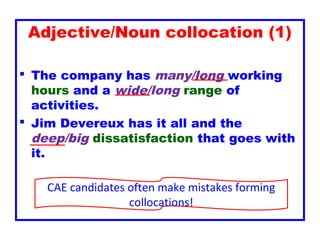
Adjective/Noun collocation (1)
 The company has many/long working
hours and a wide/long range of
activities.
 Jim Devereux has it all and the
deep/big dissatisfaction that goes with
it.
CAE candidates often make mistakes forming
collocations!
LISTENING
• Listen to an economist talking about a skills
shortage. Match these things happening in
modern workplaces with the photos.
A Offices relocating to the
countryside.
B Perks such as career breaks
and sabbaticals for key staff.
C Telecommuting – working from
home.
D People from different parts of the
world collaborating on the same
projects
E Working on past retirement
age.
F Longer working hours
2
5
1
4
3
6
LISTENING Part 2
• Before you listen, look at the gaps
to check:
– What type of information you need
– What types of words will fit the gaps
• Then, when you listen:
– Write the words you actually hear
– Make sure you spell them correctly
ADVICE
Listen to an economist talking about a skills
shortage.
KEY
1
2
3
4
5
with talent
technology and
financial
emerging
(economies)
software enginners
university
populations
6 wrong subjects
7
8
management
raising salaries
may, might, could
Possibility
•The photocopier isn’t working, there may be
some paper stuck inside.
•She could arrive sometime this afternoon.
•I might go to the party.
•The weather may well improve by the weekend.
•I’d better write it down otherwise I could easily
forget what I have to do.
•My boss could conceivably change her mind and
decide to give me a pay increase.
Other phrases to express possibility
•It’s just about possible that …
•There’s some possibility that …
•There’s a little possibility that…
•There’s a slight possibility that…
Other phrases to express stronger
possibility
•It’s quite possible that …
•There’s a good possibility that …
•There’s a strong possibility that…
•There’s a serious possibility that…
PROBABILITY
Words and phrases
•He’s not likely to make the same mistake again.
•There’s a strong likelihood of him getting the
CAE at first attempt.
•There’s little likelihood that we’ll manage to
meet our deadline.
•You have such a good level of English that you
should have no difficulty in getting the job.
CERTAINTY
Words and phrases
•There are quiete some malls in town. They must
be making a lot of money.
•During the test, she didn’t know what to do. She
can’t have studied for the test.
•With such references and qualifications, she’s
bound to get agead in her career.
•The police who survived 17 days in the jungle
must have been striving to keep himself alive.
DISCUSS
How important to you
are the people you
study with?
DISCUSS
Is it difficult to make real
friends these days?
Why?
USE OF ENGLISH Part 1
• Use of English Part 1 is a text with 12
gaps.
• You have to choose the best option, A, B,
C or D, for each gap.
• In the exam you will have about 10
minutes for this.
EXAM
INFORMATION
Use the clues to help you!
Friends benefit firms
1
2
3
4
5
A
D
C
B
D
6 A
7 B
8
9
10
11
12
C
B
D
B
D
SPEAKING PAPER Part 4
• In Speaking PART 4:
–The interviewer will ask both
candidates questions to find out
their opinions on topics related
to PART 3.
–You have to give your opinons
and also react to your partner’s
ideas.
EXAM
INFORMATION
• Listen to Frances and Sally being
asked their opinons about issues
connected with work.
• Write down the 03 questions you
think they have been asked.
Sally and Frances:
Suggest several different ideas to
answer each question
Answer some question by talking
about their personal situation
Help each other with ideas and
encouraging comments
Treat each question very seriously
Speak in quite a fromal style
T
T
F
T
F
Excercise 5 – page 43
Ask and
answer
the
questions
in pairs!
Pages 46, 47
UNIT 3 – VOCABULARY & GRAMMAR
adept
contemplate
food
generation
neighbourhood
rapid
reside
tolerate
clever
think about
grub
age group
area
quick
live
put up with
2.I really enjoy expressing my ideas but it doesn’t
matter much to me whether I win an agument or
not.
3.One of the most difficult jobs an army officer
has to do is exert control over his men when
morale is low.
4.Researchers are running an experiment to find
out how children learn and use new vocabulary.
2
3
2. Most of my family love all kinds of sport, but
not my sister – she thinks all sport is a waste
of time.
3. The exam was so difficult that I didn’t get
any of my answers right.
4. CORRECT
5. I thought we had plenty of coffee but I’ve just
looked in the cupboard and there’s none left.
6. CORRECT
7. Our rate of pay is not the point – it’s the
actual working conditions that are so awful.
8. The group left for the North Pole three weeks
ago and, so far, we’ve had no news of their
progress.
4
1. Amnesia can be caused by specific
medical conditions.
2. It is very well known that our memory is
formed by our real experiences. But could
a false memory be put into our heads?
Could we be persuaded to believe that we
had experienced something that never
actually took place?
3. Our semantic memory is used to store our
knowledge of the world … normally it can
be accessed quickly and easily. The
meaning of words and the names of people
and places are included in our semantic
memory.
4
4. It can be thought of as the ability to
remember and use a limited amount of
information for a short amount of time … If
you are distracted, the information can be
lost and the task has to be started again.
5. Forgetting is now being studied (by
researchers) and is thought of, not as a
failure of memory, but as a more active
process. It is even believed that it may be
driven by a specific biological mechanism.
HOMEWORK
Thursday 10th, May
• CD – ROM, UNITS 3 and 4
• Grammar, Vocabulary
• One Reading task
• One Listenig task
PRINT THE
REPORT

Unit 4

  • 1.
  • 2.
    STARTING OFF • Matchthese work environments with the photos in your book. • Open – plan office with individual workstations. • Office overlooking warehouse or factory. • Office/studio outside the city. • Individual office in a high-rise office block. • Room converted into an office for working from home. 1 5 3 2 4
  • 3.
    READING Part 4 •In Reading Part 4, you have to match 15 questions or statements with parts of a text or a number of shorts texts. • In the exam you will have about 18 minutes to do this. EXAM INFORMATION
  • 4.
    Is there anarchitect in the house? 1 2 3 4 5 D F D B D 6 E 7 F 8 9 10 11 12 13 14 15 A B C E E F C A
  • 5.
    Adjective/Noun collocation (1) The company has many/long working hours and a wide/long range of activities.  Jim Devereux has it all and the deep/big dissatisfaction that goes with it. CAE candidates often make mistakes forming collocations!
  • 6.
    LISTENING • Listen toan economist talking about a skills shortage. Match these things happening in modern workplaces with the photos. A Offices relocating to the countryside. B Perks such as career breaks and sabbaticals for key staff. C Telecommuting – working from home. D People from different parts of the world collaborating on the same projects E Working on past retirement age. F Longer working hours 2 5 1 4 3 6
  • 7.
    LISTENING Part 2 •Before you listen, look at the gaps to check: – What type of information you need – What types of words will fit the gaps • Then, when you listen: – Write the words you actually hear – Make sure you spell them correctly ADVICE
  • 8.
    Listen to aneconomist talking about a skills shortage. KEY 1 2 3 4 5 with talent technology and financial emerging (economies) software enginners university populations 6 wrong subjects 7 8 management raising salaries
  • 9.
    may, might, could Possibility •Thephotocopier isn’t working, there may be some paper stuck inside. •She could arrive sometime this afternoon. •I might go to the party. •The weather may well improve by the weekend. •I’d better write it down otherwise I could easily forget what I have to do. •My boss could conceivably change her mind and decide to give me a pay increase.
  • 10.
    Other phrases toexpress possibility •It’s just about possible that … •There’s some possibility that … •There’s a little possibility that… •There’s a slight possibility that… Other phrases to express stronger possibility •It’s quite possible that … •There’s a good possibility that … •There’s a strong possibility that… •There’s a serious possibility that…
  • 11.
    PROBABILITY Words and phrases •He’snot likely to make the same mistake again. •There’s a strong likelihood of him getting the CAE at first attempt. •There’s little likelihood that we’ll manage to meet our deadline. •You have such a good level of English that you should have no difficulty in getting the job.
  • 12.
    CERTAINTY Words and phrases •Thereare quiete some malls in town. They must be making a lot of money. •During the test, she didn’t know what to do. She can’t have studied for the test. •With such references and qualifications, she’s bound to get agead in her career. •The police who survived 17 days in the jungle must have been striving to keep himself alive.
  • 13.
    DISCUSS How important toyou are the people you study with?
  • 14.
    DISCUSS Is it difficultto make real friends these days? Why?
  • 15.
    USE OF ENGLISHPart 1 • Use of English Part 1 is a text with 12 gaps. • You have to choose the best option, A, B, C or D, for each gap. • In the exam you will have about 10 minutes for this. EXAM INFORMATION Use the clues to help you!
  • 16.
    Friends benefit firms 1 2 3 4 5 A D C B D 6A 7 B 8 9 10 11 12 C B D B D
  • 17.
    SPEAKING PAPER Part4 • In Speaking PART 4: –The interviewer will ask both candidates questions to find out their opinions on topics related to PART 3. –You have to give your opinons and also react to your partner’s ideas. EXAM INFORMATION
  • 18.
    • Listen toFrances and Sally being asked their opinons about issues connected with work. • Write down the 03 questions you think they have been asked.
  • 19.
    Sally and Frances: Suggestseveral different ideas to answer each question Answer some question by talking about their personal situation Help each other with ideas and encouraging comments Treat each question very seriously Speak in quite a fromal style T T F T F
  • 20.
    Excercise 5 –page 43 Ask and answer the questions in pairs!
  • 21.
  • 22.
    UNIT 3 –VOCABULARY & GRAMMAR adept contemplate food generation neighbourhood rapid reside tolerate clever think about grub age group area quick live put up with
  • 23.
    2.I really enjoyexpressing my ideas but it doesn’t matter much to me whether I win an agument or not. 3.One of the most difficult jobs an army officer has to do is exert control over his men when morale is low. 4.Researchers are running an experiment to find out how children learn and use new vocabulary. 2
  • 24.
    3 2. Most ofmy family love all kinds of sport, but not my sister – she thinks all sport is a waste of time. 3. The exam was so difficult that I didn’t get any of my answers right. 4. CORRECT 5. I thought we had plenty of coffee but I’ve just looked in the cupboard and there’s none left. 6. CORRECT 7. Our rate of pay is not the point – it’s the actual working conditions that are so awful. 8. The group left for the North Pole three weeks ago and, so far, we’ve had no news of their progress.
  • 25.
    4 1. Amnesia canbe caused by specific medical conditions. 2. It is very well known that our memory is formed by our real experiences. But could a false memory be put into our heads? Could we be persuaded to believe that we had experienced something that never actually took place? 3. Our semantic memory is used to store our knowledge of the world … normally it can be accessed quickly and easily. The meaning of words and the names of people and places are included in our semantic memory.
  • 26.
    4 4. It canbe thought of as the ability to remember and use a limited amount of information for a short amount of time … If you are distracted, the information can be lost and the task has to be started again. 5. Forgetting is now being studied (by researchers) and is thought of, not as a failure of memory, but as a more active process. It is even believed that it may be driven by a specific biological mechanism.
  • 27.
    HOMEWORK Thursday 10th, May •CD – ROM, UNITS 3 and 4 • Grammar, Vocabulary • One Reading task • One Listenig task PRINT THE REPORT