Unit Five:
Controlling and Decision Making
1
Session Objectives
• Define controlling , monitoring & evaluation
• Determine the purpose of M&E
• Describe the relationship b/n M&E
• Identify the types of evaluations
• Evaluate the characteristics of indicators
2
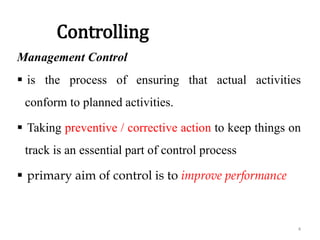
Controlling
Management Control
 is the process of ensuring that actual activities
conform to planned activities.
 Taking preventive / corrective action to keep things on
track is an essential part of control process
 primary aim of control is to improve performance
4
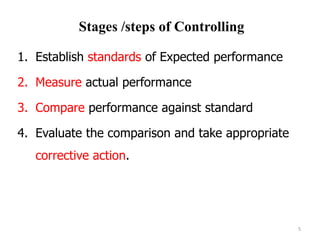
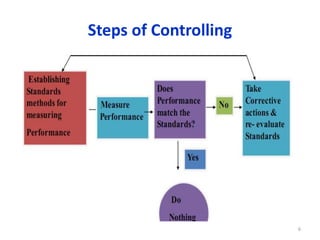
Stages /steps of Controlling
1. Establish standards of Expected performance
2. Measure actual performance
3. Compare performance against standard
4. Evaluate the comparison and take appropriate
corrective action.
5
Steps of Controlling
6
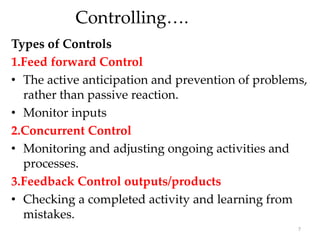
Controlling….
Types of Controls
1.Feed forward Control
• The active anticipation and prevention of problems,
rather than passive reaction.
• Monitor inputs
2.Concurrent Control
• Monitoring and adjusting ongoing activities and
processes.
3.Feedback Control outputs/products
• Checking a completed activity and learning from
mistakes.
7
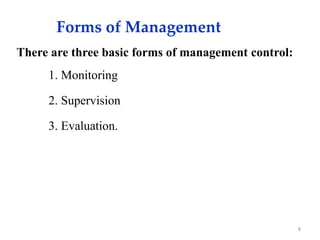
Forms of Management
There are three basic forms of management control:
1. Monitoring
2. Supervision
3. Evaluation.
8
1. MONITORING
- Monitoring = routine and continuous tracking of
planned activities
- It is the day-to-day watch on, or continuous follow up
of, the on going activities.
- It is regularly checking to see that program activities
are being done as planned.
- It is carried out through observation, discussion and
review of reports, statistical data.
9
MONITORING…
• The goals of monitoring are:
 To identify any problem early, and
 To solve without delaying the progress of the
program.
• Hence it is a basic part of implementation management.
10
2. Supervision:
• Intermittent processes to be conducted by the management in line
with controlling.
• A single person should not go for supervision
• The three main styles of supervision are
autocratic, and democratic.
• Autocratic supervisions tend to humiliate/injury the dignity/
people, make them irresponsible and mostly one way.
• It may dry up the initiative of colleagues.
• Democratic supervision helps people to grow
• become responsible for their own work to show initiative
11
3. Evaluation
• Evaluation = periodic (e.g., annual) assessment of whether
program objectives have been achieved
 Is systematical and periodical gathering, analyzing and
interpreting of information on the operation as well as the effects
and impacts of a development programme/project.
• Assess the contribution and worth of an intervention.
• It involves the comparison of the actual performance of the
system
12
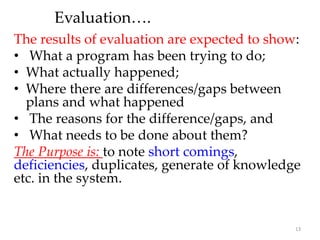
Evaluation….
The results of evaluation are expected to show:
• What a program has been trying to do;
• What actually happened;
• Where there are differences/gaps between
plans and what happened
• The reasons for the difference/gaps, and
• What needs to be done about them?
The Purpose is: to note short comings,
deficiencies, duplicates, generate of knowledge
etc. in the system.
13
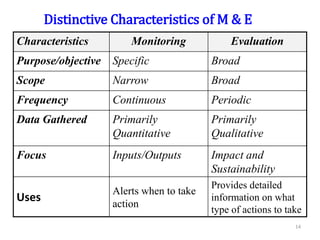
Distinctive Characteristics of M & E
Characteristics Monitoring Evaluation
Purpose/objective Specific Broad
Scope Narrow Broad
Frequency Continuous Periodic
Data Gathered Primarily
Quantitative
Primarily
Qualitative
Focus Inputs/Outputs Impact and
Sustainability
Uses
Alerts when to take
action
Provides detailed
information on what
type of actions to take
14
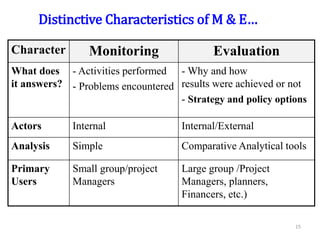
Distinctive Characteristics of M & E…
Character Monitoring Evaluation
What does
it answers?
- Activities performed
- Problems encountered
- Why and how
results were achieved or not
- Strategy and policy options
Actors Internal Internal/External
Analysis Simple Comparative Analytical tools
Primary
Users
Small group/project
Managers
Large group /Project
Managers, planners,
Financers, etc.)
15
Types of Evaluation
16
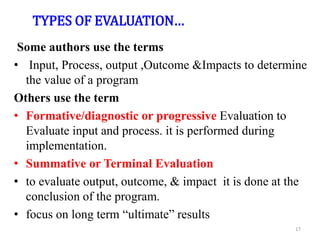
TYPES OF EVALUATION…
Some authors use the terms
• Input, Process, output ,Outcome &Impacts to determine
the value of a program
Others use the term
• Formative/diagnostic or progressive Evaluation to
Evaluate input and process. it is performed during
implementation.
• Summative or Terminal Evaluation
• to evaluate output, outcome, & impact it is done at the
conclusion of the program.
• focus on long term “ultimate” results
17
Types of Evaluation .….
• Based on people primarily responsible to lead
evaluation activities, evaluation could be classified as:
– Internal Evaluation
– External Evaluation
18
Internal Evaluation
• Evaluation activities designed and implemented
primarily under a leadership from program
implementers
• Usually serve information for program improvement
by supplementing monitoring activities
19
External Evaluation
• Evaluations designed and implemented primarily by
people who are relatively more distant from the
program (external evaluators)
• Used when:
– objectivity is a concern because of issues related to
the purpose of the evaluation
– concerns of multiple stakeholders included in
evaluation questions
– evaluation expertise beyond the organization’s
capacity is required to answer evaluation questions
20
21
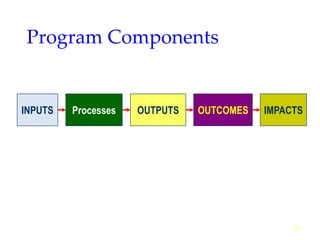
Program Components
Processes OUTPUTS OUTCOMES IMPACTS
INPUTS
22
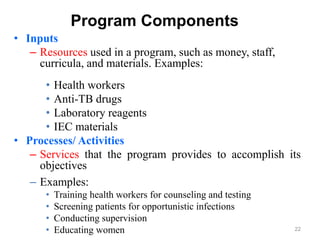
Program Components
• Inputs
– Resources used in a program, such as money, staff,
curricula, and materials. Examples:
• Health workers
• Anti-TB drugs
• Laboratory reagents
• IEC materials
• Processes/ Activities
– Services that the program provides to accomplish its
objectives
– Examples:
• Training health workers for counseling and testing
• Screening patients for opportunistic infections
• Conducting supervision
• Educating women
23
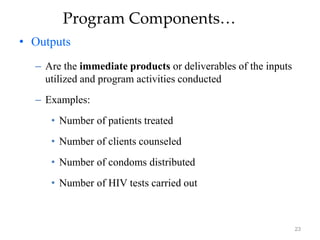
Program Components…
• Outputs
– Are the immediate products or deliverables of the inputs
utilized and program activities conducted
– Examples:
• Number of patients treated
• Number of clients counseled
• Number of condoms distributed
• Number of HIV tests carried out
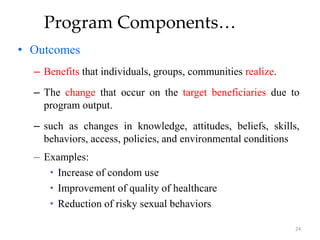
Program Components…
• Outcomes
– Benefits that individuals, groups, communities realize.
– The change that occur on the target beneficiaries due to
program output.
– such as changes in knowledge, attitudes, beliefs, skills,
behaviors, access, policies, and environmental conditions
– Examples:
• Increase of condom use
• Improvement of quality of healthcare
• Reduction of risky sexual behaviors
24
25
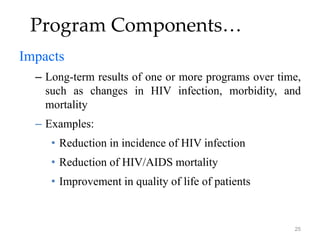
Program Components…
Impacts
– Long-term results of one or more programs over time,
such as changes in HIV infection, morbidity, and
mortality
– Examples:
• Reduction in incidence of HIV infection
• Reduction of HIV/AIDS mortality
• Improvement in quality of life of patients
26
INDICATORS
Development & selection for
M&E
“If you cannot measure results,
you can not tell success from failure!”
indicators are:
 A variable or summary of variables that
Measures key elements of a program or project
 Indicators provide critical M&E data at every
stage of program implementation
Inputs, process, outputs, outcomes and
impact
27
28
Indicators are signals which show;
 Whether we are on the right track & direction,
 How far we have progressed
 How far we still have to go to reach our
destination/objectives
Types of indicators
 Indicators could be classified based on different
aspects:
 Relationship with the subject of interest
 The nature of information they provide
 The component of a program they measure
29
Types of indicators con’t…
 Based on their relationship with the
subject of interest
• Direct indicators
• Indirect (proxy) indicators
30
Types of indicators con’t…
Direct indicators
 Are indicators directly related to the subject
intended to be measured
E.g. Proportion of children vaccinated in X district is
direct measure of EPI program output
31
Types of indicators con’t…
Indirect/proxy indicators
 They speak about a subject of interest only indirectly
 are used to measure change or results where direct
measures are not feasible
– Example:
• Monthly expenses of patients could be used to estimate
their monthly income.
• Client satisfaction may be used to measure the quality of
service
32
Types of indicators con’t…
 Based on the nature of information,
indicators could be classified as
–Quantitative indicators
–Qualitative indicators
33
Types of indicators con’t…
Quantitative indicators
 Are indicators which are measured numerically
 Include counts/frequencies, ratios, percentages,
rates, averages
Example
• Number of patients treated
• Prevalence of HIV
34
Types of indicators con’t…
Qualitative indicators
 Are indicators which are measured non-
numerically
 Usually applied when quantitative indicators are
not applicable
 are more subjective than quantitative indicators
Example
• Cleanliness of a hospital
35
Types of indicators con’t…
• Based on the component of a program the indicator measures, indicators
could be classified as:
1. Input indicators: Measures the actual use of resources
2. Process indicators: Measures the activities performed
3. Output indicators: Measures what is accomplished with inputs
4. Outcome indicators: Measures the direct and immediate impact
5. Impact indicators: Measures the indirect and longer-term impact
36
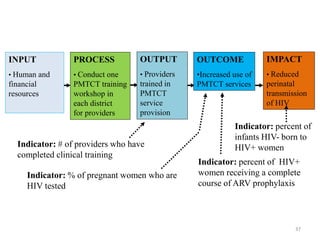
INPUT
• Human and
financial
resources
PROCESS
• Conduct one
PMTCT training
workshop in
each district
for providers
OUTPUT
• Providers
trained in
PMTCT
service
provision
OUTCOME
•Increased use of
PMTCT services
IMPACT
• Reduced
perinatal
transmission
of HIV
Indicator: # of providers who have
completed clinical training
Indicator: % of pregnant women who are
HIV tested
Indicator: percent of HIV+
women receiving a complete
course of ARV prophylaxis
Indicator: percent of
infants HIV- born to
HIV+ women
37
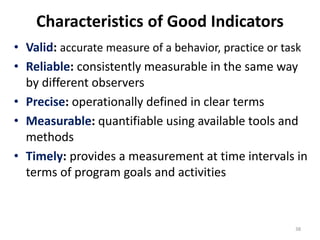
Characteristics of Good Indicators
• Valid: accurate measure of a behavior, practice or task
• Reliable: consistently measurable in the same way
by different observers
• Precise: operationally defined in clear terms
• Measurable: quantifiable using available tools and
methods
• Timely: provides a measurement at time intervals in
terms of program goals and activities
38
Data sources to measure Indicators
• Using Pre-Defined Indicators
 Surveillance
 Routine service reporting
 Special program reporting systems
 Administrative systems
 Vital registration systems
 Facility surveys
 Household surveys
 Censuses
 Evaluation and special studies
39
Self learning
Decision making
40
At the end of the session students be able:
• Define decision making
• Describe the relationship b/n decision making and other
functions of mgt
• Describe categories of decisions
• Decision making steps
• Identify factors influencing problem solving & decision
making
41
Decision Making . . .
Decision-making: the process of identifying and selecting a
course of action to solve a specific problem.
Decision making is a major part of management because :
• When planning, organizing, staffing, leading, and controlling,
managers make decisions on a daily basis.
• It requires choosing among alternative courses of action.
Decisions must be made at many levels in an organization from
executive decisions on the goals to the day to day repetitive
operations performed by lower level managers.
42
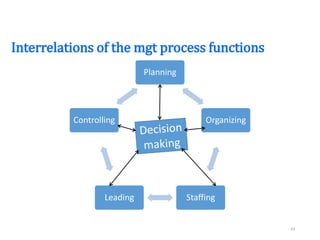
Interrelations of the mgt process functions
Planning
Organizing
Staffing
Leading
Controlling
43
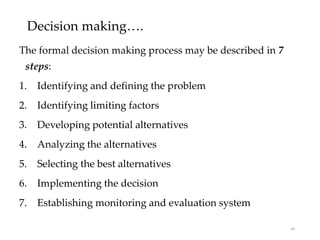
Decision making….
The formal decision making process may be described in 7
steps:
1. Identifying and defining the problem
2. Identifying limiting factors
3. Developing potential alternatives
4. Analyzing the alternatives
5. Selecting the best alternatives
6. Implementing the decision
7. Establishing monitoring and evaluation system
44
Decision making….
Types of decisions
1. Ends-means
• Ends: decision making based on our objectives/outputs
• Means: decision making based on our Strategies /operational
programs/and activities
2. Administrative-operational
• Administrative decisions: made by senior managers
“Policy decisions”
Resource allocation and utilization
• Operational decisions: made by mid-level and first-line managers
Day-to-day activities, e.g. personnel deployment, purchases,
specific work assignments
45
Decision making…
3. programmed – non-programmed
• Programmed decisions are elements of some decisions which are
similar and made so often repetitive and routine.
Includes procedures, rules and manuals. E.g. patient admission,
scheduling, inventory and supply ordering
Non-programmed decisions are unique and non-routine and may
have unclear implications for the organization, requiring creative
problem solving because they are unfamiliar.
E.g. Decision to expand, add or closes services
46
Ways of decisions making
1. Individual decision making:
Depends on :
 Style of the leader
Ability to set priorities
Timing of decision
Creativity of the manager
2. Group decision making:
Process of solving problems jointly
It plays a key role in health care management
E.g. task force
Especially very important in non-programmed decision making.
47
Techniques of group decision making
1. Brain storming:- group effort art generating ideas and
alternatives that can help to solve a problem.
 Generates more information for decision.
 Dominant groups can be a problem.
2. Nominal group technique:- tries to solve the problem of
brain storming (dominant group) as the problems are identified
individually.
 Group members are presented with a problem; each member
independently writes down his or her ideas on the problem, and
then each member presents one idea to the group until all ideas
have been presented.
No discussion takes place until all ideas have been presented.
48
Techniques of group decision making
3. Delphi technique:- A group decision making
conducted by a group leader through the use of
written questionnaires.
 It provides equal opportunity to participants.
49
Outcomes of group decision making
• Indecision: failure to decide (disagreement)
• Authority rule: decision by the team leader
• Minority rule: decision dominated by few influential
individuals.
• Majority rule: the majority agree
• Consensus: immediate agreement without thorough
discussion
• Unanimity: agree after through discussion and argument
50
Think twice before you decide!!
51
THANKS!!
Geta A.

unit 5.pptx

  • 1.
    Unit Five: Controlling andDecision Making 1
  • 2.
    Session Objectives • Definecontrolling , monitoring & evaluation • Determine the purpose of M&E • Describe the relationship b/n M&E • Identify the types of evaluations • Evaluate the characteristics of indicators 2
  • 3.
    Controlling Management Control  isthe process of ensuring that actual activities conform to planned activities.  Taking preventive / corrective action to keep things on track is an essential part of control process  primary aim of control is to improve performance 4
  • 4.
    Stages /steps ofControlling 1. Establish standards of Expected performance 2. Measure actual performance 3. Compare performance against standard 4. Evaluate the comparison and take appropriate corrective action. 5
  • 5.
  • 6.
    Controlling…. Types of Controls 1.Feedforward Control • The active anticipation and prevention of problems, rather than passive reaction. • Monitor inputs 2.Concurrent Control • Monitoring and adjusting ongoing activities and processes. 3.Feedback Control outputs/products • Checking a completed activity and learning from mistakes. 7
  • 7.
    Forms of Management Thereare three basic forms of management control: 1. Monitoring 2. Supervision 3. Evaluation. 8
  • 8.
    1. MONITORING - Monitoring= routine and continuous tracking of planned activities - It is the day-to-day watch on, or continuous follow up of, the on going activities. - It is regularly checking to see that program activities are being done as planned. - It is carried out through observation, discussion and review of reports, statistical data. 9
  • 9.
    MONITORING… • The goalsof monitoring are:  To identify any problem early, and  To solve without delaying the progress of the program. • Hence it is a basic part of implementation management. 10
  • 10.
    2. Supervision: • Intermittentprocesses to be conducted by the management in line with controlling. • A single person should not go for supervision • The three main styles of supervision are autocratic, and democratic. • Autocratic supervisions tend to humiliate/injury the dignity/ people, make them irresponsible and mostly one way. • It may dry up the initiative of colleagues. • Democratic supervision helps people to grow • become responsible for their own work to show initiative 11
  • 11.
    3. Evaluation • Evaluation= periodic (e.g., annual) assessment of whether program objectives have been achieved  Is systematical and periodical gathering, analyzing and interpreting of information on the operation as well as the effects and impacts of a development programme/project. • Assess the contribution and worth of an intervention. • It involves the comparison of the actual performance of the system 12
  • 12.
    Evaluation…. The results ofevaluation are expected to show: • What a program has been trying to do; • What actually happened; • Where there are differences/gaps between plans and what happened • The reasons for the difference/gaps, and • What needs to be done about them? The Purpose is: to note short comings, deficiencies, duplicates, generate of knowledge etc. in the system. 13
  • 13.
    Distinctive Characteristics ofM & E Characteristics Monitoring Evaluation Purpose/objective Specific Broad Scope Narrow Broad Frequency Continuous Periodic Data Gathered Primarily Quantitative Primarily Qualitative Focus Inputs/Outputs Impact and Sustainability Uses Alerts when to take action Provides detailed information on what type of actions to take 14
  • 14.
    Distinctive Characteristics ofM & E… Character Monitoring Evaluation What does it answers? - Activities performed - Problems encountered - Why and how results were achieved or not - Strategy and policy options Actors Internal Internal/External Analysis Simple Comparative Analytical tools Primary Users Small group/project Managers Large group /Project Managers, planners, Financers, etc.) 15
  • 15.
  • 16.
    TYPES OF EVALUATION… Someauthors use the terms • Input, Process, output ,Outcome &Impacts to determine the value of a program Others use the term • Formative/diagnostic or progressive Evaluation to Evaluate input and process. it is performed during implementation. • Summative or Terminal Evaluation • to evaluate output, outcome, & impact it is done at the conclusion of the program. • focus on long term “ultimate” results 17
  • 17.
    Types of Evaluation.…. • Based on people primarily responsible to lead evaluation activities, evaluation could be classified as: – Internal Evaluation – External Evaluation 18
  • 18.
    Internal Evaluation • Evaluationactivities designed and implemented primarily under a leadership from program implementers • Usually serve information for program improvement by supplementing monitoring activities 19
  • 19.
    External Evaluation • Evaluationsdesigned and implemented primarily by people who are relatively more distant from the program (external evaluators) • Used when: – objectivity is a concern because of issues related to the purpose of the evaluation – concerns of multiple stakeholders included in evaluation questions – evaluation expertise beyond the organization’s capacity is required to answer evaluation questions 20
  • 20.
  • 21.
    22 Program Components • Inputs –Resources used in a program, such as money, staff, curricula, and materials. Examples: • Health workers • Anti-TB drugs • Laboratory reagents • IEC materials • Processes/ Activities – Services that the program provides to accomplish its objectives – Examples: • Training health workers for counseling and testing • Screening patients for opportunistic infections • Conducting supervision • Educating women
  • 22.
    23 Program Components… • Outputs –Are the immediate products or deliverables of the inputs utilized and program activities conducted – Examples: • Number of patients treated • Number of clients counseled • Number of condoms distributed • Number of HIV tests carried out
  • 23.
    Program Components… • Outcomes –Benefits that individuals, groups, communities realize. – The change that occur on the target beneficiaries due to program output. – such as changes in knowledge, attitudes, beliefs, skills, behaviors, access, policies, and environmental conditions – Examples: • Increase of condom use • Improvement of quality of healthcare • Reduction of risky sexual behaviors 24
  • 24.
    25 Program Components… Impacts – Long-termresults of one or more programs over time, such as changes in HIV infection, morbidity, and mortality – Examples: • Reduction in incidence of HIV infection • Reduction of HIV/AIDS mortality • Improvement in quality of life of patients
  • 25.
    26 INDICATORS Development & selectionfor M&E “If you cannot measure results, you can not tell success from failure!”
  • 26.
    indicators are:  Avariable or summary of variables that Measures key elements of a program or project  Indicators provide critical M&E data at every stage of program implementation Inputs, process, outputs, outcomes and impact 27
  • 27.
    28 Indicators are signalswhich show;  Whether we are on the right track & direction,  How far we have progressed  How far we still have to go to reach our destination/objectives
  • 28.
    Types of indicators Indicators could be classified based on different aspects:  Relationship with the subject of interest  The nature of information they provide  The component of a program they measure 29
  • 29.
    Types of indicatorscon’t…  Based on their relationship with the subject of interest • Direct indicators • Indirect (proxy) indicators 30
  • 30.
    Types of indicatorscon’t… Direct indicators  Are indicators directly related to the subject intended to be measured E.g. Proportion of children vaccinated in X district is direct measure of EPI program output 31
  • 31.
    Types of indicatorscon’t… Indirect/proxy indicators  They speak about a subject of interest only indirectly  are used to measure change or results where direct measures are not feasible – Example: • Monthly expenses of patients could be used to estimate their monthly income. • Client satisfaction may be used to measure the quality of service 32
  • 32.
    Types of indicatorscon’t…  Based on the nature of information, indicators could be classified as –Quantitative indicators –Qualitative indicators 33
  • 33.
    Types of indicatorscon’t… Quantitative indicators  Are indicators which are measured numerically  Include counts/frequencies, ratios, percentages, rates, averages Example • Number of patients treated • Prevalence of HIV 34
  • 34.
    Types of indicatorscon’t… Qualitative indicators  Are indicators which are measured non- numerically  Usually applied when quantitative indicators are not applicable  are more subjective than quantitative indicators Example • Cleanliness of a hospital 35
  • 35.
    Types of indicatorscon’t… • Based on the component of a program the indicator measures, indicators could be classified as: 1. Input indicators: Measures the actual use of resources 2. Process indicators: Measures the activities performed 3. Output indicators: Measures what is accomplished with inputs 4. Outcome indicators: Measures the direct and immediate impact 5. Impact indicators: Measures the indirect and longer-term impact 36
  • 36.
    INPUT • Human and financial resources PROCESS •Conduct one PMTCT training workshop in each district for providers OUTPUT • Providers trained in PMTCT service provision OUTCOME •Increased use of PMTCT services IMPACT • Reduced perinatal transmission of HIV Indicator: # of providers who have completed clinical training Indicator: % of pregnant women who are HIV tested Indicator: percent of HIV+ women receiving a complete course of ARV prophylaxis Indicator: percent of infants HIV- born to HIV+ women 37
  • 37.
    Characteristics of GoodIndicators • Valid: accurate measure of a behavior, practice or task • Reliable: consistently measurable in the same way by different observers • Precise: operationally defined in clear terms • Measurable: quantifiable using available tools and methods • Timely: provides a measurement at time intervals in terms of program goals and activities 38
  • 38.
    Data sources tomeasure Indicators • Using Pre-Defined Indicators  Surveillance  Routine service reporting  Special program reporting systems  Administrative systems  Vital registration systems  Facility surveys  Household surveys  Censuses  Evaluation and special studies 39
  • 39.
  • 40.
    At the endof the session students be able: • Define decision making • Describe the relationship b/n decision making and other functions of mgt • Describe categories of decisions • Decision making steps • Identify factors influencing problem solving & decision making 41
  • 41.
    Decision Making .. . Decision-making: the process of identifying and selecting a course of action to solve a specific problem. Decision making is a major part of management because : • When planning, organizing, staffing, leading, and controlling, managers make decisions on a daily basis. • It requires choosing among alternative courses of action. Decisions must be made at many levels in an organization from executive decisions on the goals to the day to day repetitive operations performed by lower level managers. 42
  • 42.
    Interrelations of themgt process functions Planning Organizing Staffing Leading Controlling 43
  • 43.
    Decision making…. The formaldecision making process may be described in 7 steps: 1. Identifying and defining the problem 2. Identifying limiting factors 3. Developing potential alternatives 4. Analyzing the alternatives 5. Selecting the best alternatives 6. Implementing the decision 7. Establishing monitoring and evaluation system 44
  • 44.
    Decision making…. Types ofdecisions 1. Ends-means • Ends: decision making based on our objectives/outputs • Means: decision making based on our Strategies /operational programs/and activities 2. Administrative-operational • Administrative decisions: made by senior managers “Policy decisions” Resource allocation and utilization • Operational decisions: made by mid-level and first-line managers Day-to-day activities, e.g. personnel deployment, purchases, specific work assignments 45
  • 45.
    Decision making… 3. programmed– non-programmed • Programmed decisions are elements of some decisions which are similar and made so often repetitive and routine. Includes procedures, rules and manuals. E.g. patient admission, scheduling, inventory and supply ordering Non-programmed decisions are unique and non-routine and may have unclear implications for the organization, requiring creative problem solving because they are unfamiliar. E.g. Decision to expand, add or closes services 46
  • 46.
    Ways of decisionsmaking 1. Individual decision making: Depends on :  Style of the leader Ability to set priorities Timing of decision Creativity of the manager 2. Group decision making: Process of solving problems jointly It plays a key role in health care management E.g. task force Especially very important in non-programmed decision making. 47
  • 47.
    Techniques of groupdecision making 1. Brain storming:- group effort art generating ideas and alternatives that can help to solve a problem.  Generates more information for decision.  Dominant groups can be a problem. 2. Nominal group technique:- tries to solve the problem of brain storming (dominant group) as the problems are identified individually.  Group members are presented with a problem; each member independently writes down his or her ideas on the problem, and then each member presents one idea to the group until all ideas have been presented. No discussion takes place until all ideas have been presented. 48
  • 48.
    Techniques of groupdecision making 3. Delphi technique:- A group decision making conducted by a group leader through the use of written questionnaires.  It provides equal opportunity to participants. 49
  • 49.
    Outcomes of groupdecision making • Indecision: failure to decide (disagreement) • Authority rule: decision by the team leader • Minority rule: decision dominated by few influential individuals. • Majority rule: the majority agree • Consensus: immediate agreement without thorough discussion • Unanimity: agree after through discussion and argument 50
  • 50.
    Think twice beforeyou decide!! 51 THANKS!! Geta A.