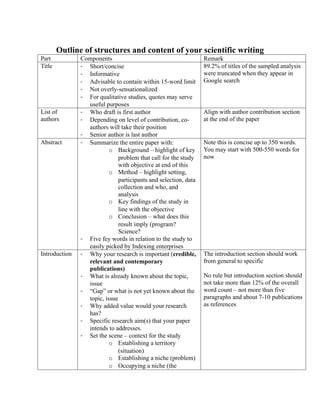
Outline of structuresand content of your scientific writing
Part Components Remark
Title - Short/concise
- Informative
- Advisable to contain within 15-word limit
- Not overly-sensationalized
- For qualitative studies, quotes may serve
useful purposes
89.2% of titles of the sampled analysis
were truncated when they appear in
Google search
List of
authors
- Who draft is first author
- Depending on level of contribution, co-
authors will take their position
- Senior author is last author
Align with author contribution section
at the end of the paper
Abstract - Summarize the entire paper with:
o Background – highlight of key
problem that call for the study
with objective at end of this
o Method – highlight setting,
participants and selection, data
collection and who, and
analysis
o Key findings of the study in
line with the objective
o Conclusion – what does this
result imply (program?
Science?
- Five fey words in relation to the study to
easily picked by Indexing enterprises
Note this is concise up to 350 words.
You may start with 500-550 words for
now
Introduction - Why your research is important (credible,
relevant and contemporary
publications)
- What is already known about the topic,
issue
- “Gap” or what is not yet known about the
topic, issue
- Why added value would your research
has?
- Specific research aim(s) that your paper
intends to addresses.
- Set the scene – context for the study
o Establishing a territory
(situation)
o Establishing a niche (problem)
o Occupying a niche (the
The introduction section should work
from general to specific
No rule but introduction section should
not take more than 12% of the overall
word count – not more than five
paragraphs and about 7-10 publications
as references
2.
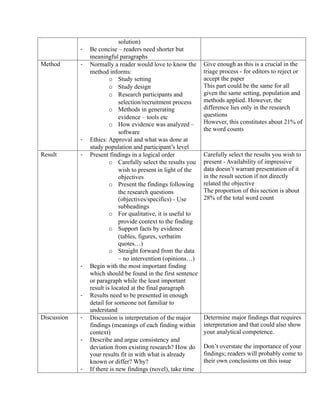
solution)
- Be concise– readers need shorter but
meaningful paragraphs
Method - Normally a reader would love to know the
method informs:
o Study setting
o Study design
o Research participants and
selection/recruitment process
o Methods in generating
evidence – tools etc
o How evidence was analyzed –
software
- Ethics: Approval and what was done at
study population and participant’s level
Give enough as this is a crucial in the
triage process - for editors to reject or
accept the paper
This part could be the same for all
given the same setting, population and
methods applied. However, the
difference lies only in the research
questions
However, this constitutes about 21% of
the word counts
Result - Present findings in a logical order
o Carefully select the results you
wish to present in light of the
objectives
o Present the findings following
the research questions
(objectives/specifics) - Use
subheadings
o For qualitative, it is useful to
provide context to the finding
o Support facts by evidence
(tables, figures, verbatim
quotes…)
o Straight forward from the data
– no intervention (opinions…)
- Begin with the most important finding
which should be found in the first sentence
or paragraph while the least important
result is located at the final paragraph
- Results need to be presented in enough
detail for someone not familiar to
understand
Carefully select the results you wish to
present - Availability of impressive
data doesn’t warrant presentation of it
in the result section if not directly
related the objective
The proportion of this section is about
28% of the total word count
Discussion - Discussion is interpretation of the major
findings (meanings of each finding within
context)
- Describe and argue consistency and
deviation from existing research? How do
your results fit in with what is already
known or differ? Why?
- If there is new findings (novel), take time
Determine major findings that requires
interpretation and that could also show
your analytical competence.
Don’t overstate the importance of your
findings; readers will probably come to
their own conclusions on this issue
3.
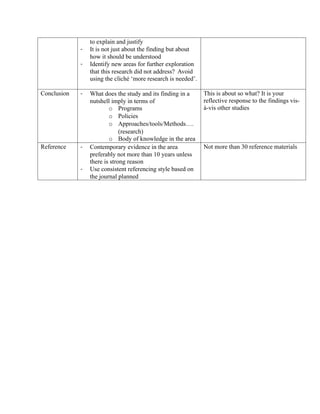
to explain andjustify
- It is not just about the finding but about
how it should be understood
- Identify new areas for further exploration
that this research did not address? Avoid
using the cliché ‘more research is needed’.
Conclusion - What does the study and its finding in a
nutshell imply in terms of
o Programs
o Policies
o Approaches/tools/Methods….
(research)
o Body of knowledge in the area
This is about so what? It is your
reflective response to the findings vis-
à-vis other studies
Reference - Contemporary evidence in the area
preferably not more than 10 years unless
there is strong reason
- Use consistent referencing style based on
the journal planned
Not more than 30 reference materials