Authentication
Receiver wantsto verify:
Contents of the message have not been modified (data authentication)
Source of message is who they claim to be (source authentication)
Different approaches available:
Symmetric Key Encryption
Message Authentication Codes (MACs)
Hash Functions
Public Key Encryption (i.e. Digital Signatures)
3.
Symmetric Encryption forAuthentication
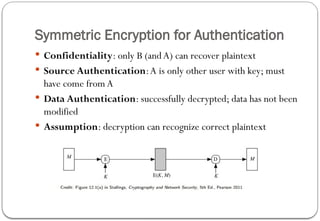
Confidentiality: only B (and A) can recover plaintext
Source Authentication:A is only other user with key; must
have come from A
Data Authentication: successfully decrypted; data has not been
modified
Assumption: decryption can recognize correct plaintext
4.
Recognizing Correct Plaintext
Example1
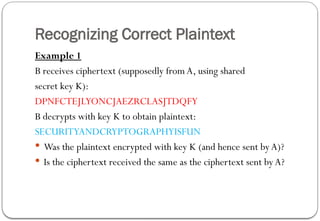
B receives ciphertext (supposedly from A, using shared
secret key K):
DPNFCTEJLYONCJAEZRCLASJTDQFY
B decrypts with key K to obtain plaintext:
SECURITYANDCRYPTOGRAPHYISFUN
Was the plaintext encrypted with key K (and hence sent byA)?
Is the ciphertext received the same as the ciphertext sent by A?
5.
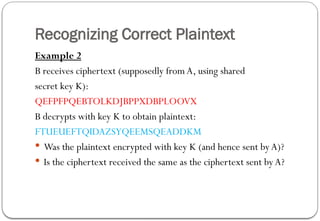
Recognizing Correct Plaintext
Example2
B receives ciphertext (supposedly from A, using shared
secret key K):
QEFPFPQEBTOLKDJBPPXDBPLOOVX
B decrypts with key K to obtain plaintext:
FTUEUEFTQIDAZSYQEEMSQEADDKM
Was the plaintext encrypted with key K (and hence sent byA)?
Is the ciphertext received the same as the ciphertext sent by A?
6.
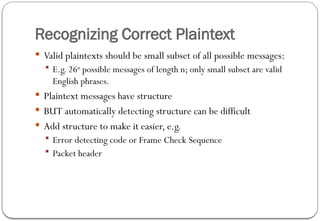
Recognizing Correct Plaintext
Valid plaintexts should be small subset of all possible messages:
E.g. 26n
possible messages of length n; only small subset are valid
English phrases.
Plaintext messages have structure
BUT automatically detecting structure can be difficult
Add structure to make it easier, e.g.
Error detecting code or Frame Check Sequence
Packet header
7.
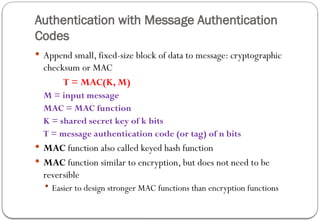
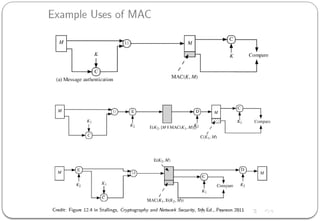
Authentication with MessageAuthentication
Codes
Append small, fixed-size block of data to message: cryptographic
checksum or MAC
T = MAC(K, M)
M = input message
MAC = MAC function
K = shared secret key of k bits
T = message authentication code (or tag) of n bits
MAC function also called keyed hash function
MAC function similar to encryption, but does not need to be
reversible
Easier to design stronger MAC functions than encryption functions
Requirement of MACs
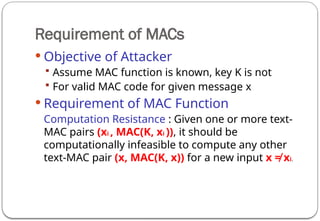
Objective of Attacker
Assume MAC function is known, key K is not
For valid MAC code for given message x
Requirement of MAC Function
Computation Resistance : Given one or more text-
MAC pairs (xi , MAC(K, xi )), it should be
computationally infeasible to compute any other
text-MAC pair (x, MAC(K, x)) for a new input x ≠ xi.
11.
Security of MACs
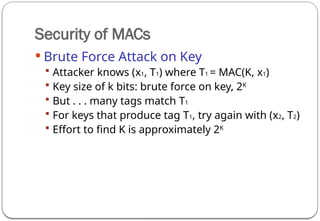
Brute Force Attack on Key
Attacker knows (x1, T1) where T1 = MAC(K, x1)
Key size of k bits: brute force on key, 2K
But . . . many tags match T1
For keys that produce tag T1, try again with (x2, T2)
Effort to find K is approximately 2K
12.
Security of MACs
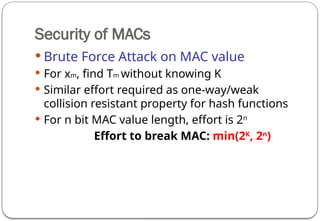
Brute Force Attack on MAC value
For xm, find Tm without knowing K
Similar effort required as one-way/weak
collision resistant property for hash functions
For n bit MAC value length, effort is 2n
Effort to break MAC: min(2K
, 2n
)
13.
Security of MACs
Cryptanalysis
Many different MAC algorithms; attacks
specific to algorithms
MAC algorithms generally considered
secure
14.
MAC Algorithms
DataAuthentication Algorithm (DAA): based on
DES; considered insecure
Cipher-Based Message Authentication Code
(CMAC): mode of operation used with Triple-
DES and AES
OMAC, PMAC, UMAC, VMAC, . . .
HMAC, function derived from cryptographic hash functions
15.
Hash Functions
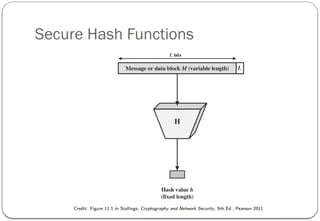
Hashfunction H: variable-length block of data M input; fixed-size
hash value h = H(M) output
Applying H to large set of inputs should produce evenly
distributed and random looking outputs
Cryptographic hash function: computationally infeasible to find:
M that maps to known h (one-way property)
M1 and M2 that produce same h (collision-free property)
Used to determine whether or not data has changed
Examples: message authentication, digital signatures, one-way
password file, intrusion/virus detection, PRNG
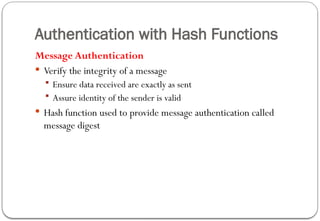
Authentication with HashFunctions
Message Authentication
Verify the integrity of a message
Ensure data received are exactly as sent
Assure identity of the sender is valid
Hash function used to provide message authentication called
message digest
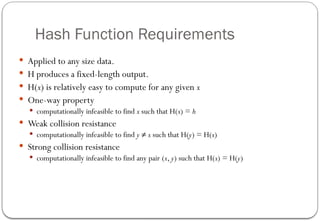
Hash Function Requirements
Applied to any size data.
H produces a fixed-length output.
H(x) is relatively easy to compute for any given x
One-way property
computationally infeasible to find x such that H(x) = h
Weak collision resistance
computationally infeasible to find y ≠ x such that H(y) = H(x)
Strong collision resistance
computationally infeasible to find any pair (x, y) such that H(x) = H(y)
20.
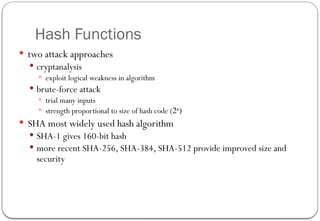
Hash Functions
twoattack approaches
cryptanalysis
exploit logical weakness in algorithm
brute-force attack
trial many inputs
strength proportional to size of hash code (2n
)
SHA most widely used hash algorithm
SHA-1 gives 160-bit hash
more recent SHA-256, SHA-384, SHA-512 provide improved size and
security
Public Key Infrastructure(PKI)
Public Key Infrastructure (PKI): integrated system of software,
encryption methodologies, protocols, legal agreements, and
third-party services enabling users to communicate securely
PKI systems based on public key cryptosystems; include digital
certificates and certificate authorities (CAs)
PKI services
PKI protectsinformation assets in several ways:
Authentication – Digital Certificate
To identify a user who claim who he/she is, in order to access the resource.
Non-repudiation – Digital Signature
To make the user becomes unable to deny that he/she has sent the message, signed the
document or participated in a transaction.
Confidentiality - Encryption
To make the transaction secure, no one else is able to read/retrieve the ongoing
transaction unless the communicating parties.
Integrity - Encryption
To ensure the information has not been tampered during transmission.
Authorization - Digital certificates
Digital certificates issued in a PKI environment can replace user IDs and passwords, enhance
security, and reduce some of the overhead required for authorization processes and controlling
access privileges
26.
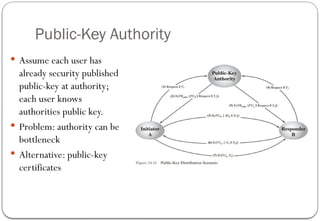
Public-Key Authority
Assumeeach user has
already security published
public-key at authority;
each user knows
authorities public key.
Problem: authority can be
bottleneck
Alternative: public-key
certificates
Digital Signatures
Encryptedmessages that can be mathematically proven to be
authentic
Created in response to rising need to verify information
transferred using electronic systems
Asymmetric encryption processes used to create digital signatures
29.
All copyrights reservedby C.C. Cheung 2003.
Digital Signature
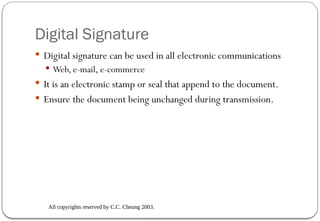
Digital signature can be used in all electronic communications
Web, e-mail, e-commerce
It is an electronic stamp or seal that append to the document.
Ensure the document being unchanged during transmission.
30.
All copyrights reservedby C.C. Cheung 2003.
How digital Signature works?
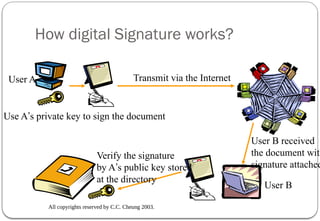
User A
User B
Use A’s private key to sign the document
Transmit via the Internet
User B received
the document with
signature attached
Verify the signature
by A’s public key stored
at the directory
31.
All copyrights reservedby C.C. Cheung 2003.
Digital Signature Generation and Verification
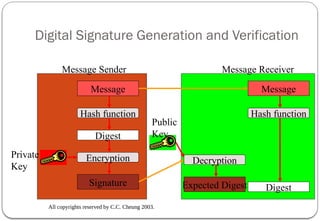
Message Sender Message Receiver
Message Message
Hash function
Digest
Encryption
Signature
Hash function
Digest
Decryption
Expected Digest
Private
Key
Public
Key
32.
Digital Signature Algorithms
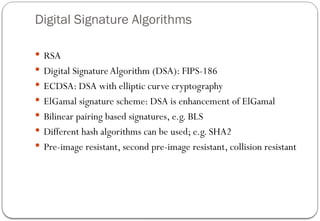
RSA
Digital SignatureAlgorithm (DSA): FIPS-186
ECDSA: DSA with elliptic curve cryptography
ElGamal signature scheme: DSA is enhancement of ElGamal
Bilinear pairing based signatures, e.g. BLS
Different hash algorithms can be used; e.g. SHA2
Pre-image resistant, second pre-image resistant, collision resistant
33.
All copyrights reservedby C.C. Cheung 2003.
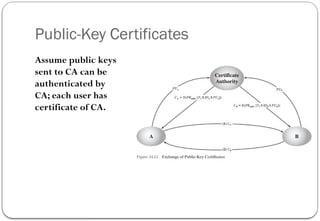
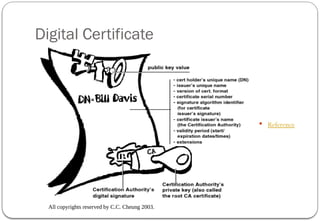
Digital Certificates
Digital Certificate is a data with digital signature from one trusted
CertificationAuthority (CA).
This data contains:
Who owns this certificate
Who signed this certificate
The expired date
User name & email address
34.
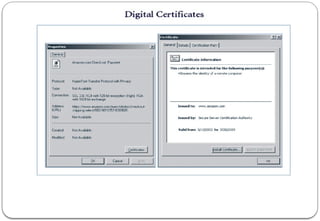
Digital Certificates
Electronicdocument containing key value and identifying
information about entity that controls key
Digital signature attached to certificate’s container file to certify
file is from entity it claims to be from
All copyrights reservedby C.C. Cheung 2003.
Certification Authority (CA)
A trusted agent who certifies public keys for general use
(Corporation or Bank).
User has to decide which CAs can be trusted.
The model for key certification based on friends and friends
of friends is called “Web ofTrust”.
The public key is passing from friend to friend.
Works well in small or high connected worlds.
What if you receive a public key from someone you don’t know?
A Certificate Authority is an agency that manages the
issuance of certificates and serves as the electronic
notary public to verify their worth and integrity.
38.
Principles of InformationSecurity, 2nd edition
Protocols for Secure Communications
Secure Socket Layer (SSL) protocol: uses public key encryption to
secure channel over public Internet
Secure HypertextTransfer Protocol (S-HTTP): extended version of
HypertextTransfer Protocol; provides for encryption of individual
messages between client and server across Internet
S-HTTP is the application of SSL over HTTP; allows encryption of
information passing between computers through protected and secure
virtual connection
39.
Principles of InformationSecurity, 2nd edition
Protocols for Secure Communications (continued)
Securing E-mail with S/MIME, PEM, and PGP
Secure Multipurpose Internet Mail Extensions (S/MIME): builds on
Multipurpose Internet Mail Extensions (MIME) encoding format by
adding encryption and authentication
Privacy Enhanced Mail (PEM): proposed as standard to function with
public key cryptosystems; uses 3DES symmetric key encryption
Pretty Good Privacy (PGP): uses IDEA Cipher for message encoding
40.
Principles of InformationSecurity, 2nd edition
Protocols for Secure Communications (continued)
SecuringWeb transactions with SET, SSL, and S-HTTP
Secure ElectronicTransactions (SET): developed by MasterCard and
VISA in 1997 to provide protection from electronic payment fraud
Uses DES to encrypt credit card information transfers
Provides security for both Internet-based credit card transactions and
credit card swipe systems in retail stores
Editor's Notes
#2 Encryption protects against passive attack (eavesdropping). Message authentication protects against active attacks (falsification of data and transactions), by verifying that received messages are authentic, that is that the contents of the message have not been altered and that the source is authentic. We may also wish to verify a message's timeliness and sequence relative to other messages flowing between two parties.
It is possible to perform authentication simply by the use of conventional encryption. If we assume that only the sender and receiver share a key (which is as it should be), then only the genuine sender would be able to encrypt a message successfully for the other participant. Furthermore, if the message includes an error-detection code and a sequence number, the receiver is assured that no alterations have been made and that sequencing is proper. If the message also includes a timestamp, the receiver is assured that the message has not been delayed beyond that normally expected for network transit.
Alternatively there are several approaches to message authentication that do not rely on encryption. In all of these approaches, an authentication tag is generated and appended to each message for transmission. The message itself is not encrypted and can be read at the destination independent of the authentication function at the destination.
#4 Answer to example 1:
Assume the message is English
Plaintext had expected structure; assume the plaintext is correct
Sent by A and has not been modified
#5 Answer to example 2:
Assume the message is English
Plaintext had no structure in expected language; assume plaintext is incorrect
Either not sent by A or modified
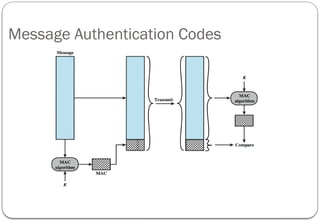
#8 One authentication technique involves the use of a secret key to generate a small block of data, known as a message authentication code, that is appended to the message. This technique assumes that two communicating parties, say A and B, share a common secret key KAB. When A has a message to send to B, it calculates the message authentication code as a function of the message and the key: MACM = F(KAB, M). The message plus code are transmitted to the intended recipient. The recipient performs the same calculation on the received message, using the same secret key, to generate a new message authentication code. The received code is compared to the calculated code, as shown here in Figure 2.4 from the text. If we assume that only the receiver and the sender know the identity of the secret key, and if the received code matches the calculated code, then:
The receiver is assured that the message has not been altered.
The receiver is assured that the message is from the alleged sender.
If the message includes a sequence number, then the receiver can be assured of the proper sequence.
A number of algorithms could be used to generate the code. The NIST specification, FIPS PUB 113, recommends the use of DES. DES is used to generate an encrypted version of the message, and the last number of bits of ciphertext are used as the code. A 16- or 32-bit code is typical.
#10 In simpler terms, computation resistance ensures that even if someone has a collection of input-output pairs, they would not be able to calculate the correct output for any new input unless they have the specific key (K) used for generating the MACs. This property is desirable for secure systems because it prevents unauthorized individuals from tampering with or generating valid MACs for new inputs without possessing the correct key.
#11 In simple terms, even though there are many keys that can produce the same MAC for a given input, the attacker needs to keep trying different inputs with these matching MACs to find the correct key. The overall effort required to find the key is approximately equal to trying all possible combinations of K bits, which is represented as 2K.
#12 A one-way property in hash functions means that it is easy to compute the hash value of an input, but computationally difficult to reverse the process and find the original input given the hash value.
Weak collision resistance refers to the property where it is difficult to find two different inputs that produce the same hash value.
In the context of a brute force attack on the MAC value, the effort required is similar to these properties because the attacker needs to try different inputs and compute their MAC values until they find a matching MAC.
#13 Cryptanalysis refers to the study of cryptographic systems with the goal of finding vulnerabilities or weaknesses that can be exploited to break their security. In the case of MAC (Message Authentication Code) algorithms, cryptanalysis involves analyzing the algorithms to identify potential attacks or weaknesses specific to those algorithms.
There are numerous MAC algorithms available, each with its own design and security properties. Cryptanalysts examine these algorithms to discover any flaws that could compromise their security. These flaws can range from mathematical weaknesses in the algorithm's structure to implementation vulnerabilities.
However, it is important to note that MAC algorithms are generally considered secure. They are designed by experts in cryptography and undergo rigorous analysis before being adopted. Nevertheless, cryptanalysts continuously research and study these algorithms to ensure their security and identify any potential weaknesses that may arise.
Overall, cryptanalysis plays a crucial role in the field of cryptography by evaluating the security of MAC algorithms and other cryptographic systems, helping to improve their resilience against potential attacks.
#16 An alternative to the message authentication code is the one-way hash function. As with the message authentication code, a hash function accepts a variable-size message M as input and produces a fixed-size message digest H(M) as output. Unlike the MAC, a hash function does not also take a secret key as input. To authenticate a message, the message digest is sent with the message in such a way that the message digest is authentic.
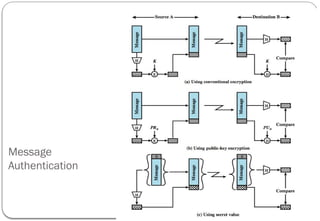
#18 Figure illustrates three ways in which the message can be authenticated. The message digest can be encrypted using conventional encryption (part a); if it is assumed that only the sender and receiver share the encryption key, then authenticity is assured. The message can also be encrypted using public-key encryption (part b); this is explained later. The public-key approach has two advantages: it provides a digital signature as well as message authentication; and it does not require the distribution of keys to communicating parties. These two approaches have an advantage over approaches that encrypt the entire message in that less computation is required. Nevertheless, there has been interest in developing a technique that avoids encryption altogether. Part c shows a technique that uses a hash function but no encryption for message authentication. This technique assumes that two communicating parties, say A and B, share a common secret value SAB. When A has a message to send to B, it calculates the hash function over the concatenation of the secret value and the message: MDM = H(SAB||M). It then sends [M||MDM] to B. Because B possesses SAB, it can recompute H(SAB||M) and verify MDM. Because the secret value itself is not sent, it is not possible for an attacker to modify an intercepted message. As long as the secret value remains secret, it is also not possible for an attacker to generate a false message.
#19 The purpose of a hash function is to produce a "fingerprint" of a file, message, or other block of data. To be useful for message authentication, a hash function H must have the properties listed here. The first three properties are requirements for the practical application of a hash function to message authentication. The fourth property is the one-way property: it is easy to generate a code given a message, but virtually impossible to generate a message given a code. This property is important if the authentication technique involves the use of a secret value (such as shown in Figure 2.5c). The fifth property guarantees that it is impossible to find an alternative message with the same hash value as a given message. This prevents forgery when an encrypted hash code is used (as in Figures 2.5a and b). A hash function that satisfies the first five properties in the preceding list is referred to as a weak hash function. If the sixth property is also satisfied, then it is referred to as a strong hash function. The sixth property protects against a sophisticated class of attack known as the birthday attack. In addition to providing authentication, a message digest also provides data integrity. It performs the same function as a frame check sequence: if any bits in the message are accidentally altered in transit, the message digest will be in error.
#20 As with symmetric encryption, there are two approaches to attacking a secure hash function: cryptanalysis and brute-force attack. As with symmetric encryption algorithms, cryptanalysis of a hash function involves exploiting logical weaknesses in the algorithm. The strength of a hash function against brute-force attacks depends solely on the length of the hash code produced by the algorithm.
If strong collision resistance is required (and this is desirable for a general-purpose secure hash code), then the value 2n/2 determines the strength of the hash code against brute-force attacks. Oorschot and Wiener presented a design for a $10 million collision search machine for MD5, which has a 128-bit hash length, that could find a collision in 24 days. Thus a 128-bit code may be viewed as inadequate. With a hash length of 160 bits, the same search machine would require over four thousand years to find a collision. With today's technology, the time would be much shorter, so that 160 bits now appears suspect.
In recent years, the most widely used hash function has been the Secure Hash Algorithm (SHA). SHA was developed by the National Institute of Standards and Technology (NIST) and published as a federal information processing standard (FIPS 180) in 1993. When weaknesses were discovered in SHA, a revised version was issued as FIPS 180-1 in 1995 and is generally referred to as SHA-1. SHA-1 produces a hash value of 160 bits. In 2002, NIST produced a revised version of the standard, FIPS 180-2, that defined three new versions of SHA, with hash value lengths of 256, 384, and 512 bits, known as SHA-256, SHA-384, and SHA-512. These new versions have the same underlying structure and use the same types of modular arithmetic and logical binary operations as SHA-1. In 2005, NIST announced the intention to phase out approval of SHA-1 and move to a reliance on the other SHA versions by 2010.
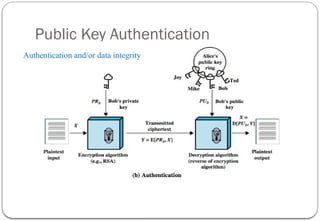
#21 Figure shown here illustrates another mode of operation of public-key cryptography, where a user encrypts data using his or her own private key. Anyone who knows the corresponding public key will then be able to decrypt the message. This is directed toward providing authentication and/or data integrity. If a user is able to successfully recover the plaintext from Bob’s ciphertext using Bob’s public key, this indicates that only Bob could have encrypted the plaintext, thus providing authentication. Further, no one but Bob would be able to modify the plaintext because only Bob could encrypt the plaintext with Bob’s private key. This can be adapted to provide authentication or data integrity. Suppose that Bob wants to send a message to Alice and, although it is not important that the message be kept secret, he wants Alice to be certain that the message is indeed from him. In this case Bob could use his own private key to encrypt the message. Here the entire message is encrypted, which, although validating both author and contents, requires a great deal of storage and additional processing cost. A more efficient way of achieving the same results is to encrypt a small block of bits that is a function of the document. Such a block, called an authenticator, must have the property that it is infeasible to change the document without changing the authenticator. If the authenticator is encrypted with the sender's private key, it serves as a signature that verifies origin, content, and sequencing. A secure hash code such as SHA-1 can serve this function. It is important to emphasize that the digital signature does not provide confidentiality. That is, the message being sent is safe from alteration but not safe from eavesdropping.
#22 Cryptography Tools
Public Key Infrastructure (PKI) is an integrated system of software, encryption methodologies, protocols, legal agreements, and third-party services that enables users to communicate securely.
PKI systems are based on public key cryptosystems and include digital certificates and certificate authorities (CAs).
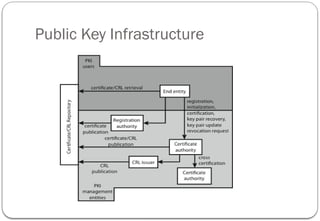
#23 RFC 2822 (Internet Security Glossary) defines public-key infrastructure (PKI) as the set of hardware, software, people, policies, and procedures needed to create, manage, store, distribute, and revoke digital certificates based on asymmetric cryptography. Its principal is to enable secure, convenient, and efficient acquisition of public keys. The IETF Public Key Infrastructure X.509 (PKIX) working group has setup a formal (and generic) model based on X.509 that is suitable for deploying a certificate-based architecture on the Internet.
Stallings Figure 14.16 shows interrelationships among some key elements:
• End entity: A generic term used to denote end users, devices (e.g., servers, routers), or any other entity that can be identified in the subject field of a public key certificate. End entities canconsume and/or support PKI-related services.
• Certification authority (CA): The issuer of certificates and (usually) certificate revocation lists (CRLs). It may also support a variety of administrative functions, although these are often delegated to Registration Authorities.
• Registration authority (RA): An optional component that can assume a number of administrative functions from the CA. The RA is often associated with the End Entity registration process, but can assist in a number of other areas as well.
• CRL issuer: An optional component that a CA can delegate to publish CRLs.
• Repository: A generic term used to denote any method for storing certificates and CRLs so that they can be retrieved by End Entities.
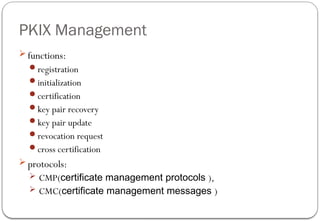
#24 PKIX identifies a number of management functions that potentially need to be supported by management protocols, as shown in Figure 14.16:
• Registration: whereby a user first makes itself known to a CA, prior to issue of a certificate(s) for that user. It usually involves some off-line or online procedure for mutual authentication.
• Initialization: to install key materials that have the appropriate relationship with keys stored elsewhere in the infrastructure.
• Certification: process where a CA issues a certificate for a user's public key, and returns it to the user's client system and/or posts it in a repository.
• Key pair recovery: a mechanism to recover the necessary decryption keys when normal access to the keying material is no longer possible.
• Key pair update: key pairs need to be updated and new certificates issued.
• Revocation request: when authorized person advises need for certificate revocation, e.g. private key compromise, affiliation change, name change.
• Cross certification: when two CAs exchange information used in establishing a cross-certificate, issued by one CA to another CA that contains a CA signature key used for issuing certificates.
The PKIX working group has defines two alternative management protocols between PKIX entities. RFC 2510 defines the certificate management protocols (CMP), which is a flexible protocol able to accommodate a variety of technical, operational, and business models. RFC 2797 defines certificate management messages over CMS (RFC 2630) called CMC. This is built on earlier work to leverage existing code.
#27 In a Public Key Infrastructure (PKI), a Certificate Authority (CA) is responsible for issuing, managing, and verifying digital certificates. The CA acts as a trusted third party that helps establish the authenticity and integrity of public keys in a secure manner. Here's how a Certificate Authority works:
Key Generation: Users generate a pair of cryptographic keys, consisting of a public key and a private key. The private key is kept secret, while the public key is made available to others.
Certification Request: When a user wants to obtain a digital certificate for their public key, they submit a certification request to the CA. This request typically includes their public key, identity information, and other necessary details.
Certificate Issuance: Upon receiving the certification request, the CA verifies the user's identity and performs the necessary checks to ensure the validity of the request. If everything is in order, the CA generates a digital certificate for the user's public key. The certificate includes the user's public key, identity information, and a digital signature generated by the CA.
Certificate Distribution: Once the certificate is issued, it is made available to the user. The CA may distribute certificates through various means, such as a public directory, email, or secure web portal. Additionally, the CA may maintain a Certificate Revocation List (CRL) to track revoked or expired certificates.
Certificate Verification: When a user wants to communicate securely with another user, they retrieve the recipient's certificate from the distribution channel or directory. The user then verifies the authenticity and integrity of the certificate. This involves validating the digital signature on the certificate using the CA's public key, which should be trusted by the user.
Key Exchange: Once the certificate is verified, the user extracts the recipient's public key from the certificate. This public key is then used for establishing secure communication channels, such as encryption and digital signatures. The private key corresponding to the public key is kept securely by the recipient
#28 Digital Signatures
An interesting thing happens when the asymmetric process is reversed, that is the private key is used to encrypt a short message.
The public key can be used to decrypt it, and the fact that the message was sent by the organization that owns the private key cannot be refuted.
This is known as non-repudiation, which is the foundation of digital signatures.
Digital Signatures are encrypted messages that are independently verified by a central facility (registry) as authentic.
#34 Digital Certificates and Certificate Authorities
As alluded to earlier, a digital certificate is an electronic document, similar to a digital signature, attacked to a file certifying that this file is from the organization it claims to be from and has not been modified from the originating format.
A Certificate Authority is an agency that manages the issuance of certificates and serves as the electronic notary public to verify their worth and integrity.
#38 Securing the Web
Secure Electronic Transactions (SET) was developed by MasterCard and Visa in 1997 to provide protection from electronic payment fraud.
SET works by encrypting the credit card transfers with DES for encryption and RSA for key exchange, much as other algorithms do.
SET provides the security for both Internet-based credit card transactions and the encryption of swipe systems of those credit cards in retail stores.
Secure Socket Layer was developed by Netscape in 1994 to provide security in online electronic commerce transactions.
It uses a number of algorithms, but mainly relies on RSA for key transfer and IDEA, DES or 3DES for encrypted symmetric key-based data transfer.
Secure Hypertext Transfer Protocol (SHTTP) is an encrypted solution to the unsecured version of HTTP.
It provides an alternative to the aforementioned protocols and can provide secure e-commerce transactions as well as encrypted Web pages for secure data transfer over the Web, using a number of different algorithms.
Secure Shell (SSH) provides security over remote access connections using tunneling. It provides authentication services between a client and server.
IP Security (IPSec) is the cryptographic authentication and encryption product of the IETF’s IP Protocol Security Working Group, defined in RFC 1825, 1826 and 1827.
IP Security (IPSec) is used to create Virtual Private Networks (VPNs) and is an open framework for security development within the TCP/IP family of protocol standards.
#39 Securing E-mail
A number of encryption cryptosystems have been adapted in an attempt to inject some degree of security into e-mail, a notoriously unsecured medium.
S/MIME builds on the Multipurpose Internet Mail Extensions (MIME) encoding format by adding encryption and authentication through digital signatures based on public key cryptosystems.
Securing E-mail
Privacy Enhanced Mail (PEM) was proposed by the Internet Engineering Task Force (IETF) as a standard to function with the public key cryptosystems.
PEM uses 3DES symmetric key encryption and RSA for key exchanges and digital signatures.
Pretty Good Privacy (PGP) was developed by Phil Zimmerman and uses the IDEA Cipher, a 128-bit symmetric key block encryption algorithm with 64 bit blocks for message encoding.
IDEA performs 8 rounds on 16 bit sub-blocks using algebraic calculations.
PGP also uses RSA for symmetric key exchange and for digital signatures.
#40 Securing Web Transactions with SET, SSL, and S-HTTP
Just as PGP, PEM, and S/MIME work to secure e-mail operations, a number of related protocols work to secure Web browsers, especially at electronic commerce sites.
Among these are Secure Electronic Transactions (SET), Secure Socket Layer (SSL), Secure Hypertext Transfer Protocol (S-HTTP), Secure Shell (SSH-2), and IP Security (IPSec).
Secure Electronic Transactions (SET) was developed by MasterCard and VISA in 1997 to provide protection from electronic payment fraud.
SET uses DES to encrypt credit card information transfers and RSA for key exchange. SET provides the security for both Internet-based credit card transactions and credit card swipe systems in retail stores.