Sanjivani Rural EducationSociety’s
Sanjivani College of Engineering, Kopargaon-423 603
Department of Information Technology
Prepared by
Mr. Umesh B. Sangule
Assistant Professor
Department of Information Technology
De
partme
ntof InformationTec
hnology, SRES’sSanjivani Colle
geof Engine
e
ring, Kopargaon-423603
Natural Language Processing(NLP)
(IT401)
2.
DEPARTMENT OF INFORMATIONTECHNOLOGY, SCOE,KOPARGAON
Unit-I
INTRODUCTION TO NATURAL LANGUAGE PROCESSING
(NLP)
Course Objectives : To introduce the Natural Language Processing (NLP)
basics and Basics of linguistics.
Course Outcome(CO1) : Understand concept and processing of NLP.
3.
Content
DEPARTMENT OF INFORMATIONTECHNOLOGY, SCOE,KOPARGAON
Introduction to NLP
Ambiguity in NLP
Automata for NLP
Stages of NLP
Challenges and Issues in NLP
Basics of Text Processing
4.
DEPARTMENT OF INFORMATIONTECHNOLOGY, SCOE,KOPARGAON
Language is used to shape the thoughts; it has structure and also it carries a meaning. By
using our language, we naturally learn the new concepts and hardly realise how we
process this natural language.
Natural Language Processing is the process of computer analysis of input provided in a
human language, and conversion of this input into a useful form of representation.
Natural language processing is concerned with the development of computational models
of aspects of human language processing.
Introduction
5.
DEPARTMENT OF INFORMATIONTECHNOLOGY, SCOE,KOPARGAON
The following are the two main reasons for such developments.
1) Develop automatic tool for natural language processing.
2) Gain better understanding of human communication.
When we build computational models by using human language, we need processing
abilities where this processing abilities and incorporates how human collects, Store and
process the language. It also needed a knowledge of the world and of language.
The input and output of the NLP is text or speech.
Cont....
6.
DEPARTMENT OF INFORMATIONTECHNOLOGY, SCOE,KOPARGAON
Natural Language Processing (NLP) is a field of Artificial Intelligence (AI) that deals with
the interaction between computers and human languages.
NLP is used to analyze, understand and generate natural language text and speech.
The goal of NLP is to enable computers to understand and interpret human language in a
way that is similar to how humans process language.
Cont....
7.
DEPARTMENT OF INFORMATIONTECHNOLOGY, SCOE,KOPARGAON
Natural Language Processing (NLP) techniques are used in wide ranges of applications:
Speech Recognition and Transcription: NLP techniques are used to convert speech to text,
which is useful for tasks such as dictation and voice-controlled assistants.
Language Translation: NLP techniques are used to translate text from one language to
another, which is useful for tasks such as global communication and e-commerce.
Text Summarization: NLP techniques are used to summarize long text documents into
shorter versions, which is useful for tasks such as news summarization and document
indexing.
Cont....
8.
DEPARTMENT OF INFORMATIONTECHNOLOGY, SCOE,KOPARGAON
Sentiment Analysis: NLP techniques are used to determine the sentiment or emotion
expressed in text, which is useful for tasks such as customer feedback analysis and social
media monitoring
Question Answering: NLP techniques are used to answer questions asked in natural
language, which is useful for tasks such as chatbots and virtual assistants.
Cont....
9.
DEPARTMENT OF INFORMATIONTECHNOLOGY, SCOE,KOPARGAON
NLP is hard because Ambiguity and Uncertainty exist in the language.
Ambiguity means not having well defined solution.
Any sentence in a language with a large-enough grammar can have another
interpretation.
There are various forms of ambiguity related to natural language and they are:
1. Lexical Ambiguity
2. Syntactic Ambiguity
3. Semantic Ambiguity
4.Metonymy Ambiguity
Ambiguity in NLP
10.
DEPARTMENT OF INFORMATIONTECHNOLOGY, SCOE,KOPARGAON
1) Lexical Ambiguity:
When words have multiple assertion then it is known as lexical ambiguity.
The word “back” can be a noun or an adjective.
Noun: back stage
Adjective: back door
Ambiguity in NLP
11.
DEPARTMENT OF INFORMATIONTECHNOLOGY, SCOE,KOPARGAON
2) Syntactic Ambiguity:
Syntactic ambiguity means sentences are parsed in multiple syntactical forms or
A sentence can be parsed in different ways.
For example:
“I saw the boy on the beach with my binoculars”
In this sentence, confusion in meaning is created. The phrase with my
binoculars could modify the verb, saw or the noun, boy.
Ambiguity in NLP
12.
DEPARTMENT OF INFORMATIONTECHNOLOGY, SCOE,KOPARGAON
3) Semantic Ambiguity:
Semantic ambiguity is related to the sentence interpretation.
For example:
“I saw the boy on the beach with my binoculars”
The sentence means that I saw a boy through my binoculars or the boy
had my binoculars with him.
Ambiguity in NLP
13.
DEPARTMENT OF INFORMATIONTECHNOLOGY, SCOE,KOPARGAON
4) Metonymy Ambiguity:
Metonymy ambiguity is related to phrases in which literal meaning is different
from the figurative assertion.
It is most difficult ambiguity.
For example:
“Nokia us screaming for new management”
Here it really doesn't mean that the company is literally screaming.
Ambiguity in NLP
14.
DEPARTMENT OF INFORMATIONTECHNOLOGY, SCOE,KOPARGAON
Natural Language:
The vocabulary of natural language is incredibly extensive.
Humans are capable of understanding natural language.
Natural Language is inherently ambiguous.
Programming Language:
Very few words are used in computer language.
The machines can easily understand computer language.
Computer Language is Unambiguous.
Programming Language Vs Natural Language
15.
DEPARTMENT OF INFORMATIONTECHNOLOGY, SCOE,KOPARGAON
Natural Language:
Are open and allow combinations without risk of making mistakes.
Human beings have ability to clarify meaning of expression.
Programming Language:
Are closed and Fixed to avoid confusion and mistakes.
Computers are very precise about instructions they receive.
Programming Language Vs Natural Language
16.
DEPARTMENT OF INFORMATIONTECHNOLOGY, SCOE,KOPARGAON
An Automaton having finite number of states is names as Finite Automata (FA) or
finite State Automata(FSA).
Finite Automata is use to identify the patterns.
It takes strings of symbol as input and changes its state accordingly, when
required symbol is found, then the transition happens.
In Finite Automata either “Accept” or “Reject” state.
Finite Automata for NLP
17.
DEPARTMENT OF INFORMATIONTECHNOLOGY, SCOE,KOPARGAON
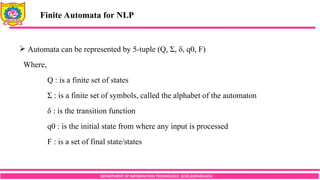
Automata can be represented by 5-tuple (Q, Σ, δ, q0, F)
Where,
Q : is a finite set of states
Σ : is a finite set of symbols, called the alphabet of the automaton
δ : is the transition function
q0 : is the initial state from where any input is processed
F : is a set of final state/states
Finite Automata for NLP
18.
DEPARTMENT OF INFORMATIONTECHNOLOGY, SCOE,KOPARGAON
There are two types of Finite Automata
1. Deterministic Finite automation (DFA)
2. Non-deterministic Finite Automation (NDFA)
Deterministic Finite Automation (DFA):
Definition: It may be defined as the type of finite automation wherein, for every
input symbol we can determine the state to which the machine will move. It has a
finite number of states that is why the machine is called Deterministic Finite
Automation(DFA)
Finite Automata for NLP
19.
DEPARTMENT OF INFORMATIONTECHNOLOGY, SCOE,KOPARGAON
Non-Deterministic Finite Automation (NDFA):
Definition: It may be defined as the type of finite automation where, for each
input symbol we cannot determine the state to which the machine will move.
(i.e. Machine can move to any combination of the states).
It mean for each state there can be more than one transition or symbol.
It has a finite number of states that is why the machine is called
Non-Deterministic Finite Automation(NDFA)
Finite Automata for NLP
DEPARTMENT OF INFORMATIONTECHNOLOGY, SCOE,KOPARGAON
Stages of NLP
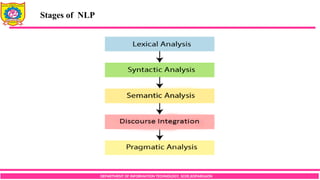
1) Lexical Analysis:
Lexical Analysis is the first stage in NLP. It is also known as morphological analysis.
At this stage the structure of the words is identified and analysed.
Lexicon of a language means the collection of words and phrases in a language.
Lexical analysis is dividing the whole portion of text into paragraphs, sentences, and
words.
22.
DEPARTMENT OF INFORMATIONTECHNOLOGY, SCOE,KOPARGAON
Stages of NLP
2) Syntactic Analysis:
It involves analysis of words in the sentence for grammar and ordering words in a way
that shows the relationship among the words.
Example:
The sentence such as “The school goes to girl” is rejected by English syntactic
analyser.
23.
DEPARTMENT OF INFORMATIONTECHNOLOGY, SCOE,KOPARGAON
Stages of NLP
3) Semantic Analysis:
Semantic analysis draws the exact meaning or the dictionary meaning from the text.
The text is checked for meaningfulness.
It is done by mapping syntactic structures and objects in the task domain.
Example:
The semantic analyser neglects sentence such as "hot ice-cream".
24.
DEPARTMENT OF INFORMATIONTECHNOLOGY, SCOE,KOPARGAON
Stages of NLP
4) Discourse Integration:
The meaning of any sentence depends upon the meaning of the sentence just before it.
Furthermore, it also brings about the meaning of immediately following sentence.
Example:
“Meena is a girl, she goes to school” here "she" is a dependency pointing to
Meena.
25.
DEPARTMENT OF INFORMATIONTECHNOLOGY, SCOE,KOPARGAON
Stages of NLP
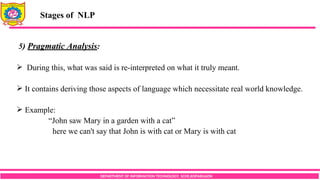
5) Pragmatic Analysis:
During this, what was said is re-interpreted on what it truly meant.
It contains deriving those aspects of language which necessitate real world knowledge.
Example:
“John saw Mary in a garden with a cat”
here we can't say that John is with cat or Mary is with cat
26.
DEPARTMENT OF INFORMATIONTECHNOLOGY, SCOE,KOPARGAON
Steps to build NLP Pipeline
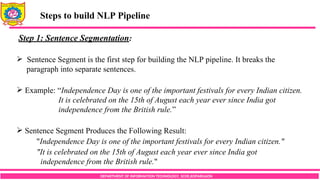
Step 1: Sentence Segmentation:
Sentence Segment is the first step for building the NLP pipeline. It breaks the
paragraph into separate sentences.
Example: “Independence Day is one of the important festivals for every Indian citizen.
It is celebrated on the 15th of August each year ever since India got
independence from the British rule.”
Sentence Segment Produces the Following Result:
"Independence Day is one of the important festivals for every Indian citizen."
"It is celebrated on the 15th of August each year ever since India got
independence from the British rule."
27.
DEPARTMENT OF INFORMATIONTECHNOLOGY, SCOE,KOPARGAON
Steps to build NLP Pipeline
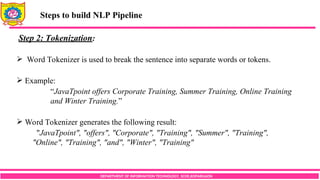
Step 2: Tokenization:
Word Tokenizer is used to break the sentence into separate words or tokens.
Example:
“JavaTpoint offers Corporate Training, Summer Training, Online Training
and Winter Training.”
Word Tokenizer generates the following result:
"JavaTpoint", "offers", "Corporate", "Training", "Summer", "Training",
"Online", "Training", "and", "Winter", "Training"
28.
DEPARTMENT OF INFORMATIONTECHNOLOGY, SCOE,KOPARGAON
Steps to build NLP Pipeline
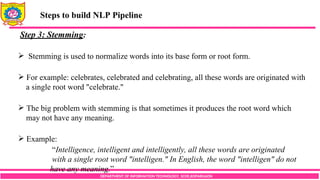
Step 3: Stemming:
Stemming is used to normalize words into its base form or root form.
For example: celebrates, celebrated and celebrating, all these words are originated with
a single root word "celebrate."
The big problem with stemming is that sometimes it produces the root word which
may not have any meaning.
Example:
“Intelligence, intelligent and intelligently, all these words are originated
with a single root word "intelligen." In English, the word "intelligen" do not
have any meaning.”
29.
DEPARTMENT OF INFORMATIONTECHNOLOGY, SCOE,KOPARGAON
Steps to build NLP Pipeline
Step 4: Lemmatization:
Lemmatization is quite similar to the Stemming. It is used to group different inflected
forms of the word, called Lemma.
The main difference between Stemming and lemmatization is that it produces the root
word, which has a meaning.
Example:
“In lemmatization, the words intelligence, intelligent and intelligently has a
root word intelligent, which has a meaning.”
30.
DEPARTMENT OF INFORMATIONTECHNOLOGY, SCOE,KOPARGAON
Steps to build NLP Pipeline
Step 5: Identifying Stop Words:
In English, there are a lot of words that appear very frequently like "is", "and", "the"
and "a".
NLP pipelines will flag these words as stop words. Stop words might be filtered out
before doing any statistical analysis.
Example:
“He is a good boy.”
31.
DEPARTMENT OF INFORMATIONTECHNOLOGY, SCOE,KOPARGAON
Steps to build NLP Pipeline
Step 6: Dependency Parsing:
Dependency Parsing is used to find that how all the words in the sentence are related
to each other.
Step 7: POS Tags:
POS stands for parts of speech, which includes Noun, verb, adverb and Adjective. It
indicates that how a word functions with its meaning as well as grammatically within
the sentences.
Example:
“Google” something on the Internet.
In the above example, Google is used as a verb, although it is a proper noun.
32.
DEPARTMENT OF INFORMATIONTECHNOLOGY, SCOE,KOPARGAON
Steps to build NLP Pipeline
Step 8: Named Entity Recognition (NER):
Named Entity Recognition (NER) is the process of detecting the named entity such as
person name, movie name organization name or location.
Example:
“Steve Jobs introduced iPhone at the Macworld Conference in San Francisco,
California.”
In the above example, “Steve Jobs” is person name,
“San Francisco” is Location,
Step 9: Chunking:
Chunking is used to collect the individual piece of information and grouping them
into bigger pieces of sentences
33.
DEPARTMENT OF INFORMATIONTECHNOLOGY, SCOE,KOPARGAON
Challenges and Issues in NLP
1) Contextual words and phrases and homonyms:
The same words and phrases can have diverse meanings according the context
of a sentence and many words have the exact same pronunciation but
completely different meanings
Example:
“ I ran to the store because we ran out of milk.”
“ The house is looking really run down.”
In the above sentences the meaning of the run is different according to the
context
34.
DEPARTMENT OF INFORMATIONTECHNOLOGY, SCOE,KOPARGAON
Challenges and Issues in NLP
Homonyms means the pronunciation of two or more words is same but have
different meaning.
For example:
“their” and “there”,
“right” and “write”,
“Know” and “No”
This will create problem in question answering and speech-to-text applications.
35.
DEPARTMENT OF INFORMATIONTECHNOLOGY, SCOE,KOPARGAON
Challenges and Issues in NLP
2) Synonyms:
Synonyms can cause issues like contextual understanding since we use many
different words to express the identical idea.
Additionally, some of these words may convey exactly the same meaning, while
some may be levels of complexity and different people use synonyms to denote
slightly different meanings within their personal vocabulary.
Example:
“ small, little, tiny, minute have same meaning”
36.
DEPARTMENT OF INFORMATIONTECHNOLOGY, SCOE,KOPARGAON
Challenges and Issues in NLP
3) Ambiguity:
Ambiguity in NLP refers to sentences and phrases that potentially have two or
more possible interpretations.
There is lexical, syntactic and semantic ambiguity.
37.
DEPARTMENT OF INFORMATIONTECHNOLOGY, SCOE,KOPARGAON
Challenges and Issues in NLP
4) Errors in text or speech:
Misspelled or misused words can generate problems for text analysis.
Autocorrect and grammar correction applications can handle common mistakes,
but do not at all times understand the writer's intention.
With spoken language it is difficult for the machine to understand
mispronunciations, different accents, stammers, etc.
38.
DEPARTMENT OF INFORMATIONTECHNOLOGY, SCOE,KOPARGAON
Challenges and Issues in NLP
5) Idioms and Slang:
Informal phrases, expressions, idioms, and culture-specific lingo present a
number of problems for NLP especially for models intended for comprehensive
use.
Because as formal language, idioms may have no dictionary definition at all, and
these expressions may ever have different meanings in different geographic
areas.
Cultural slang is continuously morphing and increasing, so new words arise
every day.
39.
DEPARTMENT OF INFORMATIONTECHNOLOGY, SCOE,KOPARGAON
Challenges and Issues in NLP
6) Domain Specific Language:
Different businesses and industries often use very different language.
Example:
“An NLP processing model needed for healthcare would be very
different than one used to process legal documents.”
40.
DEPARTMENT OF INFORMATIONTECHNOLOGY, SCOE,KOPARGAON
Challenges and Issues in NLP
7) Low-resource languages:
Artificial Intelligence, machine learning and NLP applications have been mostly
built for the most common, widely used languages.
However, many languages especially those spoken by people with less access to
technology often go overlooked and under processed.
Example:
“There are over 3,000 languages in Africa, alone.
There simply isn't ample data on many of these languages.”