Oscar González García
Mis presentaciones tienen tan solo una finalidad didáctica y sin ánimo de lucro,
estando disponibles en Internet para todo aquel que las encuentre útiles. Salvo en
casos excepcionales, no cito las fuentes escritas ni audiovisuales que utilizo por
razones de economía de espacio y tiempo; de igual forma, no requiero que se cite
lo que yo elaboro.
Sin embargo, si algún autor reconoce sus textos o imágenes en mis trabajos y
considera que debe ser citado, no tiene más que ponerse en contacto conmigo e
incluiré su nombre donde sea necesario.
Gracias y disfruten de la Historia…
Prof. Oscar González García – IES Ornia (La Bañeza) 2017/2018
What are we going to study?
ORDEN EDU 362/2015 de 4 de mayo – currículo ESO CyL
CRITERIOS DE EVALUACIÓN
1. Identificar los principales
hechos de las revoluciones
burguesas en Estados Unidos,
Francia y España e
Iberoamérica.
2. Comprender el alcance y las
limitaciones de los procesos
revolucionarios del siglo XVIII.
ESTÁNDARES DE APRENDIZAJE
EVALUABLES
1.1. Redacta una narrativa sintética con
los principales hechos de alguna de las
revoluciones burguesas del siglo XVIII,
acudiendo a explicaciones causales,
sopesando los pros y los contras.
2.1. Discute las implicaciones de la
violencia con diversos tipos de fuentes.
4.1. Sopesa las razones de los
revolucionarios para actuar como lo
hicieron.
4.2. Reconoce, mediante el análisis de
fuentes de diversa época, el valor de las
mismas no sólo como información, sino
también como evidencia para los
historiadores.
Bloque 2. La Era de las Revoluciones liberales
1. Bourgeois revolutions
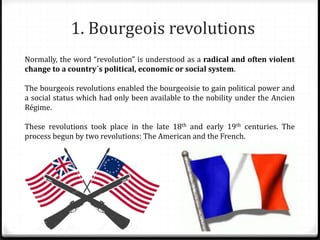
Normally, the word “revolution” is understood as a radical and often violent
change to a country´s political, economic or social system.
The bourgeois revolutions enabled the bourgeoisie to gain political power and
a social status which had only been available to the nobility under the Ancien
Régime.
These revolutions took place in the late 18th and early 19th centuries. The
process begun by two revolutions: The American and the French.
2. The American Revolution
(1775-1783)
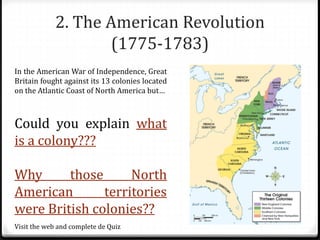
In the American War of Independence, Great
Britain fought against its 13 colonies located
on the Atlantic Coast of North America but…
Could you explain what
is a colony???
Why those North
American territories
were British colonies??
Visit the web and complete de Quiz
2. 1. The causes of the war
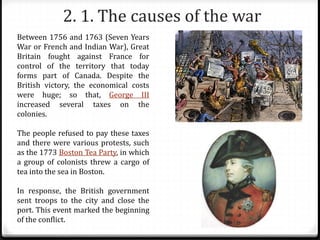
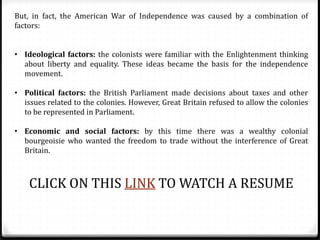
Between 1756 and 1763 (Seven Years
War or French and Indian War), Great
Britain fought against France for
control of the territory that today
forms part of Canada. Despite the
British victory, the economical costs
were huge; so that, George III
increased several taxes on the
colonies.
The people refused to pay these taxes
and there were various protests, such
as the 1773 Boston Tea Party, in which
a group of colonists threw a cargo of
tea into the sea in Boston.
In response, the British government
sent troops to the city and close the
port. This event marked the beginning
of the conflict.
But, in fact, the American War of Independence was caused by a combination of
factors:
• Ideological factors: the colonists were familiar with the Enlightenment thinking
about liberty and equality. These ideas became the basis for the independence
movement.
• Political factors: the British Parliament made decisions about taxes and other
issues related to the colonies. However, Great Britain refused to allow the colonies
to be represented in Parliament.
• Economic and social factors: by this time there was a wealthy colonial
bourgeoisie who wanted the freedom to trade without the interference of Great
Britain.
CLICK ON THIS LINK TO WATCH A RESUME
2. 2. The War of Independence and
its consequences
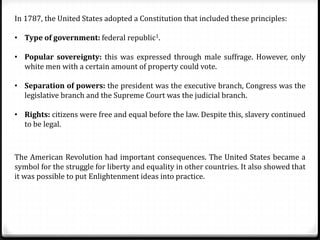
The war began when some of the colonies decided to fight for independence and, in
1775, they created their own army, which was led by George Washington.
During the first part of the conflict, Great Britain had military successes, but the
colonies started politically significant actions: they joined a Continental Congress
that proclaimed the Declaration of Independence on 4th July 1776.
Finally, the support of France and
Spain, led the colonialists to the
victory.
Great Britain recognised American
independence in 1783 Treaty of
Versailles.
George Washington
In 1787, the United States adopted a Constitution that included these principles:
• Type of government: federal republic1.
• Popular sovereignty: this was expressed through male suffrage. However, only
white men with a certain amount of property could vote.
• Separation of powers: the president was the executive branch, Congress was the
legislative branch and the Supreme Court was the judicial branch.
• Rights: citizens were free and equal before the law. Despite this, slavery continued
to be legal.
The American Revolution had important consequences. The United States became a
symbol for the struggle for liberty and equality in other countries. It also showed that
it was possible to put Enlightenment ideas into practice.
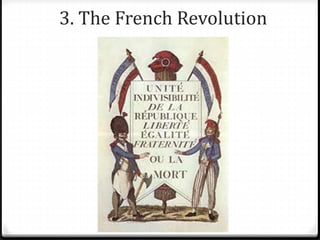
3. The French Revolution
3.1 THE CAUSES OF THE FRENCH REVOLUTION
The French Revolution was a period of violent political and social
change, which saw the abolition of absolute monarchy and the end of
the estates system of Ancien Régime (closed society).
It was caused due to a combination of related factors:
• The influence of the Enlightenment: Rousseau (Du Contrat Social),
Voltaire (Lettres Philosophiques) and Montesquieu (De l’Espirit des
Loix).
• French intellectuals and bourgeoisie supported Enlightenment ideas
and tried to put them into practice. For example, they demanded that
all French subjects be free and equal under the law. That was not
compatible with the French absolute monarchy…
IDEAS
ECONOMIC CRISIS
0 The French state was bankrupt (without money and unable to pay
debts).
0 Causes:
0 participation in military conflicts, such as the American War of
independence.
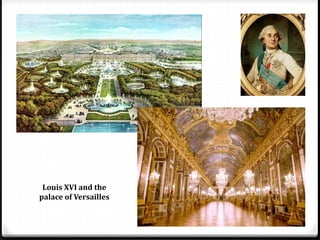
0 The royal family spent large amounts of money on palaces, luxury
goods and extravagant parties.
Poor harvests after 1770 led to an increase in the price of grain. The population
suffered from hunger while the Royal Family lived a luxurious life…
Louis XVI and the
palace of Versailles
POLITICAL CRISIS
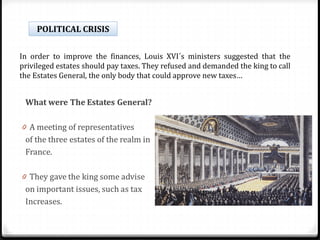
In order to improve the finances, Louis XVI´s ministers suggested that the
privileged estates should pay taxes. They refused and demanded the king to call
the Estates General, the only body that could approve new taxes…
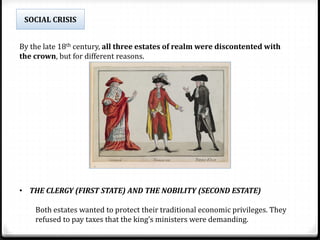
By the late 18th century, all three estates of realm were discontented with
the crown, but for different reasons.
• THE CLERGY (FIRST STATE) AND THE NOBILITY (SECOND ESTATE)
Both estates wanted to protect their traditional economic privileges. They
refused to pay taxes that the king’s ministers were demanding.
SOCIAL CRISIS
• THE MIDDLE CLASS AND THE PEASANTRY
(THIRD STATE)
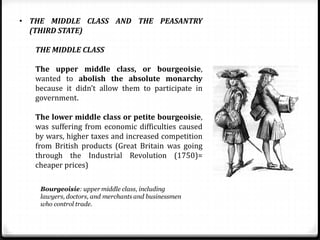
THE MIDDLE CLASS
The upper middle class, or bourgeoisie,
wanted to abolish the absolute monarchy
because it didn’t allow them to participate in
government.
The lower middle class or petite bourgeoisie,
was suffering from economic difficulties caused
by wars, higher taxes and increased competition
from British products (Great Britain was going
through the Industrial Revolution (1750)=
cheaper prices)
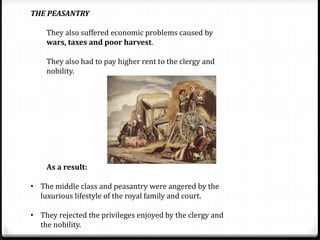
THE PEASANTRY
They also suffered economic problems caused by
wars, taxes and poor harvest.
They also had to pay higher rent to the clergy and
nobility.
As a result:
• The middle class and peasantry were angered by the
luxurious lifestyle of the royal family and court.
• They rejected the privileges enjoyed by the clergy and
the nobility.
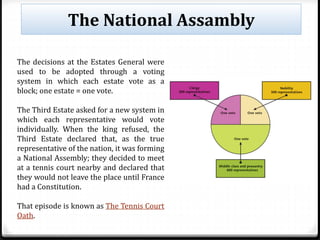
The National Assambly
The decisions at the Estates General were
used to be adopted through a voting
system in which each estate vote as a
block; one estate = one vote.
The Third Estate asked for a new system in
which each representative would vote
individually. When the king refused, the
Third Estate declared that, as the true
representative of the nation, it was forming
a National Assembly; they decided to meet
at a tennis court nearby and declared that
they would not leave the place until France
had a Constitution.
That episode is known as The Tennis Court
Oath.
The Constituent Assembly
(1789-1791)
The King had finally to agree with the Third Estate´s demands, and a Constituent
Assembly was formed to write a Constitution.
The triumph for the bourgeoisie was complete and the monarchy was no longer
absolute.
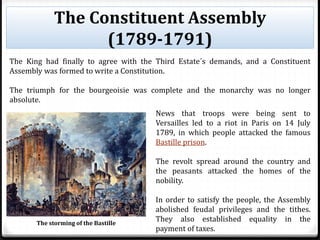
News that troops were being sent to
Versailles led to a riot in Paris on 14 July
1789, in which people attacked the famous
Bastille prison.
The revolt spread around the country and
the peasants attacked the homes of the
nobility.
In order to satisfy the people, the Assembly
abolished feudal privileges and the tithes.
They also established equality in the
payment of taxes.
The storming of the Bastille
Louis Tries to Escape
• The National Assembly restructured
the relationship between church and
state, so that, the clergy and the
nobility started to emigrate to other
European Countries and began a
campaign to defeat the revolution.
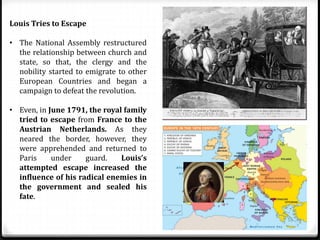
• Even, in June 1791, the royal family
tried to escape from France to the
Austrian Netherlands. As they
neared the border, however, they
were apprehended and returned to
Paris under guard. Louis’s
attempted escape increased the
influence of his radical enemies in
the government and sealed his
fate.
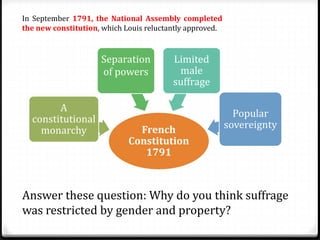
In September 1791, the National Assembly completed
the new constitution, which Louis reluctantly approved.
French
Constitution
1791
A
constitutional
monarchy
Separation
of powers
Limited
male
suffrage
Popular
sovereignty
Answer these question: Why do you think suffrage
was restricted by gender and property?
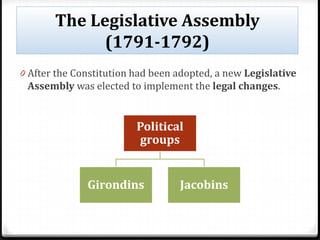
The Legislative Assembly
(1791-1792)
0 After the Constitution had been adopted, a new Legislative
Assembly was elected to implement the legal changes.
Political
groups
Girondins Jacobins
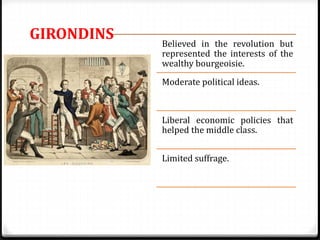
Believed in the revolution but
represented the interests of the
wealthy bourgeoisie.
Moderate political ideas.
Liberal economic policies that
helped the middle class.
Limited suffrage.
GIRONDINS
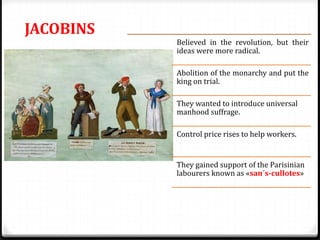
JACOBINS
Believed in the revolution, but their
ideas were more radical.
Abolition of the monarchy and put the
king on trial.
They wanted to introduce universal
manhood suffrage.
Control price rises to help workers.
They gained support of the Parisinian
labourers known as «san´s-cullotes»
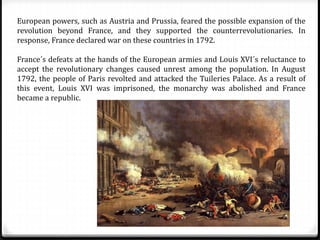
European powers, such as Austria and Prussia, feared the possible expansion of the
revolution beyond France, and they supported the counterrevolutionaries. In
response, France declared war on these countries in 1792.
France´s defeats at the hands of the European armies and Louis XVI´s reluctance to
accept the revolutionary changes caused unrest among the population. In August
1792, the people of Paris revolted and attacked the Tuileries Palace. As a result of
this event, Louis XVI was imprisoned, the monarchy was abolished and France
became a republic.
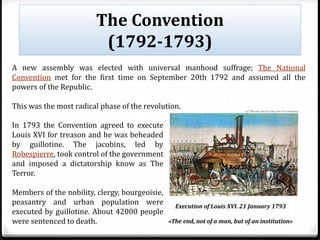
The Convention
(1792-1793)
Execution of Louis XVI. 21 January 1793
«The end, not of a man, but of an institution»
A new assembly was elected with universal manhood suffrage; The National
Convention met for the first time on September 20th 1792 and assumed all the
powers of the Republic.
This was the most radical phase of the revolution.
In 1793 the Convention agreed to execute
Louis XVI for treason and he was beheaded
by guillotine. The jacobins, led by
Robespierre, took control of the government
and imposed a dictatorship know as The
Terror.
Members of the nobility, clergy, bourgeoisie,
peasantry and urban population were
executed by guillotine. About 42000 people
were sentenced to death.
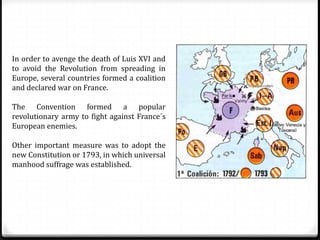
In order to avenge the death of Luis XVI and
to avoid the Revolution from spreading in
Europe, several countries formed a coalition
and declared war on France.
The Convention formed a popular
revolutionary army to fight against France´s
European enemies.
Other important measure was to adopt the
new Constitution or 1793, in which universal
manhood suffrage was established.
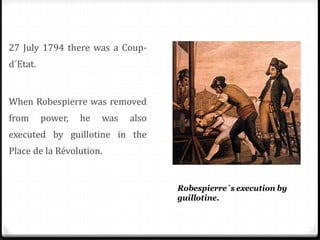
27 July 1794 there was a Coup-
d´Etat.
When Robespierre was removed
from power, he was also
executed by guillotine in the
Place de la Révolution.
The Directory and the Consulate
(1795-1799)
The moderate deputies redacted a new Constitution in 1795 that re-established
limited suffrage and introduced a new form of organisation called the Directory.
Five members or directors shared the executive power.
The power and influence of the army increased as a result of the continuing
foreign war, and of the threat that the radical revolutionaries might return to
power.
Within that context, General Napoleon Bonaparte became very famous and
prestigious and, in 1799, organised a military coup to take the power.
He established a new form of government called the Consulate, made up of three
consuls, including himself as First Consul. In 1804, Napoleon declared himself
Emperor of France with absolute power; the French Revolution had ended…
4. From the Revolution to the
Empire
Napoleon´s main political achievements were:
• His domestic policy consolidated the changes made during the revolution with the
establishment of the Civil Code, a set of laws that applied equally to all citizens.
• His foreign policy made France an empire as a result of his victories over Austria,
Russia and Prussia.
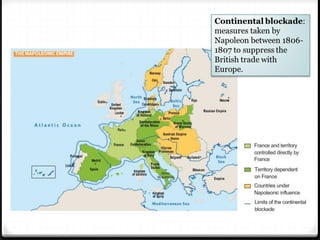
Great Britain was the only country that Napoleon never defeated, despite de
Continental Blockade he set up. No country allied with or occupied by France was
allowed to import British goods.
Napoleon spread the revolutionary principles of liberty and equality across Europe.
He also brought about the introduction of new constitutions that ended absolute
monarchies in many European countries.
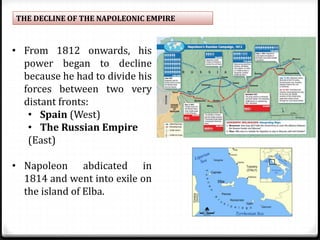
THE DECLINE OF THE NAPOLEONIC EMPIRE
• From 1812 onwards, his
power began to decline
because he had to divide his
forces between two very
distant fronts:
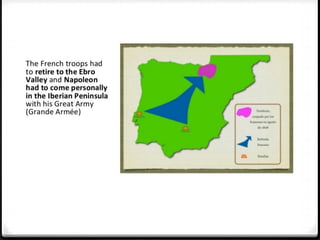
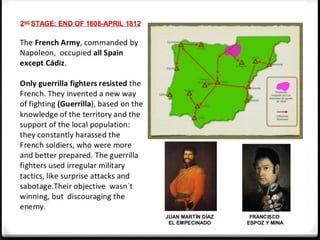
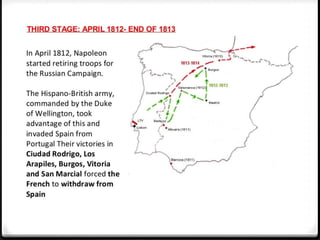
• Spain (West)
• The Russian Empire
(East)
• Napoleon abdicated in
1814 and went into exile on
the island of Elba.
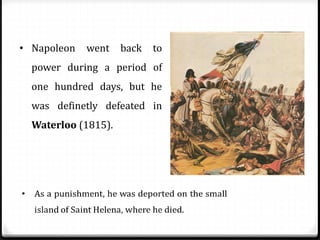
• Napoleon went back to
power during a period of
one hundred days, but he
was definetly defeated in
Waterloo (1815).
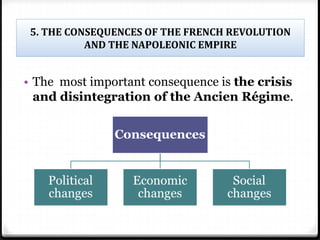
5. THE CONSEQUENCES OF THE FRENCH REVOLUTION
AND THE NAPOLEONIC EMPIRE
• The most important consequence is the crisis
and disintegration of the Ancien Régime.
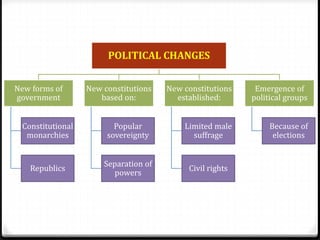
POLITICAL CHANGES
New forms of
government
Constitutional
monarchies
Republics
New constitutions
based on:
Popular
sovereignty
Separation of
powers
New constitutions
established:
Limited male
suffrage
Civil rights
Emergence of
political groups
Because of
elections
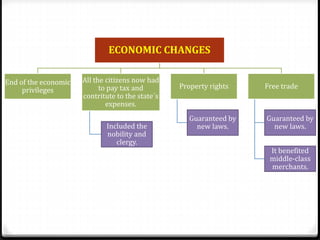
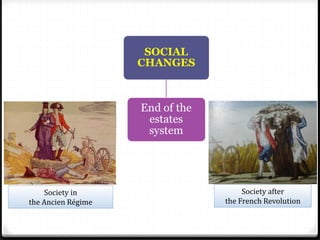
ECONOMIC CHANGES
End of the economic
privileges
All the citizens now had
to pay tax and
contritute to the state´s
expenses.
Included the
nobility and
clergy.
Property rights
Guaranteed by
new laws.
Free trade
Guaranteed by
new laws.
It benefited
middle-class
merchants.
Society in
the Ancien Régime
Society after
the French Revolution
5. THE SPANISH WAR OF INDEPENDENCE AND THE
REVOLUTION
In 1793 Spain joined the first
coalition against France as a result
of Louis XVI´s execution. France
defeated the coalition and Spain
had to sing a Treaty of Peace that
was followed by the Treaties of
San Ildefonso (1796 and 1800), in
which Spain promised to help
France in the future war against
Great Britain. However, in 1805
the French and Spanish fleets were
defeated by the British at the
Battle of Trafalgar, that marked the
end of Spanish naval power…
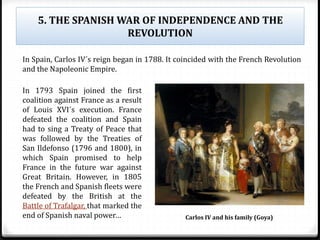
In Spain, Carlos IV´s reign began in 1788. It coincided with the French Revolution
and the Napoleonic Empire.
Carlos IV and his family (Goya)
In 1807, Napoleon achieved the Spanish
permission to cross the country in order to
invade Portugal, an ally of Great Britain. But
his intention was to occupy Spain too…
The Royal Family tried to escape from
Madrid which caused a popular revolt in
March 1808 known as the Revolt of
Aranjuez. Carlos IV was forced to abdicate in
favour of his son, Fernando VII.
Finally both, the father and the son moved to
Bayonne to meet Napoleon. There they
renounced their rights to the Spanish throne
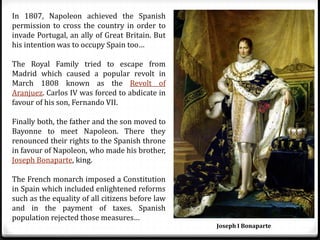
in favour of Napoleon, who made his brother,
Joseph Bonaparte, king.
The French monarch imposed a Constitution
in Spain which included enlightened reforms
such as the equality of all citizens before law
and in the payment of taxes. Spanish
population rejected those measures…
Joseph I Bonaparte
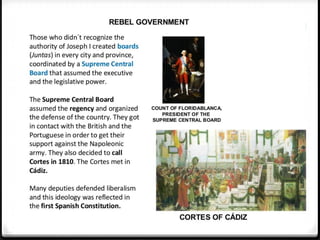
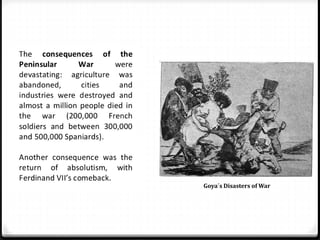
Goya´s Disasters of War
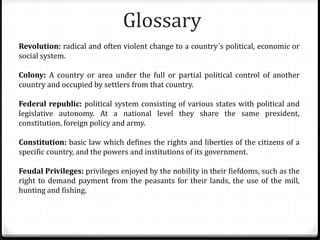
Glossary
Revolution: radical and often violent change to a country´s political, economic or
social system.
Colony: A country or area under the full or partial political control of another
country and occupied by settlers from that country.
Federal republic: political system consisting of various states with political and
legislative autonomy. At a national level they share the same president,
constitution, foreign policy and army.
Constitution: basic law which defines the rights and liberties of the citizens of a
specific country, and the powers and institutions of its government.
Feudal Privileges: privileges enjoyed by the nobility in their fiefdoms, such as the
right to demand payment from the peasants for their lands, the use of the mill,
hunting and fishing.
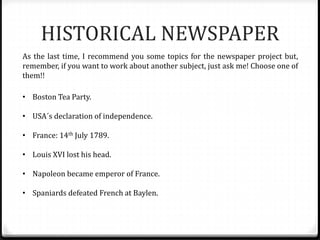
HISTORICAL NEWSPAPER
As the last time, I recommend you some topics for the newspaper project but,
remember, if you want to work about another subject, just ask me! Choose one of
them!!
• Boston Tea Party.
• USA´s declaration of independence.
• France: 14th July 1789.
• Louis XVI lost his head.
• Napoleon became emperor of France.
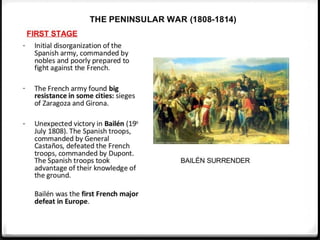
• Spaniards defeated French at Baylen.

Unit 2 The bourgeois revolutions

  • 1.
  • 2.
    Mis presentaciones tienentan solo una finalidad didáctica y sin ánimo de lucro, estando disponibles en Internet para todo aquel que las encuentre útiles. Salvo en casos excepcionales, no cito las fuentes escritas ni audiovisuales que utilizo por razones de economía de espacio y tiempo; de igual forma, no requiero que se cite lo que yo elaboro. Sin embargo, si algún autor reconoce sus textos o imágenes en mis trabajos y considera que debe ser citado, no tiene más que ponerse en contacto conmigo e incluiré su nombre donde sea necesario. Gracias y disfruten de la Historia… Prof. Oscar González García – IES Ornia (La Bañeza) 2017/2018
  • 3.
    What are wegoing to study? ORDEN EDU 362/2015 de 4 de mayo – currículo ESO CyL CRITERIOS DE EVALUACIÓN 1. Identificar los principales hechos de las revoluciones burguesas en Estados Unidos, Francia y España e Iberoamérica. 2. Comprender el alcance y las limitaciones de los procesos revolucionarios del siglo XVIII. ESTÁNDARES DE APRENDIZAJE EVALUABLES 1.1. Redacta una narrativa sintética con los principales hechos de alguna de las revoluciones burguesas del siglo XVIII, acudiendo a explicaciones causales, sopesando los pros y los contras. 2.1. Discute las implicaciones de la violencia con diversos tipos de fuentes. 4.1. Sopesa las razones de los revolucionarios para actuar como lo hicieron. 4.2. Reconoce, mediante el análisis de fuentes de diversa época, el valor de las mismas no sólo como información, sino también como evidencia para los historiadores. Bloque 2. La Era de las Revoluciones liberales
  • 4.
    1. Bourgeois revolutions Normally,the word “revolution” is understood as a radical and often violent change to a country´s political, economic or social system. The bourgeois revolutions enabled the bourgeoisie to gain political power and a social status which had only been available to the nobility under the Ancien Régime. These revolutions took place in the late 18th and early 19th centuries. The process begun by two revolutions: The American and the French.
  • 5.
    2. The AmericanRevolution (1775-1783) In the American War of Independence, Great Britain fought against its 13 colonies located on the Atlantic Coast of North America but… Could you explain what is a colony??? Why those North American territories were British colonies?? Visit the web and complete de Quiz
  • 6.
    2. 1. Thecauses of the war Between 1756 and 1763 (Seven Years War or French and Indian War), Great Britain fought against France for control of the territory that today forms part of Canada. Despite the British victory, the economical costs were huge; so that, George III increased several taxes on the colonies. The people refused to pay these taxes and there were various protests, such as the 1773 Boston Tea Party, in which a group of colonists threw a cargo of tea into the sea in Boston. In response, the British government sent troops to the city and close the port. This event marked the beginning of the conflict.
  • 7.
    But, in fact,the American War of Independence was caused by a combination of factors: • Ideological factors: the colonists were familiar with the Enlightenment thinking about liberty and equality. These ideas became the basis for the independence movement. • Political factors: the British Parliament made decisions about taxes and other issues related to the colonies. However, Great Britain refused to allow the colonies to be represented in Parliament. • Economic and social factors: by this time there was a wealthy colonial bourgeoisie who wanted the freedom to trade without the interference of Great Britain. CLICK ON THIS LINK TO WATCH A RESUME
  • 8.
    2. 2. TheWar of Independence and its consequences The war began when some of the colonies decided to fight for independence and, in 1775, they created their own army, which was led by George Washington. During the first part of the conflict, Great Britain had military successes, but the colonies started politically significant actions: they joined a Continental Congress that proclaimed the Declaration of Independence on 4th July 1776. Finally, the support of France and Spain, led the colonialists to the victory. Great Britain recognised American independence in 1783 Treaty of Versailles. George Washington
  • 9.
    In 1787, theUnited States adopted a Constitution that included these principles: • Type of government: federal republic1. • Popular sovereignty: this was expressed through male suffrage. However, only white men with a certain amount of property could vote. • Separation of powers: the president was the executive branch, Congress was the legislative branch and the Supreme Court was the judicial branch. • Rights: citizens were free and equal before the law. Despite this, slavery continued to be legal. The American Revolution had important consequences. The United States became a symbol for the struggle for liberty and equality in other countries. It also showed that it was possible to put Enlightenment ideas into practice.
  • 10.
    3. The FrenchRevolution
  • 11.
    3.1 THE CAUSESOF THE FRENCH REVOLUTION The French Revolution was a period of violent political and social change, which saw the abolition of absolute monarchy and the end of the estates system of Ancien Régime (closed society). It was caused due to a combination of related factors: • The influence of the Enlightenment: Rousseau (Du Contrat Social), Voltaire (Lettres Philosophiques) and Montesquieu (De l’Espirit des Loix). • French intellectuals and bourgeoisie supported Enlightenment ideas and tried to put them into practice. For example, they demanded that all French subjects be free and equal under the law. That was not compatible with the French absolute monarchy… IDEAS
  • 12.
    ECONOMIC CRISIS 0 TheFrench state was bankrupt (without money and unable to pay debts). 0 Causes: 0 participation in military conflicts, such as the American War of independence. 0 The royal family spent large amounts of money on palaces, luxury goods and extravagant parties. Poor harvests after 1770 led to an increase in the price of grain. The population suffered from hunger while the Royal Family lived a luxurious life…
  • 13.
    Louis XVI andthe palace of Versailles
  • 14.
    POLITICAL CRISIS In orderto improve the finances, Louis XVI´s ministers suggested that the privileged estates should pay taxes. They refused and demanded the king to call the Estates General, the only body that could approve new taxes…
  • 15.
    By the late18th century, all three estates of realm were discontented with the crown, but for different reasons. • THE CLERGY (FIRST STATE) AND THE NOBILITY (SECOND ESTATE) Both estates wanted to protect their traditional economic privileges. They refused to pay taxes that the king’s ministers were demanding. SOCIAL CRISIS
  • 16.
    • THE MIDDLECLASS AND THE PEASANTRY (THIRD STATE) THE MIDDLE CLASS The upper middle class, or bourgeoisie, wanted to abolish the absolute monarchy because it didn’t allow them to participate in government. The lower middle class or petite bourgeoisie, was suffering from economic difficulties caused by wars, higher taxes and increased competition from British products (Great Britain was going through the Industrial Revolution (1750)= cheaper prices)
  • 17.
    THE PEASANTRY They alsosuffered economic problems caused by wars, taxes and poor harvest. They also had to pay higher rent to the clergy and nobility. As a result: • The middle class and peasantry were angered by the luxurious lifestyle of the royal family and court. • They rejected the privileges enjoyed by the clergy and the nobility.
  • 19.
    The National Assambly Thedecisions at the Estates General were used to be adopted through a voting system in which each estate vote as a block; one estate = one vote. The Third Estate asked for a new system in which each representative would vote individually. When the king refused, the Third Estate declared that, as the true representative of the nation, it was forming a National Assembly; they decided to meet at a tennis court nearby and declared that they would not leave the place until France had a Constitution. That episode is known as The Tennis Court Oath.
  • 20.
    The Constituent Assembly (1789-1791) TheKing had finally to agree with the Third Estate´s demands, and a Constituent Assembly was formed to write a Constitution. The triumph for the bourgeoisie was complete and the monarchy was no longer absolute. News that troops were being sent to Versailles led to a riot in Paris on 14 July 1789, in which people attacked the famous Bastille prison. The revolt spread around the country and the peasants attacked the homes of the nobility. In order to satisfy the people, the Assembly abolished feudal privileges and the tithes. They also established equality in the payment of taxes. The storming of the Bastille
  • 21.
    Louis Tries toEscape • The National Assembly restructured the relationship between church and state, so that, the clergy and the nobility started to emigrate to other European Countries and began a campaign to defeat the revolution. • Even, in June 1791, the royal family tried to escape from France to the Austrian Netherlands. As they neared the border, however, they were apprehended and returned to Paris under guard. Louis’s attempted escape increased the influence of his radical enemies in the government and sealed his fate.
  • 22.
    In September 1791,the National Assembly completed the new constitution, which Louis reluctantly approved. French Constitution 1791 A constitutional monarchy Separation of powers Limited male suffrage Popular sovereignty Answer these question: Why do you think suffrage was restricted by gender and property?
  • 23.
    The Legislative Assembly (1791-1792) 0After the Constitution had been adopted, a new Legislative Assembly was elected to implement the legal changes. Political groups Girondins Jacobins
  • 24.
    Believed in therevolution but represented the interests of the wealthy bourgeoisie. Moderate political ideas. Liberal economic policies that helped the middle class. Limited suffrage. GIRONDINS
  • 25.
    JACOBINS Believed in therevolution, but their ideas were more radical. Abolition of the monarchy and put the king on trial. They wanted to introduce universal manhood suffrage. Control price rises to help workers. They gained support of the Parisinian labourers known as «san´s-cullotes»
  • 26.
    European powers, suchas Austria and Prussia, feared the possible expansion of the revolution beyond France, and they supported the counterrevolutionaries. In response, France declared war on these countries in 1792. France´s defeats at the hands of the European armies and Louis XVI´s reluctance to accept the revolutionary changes caused unrest among the population. In August 1792, the people of Paris revolted and attacked the Tuileries Palace. As a result of this event, Louis XVI was imprisoned, the monarchy was abolished and France became a republic.
  • 27.
    The Convention (1792-1793) Execution ofLouis XVI. 21 January 1793 «The end, not of a man, but of an institution» A new assembly was elected with universal manhood suffrage; The National Convention met for the first time on September 20th 1792 and assumed all the powers of the Republic. This was the most radical phase of the revolution. In 1793 the Convention agreed to execute Louis XVI for treason and he was beheaded by guillotine. The jacobins, led by Robespierre, took control of the government and imposed a dictatorship know as The Terror. Members of the nobility, clergy, bourgeoisie, peasantry and urban population were executed by guillotine. About 42000 people were sentenced to death.
  • 28.
    In order toavenge the death of Luis XVI and to avoid the Revolution from spreading in Europe, several countries formed a coalition and declared war on France. The Convention formed a popular revolutionary army to fight against France´s European enemies. Other important measure was to adopt the new Constitution or 1793, in which universal manhood suffrage was established.
  • 29.
    27 July 1794there was a Coup- d´Etat. When Robespierre was removed from power, he was also executed by guillotine in the Place de la Révolution.
  • 30.
    The Directory andthe Consulate (1795-1799) The moderate deputies redacted a new Constitution in 1795 that re-established limited suffrage and introduced a new form of organisation called the Directory. Five members or directors shared the executive power. The power and influence of the army increased as a result of the continuing foreign war, and of the threat that the radical revolutionaries might return to power. Within that context, General Napoleon Bonaparte became very famous and prestigious and, in 1799, organised a military coup to take the power. He established a new form of government called the Consulate, made up of three consuls, including himself as First Consul. In 1804, Napoleon declared himself Emperor of France with absolute power; the French Revolution had ended…
  • 31.
    4. From theRevolution to the Empire Napoleon´s main political achievements were: • His domestic policy consolidated the changes made during the revolution with the establishment of the Civil Code, a set of laws that applied equally to all citizens. • His foreign policy made France an empire as a result of his victories over Austria, Russia and Prussia. Great Britain was the only country that Napoleon never defeated, despite de Continental Blockade he set up. No country allied with or occupied by France was allowed to import British goods. Napoleon spread the revolutionary principles of liberty and equality across Europe. He also brought about the introduction of new constitutions that ended absolute monarchies in many European countries.
  • 33.
    THE DECLINE OFTHE NAPOLEONIC EMPIRE • From 1812 onwards, his power began to decline because he had to divide his forces between two very distant fronts: • Spain (West) • The Russian Empire (East) • Napoleon abdicated in 1814 and went into exile on the island of Elba.
  • 34.
    • Napoleon wentback to power during a period of one hundred days, but he was definetly defeated in Waterloo (1815).
  • 35.
    5. THE CONSEQUENCESOF THE FRENCH REVOLUTION AND THE NAPOLEONIC EMPIRE • The most important consequence is the crisis and disintegration of the Ancien Régime.
  • 36.
    POLITICAL CHANGES New formsof government Constitutional monarchies Republics New constitutions based on: Popular sovereignty Separation of powers New constitutions established: Limited male suffrage Civil rights Emergence of political groups Because of elections
  • 37.
    ECONOMIC CHANGES End ofthe economic privileges All the citizens now had to pay tax and contritute to the state´s expenses. Included the nobility and clergy. Property rights Guaranteed by new laws. Free trade Guaranteed by new laws. It benefited middle-class merchants.
  • 38.
    Society in the AncienRégime Society after the French Revolution
  • 39.
    5. THE SPANISHWAR OF INDEPENDENCE AND THE REVOLUTION In 1793 Spain joined the first coalition against France as a result of Louis XVI´s execution. France defeated the coalition and Spain had to sing a Treaty of Peace that was followed by the Treaties of San Ildefonso (1796 and 1800), in which Spain promised to help France in the future war against Great Britain. However, in 1805 the French and Spanish fleets were defeated by the British at the Battle of Trafalgar, that marked the end of Spanish naval power… In Spain, Carlos IV´s reign began in 1788. It coincided with the French Revolution and the Napoleonic Empire. Carlos IV and his family (Goya)
  • 40.
    In 1807, Napoleonachieved the Spanish permission to cross the country in order to invade Portugal, an ally of Great Britain. But his intention was to occupy Spain too… The Royal Family tried to escape from Madrid which caused a popular revolt in March 1808 known as the Revolt of Aranjuez. Carlos IV was forced to abdicate in favour of his son, Fernando VII. Finally both, the father and the son moved to Bayonne to meet Napoleon. There they renounced their rights to the Spanish throne in favour of Napoleon, who made his brother, Joseph Bonaparte, king. The French monarch imposed a Constitution in Spain which included enlightened reforms such as the equality of all citizens before law and in the payment of taxes. Spanish population rejected those measures… Joseph I Bonaparte
  • 49.
  • 50.
    Glossary Revolution: radical andoften violent change to a country´s political, economic or social system. Colony: A country or area under the full or partial political control of another country and occupied by settlers from that country. Federal republic: political system consisting of various states with political and legislative autonomy. At a national level they share the same president, constitution, foreign policy and army. Constitution: basic law which defines the rights and liberties of the citizens of a specific country, and the powers and institutions of its government. Feudal Privileges: privileges enjoyed by the nobility in their fiefdoms, such as the right to demand payment from the peasants for their lands, the use of the mill, hunting and fishing.
  • 51.
    HISTORICAL NEWSPAPER As thelast time, I recommend you some topics for the newspaper project but, remember, if you want to work about another subject, just ask me! Choose one of them!! • Boston Tea Party. • USA´s declaration of independence. • France: 14th July 1789. • Louis XVI lost his head. • Napoleon became emperor of France. • Spaniards defeated French at Baylen.