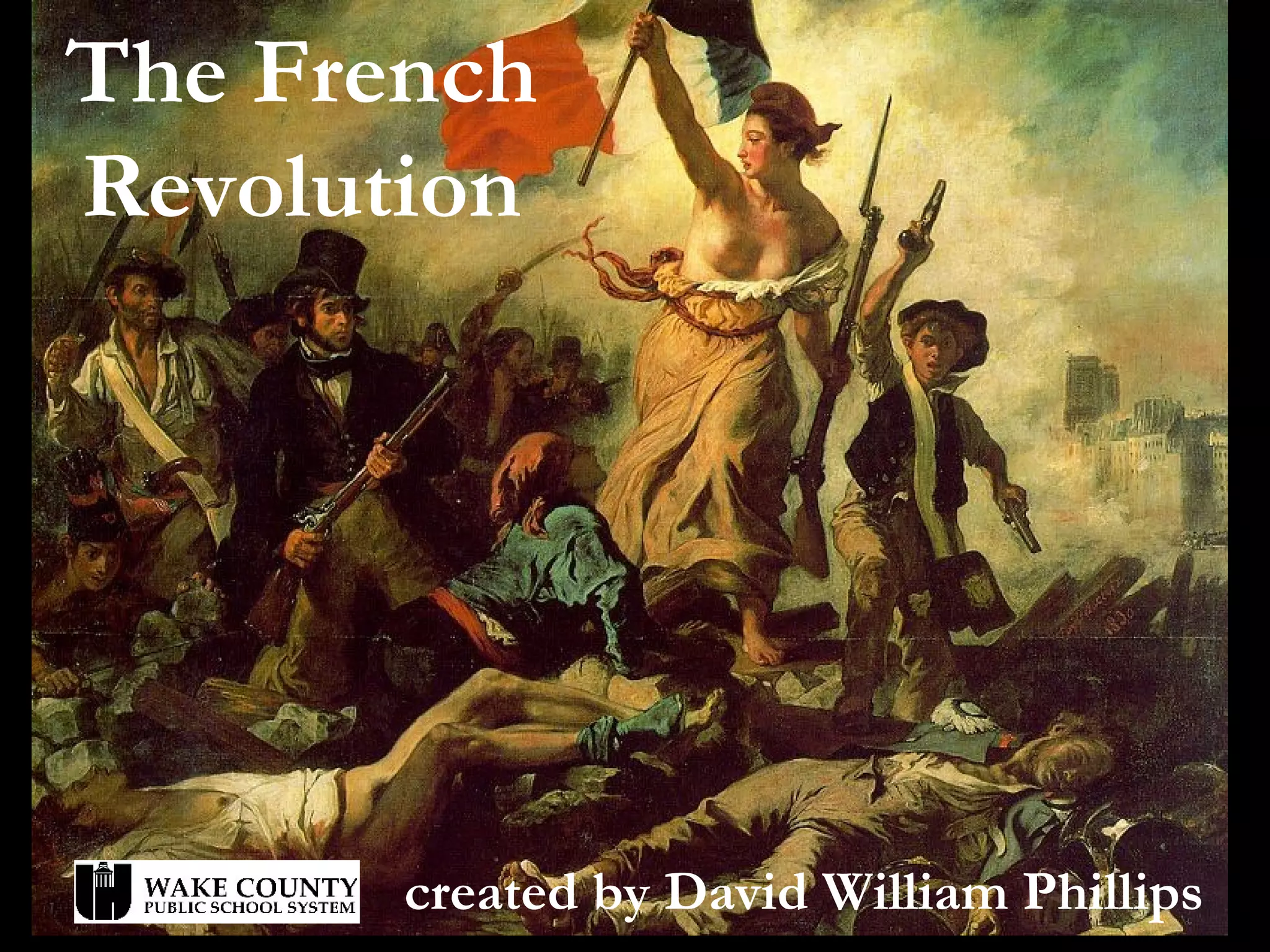




The French
Revolution
created by David William Phillips
The Age of Enlightenment culminated in the French
Revolution of 1789.
The Revolution destroyed the last remaining of the
Middle Ages in French society.
France was transformed from an absolute monarchy to
a republic of free and equal citizens.
Causes of the French
Revolution
1. The spread of
Enlightenment ideas
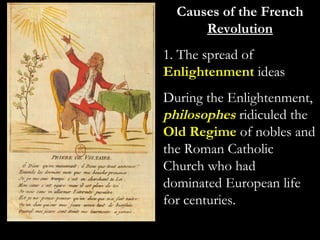
During the Enlightenment,
philosophes ridiculed the
Old Regime of nobles and
the Roman Catholic
Church who had
dominated European life
for centuries.
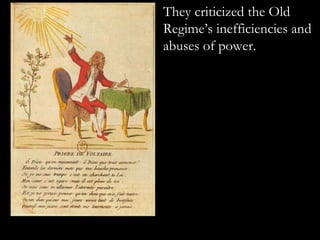
They criticized the Old
Regime’s inefficiencies and
abuses of power.
The philosophes, believed in the power of reason to
solve humanity’s problems.
They believed reason can guide never-ending progress
so that humanity itself could be changed for the better.
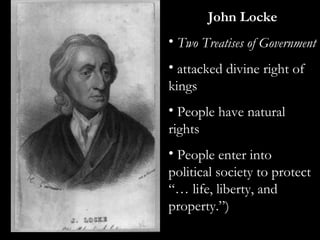
John Locke
• Two Treatises of Government
• attacked divine right of
kings
• People have natural
rights
• People enter into
political society to protect
“… life, liberty, and
property.”)
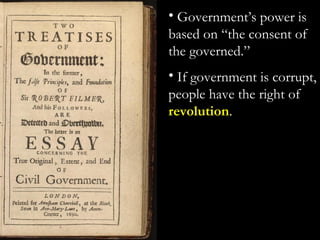
• Government’s power is
based on “the consent of
the governed.”
• If government is corrupt,
people have the right of
revolution.
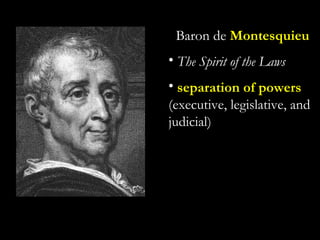
Baron de Montesquieu
• The Spirit of the Laws
• separation of powers
(executive, legislative, and
judicial)
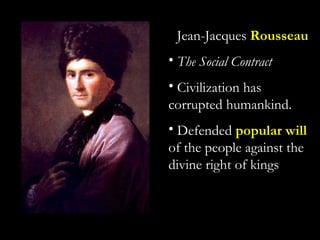
Jean-Jacques Rousseau
• The Social Contract
• Civilization has
corrupted humankind.
• Defended popular will
of the people against the
divine right of kings
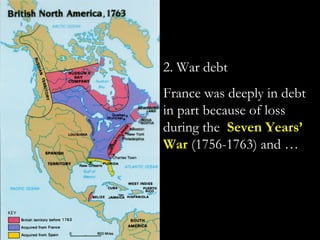
2. War debt
France was deeply in debt
in part because of loss
during the Seven Years’
War (1756-1763) and …
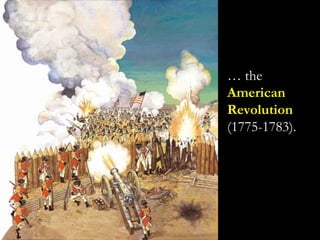
… the
American
Revolution
(1775-1783).
By 1787, France was spending nearly half its annual
revenues paying just the interest from its extensive loans.
(Expenses = 600 million livres, revenue = 475 million
livres – ½ of revenue goes just to pay interest on loans)
3. Food Shortages
In 1788-1789, bad winters ruined harvests and the price
of bread rose dramatically. Starvation led to increasing
violence in both the cities and the countryside. In early
1789, a panic gripped the nation as the poor began
rioting.
4. Tax Burden on Peasants
The peasants resented the nobility and clergy — many
of them very wealthy — who paid little in taxes while
the poor suffered a heavy tax burden.
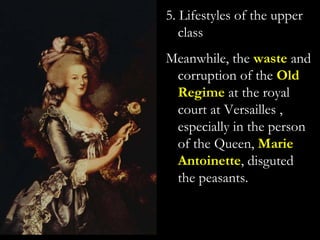
5. Lifestyles of the upper
class
Meanwhile, the waste and
corruption of the Old
Regime at the royal
court at Versailles ,
especially in the person
of the Queen, Marie
Antoinette, disguted
the peasants.
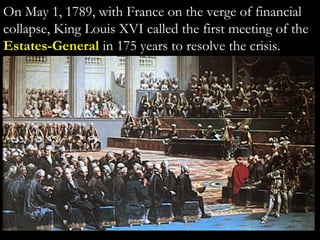
On May 1, 1789, with France on the verge of financial
collapse, King Louis XVI called the first meeting of the
Estates-General in 175 years to resolve the crisis.
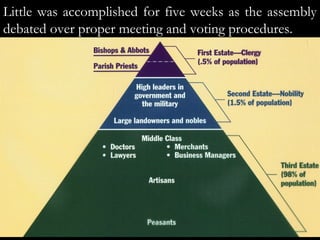
Little was accomplished for five weeks as the assembly
debated over proper meeting and voting procedures.
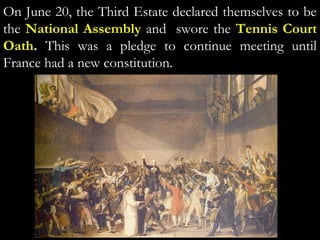
On June 20, the Third Estate declared themselves to be
the National Assembly and swore the Tennis Court
Oath. This was a pledge to continue meeting until
France had a new constitution.
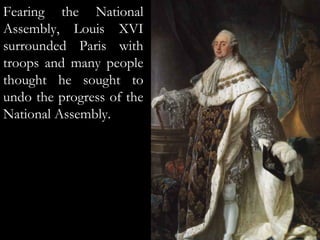
Fearing the National
Assembly, Louis XVI
surrounded Paris with
troops and many people
thought he sought to
undo the progress of the
National Assembly.
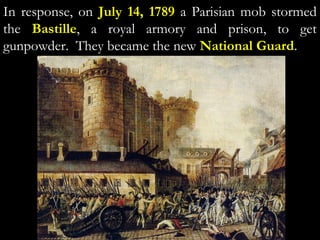
In response, on July 14, 1789 a Parisian mob stormed
the Bastille, a royal armory and prison, to get
gunpowder. They became the new National Guard.
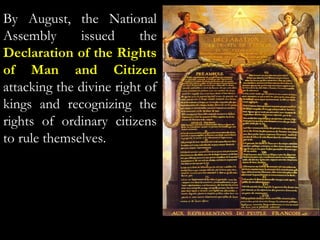
By August, the National
Assembly issued the
Declaration of the Rights
of Man and Citizen
attacking the divine right of
kings and recognizing the
rights of ordinary citizens
to rule themselves.
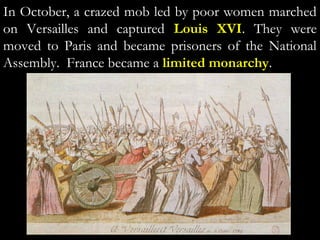
In October, a crazed mob led by poor women marched
on Versailles and captured Louis XVI. They were
moved to Paris and became prisoners of the National
Assembly. France became a limited monarchy.
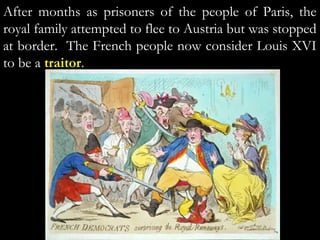
After months as prisoners of the people of Paris, the
royal family attempted to flee to Austria but was stopped
at border. The French people now consider Louis XVI
to be a traitor.
Concerned about the potential effects of the Revolution
on their own kingdoms, the Emperor of Austria and the
King of Prussia spoke of invading France on behalf of
Louis XVI.
The National Assembly, now called the National
Convention, struck first and declared war against
Austria and Prussia in April, 1792.
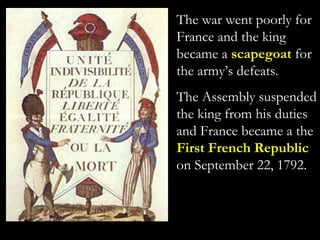
The war went poorly for
France and the king
became a scapegoat for
the army’s defeats.
The Assembly suspended
the king from his duties
and France became a the
First French Republic
on September 22, 1792.
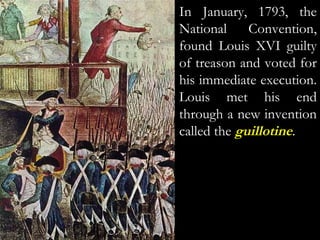
In January, 1793, the
National Convention,
found Louis XVI guilty
of treason and voted for
his immediate execution.
Louis met his end
through a new invention
called the guillotine.
After the execution of Louis XVI, Britain and the
Netherlands joined the war against France. The French,
on the defensive throughout 1793, met defeat after
defeat.
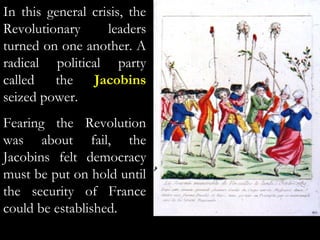
In this general crisis, the
Revolutionary leaders
turned on one another. A
radical political party
called the Jacobins
seized power.
Fearing the Revolution
was about fail, the
Jacobins felt democracy
must be put on hold until
the security of France
could be established.
The Jacobins created
a twelve-man
dictatorship led by
Maximilien
Robespierre called
the Committee for
Public Safety.
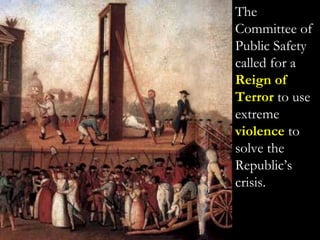
The
Committee of
Public Safety
called for a
Reign of
Terror to use
extreme
violence to
solve the
Republic’s
crisis.
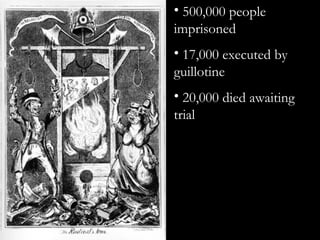
• 500,000 people
imprisoned
• 17,000 executed by
guillotine
• 20,000 died awaiting
trial
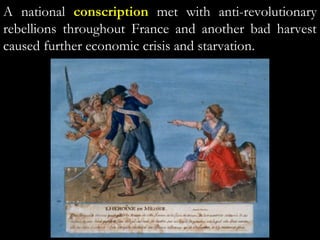
A national conscription met with anti-revolutionary
rebellions throughout France and another bad harvest
caused further economic crisis and starvation.
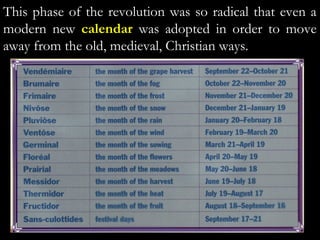
This phase of the revolution was so radical that even a
modern new calendar was adopted in order to move
away from the old, medieval, Christian ways.
Mass conscription, the seizure of grain from farmers,
and price- fixing helped save the Republic.
A reorganization of the army led to a series of military
victories.
By 1794, France had repelled Austrian, Prussian, British,
and Spanish invasions.
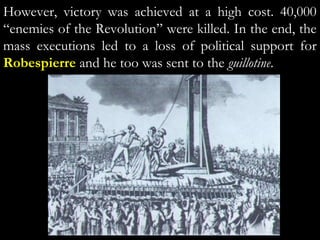
However, victory was achieved at a high cost. 40,000
“enemies of the Revolution” were killed. In the end, the
mass executions led to a loss of political support for
Robespierre and he too was sent to the guillotine.
Some historians see the radical Reign of Terror as a
major advance toward modern democracy, while
others call it a step toward modern dictatorship.
Afterwards,
with the worst
crisis passed,
moderates
established
another new
government
called the
Directory. The
Terror was
ended and
thousands of
prisoners were
released.
Lasting effects of the Revolution:
It led to the end of serfdom, slavery, inherited
privilege, and judicial torture.
It promoted nationalism. A nation was not a group of
royal subjects but a society of equal citizens.
Most European countries today are or are becoming
parliamentary democracies, along the lines set out by
the French Revolution.
It also introduced the use of terrorism as a method of
achieving political goals.

The french revolution

  • 1.
    The French Revolution created byDavid William Phillips
  • 2.
    The Age ofEnlightenment culminated in the French Revolution of 1789. The Revolution destroyed the last remaining of the Middle Ages in French society. France was transformed from an absolute monarchy to a republic of free and equal citizens.
  • 3.
    Causes of theFrench Revolution 1. The spread of Enlightenment ideas During the Enlightenment, philosophes ridiculed the Old Regime of nobles and the Roman Catholic Church who had dominated European life for centuries.
  • 4.
    They criticized theOld Regime’s inefficiencies and abuses of power.
  • 5.
    The philosophes, believedin the power of reason to solve humanity’s problems. They believed reason can guide never-ending progress so that humanity itself could be changed for the better.
  • 6.
    John Locke • TwoTreatises of Government • attacked divine right of kings • People have natural rights • People enter into political society to protect “… life, liberty, and property.”)
  • 7.
    • Government’s poweris based on “the consent of the governed.” • If government is corrupt, people have the right of revolution.
  • 8.
    Baron de Montesquieu •The Spirit of the Laws • separation of powers (executive, legislative, and judicial)
  • 9.
    Jean-Jacques Rousseau • TheSocial Contract • Civilization has corrupted humankind. • Defended popular will of the people against the divine right of kings
  • 10.
    2. War debt Francewas deeply in debt in part because of loss during the Seven Years’ War (1756-1763) and …
  • 11.
  • 12.
    By 1787, Francewas spending nearly half its annual revenues paying just the interest from its extensive loans. (Expenses = 600 million livres, revenue = 475 million livres – ½ of revenue goes just to pay interest on loans)
  • 13.
    3. Food Shortages In1788-1789, bad winters ruined harvests and the price of bread rose dramatically. Starvation led to increasing violence in both the cities and the countryside. In early 1789, a panic gripped the nation as the poor began rioting.
  • 14.
    4. Tax Burdenon Peasants The peasants resented the nobility and clergy — many of them very wealthy — who paid little in taxes while the poor suffered a heavy tax burden.
  • 15.
    5. Lifestyles ofthe upper class Meanwhile, the waste and corruption of the Old Regime at the royal court at Versailles , especially in the person of the Queen, Marie Antoinette, disguted the peasants.
  • 16.
    On May 1,1789, with France on the verge of financial collapse, King Louis XVI called the first meeting of the Estates-General in 175 years to resolve the crisis.
  • 17.
    Little was accomplishedfor five weeks as the assembly debated over proper meeting and voting procedures.
  • 18.
    On June 20,the Third Estate declared themselves to be the National Assembly and swore the Tennis Court Oath. This was a pledge to continue meeting until France had a new constitution.
  • 19.
    Fearing the National Assembly,Louis XVI surrounded Paris with troops and many people thought he sought to undo the progress of the National Assembly.
  • 20.
    In response, onJuly 14, 1789 a Parisian mob stormed the Bastille, a royal armory and prison, to get gunpowder. They became the new National Guard.
  • 21.
    By August, theNational Assembly issued the Declaration of the Rights of Man and Citizen attacking the divine right of kings and recognizing the rights of ordinary citizens to rule themselves.
  • 22.
    In October, acrazed mob led by poor women marched on Versailles and captured Louis XVI. They were moved to Paris and became prisoners of the National Assembly. France became a limited monarchy.
  • 23.
    After months asprisoners of the people of Paris, the royal family attempted to flee to Austria but was stopped at border. The French people now consider Louis XVI to be a traitor.
  • 24.
    Concerned about thepotential effects of the Revolution on their own kingdoms, the Emperor of Austria and the King of Prussia spoke of invading France on behalf of Louis XVI. The National Assembly, now called the National Convention, struck first and declared war against Austria and Prussia in April, 1792.
  • 25.
    The war wentpoorly for France and the king became a scapegoat for the army’s defeats. The Assembly suspended the king from his duties and France became a the First French Republic on September 22, 1792.
  • 26.
    In January, 1793,the National Convention, found Louis XVI guilty of treason and voted for his immediate execution. Louis met his end through a new invention called the guillotine.
  • 27.
    After the executionof Louis XVI, Britain and the Netherlands joined the war against France. The French, on the defensive throughout 1793, met defeat after defeat.
  • 28.
    In this generalcrisis, the Revolutionary leaders turned on one another. A radical political party called the Jacobins seized power. Fearing the Revolution was about fail, the Jacobins felt democracy must be put on hold until the security of France could be established.
  • 29.
    The Jacobins created atwelve-man dictatorship led by Maximilien Robespierre called the Committee for Public Safety.
  • 30.
    The Committee of Public Safety calledfor a Reign of Terror to use extreme violence to solve the Republic’s crisis.
  • 31.
    • 500,000 people imprisoned •17,000 executed by guillotine • 20,000 died awaiting trial
  • 32.
    A national conscriptionmet with anti-revolutionary rebellions throughout France and another bad harvest caused further economic crisis and starvation.
  • 33.
    This phase ofthe revolution was so radical that even a modern new calendar was adopted in order to move away from the old, medieval, Christian ways.
  • 34.
    Mass conscription, theseizure of grain from farmers, and price- fixing helped save the Republic. A reorganization of the army led to a series of military victories. By 1794, France had repelled Austrian, Prussian, British, and Spanish invasions.
  • 35.
    However, victory wasachieved at a high cost. 40,000 “enemies of the Revolution” were killed. In the end, the mass executions led to a loss of political support for Robespierre and he too was sent to the guillotine.
  • 36.
    Some historians seethe radical Reign of Terror as a major advance toward modern democracy, while others call it a step toward modern dictatorship.
  • 37.
    Afterwards, with the worst crisispassed, moderates established another new government called the Directory. The Terror was ended and thousands of prisoners were released.
  • 38.
    Lasting effects ofthe Revolution: It led to the end of serfdom, slavery, inherited privilege, and judicial torture. It promoted nationalism. A nation was not a group of royal subjects but a society of equal citizens. Most European countries today are or are becoming parliamentary democracies, along the lines set out by the French Revolution. It also introduced the use of terrorism as a method of achieving political goals.