Assyria The Empire Assyria was a great empire that spanned over four countries. It was a empire that had a strong army, advanced technology and a influential Religion.
Assyrian Geography  Assyria was a great empire but it was greatly affected by the climate its people lived in. Geography and climate affects  what you eat what you where and the culture that you live in.
Placement of the Assyrian empire Assyria spans 4 countries in the northern part of Mesopotamia  To the west it reaches the Euphrates River  To the north it extends to the point of Lake Van To the east it reaches Lake Urmi Both the Euphrates and the Tigris Rivers run in the empires area Tourus and Zagros mountains lie north east of where Assyria was To the south west is a enormous limestone plateau  In the south lie alluvium with is dumped on the land by the Tigris when the river floods Even further south lies land that doesn't have enough rainfall to hold agriculture These two inhabitable areas mark the boundaries to Assyria and its neighbors
Farmland and Water Supply  The Assyrians lived on flat exposed farmland Land was fertile and every region in the empire ad fields of produce Two critical crop producers in the empire where the people of the Arbel plain and the Nineveh plain These groups helped Assyrians receive food needed to feed its enormous population  And because of the surplus the empire was able to advance and expand their civilization and its art Their lack of natural barriers like mountains or rivers it meant they needed to build a strong army The Assyrians like the Egyptians where a river valley civilization  The Assyrians depended on the Tigris river for water for transportation and for trading
Climate  On the lime stone plateau it was cold and wet in the winters  Warm  in summer Apples where grown along figs, olives , pomegranates ,almonds ,mulberries ,and vines where grown as well A multitude of grains where also harvested such as barley and wheat  Rice was grown and popular in Babylonia  Cotton was also  grown The people wore knee length tunics  Clothing was mostly made of wool but linen was used for nicer quality garments  They grew onions but considered to be peasant food Onion leeks and Garlic plants where grown plentifully in the Assyrians gardens Knew there fungi as they knew both poisons and non poisons mushrooms
Animals  The Assyrians also hunted for food besides the trading and crops that they grew In the nearby forests lions lived Wild bull lived in the plains Also in the plains where wild asses, wild goats, and Gazelles Mastiffs (very big dog) where tamed and used for hunting Horses where imported from other lands Pelicans trained for fishing The people hunted Fowl like thrushes sparrows and larks  Fishing was done by line and through means of nets Fish eaten both fresh and dried as bigger fish would usually be dried for future purposes
In conclusion Assyria was affected by its climate and geography. Its climate and geography affected what they wore what they lived in and what they ate as well
As a result, the Assyrians created and used  devices that had helped them conquer nations and also assisted with everyday life.
War and Construction  mud brick construction: is a technique to build massive palaces with sculptures that portrayed battles and victories.  pontoons: floating structures used to support bridge; used them for crossing a river.  ladders: troops used them to climb up enemy’s city walls. iron daggers and swords: weapons used by Assyrian army  iron tipped battering rams: used to destroy the enemy’s city walls.
Inventions and Ideas locks and keys were first used. sexagesimal system of keeping time was developed.  developed medicine that eventually influenced doctors as far away as Europe. first to divide a circle into 360 degrees and invented the concept of longitude and latitude
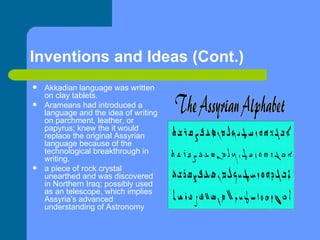
Inventions and Ideas (Cont.) Akkadian language was written on clay tablets. Arameans had introduced a language and the idea of writing on parchment, leather, or papyrus; knew the it would replace the original Assyrian language because of the technological breakthrough in writing.  a piece of rock crystal unearthed and was discovered in Northern Iraq; possibly used as an telescope, which implies Assyria’s advanced understanding of Astronomy
As a result, the Assyrians created and used  devices that had helped them conquer nations and also assisted with everyday life.
Assyrian Religion Anastasiya Sergeyeva
Intro The ancient Assyrian religion existed as a belief system for 1300 years. Assyrian religion originated  in  Sumer and Akkad .   The Assyrians were polytheistic. They performed rituals and ceremonies, and built temples for their gods. They had religious celebrations. And they put a negative view on death.
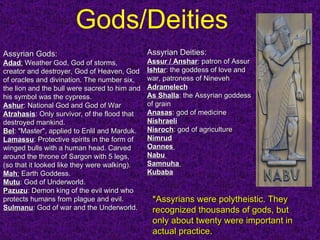
Gods/Deities   *Assyrians were polytheistic. They recognized thousands of gods, but only about twenty were important in actual practice.  Assyrian Gods: Adad :  Weather God, God of storms, creator and destroyer, God of Heaven, God of oracles and divination. The number six, the lion and the bull were sacred to him and his symbol was the cypress.  Ashur : National God and God of War  Atrahasis : Only survivor, of the flood that destroyed mankind.  Bel : "Master", applied to Enlil and Marduk.  Lamassu : Protective spirits in the form of winged bulls with a human head. Carved around the throne of Sargon with 5 legs, (so that it looked like they were walking). Mah :  Earth Goddess.  Mutu : God of Underworld. Pazuzu : Demon king of the evil wind who protects humans from plague and evil.  Sulmanu : God of war and the Underworld. Assyrian Deities:   Assur / Anshar : patron of Assur  Ishta r : the goddess of love and war, patroness of Nineveh Adramelech As Shalla : the Assyrian goddess of grain  Anasas : god of medicine  Nishraeli Nisroch : god of agriculture  Nimrud Oannes  Nabu  Samnuha  Kubaba
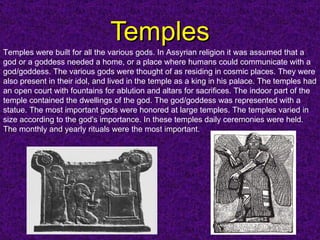
Temples Temples were built for all the various gods. In Assyrian religion it was assumed that a god or a goddess needed a home, or a place where humans could communicate with a god/goddess. The various gods were thought of as residing in cosmic places. They were also present in their idol, and lived in the temple as a king in his palace. The temples had an open court with fountains for ablution and altars for sacrifices. The indoor part of the temple contained the dwellings of the god. The god/goddess was represented with a statue. The most important gods were honored at large temples. The temples varied in size according to the god's importance.   In these temples daily ceremonies were held. The monthly and yearly rituals were the most important.
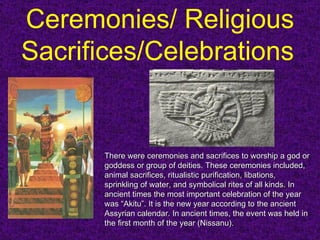
Ceremonies/ Religious Sacrifices/Celebrations   There were ceremonies and sacrifices to worship a god or goddess or group of deities. These ceremonies included, animal sacrifices, ritualistic purification, libations, sprinkling of water, and symbolical rites of all kinds.  In ancient times the most important celebration of the year was “Akitu”. It is the new year according to the ancient Assyrian calendar. In ancient times, the event was held in the first month of the year (Nissanu).
Marriage  An ancient Assyrian marriage contract reads: “Laqipum has married Hatala, daughter of Enishru in the country Laqipum [and] may not marry another [woman] in the City. He may marry a hierodule. If within two years she does not provide him with [an] offspring, she [must] purchase a slave woman. [If she does produce an offspring,] he may dispose of her by sale [or however] he pleases. Should Laqipum choose to divorce her, he must pay five minas of silver [to her] and should Hatala choose to divorce him, she must pay five minas of silver [to him]”. Witnessed by: Masa, Ashurishtikal, Talia, Shupianika. (Finkelstein)
Death   Death in and Assyrian religion was not viewed optimistically. The spirit of the dead would go to the underworld. There wasn’t any paradise or hope for any rewards for the righteous. The spirits would go to a large dark cavern below the earth,  in which all the dead were gathered and they led a miserable existence of inactivity. Occasionally a favored individual was permitted to escape from this fate and placed in a pleasant island. It appeared that the rulers were always singled out for divine grace, owing to the prevailing view that the rulers stood nearer to the gods than other mortals.
Bibliography   &quot;Assyrian Religion.&quot; 11/02/2008. 25 Nov 2008 <http://i-cias.com/e.o/bab-ass_rl.htm>.  &quot;Assyrian- Babylonian.&quot;  Wikipedia . 11/15/2008. 11/22/2008 <http://en.wikipedia.org/wiki/assyrian/religion> &quot;Babylonian and Assyrian religion.&quot;  NationMaster . 21 Nov 2008 <http://www.nationmaster.com/encyclopedia/Babylonian-and-Assyrian-religion>.  &quot;Akitu&quot;.  Wikipedia . 09Nov2008. 22 Nov 2008 <http://en.wikipedia.org/wiki/Assyrian_Akitu>.  Narada, Ty.  Sex and Marriage in the Ancient World . 21Nov 2008 <http://www.cyonic-nemeton.com/AncientSex.html>. &quot;Nabu.&quot; 11/08/08.http://upload.wikimedia.org/wikipedia/commons/1/19/Nabu-Lawrie-Highsmith.jpeg (accessed 11/22/2008).  &quot;Temple of Shamash.&quot; 08/02/07.http://www.atlastours.net/iraq/temple_of_shamash.jpg (accessed 11/23/08).  &quot;Oannes.&quot; http://www.geocities.com/dominorus/oannes2c.gif (accessed 11/22/2008).  &quot;Anshar.&quot; 04/15/08.http://www.incunabula.org/blog/images/tiamat-2.gif (accessed 11/21/08).  &quot;Eagle-Deity.&quot; http://www.ancientreplicas.com/eagle-diety-o.jpg (accessed 11/23/08).  &quot;Lamassu.&quot; http://www.ngs.noaa.gov/external/IGRS/pictures/lamassu_A4.gif (accessed 11/22/2008).  &quot;Sacrifices.&quot; 05/26/2008.http://www.hp.uab.edu/image_archive/ue/relief06.jpg (accessed 11/22/2008). &quot;Ashur.&quot;  http://tbn3.google.com/images?q=tbn:HEUT7rVVn-AkHM:http://www.geocities.com/garyweb65/ashur.jpg (accessed 11/21/08).  &quot;Nisroch.&quot; http://www.wingedhorserider.com/Image/Poster/13-07.JPG (accessed 11/22/2008).  &quot;Assyrian Underworld.&quot; http://www.bibleorigins.net/DumuziSealUnderworld.jpg (accessed 11/21/08).
“ Geography”  http:// www.aina.org/aol/peter/brief.htm#Geography  (Accessed on 11/10/08) “ Climate and Production”  http:// www.searchgodsword.org/enc/isb/view.cgi?number =T898   (Accessed on 11/17/08) “ Climate and Environment”  http://www.sron.nl/~jheise/akkadian/mesopotamia.html  (Accessed on 11/16/08) “ Gazelle”  http://animals.nationalgeographic.com/staticfiles/NGS/Shared/StaticFiles/animals/images/primary/gazelle.jpg  (Accessed on 11/15/08) “ Food and diet in Assyria”  http://www.nineveh.com/Food%20and%20Diet%20in%20Assyria.html  (Accessed on 11/17/08)  World History, Patterns of interaction, McDougal Little 2003 McDougal Little Inc (Accessed on 11/03/08) “ Assyrian flag”  http://www.aina.org/aol/album.htm  (Accessed on 11/15/08) “ Assyrians With planting”  http:// www.discovery.mala.bc.ca/web/rudischedm/scribes.gif  (Accessed on 11/15/08) “ Assyrian mountains”  http://www.gutenberg.org/files/17327/17327-h/images/221.jpg  (Accessed on 11/15/08) “ Clothing in Ancient Assyria”  http://www.nineveh.com/Clothing%20in%20Ancient%20Assyria.html  (Accessed on 11/16/08)
Bibliography McDougal Littell: World History textbook http://ancienthistory.suite101.com/article.cfm/the_ancient_assyrians  www. bethsuryoyo.com /Code/Gallery/AssyrianWeapons.html  http://patentednews.com/science-discovery/assyrian-inventions/31/   http:// www.aina.org/aol/peter/brief.htm   http://www.witiger.com/centennialcollege/GNED117/alphabet.gif http://www.gutenberg.org/files/17327/17327-h/images/013.jpg

Assyrian Empire

  • 1.
    Assyria The EmpireAssyria was a great empire that spanned over four countries. It was a empire that had a strong army, advanced technology and a influential Religion.
  • 2.
    Assyrian Geography Assyria was a great empire but it was greatly affected by the climate its people lived in. Geography and climate affects what you eat what you where and the culture that you live in.
  • 3.
    Placement of theAssyrian empire Assyria spans 4 countries in the northern part of Mesopotamia To the west it reaches the Euphrates River To the north it extends to the point of Lake Van To the east it reaches Lake Urmi Both the Euphrates and the Tigris Rivers run in the empires area Tourus and Zagros mountains lie north east of where Assyria was To the south west is a enormous limestone plateau In the south lie alluvium with is dumped on the land by the Tigris when the river floods Even further south lies land that doesn't have enough rainfall to hold agriculture These two inhabitable areas mark the boundaries to Assyria and its neighbors
  • 4.
    Farmland and WaterSupply The Assyrians lived on flat exposed farmland Land was fertile and every region in the empire ad fields of produce Two critical crop producers in the empire where the people of the Arbel plain and the Nineveh plain These groups helped Assyrians receive food needed to feed its enormous population And because of the surplus the empire was able to advance and expand their civilization and its art Their lack of natural barriers like mountains or rivers it meant they needed to build a strong army The Assyrians like the Egyptians where a river valley civilization The Assyrians depended on the Tigris river for water for transportation and for trading
  • 5.
    Climate Onthe lime stone plateau it was cold and wet in the winters Warm in summer Apples where grown along figs, olives , pomegranates ,almonds ,mulberries ,and vines where grown as well A multitude of grains where also harvested such as barley and wheat Rice was grown and popular in Babylonia Cotton was also grown The people wore knee length tunics Clothing was mostly made of wool but linen was used for nicer quality garments They grew onions but considered to be peasant food Onion leeks and Garlic plants where grown plentifully in the Assyrians gardens Knew there fungi as they knew both poisons and non poisons mushrooms
  • 6.
    Animals TheAssyrians also hunted for food besides the trading and crops that they grew In the nearby forests lions lived Wild bull lived in the plains Also in the plains where wild asses, wild goats, and Gazelles Mastiffs (very big dog) where tamed and used for hunting Horses where imported from other lands Pelicans trained for fishing The people hunted Fowl like thrushes sparrows and larks Fishing was done by line and through means of nets Fish eaten both fresh and dried as bigger fish would usually be dried for future purposes
  • 7.
    In conclusion Assyriawas affected by its climate and geography. Its climate and geography affected what they wore what they lived in and what they ate as well
  • 8.
    As a result,the Assyrians created and used devices that had helped them conquer nations and also assisted with everyday life.
  • 9.
    War and Construction mud brick construction: is a technique to build massive palaces with sculptures that portrayed battles and victories. pontoons: floating structures used to support bridge; used them for crossing a river. ladders: troops used them to climb up enemy’s city walls. iron daggers and swords: weapons used by Assyrian army iron tipped battering rams: used to destroy the enemy’s city walls.
  • 10.
    Inventions and Ideaslocks and keys were first used. sexagesimal system of keeping time was developed. developed medicine that eventually influenced doctors as far away as Europe. first to divide a circle into 360 degrees and invented the concept of longitude and latitude
  • 11.
    Inventions and Ideas(Cont.) Akkadian language was written on clay tablets. Arameans had introduced a language and the idea of writing on parchment, leather, or papyrus; knew the it would replace the original Assyrian language because of the technological breakthrough in writing. a piece of rock crystal unearthed and was discovered in Northern Iraq; possibly used as an telescope, which implies Assyria’s advanced understanding of Astronomy
  • 12.
    As a result,the Assyrians created and used devices that had helped them conquer nations and also assisted with everyday life.
  • 13.
  • 14.
    Intro The ancientAssyrian religion existed as a belief system for 1300 years. Assyrian religion originated in Sumer and Akkad . The Assyrians were polytheistic. They performed rituals and ceremonies, and built temples for their gods. They had religious celebrations. And they put a negative view on death.
  • 15.
    Gods/Deities *Assyrians were polytheistic. They recognized thousands of gods, but only about twenty were important in actual practice. Assyrian Gods: Adad : Weather God, God of storms, creator and destroyer, God of Heaven, God of oracles and divination. The number six, the lion and the bull were sacred to him and his symbol was the cypress. Ashur : National God and God of War Atrahasis : Only survivor, of the flood that destroyed mankind. Bel : &quot;Master&quot;, applied to Enlil and Marduk. Lamassu : Protective spirits in the form of winged bulls with a human head. Carved around the throne of Sargon with 5 legs, (so that it looked like they were walking). Mah : Earth Goddess. Mutu : God of Underworld. Pazuzu : Demon king of the evil wind who protects humans from plague and evil. Sulmanu : God of war and the Underworld. Assyrian Deities: Assur / Anshar : patron of Assur Ishta r : the goddess of love and war, patroness of Nineveh Adramelech As Shalla : the Assyrian goddess of grain Anasas : god of medicine Nishraeli Nisroch : god of agriculture Nimrud Oannes Nabu Samnuha Kubaba
  • 16.
    Temples Temples werebuilt for all the various gods. In Assyrian religion it was assumed that a god or a goddess needed a home, or a place where humans could communicate with a god/goddess. The various gods were thought of as residing in cosmic places. They were also present in their idol, and lived in the temple as a king in his palace. The temples had an open court with fountains for ablution and altars for sacrifices. The indoor part of the temple contained the dwellings of the god. The god/goddess was represented with a statue. The most important gods were honored at large temples. The temples varied in size according to the god's importance. In these temples daily ceremonies were held. The monthly and yearly rituals were the most important.
  • 17.
    Ceremonies/ Religious Sacrifices/Celebrations There were ceremonies and sacrifices to worship a god or goddess or group of deities. These ceremonies included, animal sacrifices, ritualistic purification, libations, sprinkling of water, and symbolical rites of all kinds. In ancient times the most important celebration of the year was “Akitu”. It is the new year according to the ancient Assyrian calendar. In ancient times, the event was held in the first month of the year (Nissanu).
  • 18.
    Marriage Anancient Assyrian marriage contract reads: “Laqipum has married Hatala, daughter of Enishru in the country Laqipum [and] may not marry another [woman] in the City. He may marry a hierodule. If within two years she does not provide him with [an] offspring, she [must] purchase a slave woman. [If she does produce an offspring,] he may dispose of her by sale [or however] he pleases. Should Laqipum choose to divorce her, he must pay five minas of silver [to her] and should Hatala choose to divorce him, she must pay five minas of silver [to him]”. Witnessed by: Masa, Ashurishtikal, Talia, Shupianika. (Finkelstein)
  • 19.
    Death Death in and Assyrian religion was not viewed optimistically. The spirit of the dead would go to the underworld. There wasn’t any paradise or hope for any rewards for the righteous. The spirits would go to a large dark cavern below the earth, in which all the dead were gathered and they led a miserable existence of inactivity. Occasionally a favored individual was permitted to escape from this fate and placed in a pleasant island. It appeared that the rulers were always singled out for divine grace, owing to the prevailing view that the rulers stood nearer to the gods than other mortals.
  • 20.
    Bibliography &quot;Assyrian Religion.&quot; 11/02/2008. 25 Nov 2008 <http://i-cias.com/e.o/bab-ass_rl.htm>. &quot;Assyrian- Babylonian.&quot; Wikipedia . 11/15/2008. 11/22/2008 <http://en.wikipedia.org/wiki/assyrian/religion> &quot;Babylonian and Assyrian religion.&quot; NationMaster . 21 Nov 2008 <http://www.nationmaster.com/encyclopedia/Babylonian-and-Assyrian-religion>. &quot;Akitu&quot;. Wikipedia . 09Nov2008. 22 Nov 2008 <http://en.wikipedia.org/wiki/Assyrian_Akitu>. Narada, Ty. Sex and Marriage in the Ancient World . 21Nov 2008 <http://www.cyonic-nemeton.com/AncientSex.html>. &quot;Nabu.&quot; 11/08/08.http://upload.wikimedia.org/wikipedia/commons/1/19/Nabu-Lawrie-Highsmith.jpeg (accessed 11/22/2008). &quot;Temple of Shamash.&quot; 08/02/07.http://www.atlastours.net/iraq/temple_of_shamash.jpg (accessed 11/23/08). &quot;Oannes.&quot; http://www.geocities.com/dominorus/oannes2c.gif (accessed 11/22/2008). &quot;Anshar.&quot; 04/15/08.http://www.incunabula.org/blog/images/tiamat-2.gif (accessed 11/21/08). &quot;Eagle-Deity.&quot; http://www.ancientreplicas.com/eagle-diety-o.jpg (accessed 11/23/08). &quot;Lamassu.&quot; http://www.ngs.noaa.gov/external/IGRS/pictures/lamassu_A4.gif (accessed 11/22/2008). &quot;Sacrifices.&quot; 05/26/2008.http://www.hp.uab.edu/image_archive/ue/relief06.jpg (accessed 11/22/2008). &quot;Ashur.&quot; http://tbn3.google.com/images?q=tbn:HEUT7rVVn-AkHM:http://www.geocities.com/garyweb65/ashur.jpg (accessed 11/21/08). &quot;Nisroch.&quot; http://www.wingedhorserider.com/Image/Poster/13-07.JPG (accessed 11/22/2008). &quot;Assyrian Underworld.&quot; http://www.bibleorigins.net/DumuziSealUnderworld.jpg (accessed 11/21/08).
  • 21.
    “ Geography” http:// www.aina.org/aol/peter/brief.htm#Geography (Accessed on 11/10/08) “ Climate and Production” http:// www.searchgodsword.org/enc/isb/view.cgi?number =T898 (Accessed on 11/17/08) “ Climate and Environment” http://www.sron.nl/~jheise/akkadian/mesopotamia.html (Accessed on 11/16/08) “ Gazelle” http://animals.nationalgeographic.com/staticfiles/NGS/Shared/StaticFiles/animals/images/primary/gazelle.jpg (Accessed on 11/15/08) “ Food and diet in Assyria” http://www.nineveh.com/Food%20and%20Diet%20in%20Assyria.html (Accessed on 11/17/08) World History, Patterns of interaction, McDougal Little 2003 McDougal Little Inc (Accessed on 11/03/08) “ Assyrian flag” http://www.aina.org/aol/album.htm (Accessed on 11/15/08) “ Assyrians With planting” http:// www.discovery.mala.bc.ca/web/rudischedm/scribes.gif (Accessed on 11/15/08) “ Assyrian mountains” http://www.gutenberg.org/files/17327/17327-h/images/221.jpg (Accessed on 11/15/08) “ Clothing in Ancient Assyria” http://www.nineveh.com/Clothing%20in%20Ancient%20Assyria.html (Accessed on 11/16/08)
  • 22.
    Bibliography McDougal Littell:World History textbook http://ancienthistory.suite101.com/article.cfm/the_ancient_assyrians www. bethsuryoyo.com /Code/Gallery/AssyrianWeapons.html http://patentednews.com/science-discovery/assyrian-inventions/31/ http:// www.aina.org/aol/peter/brief.htm http://www.witiger.com/centennialcollege/GNED117/alphabet.gif http://www.gutenberg.org/files/17327/17327-h/images/013.jpg

Editor's Notes