Chapter 16
Social
Change in the
Global
Community
 Sociology
in Modules
 Richard T.
Schaefer
Tenth edition
Group Members
1. Mohamed Abdullahi Osman
2. Feysal Hassan Hussien
3. Ahmed Abdullahi Farah
4. Said Ali Shire
5. Hafsa Abdikarim Mohamed
6. Ismail Hassan Ahmed
7. Abdiaziz Abdirahman Hassan
Social Movements
 Social change is significant alteration over time in
behavior patterns and culture, including norms and
values.
social movement to refer to an organized collective
activity to bring about or resist fundamental change in an
existing group or society (Benford 1992).
social movements have had a dramatic impact on the
course of history and the evolution of the social structure.
 social movements contribute to the formation of public
opinion
.
The Emergence of Social Movements
 How and why do social movements emerge?
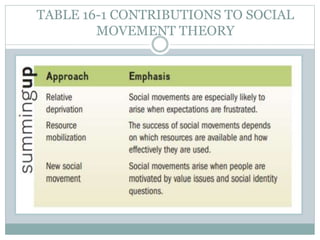
a) Relative Deprivation Approach:
 The term relative deprivation is defined as the
conscious feeling of a negative discrepancy between
legitimate expectations and present actualities.
 Before discontent is channeled into a social
movement , people must feel
- Have a right to their goals
- perceive they cannot attain goals through
conventional means
b) Resource Mobilization Approach :
The term resource mobilization refers to the ways in
which a social movement utilizes such resources.
- leadership a central factor
- often mobilized by institutional insiders
- Marx: leaders would need to help workers
overcome false-consciousness attitude that do not
reflect worker’s objective position
The Emergence of Social Movements
Gender and Social Movements
 Women find it more difficult than men to assume
leadership positions and social movement
organization .
 Gender can effect the way we view organized efforts
to bring about or resist change
New Social Movements
 New social movement : organized collective
activity that addresses values and social identities ,as
well as improvements in quality of life .
- New social movements generally do not view
government as their ally in the struggle for a better
society. While they typically do not seek to overthrow
the government, they may criticize, protest, or harass
public officials.
- The environmental movement is one of many new
movements with a worldwide focus
TABLE 16-1 CONTRIBUTIONS TO SOCIAL
MOVEMENT THEORY
Communications and the Globalization of Social
Movements
 Global text messaging and the internet allow
activists to reach people
- television and the Internet, as contrasted with
books and newspapers, often convey a false sense of
intimacy reinforced by immediacy.
• computer-mediated communication (CMC).
Computer-mediated communication may be defined as
communicative interaction through two or more
networked devices, such as a computer or cell phone
Social change
- Social change can occur so slowly as to be almost
undetectable to those it affects, but it can also happen
with breathtaking rapidity.
- Modern world’s diversity and complexity makes
explanations difficult.
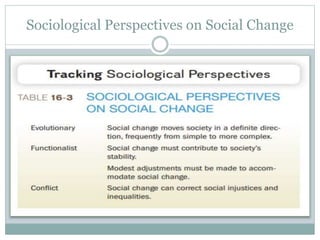
Theories of Social Change
 Evolutionary
 Functionalist
 Conflict
Evolutionary Theory
 Evolutionary Theory society is viewed as moving
in a definite direction.
- Auguste Comte (1798–1857): He saw human
societies as moving forward in their thinking, from
mythology to the scientific method.
- Émile Durkheim ([1893] 1933) maintained that
society progressed from simple to more complex forms
of social organization.
-
Functionalist Perspective
 Equilibrium model : as changes occur in one part
of society, adjustments must be made in other parts.
If not, society’s equilibrium will be threatened and
strains will occur.
 Parsons : Four process of social change
1) Differentiation refers to the increasing
complexity of social organization.
2) adaptive upgrading in which social institutions
become more specialized in their purposes.
Functionalist Perspective
3) inclusion of groups that were previously excluded
because of their gender, race, ethnicity, or social class.
Medical schools have practiced inclusion by admitting
increasing numbers of women and African Americans.
4) value generalization the development of new
values that tolerate and legitimate a greater range of
activities.
Conflict Perspective
 Change needed to correct social injustices and
inequalities .
 Marxist view of social change appeals because it does
not restrict people to passive roles .
 Dahrendorf : functionalist and conflict approaches
compatible.
Sociological Perspectives on Social Change
Resistance to Social Change
 Resistance may be due to:
 Economic factors
 Cultural factors
 Reluctance to use or fear of technology
 vested interests to refer to those people or groups
who will suffer in the event of social change.
 For example, in 2010 President Obama proposed
scuttling NASA’s Constellation project, whose
primary goal was to return humans to the moon.
Economic and Cultural Factors
 Companies may resist social change by cutting
corners or lobbying for eased regulations
 NIMBY: “not in my backyard”
 On world stage, “not on planet Earth”
 Culture lag: period of maladjustment when
nonmaterial culture is still struggling to adapt to new
material conditions
Resistance to Technology
 Technology: cultural information about ways in
which material resources of environment may be
used to satisfy
human needs and desires
 Luddites: resisted Industrial Revolution; some
raided factories, destroyed machinery
 Some people resist postindustrial expansion
of industrialization
Global Social Change
 Recent past a dramatic time in history
 Collapse of communism
 Terrorism in various parts of world
 Major regime changes and severe economic disruptions
 Spread of AIDS
 Computer revolution
 Cloning
Anticipating Change
 In era of global change, is change possible to predict?
 Collins: Soviet expansionism resulted
in an overextension of resources in 1980
 Hallinan: need to move beyond restrictive models of social
change
 Sociologists must learn to predict upheavals and
major chaotic shifts
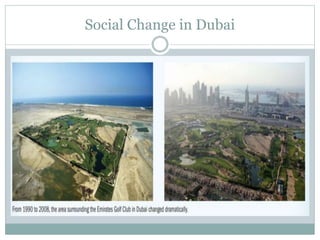
Social Change in Dubai
 Went from pearl-fishing village to tax-free
information-technology hub
 Constitutional monarchy, but relatively progressive for Arab
state
 Environmentally, cost of lavish lifestyle exorbitant
 Poor treatment of immigrant laborers
 2008 economic downturn difficult for Dubai,
but economy back on the move by 2010
Social Change in Dubai
Technology and the Future
 Technological advances—the airplane, the
automobile, the television, the atomic bomb, and
more recently, the computer, digital media, and the
cell phone—have brought striking changes to our
cultures, our patterns of socialization, our social
institutions, and our day-to-day social interactions.
Computer Technology
 Effects of computers noteworthy
with regard to Internet
 In 2012, Internet reached 2.3 billion users
 Anyone can reach Internet with a phone line, a computer, and a
modem, but not everyone can get onto information highway
 Core nations have near-monopoly on information technology
 Effect on people’s jobs
Biotechnology and the
Gene Pool
 Sex selection of fetuses, genetically engineered
organisms, and cloning of sheep, cows, and other
animals are among significant advances
 Biotechnological advances have raised
many difficult ethical and political questions
 Altering the gene pool
 Genetically Modified (GM) food
 Notable success in treatment of traumatic injuries
Social Policy and Globalization:
Transnationals
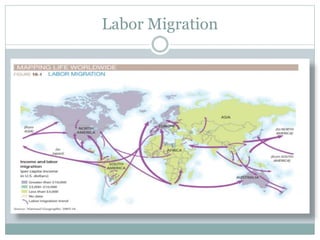
 Millions of migrant laborers play roles
in global economy
 Fill jobs where shortages exist in labor market
 Do not become wealthy, but consider themselves better off than they
were in
their native country
 Citizens of host countries often react negatively
 Looking at the Issue
 2013: 232 million international migrants
 3% of world’s population
 Globalization changed immigrant experience and labor market
 Transnationals: immigrants who sustain multiple social
relationships that link their societies of origin with the societies of
settlement
Social Policy and Globalization:
Transnationals
 Initiating Policy
 Transnationals face continuing adjustment problems in their
new home countries
 Often encounter difficult living and working conditions
 Voter eligibility remains unresolved
 Public attitudes and government policies
have not kept pace
 General public’s attitude toward illegal immigrants remains
hostile, especially in U.S
Labor Migration
New Microsoft PowerPoint Presentation.pptx

New Microsoft PowerPoint Presentation.pptx

  • 1.
    Chapter 16 Social Change inthe Global Community  Sociology in Modules  Richard T. Schaefer Tenth edition Group Members 1. Mohamed Abdullahi Osman 2. Feysal Hassan Hussien 3. Ahmed Abdullahi Farah 4. Said Ali Shire 5. Hafsa Abdikarim Mohamed 6. Ismail Hassan Ahmed 7. Abdiaziz Abdirahman Hassan
  • 2.
    Social Movements  Socialchange is significant alteration over time in behavior patterns and culture, including norms and values. social movement to refer to an organized collective activity to bring about or resist fundamental change in an existing group or society (Benford 1992). social movements have had a dramatic impact on the course of history and the evolution of the social structure.  social movements contribute to the formation of public opinion .
  • 3.
    The Emergence ofSocial Movements  How and why do social movements emerge? a) Relative Deprivation Approach:  The term relative deprivation is defined as the conscious feeling of a negative discrepancy between legitimate expectations and present actualities.  Before discontent is channeled into a social movement , people must feel - Have a right to their goals - perceive they cannot attain goals through conventional means
  • 4.
    b) Resource MobilizationApproach : The term resource mobilization refers to the ways in which a social movement utilizes such resources. - leadership a central factor - often mobilized by institutional insiders - Marx: leaders would need to help workers overcome false-consciousness attitude that do not reflect worker’s objective position The Emergence of Social Movements
  • 5.
    Gender and SocialMovements  Women find it more difficult than men to assume leadership positions and social movement organization .  Gender can effect the way we view organized efforts to bring about or resist change
  • 6.
    New Social Movements New social movement : organized collective activity that addresses values and social identities ,as well as improvements in quality of life . - New social movements generally do not view government as their ally in the struggle for a better society. While they typically do not seek to overthrow the government, they may criticize, protest, or harass public officials. - The environmental movement is one of many new movements with a worldwide focus
  • 7.
    TABLE 16-1 CONTRIBUTIONSTO SOCIAL MOVEMENT THEORY
  • 8.
    Communications and theGlobalization of Social Movements  Global text messaging and the internet allow activists to reach people - television and the Internet, as contrasted with books and newspapers, often convey a false sense of intimacy reinforced by immediacy. • computer-mediated communication (CMC). Computer-mediated communication may be defined as communicative interaction through two or more networked devices, such as a computer or cell phone
  • 9.
    Social change - Socialchange can occur so slowly as to be almost undetectable to those it affects, but it can also happen with breathtaking rapidity. - Modern world’s diversity and complexity makes explanations difficult. Theories of Social Change  Evolutionary  Functionalist  Conflict
  • 10.
    Evolutionary Theory  EvolutionaryTheory society is viewed as moving in a definite direction. - Auguste Comte (1798–1857): He saw human societies as moving forward in their thinking, from mythology to the scientific method. - Émile Durkheim ([1893] 1933) maintained that society progressed from simple to more complex forms of social organization. -
  • 11.
    Functionalist Perspective  Equilibriummodel : as changes occur in one part of society, adjustments must be made in other parts. If not, society’s equilibrium will be threatened and strains will occur.  Parsons : Four process of social change 1) Differentiation refers to the increasing complexity of social organization. 2) adaptive upgrading in which social institutions become more specialized in their purposes.
  • 12.
    Functionalist Perspective 3) inclusionof groups that were previously excluded because of their gender, race, ethnicity, or social class. Medical schools have practiced inclusion by admitting increasing numbers of women and African Americans. 4) value generalization the development of new values that tolerate and legitimate a greater range of activities.
  • 13.
    Conflict Perspective  Changeneeded to correct social injustices and inequalities .  Marxist view of social change appeals because it does not restrict people to passive roles .  Dahrendorf : functionalist and conflict approaches compatible.
  • 14.
  • 15.
    Resistance to SocialChange  Resistance may be due to:  Economic factors  Cultural factors  Reluctance to use or fear of technology  vested interests to refer to those people or groups who will suffer in the event of social change.  For example, in 2010 President Obama proposed scuttling NASA’s Constellation project, whose primary goal was to return humans to the moon.
  • 16.
    Economic and CulturalFactors  Companies may resist social change by cutting corners or lobbying for eased regulations  NIMBY: “not in my backyard”  On world stage, “not on planet Earth”  Culture lag: period of maladjustment when nonmaterial culture is still struggling to adapt to new material conditions
  • 17.
    Resistance to Technology Technology: cultural information about ways in which material resources of environment may be used to satisfy human needs and desires  Luddites: resisted Industrial Revolution; some raided factories, destroyed machinery  Some people resist postindustrial expansion of industrialization
  • 18.
    Global Social Change Recent past a dramatic time in history  Collapse of communism  Terrorism in various parts of world  Major regime changes and severe economic disruptions  Spread of AIDS  Computer revolution  Cloning
  • 19.
    Anticipating Change  Inera of global change, is change possible to predict?  Collins: Soviet expansionism resulted in an overextension of resources in 1980  Hallinan: need to move beyond restrictive models of social change  Sociologists must learn to predict upheavals and major chaotic shifts
  • 20.
    Social Change inDubai  Went from pearl-fishing village to tax-free information-technology hub  Constitutional monarchy, but relatively progressive for Arab state  Environmentally, cost of lavish lifestyle exorbitant  Poor treatment of immigrant laborers  2008 economic downturn difficult for Dubai, but economy back on the move by 2010
  • 21.
  • 22.
    Technology and theFuture  Technological advances—the airplane, the automobile, the television, the atomic bomb, and more recently, the computer, digital media, and the cell phone—have brought striking changes to our cultures, our patterns of socialization, our social institutions, and our day-to-day social interactions.
  • 23.
    Computer Technology  Effectsof computers noteworthy with regard to Internet  In 2012, Internet reached 2.3 billion users  Anyone can reach Internet with a phone line, a computer, and a modem, but not everyone can get onto information highway  Core nations have near-monopoly on information technology  Effect on people’s jobs
  • 24.
    Biotechnology and the GenePool  Sex selection of fetuses, genetically engineered organisms, and cloning of sheep, cows, and other animals are among significant advances  Biotechnological advances have raised many difficult ethical and political questions  Altering the gene pool  Genetically Modified (GM) food  Notable success in treatment of traumatic injuries
  • 25.
    Social Policy andGlobalization: Transnationals  Millions of migrant laborers play roles in global economy  Fill jobs where shortages exist in labor market  Do not become wealthy, but consider themselves better off than they were in their native country  Citizens of host countries often react negatively  Looking at the Issue  2013: 232 million international migrants  3% of world’s population  Globalization changed immigrant experience and labor market  Transnationals: immigrants who sustain multiple social relationships that link their societies of origin with the societies of settlement
  • 26.
    Social Policy andGlobalization: Transnationals  Initiating Policy  Transnationals face continuing adjustment problems in their new home countries  Often encounter difficult living and working conditions  Voter eligibility remains unresolved  Public attitudes and government policies have not kept pace  General public’s attitude toward illegal immigrants remains hostile, especially in U.S
  • 27.