Course Title: Poetry
   Course Code & NO.: LANE 447
   Course Credit Hrs.: 3 weekly
   Level: 7th Level Students


                        The Renaissance
                         Pt. 1
                        Donne’s
              Good Morrow & Holy Sonnet 10
Instructor: Dr. Noora Al-Malki
Credits of images and online content are to their original owners.
This Presentation
• is divided into two sections (Pt. 1 & Pt. 2);
  each dealing with a poet who represents the
  English Renaissance (late 15th C. to early 17th C.)
• introduces the Renaissance era (cultural and
  literary aspects).
• presents a discussion of Shakespeare’s Sonnet
  18 & Donne’s “The Good Morrow” and “Death
  Be Not Proud”.

                     Dr. Noora Al-Malki 2012
                                                    2
                     eaglenoora@yahoo.com
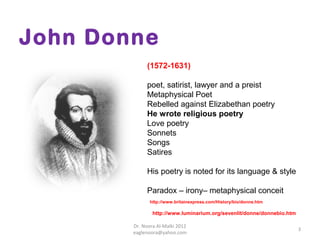
John Donne
             (1572-1631)

             poet, satirist, lawyer and a preist
             Metaphysical Poet
             Rebelled against Elizabethan poetry
             He wrote religious poetry
             Love poetry
             Sonnets
             Songs
             Satires

             His poetry is noted for its language & style

             Paradox – irony– metaphysical conceit
               http://www.britainexpress.com/History/bio/donne.htm

                http://www.luminarium.org/sevenlit/donne/donnebio.htm

        Dr. Noora Al-Malki 2012
                                                                        3
        eaglenoora@yahoo.com
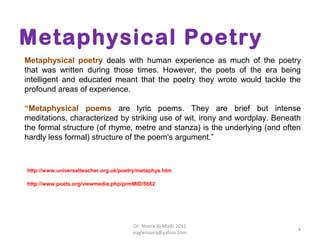
Metaphysical Poetry
Metaphysical poetry deals with human experience as much of the poetry
that was written during those times. However, the poets of the era being
intelligent and educated meant that the poetry they wrote would tackle the
profound areas of experience.

“Metaphysical poems are lyric poems. They are brief but intense
meditations, characterized by striking use of wit, irony and wordplay. Beneath
the formal structure (of rhyme, metre and stanza) is the underlying (and often
hardly less formal) structure of the poem's argument.”


http://www.universalteacher.org.uk/poetry/metaphys.htm

http://www.poets.org/viewmedia.php/prmMID/5662


                                       Dr. Noora Al-Malki 2012
                                                                             4
                                       eaglenoora@yahoo.com
The Good Morrow
From the Songs and Sonnets collection
You can find a thorough thematic and stylistic discussion of
the poem on this site:
The Good Morrow: A Metaphysical Explication


                         Dr. Noora Al-Malki 2012
                                                               5
                         eaglenoora@yahoo.com
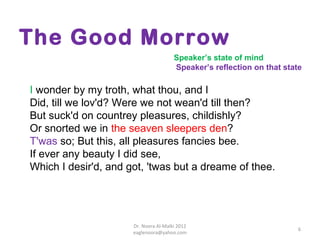
The Good Morrow
                                       Speaker’s state of mind
                                       Speaker’s reflection on that state

I wonder by my troth, what thou, and I
Did, till we lov'd? Were we not wean'd till then?
But suck'd on countrey pleasures, childishly?
Or snorted we in the seaven sleepers den?
T'was so; But this, all pleasures fancies bee.
If ever any beauty I did see,
Which I desir'd, and got, 'twas but a dreame of thee.


                      Dr. Noora Al-Malki 2012
                                                                        6
                      eaglenoora@yahoo.com
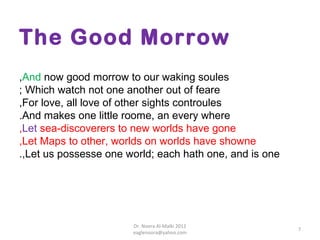
The Good Morrow
,And now good morrow to our waking soules
; Which watch not one another out of feare
,For love, all love of other sights controules
.And makes one little roome, an every where
,Let sea-discoverers to new worlds have gone
,Let Maps to other, worlds on worlds have showne
.,Let us possesse one world; each hath one, and is one


                       Dr. Noora Al-Malki 2012
                                                         7
                       eaglenoora@yahoo.com
The Good Morrow
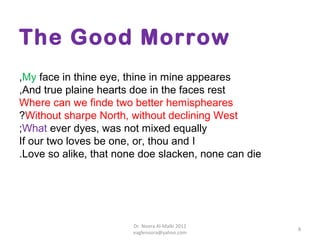
,My face in thine eye, thine in mine appeares
,And true plaine hearts doe in the faces rest
Where can we finde two better hemispheares
?Without sharpe North, without declining West
;What ever dyes, was not mixed equally
If our two loves be one, or, thou and I
.Love so alike, that none doe slacken, none can die


                        Dr. Noora Al-Malki 2012
                                                      8
                        eaglenoora@yahoo.com
The Good Morrow
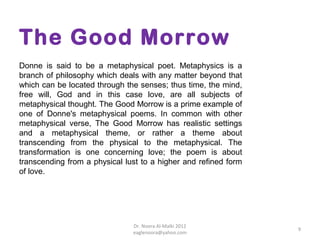
Donne is said to be a metaphysical poet. Metaphysics is a
branch of philosophy which deals with any matter beyond that
which can be located through the senses; thus time, the mind,
free will, God and in this case love, are all subjects of
metaphysical thought. The Good Morrow is a prime example of
one of Donne's metaphysical poems. In common with other
metaphysical verse, The Good Morrow has realistic settings
and a metaphysical theme, or rather a theme about
transcending from the physical to the metaphysical. The
transformation is one concerning love; the poem is about
transcending from a physical lust to a higher and refined form
of love.


                               Dr. Noora Al-Malki 2012
                                                                 9
                               eaglenoora@yahoo.com
The Good Morrow
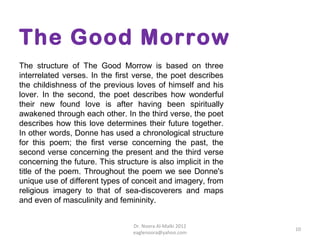
The structure of The Good Morrow is based on three
interrelated verses. In the first verse, the poet describes
the childishness of the previous loves of himself and his
lover. In the second, the poet describes how wonderful
their new found love is after having been spiritually
awakened through each other. In the third verse, the poet
describes how this love determines their future together.
In other words, Donne has used a chronological structure
for this poem; the first verse concerning the past, the
second verse concerning the present and the third verse
concerning the future. This structure is also implicit in the
title of the poem. Throughout the poem we see Donne's
unique use of different types of conceit and imagery, from
religious imagery to that of sea-discoverers and maps
and even of masculinity and femininity.


                                  Dr. Noora Al-Malki 2012
                                                                10
                                  eaglenoora@yahoo.com
Death Be Not Proud                                          Holy sonnet 10


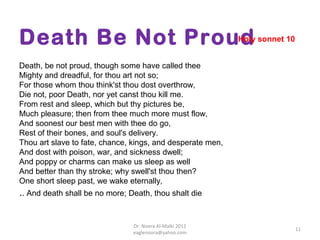
Death, be not proud, though some have called thee
Mighty and dreadful, for thou art not so;
For those whom thou think'st thou dost overthrow,
Die not, poor Death, nor yet canst thou kill me.
From rest and sleep, which but thy pictures be,
Much pleasure; then from thee much more must flow,
And soonest our best men with thee do go,
Rest of their bones, and soul's delivery.
Thou art slave to fate, chance, kings, and desperate men,
And dost with poison, war, and sickness dwell;
And poppy or charms can make us sleep as well
And better than thy stroke; why swell'st thou then?
One short sleep past, we wake eternally,
.. And death shall be no more; Death, thou shalt die


                                Dr. Noora Al-Malki 2012
                                                                             11
                                eaglenoora@yahoo.com
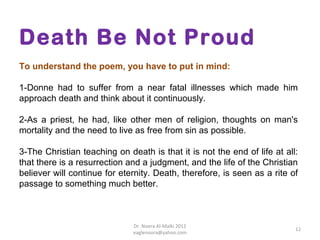
Death Be Not Proud
To understand the poem, you have to put in mind:

1-Donne had to suffer from a near fatal illnesses which made him
approach death and think about it continuously.

2-As a priest, he had, like other men of religion, thoughts on man's
mortality and the need to live as free from sin as possible.

3-The Christian teaching on death is that it is not the end of life at all:
that there is a resurrection and a judgment, and the life of the Christian
believer will continue for eternity. Death, therefore, is seen as a rite of
passage to something much better.


                              Dr. Noora Al-Malki 2012
                                                                          12
                              eaglenoora@yahoo.com
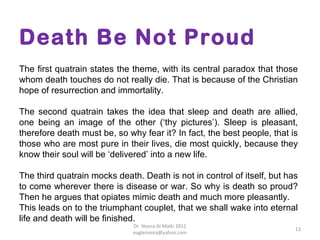
Death Be Not Proud
The first quatrain states the theme, with its central paradox that those
whom death touches do not really die. That is because of the Christian
hope of resurrection and immortality.

The second quatrain takes the idea that sleep and death are allied,
one being an image of the other (‘thy pictures’). Sleep is pleasant,
therefore death must be, so why fear it? In fact, the best people, that is
those who are most pure in their lives, die most quickly, because they
know their soul will be ‘delivered’ into a new life.

The third quatrain mocks death. Death is not in control of itself, but has
to come wherever there is disease or war. So why is death so proud?
Then he argues that opiates mimic death and much more pleasantly.
This leads on to the triumphant couplet, that we shall wake into eternal
life and death will be finished.
                              Dr. Noora Al-Malki 2012
                                                                         13
                              eaglenoora@yahoo.com
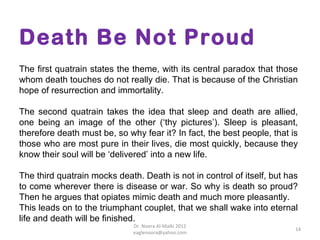
Death Be Not Proud
The first quatrain states the theme, with its central paradox that those
whom death touches do not really die. That is because of the Christian
hope of resurrection and immortality.

The second quatrain takes the idea that sleep and death are allied,
one being an image of the other (‘thy pictures’). Sleep is pleasant,
therefore death must be, so why fear it? In fact, the best people, that is
those who are most pure in their lives, die most quickly, because they
know their soul will be ‘delivered’ into a new life.

The third quatrain mocks death. Death is not in control of itself, but has
to come wherever there is disease or war. So why is death so proud?
Then he argues that opiates mimic death and much more pleasantly.
This leads on to the triumphant couplet, that we shall wake into eternal
life and death will be finished.
                              Dr. Noora Al-Malki 2012
                                                                         14
                              eaglenoora@yahoo.com
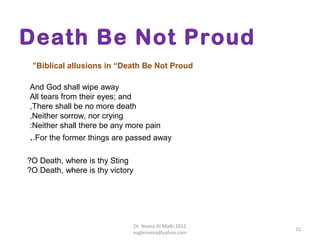
Death Be Not Proud
 ”Biblical allusions in “Death Be Not Proud

And God shall wipe away
All tears from their eyes; and
,There shall be no more death
,Neither sorrow, nor crying
:Neither shall there be any more pain
..For the former things are passed away

?O Death, where is thy Sting
?O Death, where is thy victory


                             Dr. Noora Al-Malki 2012
                                                       15
                             eaglenoora@yahoo.com

Unit 1-renaissance-pt-2

  • 1.
    Course Title: Poetry Course Code & NO.: LANE 447 Course Credit Hrs.: 3 weekly Level: 7th Level Students The Renaissance Pt. 1 Donne’s Good Morrow & Holy Sonnet 10 Instructor: Dr. Noora Al-Malki Credits of images and online content are to their original owners.
  • 2.
    This Presentation • isdivided into two sections (Pt. 1 & Pt. 2); each dealing with a poet who represents the English Renaissance (late 15th C. to early 17th C.) • introduces the Renaissance era (cultural and literary aspects). • presents a discussion of Shakespeare’s Sonnet 18 & Donne’s “The Good Morrow” and “Death Be Not Proud”. Dr. Noora Al-Malki 2012 2 eaglenoora@yahoo.com
  • 3.
    John Donne (1572-1631) poet, satirist, lawyer and a preist Metaphysical Poet Rebelled against Elizabethan poetry He wrote religious poetry Love poetry Sonnets Songs Satires His poetry is noted for its language & style Paradox – irony– metaphysical conceit http://www.britainexpress.com/History/bio/donne.htm http://www.luminarium.org/sevenlit/donne/donnebio.htm Dr. Noora Al-Malki 2012 3 eaglenoora@yahoo.com
  • 4.
    Metaphysical Poetry Metaphysical poetrydeals with human experience as much of the poetry that was written during those times. However, the poets of the era being intelligent and educated meant that the poetry they wrote would tackle the profound areas of experience. “Metaphysical poems are lyric poems. They are brief but intense meditations, characterized by striking use of wit, irony and wordplay. Beneath the formal structure (of rhyme, metre and stanza) is the underlying (and often hardly less formal) structure of the poem's argument.” http://www.universalteacher.org.uk/poetry/metaphys.htm http://www.poets.org/viewmedia.php/prmMID/5662 Dr. Noora Al-Malki 2012 4 eaglenoora@yahoo.com
  • 5.
    The Good Morrow Fromthe Songs and Sonnets collection You can find a thorough thematic and stylistic discussion of the poem on this site: The Good Morrow: A Metaphysical Explication Dr. Noora Al-Malki 2012 5 eaglenoora@yahoo.com
  • 6.
    The Good Morrow Speaker’s state of mind Speaker’s reflection on that state I wonder by my troth, what thou, and I Did, till we lov'd? Were we not wean'd till then? But suck'd on countrey pleasures, childishly? Or snorted we in the seaven sleepers den? T'was so; But this, all pleasures fancies bee. If ever any beauty I did see, Which I desir'd, and got, 'twas but a dreame of thee. Dr. Noora Al-Malki 2012 6 eaglenoora@yahoo.com
  • 7.
    The Good Morrow ,Andnow good morrow to our waking soules ; Which watch not one another out of feare ,For love, all love of other sights controules .And makes one little roome, an every where ,Let sea-discoverers to new worlds have gone ,Let Maps to other, worlds on worlds have showne .,Let us possesse one world; each hath one, and is one Dr. Noora Al-Malki 2012 7 eaglenoora@yahoo.com
  • 8.
    The Good Morrow ,Myface in thine eye, thine in mine appeares ,And true plaine hearts doe in the faces rest Where can we finde two better hemispheares ?Without sharpe North, without declining West ;What ever dyes, was not mixed equally If our two loves be one, or, thou and I .Love so alike, that none doe slacken, none can die Dr. Noora Al-Malki 2012 8 eaglenoora@yahoo.com
  • 9.
    The Good Morrow Donneis said to be a metaphysical poet. Metaphysics is a branch of philosophy which deals with any matter beyond that which can be located through the senses; thus time, the mind, free will, God and in this case love, are all subjects of metaphysical thought. The Good Morrow is a prime example of one of Donne's metaphysical poems. In common with other metaphysical verse, The Good Morrow has realistic settings and a metaphysical theme, or rather a theme about transcending from the physical to the metaphysical. The transformation is one concerning love; the poem is about transcending from a physical lust to a higher and refined form of love. Dr. Noora Al-Malki 2012 9 eaglenoora@yahoo.com
  • 10.
    The Good Morrow Thestructure of The Good Morrow is based on three interrelated verses. In the first verse, the poet describes the childishness of the previous loves of himself and his lover. In the second, the poet describes how wonderful their new found love is after having been spiritually awakened through each other. In the third verse, the poet describes how this love determines their future together. In other words, Donne has used a chronological structure for this poem; the first verse concerning the past, the second verse concerning the present and the third verse concerning the future. This structure is also implicit in the title of the poem. Throughout the poem we see Donne's unique use of different types of conceit and imagery, from religious imagery to that of sea-discoverers and maps and even of masculinity and femininity. Dr. Noora Al-Malki 2012 10 eaglenoora@yahoo.com
  • 11.
    Death Be NotProud Holy sonnet 10 Death, be not proud, though some have called thee Mighty and dreadful, for thou art not so; For those whom thou think'st thou dost overthrow, Die not, poor Death, nor yet canst thou kill me. From rest and sleep, which but thy pictures be, Much pleasure; then from thee much more must flow, And soonest our best men with thee do go, Rest of their bones, and soul's delivery. Thou art slave to fate, chance, kings, and desperate men, And dost with poison, war, and sickness dwell; And poppy or charms can make us sleep as well And better than thy stroke; why swell'st thou then? One short sleep past, we wake eternally, .. And death shall be no more; Death, thou shalt die Dr. Noora Al-Malki 2012 11 eaglenoora@yahoo.com
  • 12.
    Death Be NotProud To understand the poem, you have to put in mind: 1-Donne had to suffer from a near fatal illnesses which made him approach death and think about it continuously. 2-As a priest, he had, like other men of religion, thoughts on man's mortality and the need to live as free from sin as possible. 3-The Christian teaching on death is that it is not the end of life at all: that there is a resurrection and a judgment, and the life of the Christian believer will continue for eternity. Death, therefore, is seen as a rite of passage to something much better. Dr. Noora Al-Malki 2012 12 eaglenoora@yahoo.com
  • 13.
    Death Be NotProud The first quatrain states the theme, with its central paradox that those whom death touches do not really die. That is because of the Christian hope of resurrection and immortality. The second quatrain takes the idea that sleep and death are allied, one being an image of the other (‘thy pictures’). Sleep is pleasant, therefore death must be, so why fear it? In fact, the best people, that is those who are most pure in their lives, die most quickly, because they know their soul will be ‘delivered’ into a new life. The third quatrain mocks death. Death is not in control of itself, but has to come wherever there is disease or war. So why is death so proud? Then he argues that opiates mimic death and much more pleasantly. This leads on to the triumphant couplet, that we shall wake into eternal life and death will be finished. Dr. Noora Al-Malki 2012 13 eaglenoora@yahoo.com
  • 14.
    Death Be NotProud The first quatrain states the theme, with its central paradox that those whom death touches do not really die. That is because of the Christian hope of resurrection and immortality. The second quatrain takes the idea that sleep and death are allied, one being an image of the other (‘thy pictures’). Sleep is pleasant, therefore death must be, so why fear it? In fact, the best people, that is those who are most pure in their lives, die most quickly, because they know their soul will be ‘delivered’ into a new life. The third quatrain mocks death. Death is not in control of itself, but has to come wherever there is disease or war. So why is death so proud? Then he argues that opiates mimic death and much more pleasantly. This leads on to the triumphant couplet, that we shall wake into eternal life and death will be finished. Dr. Noora Al-Malki 2012 14 eaglenoora@yahoo.com
  • 15.
    Death Be NotProud ”Biblical allusions in “Death Be Not Proud And God shall wipe away All tears from their eyes; and ,There shall be no more death ,Neither sorrow, nor crying :Neither shall there be any more pain ..For the former things are passed away ?O Death, where is thy Sting ?O Death, where is thy victory Dr. Noora Al-Malki 2012 15 eaglenoora@yahoo.com