Dr. THULASI KRISHNA. K 
Dept. of Management Sciences, 
MITS, Madanapalle, A.P.
 In India, the system of Accounting was practiced centuries 
ago as it is clear from the book named “Artha sasthra” 
written by Koutilya, Chandra Gupta’s minister. 
 Kautilya’s Arthshastra covers accounting principles and 
standards, role and responsibilities of accountants and 
auditors, the methodology of accounting, auditing 
and fraud risk management, and the role of ethics in 
managing financial activities.
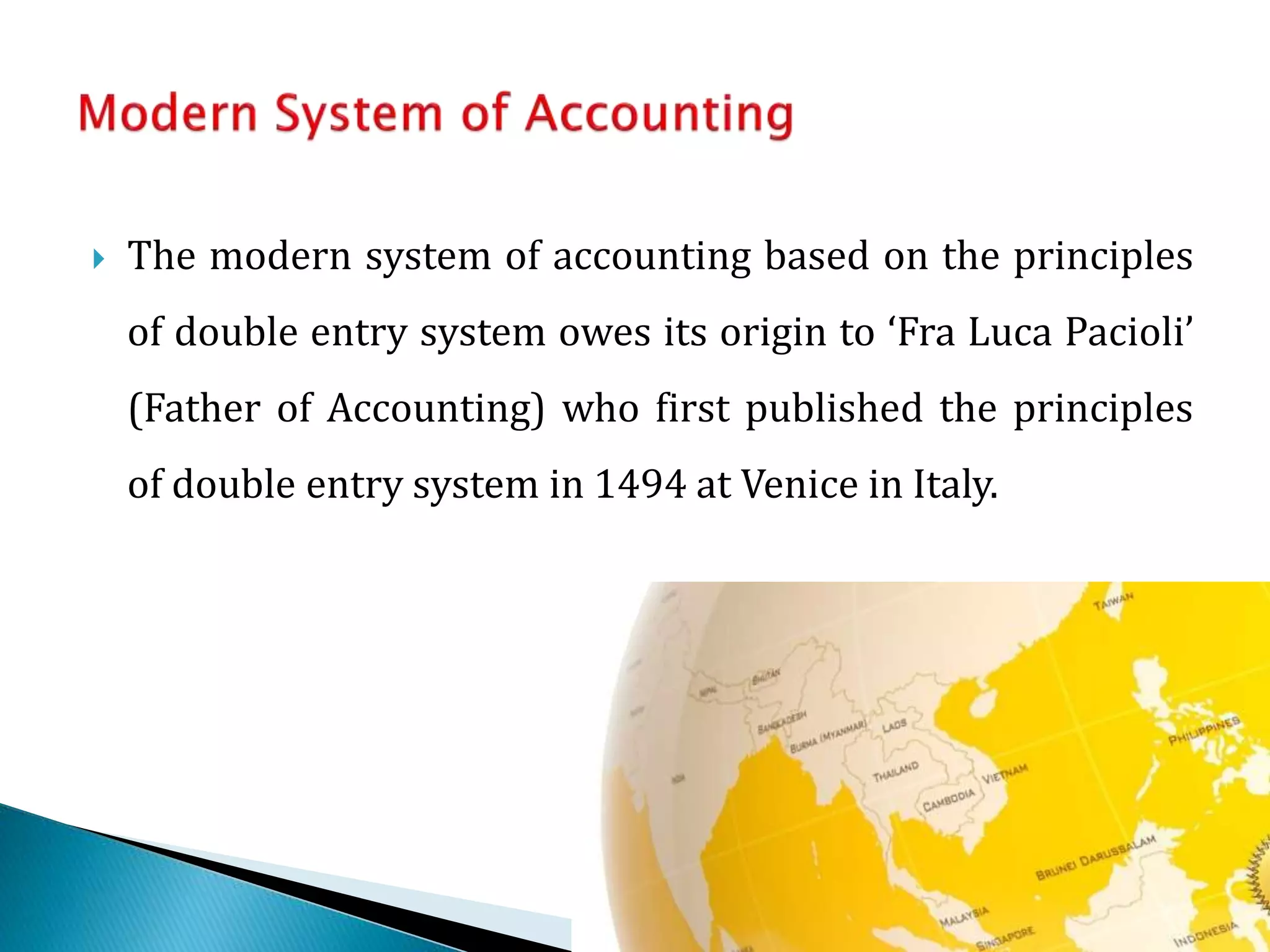
 The modern system of accounting based on the principles 
of double entry system owes its origin to ‘Fra Luca Pacioli’ 
(Father of Accounting) who first published the principles 
of double entry system in 1494 at Venice in Italy.
 Accounting is a discipline which records, classifies, 
summarises and interprets financial information about the 
activities of a concern so that intelligent decisions can be 
made about the concern. 
 The art of recording, classifying, and summarizing in a 
significant manner and in terms of money, transactions 
and events which are, in part at least, of financial character, 
and interpreting the results thereof. 
……. American Institute of Certified Public Accountants
 Accounting is a process; 
 It is an art; 
 It is a means and not an end; 
 It deals with financial information and transactions; and 
 It is an information system
 To keep a systematic record of business transactions; 
 To ascertain the results of the operation; 
 To determine the financial position of the business; 
 To portray the liquidity position; 
 To protect business properties; 
 To facilitate rational decision – making; and 
 To satisfy the requirements of law:
 It keeps a systematic permanent written record of 
business transactions of the organization. 
 It maintains a record of assets and liabilities. 
 It provides information for meeting various legal 
requirements such as I.T returns, Sales tax returns, etc. 
 It communicates the results of the business to the various 
categories of persons such as owners, creditors, Govt., etc. 
 It protects the property of the business. 
 It helps in managerial decision making. 
 It helps in optimum utilisation of resources.
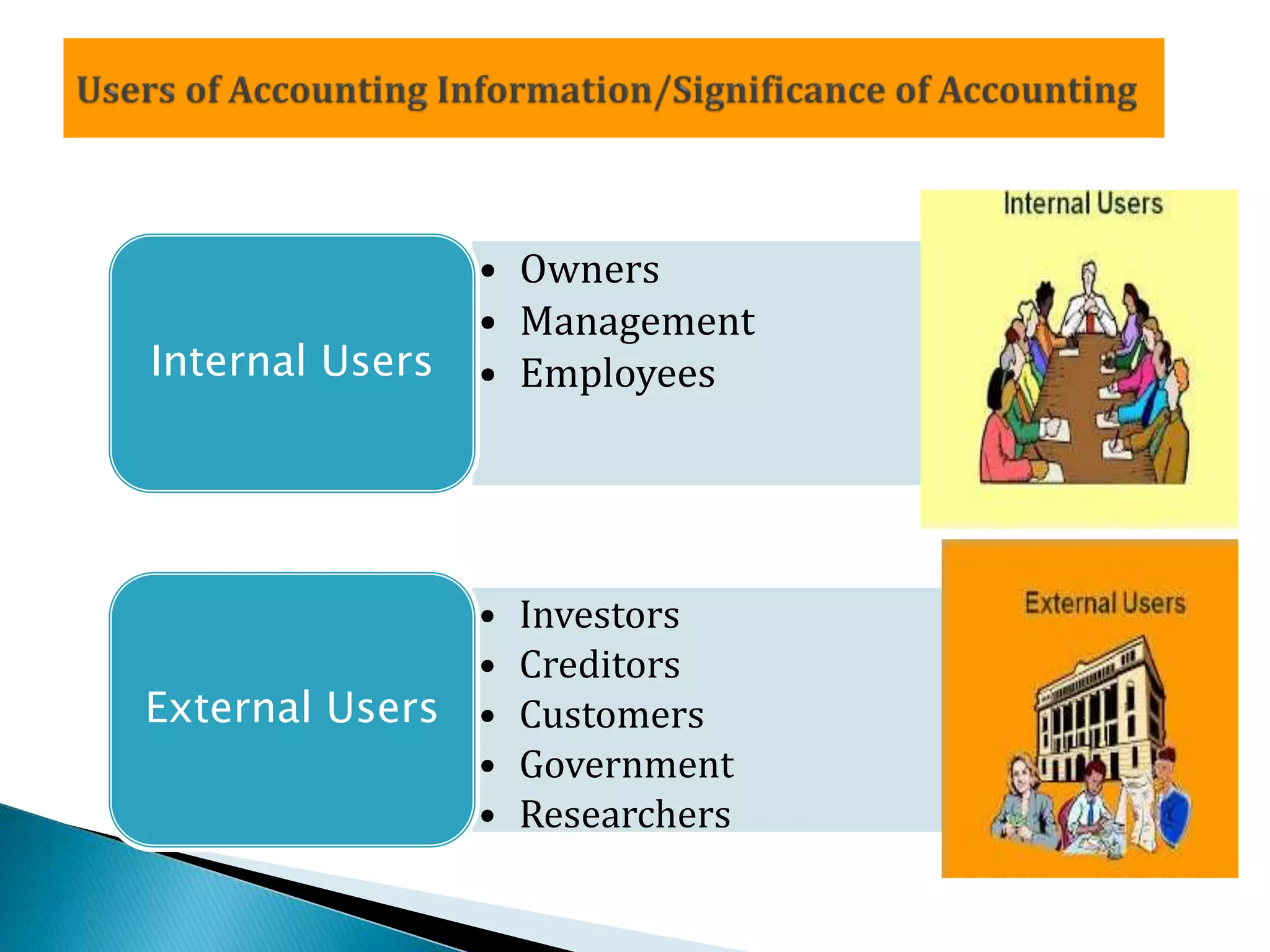
• Owners 
• Management 
Internal Users • Employees 
• Investors 
• Creditors 
• Customers 
• Government 
• Researchers 
External Users
 Maintaining systematic records 
 Meeting legal requirements 
 Protecting and safeguarding business assets 
 Facilitates rational decision-making 
 Communicating and reporting 
 Comparison of results 
 Decision making
• Deals with the preparation of financial 
statements to provide information to the 
interested parties. 
Financial 
Accounting 
• Provides the detailed cost information 
that management needs to control 
current operations and plan for the 
future 
Cost Accounting 
• Deals with the presentation of 
accounting information is such a way as 
to assist management in the creation of 
policy and the day-to-day operation of an 
undertaking 
Management 
Accounting

Unit 1-accounting introduction-ppt

  • 1.
    Dr. THULASI KRISHNA.K Dept. of Management Sciences, MITS, Madanapalle, A.P.
  • 2.
     In India,the system of Accounting was practiced centuries ago as it is clear from the book named “Artha sasthra” written by Koutilya, Chandra Gupta’s minister.  Kautilya’s Arthshastra covers accounting principles and standards, role and responsibilities of accountants and auditors, the methodology of accounting, auditing and fraud risk management, and the role of ethics in managing financial activities.
  • 3.
     The modernsystem of accounting based on the principles of double entry system owes its origin to ‘Fra Luca Pacioli’ (Father of Accounting) who first published the principles of double entry system in 1494 at Venice in Italy.
  • 4.
     Accounting isa discipline which records, classifies, summarises and interprets financial information about the activities of a concern so that intelligent decisions can be made about the concern.  The art of recording, classifying, and summarizing in a significant manner and in terms of money, transactions and events which are, in part at least, of financial character, and interpreting the results thereof. ……. American Institute of Certified Public Accountants
  • 5.
     Accounting isa process;  It is an art;  It is a means and not an end;  It deals with financial information and transactions; and  It is an information system
  • 6.
     To keepa systematic record of business transactions;  To ascertain the results of the operation;  To determine the financial position of the business;  To portray the liquidity position;  To protect business properties;  To facilitate rational decision – making; and  To satisfy the requirements of law:
  • 7.
     It keepsa systematic permanent written record of business transactions of the organization.  It maintains a record of assets and liabilities.  It provides information for meeting various legal requirements such as I.T returns, Sales tax returns, etc.  It communicates the results of the business to the various categories of persons such as owners, creditors, Govt., etc.  It protects the property of the business.  It helps in managerial decision making.  It helps in optimum utilisation of resources.
  • 8.
    • Owners •Management Internal Users • Employees • Investors • Creditors • Customers • Government • Researchers External Users
  • 9.
     Maintaining systematicrecords  Meeting legal requirements  Protecting and safeguarding business assets  Facilitates rational decision-making  Communicating and reporting  Comparison of results  Decision making
  • 10.
    • Deals withthe preparation of financial statements to provide information to the interested parties. Financial Accounting • Provides the detailed cost information that management needs to control current operations and plan for the future Cost Accounting • Deals with the presentation of accounting information is such a way as to assist management in the creation of policy and the day-to-day operation of an undertaking Management Accounting