General Principles & Concepts of Taxation (Courtesy:  www.philtaxation.blogspot.com )
Understanding the State Elements of State People Territory Sovereignty Government (Courtesy:  www.philtaxation.blogspot.com )
Understanding the State “ Government  is the  people,  for (not POOR) the  people,  by (not BUY) the  people”   (Courtesy:  www.philtaxation.blogspot.com )
Understanding the State Inherent powers of State Police Power Power of eminent domain Power of taxation Administration  (added by some authorities) (Courtesy:  www.philtaxation.blogspot.com )
Understanding the State Police Power Inherent power of the sovereign state to legislate for the protection of health, welfare and morals of the community. Examples: Regulation of practice of professions (CPA, Lawyer, Doctors of Medicine, Engineers, etc.) Three FLUNK rule in Medicine in one case; Imprisonment of criminals; Restriction on travel of those with H1N1, etc.; Ordering the destruction of a building in danger of collapse, or a tree in danger of falling; Punishing adultery & concubinage for being contrary to public morals; Requirement on license fees of business establishments (Courtesy:  www.philtaxation.blogspot.com )
Understanding the State Police Power – characteristics Exercised by the legislature, but maybe delegated; Observance of due process in the taking; Property taken under police power not compensated; Can be exercised thru taxation or eminent domain; Fees imposed, if any is limited to the cost of regulation; Superior to the non-impairment clause of the Constitution; (Courtesy:  www.philtaxation.blogspot.com )
Understanding the State Power of eminent domain Inherent power to compel a non-willing property owner to part his property for public purpose upon payment of just compensation. Examples: Taking of 6% of area of private cemeteries for the benefit of the can’t afford; Taking of parcels of land for the runway of NAIAA; Taking of the parcels of land for the expressway widening; (Courtesy:  www.philtaxation.blogspot.com )
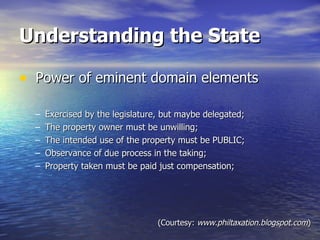
Understanding the State Power of eminent domain elements  Exercised by the legislature, but maybe delegated; The property owner must be unwilling; The intended use of the property must be PUBLIC; Observance of due process in the taking; Property taken must be paid just compensation; (Courtesy:  www.philtaxation.blogspot.com )
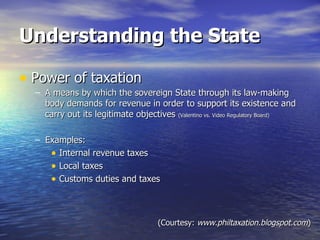
Understanding the State Power of taxation A means by which the sovereign State through its law-making body demands for revenue in order to support its existence and carry out its legitimate objectives  (Valentino vs. Video Regulatory Board) Examples: Internal revenue taxes Local taxes Customs duties and taxes (Courtesy:  www.philtaxation.blogspot.com )
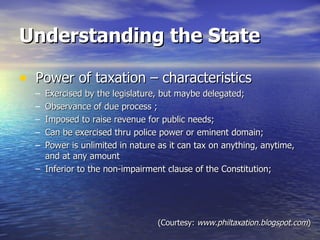
Understanding the State Power of taxation – characteristics Exercised by the legislature, but maybe delegated; Observance of due process ; Imposed to raise revenue for public needs; Can be exercised thru police power or eminent domain; Power is unlimited in nature as it can tax on anything, anytime, and at any amount Inferior to the non-impairment clause of the Constitution; (Courtesy:  www.philtaxation.blogspot.com )
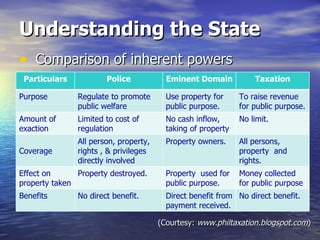
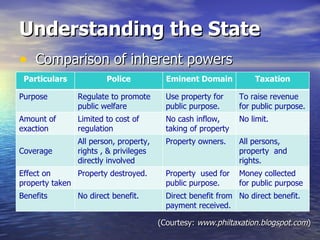
Understanding the State Comparison of inherent powers (Courtesy:  www.philtaxation.blogspot.com ) Particulars Police Eminent Domain Taxation Purpose Regulate to promote public welfare Use property for  public purpose. To raise revenue for public purpose. Amount of exaction Limited to cost of regulation No cash inflow, taking of property No limit. Coverage All person, property, rights , & privileges directly involved Property owners. All persons, property  and rights. Effect on property taken Property destroyed. Property  used for public purpose. Money collected for public purpose Benefits No direct benefit. Direct benefit from payment received. No direct benefit.
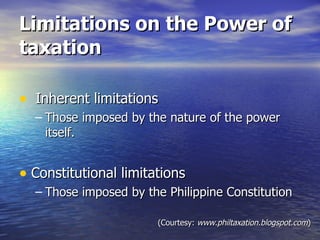
Limitations on the Power of taxation Inherent limitations Those imposed by the nature of the power itself. Constitutional limitations  Those imposed by the Philippine Constitution (Courtesy:  www.philtaxation.blogspot.com )
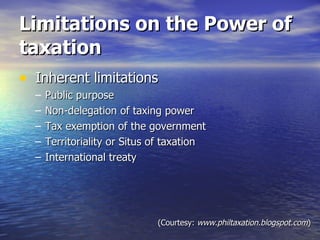
Limitations on the Power of taxation Inherent limitations Public purpose Non-delegation of taxing power Tax exemption of the government Territoriality or Situs of taxation International treaty (Courtesy:  www.philtaxation.blogspot.com )
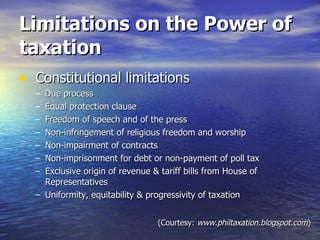
Limitations on the Power of taxation Constitutional limitations Due process Equal protection clause Freedom of speech and of the press Non-infringement of religious freedom and worship Non-impairment of contracts Non-imprisonment for debt or non-payment of poll tax Exclusive origin of revenue & tariff bills from House of Representatives Uniformity, equitability & progressivity of taxation (Courtesy:  www.philtaxation.blogspot.com )
Limitations on the Power of taxation Constitutional limitations…continued Non-impairment of the jurisdiction of the  Supreme Court in tax cases Voting requirement in granting tax exemption Partial veto power of President on revenue or tariff bills Exemption of properties actually, directly, and exclusively used for religious, charitable & educational purposes (Courtesy:  www.philtaxation.blogspot.com )
Limitations on the Power of taxation Constitutional limitations…continued Exemption from taxes of the revenues and assets of non-stock and non-profit educational institutions Non-appropriation of public money or property for religious purpose (Courtesy:  www.philtaxation.blogspot.com )
Power of taxation & taxes Tax – imposed proportional contribution upon persons, property, or rights levied by the law-making body of the estate to raise revenue for public needs  (Courtesy:  www.philtaxation.blogspot.com )
“ Taxes affects lives, care for taxes and save lives”  (Courtesy:philtaxation.blogspot.com) End of slides Thank you!

General principles/Fundamentals of Taxation

  • 1.
    General Principles &Concepts of Taxation (Courtesy: www.philtaxation.blogspot.com )
  • 2.
    Understanding the StateElements of State People Territory Sovereignty Government (Courtesy: www.philtaxation.blogspot.com )
  • 3.
    Understanding the State“ Government is the people, for (not POOR) the people, by (not BUY) the people” (Courtesy: www.philtaxation.blogspot.com )
  • 4.
    Understanding the StateInherent powers of State Police Power Power of eminent domain Power of taxation Administration (added by some authorities) (Courtesy: www.philtaxation.blogspot.com )
  • 5.
    Understanding the StatePolice Power Inherent power of the sovereign state to legislate for the protection of health, welfare and morals of the community. Examples: Regulation of practice of professions (CPA, Lawyer, Doctors of Medicine, Engineers, etc.) Three FLUNK rule in Medicine in one case; Imprisonment of criminals; Restriction on travel of those with H1N1, etc.; Ordering the destruction of a building in danger of collapse, or a tree in danger of falling; Punishing adultery & concubinage for being contrary to public morals; Requirement on license fees of business establishments (Courtesy: www.philtaxation.blogspot.com )
  • 6.
    Understanding the StatePolice Power – characteristics Exercised by the legislature, but maybe delegated; Observance of due process in the taking; Property taken under police power not compensated; Can be exercised thru taxation or eminent domain; Fees imposed, if any is limited to the cost of regulation; Superior to the non-impairment clause of the Constitution; (Courtesy: www.philtaxation.blogspot.com )
  • 7.
    Understanding the StatePower of eminent domain Inherent power to compel a non-willing property owner to part his property for public purpose upon payment of just compensation. Examples: Taking of 6% of area of private cemeteries for the benefit of the can’t afford; Taking of parcels of land for the runway of NAIAA; Taking of the parcels of land for the expressway widening; (Courtesy: www.philtaxation.blogspot.com )
  • 8.
    Understanding the StatePower of eminent domain elements Exercised by the legislature, but maybe delegated; The property owner must be unwilling; The intended use of the property must be PUBLIC; Observance of due process in the taking; Property taken must be paid just compensation; (Courtesy: www.philtaxation.blogspot.com )
  • 9.
    Understanding the StatePower of taxation A means by which the sovereign State through its law-making body demands for revenue in order to support its existence and carry out its legitimate objectives (Valentino vs. Video Regulatory Board) Examples: Internal revenue taxes Local taxes Customs duties and taxes (Courtesy: www.philtaxation.blogspot.com )
  • 10.
    Understanding the StatePower of taxation – characteristics Exercised by the legislature, but maybe delegated; Observance of due process ; Imposed to raise revenue for public needs; Can be exercised thru police power or eminent domain; Power is unlimited in nature as it can tax on anything, anytime, and at any amount Inferior to the non-impairment clause of the Constitution; (Courtesy: www.philtaxation.blogspot.com )
  • 11.
    Understanding the StateComparison of inherent powers (Courtesy: www.philtaxation.blogspot.com ) Particulars Police Eminent Domain Taxation Purpose Regulate to promote public welfare Use property for public purpose. To raise revenue for public purpose. Amount of exaction Limited to cost of regulation No cash inflow, taking of property No limit. Coverage All person, property, rights , & privileges directly involved Property owners. All persons, property and rights. Effect on property taken Property destroyed. Property used for public purpose. Money collected for public purpose Benefits No direct benefit. Direct benefit from payment received. No direct benefit.
  • 12.
    Understanding the StateComparison of inherent powers (Courtesy: www.philtaxation.blogspot.com ) Particulars Police Eminent Domain Taxation Purpose Regulate to promote public welfare Use property for public purpose. To raise revenue for public purpose. Amount of exaction Limited to cost of regulation No cash inflow, taking of property No limit. Coverage All person, property, rights , & privileges directly involved Property owners. All persons, property and rights. Effect on property taken Property destroyed. Property used for public purpose. Money collected for public purpose Benefits No direct benefit. Direct benefit from payment received. No direct benefit.
  • 13.
    Limitations on thePower of taxation Inherent limitations Those imposed by the nature of the power itself. Constitutional limitations Those imposed by the Philippine Constitution (Courtesy: www.philtaxation.blogspot.com )
  • 14.
    Limitations on thePower of taxation Inherent limitations Public purpose Non-delegation of taxing power Tax exemption of the government Territoriality or Situs of taxation International treaty (Courtesy: www.philtaxation.blogspot.com )
  • 15.
    Limitations on thePower of taxation Constitutional limitations Due process Equal protection clause Freedom of speech and of the press Non-infringement of religious freedom and worship Non-impairment of contracts Non-imprisonment for debt or non-payment of poll tax Exclusive origin of revenue & tariff bills from House of Representatives Uniformity, equitability & progressivity of taxation (Courtesy: www.philtaxation.blogspot.com )
  • 16.
    Limitations on thePower of taxation Constitutional limitations…continued Non-impairment of the jurisdiction of the Supreme Court in tax cases Voting requirement in granting tax exemption Partial veto power of President on revenue or tariff bills Exemption of properties actually, directly, and exclusively used for religious, charitable & educational purposes (Courtesy: www.philtaxation.blogspot.com )
  • 17.
    Limitations on thePower of taxation Constitutional limitations…continued Exemption from taxes of the revenues and assets of non-stock and non-profit educational institutions Non-appropriation of public money or property for religious purpose (Courtesy: www.philtaxation.blogspot.com )
  • 18.
    Power of taxation& taxes Tax – imposed proportional contribution upon persons, property, or rights levied by the law-making body of the estate to raise revenue for public needs (Courtesy: www.philtaxation.blogspot.com )
  • 19.
    “ Taxes affectslives, care for taxes and save lives” (Courtesy:philtaxation.blogspot.com) End of slides Thank you!