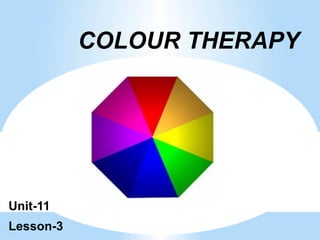
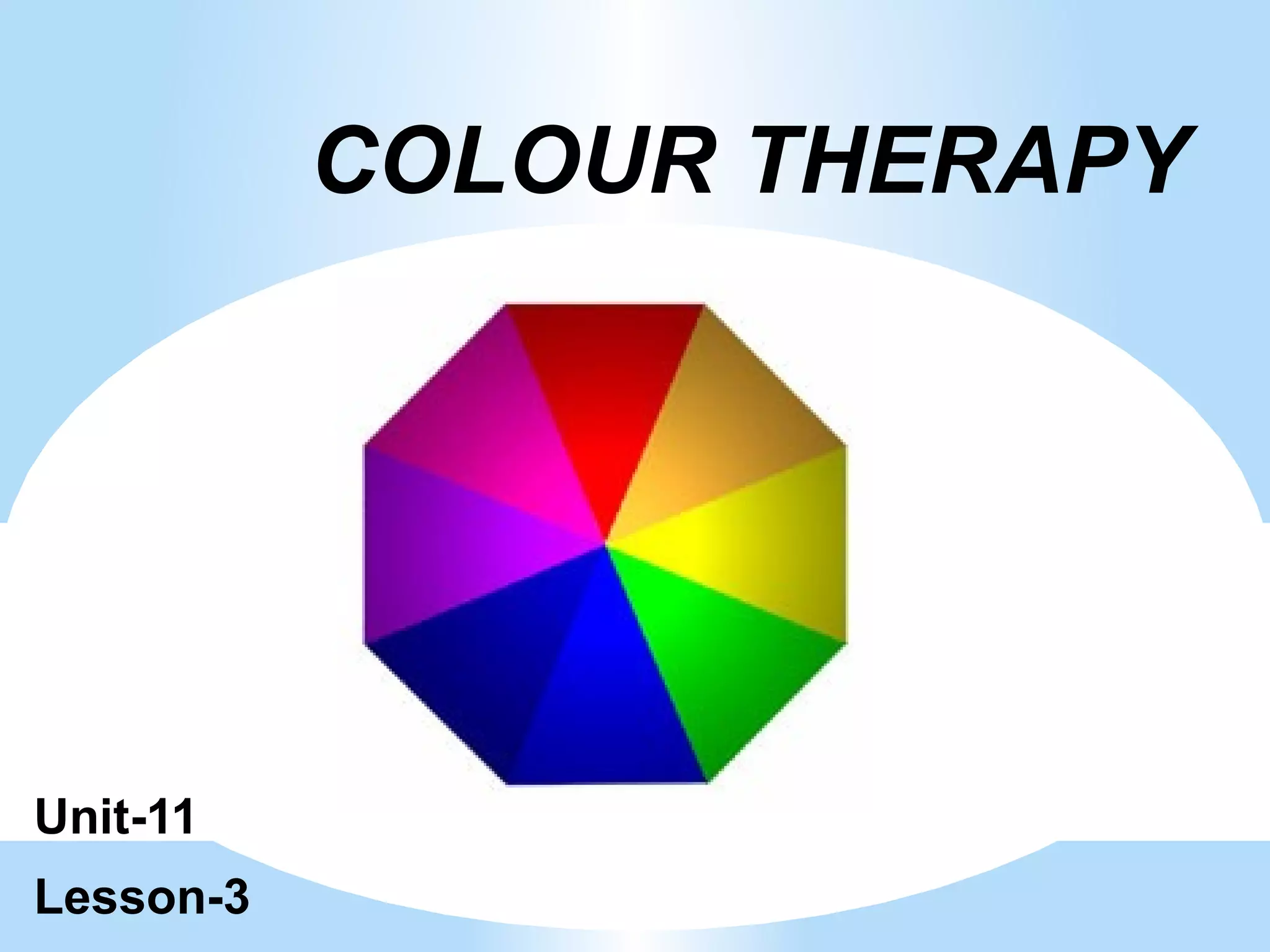
COLOUR THERAPY Unit-11 Lesson-3
- Don’t talk each other - Listen carefully - Be active
Aim:  We will be able to express our feeling and emotions
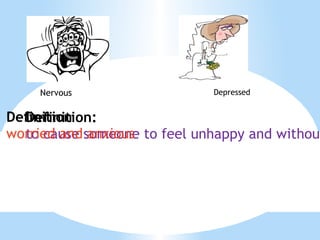
Nervous Definition: to cause someone to feel unhappy and without hope for the future Definition worried and anxious Depressed
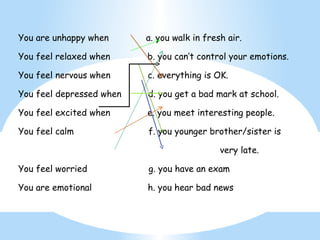
You are unhappy when  a. you walk in fresh air.
You feel relaxed when  b. you can’t control your emotions.
You feel nervous when  c. everything is OK.
You feel depressed when  d. you get a bad mark at school.
You feel excited when  e. you meet interesting people.
You feel calm  f. you younger brother/sister is  very late.  You feel worried  g. you have an exam
You are emotional  h. you hear bad news
Feeling and emotions It  makes me  (her/him)  feel  +  adjectives For example:  Blue makes me feel happy. Red makes him feel calm.
About Colour Therapy We often use colours to describe our moods and emotions. But according to practitioners of colour therapy the link between colours and our moods and emotions goes deeper than that. They believe that not only do colours affect our emotions but they have healing properties too.
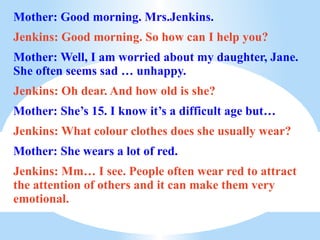
Mother: Good morning. Mrs.Jenkins. Jenkins: Good morning. So how can I help you? Mother: Well, I am worried about my daughter, Jane. She often seems sad … unhappy. Jenkins: Oh dear. And how old is she? Mother: She’s 15. I know it’s a difficult age but… Jenkins: What colour clothes does she usually wear? Mother: She wears a lot of red. Jenkins: Mm… I see. People often wear red to attract the attention of others and it can make them very emotional.
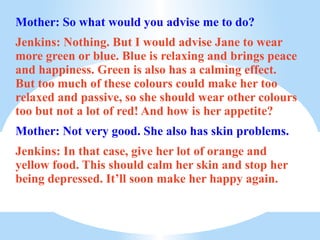
Mother: So what would you advise me to do? Jenkins: Nothing. But I would advise Jane to wear more green or blue. Blue is relaxing and brings peace and happiness. Green is also has a calming effect. But too much of these colours could make her too relaxed and passive, so she should wear other colours too but not a lot of red! And how is her appetite? Mother: Not very good. She also has skin problems. Jenkins: In that case, give her lot of orange and yellow food. This should calm her skin and stop her being depressed. It’ll soon make her happy again.
Who is worried?
Who is she worried about?
Why?
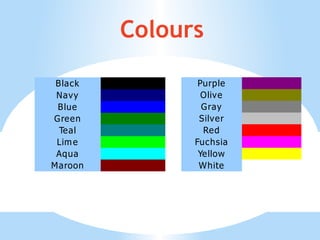
Colours Black   Navy   Blue   Green   Teal   Lime   Aqua   Maroon   Purple   Olive   Gray   Silver   Red   Fuchsia   Yellow   White  
Red :  The colour red represents vitality, creativity, energy and power. People who favour the colour red are usually those that like to be in the forefront where they can attract a lot of attention. They are often quick to react and overemotional.   This colour helps to loosen stiffness and restraints. It stimulates the release of adrenalin in the bloodstream and causes haemoglobin to multiply. Hence, it results in greater strength and energy and is good for treating anaemia and other blood-related conditions. Red can also make you feel warmer, reducing pain that comes from the cold. It also helps for people who are feeling lethargic or depressed.   However, an excess of red can make a person agitated and aggressive. While it may excite sexual passion, it can also lead to anger and destructive behaviour. It is not recommended to be used for people who have heart trouble or who have a nervous disposition. 
Orange:   Like red, orange is also an energising colour. Used in moderation, it has a gentle warming effect. It is useful in treating gallstones, digestive ailments, chest and kidnet diseases and arthritis. It helps to lift the spirits of people who are depressed, lonely, who feel hemmed in or who feel that their lives lack direction.  However, too much orange can lead to agitation and restlessness like the colour red. 

Unit 11-lesson-3

  • 1.
  • 2.
    - Don’t talkeach other - Listen carefully - Be active
  • 3.
    Aim: Wewill be able to express our feeling and emotions
  • 4.
    Nervous Definition: tocause someone to feel unhappy and without hope for the future Definition worried and anxious Depressed
  • 5.
    You are unhappywhen a. you walk in fresh air.
  • 6.
    You feel relaxedwhen b. you can’t control your emotions.
  • 7.
    You feel nervouswhen c. everything is OK.
  • 8.
    You feel depressedwhen d. you get a bad mark at school.
  • 9.
    You feel excitedwhen e. you meet interesting people.
  • 10.
    You feel calm f. you younger brother/sister is very late. You feel worried g. you have an exam
  • 11.
    You are emotional h. you hear bad news
  • 12.
    Feeling and emotionsIt makes me (her/him) feel + adjectives For example: Blue makes me feel happy. Red makes him feel calm.
  • 13.
    About Colour TherapyWe often use colours to describe our moods and emotions. But according to practitioners of colour therapy the link between colours and our moods and emotions goes deeper than that. They believe that not only do colours affect our emotions but they have healing properties too.
  • 14.
    Mother: Good morning.Mrs.Jenkins. Jenkins: Good morning. So how can I help you? Mother: Well, I am worried about my daughter, Jane. She often seems sad … unhappy. Jenkins: Oh dear. And how old is she? Mother: She’s 15. I know it’s a difficult age but… Jenkins: What colour clothes does she usually wear? Mother: She wears a lot of red. Jenkins: Mm… I see. People often wear red to attract the attention of others and it can make them very emotional.
  • 15.
    Mother: So whatwould you advise me to do? Jenkins: Nothing. But I would advise Jane to wear more green or blue. Blue is relaxing and brings peace and happiness. Green is also has a calming effect. But too much of these colours could make her too relaxed and passive, so she should wear other colours too but not a lot of red! And how is her appetite? Mother: Not very good. She also has skin problems. Jenkins: In that case, give her lot of orange and yellow food. This should calm her skin and stop her being depressed. It’ll soon make her happy again.
  • 16.
  • 17.
    Who is sheworried about?
  • 18.
  • 19.
    Colours Black  Navy   Blue   Green   Teal   Lime   Aqua   Maroon   Purple   Olive   Gray   Silver   Red   Fuchsia   Yellow   White  
  • 20.
    Red : The colour red represents vitality, creativity, energy and power. People who favour the colour red are usually those that like to be in the forefront where they can attract a lot of attention. They are often quick to react and overemotional.  This colour helps to loosen stiffness and restraints. It stimulates the release of adrenalin in the bloodstream and causes haemoglobin to multiply. Hence, it results in greater strength and energy and is good for treating anaemia and other blood-related conditions. Red can also make you feel warmer, reducing pain that comes from the cold. It also helps for people who are feeling lethargic or depressed.  However, an excess of red can make a person agitated and aggressive. While it may excite sexual passion, it can also lead to anger and destructive behaviour. It is not recommended to be used for people who have heart trouble or who have a nervous disposition. 
  • 21.
    Orange: Like red, orange is also an energising colour. Used in moderation, it has a gentle warming effect. It is useful in treating gallstones, digestive ailments, chest and kidnet diseases and arthritis. It helps to lift the spirits of people who are depressed, lonely, who feel hemmed in or who feel that their lives lack direction.  However, too much orange can lead to agitation and restlessness like the colour red.