Essence of Indian Traditional Knowledge
UNIT-1
IMPORTANCE OF TRADITIONAL KNOWLEDGE
TOPIC
Definitions, Nature , Characteristics & Types of TK
CO NO:R24 / PO :6,7,8,12/PSO:2
G Durga Bhavani
Assistant Professor
Department of EEE
Traditional Knowledge
Define traditional knowledge, nature and characteristics, scope and importance, kinds of
traditional knowledge, the physical and social contexts in which traditional knowledge
develop, the historical impact of social change on traditional knowledge systems.
Indigenous Knowledge (IK), characteristics, traditional knowledge Vs indigenous
knowledge, traditional knowledge Vs western knowledge, traditional knowledge Vs
formal knowledge
Learning Outcomes:
At the end of the unit, the student will able to:
a)Understand the traditional knowledge.
b)Contrast and compare characteristics importance kinds of traditional knowledge.
c)Analyze physical and social contexts of traditional knowledge.
d)Evaluate social change on traditional knowledge.
UNITI -Introduction to Traditional knowledge
❖Traditional knowledge is commonly called as indigenous knowledge and on
the whole referred to the established traditions and practices of certain
regional, indigenous, or local communities.
❖It is commonly believed that Traditional knowledge is indispensable part of
the indigenous community. Since it is associated with environment and nature,
it includes tribal way of life, ethics and practices followed by the indigenous
people not related to any scientific analysis as such.
TRADITIONAL KNOWLEDGE
Meaning and Definition
The term ‘traditional knowledge’ has been the subject of many
conceptualizations.
The various expressions, viz, traditional knowledge (TK), indigenous
knowledge (IK), and local knowledge are interchangeably used to refer to the
matured long-standing traditions and practices of certain regional, indigenous, or
local communities which are often expressed through stories, legends, folklore,
rituals songs, and even laws.
Definition: Article 8(j) of the Convention of Biological Diversity, 1992
defines TK as ‘knowledge, innovations and practices of indigenous and local
communities embodying traditional lifestyles relevant for the conservation and
sustainable use of biological diversity.’
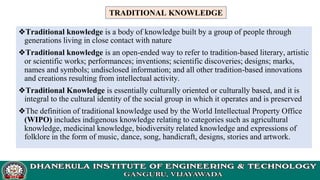
❖Traditional knowledge is a body of knowledge built by a group of people through
generations living in close contact with nature
❖Traditional knowledge is an open-ended way to refer to tradition-based literary, artistic
or scientific works; performances; inventions; scientific discoveries; designs; marks,
names and symbols; undisclosed information; and all other tradition-based innovations
and creations resulting from intellectual activity.
❖Traditional Knowledge is essentially culturally oriented or culturally based, and it is
integral to the cultural identity of the social group in which it operates and is preserved
❖The definition of traditional knowledge used by the World Intellectual Property Office
(WIPO) includes indigenous knowledge relating to categories such as agricultural
knowledge, medicinal knowledge, biodiversity related knowledge and expressions of
folklore in the form of music, dance, song, handicraft, designs, stories and artwork.
TRADITIONAL KNOWLEDGE
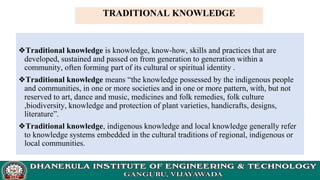
❖Traditional knowledge is knowledge, know-how, skills and practices that are
developed, sustained and passed on from generation to generation within a
community, often forming part of its cultural or spiritual identity .
❖Traditional knowledge means “the knowledge possessed by the indigenous people
and communities, in one or more societies and in one or more pattern, with, but not
reserved to art, dance and music, medicines and folk remedies, folk culture
,biodiversity, knowledge and protection of plant varieties, handicrafts, designs,
literature”.
❖Traditional knowledge, indigenous knowledge and local knowledge generally refer
to knowledge systems embedded in the cultural traditions of regional, indigenous or
local communities.
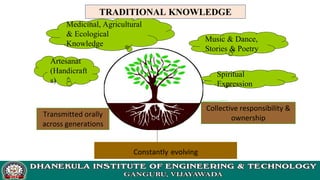
Medicinal, Agricultural
& Ecological
Knowledge
Music & Dance,
Stories & Poetry
Artesanat
(Handicraft
s)
Spiritual
Expression
Transmitted orally
across generations
Collective responsibility &
ownership
Constantly evolving
TRADITIONAL KNOWLEDGE
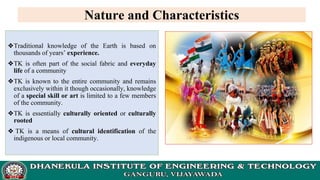
Nature and Characteristics
❖Traditional knowledge of the Earth is based on
thousands of years’ experience.
❖TK is often part of the social fabric and everyday
life of a community
❖TK is known to the entire community and remains
exclusively within it though occasionally, knowledge
of a special skill or art is limited to a few members
of the community.
❖TK is essentially culturally oriented or culturally
rooted
❖ TK is a means of cultural identification of the
indigenous or local community.
Few more characteristics features
❖It is transmitted from generations to generations
❖In many cases, it is transmitted orally for generations from person to person
❖It is being considered by the communities as gift of God and not as a private property
❖Such knowledge typically distinguishes one community from another
❖It is usually impossible to identify the original creator of the information
❖It is learned through continuous observation, experience and practice
❖It is usually associated with the biological resources.
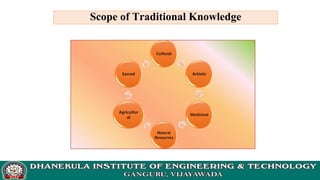
Scope of Traditional Knowledge
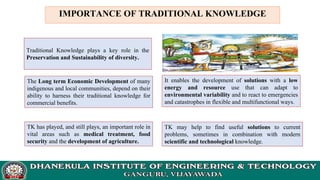
IMPORTANCE OF TRADITIONAL KNOWLEDGE
Traditional Knowledge plays a key role in the
Preservation and Sustainability of diversity.
The Long term Economic Development of many
indigenous and local communities, depend on their
ability to harness their traditional knowledge for
commercial benefits.
TK has played, and still plays, an important role in
vital areas such as medical treatment, food
security and the development of agriculture.
It enables the development of solutions with a low
energy and resource use that can adapt to
environmental variability and to react to emergencies
and catastrophes in flexible and multifunctional ways.
TK may help to find useful solutions to current
problems, sometimes in combination with modern
scientific and technological knowledge.
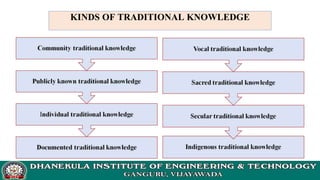
KINDS OF TRADITIONAL KNOWLEDGE
INDIAN TRADITIONS
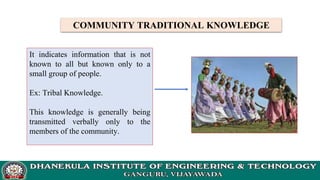
COMMUNITY TRADITIONAL KNOWLEDGE
It indicates information that is not
known to all but known only to a
small group of people.
Ex: Tribal Knowledge.
This knowledge is generally being
transmitted verbally only to the
members of the community.
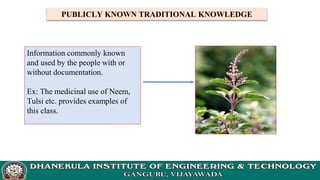
PUBLICLY KNOWN TRADITIONAL KNOWLEDGE
Information commonly known
and used by the people with or
without documentation.
Ex: The medicinal use of Neem,
Tulsi etc. provides examples of
this class.
INDIVIDUAL TRADITIONAL KNOWLEDGE
❖Available only with an individual
or certain member of a family.
❖Usually this information is handed
over orally from the elder to his
successor.
VOCAL TRADITIONAL KNOWLEDGE
Covers knowledge which is
unwritten but preserved and handed
over through generations orally.
Ex: Uses of Agricultural products
Foxtail Millets
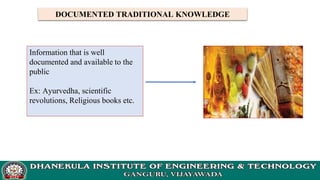
DOCUMENTED TRADITIONAL KNOWLEDGE
Information that is well
documented and available to the
public
Ex: Ayurvedha, scientific
revolutions, Religious books etc.
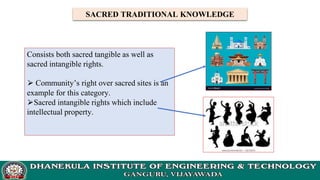
SACRED TRADITIONAL KNOWLEDGE
Consists both sacred tangible as well as
sacred intangible rights.
⮚ Community’s right over sacred sites is an
example for this category.
⮚Sacred intangible rights which include
intellectual property.
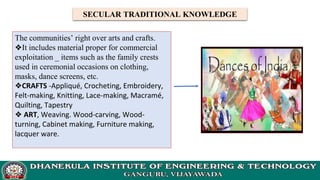
SECULAR TRADITIONAL KNOWLEDGE
The communities’ right over arts and crafts.
❖It includes material proper for commercial
exploitation _ items such as the family crests
used in ceremonial occasions on clothing,
masks, dance screens, etc.
❖CRAFTS -Appliqué, Crocheting, Embroidery,
Felt-making, Knitting, Lace-making, Macramé,
Quilting, Tapestry
❖ ART, Weaving. Wood-carving, Wood-
turning, Cabinet making, Furniture making,
lacquer ware.
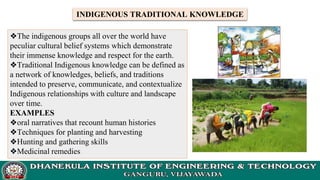
INDIGENOUS TRADITIONAL KNOWLEDGE
❖The indigenous groups all over the world have
peculiar cultural belief systems which demonstrate
their immense knowledge and respect for the earth.
❖Traditional Indigenous knowledge can be defined as
a network of knowledges, beliefs, and traditions
intended to preserve, communicate, and contextualize
Indigenous relationships with culture and landscape
over time.
EXAMPLES
❖oral narratives that recount human histories
❖Techniques for planting and harvesting
❖Hunting and gathering skills
❖Medicinal remedies
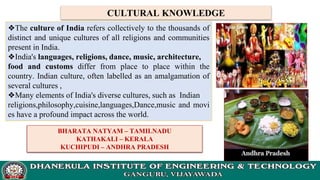
❖The culture of India refers collectively to the thousands of
distinct and unique cultures of all religions and communities
present in India.
❖India's languages, religions, dance, music, architecture,
food and customs differ from place to place within the
country. Indian culture, often labelled as an amalgamation of
several cultures ,
❖Many elements of India's diverse cultures, such as Indian
religions,philosophy,cuisine,languages,Dance,music and movi
es have a profound impact across the world.
CULTURAL KNOWLEDGE
BHARATA NATYAM – TAMILNADU
KATHAKALI – KERALA
KUCHIPUDI – ANDHRA PRADESH
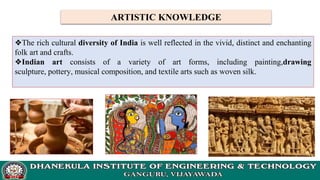
ARTISTIC KNOWLEDGE
❖The rich cultural diversity of India is well reflected in the vivid, distinct and enchanting
folk art and crafts.
❖Indian art consists of a variety of art forms, including painting,drawing
sculpture, pottery, musical composition, and textile arts such as woven silk.
MEDICINAL KNOWLEDGE
India is known for its traditional medicinal systems—
Ayurveda, Siddha, and Unani. Medical systems are found
mentioned even in the ancient Vedas and other scriptures.
The Ayurvedic concept appeared and developed between
2500 and 500 BC in India
⮚Ayurveda is attributed to Dhanvantari, the physician to the
gods in Hindu mythology, who received it from Brahma. Its
earliest concepts were set out in the portion of the Vedas
known as the Atharvaveda
⮚Siddha medicine is a traditional medicine originating in
Tamil Nadu, India and practiced over centuries.
⮚Unani" or "Yunani medicine" is the term for
Perso-Arabic traditional medicine as practiced in
Mughal India and in Muslim culture in South Asia and
modern day Central Asia
NATURAL RESOURCES KNOWLEDGE
❖Local knowledge of natural resources is made up of three types of information:
1) accumulated cultural knowledge
2) knowledge modified through contact with other cultures
3) progressive learning of the environment.
❖Knowledge of Plants, Lands ,Food, Water resources, Energy Resources , mineral resources etc.
❖The biological protection is one of the greatest features of Indian culture.
UNIT-1 TRADITIONAL KNOWLEDGE  &TYPES.pptx

UNIT-1 TRADITIONAL KNOWLEDGE &TYPES.pptx

  • 1.
    Essence of IndianTraditional Knowledge
  • 2.
    Essence of IndianTraditional Knowledge UNIT-1 IMPORTANCE OF TRADITIONAL KNOWLEDGE TOPIC Definitions, Nature , Characteristics & Types of TK CO NO:R24 / PO :6,7,8,12/PSO:2 G Durga Bhavani Assistant Professor Department of EEE
  • 3.
  • 4.
    Define traditional knowledge,nature and characteristics, scope and importance, kinds of traditional knowledge, the physical and social contexts in which traditional knowledge develop, the historical impact of social change on traditional knowledge systems. Indigenous Knowledge (IK), characteristics, traditional knowledge Vs indigenous knowledge, traditional knowledge Vs western knowledge, traditional knowledge Vs formal knowledge Learning Outcomes: At the end of the unit, the student will able to: a)Understand the traditional knowledge. b)Contrast and compare characteristics importance kinds of traditional knowledge. c)Analyze physical and social contexts of traditional knowledge. d)Evaluate social change on traditional knowledge. UNITI -Introduction to Traditional knowledge
  • 5.
    ❖Traditional knowledge iscommonly called as indigenous knowledge and on the whole referred to the established traditions and practices of certain regional, indigenous, or local communities. ❖It is commonly believed that Traditional knowledge is indispensable part of the indigenous community. Since it is associated with environment and nature, it includes tribal way of life, ethics and practices followed by the indigenous people not related to any scientific analysis as such. TRADITIONAL KNOWLEDGE
  • 6.
    Meaning and Definition Theterm ‘traditional knowledge’ has been the subject of many conceptualizations. The various expressions, viz, traditional knowledge (TK), indigenous knowledge (IK), and local knowledge are interchangeably used to refer to the matured long-standing traditions and practices of certain regional, indigenous, or local communities which are often expressed through stories, legends, folklore, rituals songs, and even laws. Definition: Article 8(j) of the Convention of Biological Diversity, 1992 defines TK as ‘knowledge, innovations and practices of indigenous and local communities embodying traditional lifestyles relevant for the conservation and sustainable use of biological diversity.’
  • 7.
    ❖Traditional knowledge isa body of knowledge built by a group of people through generations living in close contact with nature ❖Traditional knowledge is an open-ended way to refer to tradition-based literary, artistic or scientific works; performances; inventions; scientific discoveries; designs; marks, names and symbols; undisclosed information; and all other tradition-based innovations and creations resulting from intellectual activity. ❖Traditional Knowledge is essentially culturally oriented or culturally based, and it is integral to the cultural identity of the social group in which it operates and is preserved ❖The definition of traditional knowledge used by the World Intellectual Property Office (WIPO) includes indigenous knowledge relating to categories such as agricultural knowledge, medicinal knowledge, biodiversity related knowledge and expressions of folklore in the form of music, dance, song, handicraft, designs, stories and artwork. TRADITIONAL KNOWLEDGE
  • 8.
    TRADITIONAL KNOWLEDGE ❖Traditional knowledgeis knowledge, know-how, skills and practices that are developed, sustained and passed on from generation to generation within a community, often forming part of its cultural or spiritual identity . ❖Traditional knowledge means “the knowledge possessed by the indigenous people and communities, in one or more societies and in one or more pattern, with, but not reserved to art, dance and music, medicines and folk remedies, folk culture ,biodiversity, knowledge and protection of plant varieties, handicrafts, designs, literature”. ❖Traditional knowledge, indigenous knowledge and local knowledge generally refer to knowledge systems embedded in the cultural traditions of regional, indigenous or local communities.
  • 9.
    Medicinal, Agricultural & Ecological Knowledge Music& Dance, Stories & Poetry Artesanat (Handicraft s) Spiritual Expression Transmitted orally across generations Collective responsibility & ownership Constantly evolving TRADITIONAL KNOWLEDGE
  • 10.
    Nature and Characteristics ❖Traditionalknowledge of the Earth is based on thousands of years’ experience. ❖TK is often part of the social fabric and everyday life of a community ❖TK is known to the entire community and remains exclusively within it though occasionally, knowledge of a special skill or art is limited to a few members of the community. ❖TK is essentially culturally oriented or culturally rooted ❖ TK is a means of cultural identification of the indigenous or local community.
  • 11.
    Few more characteristicsfeatures ❖It is transmitted from generations to generations ❖In many cases, it is transmitted orally for generations from person to person ❖It is being considered by the communities as gift of God and not as a private property ❖Such knowledge typically distinguishes one community from another ❖It is usually impossible to identify the original creator of the information ❖It is learned through continuous observation, experience and practice ❖It is usually associated with the biological resources.
  • 12.
  • 13.
    IMPORTANCE OF TRADITIONALKNOWLEDGE Traditional Knowledge plays a key role in the Preservation and Sustainability of diversity. The Long term Economic Development of many indigenous and local communities, depend on their ability to harness their traditional knowledge for commercial benefits. TK has played, and still plays, an important role in vital areas such as medical treatment, food security and the development of agriculture. It enables the development of solutions with a low energy and resource use that can adapt to environmental variability and to react to emergencies and catastrophes in flexible and multifunctional ways. TK may help to find useful solutions to current problems, sometimes in combination with modern scientific and technological knowledge.
  • 14.
  • 15.
  • 16.
    COMMUNITY TRADITIONAL KNOWLEDGE Itindicates information that is not known to all but known only to a small group of people. Ex: Tribal Knowledge. This knowledge is generally being transmitted verbally only to the members of the community.
  • 17.
    PUBLICLY KNOWN TRADITIONALKNOWLEDGE Information commonly known and used by the people with or without documentation. Ex: The medicinal use of Neem, Tulsi etc. provides examples of this class.
  • 18.
    INDIVIDUAL TRADITIONAL KNOWLEDGE ❖Availableonly with an individual or certain member of a family. ❖Usually this information is handed over orally from the elder to his successor.
  • 19.
    VOCAL TRADITIONAL KNOWLEDGE Coversknowledge which is unwritten but preserved and handed over through generations orally. Ex: Uses of Agricultural products Foxtail Millets
  • 20.
    DOCUMENTED TRADITIONAL KNOWLEDGE Informationthat is well documented and available to the public Ex: Ayurvedha, scientific revolutions, Religious books etc.
  • 21.
    SACRED TRADITIONAL KNOWLEDGE Consistsboth sacred tangible as well as sacred intangible rights. ⮚ Community’s right over sacred sites is an example for this category. ⮚Sacred intangible rights which include intellectual property.
  • 22.
    SECULAR TRADITIONAL KNOWLEDGE Thecommunities’ right over arts and crafts. ❖It includes material proper for commercial exploitation _ items such as the family crests used in ceremonial occasions on clothing, masks, dance screens, etc. ❖CRAFTS -Appliqué, Crocheting, Embroidery, Felt-making, Knitting, Lace-making, Macramé, Quilting, Tapestry ❖ ART, Weaving. Wood-carving, Wood- turning, Cabinet making, Furniture making, lacquer ware.
  • 23.
    INDIGENOUS TRADITIONAL KNOWLEDGE ❖Theindigenous groups all over the world have peculiar cultural belief systems which demonstrate their immense knowledge and respect for the earth. ❖Traditional Indigenous knowledge can be defined as a network of knowledges, beliefs, and traditions intended to preserve, communicate, and contextualize Indigenous relationships with culture and landscape over time. EXAMPLES ❖oral narratives that recount human histories ❖Techniques for planting and harvesting ❖Hunting and gathering skills ❖Medicinal remedies
  • 25.
    ❖The culture ofIndia refers collectively to the thousands of distinct and unique cultures of all religions and communities present in India. ❖India's languages, religions, dance, music, architecture, food and customs differ from place to place within the country. Indian culture, often labelled as an amalgamation of several cultures , ❖Many elements of India's diverse cultures, such as Indian religions,philosophy,cuisine,languages,Dance,music and movi es have a profound impact across the world. CULTURAL KNOWLEDGE BHARATA NATYAM – TAMILNADU KATHAKALI – KERALA KUCHIPUDI – ANDHRA PRADESH
  • 26.
    ARTISTIC KNOWLEDGE ❖The richcultural diversity of India is well reflected in the vivid, distinct and enchanting folk art and crafts. ❖Indian art consists of a variety of art forms, including painting,drawing sculpture, pottery, musical composition, and textile arts such as woven silk.
  • 27.
    MEDICINAL KNOWLEDGE India isknown for its traditional medicinal systems— Ayurveda, Siddha, and Unani. Medical systems are found mentioned even in the ancient Vedas and other scriptures. The Ayurvedic concept appeared and developed between 2500 and 500 BC in India ⮚Ayurveda is attributed to Dhanvantari, the physician to the gods in Hindu mythology, who received it from Brahma. Its earliest concepts were set out in the portion of the Vedas known as the Atharvaveda ⮚Siddha medicine is a traditional medicine originating in Tamil Nadu, India and practiced over centuries. ⮚Unani" or "Yunani medicine" is the term for Perso-Arabic traditional medicine as practiced in Mughal India and in Muslim culture in South Asia and modern day Central Asia
  • 28.
    NATURAL RESOURCES KNOWLEDGE ❖Localknowledge of natural resources is made up of three types of information: 1) accumulated cultural knowledge 2) knowledge modified through contact with other cultures 3) progressive learning of the environment. ❖Knowledge of Plants, Lands ,Food, Water resources, Energy Resources , mineral resources etc. ❖The biological protection is one of the greatest features of Indian culture.