Traditional Knowledge
by Gord Bruyere, independent Indigenous scholar,
Canada, and Einar Bergland, Norway
Presented by: Ernesto E. Empig
Professor: Liwayway S. Viloria
Key Terms and Concepts
 colonization
 cultural bias
 living knowledge
 traditional knowledge (also known as
Indigenous knowledge, traditional
ecological knowledge)
 western scientific knowledge
Learning Objectives
 1. Define traditional knowledge
 2. Describe the physical and social contexts in which
traditional knowledge develop
 3. Describe the historical impact of social change on
traditional knowledge systems
 4. Give concrete examples of the impact of declining
traditional knowledge and lifestyles
 5. Compare traditional knowledge with western knowledge
 6. Provide examples of the ways in which modern science
and traditional knowledge are working together
Defining Traditional
Knowledge
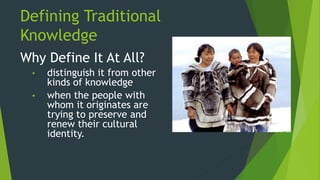
Why Define It At All?
• distinguish it from other
kinds of knowledge
• when the people with
whom it originates are
trying to preserve and
renew their cultural
identity.
Defining Traditional
Knowledge
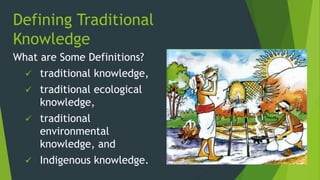
What are Some Definitions?
 traditional knowledge,
 traditional ecological
knowledge,
 traditional
environmental
knowledge, and
 Indigenous knowledge.
Traditional Knowledge
is knowledge that derives from, or is rooted
in the traditional way of life of aboriginal
people.
is the accumulated knowledge and
understanding of the human place in
relation to the universe.
Traditional Ecological Knowledge
 environmental knowledge that has been
gathered by aboriginal peoples who have
lived in and observed a particular area
for generations.
systems of experiential knowledge gained
by continual observation and transmitted
among members of a community.
Traditional Environmental Knowledge
 is a body of knowledge and beliefs transmitted
through oral traditions and first hand observation.
 The quantity and quality of TEK varies among
community members, depending upon gender, age,
social status, intellectual capability and profession.
 The use of the word “traditional” in these
definitions is often seen as problematic
Indigenous knowledge
 It includes facts, concepts, theories about
the characteristics which describe the
objects, events, behaviours and
interconnections that comprise both the
animate and inanimate environments of
Indigenous peoples.
 Even though Indigenous knowledge is not
quantitative in nature, it does not mean that
it is not precise.
Characteristics
of Indigenous
Knowledge
 is generated within communities
 is location and culture specific
 is the basis for decision making and
survival strategies
 is not systematically documented
 concerns critical issues of human and
animal life: primary production, human
and animal life, natural resource
management
 is dynamic and based on innovation,
adaptation, and experimentation
 is oral and rural in nature
The Social Context
Since time immemorial, we were put here to take care of
the land. Our grandfathers did not abuse the land and it is
our turn to pass our knowledge on to our younger
generation. What our forefathers kept all this time is very
precious. It’s now in our hands. Our Creator has given us the
responsibility for taking very good care of what we have. If
we don’t take care of it, we will lose our own culture one
day.
(John Petagumskum in McDonald, Arragutainaq, and Novalinga 1997, )
2 aspects of TK
 First: practical base - Traditional explanations of
environmental phenomena, winds or water currents
for example, are based on cumulative collective
experience , tested over centuries, by people who
had a sophisticated and practical knowledge of the
land on which they depended for every aspect of life.
 Second: spiritual - is integral to the ethical beliefs
and world views of Indigenous peoples.
The Impact of Colonization on
Traditional Knowledge
Reasons:
to exploit the natural resources found in the
territories of Indigenous peoples; and
to execute some notion of “empire” or
“manifest destiny,” to solidify economic, social,
and political power.
Colonization has adversely
affected the transmission,
preservation, and protection of
traditional knowledge
 TK has not been systematically documented until recently;
 it is largely orally transmitted;
 IP have become isolated from one another;
 enforced shifts away from traditional subsistence practices
 health and social problems; and
 the dominance of western scientific traditions
Conclusion
 To change a life, based on traditional knowledge where the
traditional lifestyle includes norms, values, relations to nature,
time, work and leisure is extremely difficult.
 Many persons leaving their traditional life experience that they are
“nobody”
 To establish a new social identity can mainly be done in two ways:
They can reduce the importance of earlier knowledge and self-
consciousness. to use the achieved traditional knowledge as a
platform for further learning
 Age, program type, social security and social are extremely
important factors for a successful transformation
Contemporary Uses of Traditional
Knowledge
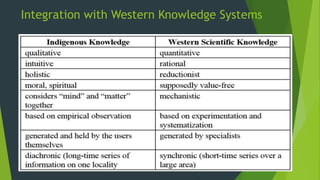
Integration with Western Knowledge Systems
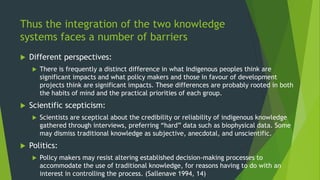
Thus the integration of the two knowledge
systems faces a number of barriers
 Different perspectives:
 There is frequently a distinct difference in what Indigenous peoples think are
significant impacts and what policy makers and those in favour of development
projects think are significant impacts. These differences are probably rooted in both
the habits of mind and the practical priorities of each group.
 Scientific scepticism:
 Scientists are sceptical about the credibility or reliability of indigenous knowledge
gathered through interviews, preferring “hard” data such as biophysical data. Some
may dismiss traditional knowledge as subjective, anecdotal, and unscientific.
 Politics:
 Policy makers may resist altering established decision-making processes to
accommodate the use of traditional knowledge, for reasons having to do with an
interest in controlling the process. (Sallenave 1994, 14)
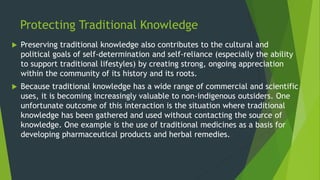
Protecting Traditional Knowledge
 Preserving traditional knowledge also contributes to the cultural and
political goals of self-determination and self-reliance (especially the ability
to support traditional lifestyles) by creating strong, ongoing appreciation
within the community of its history and its roots.
 Because traditional knowledge has a wide range of commercial and scientific
uses, it is becoming increasingly valuable to non-indigenous outsiders. One
unfortunate outcome of this interaction is the situation where traditional
knowledge has been gathered and used without contacting the source of
knowledge. One example is the use of traditional medicines as a basis for
developing pharmaceutical products and herbal remedies.
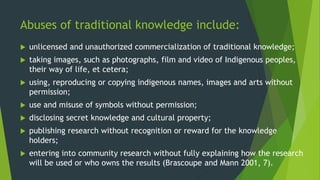
Abuses of traditional knowledge include:
 unlicensed and unauthorized commercialization of traditional knowledge;
 taking images, such as photographs, film and video of Indigenous peoples,
their way of life, et cetera;
 using, reproducing or copying indigenous names, images and arts without
permission;
 use and misuse of symbols without permission;
 disclosing secret knowledge and cultural property;
 publishing research without recognition or reward for the knowledge
holders;
 entering into community research without fully explaining how the research
will be used or who owns the results (Brascoupe and Mann 2001, 7).
Because our knowledge is a part of us, and we are
living beings, then our knowledge is in a sense “living”
too and must be nurtured like all life. The primary
lesson for Indigenous peoples within their own
communities, then, is to learn and practice traditional
knowledge. Seek out elders and traditional teachers.
Listen to the stories, ask questions, practice the
techniques, and discuss it all with your peers. Honour
the sacred.
Thank you!

traditionalknowledge-151107111934-lva1-app6892.pdf

  • 1.
    Traditional Knowledge by GordBruyere, independent Indigenous scholar, Canada, and Einar Bergland, Norway Presented by: Ernesto E. Empig Professor: Liwayway S. Viloria
  • 2.
    Key Terms andConcepts  colonization  cultural bias  living knowledge  traditional knowledge (also known as Indigenous knowledge, traditional ecological knowledge)  western scientific knowledge
  • 3.
    Learning Objectives  1.Define traditional knowledge  2. Describe the physical and social contexts in which traditional knowledge develop  3. Describe the historical impact of social change on traditional knowledge systems  4. Give concrete examples of the impact of declining traditional knowledge and lifestyles  5. Compare traditional knowledge with western knowledge  6. Provide examples of the ways in which modern science and traditional knowledge are working together
  • 4.
    Defining Traditional Knowledge Why DefineIt At All? • distinguish it from other kinds of knowledge • when the people with whom it originates are trying to preserve and renew their cultural identity.
  • 5.
    Defining Traditional Knowledge What areSome Definitions?  traditional knowledge,  traditional ecological knowledge,  traditional environmental knowledge, and  Indigenous knowledge.
  • 6.
    Traditional Knowledge is knowledgethat derives from, or is rooted in the traditional way of life of aboriginal people. is the accumulated knowledge and understanding of the human place in relation to the universe.
  • 7.
    Traditional Ecological Knowledge environmental knowledge that has been gathered by aboriginal peoples who have lived in and observed a particular area for generations. systems of experiential knowledge gained by continual observation and transmitted among members of a community.
  • 8.
    Traditional Environmental Knowledge is a body of knowledge and beliefs transmitted through oral traditions and first hand observation.  The quantity and quality of TEK varies among community members, depending upon gender, age, social status, intellectual capability and profession.  The use of the word “traditional” in these definitions is often seen as problematic
  • 9.
    Indigenous knowledge  Itincludes facts, concepts, theories about the characteristics which describe the objects, events, behaviours and interconnections that comprise both the animate and inanimate environments of Indigenous peoples.  Even though Indigenous knowledge is not quantitative in nature, it does not mean that it is not precise.
  • 10.
    Characteristics of Indigenous Knowledge  isgenerated within communities  is location and culture specific  is the basis for decision making and survival strategies  is not systematically documented  concerns critical issues of human and animal life: primary production, human and animal life, natural resource management  is dynamic and based on innovation, adaptation, and experimentation  is oral and rural in nature
  • 11.
    The Social Context Sincetime immemorial, we were put here to take care of the land. Our grandfathers did not abuse the land and it is our turn to pass our knowledge on to our younger generation. What our forefathers kept all this time is very precious. It’s now in our hands. Our Creator has given us the responsibility for taking very good care of what we have. If we don’t take care of it, we will lose our own culture one day. (John Petagumskum in McDonald, Arragutainaq, and Novalinga 1997, )
  • 12.
    2 aspects ofTK  First: practical base - Traditional explanations of environmental phenomena, winds or water currents for example, are based on cumulative collective experience , tested over centuries, by people who had a sophisticated and practical knowledge of the land on which they depended for every aspect of life.  Second: spiritual - is integral to the ethical beliefs and world views of Indigenous peoples.
  • 13.
    The Impact ofColonization on Traditional Knowledge Reasons: to exploit the natural resources found in the territories of Indigenous peoples; and to execute some notion of “empire” or “manifest destiny,” to solidify economic, social, and political power.
  • 14.
    Colonization has adversely affectedthe transmission, preservation, and protection of traditional knowledge  TK has not been systematically documented until recently;  it is largely orally transmitted;  IP have become isolated from one another;  enforced shifts away from traditional subsistence practices  health and social problems; and  the dominance of western scientific traditions
  • 15.
    Conclusion  To changea life, based on traditional knowledge where the traditional lifestyle includes norms, values, relations to nature, time, work and leisure is extremely difficult.  Many persons leaving their traditional life experience that they are “nobody”  To establish a new social identity can mainly be done in two ways: They can reduce the importance of earlier knowledge and self- consciousness. to use the achieved traditional knowledge as a platform for further learning  Age, program type, social security and social are extremely important factors for a successful transformation
  • 16.
    Contemporary Uses ofTraditional Knowledge
  • 17.
    Integration with WesternKnowledge Systems
  • 18.
    Thus the integrationof the two knowledge systems faces a number of barriers  Different perspectives:  There is frequently a distinct difference in what Indigenous peoples think are significant impacts and what policy makers and those in favour of development projects think are significant impacts. These differences are probably rooted in both the habits of mind and the practical priorities of each group.  Scientific scepticism:  Scientists are sceptical about the credibility or reliability of indigenous knowledge gathered through interviews, preferring “hard” data such as biophysical data. Some may dismiss traditional knowledge as subjective, anecdotal, and unscientific.  Politics:  Policy makers may resist altering established decision-making processes to accommodate the use of traditional knowledge, for reasons having to do with an interest in controlling the process. (Sallenave 1994, 14)
  • 19.
    Protecting Traditional Knowledge Preserving traditional knowledge also contributes to the cultural and political goals of self-determination and self-reliance (especially the ability to support traditional lifestyles) by creating strong, ongoing appreciation within the community of its history and its roots.  Because traditional knowledge has a wide range of commercial and scientific uses, it is becoming increasingly valuable to non-indigenous outsiders. One unfortunate outcome of this interaction is the situation where traditional knowledge has been gathered and used without contacting the source of knowledge. One example is the use of traditional medicines as a basis for developing pharmaceutical products and herbal remedies.
  • 20.
    Abuses of traditionalknowledge include:  unlicensed and unauthorized commercialization of traditional knowledge;  taking images, such as photographs, film and video of Indigenous peoples, their way of life, et cetera;  using, reproducing or copying indigenous names, images and arts without permission;  use and misuse of symbols without permission;  disclosing secret knowledge and cultural property;  publishing research without recognition or reward for the knowledge holders;  entering into community research without fully explaining how the research will be used or who owns the results (Brascoupe and Mann 2001, 7).
  • 21.
    Because our knowledgeis a part of us, and we are living beings, then our knowledge is in a sense “living” too and must be nurtured like all life. The primary lesson for Indigenous peoples within their own communities, then, is to learn and practice traditional knowledge. Seek out elders and traditional teachers. Listen to the stories, ask questions, practice the techniques, and discuss it all with your peers. Honour the sacred.
  • 22.