The Astronomy Picture of the Day
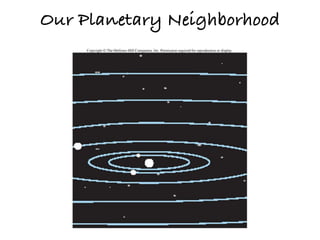
Our Planetary Neighborhood
Outline
•   Astronomy
•   The Earth
•   The Moon
•   The Planets
•   The Sun
•   The Solar System
•   The Astronomical Unit
Astronomy (from Wikipedia)

Astronomy (Greek: αστρονομία = άστρον +
νόμος, astronomia = astron + nomos, literally,
"law of the stars") is the science of celestial objects
and phenomena that originate outside the Earth's
atmosphere, such as stars, planets, comets,
auroras, galaxies, and the cosmic background
radiation. It is concerned with the formation and
development of the universe, the evolution and
physical and chemical properties of celestial objects
and the calculation of their motions.
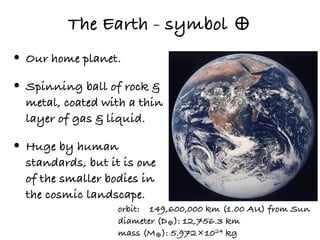
The Earth - symbol ♁
• Our home planet.
• Spinning ball of rock &
  metal, coated with a thin
  layer of gas & liquid.

• Huge by human
  standards, but it is one
  of the smaller bodies in
  the cosmic landscape.
                   orbit: 149,600,000 km (1.00 AU) from Sun
                   diameter (D♁): 12,756.3 km
                   mass (M♁): 5.972×1024 kg
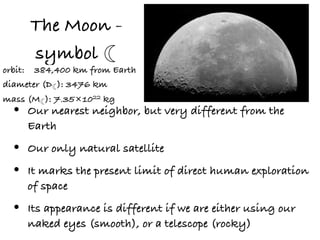
The Moon -
      symbol ☾
orbit: 384,400 km from Earth
diameter (D☾): 3476 km
mass (M☾): 7.35×10²² kg
  •   Our nearest neighbor, but very different from the
      Earth

  •   Our only natural satellite

  •   It marks the present limit of direct human exploration
      of space

  •   Its appearance is different if we are either using our
      naked eyes (smooth), or a telescope (rocky)
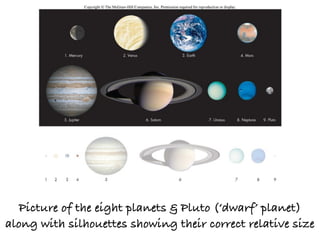
The Planets
• In order of increasing distance from
  the Sun, the eight planets are:
  Mercury, Venus, Earth, Mars,
  Jupiter, Saturn, Uranus, & Neptune.
  These worlds have dramatically
  different sizes and landscapes.
• They range in size from Jupiter
  (RJupiter = 11 R♁), down to
  Mercury(RMercury = 0.4 R♁).
The Planets cont.
• Our two nearest neighboring planets
  are Venus (RVenus = 0.95 R♁), & Mars
  (RMars = 0.53 R♁). Despite their
  similarities in size & in distance from
  the Sun, Venus & Mars have
  dramatically different atmospheres.
• On Venus we would be crushed &
  cooked by its intensely hot, dense
  atmosphere, whereas on Mars we would
  suffocate & freeze.
Picture of the eight planets & Pluto (‘dwarf’ planet)
along with silhouettes showing their correct relative size
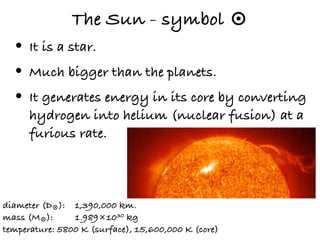
The Sun - symbol
  • It is a star.
  • Much bigger than the planets.
  • It generates energy in its core by converting
      hydrogen into helium (nuclear fusion) at a
      furious rate.


diameter (D ): 1,390,000 km.
mass (M ):      1.989×1030 kg
temperature: 5800 K (surface), 15,600,000 K (core)
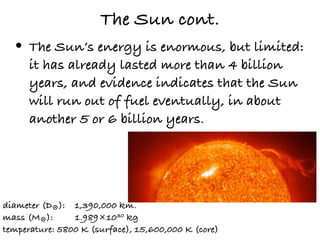
The Sun cont.
  • The Sun’s energy is enormous, but limited:
      it has already lasted more than 4 billion
      years, and evidence indicates that the Sun
      will run out of fuel eventually, in about
      another 5 or 6 billion years.


diameter (D ): 1,390,000 km.
mass (M ):      1.989×1030 kg
temperature: 5800 K (surface), 15,600,000 K (core)
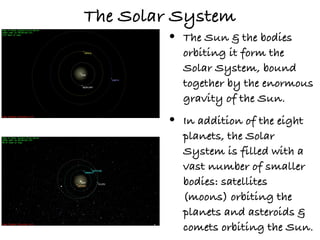
The Solar System
        •   The Sun & the bodies
            orbiting it form the
            Solar System, bound
            together by the enormous
            gravity of the Sun.

        •   In addition of the eight
            planets, the Solar
            System is filled with a
            vast number of smaller
            bodies: satellites
            (moons) orbiting the
            planets and asteroids &
            comets orbiting the Sun.
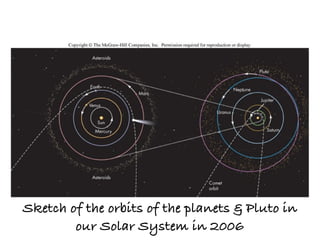
Sketch of the orbits of the planets & Pluto in
        our Solar System in 2006
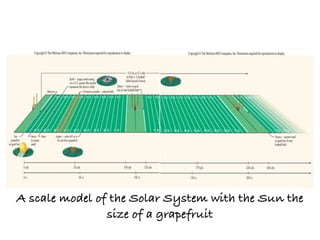
A scale model of the Solar System with the Sun the
                size of a grapefruit
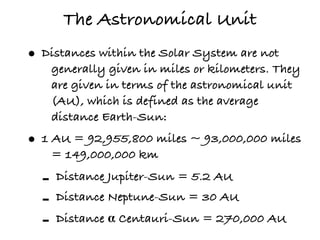
The Astronomical Unit
• Distances within the Solar System are not
      generally given in miles or kilometers. They
      are given in terms of the astronomical unit
      (AU), which is defined as the average
      distance Earth-Sun:

• 1 AU = 92,955,800 miles ~ 93,000,000 miles
      = 149,000,000 km

  -   Distance Jupiter-Sun = 5.2 AU
  -   Distance Neptune-Sun = 30 AU

  -   Distance α Centauri-Sun = 270,000 AU
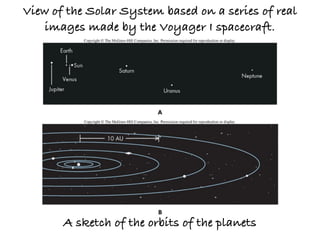
View of the Solar System based on a series of real
    images made by the Voyager I spacecraft.


       A sketch of the orbits of the planets
Key Terms

•   astronomical unit (AU):
•   metric system:
•   planet:
•   satellite:
•   Solar System:
•   star:
•   unit:

Unit 1 - Our Planetary Neighborhood

  • 1.
  • 2.
  • 3.
    Outline • Astronomy • The Earth • The Moon • The Planets • The Sun • The Solar System • The Astronomical Unit
  • 4.
    Astronomy (from Wikipedia) Astronomy(Greek: αστρονομία = άστρον + νόμος, astronomia = astron + nomos, literally, "law of the stars") is the science of celestial objects and phenomena that originate outside the Earth's atmosphere, such as stars, planets, comets, auroras, galaxies, and the cosmic background radiation. It is concerned with the formation and development of the universe, the evolution and physical and chemical properties of celestial objects and the calculation of their motions.
  • 5.
    The Earth -symbol ♁ • Our home planet. • Spinning ball of rock & metal, coated with a thin layer of gas & liquid. • Huge by human standards, but it is one of the smaller bodies in the cosmic landscape. orbit: 149,600,000 km (1.00 AU) from Sun diameter (D♁): 12,756.3 km mass (M♁): 5.972×1024 kg
  • 6.
    The Moon - symbol ☾ orbit: 384,400 km from Earth diameter (D☾): 3476 km mass (M☾): 7.35×10²² kg • Our nearest neighbor, but very different from the Earth • Our only natural satellite • It marks the present limit of direct human exploration of space • Its appearance is different if we are either using our naked eyes (smooth), or a telescope (rocky)
  • 7.
    The Planets • Inorder of increasing distance from the Sun, the eight planets are: Mercury, Venus, Earth, Mars, Jupiter, Saturn, Uranus, & Neptune. These worlds have dramatically different sizes and landscapes. • They range in size from Jupiter (RJupiter = 11 R♁), down to Mercury(RMercury = 0.4 R♁).
  • 8.
    The Planets cont. •Our two nearest neighboring planets are Venus (RVenus = 0.95 R♁), & Mars (RMars = 0.53 R♁). Despite their similarities in size & in distance from the Sun, Venus & Mars have dramatically different atmospheres. • On Venus we would be crushed & cooked by its intensely hot, dense atmosphere, whereas on Mars we would suffocate & freeze.
  • 9.
    Picture of theeight planets & Pluto (‘dwarf’ planet) along with silhouettes showing their correct relative size
  • 10.
    The Sun -symbol • It is a star. • Much bigger than the planets. • It generates energy in its core by converting hydrogen into helium (nuclear fusion) at a furious rate. diameter (D ): 1,390,000 km. mass (M ): 1.989×1030 kg temperature: 5800 K (surface), 15,600,000 K (core)
  • 11.
    The Sun cont. • The Sun’s energy is enormous, but limited: it has already lasted more than 4 billion years, and evidence indicates that the Sun will run out of fuel eventually, in about another 5 or 6 billion years. diameter (D ): 1,390,000 km. mass (M ): 1.989×1030 kg temperature: 5800 K (surface), 15,600,000 K (core)
  • 12.
    The Solar System • The Sun & the bodies orbiting it form the Solar System, bound together by the enormous gravity of the Sun. • In addition of the eight planets, the Solar System is filled with a vast number of smaller bodies: satellites (moons) orbiting the planets and asteroids & comets orbiting the Sun.
  • 13.
    Sketch of theorbits of the planets & Pluto in our Solar System in 2006
  • 14.
    A scale modelof the Solar System with the Sun the size of a grapefruit
  • 15.
    The Astronomical Unit •Distances within the Solar System are not generally given in miles or kilometers. They are given in terms of the astronomical unit (AU), which is defined as the average distance Earth-Sun: • 1 AU = 92,955,800 miles ~ 93,000,000 miles = 149,000,000 km - Distance Jupiter-Sun = 5.2 AU - Distance Neptune-Sun = 30 AU - Distance α Centauri-Sun = 270,000 AU
  • 16.
    View of theSolar System based on a series of real images made by the Voyager I spacecraft. A sketch of the orbits of the planets
  • 17.
    Key Terms • astronomical unit (AU): • metric system: • planet: • satellite: • Solar System: • star: • unit: