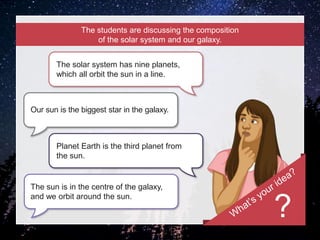
The sun is in the centre of the galaxy,
and we orbit around the sun.
Planet Earth is the third planet from
the sun.
Our sun is the biggest star in the galaxy.
The solar system has nine planets,
which all orbit the sun in a line.
The students are discussing the composition
of the solar system and our galaxy.
?
Possible Points of Discussion
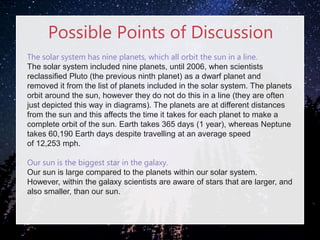
The solar system has nine planets, which all orbit the sun in a line.
The solar system included nine planets, until 2006, when scientists
reclassified Pluto (the previous ninth planet) as a dwarf planet and
removed it from the list of planets included in the solar system. The planets
orbit around the sun, however they do not do this in a line (they are often
just depicted this way in diagrams). The planets are at different distances
from the sun and this affects the time it takes for each planet to make a
complete orbit of the sun. Earth takes 365 days (1 year), whereas Neptune
takes 60,190 Earth days despite travelling at an average speed
of 12,253 mph.
Our sun is the biggest star in the galaxy.
Our sun is large compared to the planets within our solar system.
However, within the galaxy scientists are aware of stars that are larger, and
also smaller, than our sun.
Possible Points of Discussion
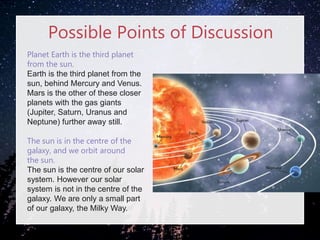
Planet Earth is the third planet
from the sun.
Earth is the third planet from the
sun, behind Mercury and Venus.
Mars is the other of these closer
planets with the gas giants
(Jupiter, Saturn, Uranus and
Neptune) further away still.
The sun is in the centre of the
galaxy, and we orbit around
the sun.
The sun is the centre of our solar
system. However our solar
system is not in the centre of the
galaxy. We are only a small part
of our galaxy, the Milky Way.
Our Solar System
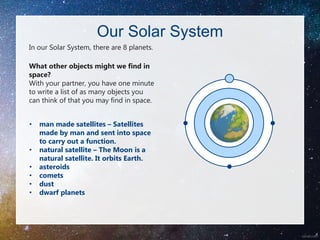
In our Solar System, there are 8 planets.
What other objects might we find in
space?
With your partner, you have one minute
to write a list of as many objects you
can think of that you may find in space.
• man made satellites – Satellites
made by man and sent into space
to carry out a function.
• natural satellite – The Moon is a
natural satellite. It orbits Earth.
• asteroids
• comets
• dust
• dwarf planets
The Solar System
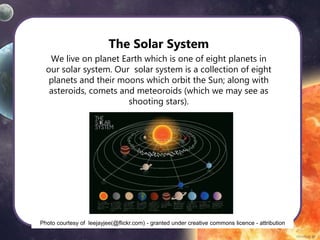
We live on planet Earth which is one of eight planets in
our solar system. Our solar system is a collection of eight
planets and their moons which orbit the Sun; along with
asteroids, comets and meteoroids (which we may see as
shooting stars).
Photo courtesy of leejayjee(@flickr.com) - granted under creative commons licence - attribution
The Sun
Size
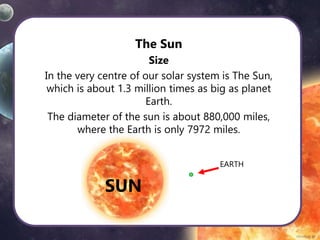
In the very centre of our solar system is The Sun,
which is about 1.3 million times as big as planet
Earth.
The diameter of the sun is about 880,000 miles,
where the Earth is only 7972 miles.
EARTH
SUN
The Sun
Stars in the skies
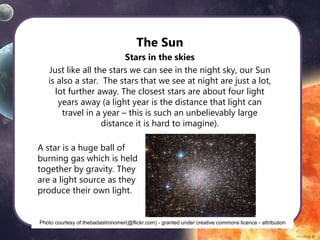
Just like all the stars we can see in the night sky, our Sun
is also a star. The stars that we see at night are just a lot,
lot further away. The closest stars are about four light
years away (a light year is the distance that light can
travel in a year – this is such an unbelievably large
distance it is hard to imagine).
Photo courtesy of thebadastronomer(@flickr.com) - granted under creative commons licence - attribution
A star is a huge ball of
burning gas which is held
together by gravity. They
are a light source as they
produce their own light.
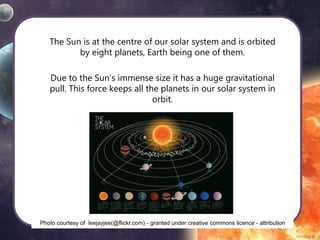
The Sun is at the centre of our solar system and is orbited
by eight planets, Earth being one of them.
Due to the Sun’s immense size it has a huge gravitational
pull. This force keeps all the planets in our solar system in
orbit.
Photo courtesy of leejayjee(@flickr.com) - granted under creative commons licence - attribution
The Moon
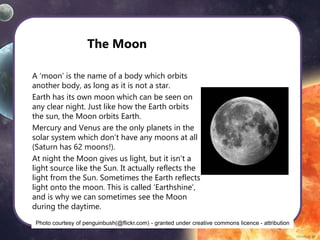
A ‘moon’ is the name of a body which orbits
another body, as long as it is not a star.
Earth has its own moon which can be seen on
any clear night. Just like how the Earth orbits
the sun, the Moon orbits Earth.
Mercury and Venus are the only planets in the
solar system which don’t have any moons at all
(Saturn has 62 moons!).
At night the Moon gives us light, but it isn’t a
light source like the Sun. It actually reflects the
light from the Sun. Sometimes the Earth reflects
light onto the moon. This is called ‘Earthshine’,
and is why we can sometimes see the Moon
during the daytime.
Photo courtesy of penguinbush(@flickr.com) - granted under creative commons licence - attribution
The Planets
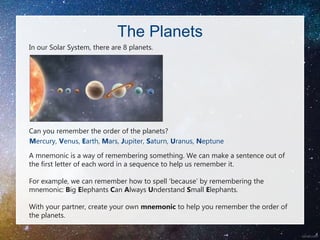
In our Solar System, there are 8 planets.
Can you remember the order of the planets?
Mercury, Venus, Earth, Mars, Jupiter, Saturn, Uranus, Neptune
A mnemonic is a way of remembering something. We can make a sentence out of
the first letter of each word in a sequence to help us remember it.
For example, we can remember how to spell ‘because’ by remembering the
mnemonic: Big Elephants Can Always Understand Small Elephants.
With your partner, create your own mnemonic to help you remember the order of
the planets.
Plenary
What is a planet?
What is a star?
What is a moon?
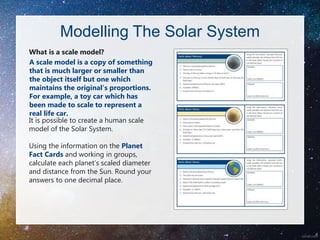
Modelling The Solar System
What is a scale model?
It is possible to create a human scale
model of the Solar System.
Using the information on the Planet
Fact Cards and working in groups,
calculate each planet’s scaled diameter
and distance from the Sun. Round your
answers to one decimal place.
A scale model is a copy of something
that is much larger or smaller than
the object itself but one which
maintains the original’s proportions.
For example, a toy car which has
been made to scale to represent a
real life car.
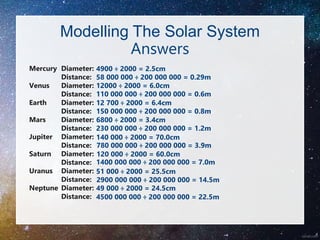
Modelling The Solar System
Answers
Mercury Diameter:
Distance:
Venus Diameter:
Distance:
Earth Diameter:
Distance:
Mars Diameter:
Distance:
Jupiter Diameter:
Distance:
Saturn Diameter:
Distance:
Uranus Diameter:
Distance:
Neptune Diameter:
Distance:
4900 ÷ 2000 = 2.5cm
58 000 000 ÷ 200 000 000 = 0.29m
12000 ÷ 2000 = 6.0cm
110 000 000 ÷ 200 000 000 = 0.6m
12 700 ÷ 2000 = 6.4cm
150 000 000 ÷ 200 000 000 = 0.8m
6800 ÷ 2000 = 3.4cm
230 000 000 ÷ 200 000 000 = 1.2m
140 000 ÷ 2000 = 70.0cm
780 000 000 ÷ 200 000 000 = 3.9m
120 000 ÷ 2000 = 60.0cm
1400 000 000 ÷ 200 000 000 = 7.0m
51 000 ÷ 2000 = 25.5cm
2900 000 000 ÷ 200 000 000 = 14.5m
49 000 ÷ 2000 = 24.5cm
4500 000 000 ÷ 200 000 000 = 22.5m
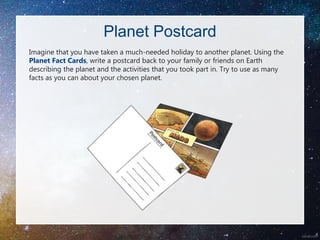
Planet Postcard
Imagine that you have taken a much-needed holiday to another planet. Using the
Planet Fact Cards, write a postcard back to your family or friends on Earth
describing the planet and the activities that you took part in. Try to use as many
facts as you can about your chosen planet.
4b The Solar System PowerPoint.pptx

4b The Solar System PowerPoint.pptx

  • 1.
    The sun isin the centre of the galaxy, and we orbit around the sun. Planet Earth is the third planet from the sun. Our sun is the biggest star in the galaxy. The solar system has nine planets, which all orbit the sun in a line. The students are discussing the composition of the solar system and our galaxy. ?
  • 2.
    Possible Points ofDiscussion The solar system has nine planets, which all orbit the sun in a line. The solar system included nine planets, until 2006, when scientists reclassified Pluto (the previous ninth planet) as a dwarf planet and removed it from the list of planets included in the solar system. The planets orbit around the sun, however they do not do this in a line (they are often just depicted this way in diagrams). The planets are at different distances from the sun and this affects the time it takes for each planet to make a complete orbit of the sun. Earth takes 365 days (1 year), whereas Neptune takes 60,190 Earth days despite travelling at an average speed of 12,253 mph. Our sun is the biggest star in the galaxy. Our sun is large compared to the planets within our solar system. However, within the galaxy scientists are aware of stars that are larger, and also smaller, than our sun.
  • 3.
    Possible Points ofDiscussion Planet Earth is the third planet from the sun. Earth is the third planet from the sun, behind Mercury and Venus. Mars is the other of these closer planets with the gas giants (Jupiter, Saturn, Uranus and Neptune) further away still. The sun is in the centre of the galaxy, and we orbit around the sun. The sun is the centre of our solar system. However our solar system is not in the centre of the galaxy. We are only a small part of our galaxy, the Milky Way.
  • 4.
    Our Solar System Inour Solar System, there are 8 planets. What other objects might we find in space? With your partner, you have one minute to write a list of as many objects you can think of that you may find in space. • man made satellites – Satellites made by man and sent into space to carry out a function. • natural satellite – The Moon is a natural satellite. It orbits Earth. • asteroids • comets • dust • dwarf planets
  • 5.
    The Solar System Welive on planet Earth which is one of eight planets in our solar system. Our solar system is a collection of eight planets and their moons which orbit the Sun; along with asteroids, comets and meteoroids (which we may see as shooting stars). Photo courtesy of leejayjee(@flickr.com) - granted under creative commons licence - attribution
  • 6.
    The Sun Size In thevery centre of our solar system is The Sun, which is about 1.3 million times as big as planet Earth. The diameter of the sun is about 880,000 miles, where the Earth is only 7972 miles. EARTH SUN
  • 7.
    The Sun Stars inthe skies Just like all the stars we can see in the night sky, our Sun is also a star. The stars that we see at night are just a lot, lot further away. The closest stars are about four light years away (a light year is the distance that light can travel in a year – this is such an unbelievably large distance it is hard to imagine). Photo courtesy of thebadastronomer(@flickr.com) - granted under creative commons licence - attribution A star is a huge ball of burning gas which is held together by gravity. They are a light source as they produce their own light.
  • 8.
    The Sun isat the centre of our solar system and is orbited by eight planets, Earth being one of them. Due to the Sun’s immense size it has a huge gravitational pull. This force keeps all the planets in our solar system in orbit. Photo courtesy of leejayjee(@flickr.com) - granted under creative commons licence - attribution
  • 9.
    The Moon A ‘moon’is the name of a body which orbits another body, as long as it is not a star. Earth has its own moon which can be seen on any clear night. Just like how the Earth orbits the sun, the Moon orbits Earth. Mercury and Venus are the only planets in the solar system which don’t have any moons at all (Saturn has 62 moons!). At night the Moon gives us light, but it isn’t a light source like the Sun. It actually reflects the light from the Sun. Sometimes the Earth reflects light onto the moon. This is called ‘Earthshine’, and is why we can sometimes see the Moon during the daytime. Photo courtesy of penguinbush(@flickr.com) - granted under creative commons licence - attribution
  • 10.
    The Planets In ourSolar System, there are 8 planets. Can you remember the order of the planets? Mercury, Venus, Earth, Mars, Jupiter, Saturn, Uranus, Neptune A mnemonic is a way of remembering something. We can make a sentence out of the first letter of each word in a sequence to help us remember it. For example, we can remember how to spell ‘because’ by remembering the mnemonic: Big Elephants Can Always Understand Small Elephants. With your partner, create your own mnemonic to help you remember the order of the planets.
  • 11.
    Plenary What is aplanet? What is a star? What is a moon?
  • 12.
    Modelling The SolarSystem What is a scale model? It is possible to create a human scale model of the Solar System. Using the information on the Planet Fact Cards and working in groups, calculate each planet’s scaled diameter and distance from the Sun. Round your answers to one decimal place. A scale model is a copy of something that is much larger or smaller than the object itself but one which maintains the original’s proportions. For example, a toy car which has been made to scale to represent a real life car.
  • 13.
    Modelling The SolarSystem Answers Mercury Diameter: Distance: Venus Diameter: Distance: Earth Diameter: Distance: Mars Diameter: Distance: Jupiter Diameter: Distance: Saturn Diameter: Distance: Uranus Diameter: Distance: Neptune Diameter: Distance: 4900 ÷ 2000 = 2.5cm 58 000 000 ÷ 200 000 000 = 0.29m 12000 ÷ 2000 = 6.0cm 110 000 000 ÷ 200 000 000 = 0.6m 12 700 ÷ 2000 = 6.4cm 150 000 000 ÷ 200 000 000 = 0.8m 6800 ÷ 2000 = 3.4cm 230 000 000 ÷ 200 000 000 = 1.2m 140 000 ÷ 2000 = 70.0cm 780 000 000 ÷ 200 000 000 = 3.9m 120 000 ÷ 2000 = 60.0cm 1400 000 000 ÷ 200 000 000 = 7.0m 51 000 ÷ 2000 = 25.5cm 2900 000 000 ÷ 200 000 000 = 14.5m 49 000 ÷ 2000 = 24.5cm 4500 000 000 ÷ 200 000 000 = 22.5m
  • 14.
    Planet Postcard Imagine thatyou have taken a much-needed holiday to another planet. Using the Planet Fact Cards, write a postcard back to your family or friends on Earth describing the planet and the activities that you took part in. Try to use as many facts as you can about your chosen planet.