


Julia’s type system and
multiple dispatch
杜岳華
Julia Taiwan 發起人
Type
 Everything in Julia is an object.
 An object has its own type.
Type Declaration
 Type is similar to class in object-oriented
programming.
 But it has more meanings……
Type Declaration
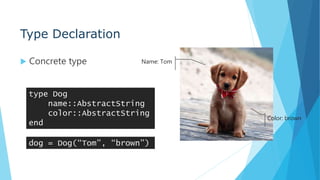
 Concrete type
type Dog
name::AbstractString
color::AbstractString
end
dog = Dog(“Tom”, “brown”)
Name: Tom
Color: brown
Type Declaration
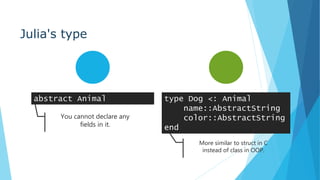
 Abstract type
abstract Animal
Julia's type
abstract Animal type Dog <: Animal
name::AbstractString
color::AbstractString
end
More similar to struct in C
instead of class in OOP.
You cannot declare any
fields in it.
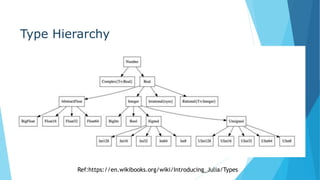
Type Hierarchy
Ref:https://en.wikibooks.org/wiki/Introducing_Julia/Types
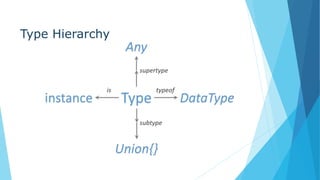
Type Hierarchy
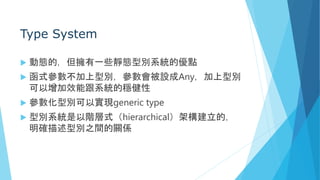
Type System
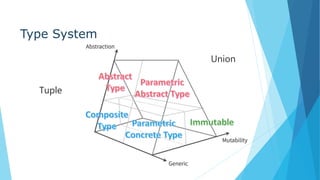
 動態的,但擁有一些靜態型別系統的優點
 函式參數不加上型別,參數會被設成Any,加上型別
可以增加效能跟系統的穩健性
 參數化型別可以實現generic type
 型別系統是以階層式(hierarchical)架構建立的,
明確描述型別之間的關係
Type System
Tuple
Union
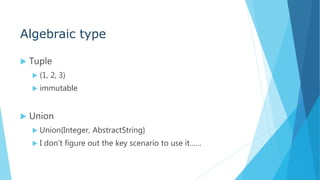
Algebraic type
 Tuple
 (1, 2, 3)
 immutable
 Union
 Union{Integer, AbstractString}
 I don't figure out the key scenario to use it……
The "nothing"
 The singleton of type Void, the only object belongs
to the type Void.
 While function does not return, it returns nothing!
Union{Integer, Void}?
 No! Nullable!
 Sometimes, you are not sure a function gives a
result, then you can use Nullable.
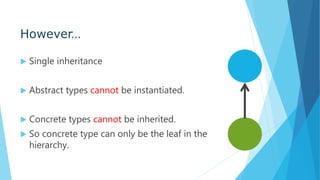
However…
 Single inheritance
 Abstract types cannot be instantiated.
 Concrete types cannot be inherited.
 So concrete type can only be the leaf in the
hierarchy.
http://www.quickmeme.com/meme/36b
esu
It cannot be reused!
 The major reason to use object-oriented programming
is reusability.
 However……
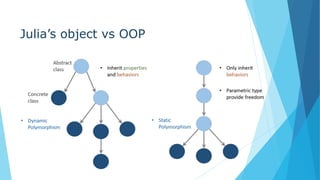
 Behaviors are not inherited.
 Fields are not inherited.
 It cannot be reused!!
Hopefully, we have……
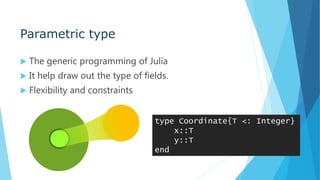
 Parametric type
 Multiple dispatch
Parametric type
 The generic programming of Julia
 It help draw out the type of fields.
 Flexibility and constraints
type Coordinate{T <: Integer}
x::T
y::T
end
Before talking about multiple
dispatch…
 Let's review polymorphism!
Polymorphism
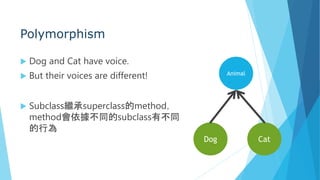
 Dog and Cat have voice.
 But their voices are different!
 Subclass繼承superclass的method,
method會依據不同的subclass有不同
的行為
Animal
Dog Cat
Polymorphism
 polymorphism不只是單單放在物件導向的繼承上,只要
符合同樣的function會依據不同型別而有不同行為就算
 若是依據維基百科的定義:
 Polymorphism is the provision of a single interface to
entities of different types.
 多型為不同型別的實體提供了單一介面
 C++的函式多載(function overloading)跟運算子多載
(operator overloading)
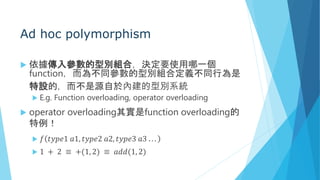
Ad hoc polymorphism
 依據傳入參數的型別組合,決定要使用哪一個
function,而為不同參數的型別組合定義不同行為是
特設的,而不是源自於內建的型別系統
 E.g. Function overloading, operator overloading
 operator overloading其實是function overloading的
特例!
 𝑓 𝑡𝑦𝑝𝑒1 𝑎1, 𝑡𝑦𝑝𝑒2 𝑎2, 𝑡𝑦𝑝𝑒3 𝑎3 . . .
 1 + 2 ≡ +(1, 2) ≡ 𝑎𝑑𝑑(1, 2)
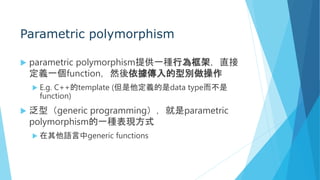
Parametric polymorphism
 parametric polymorphism提供一種行為框架,直接
定義一個function,然後依據傳入的型別做操作
 E.g. C++的template (但是他定義的是data type而不是
function)
 泛型(generic programming),就是parametric
polymorphism的一種表現方式
 在其他語言中generic functions
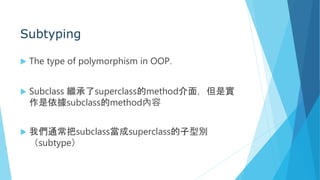
Subtyping
 The type of polymorphism in OOP.
 Subclass 繼承了superclass的method介面,但是實
作是依據subclass的method內容
 我們通常把subclass當成superclass的子型別
(subtype)
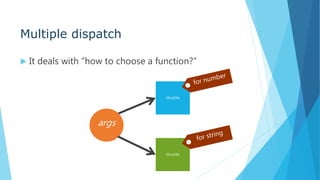
Multiple dispatch
 It deals with “how to choose a function?”
double
double
args
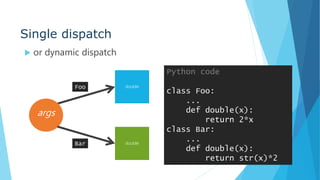
Single dispatch
 or dynamic dispatch
Python code
class Foo:
...
def double(x):
return 2*x
class Bar:
...
def double(x):
return str(x)*2
double
double
args
Foo
Bar
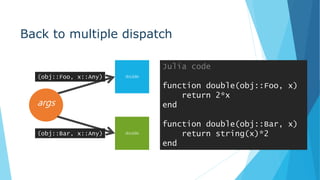
Back to multiple dispatch
Julia code
function double(obj::Foo, x)
return 2*x
end
function double(obj::Bar, x)
return string(x)*2
end
double
double
args
(obj::Foo, x::Any)
(obj::Bar, x::Any)
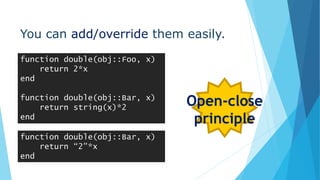
You can add/override them easily.
function double(obj::Foo, x)
return 2*x
end
function double(obj::Bar, x)
return string(x)*2
end
Open-close
principle
function double(obj::Bar, x)
return “2”*x
end
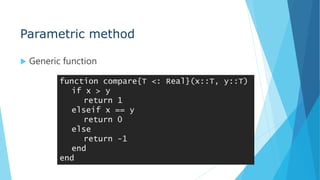
Parametric method
 Generic function
function compare{T <: Real}(x::T, y::T)
if x > y
return 1
elseif x == y
return 0
else
return -1
end
end
Parametric method
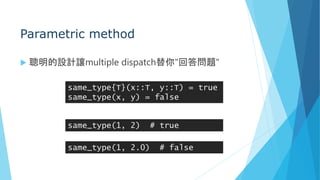
 聰明的設計讓multiple dispatch替你"回答問題"
same_type{T}(x::T, y::T) = true
same_type(x, y) = false
same_type(1, 2) # true
same_type(1, 2.0) # false
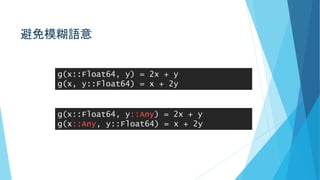
避免模糊語意
g(x::Float64, y) = 2x + y
g(x, y::Float64) = x + 2y
g(x::Float64, y::Any) = 2x + y
g(x::Any, y::Float64) = x + 2y
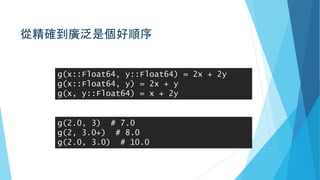
從精確到廣泛是個好順序
g(x::Float64, y::Float64) = 2x + 2y
g(x::Float64, y) = 2x + y
g(x, y::Float64) = x + 2y
g(2.0, 3) # 7.0
g(2, 3.0+) # 8.0
g(2.0, 3.0) # 10.0
Constructors
 要建構一個object,constructor是少不了的
 There are 2 major kinds of constructor:
 Inner constructor
 Outer constructor
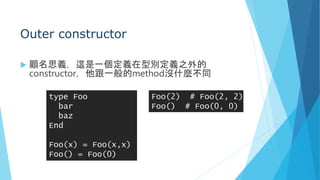
Outer constructor
 顧名思義,這是一個定義在型別定義之外的
constructor,他跟一般的method沒什麼不同
type Foo
bar
baz
End
Foo(x) = Foo(x,x)
Foo() = Foo(0)
Foo(2) # Foo(2, 2)
Foo() # Foo(0, 0)
Outer constructor
 你可以很簡單的在型別宣告之外加上很多不同的
constructor,如同其他語言的constructor
overloading一般
 擴充功能的時候很好用
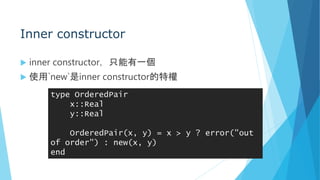
Inner constructor
 inner constructor,只能有一個
 使用`new`是inner constructor的特權
type OrderedPair
x::Real
y::Real
OrderedPair(x, y) = x > y ? error("out
of order") : new(x, y)
end
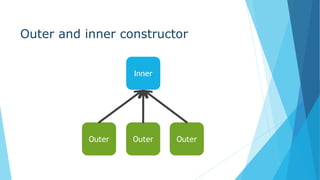
Outer and inner constructor
Inner
Outer OuterOuter
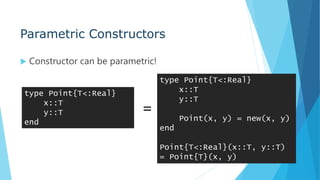
Parametric Constructors
 Constructor can be parametric!
type Point{T<:Real}
x::T
y::T
end
type Point{T<:Real}
x::T
y::T
Point(x, y) = new(x, y)
end
Point{T<:Real}(x::T, y::T)
= Point{T}(x, y)
=
Break!
 Next, the OOP in Julia!
OOP in Julia
 先來複習一下:
 Encapsulation (封裝): 定義fields跟methods,甚至存取權
限
 Inheritance (繼承): 組織類別之間的關係,以便重用
 Polymorphism (多型): 使可以同樣的methods根據不同的
類別展現出不同的行為
Julia的哲學
 Polymorphism
 Multiple dispatch佔了重要的角色
 解耦子型別繼承了不想要的方法
 Inheritance
 Julia的型別系統佔了重要的角色
 只描述型別之間關係,而非實作
 Encapsulation
 若是中介的隱私狀態是不需要的,那封裝也是不需要的!
以往OOP方式
 Subtyping + single dispatch
 E.g. C++, Java, Python……
但是subtyping通常會有個問題……
 當inheritance發生的時候,superclass的行為都會被
subclass繼承,如此一來,確認superclass跟
subclass的關係就需要無比精確,不然subclass就會
繼承到不必要的行為
 有些語言設法將method綁定在class上的作法打破,
像是Swift、Scala或Rust,用trait
精巧設計
 Parametric polymorphism + multiple dispatch
 E.g. Julia, Common Lisp (?)
 Subtyping
 面對一個類別並定義他的行為
 Julia
 希望你在定義行為的時候考慮到整個type hierarchy,你需要對
某群 (特定範圍)的type定義行為
 善用泛型,讓你在定義行為的時候可以收放自如
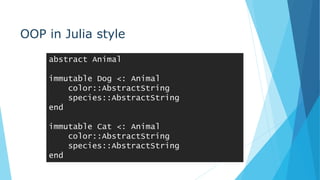
OOP in Julia style
abstract Animal
immutable Dog <: Animal
color::AbstractString
species::AbstractString
end
immutable Cat <: Animal
color::AbstractString
species::AbstractString
end
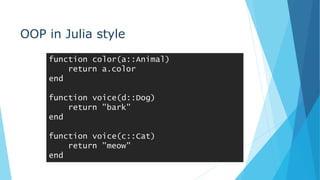
OOP in Julia style
function color(a::Animal)
return a.color
end
function voice(d::Dog)
return "bark"
end
function voice(c::Cat)
return "meow"
end
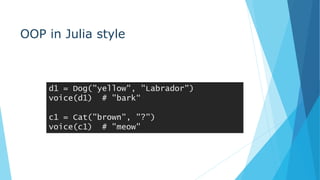
OOP in Julia style
d1 = Dog("yellow", "Labrador")
voice(d1) # "bark“
c1 = Cat("brown", "?")
voice(c1) # "meow"
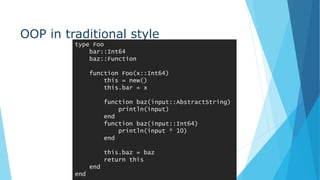
OOP in traditional style
type Foo
bar::Int64
baz::Function
function Foo(x::Int64)
this = new()
this.bar = x
function baz(input::AbstractString)
println(input)
end
function baz(input::Int64)
println(input * 10)
end
this.baz = baz
return this
end
end
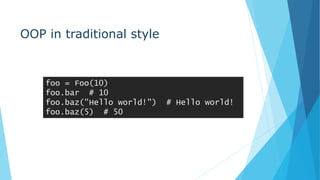
OOP in traditional style
foo = Foo(10)
foo.bar # 10
foo.baz("Hello world!") # Hello world!
foo.baz(5) # 50
Julia’s object vs OOP
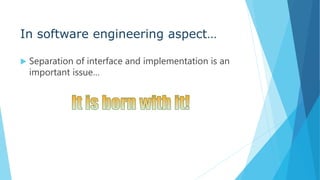
In software engineering aspect…
 Separation of interface and implementation is an
important issue…
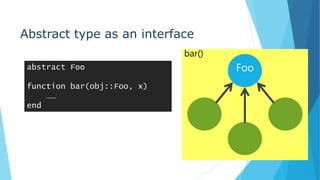
bar()
Abstract type as an interface
Fooabstract Foo
function bar(obj::Foo, x)
……
end
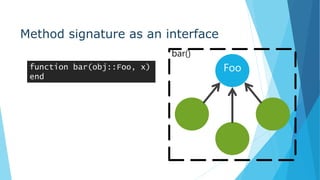
Method signature as an interface
function bar(obj::Foo, x)
end
bar()
Foo
Julia tastes good!
http://images.clipartpanda.com/taste-clipart-dT8oABxEc.jpeg
What kind of language Julia belongs
to?
 We usually say that Java and Python are object-
oriented languages.
 So, how about Julia?
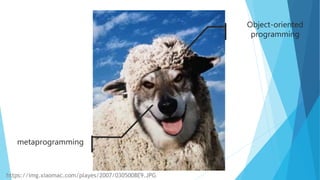
 Julia majors in metaprogramming, and minors in
object-oriented programming.
Object-oriented
programming
metaprogramming
https://img.xiaomac.com/playes/2007/0305008E9.JPG
Elegant but complicated type
system
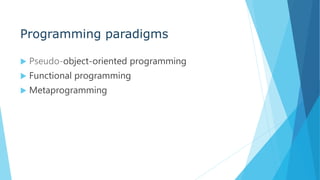
Programming paradigms
 Pseudo-object-oriented programming
 Functional programming
 Metaprogramming
Q&A
Thank you for attention

20170113 julia’s type system and multiple dispatch