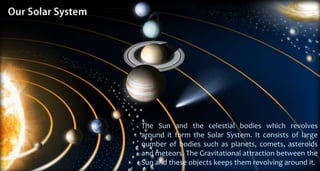
The Sun and the celestial bodies which revolves
around it form the Solar System. It consists of large
number of bodies such as planets, comets, asteroids
and meteors. The Gravitational attraction between the
Sun and these objects keeps them revolving around it.
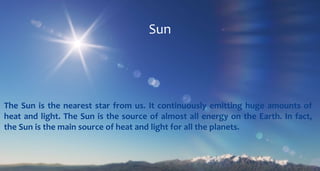
The Sun is the nearest star from us. It continuously emitting huge amounts of
heat and light. The Sun is the source of almost all energy on the Earth. In fact,
the Sun is the main source of heat and light for all the planets.
Sun
The Planets look like star, but they do not have light of there
own. They merely reflect the sunlight that falls on them.
The simplest Method of identifying a planet from a star is that
star twinkles and planets do not. Also the planets keep changing
their positions with respect to star.
The Planets
Star is a massive, luminous sphere of plasma held together
by its own gravity.
The Star
Satellites
A natural satellite, or moon, is a celestial body that orbits another body, e.g.
a planet, which is called its primary. There are 173 known natural satellites
orbiting planets in the Solar System, as well as at least eight orbiting IAU-
listed dwarf planets. As of January 2012, over 200 minor-planet moons have
been discovered.
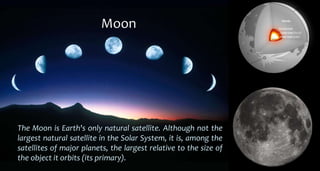
The Moon is Earth's only natural satellite. Although not the
largest natural satellite in the Solar System, it is, among the
satellites of major planets, the largest relative to the size of
the object it orbits (its primary).
Moon
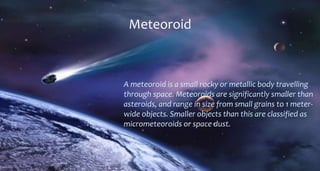
A meteoroid is a small rocky or metallic body travelling
through space. Meteoroids are significantly smaller than
asteroids, and range in size from small grains to 1 meter-
wide objects. Smaller objects than this are classified as
micrometeoroids or space dust.
Meteoroid
Asteroids are minor planets, especially those of the inner Solar System.
These terms have historically been applied to any astronomical object
orbiting the Sun that did not show the disc of a planet.
Asteroid
A comet is a ball of
mostly ice that moves
around in outer space.
Comets are often
described as "dirty
snowballs". They are
very different from
asteroids. The orbital
inclinations of comets
are usually high and not
near the ecliptic where
most solar system
objects are found. Most
of them are long-period
comets and go further
than Pluto. Those are
very far away from the
Sun, but some comets
come near enough to
Earth for us to see at
night.
In modern astronomy, a constellation is a specific area of the celestial
sphere as defined by the International Astronomical Union (IAU). These
areas had their origins in star patterns from which the constellations take
their names. There are 88 officially recognized constellations, covering
the entire sky.
Constellation
Mercury is the smallest and closest to the Sun of the eight planets in the Solar
System, with an orbital period of about 88 Earth days. Seen from Earth, it
appears to move around its orbit in about 116 days, which is much faster than
any other planet. It has no known natural satellites.
Venus is the second planet from the Sun, orbiting it every 224.7 Earth days. It
has no natural satellite. After the Moon, it is the brightest natural object in the
night sky. Venus is an inferior planet, and nearest planet to Earth.
Venus
The Earth is the only planet in the solar system on which life exist. Some special
environmental condition conditions are responsible for the existence and
continuation of life on the Earth. These includes just the right distance from the
Sun, so that it has the right temperature range, the presence of water and
suitable atmosphere and blanket of Ozone.
The Earth
Mars
Mars is the fourth planet from the Sun and the second smallest planet in
the Solar System, after Mercury. Named after the Roman god of war, it is
often described as the "Red Planet" because the iron oxide prevalent on
its surface gives it a reddish appearance. Mars is a terrestrial planet with a
thin atmosphere, having surface features reminiscent both of the impact
craters of the Moon and the volcanoes, valleys, deserts, and polar ice
caps of Earth.
Jupiter is the fifth planet from the Sun and the largest planet in the Solar
System. It is a gas giant with mass one-thousandth of that of the Sun but is two
and a half times the mass of all the other planets in the Solar System combined.
Jupiter
Saturn is the sixth planet from the Sun and the second largest planet in the Solar
System, after Jupiter. Although only one-eighth the average density of Earth, with
its larger volume Saturn is just over 95 times more massive.
Saturn
Uranus is the seventh planet from
the Sun. It has the third-largest
planetary radius and fourth-largest
planetary mass in the Solar System.
Uranus is similar in composition to
Neptune, and both are of different
chemical composition to the larger
gas giants Jupiter and Saturn.
Uranus
Neptune is the eighth and farthest planet from the Sun in the Solar System. It is
the fourth-largest planet by diameter and the third-largest by mass. Among the
gaseous planets in the Solar System, Neptune is the most dense. Neptune is 17
times the mass of Earth and is slightly more massive than its near-twin Uranus,
which is 15 times the mass of Earth but not as dense.
Neptune
Till 2006 there were
nine planets in our
solar system. Pluto
was farthest planet
from the sun. In 2006, the international Astronomical Union
(IAU) adopted a new definition. Pluto does not fit
on this definition. It is no longer a planet of our
solar system.
The Hubble Space Telescope (HST) is a space telescope that was launched into
low Earth orbit in 1990, and remains in operation. With a 2.4-meter (7.9 ft.)
mirror, Hubble's four main instruments observe in the near ultraviolet, visible,
and near infrared spectra. The telescope is named after the astronomer Edwin
Hubble.
Hubble Space Telescope
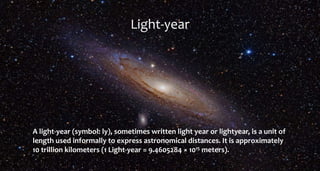
A light-year (symbol: ly), sometimes written light year or lightyear, is a unit of
length used informally to express astronomical distances. It is approximately
10 trillion kilometers (1 Light-year = 9.4605284 × 10¹⁵ meters).
Light-year
Alpha Centauri is the brightest star in the southern Centaurs
constellation. It is the fourth brightest star in the night sky. It is
visible in the Southern Hemisphere, and is too far south for most of
the Northern Hemisphere to see. Its next nearest star from Earth.
Alpha Centauri
A dwarf planet is an
object the size of a planet
(a planetary-mass object)
that is neither
a planet nor a natural
satellite. More explicitly,
the International
Astronomical Union (IAU)
defines a dwarf planet as
a celestial body in
direct orbit of
the Sun that is massive
enough for its shape to
be controlled by gravity,
but that unlike a planet
has not cleared its
orbit of other objects.
Dwarf
Planets
The Kuiper belt,
sometimes called the
Edge worth–Kuiper
belt, is a region of the
Solar System beyond
the planets, extending
from the orbit of
Neptune. It is similar to
the asteroid belt, but it
is far larger-20 times as
wide and 20 to 200
times as massive. The
Kuiper belt is home to
at least three dwarf
planets: Pluto, Haumea,
and Makemake.
Kuiper Belt
The Oort cloud, or Öpik–Oort cloud, is a cloud of comets and other objects.
Astronomers believe it is way beyond the orbits of Pluto and the Kuiper belt. The
Oort cloud is believed to be the source of long-period comets in the Solar System.
Oort cloud
Space, also known as outer space, is the near-vacuum
between celestial bodies. It is where everything (all of the
planets, stars, galaxies and other objects) is found On Earth,
space begins at the Kármán line (100 km above sea level).
Outer Space
Aryan
Chauhan
Class- 8 B
School-
Kendriya
Vidyalaya No.2
S.R.G.

Solar System

  • 2.
    The Sun andthe celestial bodies which revolves around it form the Solar System. It consists of large number of bodies such as planets, comets, asteroids and meteors. The Gravitational attraction between the Sun and these objects keeps them revolving around it.
  • 3.
    The Sun isthe nearest star from us. It continuously emitting huge amounts of heat and light. The Sun is the source of almost all energy on the Earth. In fact, the Sun is the main source of heat and light for all the planets. Sun
  • 5.
    The Planets looklike star, but they do not have light of there own. They merely reflect the sunlight that falls on them. The simplest Method of identifying a planet from a star is that star twinkles and planets do not. Also the planets keep changing their positions with respect to star. The Planets
  • 6.
    Star is amassive, luminous sphere of plasma held together by its own gravity. The Star
  • 7.
    Satellites A natural satellite,or moon, is a celestial body that orbits another body, e.g. a planet, which is called its primary. There are 173 known natural satellites orbiting planets in the Solar System, as well as at least eight orbiting IAU- listed dwarf planets. As of January 2012, over 200 minor-planet moons have been discovered.
  • 8.
    The Moon isEarth's only natural satellite. Although not the largest natural satellite in the Solar System, it is, among the satellites of major planets, the largest relative to the size of the object it orbits (its primary). Moon
  • 9.
    A meteoroid isa small rocky or metallic body travelling through space. Meteoroids are significantly smaller than asteroids, and range in size from small grains to 1 meter- wide objects. Smaller objects than this are classified as micrometeoroids or space dust. Meteoroid
  • 10.
    Asteroids are minorplanets, especially those of the inner Solar System. These terms have historically been applied to any astronomical object orbiting the Sun that did not show the disc of a planet. Asteroid
  • 11.
    A comet isa ball of mostly ice that moves around in outer space. Comets are often described as "dirty snowballs". They are very different from asteroids. The orbital inclinations of comets are usually high and not near the ecliptic where most solar system objects are found. Most of them are long-period comets and go further than Pluto. Those are very far away from the Sun, but some comets come near enough to Earth for us to see at night.
  • 12.
    In modern astronomy,a constellation is a specific area of the celestial sphere as defined by the International Astronomical Union (IAU). These areas had their origins in star patterns from which the constellations take their names. There are 88 officially recognized constellations, covering the entire sky. Constellation
  • 14.
    Mercury is thesmallest and closest to the Sun of the eight planets in the Solar System, with an orbital period of about 88 Earth days. Seen from Earth, it appears to move around its orbit in about 116 days, which is much faster than any other planet. It has no known natural satellites.
  • 15.
    Venus is thesecond planet from the Sun, orbiting it every 224.7 Earth days. It has no natural satellite. After the Moon, it is the brightest natural object in the night sky. Venus is an inferior planet, and nearest planet to Earth. Venus
  • 16.
    The Earth isthe only planet in the solar system on which life exist. Some special environmental condition conditions are responsible for the existence and continuation of life on the Earth. These includes just the right distance from the Sun, so that it has the right temperature range, the presence of water and suitable atmosphere and blanket of Ozone. The Earth
  • 17.
    Mars Mars is thefourth planet from the Sun and the second smallest planet in the Solar System, after Mercury. Named after the Roman god of war, it is often described as the "Red Planet" because the iron oxide prevalent on its surface gives it a reddish appearance. Mars is a terrestrial planet with a thin atmosphere, having surface features reminiscent both of the impact craters of the Moon and the volcanoes, valleys, deserts, and polar ice caps of Earth.
  • 18.
    Jupiter is thefifth planet from the Sun and the largest planet in the Solar System. It is a gas giant with mass one-thousandth of that of the Sun but is two and a half times the mass of all the other planets in the Solar System combined. Jupiter
  • 19.
    Saturn is thesixth planet from the Sun and the second largest planet in the Solar System, after Jupiter. Although only one-eighth the average density of Earth, with its larger volume Saturn is just over 95 times more massive. Saturn
  • 20.
    Uranus is theseventh planet from the Sun. It has the third-largest planetary radius and fourth-largest planetary mass in the Solar System. Uranus is similar in composition to Neptune, and both are of different chemical composition to the larger gas giants Jupiter and Saturn. Uranus
  • 21.
    Neptune is theeighth and farthest planet from the Sun in the Solar System. It is the fourth-largest planet by diameter and the third-largest by mass. Among the gaseous planets in the Solar System, Neptune is the most dense. Neptune is 17 times the mass of Earth and is slightly more massive than its near-twin Uranus, which is 15 times the mass of Earth but not as dense. Neptune
  • 22.
    Till 2006 therewere nine planets in our solar system. Pluto was farthest planet from the sun. In 2006, the international Astronomical Union (IAU) adopted a new definition. Pluto does not fit on this definition. It is no longer a planet of our solar system.
  • 23.
    The Hubble SpaceTelescope (HST) is a space telescope that was launched into low Earth orbit in 1990, and remains in operation. With a 2.4-meter (7.9 ft.) mirror, Hubble's four main instruments observe in the near ultraviolet, visible, and near infrared spectra. The telescope is named after the astronomer Edwin Hubble. Hubble Space Telescope
  • 24.
    A light-year (symbol:ly), sometimes written light year or lightyear, is a unit of length used informally to express astronomical distances. It is approximately 10 trillion kilometers (1 Light-year = 9.4605284 × 10¹⁵ meters). Light-year
  • 25.
    Alpha Centauri isthe brightest star in the southern Centaurs constellation. It is the fourth brightest star in the night sky. It is visible in the Southern Hemisphere, and is too far south for most of the Northern Hemisphere to see. Its next nearest star from Earth. Alpha Centauri
  • 26.
    A dwarf planetis an object the size of a planet (a planetary-mass object) that is neither a planet nor a natural satellite. More explicitly, the International Astronomical Union (IAU) defines a dwarf planet as a celestial body in direct orbit of the Sun that is massive enough for its shape to be controlled by gravity, but that unlike a planet has not cleared its orbit of other objects. Dwarf Planets
  • 27.
    The Kuiper belt, sometimescalled the Edge worth–Kuiper belt, is a region of the Solar System beyond the planets, extending from the orbit of Neptune. It is similar to the asteroid belt, but it is far larger-20 times as wide and 20 to 200 times as massive. The Kuiper belt is home to at least three dwarf planets: Pluto, Haumea, and Makemake. Kuiper Belt
  • 28.
    The Oort cloud,or Öpik–Oort cloud, is a cloud of comets and other objects. Astronomers believe it is way beyond the orbits of Pluto and the Kuiper belt. The Oort cloud is believed to be the source of long-period comets in the Solar System. Oort cloud
  • 29.
    Space, also knownas outer space, is the near-vacuum between celestial bodies. It is where everything (all of the planets, stars, galaxies and other objects) is found On Earth, space begins at the Kármán line (100 km above sea level). Outer Space
  • 30.