Unit 1
The 3 Components of NSTP
and its law.
What is National Service Training Program
(NSTP)?
According to Section 3 of Implementing Rules and
Regulations of RA 9163 stated that, this program
aimed at enhancing civic consciousness and defense
preparedness in the youth, by developing the ethics
of service and patriotism while undergoing training
in any of the three (3) Program components,
specifically designed to enhance the youth’s active
contributory to the general welfare.
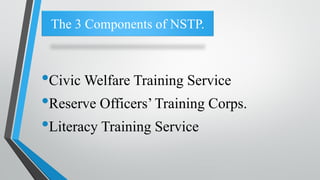
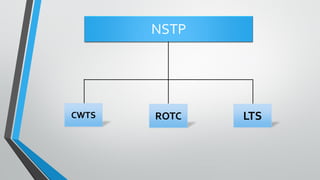
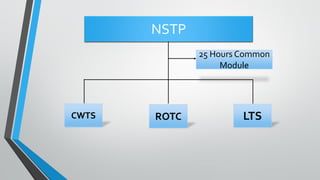
The 3 Components of NSTP.
•Civic Welfare Training Service
•Reserve Officers’ Training Corps.
•Literacy Training Service
NSTP
CWTS ROTC LTS
NSTP
CWTS ROTC LTS
25 Hours Common
Module
3Components of NSTP
Civic Welfare Training Service (CWTS) –
refer to the Program component or
activities contributory to the general
welfare and the betterment of life for the
members of the community or the
enhancement of its facilities,
Especially those devoted to improving
health, education, environment,
entrepreneurship, safety, recreation and
moral of the citizenry and other social
welfare services;
3Components of NSTP
Reserve Officers’ Training Corps (ROTC) – refers to
the Program component, institutionalized under
Section 38 and 39 of Republic Act No. 7077,
designed to provide military training to tertiary level
students in order to motivate, train, organize and
mobilize them for national defense preparedness.
3Components of NSTP
Literacy Training Service (LTS) – refers to the
Program component designed to train the students
to teach literacy and numeracy skills to school
children, out-of-school youths and other segments
of society in need of their services.
•The Republic Act 9163 was signed by
former Philippine President Gloria
Macapagal Arroyo. The origin or
backbone of RA 9163 is the Republic Act
7077. The National Service Training
Program has a 3 program component.
Furthermore, some sections will be
discussed for you to understand the RA
9163.
REVISED IMPLEMENTING
RULES AND REGULATIONS
OFTHE NATIONAL SERVICE
TRAINING PROGRM (NSTP)
RULE I
GUIDING PRINCIPLES
Section 1. Guiding Principles – While it is the
prime duty of the government to serve and
protect its citizens, in turn it shall be the
responsibility of all citizen to defend the security
and promote the general welfare of the State,
and in fulfillment thereof, the government may
require each citizen to render personal military
or civil service.
•Section 2. Role of the Youth – In
recognition of the vital role of the youth in
nation building , the State shall promote
civic consciousness among them and shall
develop their physical, moral, spiritual,
intellectual and social well – being. It shall
inculcate the ideas of patriotism,
nationalism, and advance their
involvement in public and civic affairs.
RULE II
DEFINITION OFTERMS
• A. “National ServiceTraining Program” (NSTP) –
•B. “Reserve Officers’Training Corps.” (ROTC) –
•C. “LiteracyTraining Service” (LTS) –
•D. “CivicWelfareTraining Service” (CWTS) -
RULE II
DEFINITION OFTERMS
•E. “Program Component” – refers to service
components of NSTP as defined herein;
•F. “Clustering” – refers to the grouping of
students enrolled to different schools and taking
up the same NSTP component into one (1) group
under the management and supervision of a
designated school;
•G. “Cross Enrollment” – refers to a system of
enrolment where a student is officially enrolled in
an academic program of an origin school but is
allowed to enroll in the same NSTP component of
another accepting school;
•H. Non – Government Organization” (NGO) –
refers to any private organization duly accredited
by CHED or recognized byTESDA.
•I. “Student Cadet” – refers to the student enrolled
in the ROTC Components.
RULE II
PROGRAM IMPLEMENTATION
•Section 4. Coverage
All incoming freshmen students, male and female,
starting School Year (SY) 2002 – 2003, enrolled in
any baccalaureate and in at least two (2) year
technical – vocational or associate course, are
required to complete one (1) NSTP component of
their choice, as a graduation requirement.
Exempted
•Students who finish or graduated from a
baccalaureate degree or two year technical
vocational or associate course and pursuing
or enrolled in another or additional
baccalaureate degree or two – year technical
– vocational or associate course SY 2003 –
2004, and:
Exempted
•Student who completed any of the three
NSTP component but considered
freshmen to the course where they
transferred or shifted;
Exempted
•Foreign students or aliens.
•All higher educational institutions
including State Universities and Colleges
(SUCs) and technical – vocational
education institution must offer upon
enrolment, all three (3) NSTP
components. (However) State
Universities and Colleges (SUCs) are
required to provide and maintain the
ROTC components.
•The students enrolled in the first
semester of the freshman year shall be
made to undergo a common module
phase for 25 hours training; drug
education, disaster awareness,
preparedness and management;
environmental protection, and other
national security concerns.
•Private Higher Education Institution
(HEIs) and technical vocational education
institutions with at least 350 student
cadets. In case where the number of
cadets will be lesser than 350 clustering
or ROTCU will be undertaken with
ROTCU of the State University and
Colleges within the nearest environ with
the lead role.
Duration and Equivalent Course Unit
•2 Semester
•3 Units
•54 – 90 hours per semester
•NSTP units shall not be included in the
computation of Grade Point Average GPA
grades of college graduating students.
RULEV
ORGANIZATION OF NSTP GRADUATES
•Organization of NSTP graduates
The graduates of the non – ROTC
components of the NSTP shall belong to
the National Service Reserve Corps
(NSRC).
RULEV
ORGANIZATION OF NSTP GRADUATES
•The graduates of the ROTC program shall
from part of the Citizen Armed Force
pursuant to RA 7077, subject to the
requirements of DND.
RULEVI
MISCELLANEOUS PROVISIONS
•Certificate of Completion
Certificate of Completion with
corresponding serial number issued b
CHED, TESDA or DND, shall be awarded to
students who have successfully complied
with the program requirements.

Unit 1- Introduction.pdf

  • 1.
    Unit 1 The 3Components of NSTP and its law.
  • 2.
    What is NationalService Training Program (NSTP)? According to Section 3 of Implementing Rules and Regulations of RA 9163 stated that, this program aimed at enhancing civic consciousness and defense preparedness in the youth, by developing the ethics of service and patriotism while undergoing training in any of the three (3) Program components, specifically designed to enhance the youth’s active contributory to the general welfare.
  • 3.
    The 3 Componentsof NSTP. •Civic Welfare Training Service •Reserve Officers’ Training Corps. •Literacy Training Service
  • 4.
  • 5.
    NSTP CWTS ROTC LTS 25Hours Common Module
  • 6.
    3Components of NSTP CivicWelfare Training Service (CWTS) – refer to the Program component or activities contributory to the general welfare and the betterment of life for the members of the community or the enhancement of its facilities,
  • 7.
    Especially those devotedto improving health, education, environment, entrepreneurship, safety, recreation and moral of the citizenry and other social welfare services;
  • 8.
    3Components of NSTP ReserveOfficers’ Training Corps (ROTC) – refers to the Program component, institutionalized under Section 38 and 39 of Republic Act No. 7077, designed to provide military training to tertiary level students in order to motivate, train, organize and mobilize them for national defense preparedness.
  • 9.
    3Components of NSTP LiteracyTraining Service (LTS) – refers to the Program component designed to train the students to teach literacy and numeracy skills to school children, out-of-school youths and other segments of society in need of their services.
  • 10.
    •The Republic Act9163 was signed by former Philippine President Gloria Macapagal Arroyo. The origin or backbone of RA 9163 is the Republic Act 7077. The National Service Training Program has a 3 program component. Furthermore, some sections will be discussed for you to understand the RA 9163.
  • 11.
    REVISED IMPLEMENTING RULES ANDREGULATIONS OFTHE NATIONAL SERVICE TRAINING PROGRM (NSTP)
  • 12.
    RULE I GUIDING PRINCIPLES Section1. Guiding Principles – While it is the prime duty of the government to serve and protect its citizens, in turn it shall be the responsibility of all citizen to defend the security and promote the general welfare of the State, and in fulfillment thereof, the government may require each citizen to render personal military or civil service.
  • 13.
    •Section 2. Roleof the Youth – In recognition of the vital role of the youth in nation building , the State shall promote civic consciousness among them and shall develop their physical, moral, spiritual, intellectual and social well – being. It shall inculcate the ideas of patriotism, nationalism, and advance their involvement in public and civic affairs.
  • 14.
    RULE II DEFINITION OFTERMS •A. “National ServiceTraining Program” (NSTP) – •B. “Reserve Officers’Training Corps.” (ROTC) – •C. “LiteracyTraining Service” (LTS) – •D. “CivicWelfareTraining Service” (CWTS) -
  • 15.
    RULE II DEFINITION OFTERMS •E.“Program Component” – refers to service components of NSTP as defined herein; •F. “Clustering” – refers to the grouping of students enrolled to different schools and taking up the same NSTP component into one (1) group under the management and supervision of a designated school;
  • 16.
    •G. “Cross Enrollment”– refers to a system of enrolment where a student is officially enrolled in an academic program of an origin school but is allowed to enroll in the same NSTP component of another accepting school; •H. Non – Government Organization” (NGO) – refers to any private organization duly accredited by CHED or recognized byTESDA. •I. “Student Cadet” – refers to the student enrolled in the ROTC Components.
  • 17.
    RULE II PROGRAM IMPLEMENTATION •Section4. Coverage All incoming freshmen students, male and female, starting School Year (SY) 2002 – 2003, enrolled in any baccalaureate and in at least two (2) year technical – vocational or associate course, are required to complete one (1) NSTP component of their choice, as a graduation requirement.
  • 18.
    Exempted •Students who finishor graduated from a baccalaureate degree or two year technical vocational or associate course and pursuing or enrolled in another or additional baccalaureate degree or two – year technical – vocational or associate course SY 2003 – 2004, and:
  • 19.
    Exempted •Student who completedany of the three NSTP component but considered freshmen to the course where they transferred or shifted;
  • 20.
  • 21.
    •All higher educationalinstitutions including State Universities and Colleges (SUCs) and technical – vocational education institution must offer upon enrolment, all three (3) NSTP components. (However) State Universities and Colleges (SUCs) are required to provide and maintain the ROTC components.
  • 22.
    •The students enrolledin the first semester of the freshman year shall be made to undergo a common module phase for 25 hours training; drug education, disaster awareness, preparedness and management; environmental protection, and other national security concerns.
  • 23.
    •Private Higher EducationInstitution (HEIs) and technical vocational education institutions with at least 350 student cadets. In case where the number of cadets will be lesser than 350 clustering or ROTCU will be undertaken with ROTCU of the State University and Colleges within the nearest environ with the lead role.
  • 24.
    Duration and EquivalentCourse Unit •2 Semester •3 Units •54 – 90 hours per semester •NSTP units shall not be included in the computation of Grade Point Average GPA grades of college graduating students.
  • 25.
    RULEV ORGANIZATION OF NSTPGRADUATES •Organization of NSTP graduates The graduates of the non – ROTC components of the NSTP shall belong to the National Service Reserve Corps (NSRC).
  • 26.
    RULEV ORGANIZATION OF NSTPGRADUATES •The graduates of the ROTC program shall from part of the Citizen Armed Force pursuant to RA 7077, subject to the requirements of DND.
  • 27.
    RULEVI MISCELLANEOUS PROVISIONS •Certificate ofCompletion Certificate of Completion with corresponding serial number issued b CHED, TESDA or DND, shall be awarded to students who have successfully complied with the program requirements.