UNIT 1
NSTP
COMMON
MODULES
Module 1 : The National Service Training Program
Learning Outcomes:
After completion of the module, the students will be able
to:
1. enumerate the legal bases of the National Service
Training Program;
2. identify and explain vital provisions of the NSTP Law;
3. differentiate the scope of the three components of
NSTP;
4. appreciate the importance of the National Service
Training Program
As stipulated in our Core Values, the
University of Rizal System has an innate social
responsibility to be of service in the development
of its immediate and neighboring communities.
Being part of the said communities, students
could serve as the forerunners of community
development. Thus, they should be equipped with
proper knowledge, skills and values in order to be
the catalysts of change.
Introduction
The National Service Training Program (NSTP)
is a mandatory program for tertiary level students
established through Republic Act 9163 otherwise
known as the National Service Training Program
(NSTP) Act of 2001. RA 9163 was passed into law
on December 19, 2001 and was approved by Her
Excellency, President Gloria Macapagal Arroyo
on January 23, 2002 in response to the clamor to
reform the ROTC Program. NSTP implementation
took effect on March 23, 2002.
What is the National Service Training Program (NSTP)?
According to Section 3 of RA 9163, NSTP is a
program aimed at enhancing the civic consciousness
and defense preparedness in the youth by developing
the ethics of service and patriotism by undergoing
training in any of the three program components which
are especially designed to enhance the youths active
contribution to the general welfare.
LESSON PROPER
Salient Features of the NSTP Law
Section 5 of the Implementing Rules and
Regulation of RA 9163 provides that the NSTP
shall have the following components that the
students can choose from:
What are the components of the NSTP ?
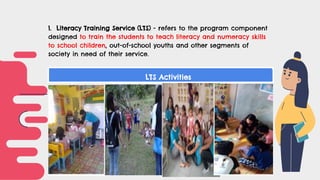
LTS Activities
1. Literacy Training Service (LTS) - refers to the program component
designed to train the students to teach literacy and numeracy skills
to school children, out-of-school youths and other segments of
society in need of their service.
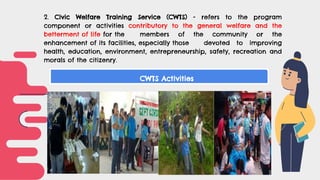
2. Civic Welfare Training Service (CWTS) - refers to the program
component or activities contributory to the general welfare and the
betterment of life for the members of the community or the
enhancement of its facilities, especially those devoted to improving
health, education, environment, entrepreneurship, safety, recreation and
morals of the citizenry.
CWTS Activities
3. Reserve Officers’ Training Corps (ROTC) - the program component,
designed to provide military training to tertiary level students in
order to motivate, train, organize and mobilize them for national
defense preparedness.
ROTC Activities
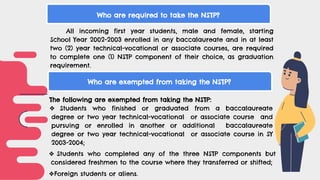
Who are required to take the NSTP?
All incoming first year students, male and female, starting
School Year 2002-2003 enrolled in any baccalaureate and in at least
two (2) year technical-vocational or associate courses, are required
to complete one (1) NSTP component of their choice, as graduation
requirement.
The following are exempted from taking the NSTP:
❖ Students who finished or graduated from a baccalaureate
degree or two year technical-vocational or associate course and
pursuing or enrolled in another or additional baccalaureate
degree or two year technical-vocational or associate course in SY
2003-2004;
Who are exempted from taking the NSTP?
❖ Students who completed any of the three NSTP components but
considered freshmen to the course where they transferred or shifted;
❖Foreign students or aliens.
What is the duration and equivalent course unit of each NSTP component?
Each NSTP component shall be undertaken for an academic period of two
(2)Semesters. Three (3) units per semester shall be credited to the students for
fifty four (54) to ninety (90) training hours. A One (1) Summer Program in lieu
of the two (2) semester program (108 hours) maybe offered in accordance to
the Department of National Defense (DND), Commission of Higher Education
(CHED) and Technical Education and Skills Development Authority (TESDA)
guidelines, subject to the capability of the school and the DND to do the same.
What NSTP components are offered in universities and colleges?
All higher technical-vocational institutions offer at least one of the
NSTP components. State universities on the other hand, are required to offer
the ROTC component in addition to at least one non-ROTC component.
Private Higher Education Institutions may also offer the ROTC component
provided they have at least 350 enrolled cadets.
How much fee will be charged for each NSTP component per semester ?
No fees shall be collected for any of the NSTP components
What will become of NSTP Graduates ?
Graduates of LTS and CWTS shall belong to the National Service Reserve
Corps (NSRC) and could be tapped by the State for literacy and civic
welfare activities, especially in times of calamities. On the other hand,
graduates of the ROTC program shall form part of the Citizen Armed
Force pursuant to RA 7077, subject to the requirements of DND.
https://nstp.upd.edu.ph/about-us/
Reading: Click and read the following links
Learning Activity 1.1
Name: ______________________________ Score: _______________________
Section: _____________________________ Facilitator: ___________________
Describe the salient provisions of the following Legal Bases of the NSTP Law and
draw a diagram to illustrate their contribution in the evolution of the National
Service Training Program
— Commonwealth Act No. 1 (National Defense Act-1935)
— PD 1706 (National Service Law-1980)
— RA 7077 (The Citizens Armed Forces of the Philippines Reservist Law)
— Article II, Sections 4 and 13 of the 1987 Philippine Constitution
https://www.officialgazette.gov.ph/2002/01/23/republic-act-no-9163/
Your output, should be submitted via Google Classroom on August 26, 2022.
Stay at Home, Keep Safe!
Thanks!

Module 1 - LTS - NSTP 1.pptx

  • 1.
  • 2.
    Module 1 :The National Service Training Program Learning Outcomes: After completion of the module, the students will be able to: 1. enumerate the legal bases of the National Service Training Program; 2. identify and explain vital provisions of the NSTP Law; 3. differentiate the scope of the three components of NSTP; 4. appreciate the importance of the National Service Training Program
  • 3.
    As stipulated inour Core Values, the University of Rizal System has an innate social responsibility to be of service in the development of its immediate and neighboring communities. Being part of the said communities, students could serve as the forerunners of community development. Thus, they should be equipped with proper knowledge, skills and values in order to be the catalysts of change. Introduction
  • 4.
    The National ServiceTraining Program (NSTP) is a mandatory program for tertiary level students established through Republic Act 9163 otherwise known as the National Service Training Program (NSTP) Act of 2001. RA 9163 was passed into law on December 19, 2001 and was approved by Her Excellency, President Gloria Macapagal Arroyo on January 23, 2002 in response to the clamor to reform the ROTC Program. NSTP implementation took effect on March 23, 2002.
  • 5.
    What is theNational Service Training Program (NSTP)? According to Section 3 of RA 9163, NSTP is a program aimed at enhancing the civic consciousness and defense preparedness in the youth by developing the ethics of service and patriotism by undergoing training in any of the three program components which are especially designed to enhance the youths active contribution to the general welfare. LESSON PROPER Salient Features of the NSTP Law
  • 6.
    Section 5 ofthe Implementing Rules and Regulation of RA 9163 provides that the NSTP shall have the following components that the students can choose from: What are the components of the NSTP ?
  • 7.
    LTS Activities 1. LiteracyTraining Service (LTS) - refers to the program component designed to train the students to teach literacy and numeracy skills to school children, out-of-school youths and other segments of society in need of their service.
  • 8.
    2. Civic WelfareTraining Service (CWTS) - refers to the program component or activities contributory to the general welfare and the betterment of life for the members of the community or the enhancement of its facilities, especially those devoted to improving health, education, environment, entrepreneurship, safety, recreation and morals of the citizenry. CWTS Activities
  • 9.
    3. Reserve Officers’Training Corps (ROTC) - the program component, designed to provide military training to tertiary level students in order to motivate, train, organize and mobilize them for national defense preparedness. ROTC Activities
  • 10.
    Who are requiredto take the NSTP? All incoming first year students, male and female, starting School Year 2002-2003 enrolled in any baccalaureate and in at least two (2) year technical-vocational or associate courses, are required to complete one (1) NSTP component of their choice, as graduation requirement. The following are exempted from taking the NSTP: ❖ Students who finished or graduated from a baccalaureate degree or two year technical-vocational or associate course and pursuing or enrolled in another or additional baccalaureate degree or two year technical-vocational or associate course in SY 2003-2004; Who are exempted from taking the NSTP? ❖ Students who completed any of the three NSTP components but considered freshmen to the course where they transferred or shifted; ❖Foreign students or aliens.
  • 11.
    What is theduration and equivalent course unit of each NSTP component? Each NSTP component shall be undertaken for an academic period of two (2)Semesters. Three (3) units per semester shall be credited to the students for fifty four (54) to ninety (90) training hours. A One (1) Summer Program in lieu of the two (2) semester program (108 hours) maybe offered in accordance to the Department of National Defense (DND), Commission of Higher Education (CHED) and Technical Education and Skills Development Authority (TESDA) guidelines, subject to the capability of the school and the DND to do the same. What NSTP components are offered in universities and colleges? All higher technical-vocational institutions offer at least one of the NSTP components. State universities on the other hand, are required to offer the ROTC component in addition to at least one non-ROTC component. Private Higher Education Institutions may also offer the ROTC component provided they have at least 350 enrolled cadets.
  • 12.
    How much feewill be charged for each NSTP component per semester ? No fees shall be collected for any of the NSTP components What will become of NSTP Graduates ? Graduates of LTS and CWTS shall belong to the National Service Reserve Corps (NSRC) and could be tapped by the State for literacy and civic welfare activities, especially in times of calamities. On the other hand, graduates of the ROTC program shall form part of the Citizen Armed Force pursuant to RA 7077, subject to the requirements of DND. https://nstp.upd.edu.ph/about-us/
  • 13.
    Reading: Click andread the following links Learning Activity 1.1 Name: ______________________________ Score: _______________________ Section: _____________________________ Facilitator: ___________________ Describe the salient provisions of the following Legal Bases of the NSTP Law and draw a diagram to illustrate their contribution in the evolution of the National Service Training Program — Commonwealth Act No. 1 (National Defense Act-1935) — PD 1706 (National Service Law-1980) — RA 7077 (The Citizens Armed Forces of the Philippines Reservist Law) — Article II, Sections 4 and 13 of the 1987 Philippine Constitution https://www.officialgazette.gov.ph/2002/01/23/republic-act-no-9163/ Your output, should be submitted via Google Classroom on August 26, 2022.
  • 14.
    Stay at Home,Keep Safe! Thanks!