ASPECTS OF CULTURE
THE COMPLEXITY OF CULTURE
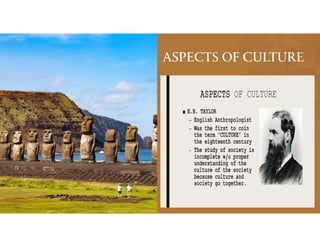
• CULTURE
• - is a people's way of life
• •“That complex whole, which
encompasses beliefs, practices, values,
attitudes, laws, norms, artifacts, symbols,
knowledge, and everything that a
person learns and shares as a member
of society.”- E.B. Taylor
The WHAT, HOW
and WHY of
CULTURE
• •“What” contains the actions, artifacts,
language, and behavior that characterize a
given culture.
• •“How” identifies the processes that
guarantee the transmission and
dissemination of the content.
• •“Why” pinpoints the reasons why
individuals comply and the mechanisms
that facilitate the performance of expected
behavior
Enculturation and
Culture Shock
ENCULTURATION
• •refers to a gradual acquisition of
the characteristics and norms of a
culture or group by a person,
another culture, etc.
• •starts with actual exposure to
another culture and the duration
and extent of exposure account for
the quality of the resulting
enculturation.
CULTURE SHOCK
• Is a good example of enculturation
• Individuals who have stayed for
quite a good portion of their lives
especially after the formative years
in a foreign culture maybe shocked
by their birth culture once exposed
to it again
• The shock created by their birth
culture is a product of their
enculturation in the second culture
ASPECTS OF CULTURE
DEFINITIONS OF CULTURE
•“ THE HANDIWORK OF MAN AND THE MEDIUM THROUGH WHICH HE
ACHIEVES HIS ENDS.”- B. MALINOWSKI
•“AN ORGANIZED BODY OF CONVENTIONAL UNDERSTANDINGS
MANIFEST IN ART WHICH PERSISTING THROUGH TRADITION,
CHARACTERIZES A HUMAN GROUP”- R. REDFIELD
•“THE BODY OF THOUGHT AND KNOWLEDGE, BOTH
THEORETICAL AND PRACTICAL, WHICH ONLY MAN CAN
POSSESS”- V. DE ROBERT
DEFINITIONS OF CULTURE
•“WAY OF LIFE”
•“DESIGNS FOR LIVING” •“A CULTURE IS A HISTORICALLY DERIVED
SYSTEM OF EXPLICIT AND IMPLICIT DESIGNS
FOR LIVING, WHICH TENDS TO BE SHARED BY
ALL ESPECIALLY DESIGNED MEMBERS OF A
GROUP.”- KLUCKHOHN AND KELLY
A PEOPLE'S SHARED WAYS OF
DOING AND THINKING
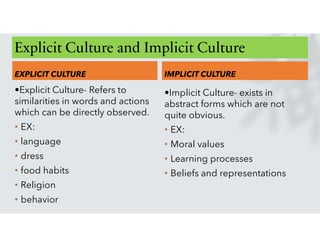
Explicit Culture and Implicit Culture
EXPLICIT CULTURE
•Explicit Culture- Refers to
similarities in words and actions
which can be directly observed.
• EX:
• language
• dress
• food habits
• Religion
• behavior
IMPLICIT CULTURE
•Implicit Culture- exists in
abstract forms which are not
quite obvious.
• EX:
• Moral values
• Learning processes
• Beliefs and representations
Three Essences
of Culture as a
System
•Super- organic -Culture is seen as something superior to
nature because nature serves as the ingredient of any
cultural productions.
•Integrated - Culture’s various parts are integrated with
each other and any new element which is introduced is also
integrated. This integrity of the culture system makes it
pervasive.
•Pervasive - It touches every aspect of life and is
manifested in two ways. Culture provides an unquestioned
context within which individual action and response take
place. Culture pervades social activities and institutions.
CHARACTERISTICS
OF CULTURE
• 1.Culture is social because it is the
product of behavior.
• 2.Culture varies from society to
society.
• 3.Culture is shared.
• 4.Culture is learned.
• 5.Culture is transmitted among
members of society.
• 6.Culture is continuous and
cumulative.
• 7.Culture is gratifying and idealistic.
FUNCTIONS OF
CULTURE
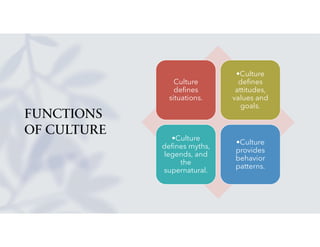
FUNCTIONS
OF CULTURE
Culture
defines
situations.
•Culture
defines
attitudes,
values and
goals.
•Culture
defines myths,
legends, and
the
supernatural.
•Culture
provides
behavior
patterns.
ETHNOCENTRISM
• ETHNO –Greek word, which refers to people, nation or cultural grouping
• CENTRIC –Latin word, which refers to center
• ETHNOCENTRISM – refers to the tendency of each society to place its own
culture patterns at the center of things
• is the practice of comparing other cultural practices with those of one's own
and automatically finding those other cultural practices to be inferior.
• It is the act of evaluating other cultures according to
preconceptions originating in the standards and customs of one's own culture
ETHNOCENTRISM
• -A term coined by William Graham Sumner
• A belief that your native culture is the most
natural or superior way of understanding the
world
• Is a universal human reaction found in all
known societies, in all groups and in
practically all individuals
FUNCTIONS OF
ETHNOCENTRISM
• 1. Ethnocentrism encourages
the solidarity of group.
• 2. Ethnocentrism hinders the
understanding or the
cooperation between groups.
• 3. Conflict of course leads to
social change.
Cultural relativism
• Is the idea that all norms, beliefs and values are
dependent on their cultural context and should
be treated as such
• Is a belief that maintains it does not matter
whether cultures are either equal or different
because equality and similarity do not
necessarily translate to real or imagined
inferiority/superiority of cultures out there
• Is also a research method whereby different
societies or cultures are analyzed objectively
without using the values of one culture to judge
the worth of another
ETHNOCENTRISM VS CULTURAL RELATIVISM
• Is judging other culture based on
the preconceptions originating in
the standards and customs of
one’s own culture
• Involves looking at another
culture from the perspective of
one’s own culture
• An ethnocentric individual will
believe that his culture is better,
‘correct’ and ‘normal’
• Is the notion that a culture should
be understood on its own terms,
not using standards of another
culture
• Involves looking at another
culture by its own perspective
instead of one’s own culture
• A person who believes in cultural
relativism understands that one
culture is not better than another
Xenocentrism and
Xenophobia
• XENOCENTRISM - refers to a
preference for the foreign
• - exact opposite of ethnocentrism
• XENOPHOBIA - is the fear of what
is perceived as foreign or strange
• - extreme dislike
or fear of foreigners, their customs,
their religions, etc.
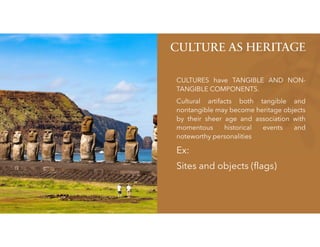
CULTURE AS HERITAGE
• CULTURES have TANGIBLE AND NON-
TANGIBLE COMPONENTS.
• Cultural artifacts both tangible and
nontangible may become heritage objects
by their sheer age and association with
momentous historical events and
noteworthy personalities
• Ex:
• Sites and objects (flags)

ASPECTS-OF-CULTURE.pdf

  • 1.
  • 2.
    THE COMPLEXITY OFCULTURE • CULTURE • - is a people's way of life • •“That complex whole, which encompasses beliefs, practices, values, attitudes, laws, norms, artifacts, symbols, knowledge, and everything that a person learns and shares as a member of society.”- E.B. Taylor
  • 3.
    The WHAT, HOW andWHY of CULTURE • •“What” contains the actions, artifacts, language, and behavior that characterize a given culture. • •“How” identifies the processes that guarantee the transmission and dissemination of the content. • •“Why” pinpoints the reasons why individuals comply and the mechanisms that facilitate the performance of expected behavior
  • 4.
  • 5.
    ENCULTURATION • •refers toa gradual acquisition of the characteristics and norms of a culture or group by a person, another culture, etc. • •starts with actual exposure to another culture and the duration and extent of exposure account for the quality of the resulting enculturation.
  • 6.
    CULTURE SHOCK • Isa good example of enculturation • Individuals who have stayed for quite a good portion of their lives especially after the formative years in a foreign culture maybe shocked by their birth culture once exposed to it again • The shock created by their birth culture is a product of their enculturation in the second culture
  • 7.
  • 8.
    DEFINITIONS OF CULTURE •“THE HANDIWORK OF MAN AND THE MEDIUM THROUGH WHICH HE ACHIEVES HIS ENDS.”- B. MALINOWSKI •“AN ORGANIZED BODY OF CONVENTIONAL UNDERSTANDINGS MANIFEST IN ART WHICH PERSISTING THROUGH TRADITION, CHARACTERIZES A HUMAN GROUP”- R. REDFIELD •“THE BODY OF THOUGHT AND KNOWLEDGE, BOTH THEORETICAL AND PRACTICAL, WHICH ONLY MAN CAN POSSESS”- V. DE ROBERT
  • 9.
    DEFINITIONS OF CULTURE •“WAYOF LIFE” •“DESIGNS FOR LIVING” •“A CULTURE IS A HISTORICALLY DERIVED SYSTEM OF EXPLICIT AND IMPLICIT DESIGNS FOR LIVING, WHICH TENDS TO BE SHARED BY ALL ESPECIALLY DESIGNED MEMBERS OF A GROUP.”- KLUCKHOHN AND KELLY A PEOPLE'S SHARED WAYS OF DOING AND THINKING
  • 10.
    Explicit Culture andImplicit Culture EXPLICIT CULTURE •Explicit Culture- Refers to similarities in words and actions which can be directly observed. • EX: • language • dress • food habits • Religion • behavior IMPLICIT CULTURE •Implicit Culture- exists in abstract forms which are not quite obvious. • EX: • Moral values • Learning processes • Beliefs and representations
  • 12.
    Three Essences of Cultureas a System •Super- organic -Culture is seen as something superior to nature because nature serves as the ingredient of any cultural productions. •Integrated - Culture’s various parts are integrated with each other and any new element which is introduced is also integrated. This integrity of the culture system makes it pervasive. •Pervasive - It touches every aspect of life and is manifested in two ways. Culture provides an unquestioned context within which individual action and response take place. Culture pervades social activities and institutions.
  • 13.
    CHARACTERISTICS OF CULTURE • 1.Cultureis social because it is the product of behavior. • 2.Culture varies from society to society. • 3.Culture is shared. • 4.Culture is learned. • 5.Culture is transmitted among members of society. • 6.Culture is continuous and cumulative. • 7.Culture is gratifying and idealistic.
  • 14.
  • 15.
    FUNCTIONS OF CULTURE Culture defines situations. •Culture defines attitudes, values and goals. •Culture definesmyths, legends, and the supernatural. •Culture provides behavior patterns.
  • 16.
    ETHNOCENTRISM • ETHNO –Greekword, which refers to people, nation or cultural grouping • CENTRIC –Latin word, which refers to center • ETHNOCENTRISM – refers to the tendency of each society to place its own culture patterns at the center of things • is the practice of comparing other cultural practices with those of one's own and automatically finding those other cultural practices to be inferior. • It is the act of evaluating other cultures according to preconceptions originating in the standards and customs of one's own culture
  • 17.
    ETHNOCENTRISM • -A termcoined by William Graham Sumner • A belief that your native culture is the most natural or superior way of understanding the world • Is a universal human reaction found in all known societies, in all groups and in practically all individuals
  • 18.
    FUNCTIONS OF ETHNOCENTRISM • 1.Ethnocentrism encourages the solidarity of group. • 2. Ethnocentrism hinders the understanding or the cooperation between groups. • 3. Conflict of course leads to social change.
  • 19.
    Cultural relativism • Isthe idea that all norms, beliefs and values are dependent on their cultural context and should be treated as such • Is a belief that maintains it does not matter whether cultures are either equal or different because equality and similarity do not necessarily translate to real or imagined inferiority/superiority of cultures out there • Is also a research method whereby different societies or cultures are analyzed objectively without using the values of one culture to judge the worth of another
  • 20.
    ETHNOCENTRISM VS CULTURALRELATIVISM • Is judging other culture based on the preconceptions originating in the standards and customs of one’s own culture • Involves looking at another culture from the perspective of one’s own culture • An ethnocentric individual will believe that his culture is better, ‘correct’ and ‘normal’ • Is the notion that a culture should be understood on its own terms, not using standards of another culture • Involves looking at another culture by its own perspective instead of one’s own culture • A person who believes in cultural relativism understands that one culture is not better than another
  • 21.
    Xenocentrism and Xenophobia • XENOCENTRISM- refers to a preference for the foreign • - exact opposite of ethnocentrism • XENOPHOBIA - is the fear of what is perceived as foreign or strange • - extreme dislike or fear of foreigners, their customs, their religions, etc.
  • 22.
    CULTURE AS HERITAGE •CULTURES have TANGIBLE AND NON- TANGIBLE COMPONENTS. • Cultural artifacts both tangible and nontangible may become heritage objects by their sheer age and association with momentous historical events and noteworthy personalities • Ex: • Sites and objects (flags)