 The success and credibility of the hotels depends
solely on their in-house professionally skilled team.
 Top quality service, with dedicated, trained,
intelligent, sincere, honest and motivated staff is what
is important for a hotel housekeeping department.
 This team succeeds in building and maintaining the
image and reputation of the hotel and creating and
sustaining regular and privileged guest visits.
 For providing excellent and satisfying quality service,
lot of effort has to be made towards organizing and
training the housekeeping staffs continuously.
 Additionally, the trained staff must be retained
ensuring the consistency and staff dedication remains
focused through various methods of training and
motivation.
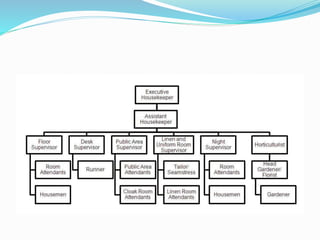
 The largest work force of the hotel is in the
housekeeping department.
 It would be appropriate at this stage to understand the
hierarchy, duties and responsibilities of all the
housekeeping staffs for effective communication and
coordination.
 The organizational structure of the housekeeping
department mainly depends on the activities and the
size of the hotel.
 1. Executive Housekeeper
 Responsible and accountable for the total cleanliness,
maintenance and aesthetic upkeep of the hotel.
 This is achieved with the resources of manpower,
materials, machines, money, space and time available
to him.
 2. Assistant Housekeeper
 May be one for each shift of a large hotel.
 He may be the housekeeper of a small hotel or the only
deputy to the Executive Housekeeper of a medium-
sized hotel.
 He manages the resources given by the Executive
Housekeeper to achieve the common objectives of
cleanliness, maintenance and attractiveness in a given
shift.
 His accountability normally ends on the completion of
his shift.
 3. Uniform Room Supervisor
 A non-management person solely responsible for
providing clean serviceable uniforms to the staff of the
hotel.
 As the hotel staff are all practically in uniforms his /
her task is enormous and demanding as h e / she has
to keep an inventory control on various stages of use,
such as, when sorted ones are handed over, or those
which are being washed or dry-cleaned in the laundry.
 4. Uniform Room Attendants
 The uniform supervisor is assisted by attendants who
actually do the issue of uniforms in e x c h a n g e f o r
soiled ones for onward transmission to the laundry.
 These attendants are in actual contact with the staff.
 5. Linen Room Supervisors
 A non-management person solely responsible for the
acquisition, storage, issue and cleanliness of linen in
its various forms.
 His job is a mammoth task because he keeps track of
all linen as they would number in thousands.
 6. Linen Room Attendant
 Assists the supervisor by actually issuing linen and
filling such records as necessary.
 7. Tailor / Seamstress
 Tailor or seamstress personnel are responsible for
stitching and mending t h e l i n e n and upholsterys.
 8. Helpers
 They are to be found both in Uniforms and linen
Rooms and do the physical work of transporting,
counting and bundling of uniforms and linen.
 9. Floor Supervisor
 Responsible for the cleanliness, maintenance and
presentability of the guest floors attached to him in a
shift.
 His scope encompasses guest rooms, corridors,
staircases and floor pantries of the allotted floor.
 10. Public Area Supervisor
 Responsible for the cleanliness, maintenance and
presentability of all public areas which include
restaurants, bars, banquet halls, garden,
administrative offices, shopping arcade, health club,
swimming pool, main entrances and car park areas.
 11. Room Attendants
 Known also as chamber maids or room boys.
 They do the actual cleaning of guest rooms and
bathrooms allotted to them.
 They are not responsible for the cleanliness of
corridors, guest elevators or floor pantries.
 12. Head Houseman
 Supervises the work allotted to Houseman, especially
those in public areas.
 In medium sized hotels he could be the person in
charge of housekeeping on night shifts.
 13. Housemen
 Usually handy men who do the heavy physical
cleaning required in guest rooms and public areas.
 Their job would include vacuuming, shifting of
furniture, cleaning of windows panes, mopping,
braising, sweeping, etc.
 14. Desk Control Supervisor
 Is the hub of information dissemination in housekeeping
and is thus the critical person in housekeeping operations.
 The Housekeeping Desk must be manned 24 hours as
guests and staff will contact this desk to transmit or receive
information.
 It is the Desk Control Supervisor who co-ordinates with the
front office for information on departure rooms and
handing over cleared rooms.
 The Desk also receives complaints on maintenance from
Housekeeping supervisors spread all over the hotel.
 15. Runner
 He is a person who goes from one guest room to
another collecting or delivering guest laundry.
 16. Cloak Room Attendants (UK)
 Cloak Room Attendants are boy or sometimes girl who
clean and maintain in public area guest toilets.
 Their responsibility is the supply of clean and dry
towels. Like: Bath Towels, Hand Towels, Bath Maths,
Face Towels, etc.
 17. Hat- Checkers ( Cloak Room Attender – USA)
 This is a service provided by superior hotels in cold
climates.
 A hat-check room is where hat and heavy overcoats are
deposited by guests as soon as they enter the hotel
lobby so as to spare them the inconvenience of
carrying them around in the hotel.
 The hat-checker would carefully label these guest
articles and hang and store them correctly so as to
return them to the guests when they are leaving the
hotel.
 18. Night Supervisor
 They handle all aspect of housekeeping at night
including desk control operations, issue of linen and
uniform in an emergency, etc.
 His area of activity extends over guest rooms, public
areas as also linen and uniform rooms.
 He is solely responsible and accountable at night for
smooth housekeeping through his night brigade and
has larger decision-making authority than other
supervisors as he is the housekeeper for the night.
 19. Horticulturist
 Many hotels may contract horticultural work to an outside
agency.
 However, a large number of large hotels have professionally
trained Horticulturists who maintain the gardens of the
hotels as well as supply flowers from the garden for interior
decorations and floral arrangements.
 Flowers are used in banquet functions, guest rooms,
restaurants, lobbies, offices, etc.
 The Horticulturist would have to ensure smooth supply of
flowers as well as assist the Housekeeper in flower
arrangements.
 20. Head Gardener
 Supervises the brigade of gardeners in maintaining
hotel garden and keeping them contemporary each
season.
 21. Gardeners
 Does the actual digging, planting, watering, etc. of
gardens on a day-to-day basis.

MTA -Unit 1 - Housekeeping organization

  • 2.
     The successand credibility of the hotels depends solely on their in-house professionally skilled team.  Top quality service, with dedicated, trained, intelligent, sincere, honest and motivated staff is what is important for a hotel housekeeping department.
  • 3.
     This teamsucceeds in building and maintaining the image and reputation of the hotel and creating and sustaining regular and privileged guest visits.
  • 4.
     For providingexcellent and satisfying quality service, lot of effort has to be made towards organizing and training the housekeeping staffs continuously.  Additionally, the trained staff must be retained ensuring the consistency and staff dedication remains focused through various methods of training and motivation.
  • 5.
     The largestwork force of the hotel is in the housekeeping department.  It would be appropriate at this stage to understand the hierarchy, duties and responsibilities of all the housekeeping staffs for effective communication and coordination.
  • 6.
     The organizationalstructure of the housekeeping department mainly depends on the activities and the size of the hotel.
  • 8.
     1. ExecutiveHousekeeper  Responsible and accountable for the total cleanliness, maintenance and aesthetic upkeep of the hotel.  This is achieved with the resources of manpower, materials, machines, money, space and time available to him.
  • 9.
     2. AssistantHousekeeper  May be one for each shift of a large hotel.  He may be the housekeeper of a small hotel or the only deputy to the Executive Housekeeper of a medium- sized hotel.  He manages the resources given by the Executive Housekeeper to achieve the common objectives of cleanliness, maintenance and attractiveness in a given shift.  His accountability normally ends on the completion of his shift.
  • 10.
     3. UniformRoom Supervisor  A non-management person solely responsible for providing clean serviceable uniforms to the staff of the hotel.  As the hotel staff are all practically in uniforms his / her task is enormous and demanding as h e / she has to keep an inventory control on various stages of use, such as, when sorted ones are handed over, or those which are being washed or dry-cleaned in the laundry.
  • 11.
     4. UniformRoom Attendants  The uniform supervisor is assisted by attendants who actually do the issue of uniforms in e x c h a n g e f o r soiled ones for onward transmission to the laundry.  These attendants are in actual contact with the staff.
  • 12.
     5. LinenRoom Supervisors  A non-management person solely responsible for the acquisition, storage, issue and cleanliness of linen in its various forms.  His job is a mammoth task because he keeps track of all linen as they would number in thousands.
  • 13.
     6. LinenRoom Attendant  Assists the supervisor by actually issuing linen and filling such records as necessary.
  • 14.
     7. Tailor/ Seamstress  Tailor or seamstress personnel are responsible for stitching and mending t h e l i n e n and upholsterys.
  • 15.
     8. Helpers They are to be found both in Uniforms and linen Rooms and do the physical work of transporting, counting and bundling of uniforms and linen.
  • 16.
     9. FloorSupervisor  Responsible for the cleanliness, maintenance and presentability of the guest floors attached to him in a shift.  His scope encompasses guest rooms, corridors, staircases and floor pantries of the allotted floor.
  • 17.
     10. PublicArea Supervisor  Responsible for the cleanliness, maintenance and presentability of all public areas which include restaurants, bars, banquet halls, garden, administrative offices, shopping arcade, health club, swimming pool, main entrances and car park areas.
  • 18.
     11. RoomAttendants  Known also as chamber maids or room boys.  They do the actual cleaning of guest rooms and bathrooms allotted to them.  They are not responsible for the cleanliness of corridors, guest elevators or floor pantries.
  • 19.
     12. HeadHouseman  Supervises the work allotted to Houseman, especially those in public areas.  In medium sized hotels he could be the person in charge of housekeeping on night shifts.
  • 20.
     13. Housemen Usually handy men who do the heavy physical cleaning required in guest rooms and public areas.  Their job would include vacuuming, shifting of furniture, cleaning of windows panes, mopping, braising, sweeping, etc.
  • 21.
     14. DeskControl Supervisor  Is the hub of information dissemination in housekeeping and is thus the critical person in housekeeping operations.  The Housekeeping Desk must be manned 24 hours as guests and staff will contact this desk to transmit or receive information.  It is the Desk Control Supervisor who co-ordinates with the front office for information on departure rooms and handing over cleared rooms.  The Desk also receives complaints on maintenance from Housekeeping supervisors spread all over the hotel.
  • 22.
     15. Runner He is a person who goes from one guest room to another collecting or delivering guest laundry.
  • 23.
     16. CloakRoom Attendants (UK)  Cloak Room Attendants are boy or sometimes girl who clean and maintain in public area guest toilets.  Their responsibility is the supply of clean and dry towels. Like: Bath Towels, Hand Towels, Bath Maths, Face Towels, etc.
  • 24.
     17. Hat-Checkers ( Cloak Room Attender – USA)  This is a service provided by superior hotels in cold climates.  A hat-check room is where hat and heavy overcoats are deposited by guests as soon as they enter the hotel lobby so as to spare them the inconvenience of carrying them around in the hotel.  The hat-checker would carefully label these guest articles and hang and store them correctly so as to return them to the guests when they are leaving the hotel.
  • 25.
     18. NightSupervisor  They handle all aspect of housekeeping at night including desk control operations, issue of linen and uniform in an emergency, etc.  His area of activity extends over guest rooms, public areas as also linen and uniform rooms.  He is solely responsible and accountable at night for smooth housekeeping through his night brigade and has larger decision-making authority than other supervisors as he is the housekeeper for the night.
  • 26.
     19. Horticulturist Many hotels may contract horticultural work to an outside agency.  However, a large number of large hotels have professionally trained Horticulturists who maintain the gardens of the hotels as well as supply flowers from the garden for interior decorations and floral arrangements.  Flowers are used in banquet functions, guest rooms, restaurants, lobbies, offices, etc.  The Horticulturist would have to ensure smooth supply of flowers as well as assist the Housekeeper in flower arrangements.
  • 27.
     20. HeadGardener  Supervises the brigade of gardeners in maintaining hotel garden and keeping them contemporary each season.
  • 28.
     21. Gardeners Does the actual digging, planting, watering, etc. of gardens on a day-to-day basis.