WELCOME TO
Basic - 1
Unit 1
UNIT 1 - VOCABULARY
❖ I’d like you to meet ….
❖ It’s a pleasure to meet you.
❖ Great to meet you.
❖ Just call me...
❖ How nice to meet you.
❖ Please call me...
❖ Who’s that?
❖ Good morning
❖ Where are you from?
❖ I’m from [Peru]?
❖ For real?
❖ She’s [fantastic]
❖ I think….
❖ What’s your phone number?
❖ Over there!
❖ What’s your occupation?
❖ Let’s say hello
❖ You don’t know?
Vocabulary UNIT 1
https://www.youtube.com/watch?v=k6tMgxne_bI-
VERB TO BE
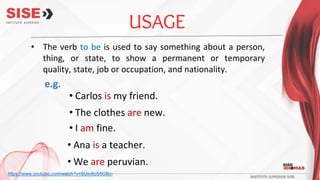
USAGE
e.g.
• The verb to be is used to say something about a person,
thing, or state, to show a permanent or temporary
quality, state, job or occupation, and nationality.
• Carlos is my friend.
• The clothes are new.
• I am fine.
• Ana is a teacher.
• We are peruvian.
https://www.youtube.com/watch?v=SUinXcS5GBc-
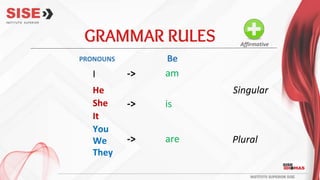
GRAMMAR RULES
am
You
We
They
-> is
->
PRONOUNS
Affirmative
I
He
She
It
->
are
Singular
Plural
Be
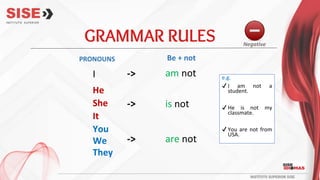
GRAMMAR RULES
am not
You
We
They
-> is not
->
PRONOUNS
Negative
I
He
She
It
->
are not
Be + not
e.g.
✔ I am not a
student.
✔ He is not my
classmate.
✔ You are not from
USA.
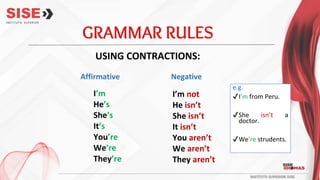
USING CONTRACTIONS:
GRAMMAR RULES
Affirmative
I’m
He’s
She’s
It’s
You’re
We’re
They’re
I’m not
He isn’t
She isn’t
It isn’t
You aren’t
We aren’t
They aren’t
Negative
e.g.
✔I’m from Peru.
✔She isn’t a
doctor.
✔We’re strudents.
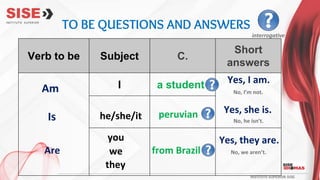
Verb to be Subject C.
Short
answers
I a student
Am
Is
Are
Yes, I am.
Yes, she is.
peruvian
Yes, they are.
you
we
he/she/it
TO BE QUESTIONS AND ANSWERS
interrogative
No, I’m not.
No, he isn’t.
they
from Brazil No, we aren’t.
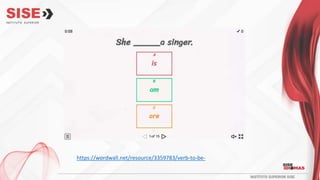
https://wordwall.net/resource/3359783/verb-to-be-
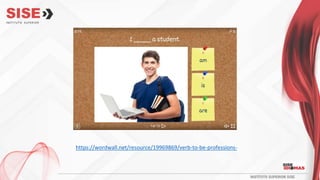
https://wordwall.net/resource/19969869/verb-to-be-professions-
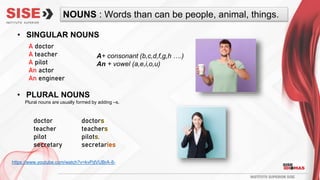
• SINGULAR NOUNS
• PLURAL NOUNS
Plural nouns are usually formed by adding –s.
NOUNS : Words than can be people, animal, things.
doctor doctors
teacher teachers
pilot pilots.
secretary secretaries
A doctor
A teacher
A pilot
An actor
An engineer
A+ consonant (b,c,d,f,g,h ….)
An + vowel (a,e,i,o,u)
https://www.youtube.com/watch?v=kvPdVUBrA-8-
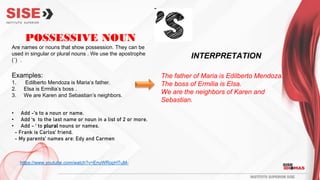
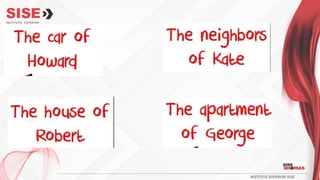
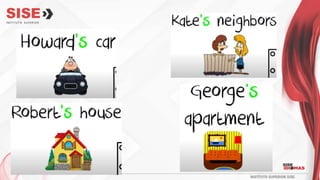
POSSESSIVE NOUN
Are names or nouns that show possession. They can be
used in singular or plural nouns . We use the apostrophe
(´) .
Examples:
1. Edilberto Mendoza is Maria’s father.
2. Elsa is Ermilia’s boss .
3. We are Karen and Sebastian’s neighbors.
• Add -’s to a noun or name.
• Add ‘s to the last name or noun in a list of 2 or more.
• Add - ‘ to plural nouns or names.
- Frank is Carlos’ friend.
- My parents’ names are: Edy and Carmen
The father of Maria is Edilberto Mendoza.
The boss of Ermilia is Elsa.
We are the neighbors of Karen and
Sebastian.
INTERPRETATION
https://www.youtube.com/watch?v=EnyWRopHTuM-
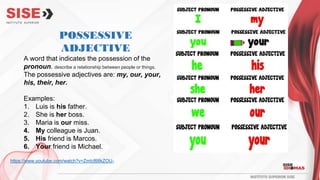
POSSESSIVE
ADJECTIVE
A word that indicates the possession of the
pronoun. describe a relationship between people or things.
The possessive adjectives are: my, our, your,
his, their, her.
Examples:
1. Luis is his father.
2. She is her boss.
3. Maria is our miss.
4. My colleague is Juan.
5. His friend is Marcos.
6. Your friend is Michael.
https://www.youtube.com/watch?v=ZmIcf68kZOU-
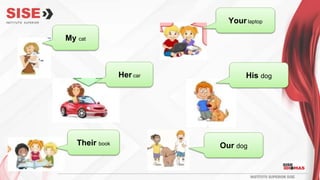
My cat
Your laptop
Her car His dog
Our dog
Their book
Wh- Questions
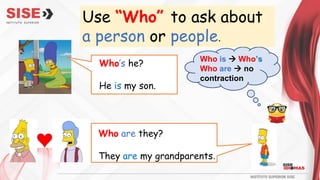
Use “Who” to ask about
a person or people.
Who’s he?
He is my son.
Who are they?
They are my grandparents.
Who is  Who’s
Who are  no
contraction
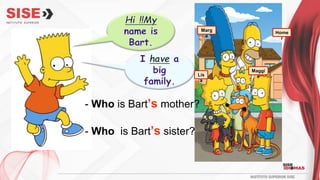
Home
r
Marg
e
Maggi
e
Lis
a
- Who is Bart’s mother?
- Who is Bart’s sister?
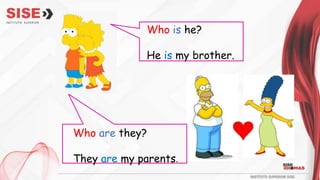
Who is he?
He is my brother.
Who are they?
They are my parents.
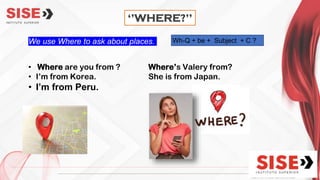
‘’WHERE?’’
We use Where to ask about places.
• Where are you from ? Where’s Valery from?
• I’m from Korea. She is from Japan.
• I’m from Peru.
Wh-Q + be + Subject + C ?
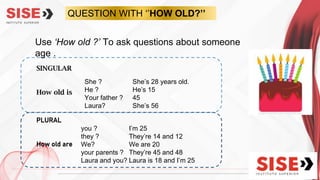
QUESTION WITH ‘’HOW OLD?’’
Use ‘How old ?’ To ask questions about someone
age .
SINGULAR
How old is
She ? She’s 28 years old.
He ? He’s 15
Your father ? 45
Laura? She’s 56
PLURAL
How old are
you ? I’m 25
they ? They’re 14 and 12
We? We are 20
your parents ? They’re 45 and 48
Laura and you? Laura is 18 and I’m 25
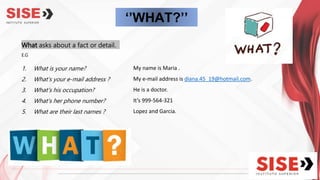
‘’WHAT?’’
What asks about a fact or detail.
E.G
1. What is your name?
2. What’s your e-mail address ?
3. What’s his occupation?
4. What's her phone number?
5. What are their last names ?
My name is Maria .
My e-mail address is diana.45_19@hotmail.com.
He is a doctor.
It’s 999-564-321
Lopez and Garcia.
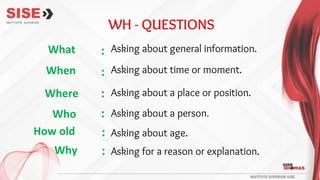
WH - QUESTIONS
What
When
Where
Who
How old
Why
Asking about general information.
Asking about time or moment.
Asking about a place or position.
Asking about a person.
Asking about age.
Asking for a reason or explanation.
:
:
:
:
:
:
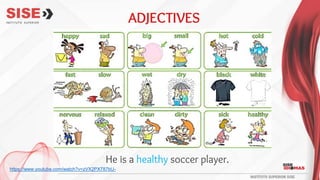
ADJECTIVES
He is a healthy soccer player.
https://www.youtube.com/watch?v=zVX2PX787bU-
LET’S
PRACTICE!
REFERENCES
Saslow, J. & Ascher, A. (2015). Top Notch: English for Today’s World Level 1 (3rd ed.) [ebook]. Pearson
Education.
Teacher Luis Brandâo Brandao (2018). To be in songs [Video]. YouTube.
https://www.engames.eu/there-is-there-are-in-questions/
Woodward English (2019). Adjetivos - Opuestos [Video]. YouTube.
https://www.youtube.com/watch?v=d2RuO_fseyM
Wordwall. Verb to be. From https://wordwall.net/resource/3359783/verb-to-be
Wordwall. Verb to be (professions). From https://wordwall.net/resource/19969869/verb-to-be-professions
THANK YOU

BÁSICO-1-UNIT-1.pptx

  • 1.
  • 2.
    UNIT 1 -VOCABULARY
  • 3.
    ❖ I’d likeyou to meet …. ❖ It’s a pleasure to meet you. ❖ Great to meet you. ❖ Just call me... ❖ How nice to meet you. ❖ Please call me... ❖ Who’s that? ❖ Good morning ❖ Where are you from? ❖ I’m from [Peru]? ❖ For real? ❖ She’s [fantastic] ❖ I think…. ❖ What’s your phone number? ❖ Over there! ❖ What’s your occupation? ❖ Let’s say hello ❖ You don’t know? Vocabulary UNIT 1 https://www.youtube.com/watch?v=k6tMgxne_bI-
  • 4.
  • 5.
    USAGE e.g. • The verbto be is used to say something about a person, thing, or state, to show a permanent or temporary quality, state, job or occupation, and nationality. • Carlos is my friend. • The clothes are new. • I am fine. • Ana is a teacher. • We are peruvian. https://www.youtube.com/watch?v=SUinXcS5GBc-
  • 6.
  • 7.
    GRAMMAR RULES am not You We They ->is not -> PRONOUNS Negative I He She It -> are not Be + not e.g. ✔ I am not a student. ✔ He is not my classmate. ✔ You are not from USA.
  • 8.
    USING CONTRACTIONS: GRAMMAR RULES Affirmative I’m He’s She’s It’s You’re We’re They’re I’mnot He isn’t She isn’t It isn’t You aren’t We aren’t They aren’t Negative e.g. ✔I’m from Peru. ✔She isn’t a doctor. ✔We’re strudents.
  • 9.
    Verb to beSubject C. Short answers I a student Am Is Are Yes, I am. Yes, she is. peruvian Yes, they are. you we he/she/it TO BE QUESTIONS AND ANSWERS interrogative No, I’m not. No, he isn’t. they from Brazil No, we aren’t.
  • 10.
  • 11.
  • 12.
    • SINGULAR NOUNS •PLURAL NOUNS Plural nouns are usually formed by adding –s. NOUNS : Words than can be people, animal, things. doctor doctors teacher teachers pilot pilots. secretary secretaries A doctor A teacher A pilot An actor An engineer A+ consonant (b,c,d,f,g,h ….) An + vowel (a,e,i,o,u) https://www.youtube.com/watch?v=kvPdVUBrA-8-
  • 13.
    POSSESSIVE NOUN Are namesor nouns that show possession. They can be used in singular or plural nouns . We use the apostrophe (´) . Examples: 1. Edilberto Mendoza is Maria’s father. 2. Elsa is Ermilia’s boss . 3. We are Karen and Sebastian’s neighbors. • Add -’s to a noun or name. • Add ‘s to the last name or noun in a list of 2 or more. • Add - ‘ to plural nouns or names. - Frank is Carlos’ friend. - My parents’ names are: Edy and Carmen The father of Maria is Edilberto Mendoza. The boss of Ermilia is Elsa. We are the neighbors of Karen and Sebastian. INTERPRETATION https://www.youtube.com/watch?v=EnyWRopHTuM-
  • 17.
    POSSESSIVE ADJECTIVE A word thatindicates the possession of the pronoun. describe a relationship between people or things. The possessive adjectives are: my, our, your, his, their, her. Examples: 1. Luis is his father. 2. She is her boss. 3. Maria is our miss. 4. My colleague is Juan. 5. His friend is Marcos. 6. Your friend is Michael. https://www.youtube.com/watch?v=ZmIcf68kZOU-
  • 18.
    My cat Your laptop Hercar His dog Our dog Their book
  • 19.
  • 20.
    Use “Who” toask about a person or people. Who’s he? He is my son. Who are they? They are my grandparents. Who is  Who’s Who are  no contraction
  • 21.
    Home r Marg e Maggi e Lis a - Who isBart’s mother? - Who is Bart’s sister?
  • 22.
    Who is he? Heis my brother. Who are they? They are my parents.
  • 23.
    ‘’WHERE?’’ We use Whereto ask about places. • Where are you from ? Where’s Valery from? • I’m from Korea. She is from Japan. • I’m from Peru. Wh-Q + be + Subject + C ?
  • 24.
    QUESTION WITH ‘’HOWOLD?’’ Use ‘How old ?’ To ask questions about someone age . SINGULAR How old is She ? She’s 28 years old. He ? He’s 15 Your father ? 45 Laura? She’s 56 PLURAL How old are you ? I’m 25 they ? They’re 14 and 12 We? We are 20 your parents ? They’re 45 and 48 Laura and you? Laura is 18 and I’m 25
  • 25.
    ‘’WHAT?’’ What asks abouta fact or detail. E.G 1. What is your name? 2. What’s your e-mail address ? 3. What’s his occupation? 4. What's her phone number? 5. What are their last names ? My name is Maria . My e-mail address is diana.45_19@hotmail.com. He is a doctor. It’s 999-564-321 Lopez and Garcia.
  • 26.
    WH - QUESTIONS What When Where Who Howold Why Asking about general information. Asking about time or moment. Asking about a place or position. Asking about a person. Asking about age. Asking for a reason or explanation. : : : : : :
  • 27.
    ADJECTIVES He is ahealthy soccer player. https://www.youtube.com/watch?v=zVX2PX787bU-
  • 28.
  • 29.
    REFERENCES Saslow, J. &Ascher, A. (2015). Top Notch: English for Today’s World Level 1 (3rd ed.) [ebook]. Pearson Education. Teacher Luis Brandâo Brandao (2018). To be in songs [Video]. YouTube. https://www.engames.eu/there-is-there-are-in-questions/ Woodward English (2019). Adjetivos - Opuestos [Video]. YouTube. https://www.youtube.com/watch?v=d2RuO_fseyM Wordwall. Verb to be. From https://wordwall.net/resource/3359783/verb-to-be Wordwall. Verb to be (professions). From https://wordwall.net/resource/19969869/verb-to-be-professions
  • 30.