MEANING AND DEFINITION OF
ECONOMICS
By karthik
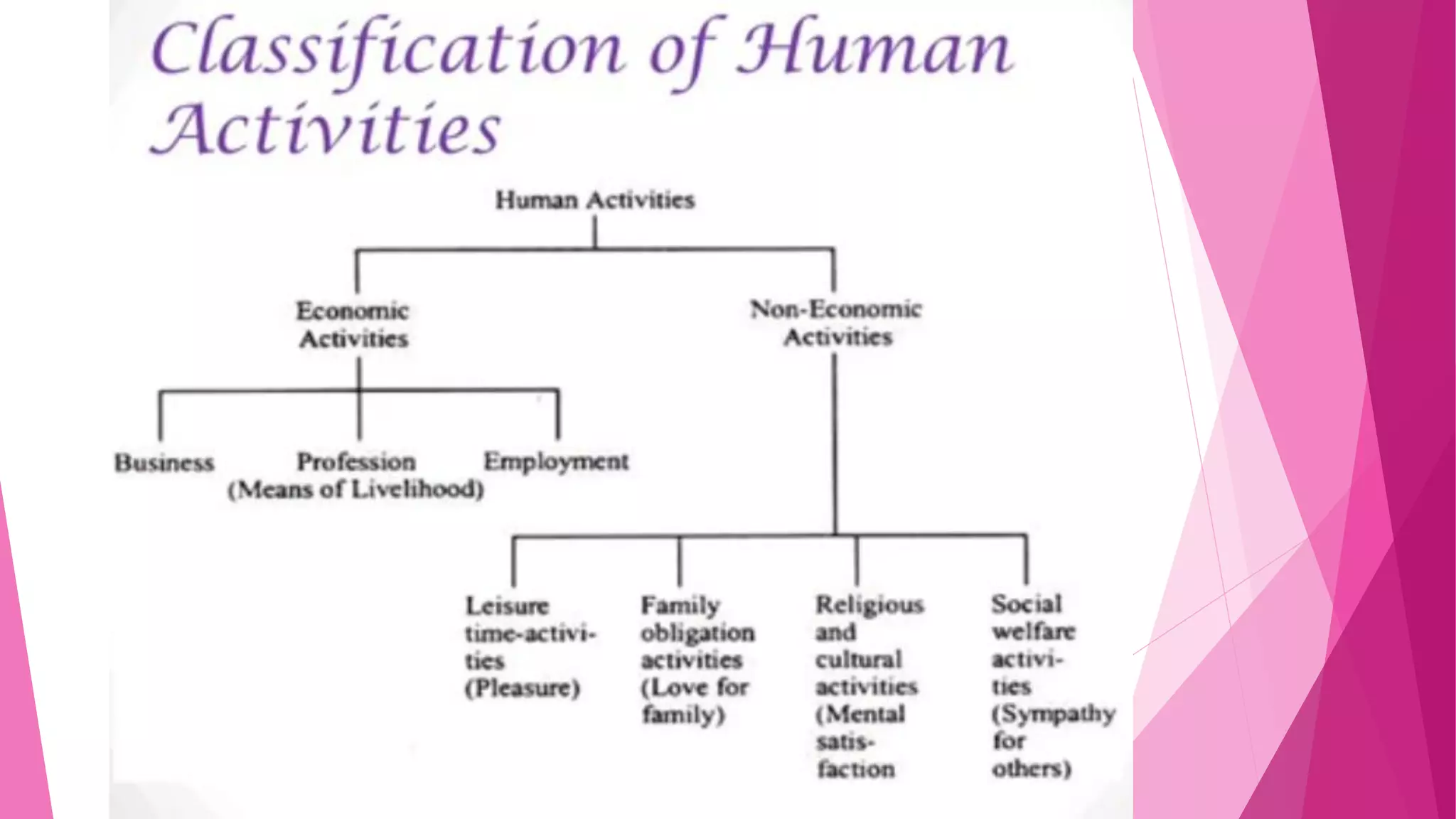
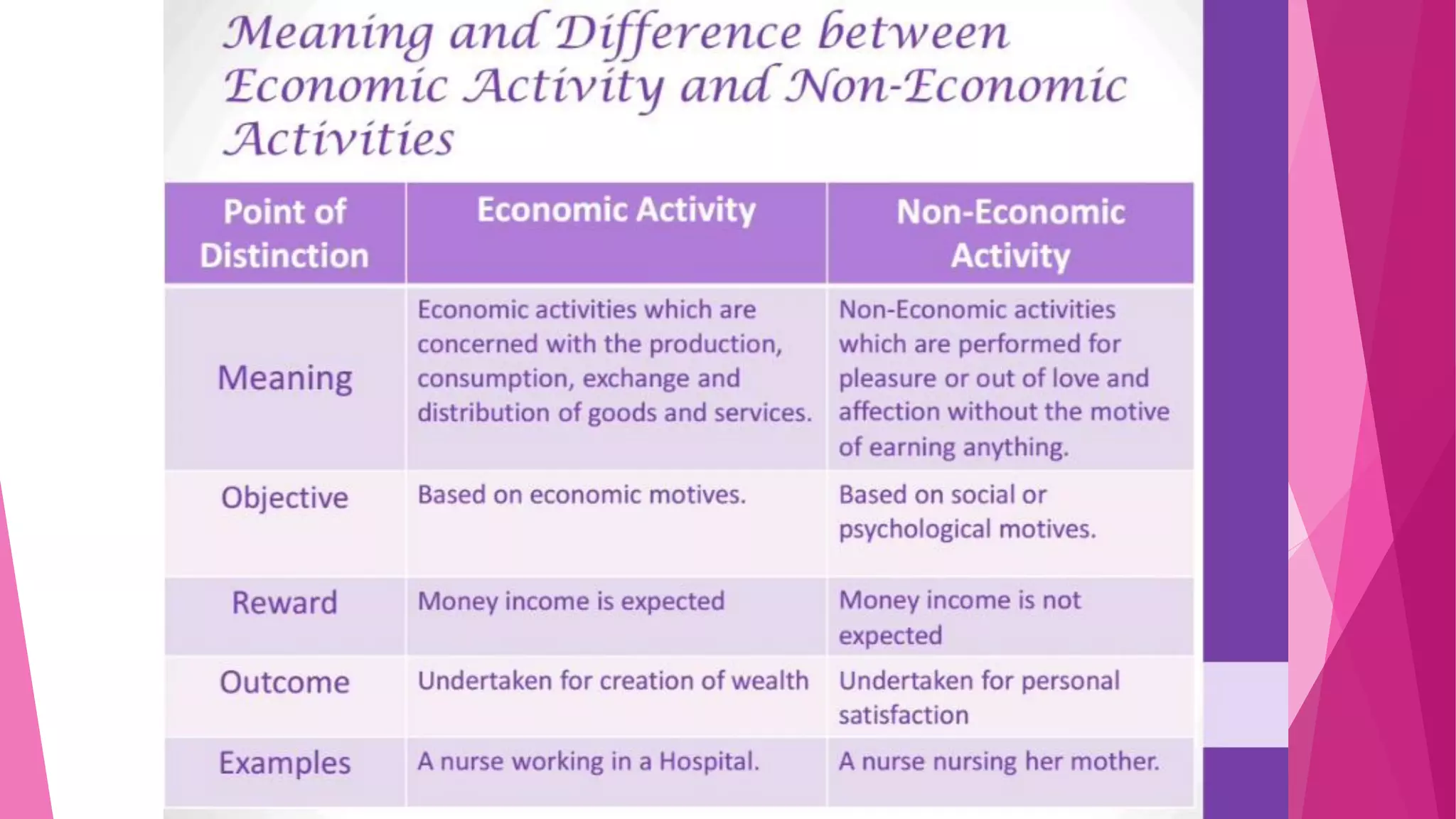
ECONOMIC ACTIVITIES
• It is an activity concerned with the production,
consumption, distribution and exchange of
economic goods.
• Economic activities refer to those activities
which are concerned with money or wealth.
• Economic activities are supposed to satisfy
human wants
• Non economic activities are those which are not
concerned with money or wealth (no economic
aspect)
• Examples of non economic activities include
• Social activities like birthday parties
• Political activities like congress assembly
• Religious activities like worship of god
• Charitable activities like helping poor or disabled
persons
• Parental activities like buying children toys
• Recreational activities like watching T.V.
NON ECONOMIC ACTIVITIES
HUMAN LIFE IS FULL OF ACTIVITIES THAT CAN BE
CLASSIFIED INTO 2 TYPES
DEFINITION OF ECONOMICS
• Generally economics is defined as the
social science that studies economic
activities
• Term economics comes from the Greek
word “okios” which means household and
“nomous” which means management.
• Economics is the management of
households with limited funds.
• Economics studies the ways and means In
which people organize themselves to
tackle the problems of scarcity.
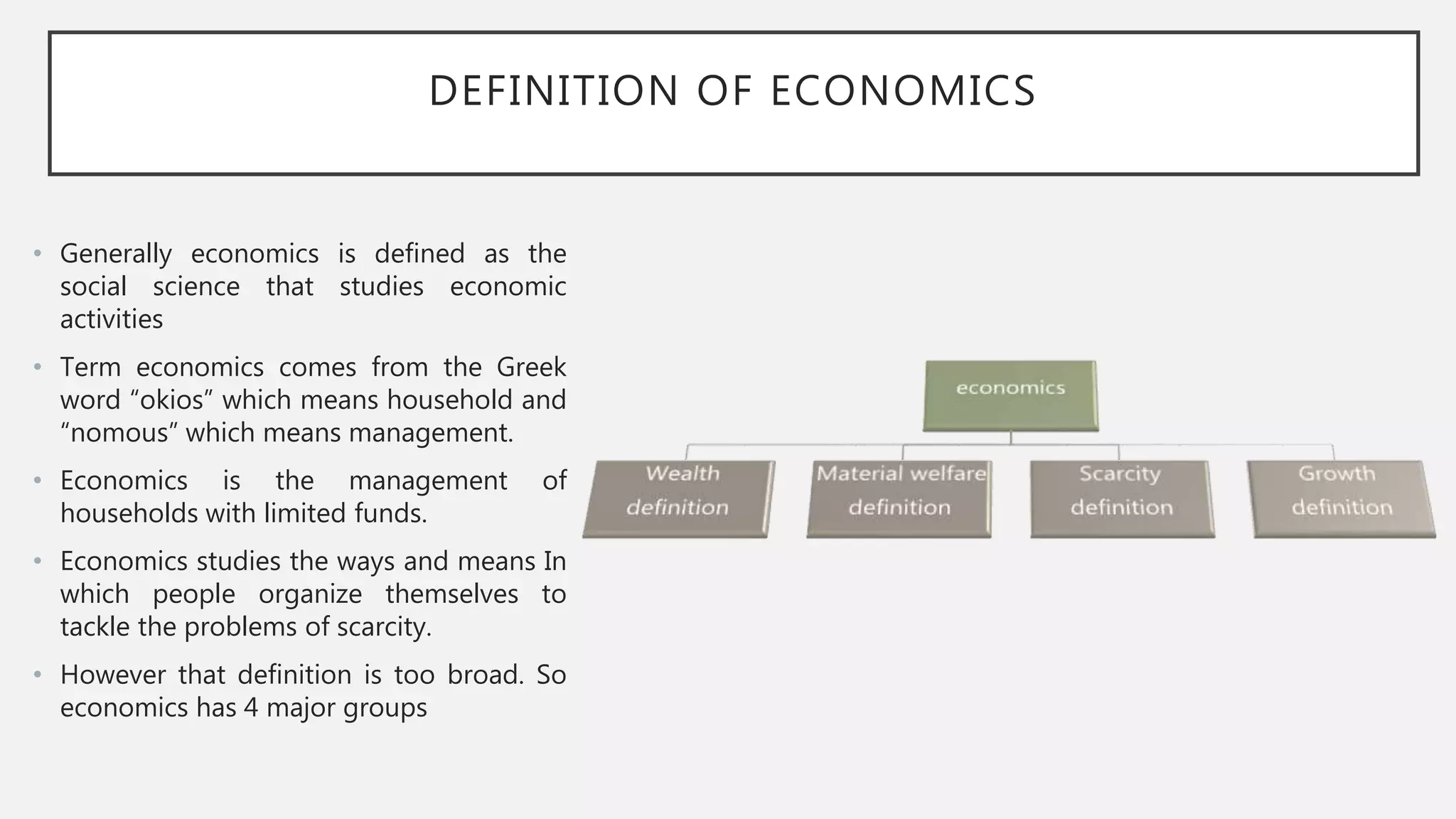
• However that definition is too broad. So
economics has 4 major groups
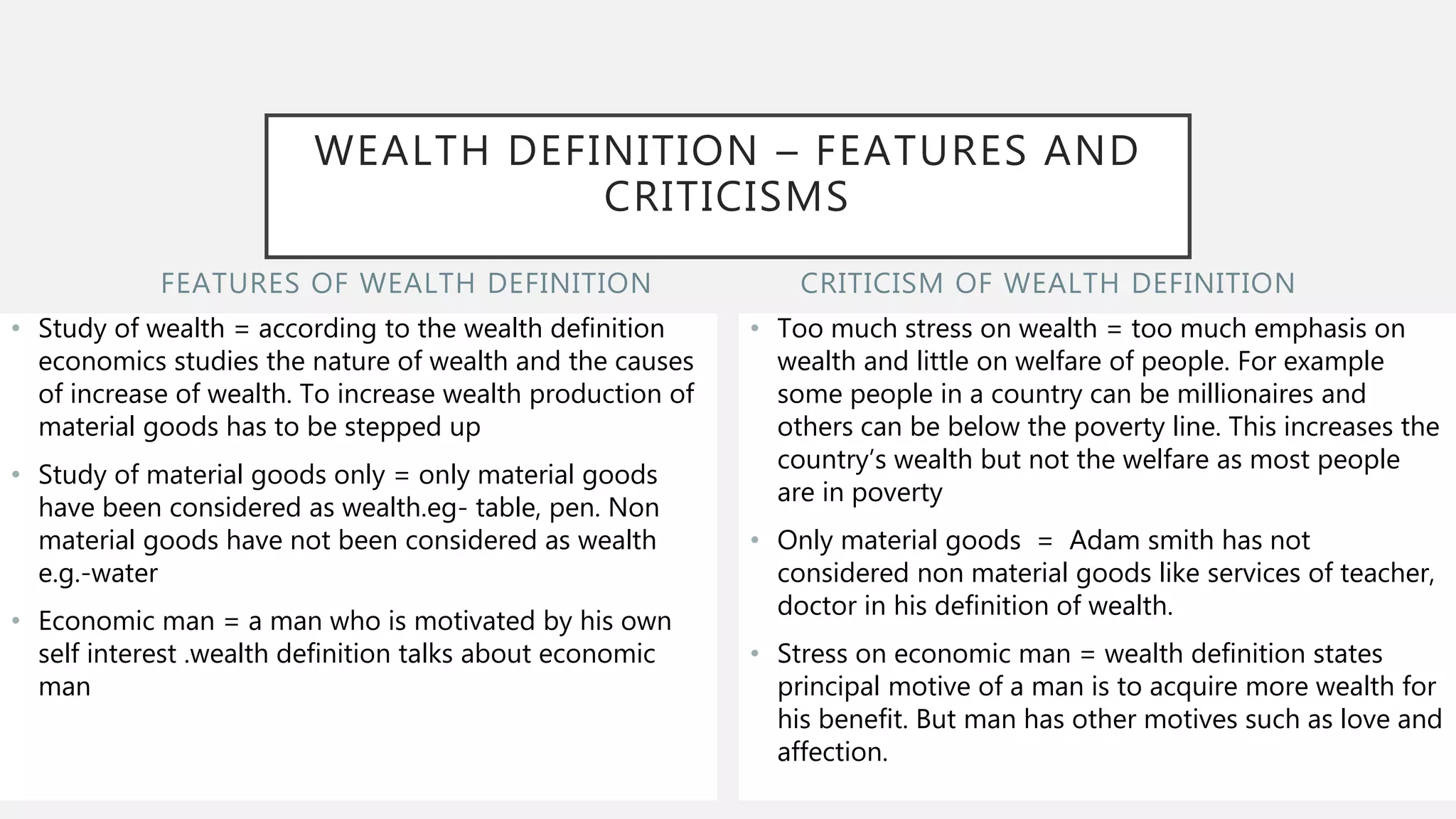
WEALTH DEFINITION
• Adam smith is the father of economics and he defined the wealth definition.
• He defined economics as the production and consumption of wealth in his book “enquiry into the nature and
study of causes of wealth of nations”
• Defined economics as the science of wealth
• He assumes that the wealthier a nation is the happier its citizens are.
• He does not include money into his meaning of wealth as it is only a medium of exchange of goods and
services
• According to him wealth is the annual produce of labor and land of society.
FEATURES OF WEALTH DEFINITION
• Study of wealth = according to the wealth definition
economics studies the nature of wealth and the causes
of increase of wealth. To increase wealth production of
material goods has to be stepped up
• Study of material goods only = only material goods
have been considered as wealth.eg- table, pen. Non
material goods have not been considered as wealth
e.g.-water
• Economic man = a man who is motivated by his own
self interest .wealth definition talks about economic
man
• Too much stress on wealth = too much emphasis on
wealth and little on welfare of people. For example
some people in a country can be millionaires and
others can be below the poverty line. This increases the
country’s wealth but not the welfare as most people
are in poverty
• Only material goods = Adam smith has not
considered non material goods like services of teacher,
doctor in his definition of wealth.
• Stress on economic man = wealth definition states
principal motive of a man is to acquire more wealth for
his benefit. But man has other motives such as love and
affection.
CRITICISM OF WEALTH DEFINITION
WEALTH DEFINITION – FEATURES AND
CRITICISMS
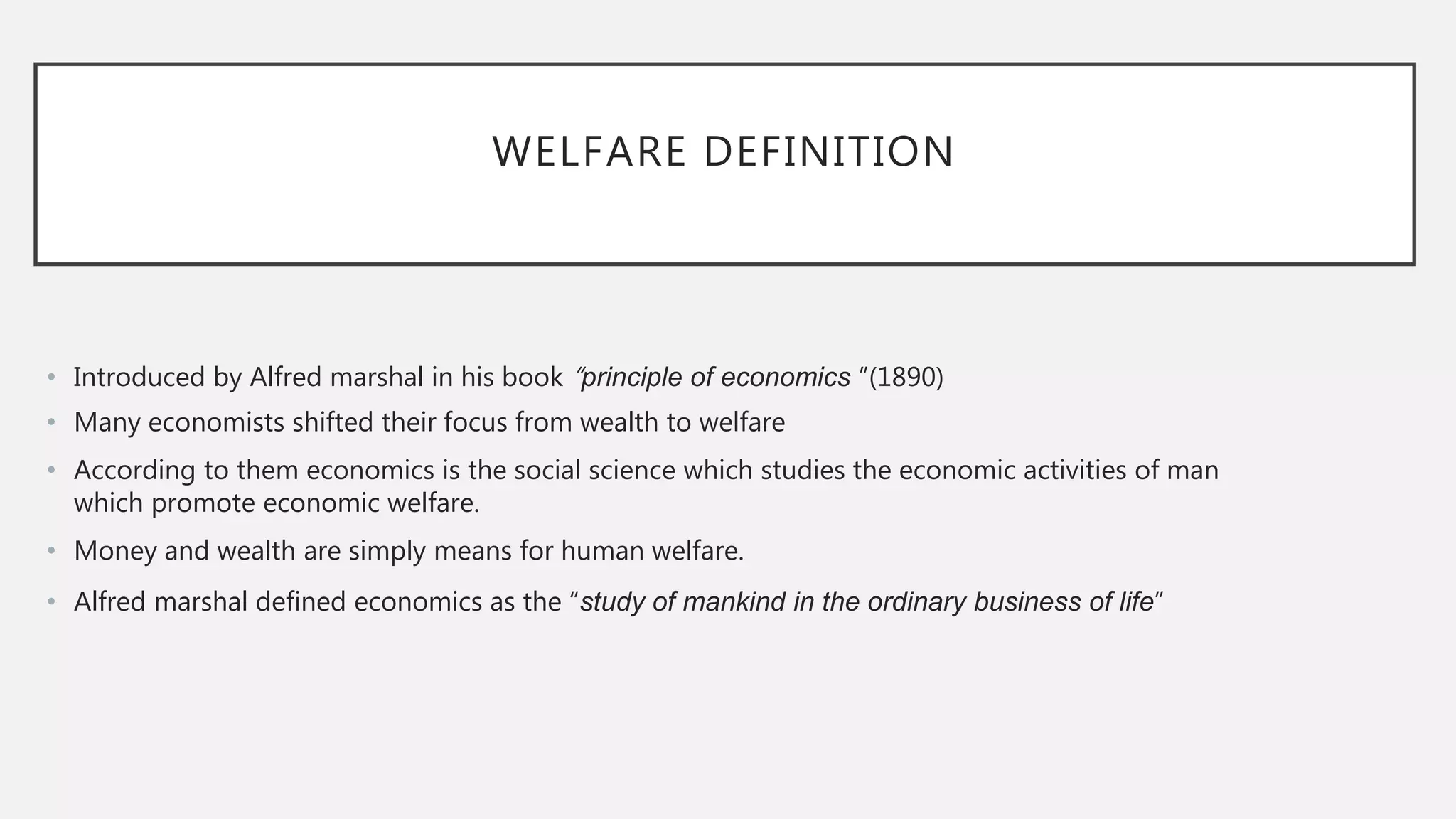
WELFARE DEFINITION
• Introduced by Alfred marshal in his book “principle of economics ”(1890)
• Many economists shifted their focus from wealth to welfare
• According to them economics is the social science which studies the economic activities of man
which promote economic welfare.
• Money and wealth are simply means for human welfare.
• Alfred marshal defined economics as the “study of mankind in the ordinary business of life”
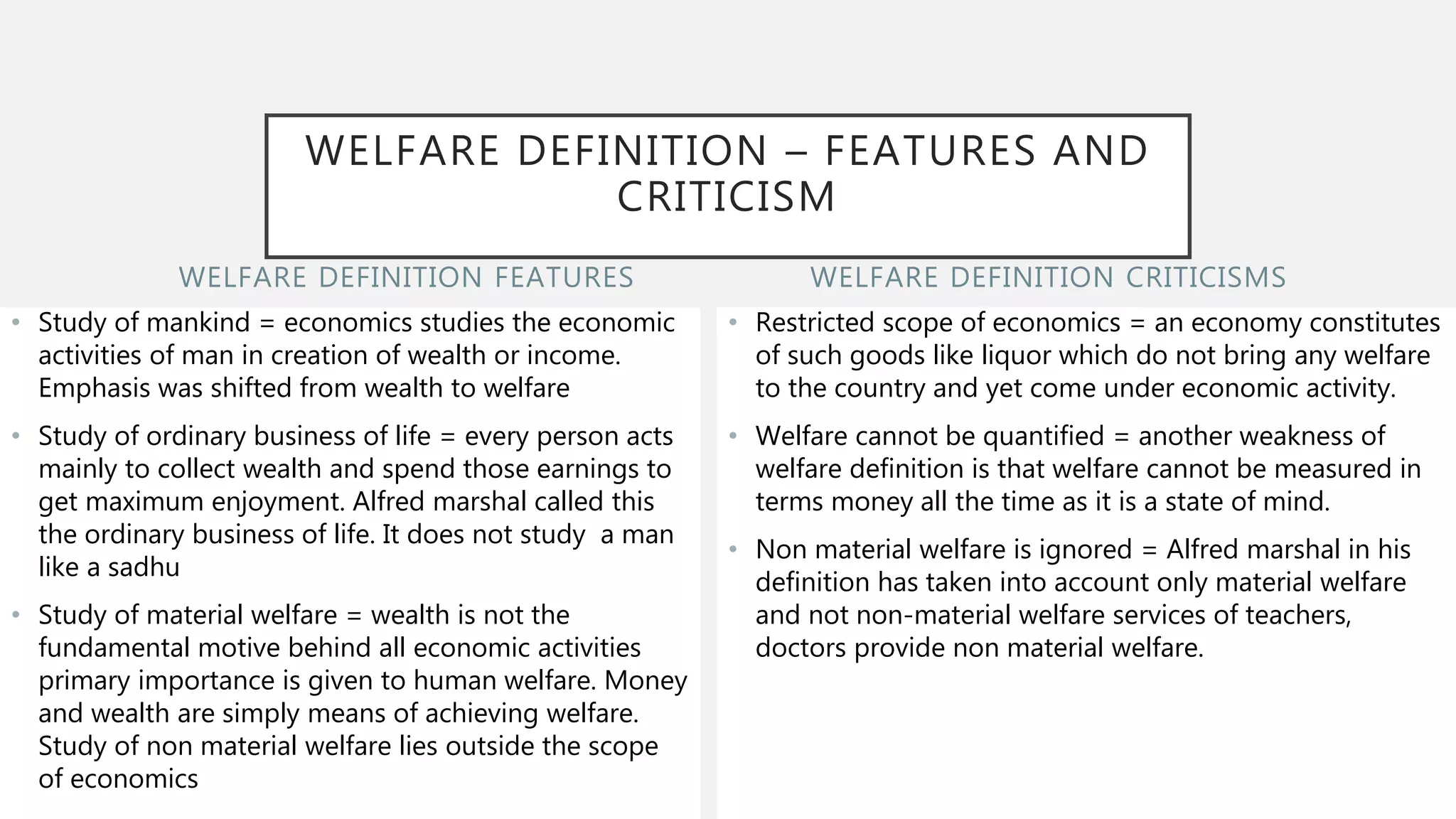
WELFARE DEFINITION FEATURES
• Study of mankind = economics studies the economic
activities of man in creation of wealth or income.
Emphasis was shifted from wealth to welfare
• Study of ordinary business of life = every person acts
mainly to collect wealth and spend those earnings to
get maximum enjoyment. Alfred marshal called this
the ordinary business of life. It does not study a man
like a sadhu
• Study of material welfare = wealth is not the
fundamental motive behind all economic activities
primary importance is given to human welfare. Money
and wealth are simply means of achieving welfare.
Study of non material welfare lies outside the scope
of economics
• Restricted scope of economics = an economy constitutes
of such goods like liquor which do not bring any welfare
to the country and yet come under economic activity.
• Welfare cannot be quantified = another weakness of
welfare definition is that welfare cannot be measured in
terms money all the time as it is a state of mind.
• Non material welfare is ignored = Alfred marshal in his
definition has taken into account only material welfare
and not non-material welfare services of teachers,
doctors provide non material welfare.
WELFARE DEFINITION CRITICISMS
WELFARE DEFINITION – FEATURES AND
CRITICISM
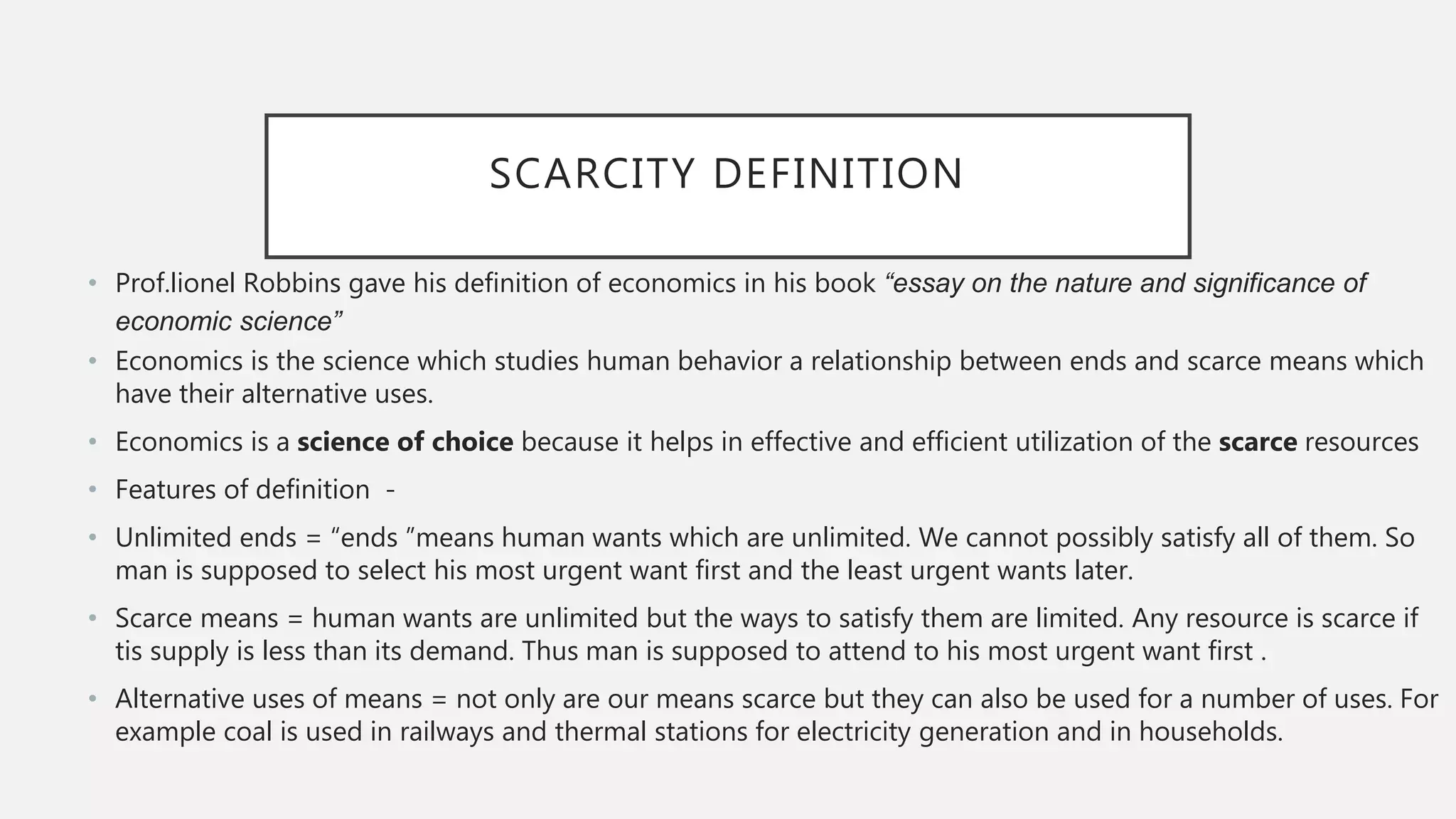
SCARCITY DEFINITION
• Prof.lionel Robbins gave his definition of economics in his book “essay on the nature and significance of
economic science”
• Economics is the science which studies human behavior a relationship between ends and scarce means which
have their alternative uses.
• Economics is a science of choice because it helps in effective and efficient utilization of the scarce resources
• Features of definition -
• Unlimited ends = “ends ”means human wants which are unlimited. We cannot possibly satisfy all of them. So
man is supposed to select his most urgent want first and the least urgent wants later.
• Scarce means = human wants are unlimited but the ways to satisfy them are limited. Any resource is scarce if
tis supply is less than its demand. Thus man is supposed to attend to his most urgent want first .
• Alternative uses of means = not only are our means scarce but they can also be used for a number of uses. For
example coal is used in railways and thermal stations for electricity generation and in households.
SUPERIORITY OF SCARCITY DEFINITION
• More scientific = Robbins regarded economics as a
science that has nothing to do with the goodness or
badness of an economic activity. It is only concerned
with scarcity of resources and unlimited wants.
• (optional)Analytical definition = Robbins definition is
more analytical. he gave the root cause of economic
problems which forms subject and matter of economics
• (optional)Universal definition = Robbins definition is a
universal one as the problem of scarcity lies in every
economy rich or poor traditional or modern.
• Wider scope = economics is a human science and not
just a social science. This is because problem of choice
is faded by an individual irrespective if he is in isolation
or in a community.
• Not applicable to rich countries = the economic
problem for rich nation is to maintain a high level o
consumption an equal distribution.
• Neutrality towards ends = if we accept wants to be
economically neutral the study of economics will be of
no use. we are interested only in science that can solve
our economic problems.
• Contradictory = Robbins has conflicted with himself as
on one hand he regards economics as neutral towards
wants(there are no good or bad wants (ends)) while he
considers economics as the science of choice.
(using resources to get maximum benefit)
CRITICISMS OF SCARCITY DEFINITION
SCARCITY DEFINITION
GROWTH DEFINITION
• Samuelson gave a growth oriented definition of economics.
• economics is the study of how man and society choose
• with or without the use of money
• to employ the scarce productive resources,
• which could have alternate uses
• to produce various commodities over time
• To distribute them now and for future among various groups of people and society for consumption
FEATURES OF GROWTH DEFINITION
• Efficient allocation of resources = the definition lays stress on the allocation of
resources but also on their proper utilization so that more wants could be satisfied
• Growth of resources = according to samuelson available resources should not only be
used properly but efforts should be made to increase them so as to satisfy ever
increasing wants
• Solutions to economic problems = economics should not only identify problems but
should also be able to solve them.
• Dynamism = economic growth is measured in terms of national product overtime.
This definition lays that economics is concerned with determining the pattern of
employment of scarce resources to produce goods over time. Thus the dynamic
problem of production has been brought within the purview of economics.
GANDHINAGAR INSTITUTE OF TECHNOLOGY
SUBJECT :- ENGINEERING ECONOMICS AND MANGEMENT
BRANCH :- CIVIL ENGINEERING
Prepared By :- ISTIYAK PATHAN 150123106020
CHIRAG FALIYA 150123106006
PATEL KARAN 150123106017
GUIDED BY :- PROF. PRASANT PANDYA
ACTIVE LEARNING ASSIGNMENT
DIFFERENCE BETWWEN MACRO AND MICRO
ECONOMICS
MICROECONMIC AND MACRO ECONOMY
 MICROECONOMICS:- The micro means small, so it shouldn’t be surprising that
microeconomics is the study of small economic units. The field of microeconomics is concerned
with thing like:
 Customer decision making and utility maximization
 Firm production and profit maximization
 Individual market equilibrium
 Effects of government regulation on individual markets
 Externalities and other market side effects
 MACROECONOMICS:- Macroeconomics can be though of as the “big picture”
version of economics. Rather than analyzing individual market, macroeconomics focuses on
aggregate production and consumption in an economy. Some topics that macroeconomics
study are:
 The effects of general taxes such as income and sales taxes on output prices
 The causes of economics upswings and downturns
 The effects of monetary and fiscal policy on economics health
 How interest rates are determined
 Why some economics grow faster than others
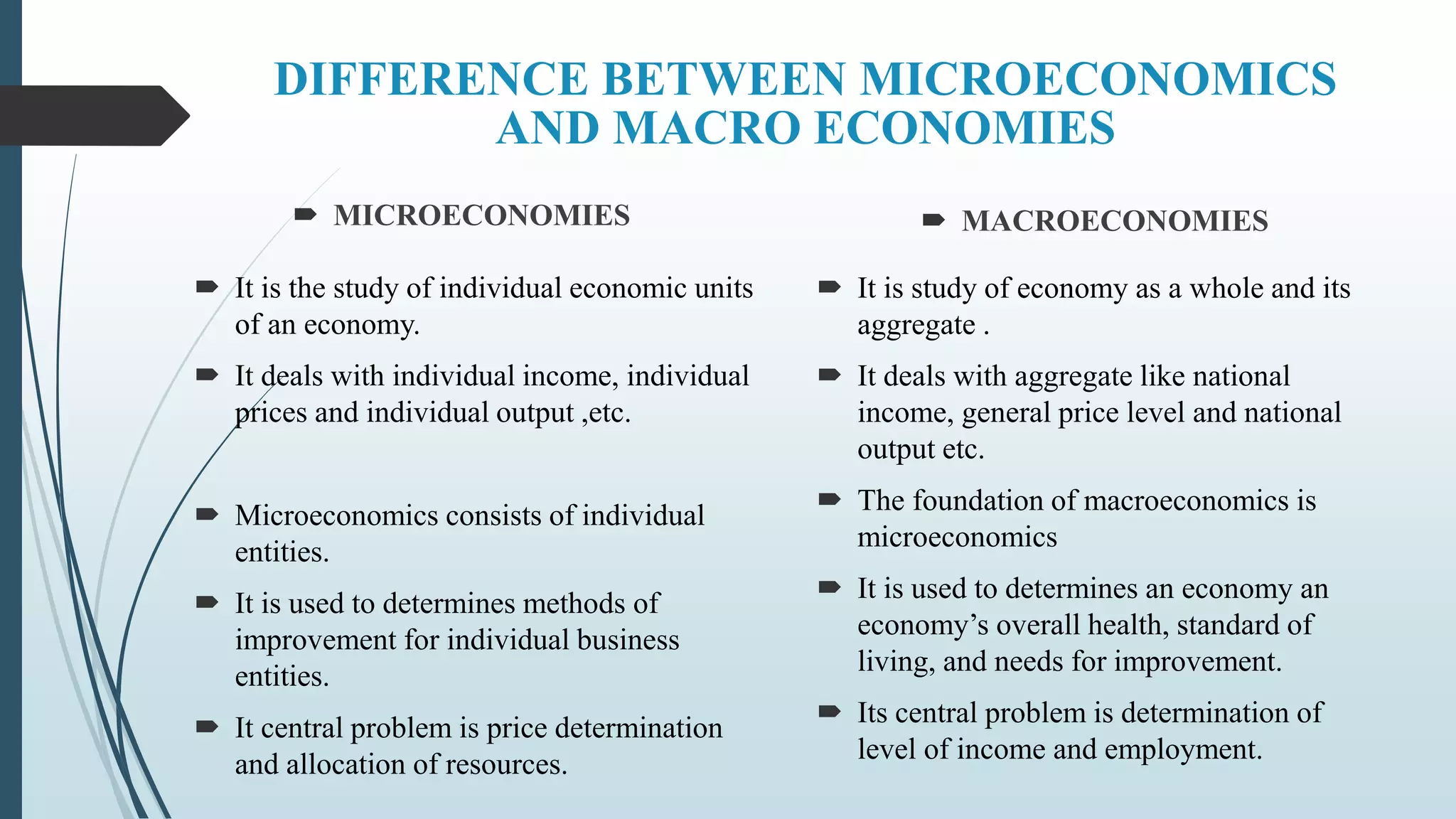
DIFFERENCE BETWEEN MICROECONOMICS
AND MACRO ECONOMIES
 MACROECONOMIES
 MICROECONOMIES
 It is the study of individual economic units
of an economy.
 It deals with individual income, individual
prices and individual output ,etc.
 Microeconomics consists of individual
entities.
 It is used to determines methods of
improvement for individual business
entities.
 It central problem is price determination
and allocation of resources.
 It is study of economy as a whole and its
aggregate .
 It deals with aggregate like national
income, general price level and national
output etc.
 The foundation of macroeconomics is
microeconomics
 It is used to determines an economy an
economy’s overall health, standard of
living, and needs for improvement.
 Its central problem is determination of
level of income and employment.
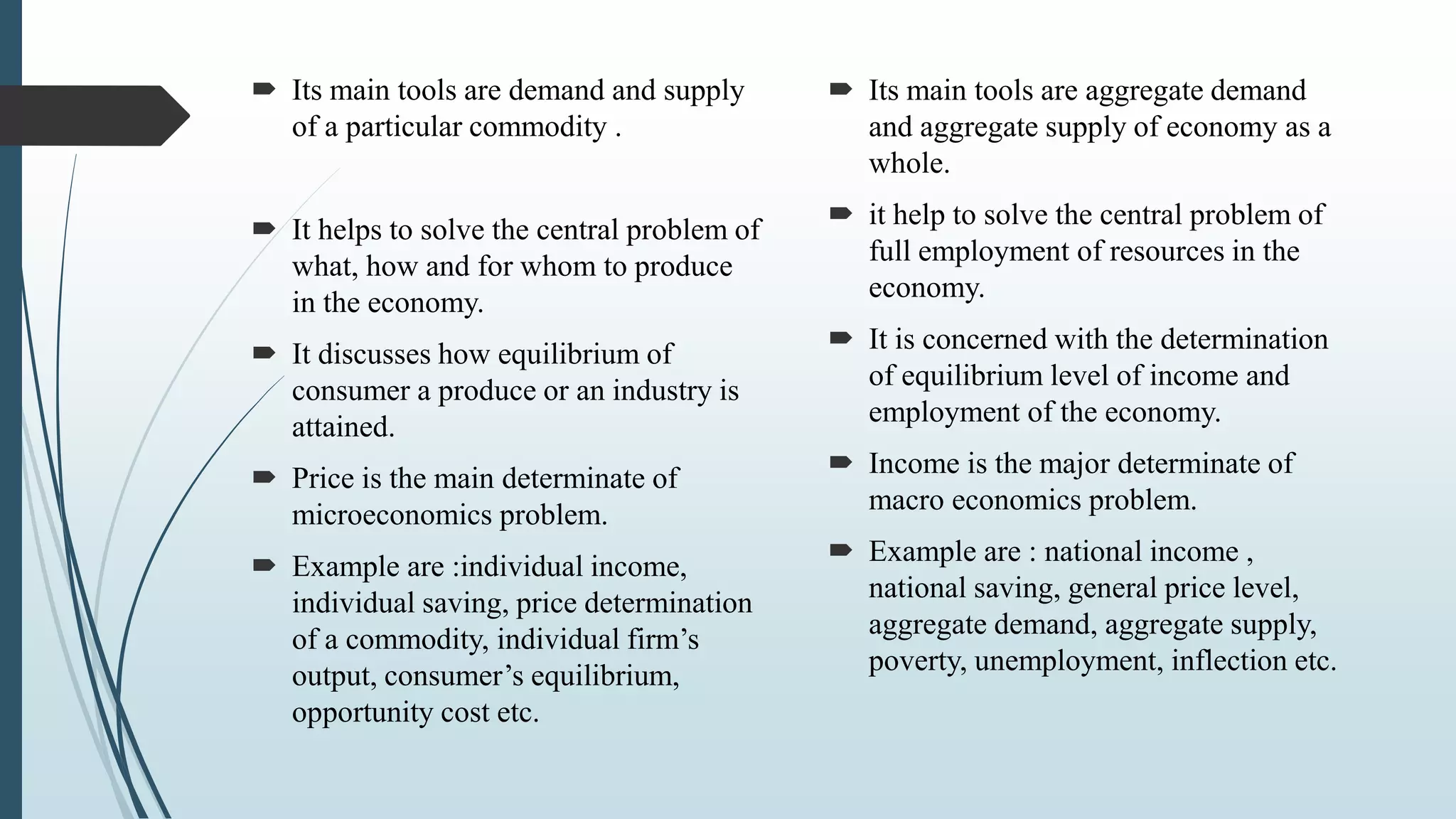
 Its main tools are demand and supply
of a particular commodity .
 It helps to solve the central problem of
what, how and for whom to produce
in the economy.
 It discusses how equilibrium of
consumer a produce or an industry is
attained.
 Price is the main determinate of
microeconomics problem.
 Example are :individual income,
individual saving, price determination
of a commodity, individual firm’s
output, consumer’s equilibrium,
opportunity cost etc.
 Its main tools are aggregate demand
and aggregate supply of economy as a
whole.
 it help to solve the central problem of
full employment of resources in the
economy.
 It is concerned with the determination
of equilibrium level of income and
employment of the economy.
 Income is the major determinate of
macro economics problem.
 Example are : national income ,
national saving, general price level,
aggregate demand, aggregate supply,
poverty, unemployment, inflection etc.
Types of Activities
Ch 1 Defn and Meaning of Economics.pdf

Ch 1 Defn and Meaning of Economics.pdf

  • 1.
    MEANING AND DEFINITIONOF ECONOMICS By karthik
  • 2.
    ECONOMIC ACTIVITIES • Itis an activity concerned with the production, consumption, distribution and exchange of economic goods. • Economic activities refer to those activities which are concerned with money or wealth. • Economic activities are supposed to satisfy human wants • Non economic activities are those which are not concerned with money or wealth (no economic aspect) • Examples of non economic activities include • Social activities like birthday parties • Political activities like congress assembly • Religious activities like worship of god • Charitable activities like helping poor or disabled persons • Parental activities like buying children toys • Recreational activities like watching T.V. NON ECONOMIC ACTIVITIES HUMAN LIFE IS FULL OF ACTIVITIES THAT CAN BE CLASSIFIED INTO 2 TYPES
  • 3.
    DEFINITION OF ECONOMICS •Generally economics is defined as the social science that studies economic activities • Term economics comes from the Greek word “okios” which means household and “nomous” which means management. • Economics is the management of households with limited funds. • Economics studies the ways and means In which people organize themselves to tackle the problems of scarcity. • However that definition is too broad. So economics has 4 major groups
  • 4.
    WEALTH DEFINITION • Adamsmith is the father of economics and he defined the wealth definition. • He defined economics as the production and consumption of wealth in his book “enquiry into the nature and study of causes of wealth of nations” • Defined economics as the science of wealth • He assumes that the wealthier a nation is the happier its citizens are. • He does not include money into his meaning of wealth as it is only a medium of exchange of goods and services • According to him wealth is the annual produce of labor and land of society.
  • 5.
    FEATURES OF WEALTHDEFINITION • Study of wealth = according to the wealth definition economics studies the nature of wealth and the causes of increase of wealth. To increase wealth production of material goods has to be stepped up • Study of material goods only = only material goods have been considered as wealth.eg- table, pen. Non material goods have not been considered as wealth e.g.-water • Economic man = a man who is motivated by his own self interest .wealth definition talks about economic man • Too much stress on wealth = too much emphasis on wealth and little on welfare of people. For example some people in a country can be millionaires and others can be below the poverty line. This increases the country’s wealth but not the welfare as most people are in poverty • Only material goods = Adam smith has not considered non material goods like services of teacher, doctor in his definition of wealth. • Stress on economic man = wealth definition states principal motive of a man is to acquire more wealth for his benefit. But man has other motives such as love and affection. CRITICISM OF WEALTH DEFINITION WEALTH DEFINITION – FEATURES AND CRITICISMS
  • 6.
    WELFARE DEFINITION • Introducedby Alfred marshal in his book “principle of economics ”(1890) • Many economists shifted their focus from wealth to welfare • According to them economics is the social science which studies the economic activities of man which promote economic welfare. • Money and wealth are simply means for human welfare. • Alfred marshal defined economics as the “study of mankind in the ordinary business of life”
  • 7.
    WELFARE DEFINITION FEATURES •Study of mankind = economics studies the economic activities of man in creation of wealth or income. Emphasis was shifted from wealth to welfare • Study of ordinary business of life = every person acts mainly to collect wealth and spend those earnings to get maximum enjoyment. Alfred marshal called this the ordinary business of life. It does not study a man like a sadhu • Study of material welfare = wealth is not the fundamental motive behind all economic activities primary importance is given to human welfare. Money and wealth are simply means of achieving welfare. Study of non material welfare lies outside the scope of economics • Restricted scope of economics = an economy constitutes of such goods like liquor which do not bring any welfare to the country and yet come under economic activity. • Welfare cannot be quantified = another weakness of welfare definition is that welfare cannot be measured in terms money all the time as it is a state of mind. • Non material welfare is ignored = Alfred marshal in his definition has taken into account only material welfare and not non-material welfare services of teachers, doctors provide non material welfare. WELFARE DEFINITION CRITICISMS WELFARE DEFINITION – FEATURES AND CRITICISM
  • 8.
    SCARCITY DEFINITION • Prof.lionelRobbins gave his definition of economics in his book “essay on the nature and significance of economic science” • Economics is the science which studies human behavior a relationship between ends and scarce means which have their alternative uses. • Economics is a science of choice because it helps in effective and efficient utilization of the scarce resources • Features of definition - • Unlimited ends = “ends ”means human wants which are unlimited. We cannot possibly satisfy all of them. So man is supposed to select his most urgent want first and the least urgent wants later. • Scarce means = human wants are unlimited but the ways to satisfy them are limited. Any resource is scarce if tis supply is less than its demand. Thus man is supposed to attend to his most urgent want first . • Alternative uses of means = not only are our means scarce but they can also be used for a number of uses. For example coal is used in railways and thermal stations for electricity generation and in households.
  • 9.
    SUPERIORITY OF SCARCITYDEFINITION • More scientific = Robbins regarded economics as a science that has nothing to do with the goodness or badness of an economic activity. It is only concerned with scarcity of resources and unlimited wants. • (optional)Analytical definition = Robbins definition is more analytical. he gave the root cause of economic problems which forms subject and matter of economics • (optional)Universal definition = Robbins definition is a universal one as the problem of scarcity lies in every economy rich or poor traditional or modern. • Wider scope = economics is a human science and not just a social science. This is because problem of choice is faded by an individual irrespective if he is in isolation or in a community. • Not applicable to rich countries = the economic problem for rich nation is to maintain a high level o consumption an equal distribution. • Neutrality towards ends = if we accept wants to be economically neutral the study of economics will be of no use. we are interested only in science that can solve our economic problems. • Contradictory = Robbins has conflicted with himself as on one hand he regards economics as neutral towards wants(there are no good or bad wants (ends)) while he considers economics as the science of choice. (using resources to get maximum benefit) CRITICISMS OF SCARCITY DEFINITION SCARCITY DEFINITION
  • 10.
    GROWTH DEFINITION • Samuelsongave a growth oriented definition of economics. • economics is the study of how man and society choose • with or without the use of money • to employ the scarce productive resources, • which could have alternate uses • to produce various commodities over time • To distribute them now and for future among various groups of people and society for consumption
  • 11.
    FEATURES OF GROWTHDEFINITION • Efficient allocation of resources = the definition lays stress on the allocation of resources but also on their proper utilization so that more wants could be satisfied • Growth of resources = according to samuelson available resources should not only be used properly but efforts should be made to increase them so as to satisfy ever increasing wants • Solutions to economic problems = economics should not only identify problems but should also be able to solve them. • Dynamism = economic growth is measured in terms of national product overtime. This definition lays that economics is concerned with determining the pattern of employment of scarce resources to produce goods over time. Thus the dynamic problem of production has been brought within the purview of economics.
  • 12.
    GANDHINAGAR INSTITUTE OFTECHNOLOGY SUBJECT :- ENGINEERING ECONOMICS AND MANGEMENT BRANCH :- CIVIL ENGINEERING Prepared By :- ISTIYAK PATHAN 150123106020 CHIRAG FALIYA 150123106006 PATEL KARAN 150123106017 GUIDED BY :- PROF. PRASANT PANDYA ACTIVE LEARNING ASSIGNMENT DIFFERENCE BETWWEN MACRO AND MICRO ECONOMICS
  • 13.
    MICROECONMIC AND MACROECONOMY  MICROECONOMICS:- The micro means small, so it shouldn’t be surprising that microeconomics is the study of small economic units. The field of microeconomics is concerned with thing like:  Customer decision making and utility maximization  Firm production and profit maximization  Individual market equilibrium  Effects of government regulation on individual markets  Externalities and other market side effects
  • 14.
     MACROECONOMICS:- Macroeconomicscan be though of as the “big picture” version of economics. Rather than analyzing individual market, macroeconomics focuses on aggregate production and consumption in an economy. Some topics that macroeconomics study are:  The effects of general taxes such as income and sales taxes on output prices  The causes of economics upswings and downturns  The effects of monetary and fiscal policy on economics health  How interest rates are determined  Why some economics grow faster than others
  • 15.
    DIFFERENCE BETWEEN MICROECONOMICS ANDMACRO ECONOMIES  MACROECONOMIES  MICROECONOMIES  It is the study of individual economic units of an economy.  It deals with individual income, individual prices and individual output ,etc.  Microeconomics consists of individual entities.  It is used to determines methods of improvement for individual business entities.  It central problem is price determination and allocation of resources.  It is study of economy as a whole and its aggregate .  It deals with aggregate like national income, general price level and national output etc.  The foundation of macroeconomics is microeconomics  It is used to determines an economy an economy’s overall health, standard of living, and needs for improvement.  Its central problem is determination of level of income and employment.
  • 16.
     Its maintools are demand and supply of a particular commodity .  It helps to solve the central problem of what, how and for whom to produce in the economy.  It discusses how equilibrium of consumer a produce or an industry is attained.  Price is the main determinate of microeconomics problem.  Example are :individual income, individual saving, price determination of a commodity, individual firm’s output, consumer’s equilibrium, opportunity cost etc.  Its main tools are aggregate demand and aggregate supply of economy as a whole.  it help to solve the central problem of full employment of resources in the economy.  It is concerned with the determination of equilibrium level of income and employment of the economy.  Income is the major determinate of macro economics problem.  Example are : national income , national saving, general price level, aggregate demand, aggregate supply, poverty, unemployment, inflection etc.
  • 18.