 
2ND Graders ESO. Social Studies Department
Almudena Corrales Marbán
In the 27 BC Augustus becomes the
first Roman emperor. The emperor commands
the army and he is the chief priest. There is still a
senate, but it is very week.
Augustus brings stability to Rome. The
first 200 years of Roman Empire are known as
the Pax Romana-the Roman peace. During this
period, the Empire is safe and prosperous. This is
when the Romans build the Coliseum in Rome and
many other great buildings like the Panteon.
The Roman Empire is at its biggest
under emperor Trajan.
Almudena Corrales Marbán
In the 3rd century the Roman Empire has another crisis:
1. Lots of Roman generals want to be emperor, so there is a constant civil
war.
2. Germanic tribes attack Roman towns, and the Roman people escape to
the countryside.
3. It is dangerous to transport goods, so there is less trade. Prices therefore
go up, and people become much poorer.
Finally the civil war end, and the Romans defeat their enemies. The
emperors Diocletian (Diocleciano) and Constantine (Constantino) bring
stability and the 4th century is quite peaceful again.
Almudena Corrales Marbán
Germanic tribes lived to
the north of the Roman Empire. The
Romans called them barbarians
(foreigners). The empire’s wealth
and military weakness led to a
series of Germanis migrations
across the frontier. Some of these
were violent invasions.
Almudena Corrales Marbán
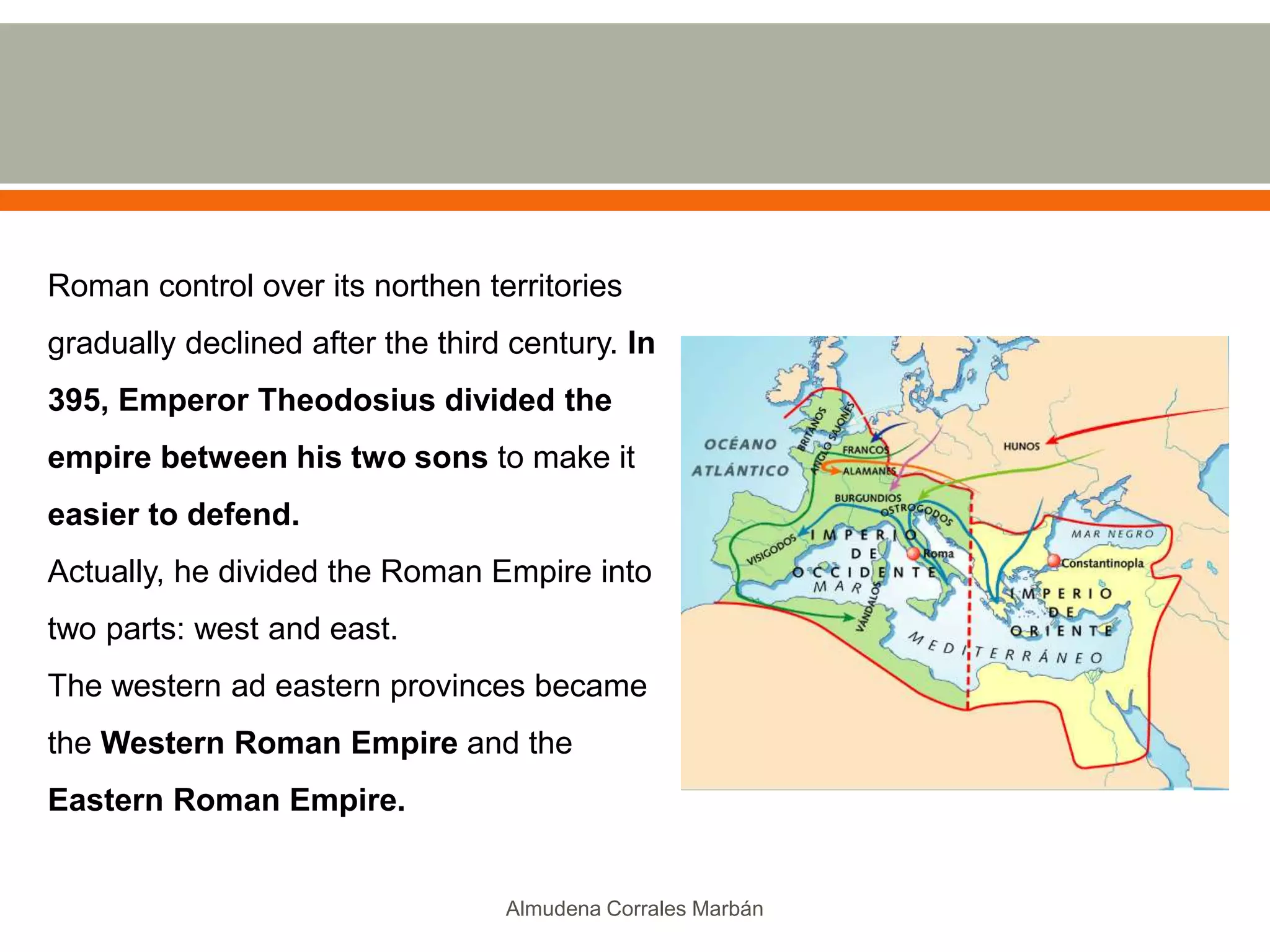
Roman control over its northen territories
gradually declined after the third century. In
395, Emperor Theodosius divided the
empire between his two sons to make it
easier to defend.
Actually, he divided the Roman Empire into
two parts: west and east.
The western ad eastern provinces became
the Western Roman Empire and the
Eastern Roman Empire.
Almudena Corrales Marbán
Germanic tribes invade the western part . Romulus
Augustus, the last Roman Emperor, surrenders in 476
AD.
The eastern part of the Roman Empire becomes the
Byzantine Empire, which survives for another 1. 000
years.
The centralized government of the Western Empired was
replaced by smaller kingdoms:
• The Franks, in France.
• The Visigoths, in Spain.
• The Ostrogoths, and later the Lombards, in Italy.
Almudena Corrales Marbán
It as dangerous to travel. Consequently, there was
very little long-distance trade, and many
industries disappeared. Cities declined, and
people moved to the countryside –origin of
feudalism-. !!!
Cultural activity also declined. Some examples of
Germanic art have surived, such as small
churches and attractive jewellery.
At first, the Romans and the Germanic tribes had
different laws, customs and religions. Then in
some places, the Germanic peoples spoke Latin
San Pedro de la Nave,
Zamora. 680-711
Tesoro de Guarrazar,
Museo Arqueológico
Nacional, Madrid. 7th
century.

Unit 0 the roman empire and its decline

  • 1.
      2ND GradersESO. Social Studies Department Almudena Corrales Marbán
  • 2.
    Almudena Corrales Marbán Inthe 27 BC Augustus becomes the first Roman emperor. The emperor commands the army and he is the chief priest. There is still a senate, but it is very week. Augustus brings stability to Rome. The first 200 years of Roman Empire are known as the Pax Romana-the Roman peace. During this period, the Empire is safe and prosperous. This is when the Romans build the Coliseum in Rome and many other great buildings like the Panteon. The Roman Empire is at its biggest under emperor Trajan.
  • 3.
  • 4.
    Almudena Corrales Marbán Inthe 3rd century the Roman Empire has another crisis: 1. Lots of Roman generals want to be emperor, so there is a constant civil war. 2. Germanic tribes attack Roman towns, and the Roman people escape to the countryside. 3. It is dangerous to transport goods, so there is less trade. Prices therefore go up, and people become much poorer. Finally the civil war end, and the Romans defeat their enemies. The emperors Diocletian (Diocleciano) and Constantine (Constantino) bring stability and the 4th century is quite peaceful again.
  • 5.
    Almudena Corrales Marbán Germanictribes lived to the north of the Roman Empire. The Romans called them barbarians (foreigners). The empire’s wealth and military weakness led to a series of Germanis migrations across the frontier. Some of these were violent invasions.
  • 6.
    Almudena Corrales Marbán Romancontrol over its northen territories gradually declined after the third century. In 395, Emperor Theodosius divided the empire between his two sons to make it easier to defend. Actually, he divided the Roman Empire into two parts: west and east. The western ad eastern provinces became the Western Roman Empire and the Eastern Roman Empire.
  • 7.
    Almudena Corrales Marbán Germanictribes invade the western part . Romulus Augustus, the last Roman Emperor, surrenders in 476 AD. The eastern part of the Roman Empire becomes the Byzantine Empire, which survives for another 1. 000 years. The centralized government of the Western Empired was replaced by smaller kingdoms: • The Franks, in France. • The Visigoths, in Spain. • The Ostrogoths, and later the Lombards, in Italy.
  • 8.
    Almudena Corrales Marbán Itas dangerous to travel. Consequently, there was very little long-distance trade, and many industries disappeared. Cities declined, and people moved to the countryside –origin of feudalism-. !!! Cultural activity also declined. Some examples of Germanic art have surived, such as small churches and attractive jewellery. At first, the Romans and the Germanic tribes had different laws, customs and religions. Then in some places, the Germanic peoples spoke Latin San Pedro de la Nave, Zamora. 680-711 Tesoro de Guarrazar, Museo Arqueológico Nacional, Madrid. 7th century.