European External Action Service
• The EEAS manages the EU’s diplomatic
relations with other countries outside the
bloc. It aims to make the EU's foreign
policy more consistent and efficient,
thereby increasing Europe's influence in
the world.
• The service works closely with national
diplomatic services in EU member
countries, with many personnel from those
services seconded to its staff.
• One major role is to support the EU’s
strategic partnerships with key
international players and its engagement
with emerging powers around the world.
The EEAS works closely with the UN and
other leading powers such as the United
States and Russia.
Notable EU activities on the world stage
include:
• peacebuilding, through political, economic and practical support – for
example in the western Balkans after the Yugoslav wars.
• operating civilian and military missions to build security around the world,
under the common security & defence policy
• maintaining friendly relations with countries at the EU's borders, through
the European neighbourhood policy
• providing development aid, crisis response and humanitarian aid, and
tackling climate change and human rights issues.
Council of the European Union
• It negotiates and adopts legislative acts in
most cases together with the European
Parliament through the ordinary legislative
procedure, also known as codecision.
• Codecision is used for policy areas where
the EU has exclusive or shared competence
with the member states. In these cases,
the Council legislates on the basis of
proposals submitted by the European
Commission.
The Council is responsible for
coordinating member states' policies in
specific fields, such as:
• economic and fiscal policies
• education, culture, youth and sport
• employment policy
• The Council defines and implements EU
foreign and security policy on the basis of
guidelines set by the European Council.
This also includes the EU's development
and humanitarian aid, defense and trade.
• Together with the High Representative of
the Union for Foreign Affairs and Security
Policy, the Council ensures the unity,
consistency and effectiveness of the EU's
external action.
• The Council adopts the EU budget together with the Parliament.
• The budget period covers a calendar year. It is usually adopted in
December and starts running on 1 January the following year.
• The presidency of the Council rotates
among the EU member states every 6
months. During this 6-month period,
the presidency chairs meetings at every
level in the Council, helping to ensure
the continuity of the EU's work in the
Council.
• Member states holding the presidency
work together closely in groups of
three, called 'trios‘ that sets long-term
goals and prepares a common agenda
determining the topics and major issues
that will be addressed by the Council
over an 18 month period. On the basis
of this programme, each of the three
countries prepares its own more
detailed 6-month programme.
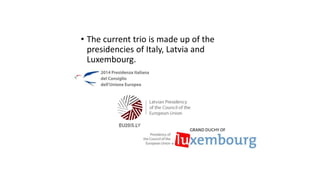
• The current trio is made up of the
presidencies of Italy, Latvia and
Luxembourg.
European Council
• The members of the European Council are
the heads of state or government of the 28
EU member states, the European Council
President and the President of the
European Commission.
• The High Representative of the Union for
Foreign Affairs and Security Policy also
takes part in European Council meetings
when foreign affairs issues are discussed.
• The European Council mostly takes its
decisions by consensus. However, in
certain specific cases outlined in the EU
treaties, it decides by unanimity or by
qualified majority.
• If a vote is taken, neither the European
Council President nor the Commission
President take part.
• The European Council meets at least twice
every 6 months. Its meetings, often
referred to as 'EU summits' are held in
Brussels, in the Justus Lipsius building.
• Meetings are chaired by the European
Council President. The President can also
convene extraordinary European Council
meetings when needed.
• The President of the European Parliament
attends the start of each meeting, to
outline the European Parliament's views.
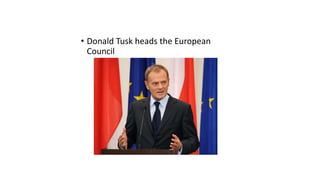
• Donald Tusk heads the European
Council
EUROPEAN PARLIAMENT
• The Parliament acts as a co-legislator,
sharing with the Council the power to
adopt and amend legislative proposals
and to decide on the EU budget. It also
supervises the work of the Commission
and other EU bodies and cooperates
with national parliaments of EU
countries to get their input.
• The European Parliament is an
important forum for political debate
and decision-making at the EU level.
The Members of the European
Parliament are directly elected by
voters in all Member States to
represent people’s interests with regard
to EU law-making and to make sure
other EU institutions are working
democratically.
• The President is elected for a renewable
term of two and a half years and
represents the European Parliament
vis-à-vis the outside world and in its
relations with the other EU institutions.
• The President oversees the work of the
Parliament and its constituent bodies as
well as the debates in plenary and
ensures that Parliament’s Rules of
Procedure are adhered to.
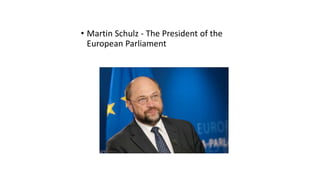
• Martin Schulz - The President of the
European Parliament
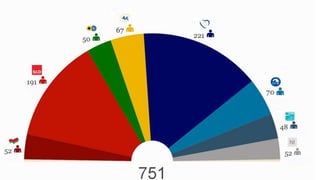
• The European Parliament is made up of
751 Members elected in the 28
Member States of the enlarged
European Union. Since 1979 MEPs have
been elected by direct universal
suffrage for a five-year period.
• Each country decides on the form its
election will take, but must guarantee
equality of the sexes and a secret
ballot. EU elections are by proportional
representation.
• Seats are allocated on the basis of
population of each Member State.
Slightly more than a third of MEPs are
women. MEPs are grouped by political
affinity, not nationality.
Union Europea
Union Europea
Union Europea
Union Europea
Union Europea
Union Europea
Union Europea
Union Europea
Union Europea

Union Europea

  • 1.
  • 2.
    • The EEASmanages the EU’s diplomatic relations with other countries outside the bloc. It aims to make the EU's foreign policy more consistent and efficient, thereby increasing Europe's influence in the world.
  • 3.
    • The serviceworks closely with national diplomatic services in EU member countries, with many personnel from those services seconded to its staff. • One major role is to support the EU’s strategic partnerships with key international players and its engagement with emerging powers around the world. The EEAS works closely with the UN and other leading powers such as the United States and Russia.
  • 4.
    Notable EU activitieson the world stage include: • peacebuilding, through political, economic and practical support – for example in the western Balkans after the Yugoslav wars. • operating civilian and military missions to build security around the world, under the common security & defence policy • maintaining friendly relations with countries at the EU's borders, through the European neighbourhood policy • providing development aid, crisis response and humanitarian aid, and tackling climate change and human rights issues.
  • 5.
    Council of theEuropean Union
  • 6.
    • It negotiatesand adopts legislative acts in most cases together with the European Parliament through the ordinary legislative procedure, also known as codecision. • Codecision is used for policy areas where the EU has exclusive or shared competence with the member states. In these cases, the Council legislates on the basis of proposals submitted by the European Commission.
  • 7.
    The Council isresponsible for coordinating member states' policies in specific fields, such as: • economic and fiscal policies • education, culture, youth and sport • employment policy
  • 8.
    • The Councildefines and implements EU foreign and security policy on the basis of guidelines set by the European Council. This also includes the EU's development and humanitarian aid, defense and trade. • Together with the High Representative of the Union for Foreign Affairs and Security Policy, the Council ensures the unity, consistency and effectiveness of the EU's external action.
  • 9.
    • The Counciladopts the EU budget together with the Parliament. • The budget period covers a calendar year. It is usually adopted in December and starts running on 1 January the following year.
  • 10.
    • The presidencyof the Council rotates among the EU member states every 6 months. During this 6-month period, the presidency chairs meetings at every level in the Council, helping to ensure the continuity of the EU's work in the Council.
  • 11.
    • Member statesholding the presidency work together closely in groups of three, called 'trios‘ that sets long-term goals and prepares a common agenda determining the topics and major issues that will be addressed by the Council over an 18 month period. On the basis of this programme, each of the three countries prepares its own more detailed 6-month programme.
  • 12.
    • The currenttrio is made up of the presidencies of Italy, Latvia and Luxembourg.
  • 13.
  • 14.
    • The membersof the European Council are the heads of state or government of the 28 EU member states, the European Council President and the President of the European Commission. • The High Representative of the Union for Foreign Affairs and Security Policy also takes part in European Council meetings when foreign affairs issues are discussed.
  • 15.
    • The EuropeanCouncil mostly takes its decisions by consensus. However, in certain specific cases outlined in the EU treaties, it decides by unanimity or by qualified majority. • If a vote is taken, neither the European Council President nor the Commission President take part.
  • 16.
    • The EuropeanCouncil meets at least twice every 6 months. Its meetings, often referred to as 'EU summits' are held in Brussels, in the Justus Lipsius building. • Meetings are chaired by the European Council President. The President can also convene extraordinary European Council meetings when needed. • The President of the European Parliament attends the start of each meeting, to outline the European Parliament's views.
  • 17.
    • Donald Tuskheads the European Council
  • 18.
  • 19.
    • The Parliamentacts as a co-legislator, sharing with the Council the power to adopt and amend legislative proposals and to decide on the EU budget. It also supervises the work of the Commission and other EU bodies and cooperates with national parliaments of EU countries to get their input.
  • 20.
    • The EuropeanParliament is an important forum for political debate and decision-making at the EU level. The Members of the European Parliament are directly elected by voters in all Member States to represent people’s interests with regard to EU law-making and to make sure other EU institutions are working democratically.
  • 21.
    • The Presidentis elected for a renewable term of two and a half years and represents the European Parliament vis-à-vis the outside world and in its relations with the other EU institutions. • The President oversees the work of the Parliament and its constituent bodies as well as the debates in plenary and ensures that Parliament’s Rules of Procedure are adhered to.
  • 22.
    • Martin Schulz- The President of the European Parliament
  • 23.
    • The EuropeanParliament is made up of 751 Members elected in the 28 Member States of the enlarged European Union. Since 1979 MEPs have been elected by direct universal suffrage for a five-year period. • Each country decides on the form its election will take, but must guarantee equality of the sexes and a secret ballot. EU elections are by proportional representation.
  • 24.
    • Seats areallocated on the basis of population of each Member State. Slightly more than a third of MEPs are women. MEPs are grouped by political affinity, not nationality.