Institutions and history of the
European Union
Prof. Dr. Andreas Kellerhals, LL.M.
Goals
> Know the main institutions within the institutional system of the EU.
> Know the history of the EU.
214. April 2017
Program
314. April 2017
> Main European Union organs
1. European Commission
2. European Parliament
3. Council of the European Union
4. European Council
5. European Court of Justice
> Brief History of the EU
Introduction
> EU is not a state or a federation of states
> Powers and compewtences are selectively delegated by the member states
> No «EU people», only additional EU citizenship for citizens of member states
> EU is a supranational organization
> Principal of conferral
> No competence-competence
> Legal basis are the treaties of the EU
> TEU: Treaty of the European Union
> TFEU: Treaty on the Functioning of the European Union
414. April 2017
EU Institutions
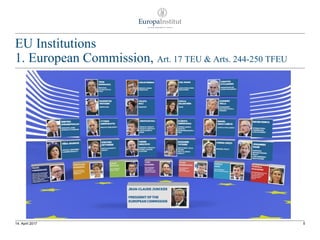
1. European Commission, Art. 17 TEU & Arts. 244-250 TFEU
514. April 2017
EU Institutions
1. European Commission, Art. 17 TEU & Arts. 244-250 TFEU
> The Commission has 28 members. Each of the 28 member states is sending
one of its citizens.
> Members of the commission are appointed for a period of 5 years.
> The president of the commission lays down the general guidelines for the
commissions' work, decides on the internal organization and appoints the vice-
president of the commission, who is also the EU’s High Representative for its
common foreign and security policy.
> Next to the commissioners, there are approximately 33’000 (2015) staff
members working for the Commission.
614. April 2017
EU Institutions
1. European Commission, Art. 17 TEU & Arts. 244-250 TFEU
1. Right of Initiative
> The Commission is the only institution with the power to initiate EU law;
however, the council and the parliament have to agree on the
Commissions’ proposal.
1. Guardian of the treaties
> The Commission has the right to to take infringement actions against
Member States which have not met their obligations under EU law.
7April 14, 2017
EU Institutions
1. European Commission, Art. 17 TEU & Arts. 244-250 TFEU
3. Policy implementation
> The Commission has the role for administering the EU’s budget and
deciding how the budget is spent within the EU Member States.
3. International dimension
> The Commission has the sole competence to negotiate international
treaties on behalf of the EU. In this regard, the High Representative,
which is also a member of the Commission, conducts the EU’s foreign
policy and makes proposals regarding that policy.
8April 14, 2017
EU Institutions
2. European Parliament, Art. 14 TEU & Arts. 223 - 234 TFEU
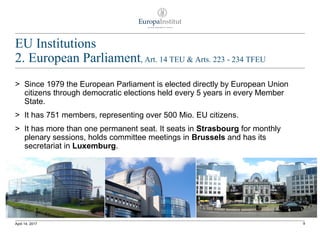
> Since 1979 the European Parliament is elected directly by European Union
citizens through democratic elections held every 5 years in every Member
State.
> It has 751 members, representing over 500 Mio. EU citizens.
> It has more than one permanent seat. It seats in Strasbourg for monthly
plenary sessions, holds committee meetings in Brussels and has its
secretariat in Luxemburg.
9April 14, 2017
EU Institutions
2. European Parliament, Art. 14 TEU & Arts. 223 - 234 TFEU
10April 14, 2017
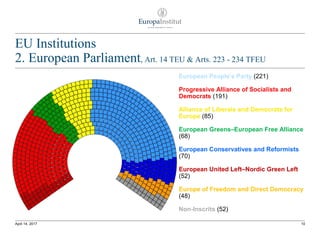
European People's Party (221)
Progressive Alliance of Socialists and
Democrats (191)
Alliance of Liberals and Democrats for
Europe (85)
European Greens–European Free Alliance
(68)
European Conservatives and Reformists
(70)
European United Left–Nordic Green Left
(52)
Europe of Freedom and Direct Democracy
(48)
Non-Inscrits (52)
EU Institutions
2. European Parliament, Art. 14 TEU & Arts. 223 - 234 TFEU
> The European Parliament has three main functions:
1. Legislative role: The Parliament has different levels of participation during
the legislative process (discussed later).
2. Budgetary role: The European parliament has to approve the budget of the
European Union (Art. 314 TFEU).
3. Supervisory role: the parliament has certain control powers:
> Art. 230 TFEU: right to ask questions to the Commission
> Art. 234 TFEU: ask the Commission to resign “en bloc”
> Art. 263 and 265 TFEU: challenge actions by other EU institutions in
front of the CJEU.
> Art. 226 TFEU: set up commissions of inquiry.
11April 14, 2017
EU Institutions
3. Council of the EU, Art. 16 TEU & Arts. 237 – 243 TFEU
> Council is comprised of one minister of each Member State authorized to bind
the government of that State.
> Composition of the council is dependent on the subject matter discussed in the
council (if the subject matter is agriculture, all agriculture ministers of the
Member States will be present).
> A special case is the foreign affairs council, which is presided over by the
High Representative.
> In comparison to the other EU institutions, the Council represents national
interests. The ministers in the Council are responsible to their national
governments.
12April 14, 2017
EU Institutions
3. Council of the EU, Art. 16 TEU & Arts. 237 – 243 TFEU
> The Council has three voting mechanisms:
1. Simple majority (15 Member States in favor).
2. Qualified majority (55% of Member States in favor, representing 65% of
the EU population).
3. Unanimous vote (100% of Member States in favor).
13April 14, 2017
EU Institutions
3. European Council of the EU, Art. 15 TEU & Arts. 235-236
TFEU
> Should not be mixed up with the Council and the Council of Europe, another
institution outside the EU system.
> The European Council was initially an informal body, composed the Head of
States or governments of the EU Member States.
> Since the treaty of Lisbon, the European Council is recognized as an EU
institution. The Head of States are joined by the president of the Commission
and in some instances by the High Representative.
> It meets at least twice a year.
14April 14, 2017
EU Institutions
4. European Council, Art. 15 TEU & Arts. 235-236 TFEU
> The European Council has a rather vague role in the institutional setting of the
EU. Art. 15 TEU: “…provide the Union with the necessary impetus (…) and
shall define the general political direction…”.
> No legislative functions.
> But: The European Council can provide an agreement, where such agreement
was not possible on a lower level.
> Decisions by the European Council are made by consensus.
> The direct election procedure of the parliament or the introduction of the EURO
were decided at the level of the European Council.
15April 14, 2017
EU Institutions
5. European Court of Justice
> Central judicial authority
> Interpretaion of EU law
> Structure of the ECJ
> 28 judges & 8 advocate generals
> ECJ & court of first instance
> Pivotal role in the interpretation of EU law
1614. April 2017
History of the EU
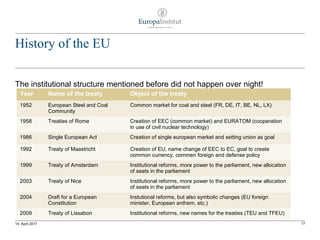
The institutional structure mentioned before did not happen over night!
1714. April 2017
Year Name of the treaty Object of the treaty
1952 European Steel and Coal
Community
Common market for coal and steel (FR, DE, IT, BE, NL, LX)
1958 Treaties of Rome Creation of EEC (common market) and EURATOM (cooperation
in use of civil nuclear technology)
1986 Single European Act Creation of single european market and setting union as goal
1992 Treaty of Maastricht Creation of EU, name change of EEC to EC, goal to create
common currency, commen foreign and defense policy
1999 Treaty of Amsterdam Institutional reforms, more power to the parliament, new allocation
of seats in the parliament
2003 Treaty of Nice Institutional reforms, more power to the parliament, new allocation
of seats in the parliament
2004 Draft for a European
Constitution
Instutional reforms, but also symbolic changes (EU foreign
minister, European anthem, etc.)
2009 Treaty of Lissabon Institutional reforms, new names for the treaties (TEU and TFEU)
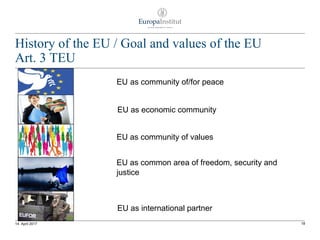
History of the EU / Goal and values of the EU
Art. 3 TEU
1814. April 2017
EU as community of/for peace
EU as economic community
EU as international partner
EU as common area of freedom, security and
justice
EU as community of values
Thank you!
Prof. Dr. Andreas Kellerhals, LL.M.

EU institutions

  • 1.
    Institutions and historyof the European Union Prof. Dr. Andreas Kellerhals, LL.M.
  • 2.
    Goals > Know themain institutions within the institutional system of the EU. > Know the history of the EU. 214. April 2017
  • 3.
    Program 314. April 2017 >Main European Union organs 1. European Commission 2. European Parliament 3. Council of the European Union 4. European Council 5. European Court of Justice > Brief History of the EU
  • 4.
    Introduction > EU isnot a state or a federation of states > Powers and compewtences are selectively delegated by the member states > No «EU people», only additional EU citizenship for citizens of member states > EU is a supranational organization > Principal of conferral > No competence-competence > Legal basis are the treaties of the EU > TEU: Treaty of the European Union > TFEU: Treaty on the Functioning of the European Union 414. April 2017
  • 5.
    EU Institutions 1. EuropeanCommission, Art. 17 TEU & Arts. 244-250 TFEU 514. April 2017
  • 6.
    EU Institutions 1. EuropeanCommission, Art. 17 TEU & Arts. 244-250 TFEU > The Commission has 28 members. Each of the 28 member states is sending one of its citizens. > Members of the commission are appointed for a period of 5 years. > The president of the commission lays down the general guidelines for the commissions' work, decides on the internal organization and appoints the vice- president of the commission, who is also the EU’s High Representative for its common foreign and security policy. > Next to the commissioners, there are approximately 33’000 (2015) staff members working for the Commission. 614. April 2017
  • 7.
    EU Institutions 1. EuropeanCommission, Art. 17 TEU & Arts. 244-250 TFEU 1. Right of Initiative > The Commission is the only institution with the power to initiate EU law; however, the council and the parliament have to agree on the Commissions’ proposal. 1. Guardian of the treaties > The Commission has the right to to take infringement actions against Member States which have not met their obligations under EU law. 7April 14, 2017
  • 8.
    EU Institutions 1. EuropeanCommission, Art. 17 TEU & Arts. 244-250 TFEU 3. Policy implementation > The Commission has the role for administering the EU’s budget and deciding how the budget is spent within the EU Member States. 3. International dimension > The Commission has the sole competence to negotiate international treaties on behalf of the EU. In this regard, the High Representative, which is also a member of the Commission, conducts the EU’s foreign policy and makes proposals regarding that policy. 8April 14, 2017
  • 9.
    EU Institutions 2. EuropeanParliament, Art. 14 TEU & Arts. 223 - 234 TFEU > Since 1979 the European Parliament is elected directly by European Union citizens through democratic elections held every 5 years in every Member State. > It has 751 members, representing over 500 Mio. EU citizens. > It has more than one permanent seat. It seats in Strasbourg for monthly plenary sessions, holds committee meetings in Brussels and has its secretariat in Luxemburg. 9April 14, 2017
  • 10.
    EU Institutions 2. EuropeanParliament, Art. 14 TEU & Arts. 223 - 234 TFEU 10April 14, 2017 European People's Party (221) Progressive Alliance of Socialists and Democrats (191) Alliance of Liberals and Democrats for Europe (85) European Greens–European Free Alliance (68) European Conservatives and Reformists (70) European United Left–Nordic Green Left (52) Europe of Freedom and Direct Democracy (48) Non-Inscrits (52)
  • 11.
    EU Institutions 2. EuropeanParliament, Art. 14 TEU & Arts. 223 - 234 TFEU > The European Parliament has three main functions: 1. Legislative role: The Parliament has different levels of participation during the legislative process (discussed later). 2. Budgetary role: The European parliament has to approve the budget of the European Union (Art. 314 TFEU). 3. Supervisory role: the parliament has certain control powers: > Art. 230 TFEU: right to ask questions to the Commission > Art. 234 TFEU: ask the Commission to resign “en bloc” > Art. 263 and 265 TFEU: challenge actions by other EU institutions in front of the CJEU. > Art. 226 TFEU: set up commissions of inquiry. 11April 14, 2017
  • 12.
    EU Institutions 3. Councilof the EU, Art. 16 TEU & Arts. 237 – 243 TFEU > Council is comprised of one minister of each Member State authorized to bind the government of that State. > Composition of the council is dependent on the subject matter discussed in the council (if the subject matter is agriculture, all agriculture ministers of the Member States will be present). > A special case is the foreign affairs council, which is presided over by the High Representative. > In comparison to the other EU institutions, the Council represents national interests. The ministers in the Council are responsible to their national governments. 12April 14, 2017
  • 13.
    EU Institutions 3. Councilof the EU, Art. 16 TEU & Arts. 237 – 243 TFEU > The Council has three voting mechanisms: 1. Simple majority (15 Member States in favor). 2. Qualified majority (55% of Member States in favor, representing 65% of the EU population). 3. Unanimous vote (100% of Member States in favor). 13April 14, 2017
  • 14.
    EU Institutions 3. EuropeanCouncil of the EU, Art. 15 TEU & Arts. 235-236 TFEU > Should not be mixed up with the Council and the Council of Europe, another institution outside the EU system. > The European Council was initially an informal body, composed the Head of States or governments of the EU Member States. > Since the treaty of Lisbon, the European Council is recognized as an EU institution. The Head of States are joined by the president of the Commission and in some instances by the High Representative. > It meets at least twice a year. 14April 14, 2017
  • 15.
    EU Institutions 4. EuropeanCouncil, Art. 15 TEU & Arts. 235-236 TFEU > The European Council has a rather vague role in the institutional setting of the EU. Art. 15 TEU: “…provide the Union with the necessary impetus (…) and shall define the general political direction…”. > No legislative functions. > But: The European Council can provide an agreement, where such agreement was not possible on a lower level. > Decisions by the European Council are made by consensus. > The direct election procedure of the parliament or the introduction of the EURO were decided at the level of the European Council. 15April 14, 2017
  • 16.
    EU Institutions 5. EuropeanCourt of Justice > Central judicial authority > Interpretaion of EU law > Structure of the ECJ > 28 judges & 8 advocate generals > ECJ & court of first instance > Pivotal role in the interpretation of EU law 1614. April 2017
  • 17.
    History of theEU The institutional structure mentioned before did not happen over night! 1714. April 2017 Year Name of the treaty Object of the treaty 1952 European Steel and Coal Community Common market for coal and steel (FR, DE, IT, BE, NL, LX) 1958 Treaties of Rome Creation of EEC (common market) and EURATOM (cooperation in use of civil nuclear technology) 1986 Single European Act Creation of single european market and setting union as goal 1992 Treaty of Maastricht Creation of EU, name change of EEC to EC, goal to create common currency, commen foreign and defense policy 1999 Treaty of Amsterdam Institutional reforms, more power to the parliament, new allocation of seats in the parliament 2003 Treaty of Nice Institutional reforms, more power to the parliament, new allocation of seats in the parliament 2004 Draft for a European Constitution Instutional reforms, but also symbolic changes (EU foreign minister, European anthem, etc.) 2009 Treaty of Lissabon Institutional reforms, new names for the treaties (TEU and TFEU)
  • 18.
    History of theEU / Goal and values of the EU Art. 3 TEU 1814. April 2017 EU as community of/for peace EU as economic community EU as international partner EU as common area of freedom, security and justice EU as community of values
  • 19.
    Thank you! Prof. Dr.Andreas Kellerhals, LL.M.

Editor's Notes

  • #7 Structure of General-Directorates, turf wars, etc.
  • #11 Parteienfinanzierung Lobbying