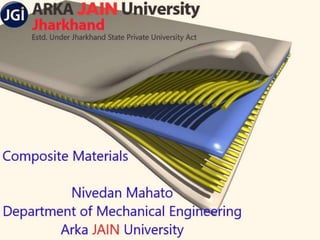
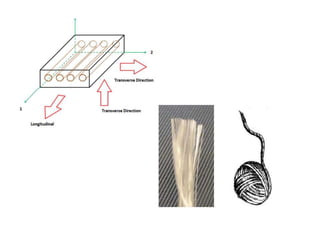
Unidirectional composite
• A lamina is the building block of modern
composite laminated structures.
• Each lamina may have in itself more than one
types of fibers. These fibers may be oriented
oriented in different different directions.
directions.
• A laminate has several layers, or laminae.
Each lamina may have a different:
– Thickness
– Fiber orientation angle
– Fiber material
– Matrix material
A lamina is also known as a ply, or a layer.
Each layer in a laminate has in general three planes of
material symmetry. Because Because of this, they exhibit
exhibit orthotropic orthotropic behavior behavior.
A lamina cut across these planes of symmetry will exhibit
same mechanical properties.
• In isotropic materials, failure prediction requires
calculating principal stresses or Strain and
comparing them to allowable stress/strain limits
prescribed for the material.
• In non‐isotropic materials (e.g. transversely
isotropic materials), this approach does not work.
• The notion of Principal stress makes no sense for
these materials as material strength changes with
direction, and the direction of principal stress
may not in most of the cases coincide with
direction of maximum strength.
For unidirectional materials, we evaluate allowable
stress field in context of different strengths of
material in principal material directions. These
are:
– Longitudinal tensile strength
Lateral tensile strength
– Longitudinal compressive strength
Lateral compressive strength
– In‐plane shear strength

Unidirectional fiber composite

  • 2.
    Unidirectional composite • Alamina is the building block of modern composite laminated structures. • Each lamina may have in itself more than one types of fibers. These fibers may be oriented oriented in different different directions. directions. • A laminate has several layers, or laminae.
  • 3.
    Each lamina mayhave a different: – Thickness – Fiber orientation angle – Fiber material – Matrix material A lamina is also known as a ply, or a layer. Each layer in a laminate has in general three planes of material symmetry. Because Because of this, they exhibit exhibit orthotropic orthotropic behavior behavior. A lamina cut across these planes of symmetry will exhibit same mechanical properties.
  • 5.
    • In isotropicmaterials, failure prediction requires calculating principal stresses or Strain and comparing them to allowable stress/strain limits prescribed for the material. • In non‐isotropic materials (e.g. transversely isotropic materials), this approach does not work. • The notion of Principal stress makes no sense for these materials as material strength changes with direction, and the direction of principal stress may not in most of the cases coincide with direction of maximum strength.
  • 6.
    For unidirectional materials,we evaluate allowable stress field in context of different strengths of material in principal material directions. These are: – Longitudinal tensile strength Lateral tensile strength – Longitudinal compressive strength Lateral compressive strength – In‐plane shear strength