Why are cities not states?
Alan Freeman
Governance of London
 The questions
– Where should London’s boundaries be?
– How big should a borough be?
– How should either and both be governed?
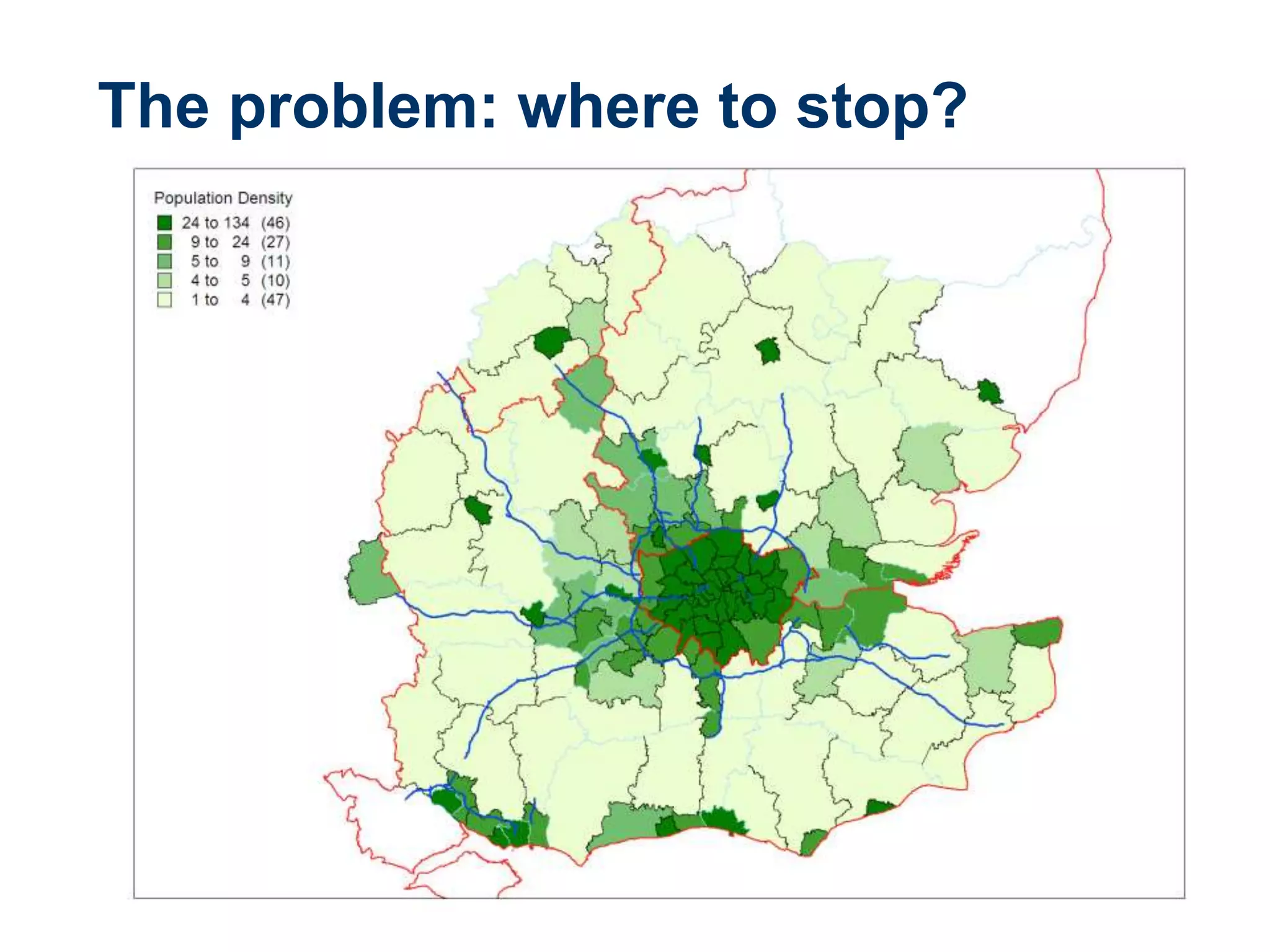
The problem: where to stop?
East-West issues I: the jobs
East-West issues II: the commuters
Why is a city not a state?
 Only two points in history when cities assumed
state-type functions
– Greece 700-315 bc
– Italy 950-1515
 In each case absorbed by a larger territorial
project
 Nation state has become the dominant form
Working definition
 Function of political power is to optimise the
achievement of social objectives by economic
means
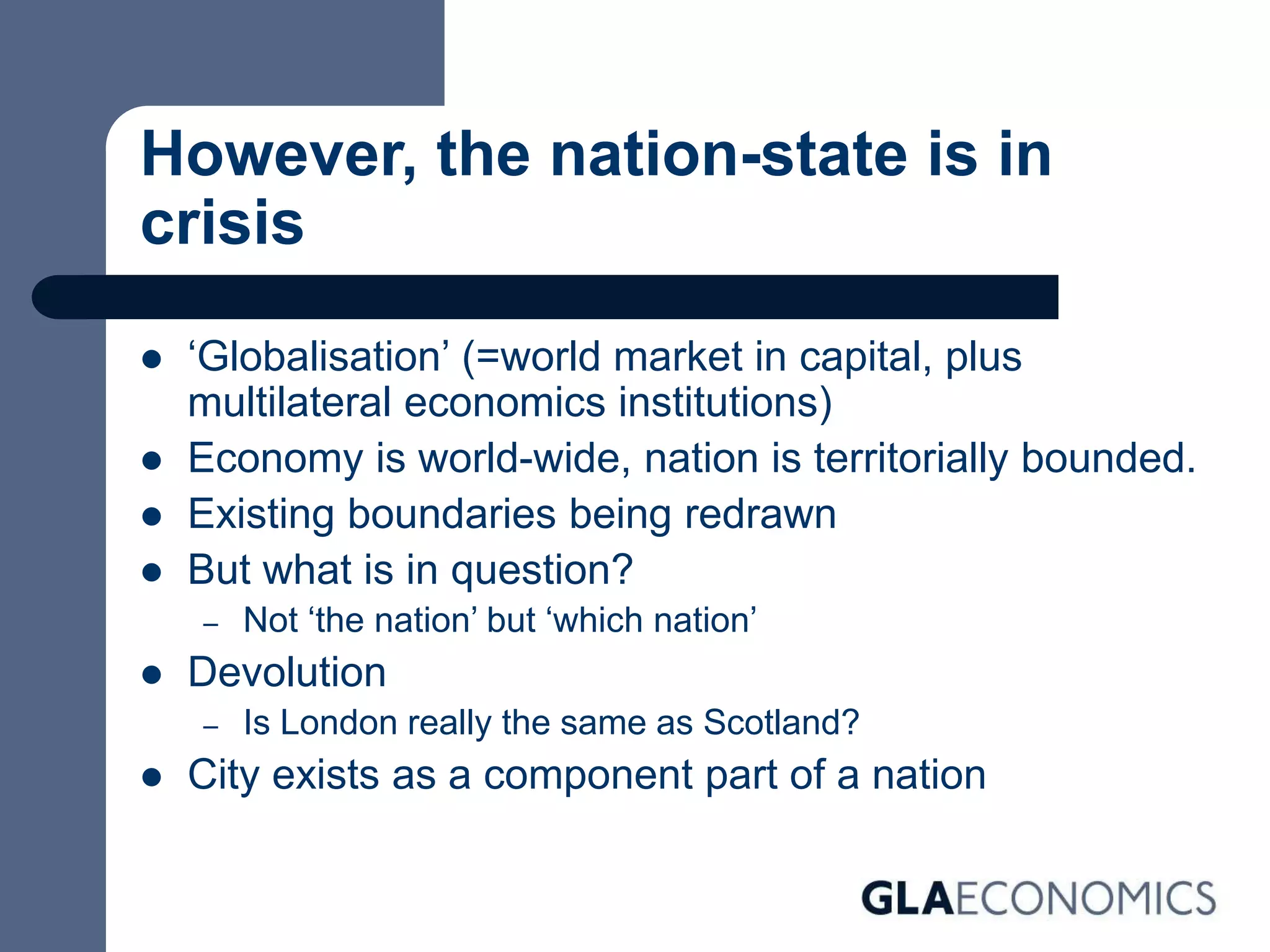
However, the nation-state is in
crisis
 ‘Globalisation’ (=world market in capital, plus
multilateral economics institutions)
 Economy is world-wide, nation is territorially bounded.
 Existing boundaries being redrawn
 But what is in question?
– Not ‘the nation’ but ‘which nation’
 Devolution
– Is London really the same as Scotland?
 City exists as a component part of a nation
London: between two continents
 Globalisation has in fact undermined the political basis
of multilateralism
 Return of unilateral political action
 Decline of the multilateral institutions
 But inadequacy of the national form remains
 Structural crisis of the nation-state
 But no sign that the city has heightened autonomy
 Conclusion: cities, even global cities, can only optimise
in context of relation to world and national economy
 But which nation?
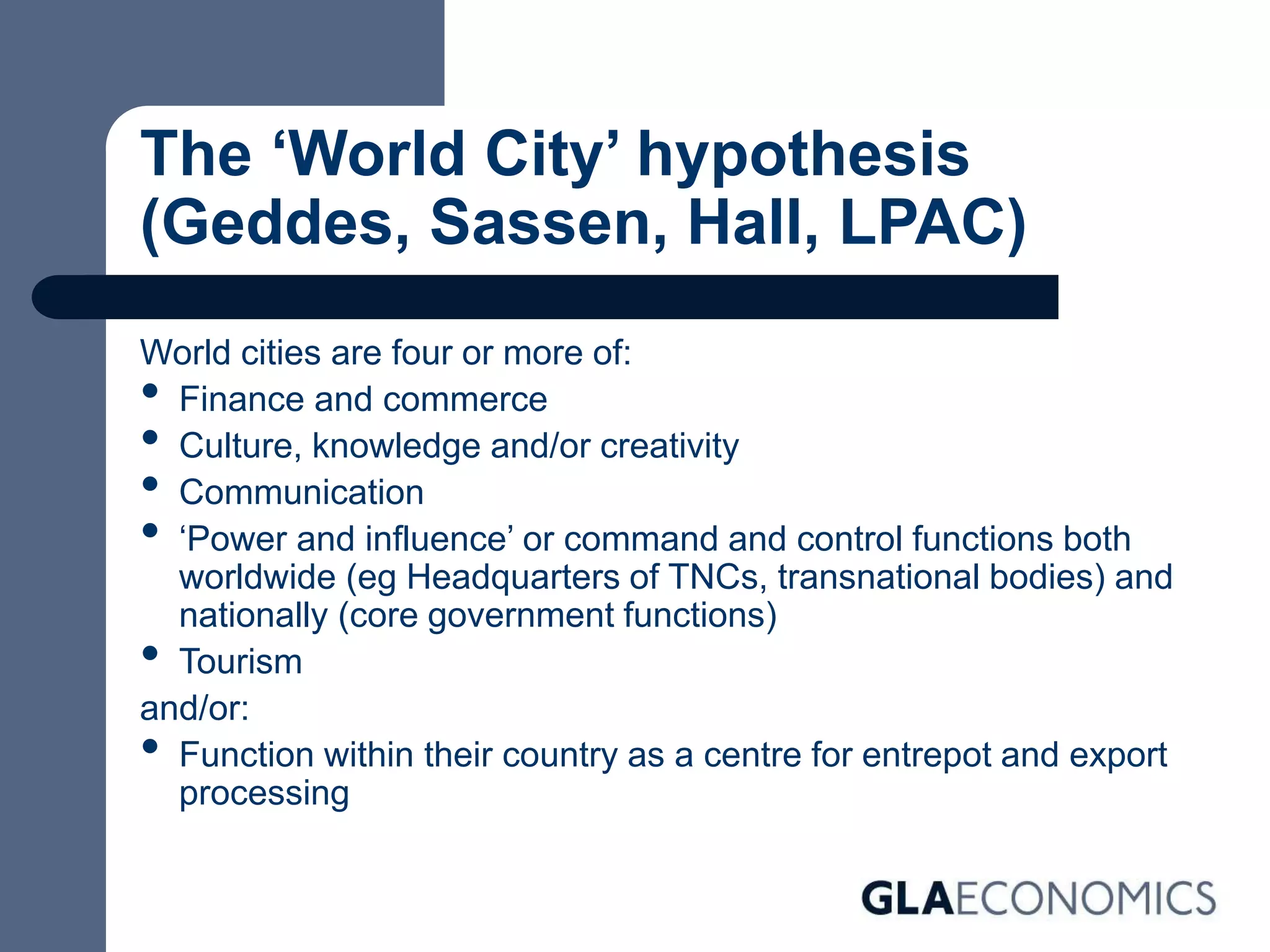
The ‘World City’ hypothesis
(Geddes, Sassen, Hall, LPAC)
World cities are four or more of:
• Finance and commerce
• Culture, knowledge and/or creativity
• Communication
• ‘Power and influence’ or command and control functions both
worldwide (eg Headquarters of TNCs, transnational bodies) and
nationally (core government functions)
• Tourism
and/or:
• Function within their country as a centre for entrepot and export
processing
The GLA World Cities Project
 Originally concerned with World City Hypothesis but
now more limited
 ‘Core Cities’ project
– Regional productivity differentials targetted by HM Treasury
– Cities thought to be drivers of regional growth
– so cities want to measure their productivity
 LDA
– Want to learn best practice relations with other cities
 GLA Economics
– Want to understand London by comparing it with other cities
The aims
 Comparable data
 Continuous data
 Robust data
BUT…
The world according to Parkinson
GDP Per Capita (Euros) 2001
0
10000
20000
30000
40000
50000
60000
70000
80000
Nation
Supplier 2
Supplier 1
Parkinson
Source: CoreCitiesproject
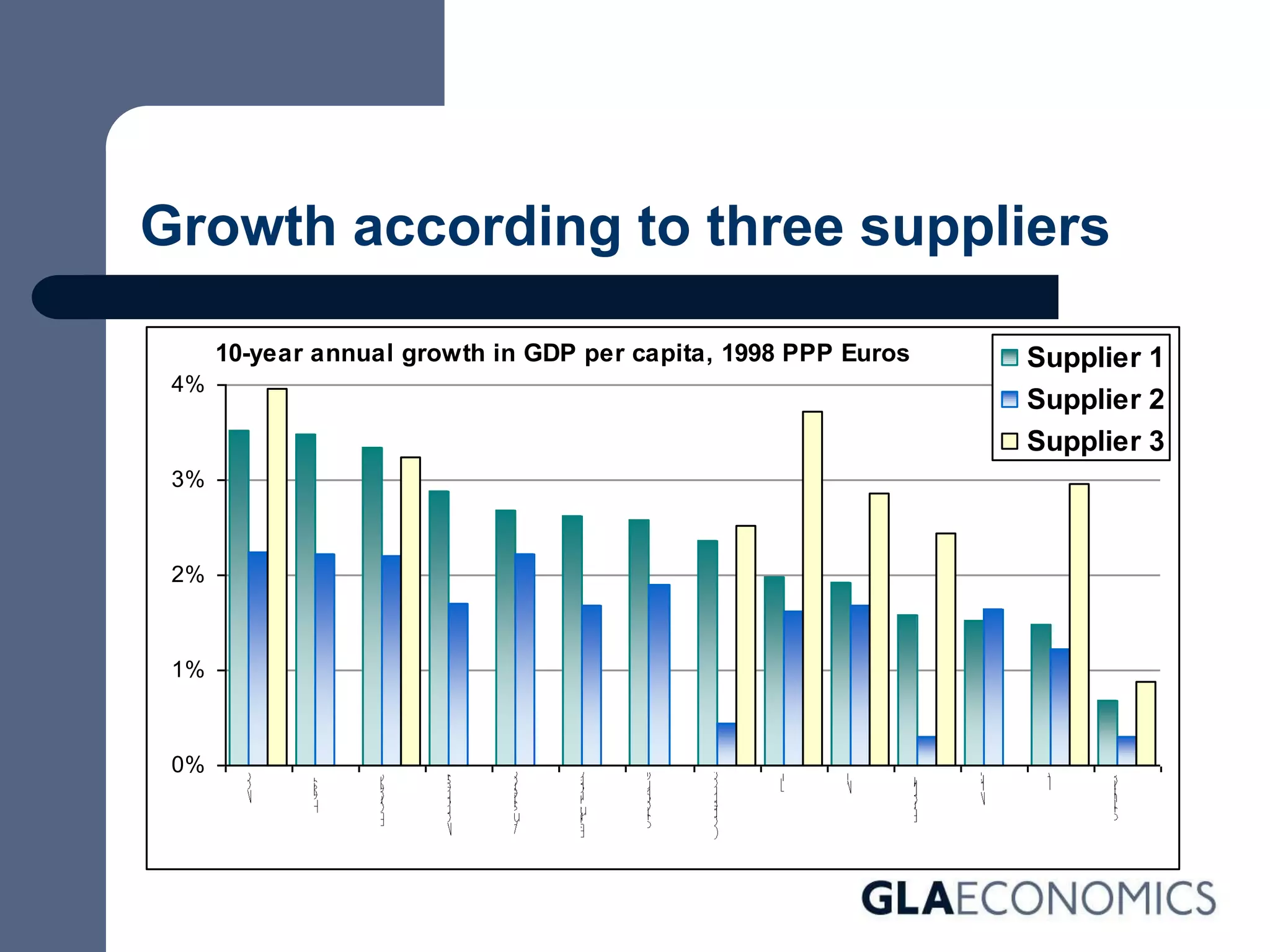
Growth according to three suppliers
10-year annual growth in GDP per capita, 1998 PPP Euros
0%
1%
2%
3%
4%
Supplier 1
Supplier 2
Supplier 3
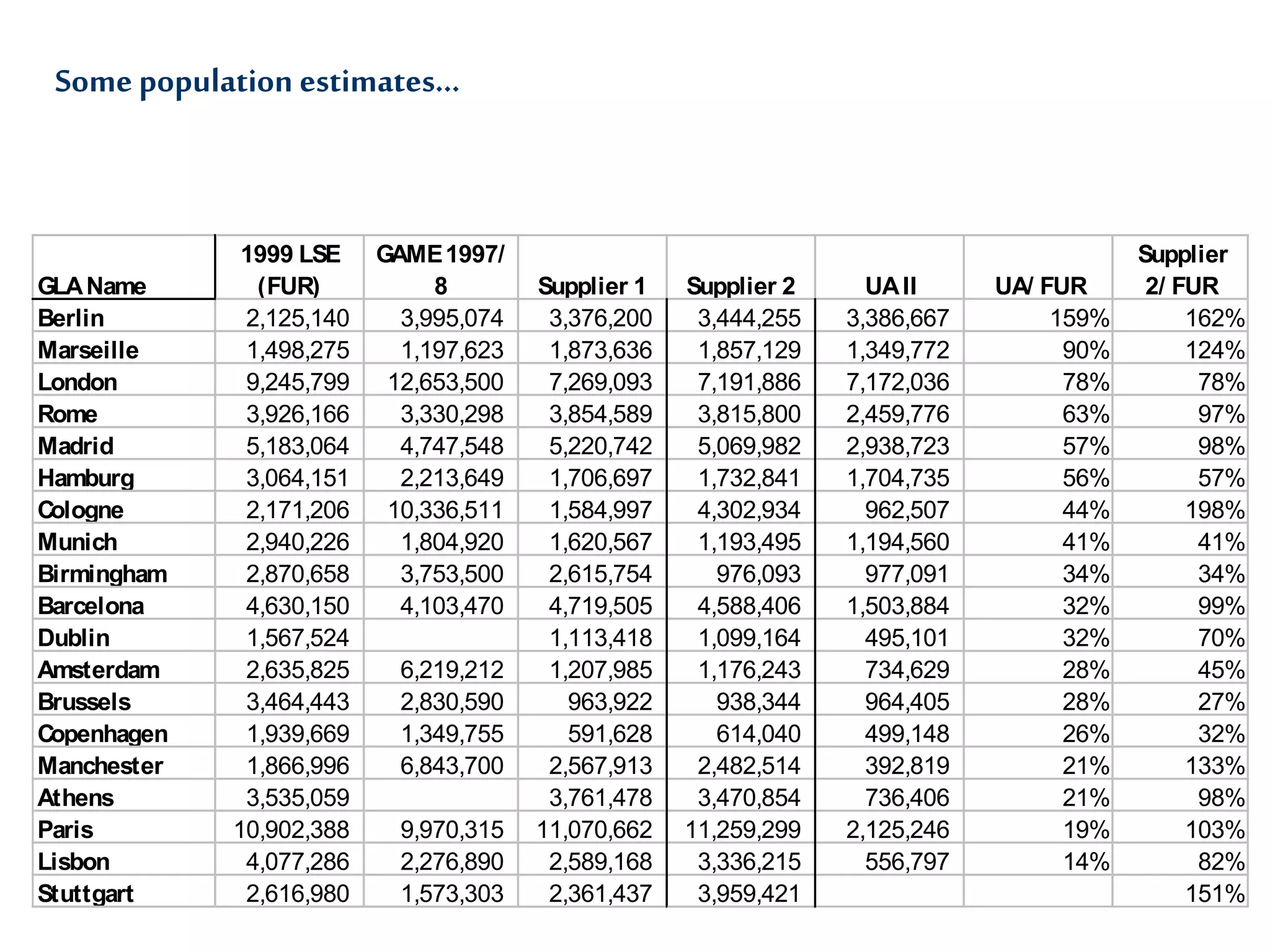
Why so many different estimates?
 City definition
 Employment
 Output
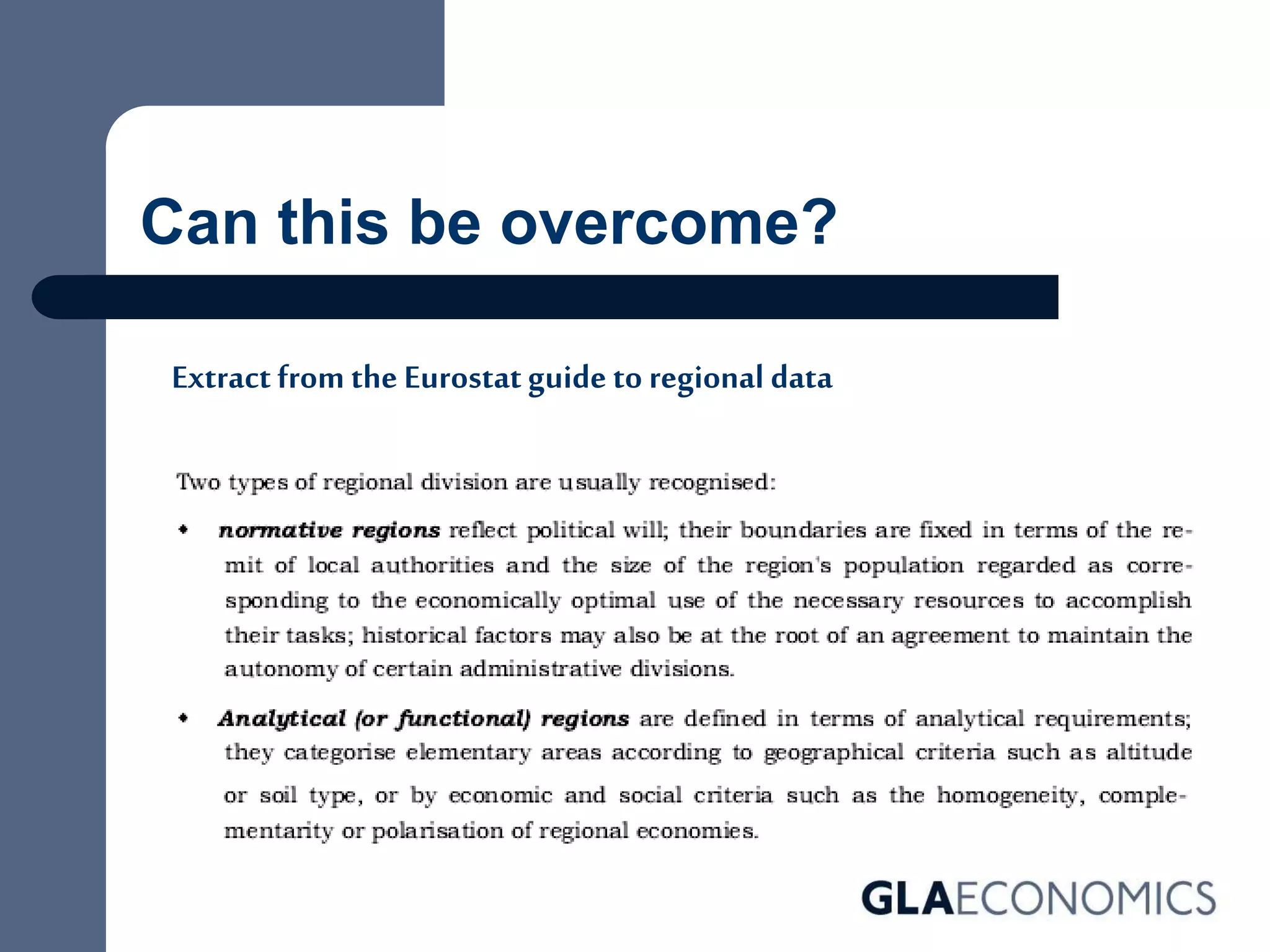
Can this be overcome?
Extract from the Eurostatguide to regional data
Apparently not
Urban Audit – first (official) attempt
to classify and measure cities
‘Cities have generally been defined as the central municipality which is responsible
for local government. In most countries, the city corresponds to the concept of
Local administrative unit (LAU) level 2 (formerly NUTS level 5). Exceptions to this
rule are listed below. Given that the structure of local government varies a lot
between EU countries, the result is a city concept that is not always comparable
between countries. The emphasis has been on identifying a city concept with
political responsibility in the various countries.
‘The following countries have defined “city” differently than LAU level 2 in the
context of the Urban Audit.
Belgium;
France:
Portugal:
United Kingdom:
Ireland:
GLAName
1999 LSE
(FUR)
GAME1997/
8 Supplier 1 Supplier 2 UAII UA/ FUR
Supplier
2/ FUR
Berlin 2,125,140 3,995,074 3,376,200 3,444,255 3,386,667 159% 162%
Marseille 1,498,275 1,197,623 1,873,636 1,857,129 1,349,772 90% 124%
London 9,245,799 12,653,500 7,269,093 7,191,886 7,172,036 78% 78%
Rome 3,926,166 3,330,298 3,854,589 3,815,800 2,459,776 63% 97%
Madrid 5,183,064 4,747,548 5,220,742 5,069,982 2,938,723 57% 98%
Hamburg 3,064,151 2,213,649 1,706,697 1,732,841 1,704,735 56% 57%
Cologne 2,171,206 10,336,511 1,584,997 4,302,934 962,507 44% 198%
Munich 2,940,226 1,804,920 1,620,567 1,193,495 1,194,560 41% 41%
Birmingham 2,870,658 3,753,500 2,615,754 976,093 977,091 34% 34%
Barcelona 4,630,150 4,103,470 4,719,505 4,588,406 1,503,884 32% 99%
Dublin 1,567,524 1,113,418 1,099,164 495,101 32% 70%
Amsterdam 2,635,825 6,219,212 1,207,985 1,176,243 734,629 28% 45%
Brussels 3,464,443 2,830,590 963,922 938,344 964,405 28% 27%
Copenhagen 1,939,669 1,349,755 591,628 614,040 499,148 26% 32%
Manchester 1,866,996 6,843,700 2,567,913 2,482,514 392,819 21% 133%
Athens 3,535,059 3,761,478 3,470,854 736,406 21% 98%
Paris 10,902,388 9,970,315 11,070,662 11,259,299 2,125,246 19% 103%
Lisbon 4,077,286 2,276,890 2,589,168 3,336,215 556,797 14% 82%
Stuttgart 2,616,980 1,573,303 2,361,437 3,959,421 151%
Some population estimates…
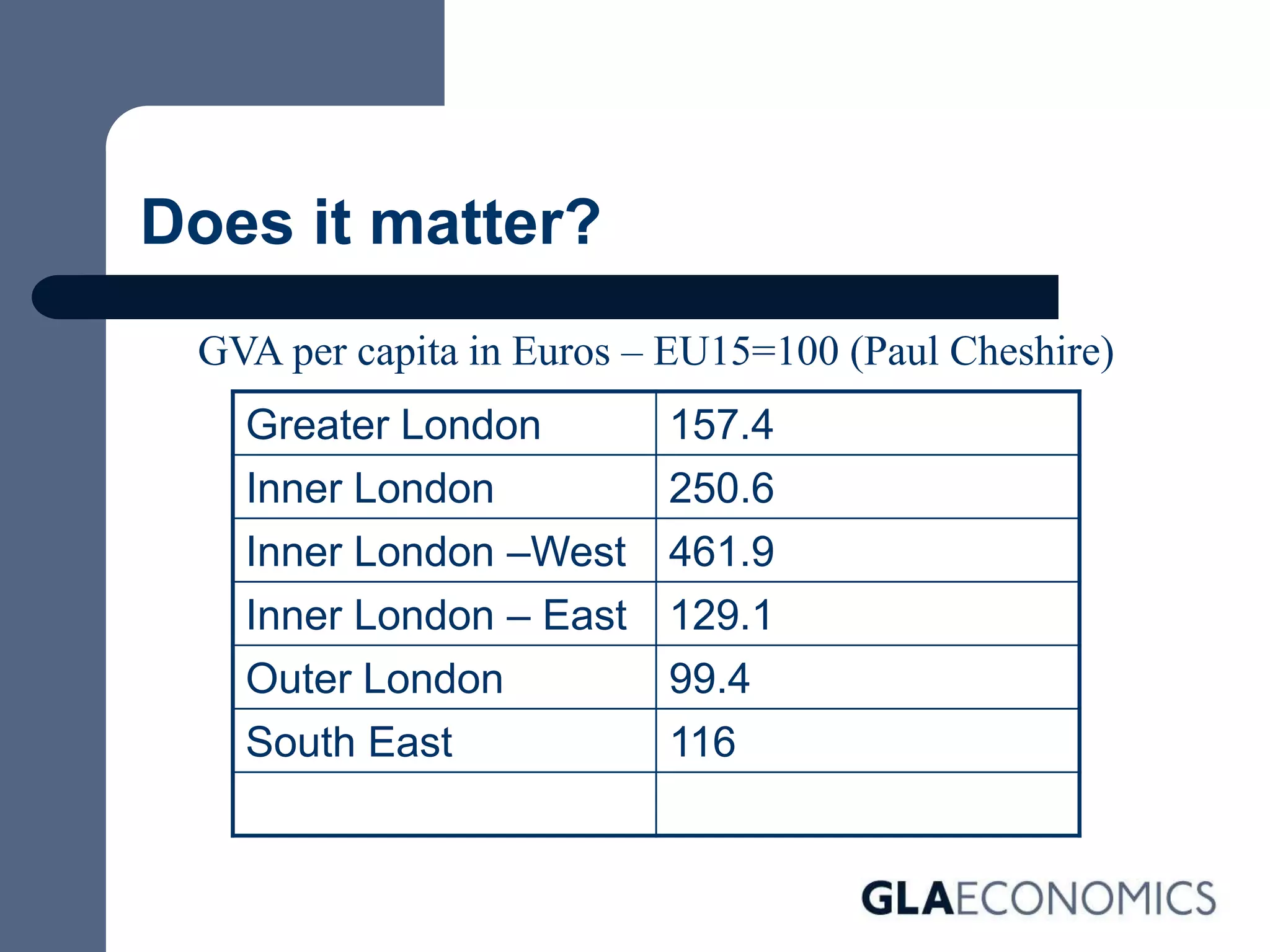
Does it matter?
Greater London 157.4
Inner London 250.6
Inner London –West 461.9
Inner London – East 129.1
Outer London 99.4
South East 116
GVA per capita in Euros – EU15=100 (Paul Cheshire)
And now for something entirely
different…
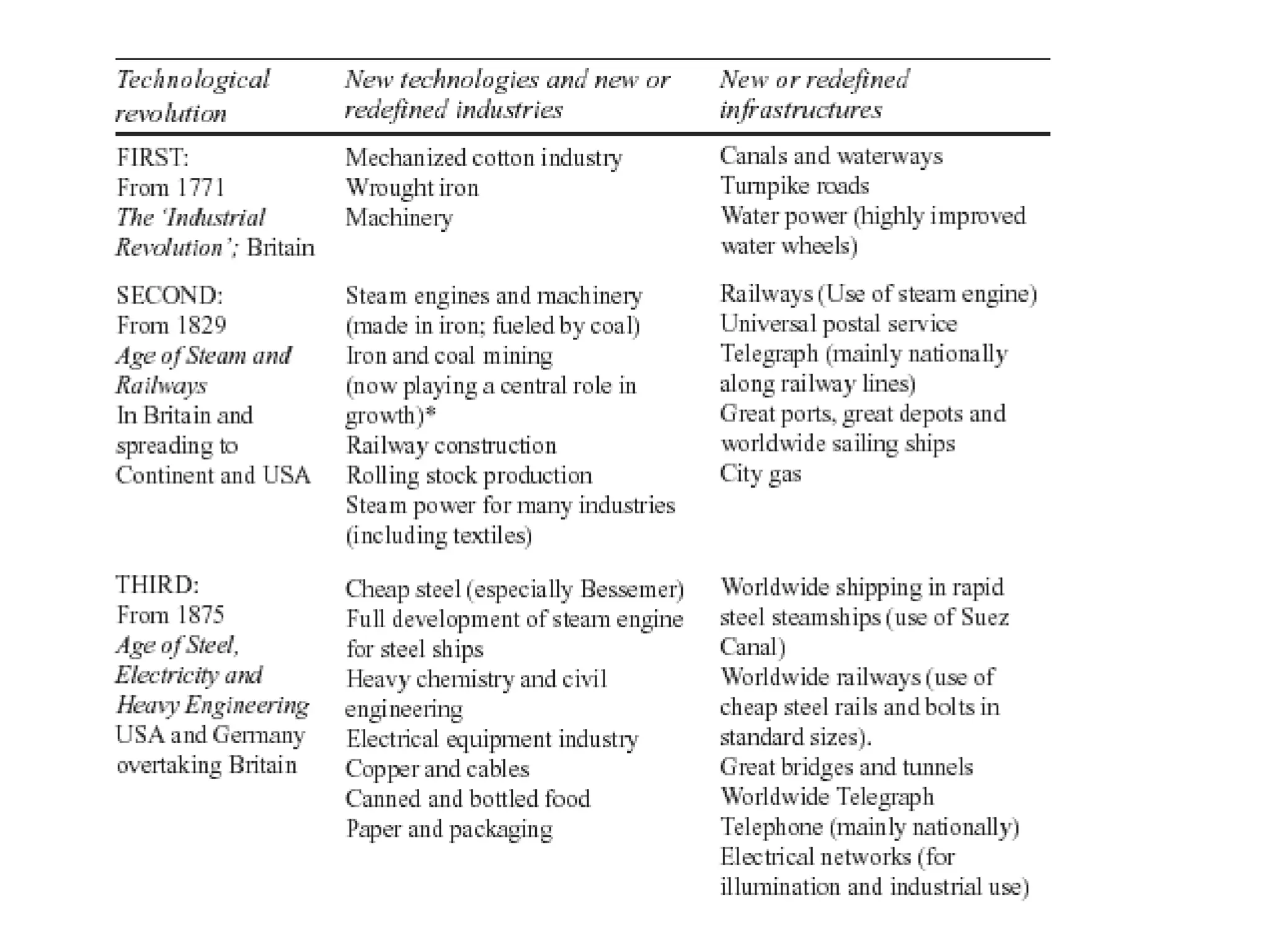
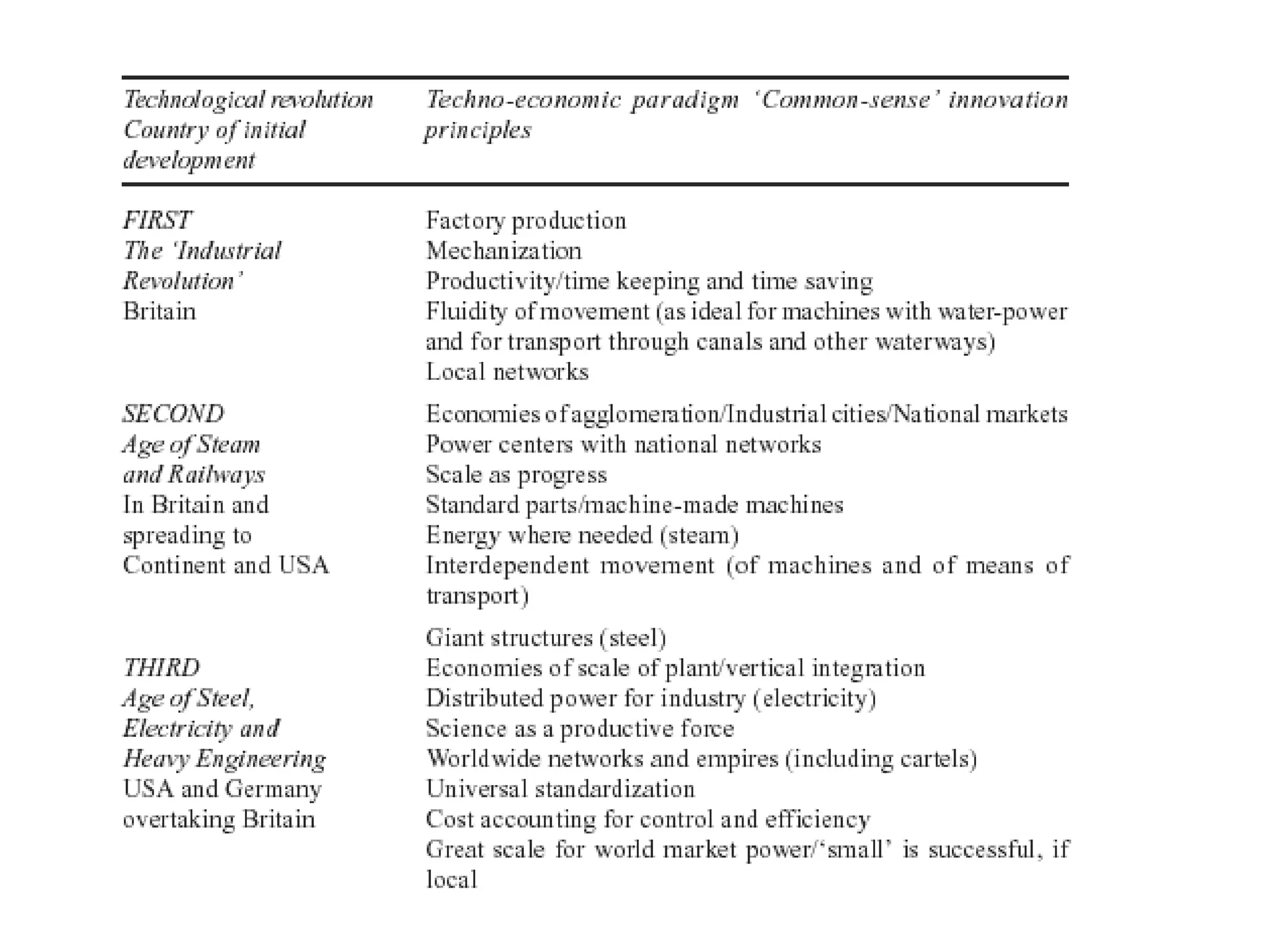
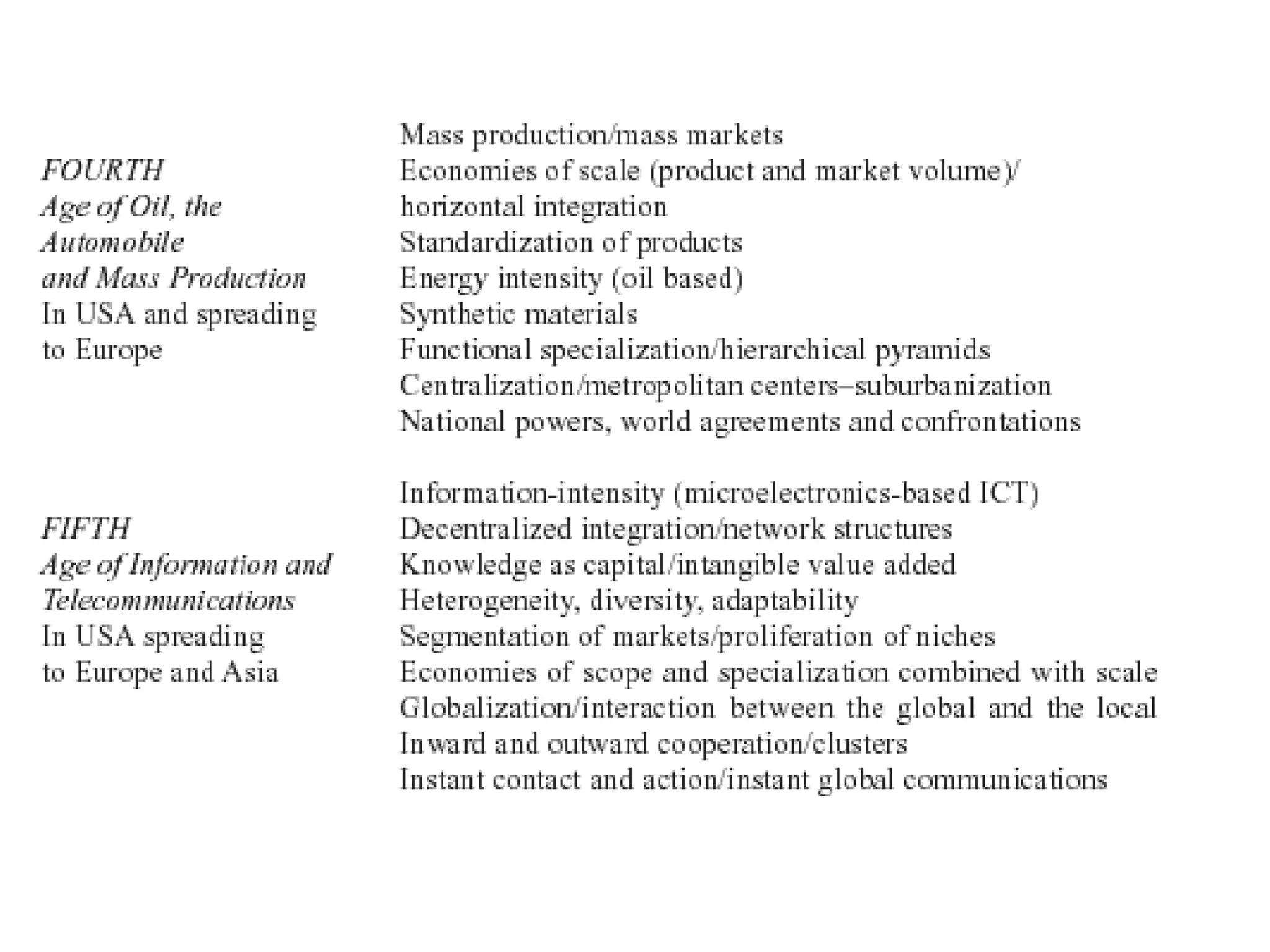
Invention and transformation: Theintegration ofKondratieff waves with social,
geographical and geopolitical change (Perez)
Date of
‘big bang’
Boom age Popular name for
the period
Core country or
countries
Year Big-bang
initiating the
revolution
Citiesborn or
transformed
1771 1800-1825 The ‘Industrial
Revolution’
Britain Arkwright’smill opensin
Cromford
The modern Industrial
City
1829 1848-73 Age of Steamand
Railways
Britain (spreading
to Continent and
USA)
Test of the ‘Rocket’
engine for the Liverpool–
Manchester railway
The North West (UK);
the Midwest (US)
1875 1890-1914 ‘BelleÉpoque’; Age
of Steel, Electricity
and Heavy
Engineering
USA and Germany
forging ahead and
overtaking Britain
Carnegie Bessemer steel
plant opensin Pittsburgh,
Pennsylvania
New York
Ruhr
1908 1947-1962 Age of Oil, the
Automobile and
MassProduction
USA (with
Germany at first
vying for world
leadership), later
spreading to
Europe
First Model-T comesout
of Ford plant in Detroit,
Michigan
Detroit
Birmingham
Darmstadt
Etc
1971 Please
wait for
announce-
ments
Age of Information
and
Telecommunications
USA (spreading to
Europe and Asia)
Intel microprocessor is
announced in Santa
Clara, California
Silicon Valley
The West (UK)
Global Cities?
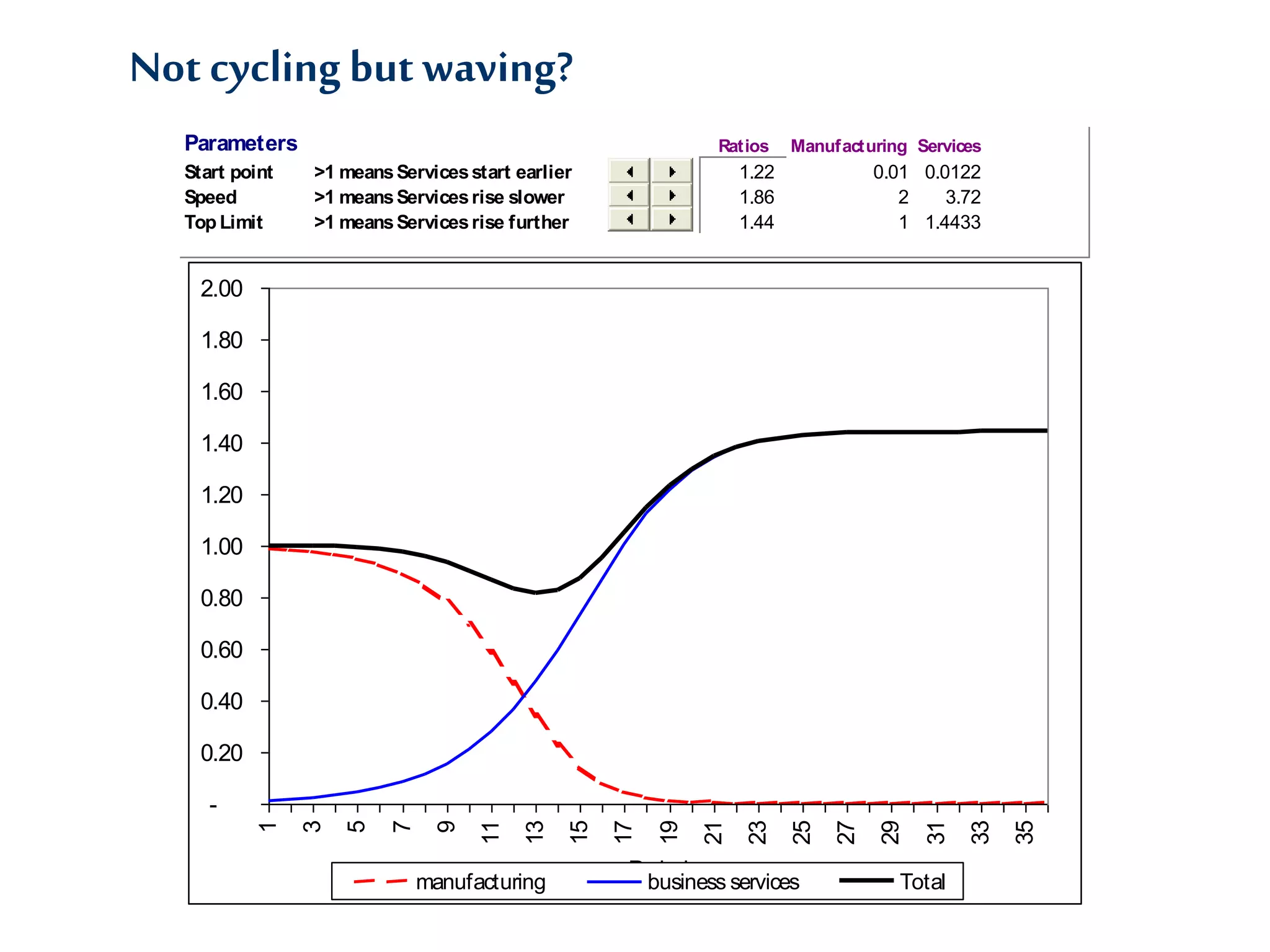
Not cyclingbut waving?
Parameters Ratios Manufacturing Services
Start point >1 meansServicesstart earlier 1.22 0.01 0.0122
Speed >1 meansServicesrise slower 1.86 2 3.72
Top Limit >1 meansServicesrise further 1.44 1 1.4433
-
0.20
0.40
0.60
0.80
1.00
1.20
1.40
1.60
1.80
2.00
1
3
5
7
9
11
13
15
17
19
21
23
25
27
29
31
33
35
Period
manufacturing business services Total
What happened in the nineties?
0%
5%
10%
15%
20%
25%
30%
35%
40%
1971
1974
1977
1980
1983
1986
1989
1992
1995
1998
2001
2004
2007
2010
2013
2016
Manufacturing
Businessservices
Manufacturing plusBusinessServices
London’s output growth
1995-2000
CreativeIndustries:a qualitative reshapingofindustrial structure
Jobs growth
Output growth
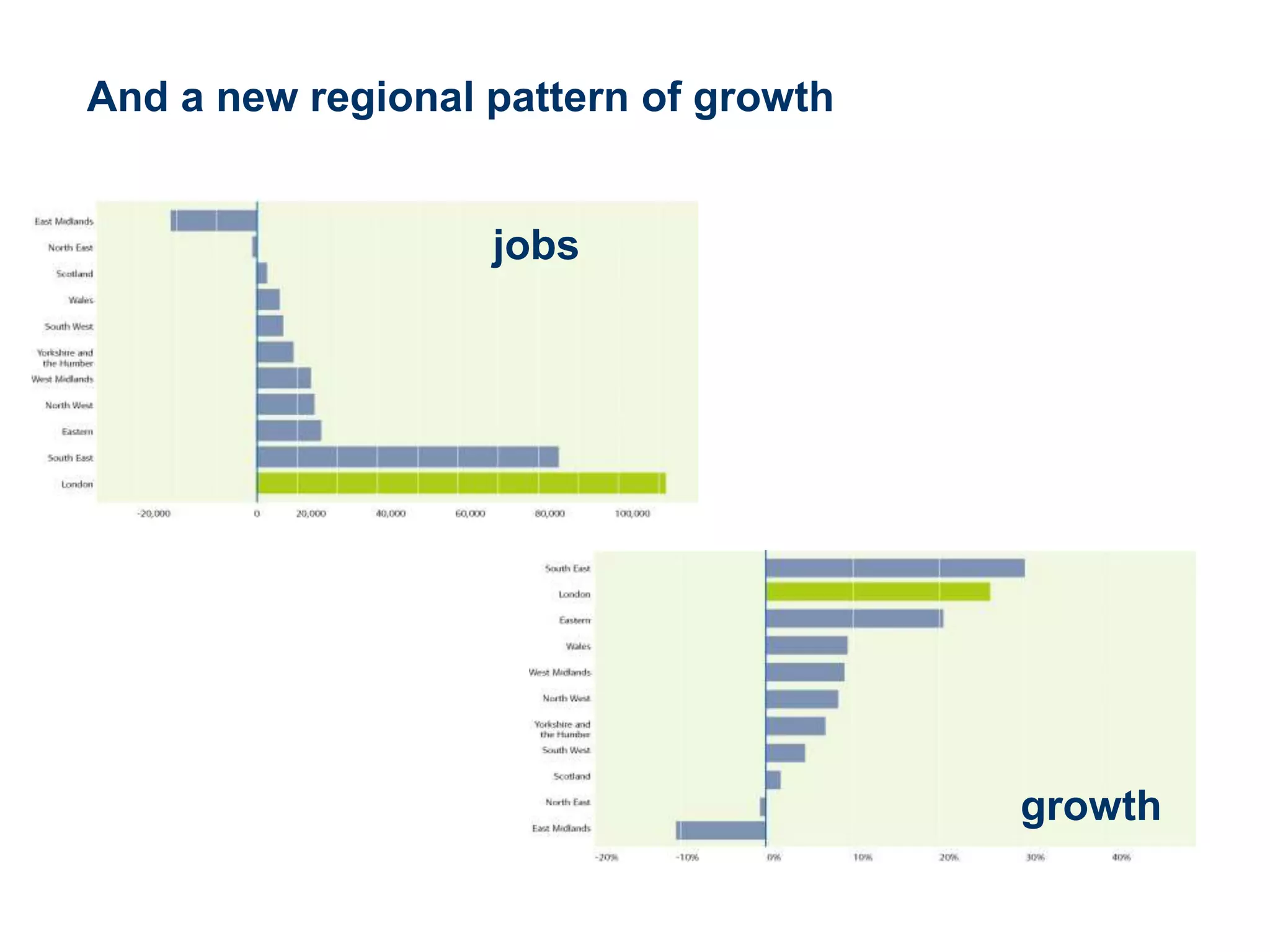
And a new regional pattern of growth
jobs
growth
London: CI job
growth 1995-2000
Including in London itself
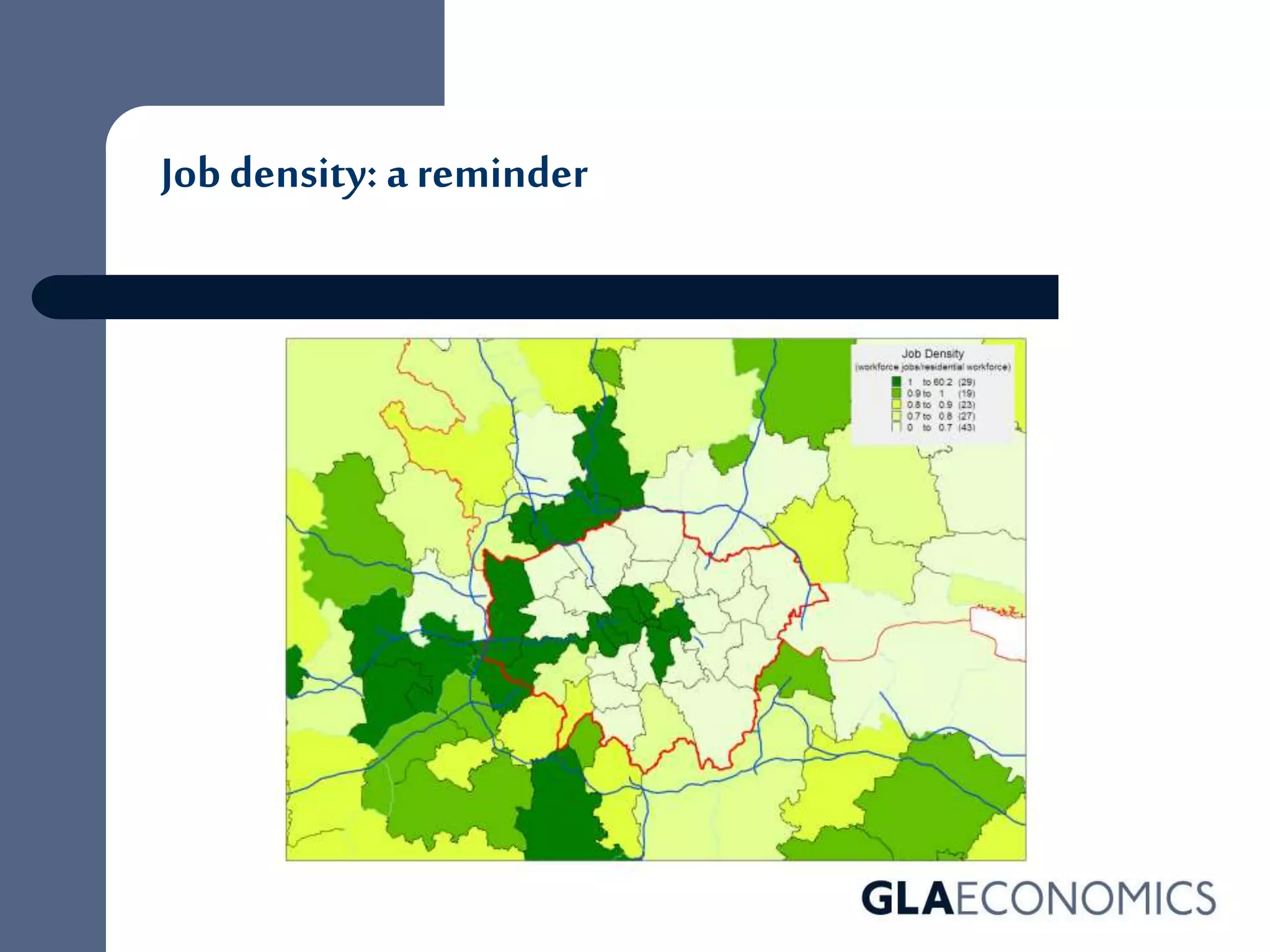
Job density: a reminder
Borough      
Havering 2,744 4,147 6,610 281 3,866 4%
Barking and Dagenham 1,948 3,587 5,074 461 3,126 9%
Waltham Forest 6,566 6,900 11,726 1,740 5,160 15%
Harrow 10,517 8,443 16,466 2,494 5,949 15%
Greenwich 7,688 4,939 10,851 1,776 3,163 16%
Bromley 16,098 9,654 21,558 4,194 5,460 19%
Newham 7,072 4,295 9,417 1,950 2,345 21%
Bexley 5,003 3,337 6,848 1,492 1,845 22%
Hillingdon 9,961 9,420 15,874 3,507 5,913 22%
Ealing 17,849 14,523 26,446 5,926 8,597 22%
Croydon 12,256 12,713 20,149 4,820 7,893 24%
Enfield 8,638 6,544 11,844 3,338 3,206 28%
Kingston upon Thames 11,237 9,657 16,153 4,741 4,916 29%
Hounslow 9,536 5,094 11,300 3,330 1,764 29%
Redbridge 7,432 8,338 11,953 3,817 4,521 32%
Merton 9,995 8,905 14,089 4,811 4,094 34%
Lewisham 10,726 10,557 15,780 5,503 5,054 35%
Sutton 9,549 7,337 12,435 4,451 2,886 36%
Brent 12,721 10,794 17,068 6,447 4,347 38%
Richmond upon Thames 18,232 13,535 22,736 9,031 4,504 40%
Wandsworth 27,495 22,574 35,658 14,411 8,163 40%
Barnet 20,093 15,791 25,479 10,405 5,386 41%
Tower Hamlets 9,434 9,121 12,912 5,643 3,478 44%
Westminster 21,213 15,893 25,479 11,627 4,266 46%
Lambeth 20,237 17,561 25,767 12,031 5,530 47%
Hammersmith and Fulham 19,341 14,931 23,344 10,928 4,003 47%
Hackney 11,467 10,285 14,756 6,996 3,289 47%
Kensington and Chelsea 18,410 14,641 22,243 10,808 3,833 49%
Southwark 15,146 14,390 19,565 9,971 4,419 51%
Camden 24,555 19,257 28,665 15,147 4,110 53%
Islington 15,426 12,234 17,854 9,806 2,428 55%
Haringey 18,169 13,750 20,495 11,424 2,326 56%
Is there a
pattern of
specialisation?
I= working inCreative industry
O= inCreative Occupation
O I= TotalCreative Workforce =
industry +occupation(DCMSdefinition)
OI= ‘specialist’ workforce (anycreative
occupationalsoworking increative
industry)
OI/O  I= ‘Creative Factor Utilisation’
indicator
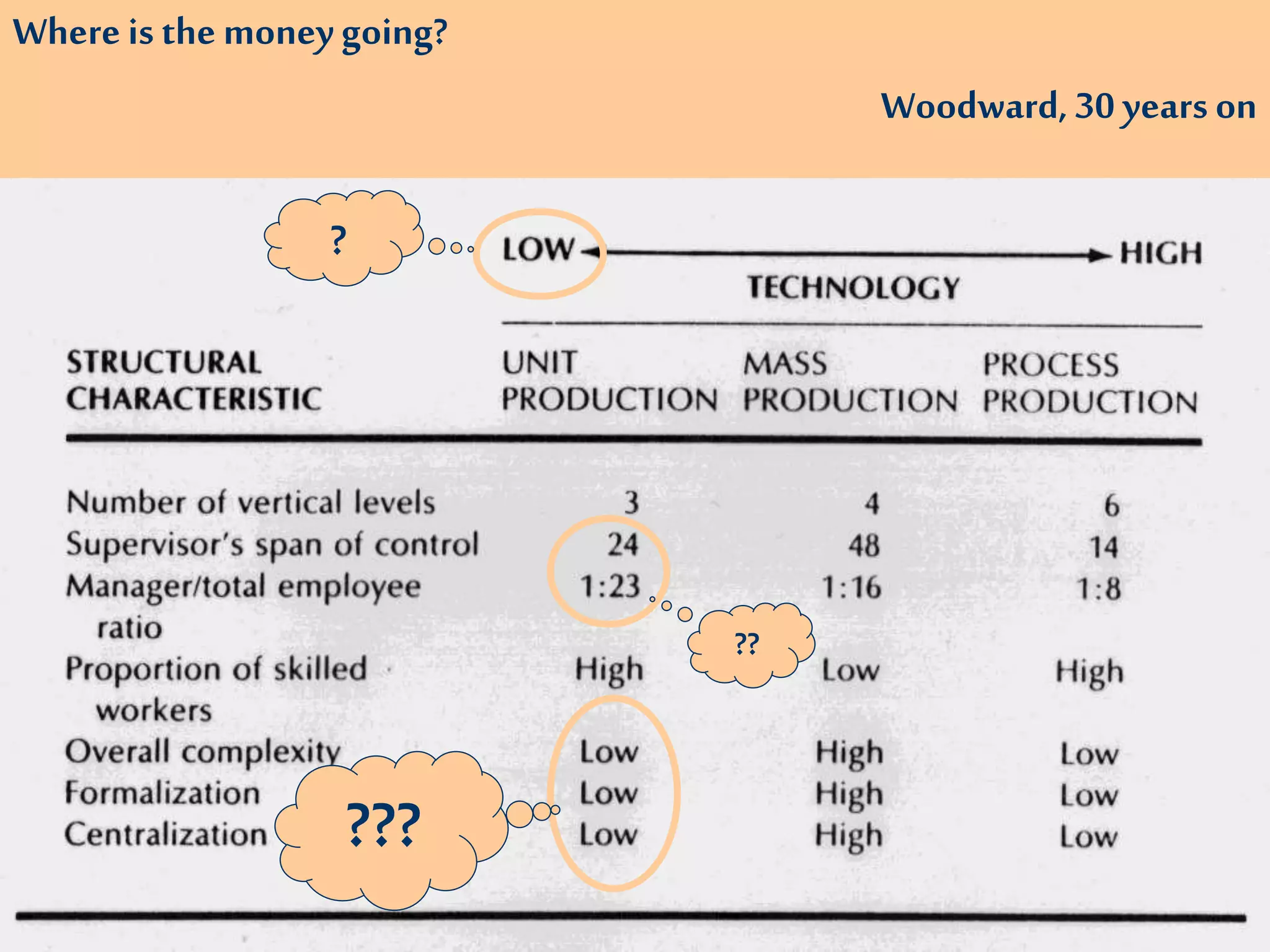
Where is the moneygoing?
Woodward, 30 years on
???
?
??
A new technological paradigm?
● Small runs, big bucks: mass producing difference
The end of the market in sameness
What matters: on spec, and on time
● Birth of a new industrial structure
Capital flows into optimising small unit production
Flexible manufacturing becomes a universal technique
Design becomes a universal factor of production
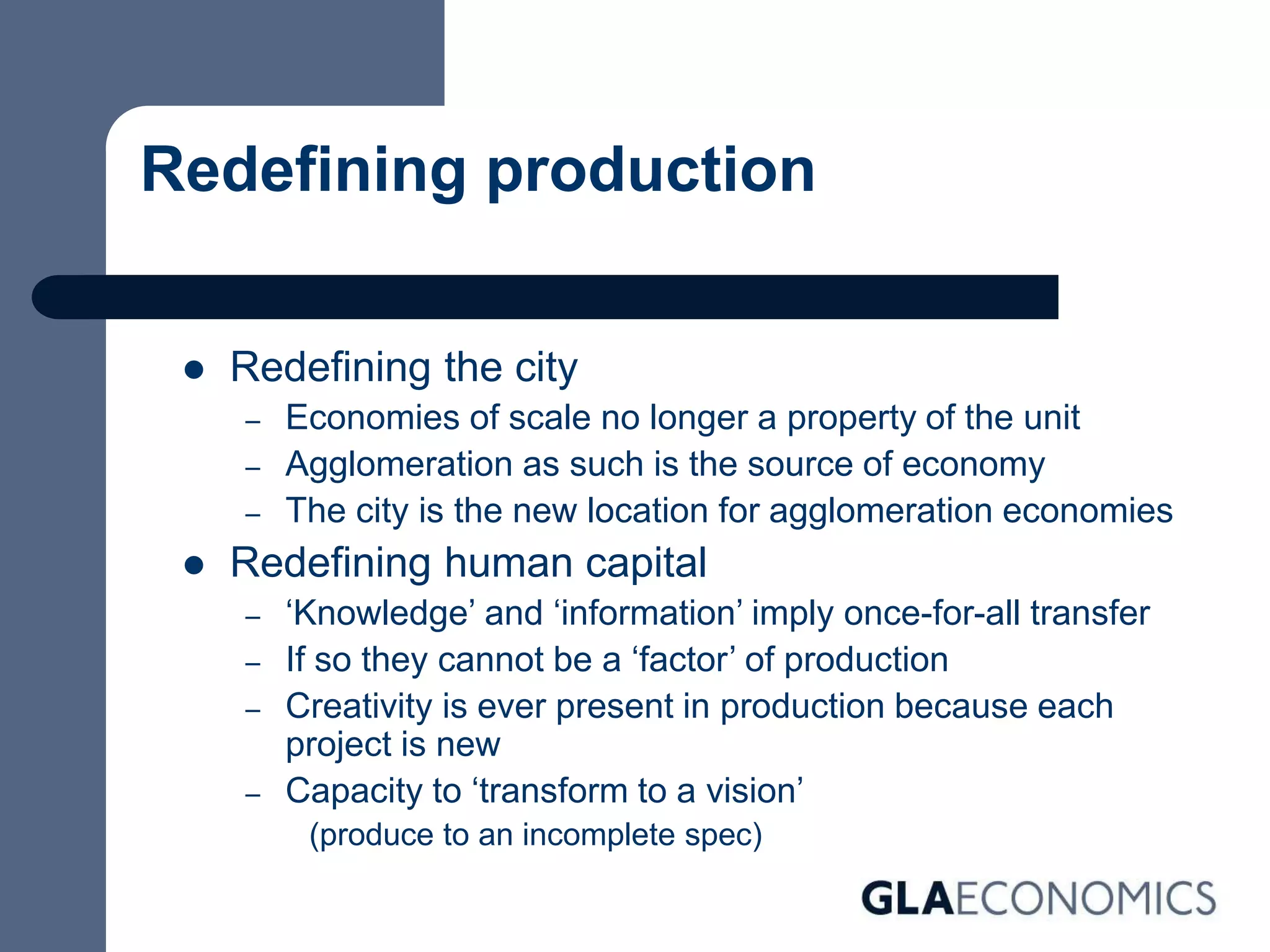
Redefining production
 Redefining the city
– Economies of scale no longer a property of the unit
– Agglomeration as such is the source of economy
– The city is the new location for agglomeration economies
 Redefining human capital
– ‘Knowledge’ and ‘information’ imply once-for-all transfer
– If so they cannot be a ‘factor’ of production
– Creativity is ever present in production because each
project is new
– Capacity to ‘transform to a vision’
(produce to an incomplete spec)
What London might be doing
 New market, both domestic and global
High value-added, short-run, differentiated consumer services
and products
 New production paradigm
Flexibly specialised hi-tech delivery of services, or products
which are close substitutes for a service (eg films, videos)
 New factor of production
Creative capacity
 Organised through specialist productive units
–Using the new factor of production
–in the new production paradigm
–to produce commodities to the new market

Not the return of the city state

  • 1.
    Why are citiesnot states? Alan Freeman
  • 2.
    Governance of London The questions – Where should London’s boundaries be? – How big should a borough be? – How should either and both be governed?
  • 3.
  • 4.
  • 5.
    East-West issues II:the commuters
  • 6.
    Why is acity not a state?  Only two points in history when cities assumed state-type functions – Greece 700-315 bc – Italy 950-1515  In each case absorbed by a larger territorial project  Nation state has become the dominant form
  • 7.
    Working definition  Functionof political power is to optimise the achievement of social objectives by economic means
  • 8.
    However, the nation-stateis in crisis  ‘Globalisation’ (=world market in capital, plus multilateral economics institutions)  Economy is world-wide, nation is territorially bounded.  Existing boundaries being redrawn  But what is in question? – Not ‘the nation’ but ‘which nation’  Devolution – Is London really the same as Scotland?  City exists as a component part of a nation
  • 9.
    London: between twocontinents  Globalisation has in fact undermined the political basis of multilateralism  Return of unilateral political action  Decline of the multilateral institutions  But inadequacy of the national form remains  Structural crisis of the nation-state  But no sign that the city has heightened autonomy  Conclusion: cities, even global cities, can only optimise in context of relation to world and national economy  But which nation?
  • 10.
    The ‘World City’hypothesis (Geddes, Sassen, Hall, LPAC) World cities are four or more of: • Finance and commerce • Culture, knowledge and/or creativity • Communication • ‘Power and influence’ or command and control functions both worldwide (eg Headquarters of TNCs, transnational bodies) and nationally (core government functions) • Tourism and/or: • Function within their country as a centre for entrepot and export processing
  • 11.
    The GLA WorldCities Project  Originally concerned with World City Hypothesis but now more limited  ‘Core Cities’ project – Regional productivity differentials targetted by HM Treasury – Cities thought to be drivers of regional growth – so cities want to measure their productivity  LDA – Want to learn best practice relations with other cities  GLA Economics – Want to understand London by comparing it with other cities
  • 12.
    The aims  Comparabledata  Continuous data  Robust data BUT…
  • 13.
    The world accordingto Parkinson GDP Per Capita (Euros) 2001 0 10000 20000 30000 40000 50000 60000 70000 80000 Nation Supplier 2 Supplier 1 Parkinson Source: CoreCitiesproject
  • 14.
    Growth according tothree suppliers 10-year annual growth in GDP per capita, 1998 PPP Euros 0% 1% 2% 3% 4% Supplier 1 Supplier 2 Supplier 3
  • 15.
    Why so manydifferent estimates?  City definition  Employment  Output
  • 16.
    Can this beovercome? Extract from the Eurostatguide to regional data
  • 17.
  • 18.
    Urban Audit –first (official) attempt to classify and measure cities ‘Cities have generally been defined as the central municipality which is responsible for local government. In most countries, the city corresponds to the concept of Local administrative unit (LAU) level 2 (formerly NUTS level 5). Exceptions to this rule are listed below. Given that the structure of local government varies a lot between EU countries, the result is a city concept that is not always comparable between countries. The emphasis has been on identifying a city concept with political responsibility in the various countries. ‘The following countries have defined “city” differently than LAU level 2 in the context of the Urban Audit. Belgium; France: Portugal: United Kingdom: Ireland:
  • 19.
    GLAName 1999 LSE (FUR) GAME1997/ 8 Supplier1 Supplier 2 UAII UA/ FUR Supplier 2/ FUR Berlin 2,125,140 3,995,074 3,376,200 3,444,255 3,386,667 159% 162% Marseille 1,498,275 1,197,623 1,873,636 1,857,129 1,349,772 90% 124% London 9,245,799 12,653,500 7,269,093 7,191,886 7,172,036 78% 78% Rome 3,926,166 3,330,298 3,854,589 3,815,800 2,459,776 63% 97% Madrid 5,183,064 4,747,548 5,220,742 5,069,982 2,938,723 57% 98% Hamburg 3,064,151 2,213,649 1,706,697 1,732,841 1,704,735 56% 57% Cologne 2,171,206 10,336,511 1,584,997 4,302,934 962,507 44% 198% Munich 2,940,226 1,804,920 1,620,567 1,193,495 1,194,560 41% 41% Birmingham 2,870,658 3,753,500 2,615,754 976,093 977,091 34% 34% Barcelona 4,630,150 4,103,470 4,719,505 4,588,406 1,503,884 32% 99% Dublin 1,567,524 1,113,418 1,099,164 495,101 32% 70% Amsterdam 2,635,825 6,219,212 1,207,985 1,176,243 734,629 28% 45% Brussels 3,464,443 2,830,590 963,922 938,344 964,405 28% 27% Copenhagen 1,939,669 1,349,755 591,628 614,040 499,148 26% 32% Manchester 1,866,996 6,843,700 2,567,913 2,482,514 392,819 21% 133% Athens 3,535,059 3,761,478 3,470,854 736,406 21% 98% Paris 10,902,388 9,970,315 11,070,662 11,259,299 2,125,246 19% 103% Lisbon 4,077,286 2,276,890 2,589,168 3,336,215 556,797 14% 82% Stuttgart 2,616,980 1,573,303 2,361,437 3,959,421 151% Some population estimates…
  • 20.
    Does it matter? GreaterLondon 157.4 Inner London 250.6 Inner London –West 461.9 Inner London – East 129.1 Outer London 99.4 South East 116 GVA per capita in Euros – EU15=100 (Paul Cheshire)
  • 21.
    And now forsomething entirely different…
  • 22.
    Invention and transformation:Theintegration ofKondratieff waves with social, geographical and geopolitical change (Perez) Date of ‘big bang’ Boom age Popular name for the period Core country or countries Year Big-bang initiating the revolution Citiesborn or transformed 1771 1800-1825 The ‘Industrial Revolution’ Britain Arkwright’smill opensin Cromford The modern Industrial City 1829 1848-73 Age of Steamand Railways Britain (spreading to Continent and USA) Test of the ‘Rocket’ engine for the Liverpool– Manchester railway The North West (UK); the Midwest (US) 1875 1890-1914 ‘BelleÉpoque’; Age of Steel, Electricity and Heavy Engineering USA and Germany forging ahead and overtaking Britain Carnegie Bessemer steel plant opensin Pittsburgh, Pennsylvania New York Ruhr 1908 1947-1962 Age of Oil, the Automobile and MassProduction USA (with Germany at first vying for world leadership), later spreading to Europe First Model-T comesout of Ford plant in Detroit, Michigan Detroit Birmingham Darmstadt Etc 1971 Please wait for announce- ments Age of Information and Telecommunications USA (spreading to Europe and Asia) Intel microprocessor is announced in Santa Clara, California Silicon Valley The West (UK) Global Cities?
  • 27.
    Not cyclingbut waving? ParametersRatios Manufacturing Services Start point >1 meansServicesstart earlier 1.22 0.01 0.0122 Speed >1 meansServicesrise slower 1.86 2 3.72 Top Limit >1 meansServicesrise further 1.44 1 1.4433 - 0.20 0.40 0.60 0.80 1.00 1.20 1.40 1.60 1.80 2.00 1 3 5 7 9 11 13 15 17 19 21 23 25 27 29 31 33 35 Period manufacturing business services Total
  • 28.
    What happened inthe nineties? 0% 5% 10% 15% 20% 25% 30% 35% 40% 1971 1974 1977 1980 1983 1986 1989 1992 1995 1998 2001 2004 2007 2010 2013 2016 Manufacturing Businessservices Manufacturing plusBusinessServices
  • 29.
    London’s output growth 1995-2000 CreativeIndustries:aqualitative reshapingofindustrial structure Jobs growth Output growth
  • 30.
    And a newregional pattern of growth jobs growth
  • 31.
    London: CI job growth1995-2000 Including in London itself
  • 32.
  • 33.
    Borough      Havering 2,744 4,147 6,610 281 3,866 4% Barking and Dagenham 1,948 3,587 5,074 461 3,126 9% Waltham Forest 6,566 6,900 11,726 1,740 5,160 15% Harrow 10,517 8,443 16,466 2,494 5,949 15% Greenwich 7,688 4,939 10,851 1,776 3,163 16% Bromley 16,098 9,654 21,558 4,194 5,460 19% Newham 7,072 4,295 9,417 1,950 2,345 21% Bexley 5,003 3,337 6,848 1,492 1,845 22% Hillingdon 9,961 9,420 15,874 3,507 5,913 22% Ealing 17,849 14,523 26,446 5,926 8,597 22% Croydon 12,256 12,713 20,149 4,820 7,893 24% Enfield 8,638 6,544 11,844 3,338 3,206 28% Kingston upon Thames 11,237 9,657 16,153 4,741 4,916 29% Hounslow 9,536 5,094 11,300 3,330 1,764 29% Redbridge 7,432 8,338 11,953 3,817 4,521 32% Merton 9,995 8,905 14,089 4,811 4,094 34% Lewisham 10,726 10,557 15,780 5,503 5,054 35% Sutton 9,549 7,337 12,435 4,451 2,886 36% Brent 12,721 10,794 17,068 6,447 4,347 38% Richmond upon Thames 18,232 13,535 22,736 9,031 4,504 40% Wandsworth 27,495 22,574 35,658 14,411 8,163 40% Barnet 20,093 15,791 25,479 10,405 5,386 41% Tower Hamlets 9,434 9,121 12,912 5,643 3,478 44% Westminster 21,213 15,893 25,479 11,627 4,266 46% Lambeth 20,237 17,561 25,767 12,031 5,530 47% Hammersmith and Fulham 19,341 14,931 23,344 10,928 4,003 47% Hackney 11,467 10,285 14,756 6,996 3,289 47% Kensington and Chelsea 18,410 14,641 22,243 10,808 3,833 49% Southwark 15,146 14,390 19,565 9,971 4,419 51% Camden 24,555 19,257 28,665 15,147 4,110 53% Islington 15,426 12,234 17,854 9,806 2,428 55% Haringey 18,169 13,750 20,495 11,424 2,326 56% Is there a pattern of specialisation? I= working inCreative industry O= inCreative Occupation O I= TotalCreative Workforce = industry +occupation(DCMSdefinition) OI= ‘specialist’ workforce (anycreative occupationalsoworking increative industry) OI/O  I= ‘Creative Factor Utilisation’ indicator
  • 34.
    Where is themoneygoing? Woodward, 30 years on ??? ? ??
  • 35.
    A new technologicalparadigm? ● Small runs, big bucks: mass producing difference The end of the market in sameness What matters: on spec, and on time ● Birth of a new industrial structure Capital flows into optimising small unit production Flexible manufacturing becomes a universal technique Design becomes a universal factor of production
  • 36.
    Redefining production  Redefiningthe city – Economies of scale no longer a property of the unit – Agglomeration as such is the source of economy – The city is the new location for agglomeration economies  Redefining human capital – ‘Knowledge’ and ‘information’ imply once-for-all transfer – If so they cannot be a ‘factor’ of production – Creativity is ever present in production because each project is new – Capacity to ‘transform to a vision’ (produce to an incomplete spec)
  • 37.
    What London mightbe doing  New market, both domestic and global High value-added, short-run, differentiated consumer services and products  New production paradigm Flexibly specialised hi-tech delivery of services, or products which are close substitutes for a service (eg films, videos)  New factor of production Creative capacity  Organised through specialist productive units –Using the new factor of production –in the new production paradigm –to produce commodities to the new market