THE FUTURE OF LEARNING
Jesper Christiansen,
Head of strategy & development, innovation skills
Nesta
How platforms enable brand new ways of turning
collective knowledge and data into
improved impact
1
UNDP
CONTEXT
2
UNDP 3
Icon: “complex" by Marie Van den Broeck from the Noun Project
UNDP 4
The increased pace of change is fundamentally challenging the organizational operating
model.
Dealing with the SDGs which involve high levels of interconnectedness, uncertainty, and
indeterminateness requires making use of new approaches, causing a growing skills gap and a
persistent need for a more learning-oriented culture
UNDP (alongside other international institutions and governments around the world) are
struggling to embed learning-oriented ways of working in their daily practice.
There is a widespread underestimation of what it takes to enable the uptake of new ways of
working. A new approach is needed to develop and operationalize mechanisms that can
support cultural transformation process and behavior change
CONTEXT
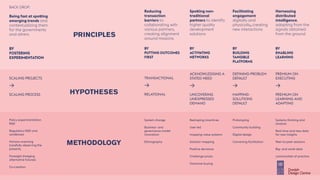
Reducing
transaction
barriers to
collaborating with
various partners,
creating alignment
around missions
TRANSACTIONAL
→
RELATIONAL
BY
PUTTING OUTCOMES
FIRST
BY
FOSTERING
EXPERIMENTATION
BY
ACTIVATING
NETWORKS
BY
BUILDING
TANGIBLE
PLATFORMS
BY
ENABLING
LEARNING
System change
Business- and
governance model
innovation
Ethnography
Spotting non-
traditional
partners to identify
higher quality
development
solutions
ACKNOWLEDGING A
STATED NEED
→
UNCOVERING
UNEXPRESSED
DEMAND
Reshaping incentives
User led
mapping value systems
Solution mapping
Positive deviance
Challenge prizes
Outcome buying
Facilitating
engagement
digitally and
physically, creating
new interactions
DEFINING-PROBLEM
DEFAULT
→
MAPPING-
SOLUTIONS
DEFAULT
Prototyping
Community building
Digital design
Convening facilitation
Harnessing
distributed
intelligence,
adapting from the
signals obtained
from the ground
BACK DROP:
Being fast at spotting
emerging trends and
contextualizing them
for the governments
and others
PREMIUM ON
EXECUTING
→
PREMIUM ON
LEARNING AND
ADAPTING
SCALING PROJECTS
→
SCALING PROCESS
Systems thinking and
analysis
Real time and new data
for new insights
Peer-to-peer sessions
Big- and small data
communities of practice
Policy experimentation
R&D
Regulatory R&D and
sandboxes
Horizon scanning
(carefully observing the
present),
Foresight (imaging
alternative futures)
Co-creation
PRINCIPLES
HYPOTHESES
METHODOLOGY
UNDP 6
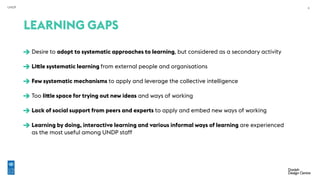
Desire to adopt to systematic approaches to learning, but considered as a secondary activity

Little systematic learning from external people and organisations

Few systematic mechanisms to apply and leverage the collective intelligence

Too little space for trying out new ideas and ways of working

Lack of social support from peers and experts to apply and embed new ways of working

Learning by doing, interactive learning and various informal ways of learning are experienced
as the most useful among UNDP staff
LEARNING GAPS
UNDP
RESPONSE
7
UNDP 8
UNDP as a dynamic platform for
knowledge mobilization and exchange
that can raise the bar and set the
benchmark for the next stage of
development practice.
MISSION FOR LEARNING
UNDP 9
Space of the
obvious
Space of the
unobvious
[Inspired by and adapted from Innovation learning approach for Nesta’s Skills Team]
UNDP 10
LANDSCAPE OF INNOVATION APPROACHES
[Landscape of Innovation Approaches, Nesta’s Skills Team]
UNDP 11
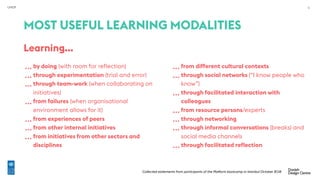
Collected statements from participants of the Platform bootcamp in Istanbul October 2018
MOST USEFUL LEARNING MODALITIES
Learning…
...by doing (with room for reflection)
...through experimentation (trial and error)
...through team-work (when collaborating on
initiatives)
...from failures (when organisational
environment allows for it)
...from experiences of peers
...from other internal initiatives
...from initiatives from other sectors and
disciplines
...from different cultural contexts
...through social networks (“I know people who
know”)
...through facilitated interaction with
colleagues
...from resource persons/experts
...through networking
...through informal conversations (breaks) and
social media channels
...through facilitated reflection
UNDP 12
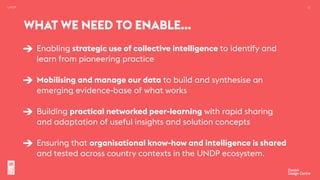
Enabling strategic use of collective intelligence to identify and
learn from pioneering practice

Mobilising and manage our data to build and synthesise an
emerging evidence-base of what works

Building practical networked peer-learning with rapid sharing
and adaptation of useful insights and solution concepts 

Ensuring that organisational know-how and intelligence is shared
and tested across country contexts in the UNDP ecosystem.
WHAT WE NEED TO ENABLE…
UNDP
LEARNING APPROACH
13
UNDP 14
LEARNING PRINCIPLES
[Inspired by and adapted from Innovation learning approach for Nesta’s Skills Team]
Focus on mindset change
and skills development
simultaneously
Learn by doing and
change behaviors through
experimentation
Foster communities of
practice in which social
learning can emerge
UNDP 15
Focus on mindsets to effectively apply new methods 

Simultaneous focus on mindset change and skills development to be able to manage complex sets of
attitudes, tactics and judgment, skills and techniques needed for effective application of new methods with
strategic impact.
Learning by doing 

The very nature of a platform way of working implies transformation and should enable learners to rehearse
and change their behaviours through learning by doing and experimenting with new ways of working.

Build communities of practice 

Learning requires continuous and constant practice and renewal of skills. Learners will benefit from a
strategic engagement in a community of practice to learn from others and enable peer-to-peer feedback,
critical reflection and collaborative sensemaking
LEARNING PRINCIPLES
[Inspired by and adapted from Innovation learning approach for Nesta’s Skills Team]
UNDP 16
RAISING
AWARENESS
Understand and be able to
Articulate the benefits of
innovation
MAKING IT
HAPPEN
Learn how to develop ideas into
action (set up pilots, create
prototypes)
INTEGRATE NEW
PRACTICES
Integrate innovation methods

and tools into the daily practice

of organisations and scale
LEARNING JOURNEY
[Inspired by and adapted from Innovation learning approach for Nesta’s Skills Team]
UNDP 17
INFORMAL
LEARNING
Involves learning in and from
everyday practice (e.g.
apprenticeship)
MENTORING /
COACHING
Reflecting on experiences and
given guidance by more
experienced others
TRAINING &
SIMULATION
Simulations and /hands-on)
exercises led by expert instructors
SELF
STUDY
Self led learning activities (e.g.
reading, webinars) and exercises
IN PRACTICE
Drives the development of
embodied knowledge, complex
skills, situational awareness and
reflexivity
ABOUT PRACTICE
Helps generate conceptual
understanding, develop basic
skills and build confidence
SELF DIRECTED DIRECTED
LEARNABLE
Tacit knowlede and
implicit practice
TEACHABLE
Explicit knowledge and
codified practices
}
}
[From Innovation learning approach for Nesta’s Skills Team]
UNDP 18
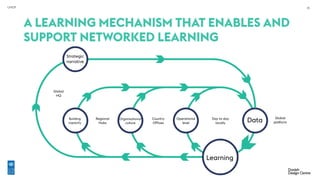
Data
Learning
Operational
level
Organisational
culture
Building
capacity
Strategic
narrative
Global
platform
Regional
Hubs
Country
Offices
Day to day
locally
Global
HQ
A LEARNING MECHANISM THAT ENABLES AND
SUPPORT NETWORKED LEARNING
UNDP 19
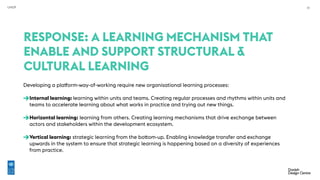
Developing a platform-way-of-working require new organisational learning processes: 
Internal learning: learning within units and teams. Creating regular processes and rhythms within units and
teams to accelerate learning about what works in practice and trying out new things.
Horizontal learning: learning from others. Creating learning mechanisms that drive exchange between
actors and stakeholders within the development ecosystem.
Vertical learning: strategic learning from the bottom-up. Enabling knowledge transfer and exchange
upwards in the system to ensure that strategic learning is happening based on a diversity of experiences
from practice. 
RESPONSE: A LEARNING MECHANISM THAT
ENABLE AND SUPPORT STRUCTURAL &
CULTURAL LEARNING
UNDP
WHAT’S NEXT?
20
UNDP 21
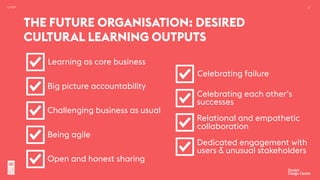
THE FUTURE ORGANISATION: DESIRED
CULTURAL LEARNING OUTPUTS
Learning as core business
Big picture accountability
Challenging business as usual
Being agile
Open and honest sharing
Celebrating failure
Celebrating each other’s 

successes
Relational and empathetic 

collaboration
Dedicated engagement with
users & unusual stakeholders
UNDP 22
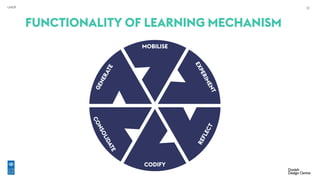
FUNCTIONALITY OF LEARNING MECHANISM
GENERATE
MOBILISE
EXPERIMENT
REFLECT
CODIFY
CONSOLIDATE
UNDP 23
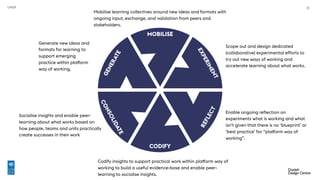
GENERATE
MOBILISE
EXPERIMENT
REFLECT
CODIFY
CONSOLIDATE
Generate new ideas and
formats for learning to
support emerging
practice within platform
way of working.
Mobilise learning collectives around new ideas and formats with
ongoing input, exchange, and validation from peers and
stakeholders.
Scope out and design dedicated
(collaborative) experimental efforts to
try out new ways of working and
accelerate learning about what works.
Enable ongoing reflection on
experiments what is working and what
isn't given that there is no ‘blueprint’ or
‘best practice’ for “platform way of
working”.
Codify insights to support practical work within platform way of
working to build a useful evidence-base and enable peer-
learning to socialise insights.
Socialise insights and enable peer-
learning about what works based on
how people, teams and units practically
create successes in their work 
UNDP 24
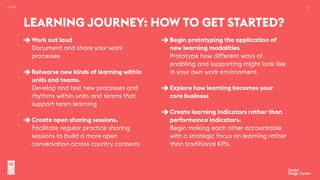
LEARNING JOURNEY: HOW TO GET STARTED?
Work out loud

Document and share your work
processes 

Rehearse new kinds of learning within
units and teams. 

Develop and test new processes and
rhythms within units and teams that
support team learning 

Create open sharing sessions.

Facilitate regular practice sharing
sessions to build a more open
conversation across country contexts
Begin prototyping the application of
new learning modalities 

Prototype how different ways of
enabling and supporting might look like
in your own work environment. 

Explore how learning becomes your
core business

Create learning indicators rather than
performance indicators.

Begin making each other accountable
with a strategic focus on learning rather
than traditional KPIs.

UNDP Learning mechanism primer

  • 1.
    THE FUTURE OFLEARNING Jesper Christiansen, Head of strategy & development, innovation skills Nesta How platforms enable brand new ways of turning collective knowledge and data into improved impact 1
  • 2.
  • 3.
    UNDP 3 Icon: “complex"by Marie Van den Broeck from the Noun Project
  • 4.
    UNDP 4 The increasedpace of change is fundamentally challenging the organizational operating model. Dealing with the SDGs which involve high levels of interconnectedness, uncertainty, and indeterminateness requires making use of new approaches, causing a growing skills gap and a persistent need for a more learning-oriented culture UNDP (alongside other international institutions and governments around the world) are struggling to embed learning-oriented ways of working in their daily practice. There is a widespread underestimation of what it takes to enable the uptake of new ways of working. A new approach is needed to develop and operationalize mechanisms that can support cultural transformation process and behavior change CONTEXT
  • 5.
    Reducing transaction barriers to collaborating with variouspartners, creating alignment around missions TRANSACTIONAL → RELATIONAL BY PUTTING OUTCOMES FIRST BY FOSTERING EXPERIMENTATION BY ACTIVATING NETWORKS BY BUILDING TANGIBLE PLATFORMS BY ENABLING LEARNING System change Business- and governance model innovation Ethnography Spotting non- traditional partners to identify higher quality development solutions ACKNOWLEDGING A STATED NEED → UNCOVERING UNEXPRESSED DEMAND Reshaping incentives User led mapping value systems Solution mapping Positive deviance Challenge prizes Outcome buying Facilitating engagement digitally and physically, creating new interactions DEFINING-PROBLEM DEFAULT → MAPPING- SOLUTIONS DEFAULT Prototyping Community building Digital design Convening facilitation Harnessing distributed intelligence, adapting from the signals obtained from the ground BACK DROP: Being fast at spotting emerging trends and contextualizing them for the governments and others PREMIUM ON EXECUTING → PREMIUM ON LEARNING AND ADAPTING SCALING PROJECTS → SCALING PROCESS Systems thinking and analysis Real time and new data for new insights Peer-to-peer sessions Big- and small data communities of practice Policy experimentation R&D Regulatory R&D and sandboxes Horizon scanning (carefully observing the present), Foresight (imaging alternative futures) Co-creation PRINCIPLES HYPOTHESES METHODOLOGY
  • 6.
    UNDP 6 Desire toadopt to systematic approaches to learning, but considered as a secondary activity
 Little systematic learning from external people and organisations
 Few systematic mechanisms to apply and leverage the collective intelligence
 Too little space for trying out new ideas and ways of working
 Lack of social support from peers and experts to apply and embed new ways of working
 Learning by doing, interactive learning and various informal ways of learning are experienced as the most useful among UNDP staff LEARNING GAPS
  • 7.
  • 8.
    UNDP 8 UNDP asa dynamic platform for knowledge mobilization and exchange that can raise the bar and set the benchmark for the next stage of development practice. MISSION FOR LEARNING
  • 9.
    UNDP 9 Space ofthe obvious Space of the unobvious [Inspired by and adapted from Innovation learning approach for Nesta’s Skills Team]
  • 10.
    UNDP 10 LANDSCAPE OFINNOVATION APPROACHES [Landscape of Innovation Approaches, Nesta’s Skills Team]
  • 11.
    UNDP 11 Collected statementsfrom participants of the Platform bootcamp in Istanbul October 2018 MOST USEFUL LEARNING MODALITIES Learning… ...by doing (with room for reflection) ...through experimentation (trial and error) ...through team-work (when collaborating on initiatives) ...from failures (when organisational environment allows for it) ...from experiences of peers ...from other internal initiatives ...from initiatives from other sectors and disciplines ...from different cultural contexts ...through social networks (“I know people who know”) ...through facilitated interaction with colleagues ...from resource persons/experts ...through networking ...through informal conversations (breaks) and social media channels ...through facilitated reflection
  • 12.
    UNDP 12 Enabling strategicuse of collective intelligence to identify and learn from pioneering practice
 Mobilising and manage our data to build and synthesise an emerging evidence-base of what works
 Building practical networked peer-learning with rapid sharing and adaptation of useful insights and solution concepts 
 Ensuring that organisational know-how and intelligence is shared and tested across country contexts in the UNDP ecosystem. WHAT WE NEED TO ENABLE…
  • 13.
  • 14.
    UNDP 14 LEARNING PRINCIPLES [Inspiredby and adapted from Innovation learning approach for Nesta’s Skills Team] Focus on mindset change and skills development simultaneously Learn by doing and change behaviors through experimentation Foster communities of practice in which social learning can emerge
  • 15.
    UNDP 15 Focus onmindsets to effectively apply new methods 
 Simultaneous focus on mindset change and skills development to be able to manage complex sets of attitudes, tactics and judgment, skills and techniques needed for effective application of new methods with strategic impact. Learning by doing 
 The very nature of a platform way of working implies transformation and should enable learners to rehearse and change their behaviours through learning by doing and experimenting with new ways of working.
 Build communities of practice 
 Learning requires continuous and constant practice and renewal of skills. Learners will benefit from a strategic engagement in a community of practice to learn from others and enable peer-to-peer feedback, critical reflection and collaborative sensemaking LEARNING PRINCIPLES [Inspired by and adapted from Innovation learning approach for Nesta’s Skills Team]
  • 16.
    UNDP 16 RAISING AWARENESS Understand andbe able to Articulate the benefits of innovation MAKING IT HAPPEN Learn how to develop ideas into action (set up pilots, create prototypes) INTEGRATE NEW PRACTICES Integrate innovation methods
 and tools into the daily practice
 of organisations and scale LEARNING JOURNEY [Inspired by and adapted from Innovation learning approach for Nesta’s Skills Team]
  • 17.
    UNDP 17 INFORMAL LEARNING Involves learningin and from everyday practice (e.g. apprenticeship) MENTORING / COACHING Reflecting on experiences and given guidance by more experienced others TRAINING & SIMULATION Simulations and /hands-on) exercises led by expert instructors SELF STUDY Self led learning activities (e.g. reading, webinars) and exercises IN PRACTICE Drives the development of embodied knowledge, complex skills, situational awareness and reflexivity ABOUT PRACTICE Helps generate conceptual understanding, develop basic skills and build confidence SELF DIRECTED DIRECTED LEARNABLE Tacit knowlede and implicit practice TEACHABLE Explicit knowledge and codified practices } } [From Innovation learning approach for Nesta’s Skills Team]
  • 18.
  • 19.
    UNDP 19 Developing aplatform-way-of-working require new organisational learning processes:  Internal learning: learning within units and teams. Creating regular processes and rhythms within units and teams to accelerate learning about what works in practice and trying out new things. Horizontal learning: learning from others. Creating learning mechanisms that drive exchange between actors and stakeholders within the development ecosystem. Vertical learning: strategic learning from the bottom-up. Enabling knowledge transfer and exchange upwards in the system to ensure that strategic learning is happening based on a diversity of experiences from practice.  RESPONSE: A LEARNING MECHANISM THAT ENABLE AND SUPPORT STRUCTURAL & CULTURAL LEARNING
  • 20.
  • 21.
    UNDP 21 THE FUTUREORGANISATION: DESIRED CULTURAL LEARNING OUTPUTS Learning as core business Big picture accountability Challenging business as usual Being agile Open and honest sharing Celebrating failure Celebrating each other’s 
 successes Relational and empathetic 
 collaboration Dedicated engagement with users & unusual stakeholders
  • 22.
    UNDP 22 FUNCTIONALITY OFLEARNING MECHANISM GENERATE MOBILISE EXPERIMENT REFLECT CODIFY CONSOLIDATE
  • 23.
    UNDP 23 GENERATE MOBILISE EXPERIMENT REFLECT CODIFY CONSOLIDATE Generate newideas and formats for learning to support emerging practice within platform way of working. Mobilise learning collectives around new ideas and formats with ongoing input, exchange, and validation from peers and stakeholders. Scope out and design dedicated (collaborative) experimental efforts to try out new ways of working and accelerate learning about what works. Enable ongoing reflection on experiments what is working and what isn't given that there is no ‘blueprint’ or ‘best practice’ for “platform way of working”. Codify insights to support practical work within platform way of working to build a useful evidence-base and enable peer- learning to socialise insights. Socialise insights and enable peer- learning about what works based on how people, teams and units practically create successes in their work 
  • 24.
    UNDP 24 LEARNING JOURNEY:HOW TO GET STARTED? Work out loud
 Document and share your work processes 
 Rehearse new kinds of learning within units and teams. 
 Develop and test new processes and rhythms within units and teams that support team learning 
 Create open sharing sessions.
 Facilitate regular practice sharing sessions to build a more open conversation across country contexts Begin prototyping the application of new learning modalities 
 Prototype how different ways of enabling and supporting might look like in your own work environment. 
 Explore how learning becomes your core business
 Create learning indicators rather than performance indicators.
 Begin making each other accountable with a strategic focus on learning rather than traditional KPIs.