

1
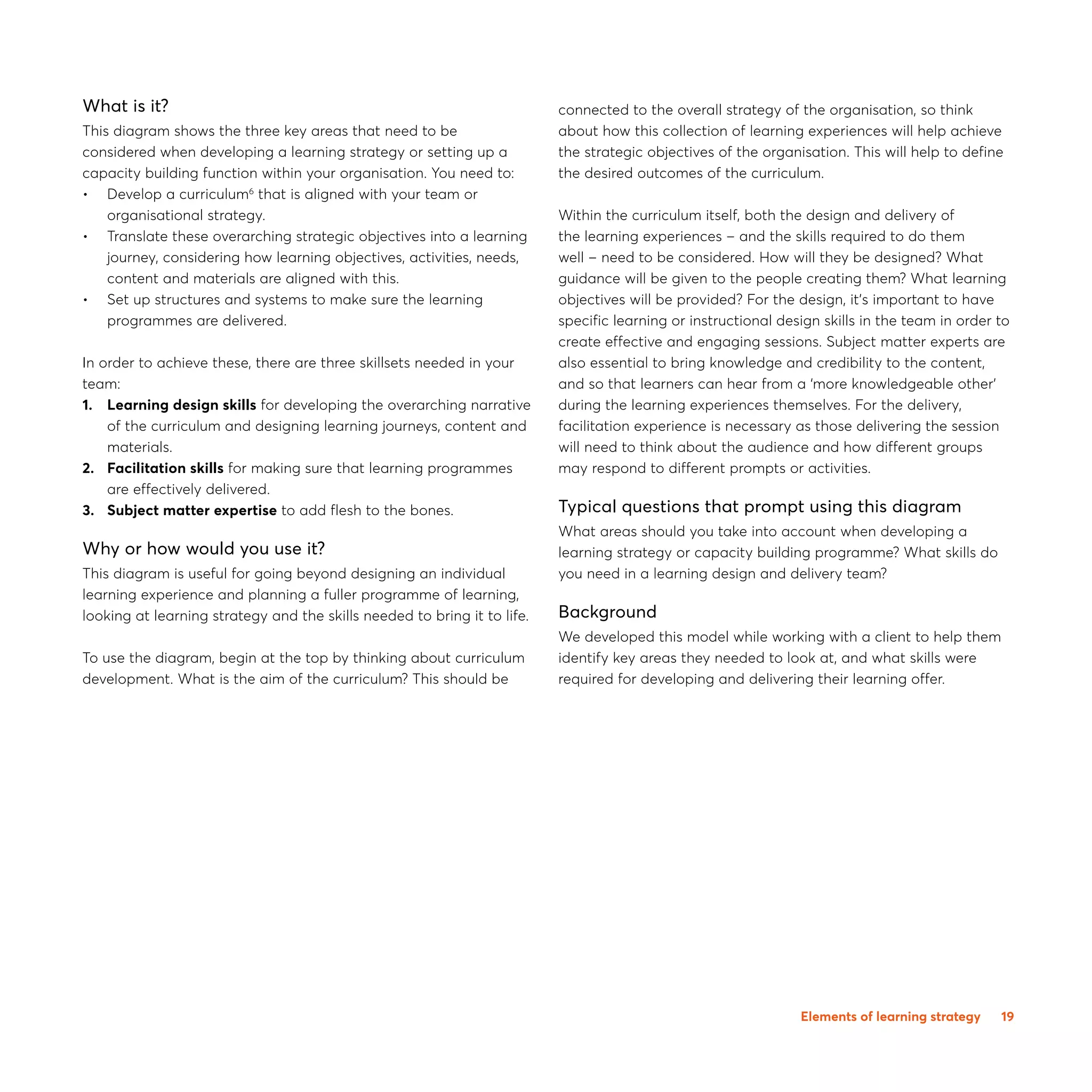
Playbook for
innovation
learning
35 diagrams to support talking and
thinking about learning for innovation
Acknowledgements
This playbook was written by Bas Leurs and Isobel Roberts, and produced by Nesta’s
Innovation Skills team.
Thank you to the following colleagues for their contributions, suggestions and help:
Brenton Caffin, Diana Hidalgo, Jesper Christiansen, Sonja Dahl, Giulio Quaggiotto,
Kelly Duggan, Glen Mehn, Geoff Mulgan, Paulina Gonzalez-Ortega and Zosia Poulter.
We also would like to thank our friends, partners, colleagues and clients that we have
worked with. This book is for you! Millie, Stéphane, Gianncarlo, Aisha, George, Magali,
Ramya, Sophie, Katalina, Shatha, Francoise, Beatriz, Nadège, Nick, Juan Felipe, Huda,
Georgina, Behzad, Kimberly, Alex, Marina, Mary, Peter, Louise, Christina, Dom, Ulzi,
Jess, Daniel, Andres, Sam, Roman, Saskia, Jill, Rob, Ella, Josh, Cath, Nicolás, Lou,
Gazbia, Jasper, Seema, Zevae, Sam, Keano, Sandy, Madeleine, Rob, Naguib, Jennyfer,
Gabriela, James, Sherif, Tom, Fadhil, Adam, Jasmina, Elena, Andrew, Julia, Celia,
Kathy, Oliver, Shaun, Deb, Khatuna, Rui, Sarah, Eli, Melanie, Jorge, Nicole, Ingrid,
Paulo, Elisa, Harry, Benjamin, João, Bruno, Joaquin, Andrew, Majken, Carrie, Roshan,
Jens, Filipa, Komal, Triin, Asaf, Maree, Sid, Suzannah, Teo, Christian, Valerie, Marco,
Eva, Ben, Maesy, Gabriella, Grace, Jakob, Lea, Layla, Emilia, Amal, Nourhan, Jennifer,
Rebecca, Jonathan and the many other change-makers out there who are building
innovation capacity for the common good.
About Nesta
Nesta is a global innovation foundation. We back new ideas to tackle the big
challenges of our time. We use our knowledge, networks, funding and skills - working
in partnership with others, including governments, businesses and charities. We are a
UK charity but work all over the world, supported by a financial endowment.
About Nesta’s Innovation Skills team
We help people become better innovators for the common good. We know there is
a lot of hot air when it comes to talking about innovation, so we want to cut through
this and help people in simple, practical ways. We do this by providing content,
learning experiences and strategic support to improve innovation skills and embed
them into everyday practice.
To find out more visit www.nesta.org.uk
Playbook for
innovation
learning
35 diagrams to support talking and
thinking about learning for innovation
Bas Leurs & Isobel Roberts, April 2018
Preface
Background
Over the past three years, in Nesta’s Innovation Skills team
we’ve had numerous conversations with colleagues, partners,
participants and practitioners about building innovation capacity
for the public and development sector. Whether in a design
workshop, briefing or strategy session – or just an informal
conversation – we often found ourselves quickly sketching a model,
or pulling out a diagram from a slide deck, or a printed copy
of a deck (as shown in the photo) to support the conversation,
stimulate discussion or challenge thinking on learning for
innovation.
We have been collecting these frequently used diagrams, models
and frameworks, and are now publishing them in this ‘Playbook
for innovation learning’1
. Alongside each of the 35 diagrams,
we’ve added a short description explaining their purpose and
background and how we use them to help others think about and
discuss learning for innovation.
Who might find this book useful?
This is a practitioners book, it is written for innovation practitioners
who want to spread innovation skills, methods and tools. When
we wrote this book we had practitioners with several years of
experience in mind, but we believe that newcomers may also find
it useful. We see that innovation practitioners, at some point in
time, get involved in – or tasked with – the design and delivery of
a learning offer or capacity building programme, but might not
have a background or training in learning design. We made this
book to provide them with a foundation and structure for making
innovation learning decisions – including designing more effective
learning experiences, identifying and articulating learning needs,
pitching a learning offer at the right level, connecting a team or
innovation strategy with learning and development, etc.
This book is not meant as an introduction to learning or
instructional design, but instead we see it more as a toolkit. If
you are looking for an introduction to learning design, we highly
recommend Julie Dirksen’s book Design for How People Learn.
How to use this book
We often use these diagrams in a non-linear, interactive way,
going back and forth between them, or combining them, and we
suggest you might use them in a similar way. While there isn’t a
comprehensive narrative that connects all these diagrams in a
linear way, we have grouped them into five categories to make
browsing easier, although you may notice that some diagrams fit
into more than one category. These categories are:
•0 Learning processes & strategy
•0 Competencies & expertise levels
•0 Content & communication
•0 Design & innovation processes
•0 Team & innovation strategy
Please bear in mind that this book is not an exhaustive list of
diagrams. We are conscious that there are many more models,
concepts and frameworks on learning and innovation out there,
and we are also well aware that some models included here are
not supported by rigorous academic research. Instead, we have
selected those that in our experience have prompted reflective
conversations and inspired action. These models alone are not
recipes for success, instead consider them as the seasoning to add
flavour and depth to your discussions.
This is also not a static document; as our thinking on learning for
innovation develops, we may add or revise diagrams and publish
updated versions of this book. We also invite you – particularly the
visual thinkers among us – to customise these diagrams to your
own needs. You may even generate your own diagrams whilst in
discussion, and over time create your own playbook.
If you’d like to know more, or send us feedback and suggestions,
please contact us on: skills@nesta.org.uk
Preface
Nesta’s Brenton Caffin shares Lafley and Martin’s five strategic questions in a session with the Portuguese government’s LabX team.
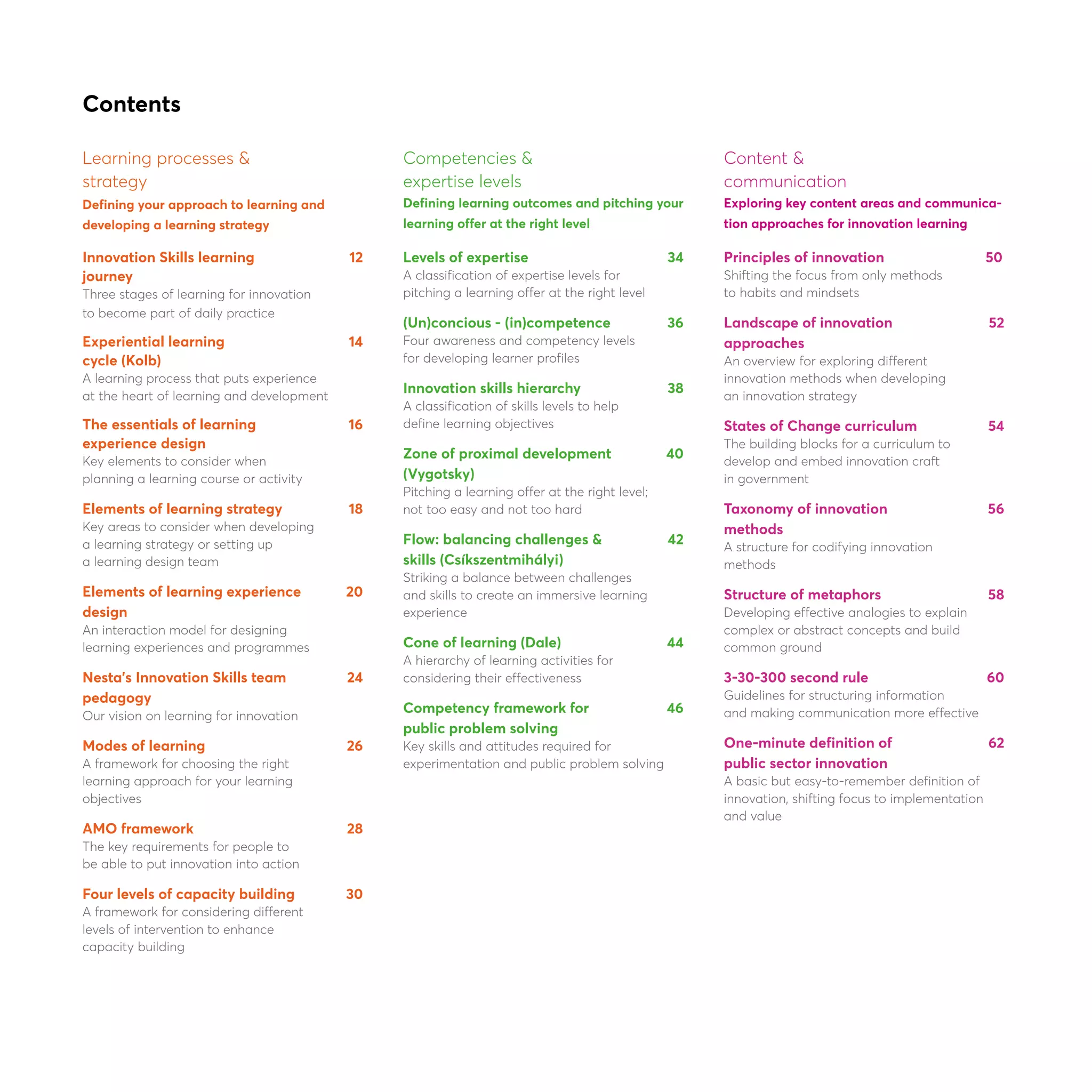
Contents
Learning processes &
strategy
Defining your approach to learning and
developing a learning strategy
Innovation Skills learning	 12
journey
Three stages of learning for innovation
to become part of daily practice
Experiential learning 	 14
cycle (Kolb)
A learning process that puts experience
at the heart of learning and development
The essentials of learning 	 16
experience design
Key elements to consider when
planning a learning course or activity
Elements of learning strategy	 18
Key areas to consider when developing
a learning strategy or setting up
a learning design team
Elements of learning experience 	 20
design
An interaction model for designing
learning experiences and programmes
Nesta’s Innovation Skills team 	 24
pedagogy
Our vision on learning for innovation
Modes of learning 	 26
A framework for choosing the right
learning approach for your learning
objectives
AMO framework	 28
The key requirements for people to
be able to put innovation into action
Four levels of capacity building	 30
A framework for considering different
levels of intervention to enhance
capacity building
Competencies &
expertise levels
Defining learning outcomes and pitching your
learning offer at the right level
Levels of expertise	 34
A classification of expertise levels for
pitching a learning offer at the right level
(Un)concious - (in)competence	 36
Four awareness and competency levels
for developing learner profiles
Innovation skills hierarchy 	 38
A classification of skills levels to help
define learning objectives
Zone of proximal development 	 40
(Vygotsky)
Pitching a learning offer at the right level;
not too easy and not too hard
Flow: balancing challenges & 	 42
skills (Csíkszentmihályi)
Striking a balance between challenges
and skills to create an immersive learning
experience
Cone of learning (Dale)	 44
A hierarchy of learning activities for
considering their effectiveness
Competency framework for 	 46
public problem solving
Key skills and attitudes required for
experimentation and public problem solving
Content &
communication
Exploring key content areas and communica-
tion approaches for innovation learning
Principles of innovation		 50
Shifting the focus from only methods
to habits and mindsets
Landscape of innovation 	 52
approaches
An overview for exploring different
innovation methods when developing
an innovation strategy
States of Change curriculum 	 54
The building blocks for a curriculum to
develop and embed innovation craft
in government
Taxonomy of innovation 	 56
methods
A structure for codifying innovation
methods
Structure of metaphors	 58
Developing effective analogies to explain
complex or abstract concepts and build
common ground
3-30-300 second rule	 60
Guidelines for structuring information
and making communication more effective
One-minute definition of 	 62
public sector innovation
A basic but easy-to-remember definition of
innovation, shifting focus to implementation
and value
Design & innovation
processes
Clarifying design and innovation processes
and putting them into practice
Basic model of design	 66
A basic change process that can bring
clarity when conversations get cluttered
Double Diamond design 	 68
process (Design Council)
An archetypical design process that explains
its practice and value
Problem & solution space	 70
Two different problem solving styles, using
an analytical or design approach
Prototyping vs big bang 	 72
implementation
Positioning prototyping as a risk management
approach and explaining the value of iteration
Innovation spiral (Nesta)	 74
An innovation process for planning and
navigating an innovation journey (from defining
your challenge to changing systems)
Knowledge funnel (Martin)	 76
Three categories through which knowledge
in innovation processes naturally develops
Continuum of experimentation	 78
A categorisation of experimental approaches
for planning and managing experiments
Team & innovation
strategy
Thinking about and setting up a strategy for
your team or innovation approach
Five strategic questions 	 82
(Lafley & Martin)
A framework with five fundamental questions
for strategic decision making
Nesta’s Innovation Skills 	 84
team operating model
An overview of our key activities to support
team design and reflection
Purpose of design: creating 	 86
a more appropriate fit
An overview of the key elements of design for
explaining its essence and key principles
Innovation functions in 	 88
government organisations
Five possible configurations of innovation
functions within government for reflection
and design
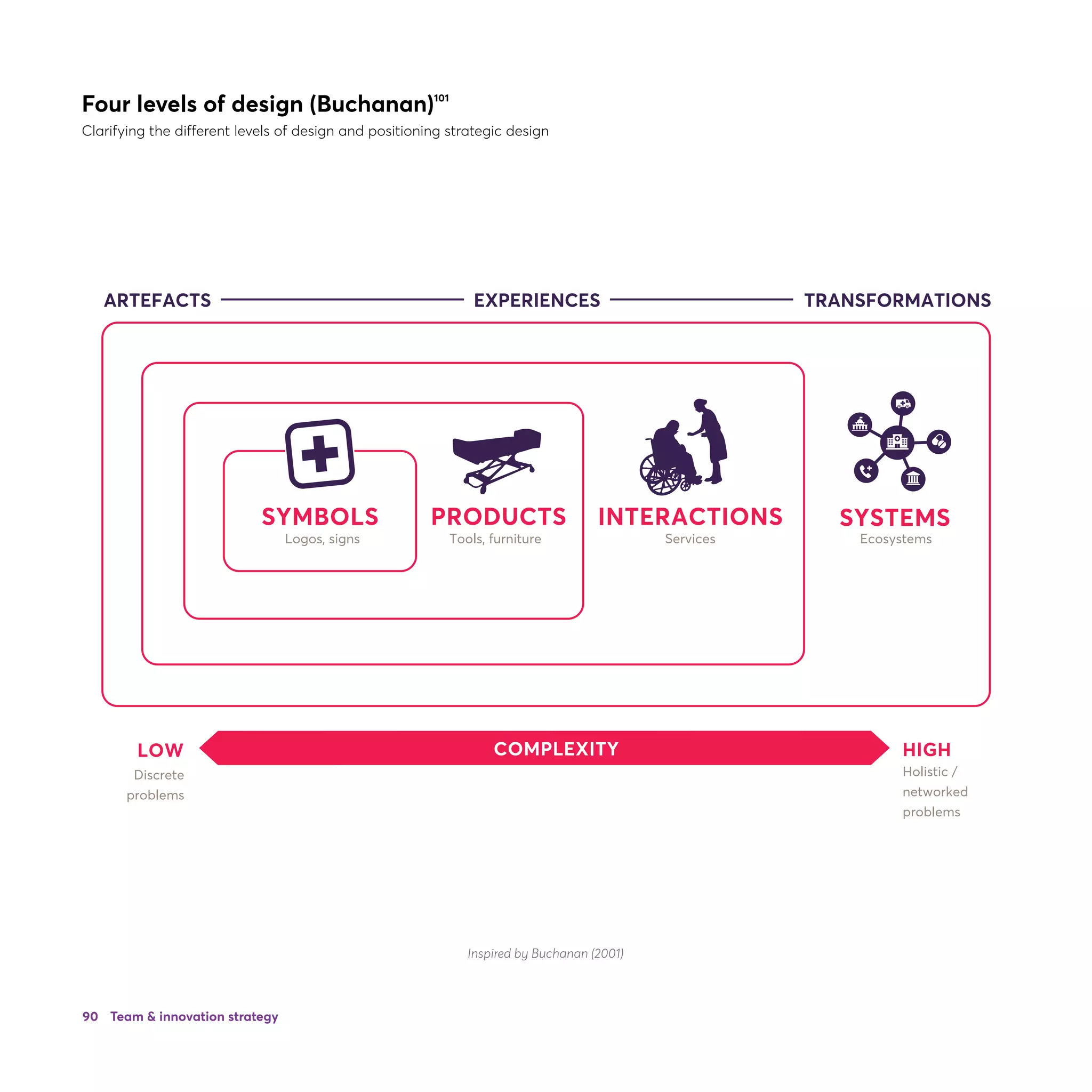
Four levels of design 	 90
(Buchanan)
Clarifying the different levels of design
and positioning strategic design
References
Endnotes	94
Bibliography	96
Contents
PEOPLE
PROBLEMS
SOLUTIONS
FACTS
FUTURES
SYSTEMS
Identifying and
framing an issue
Taking a holistic
view, identifying
intervention points
Exploring multiple
possible futures
Understanding
people’s experiences,
building empathy
Developing and testing
solutions, mapping existing
solutions
Using evidence
and data
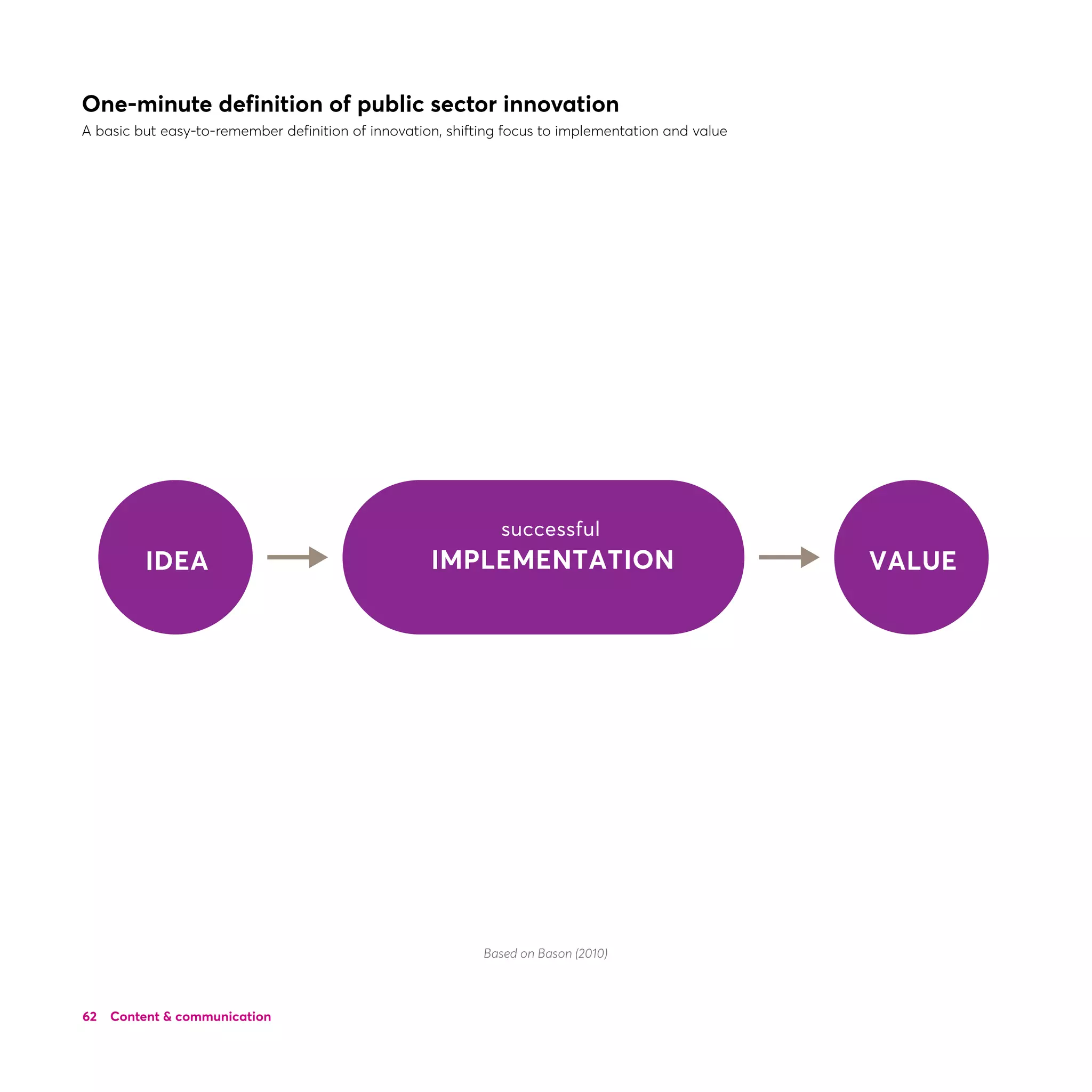
successful
IMPLEMENTATIONIDEA VALUE30
300
3KEY MESSAGE
ESSENTIAL
LESS
SIGNIFICANT
seconds
seconds
seconds
SUMMARY
DETAILS
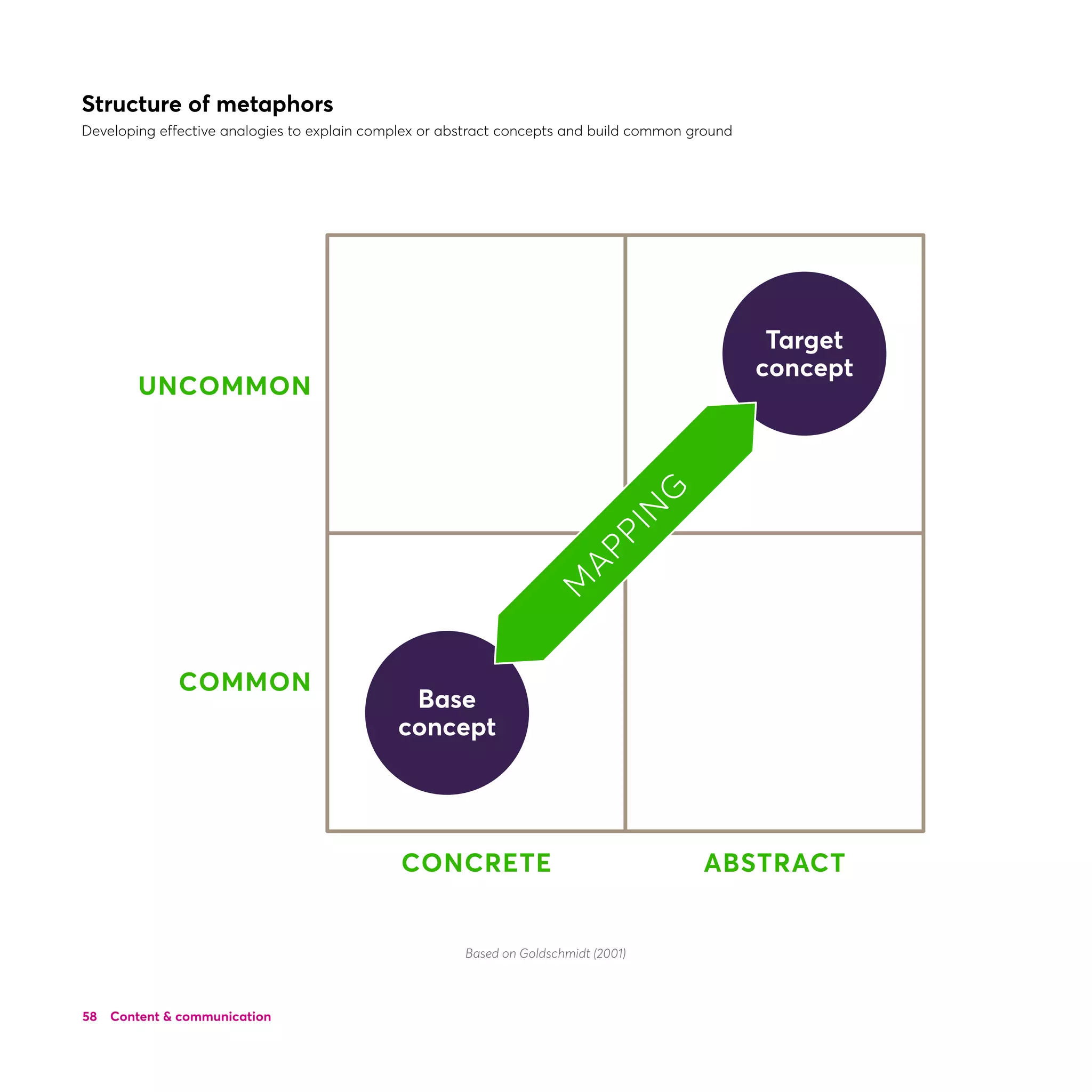
CONCRETE
COMMON
UNCOMMON
ABSTRACT
Base
concept
Target
concept
M
A
PPIN
G
PRINCIPLES
PROCESS
TECHNIQUES & METHODS
TOOLS
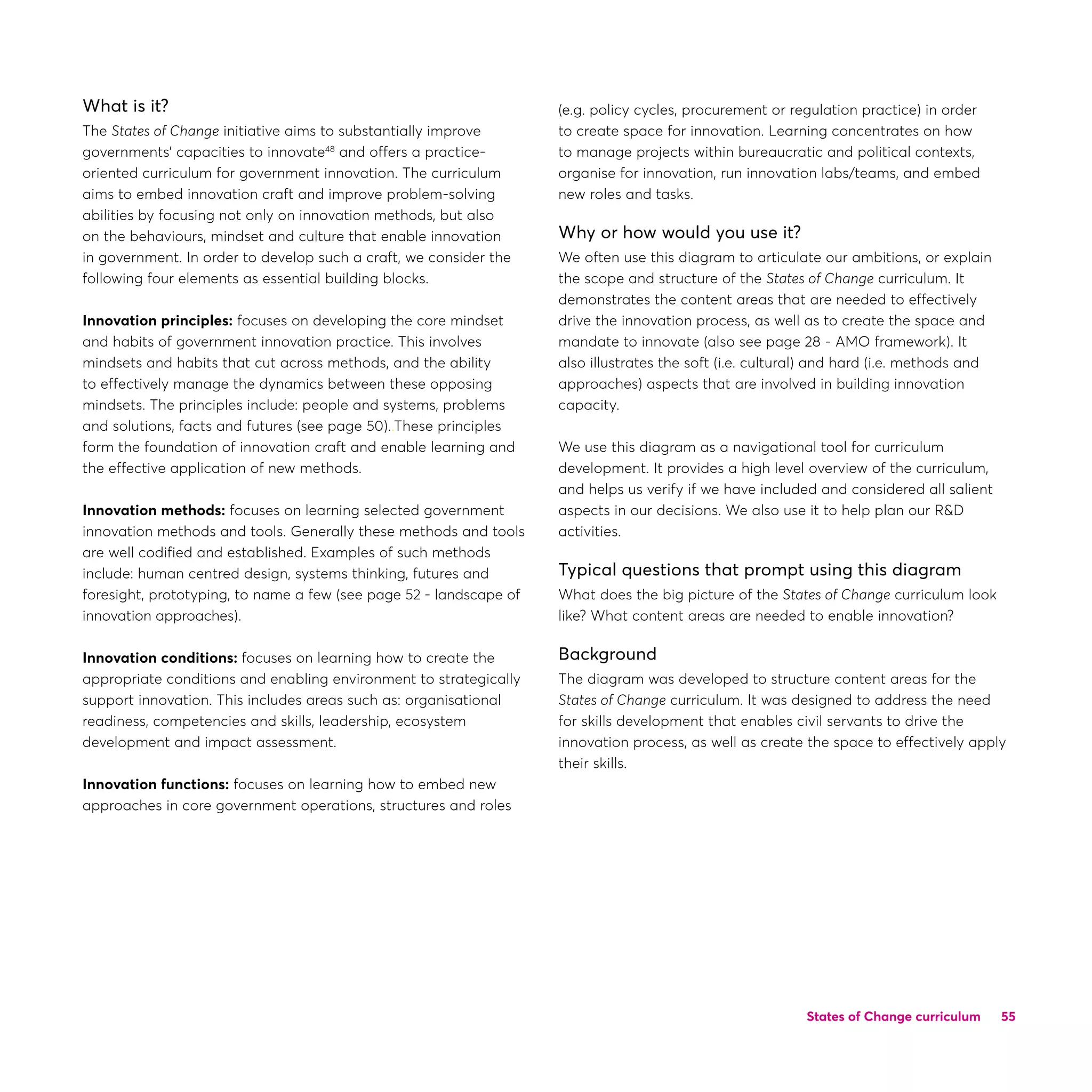
Core beliefs that drive certain behaviours
Series of steps, or categories of actions
taken to achieve a certain outcome
Activities or tasks that generate
a certain output
Instruments or artefacts needed to
carry out a particular activitiy or task
Learning the core mindset
and habits of government
innovation practice
Learning how to create
space for and strategically
support innovation
Learning how to embed
new approaches in
government operations
CONDITIONSPRINCIPLES
METHODS FUNCTIONS
Learning selected
government innovation
methods and tools
INNOVATION
CRAFT
Organisational
environment
Approaches
Culture
Innovation
processes
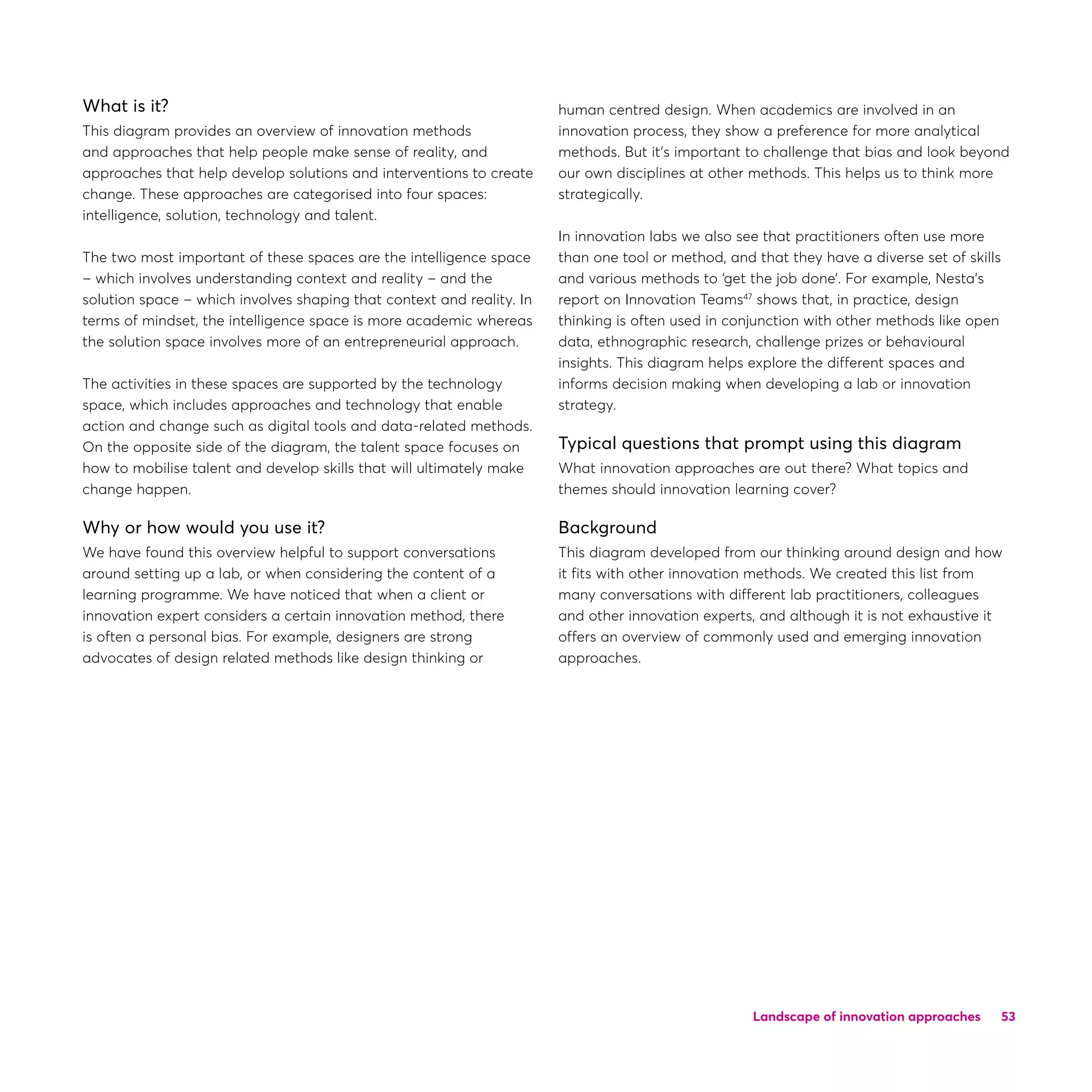
INTELLIGENCE
SPACE
SOLUTION
SPACE
TALENT
SPACE
TECHNOLOGY
SPACE
Understanding reality Shaping reality
Enabling action
Empowering people
Lead User
Innovation
Collective
Intelligence
“Nowcasting”
Citizen
Generated Data
Sensors
Augmented
Reality
Virtual
Reality
Social Media
Analysis
Open
DataBig
DataAgent Based
Modelling
Artificial Intelligence /
Machine Learning
Digital Social
Innovation
Algorithmic
Governance
Blockchain
Open
Source
Open
Design
Design
Sprint
Internet of
Things
Smart
Cities
Gamification
Innovation/Creative
Spaces
HackathonsFabLabs
Social Innovation
Camps
Challenges &
Prizes
Prototyping
Minimal
Viable
Product
(MVP)
Riskiest
Assumption
Testing
Lean
Startup
Impact
InvestmentAlternative
Finance
Crowdfunding
Citizen
Engagement
(Community)
Asset Mapping
Frugal
Innovation
Jugaad
Reverse
Innovation
Transdisciplinary
Design
Design
Research
Data
Ethnography
Regulatory
Sandboxes
Crypto
Currencies
Adaptive
Leadership
Innovation
Learning /
Pedagogy
Ambidextrous
Leadership
System
Leadership
Experimental
culture
Adaptive
Management
Talent
Management Change
Management
Team /
Organisational
Design
Innovation
Labs / Teams
Reality
labsCo-creation
GovJams /
Service Jams
Accelerators
Open Policy
Making
Open
Innovation
Action
Research
Design
Thinking
Systemic
Design
Systems
Thinking
Service
Design
Human
Centered
Design
User
Experience
DesignDigital
Transformation
Behavioural
InsightsSpeculative
DesignCrticial
Design
Transition
Design
Positive
Deviance
Living
Labs
Democratic
Dialogue
Social
Innovation
Camps
Evidence-based
PolicyEthnographic
Research
Contextual
Inquiry
Sensemaking
Reverse
Engineering
Data
Visualisation
Foresight
Policy
Analysis
Randomised
Control Trials
Futures
Analysis
CORE SKILLS
EXPERIMENTING &
PUBLIC PROBLEM
SOLVING
Competencies for
KEY ATTITUDES
Political &
Bureaucratic
Awareness
Operating political
dynamics and bureaucratic
procedures to ensure
strategic support
Financing change
Understanding the many ways
to liberate and use financial
resources for innovation
Outcomes-
focused
Strong commitment
to real world effects
Courageous
Willingness to take
risks
Intrapreneurship
Being insurgent and use business
acumen to create opportunities
Storytelling
& Advocacy
Using narratives and media
to articulate vision and
information in compelling
ways
Resilient
The persever-
ance to deal
with resistance
Imaginative
Exploring and
envisioning new
possible futures
Empathetic
Understanding
others’ experiences
and frames of
reference
Agile
Responding to
changing environ-
ments with flexibility
Building Bridges
Orchestrating interaction to
find common ground and
create shared ownership
Creative Facilitation
Creatively processing different
perspectives and deliberating
multiple options
Brokering
Mediating contrasting
interests and reducing
friction between multiple
stakeholders
Demonstrating Value
Articulating the value of new
approaches and solutions for
decision-making purposes
Citizen
& Stakeholder
Engagement
Actively involving citizens,
stakeholders and unusual
suspects
Mobilising resources and
legitimacy to make
change happen
LEADING
CHANGE
Exploring and iterating
new ideas to inform and
validate solutions
ACCELERATING
LEARNING
Engaging with citizens and
stakeholders to create
shared ownership of new
solutions
WORKING
TOGETHER
Systems
Thinking
Combining micro and
macro perspectives to
grasp complexity
Tech Literacy
Understanding technological
developments and use their
potential
Data Literacy
& Evidence
Using different kinds of
data effectively to
accelerate sense-making
Prototyping
& Iterating
Testing ideas and
systematically improving
them
Action-
oriented
Biased towards
action and learning
by doing
Reflective
Habit of critically
reflecting on process
and results
Curious
The desire to
explore multiple
possibilities
Future Acumen
Connecting long-term
vision with short-term
achievable tasks
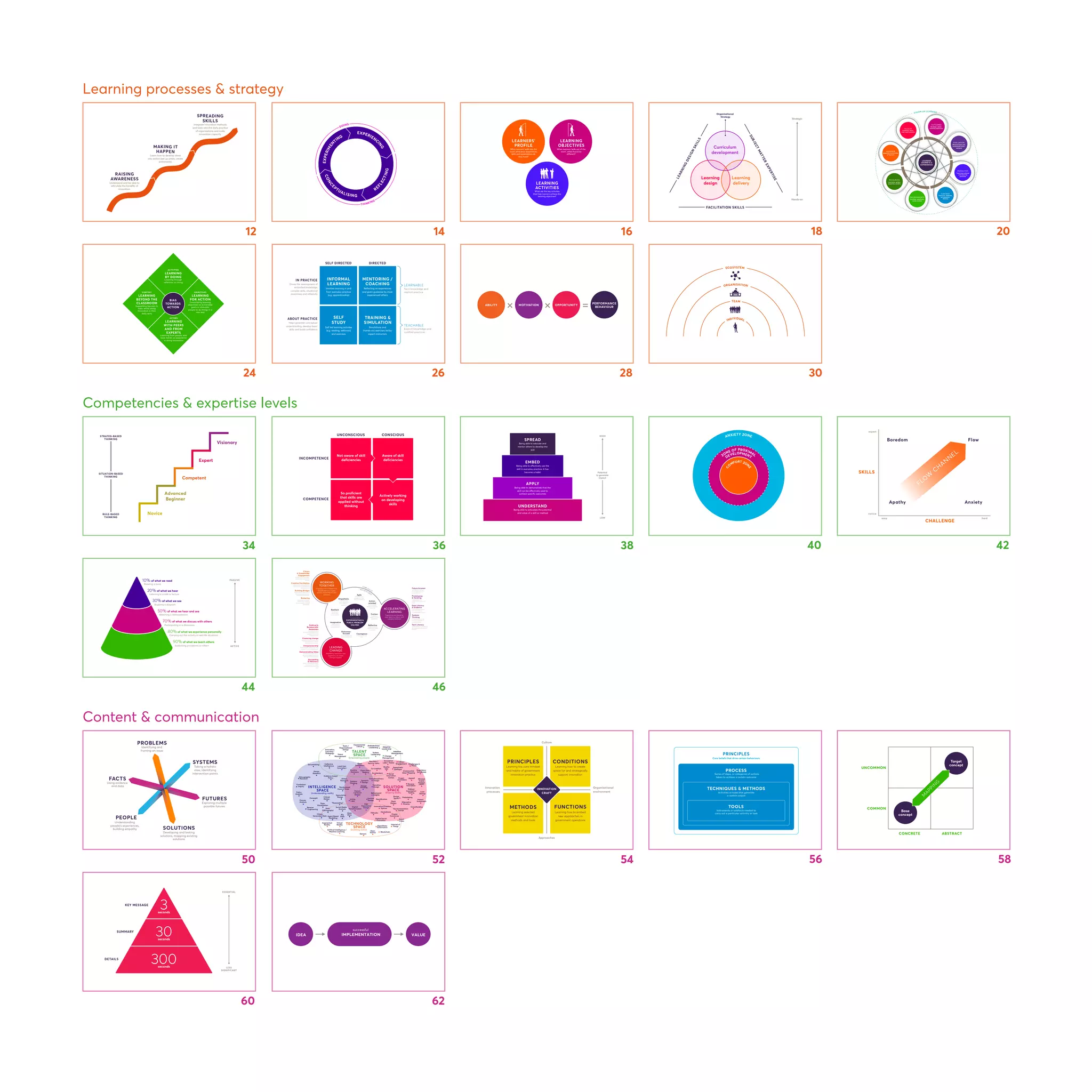
Learning processes & strategy
Competencies & expertise levels
Content & communication
12
34
50
16
38
54
14
36
52
18
40
56
20
42
58
24
44
60
2826
46
62
30
RULE-BASED
THINKING
SITUATION-BASED
THINKING
STRATEG-BASED
THINKING
Novice
Advanced
Beginner
Competent
Expert
Visionary
UNCONSCIOUS
INCOMPETENCE
COMPETENCE
CONSCIOUS
Not aware of skill
deficiencies
Aware of skill
deficiencies
So proficient
that skills are
applied without
thinking
Actively working
on developing
skills
UNDERSTAND
Being able to articulate the potential
and value of a skill or method
APPLY
Being able to demonstrate that the
skill can be effectively used to
achieve specific outcomes
EMBED
Being able to effectively use the
skill in everyday practice, it has
become a habit
SPREAD
Being able to educate and
mentor others to develop the
skill
HIGH
Potential
to generate
impact
LOW
ZONE OF PROXIMAL
C
O
MFORT ZON
E
ANXIETY ZONE
DEVELOPMENT
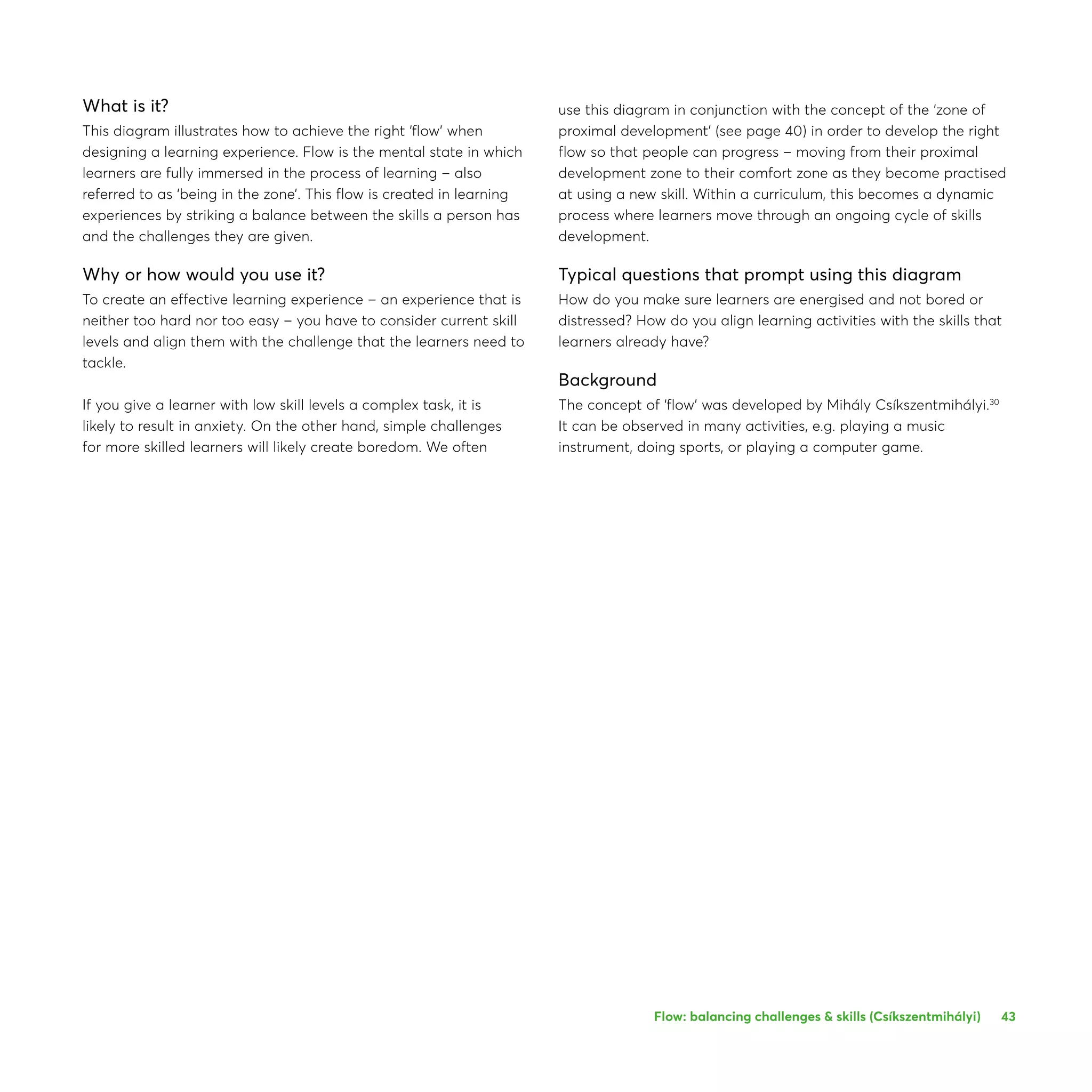
FLO
W
C
HAN
N
EL
SKILLS
CHALLENGE
Boredom Flow
Apathy
easy
novice
expert
hard
Anxiety
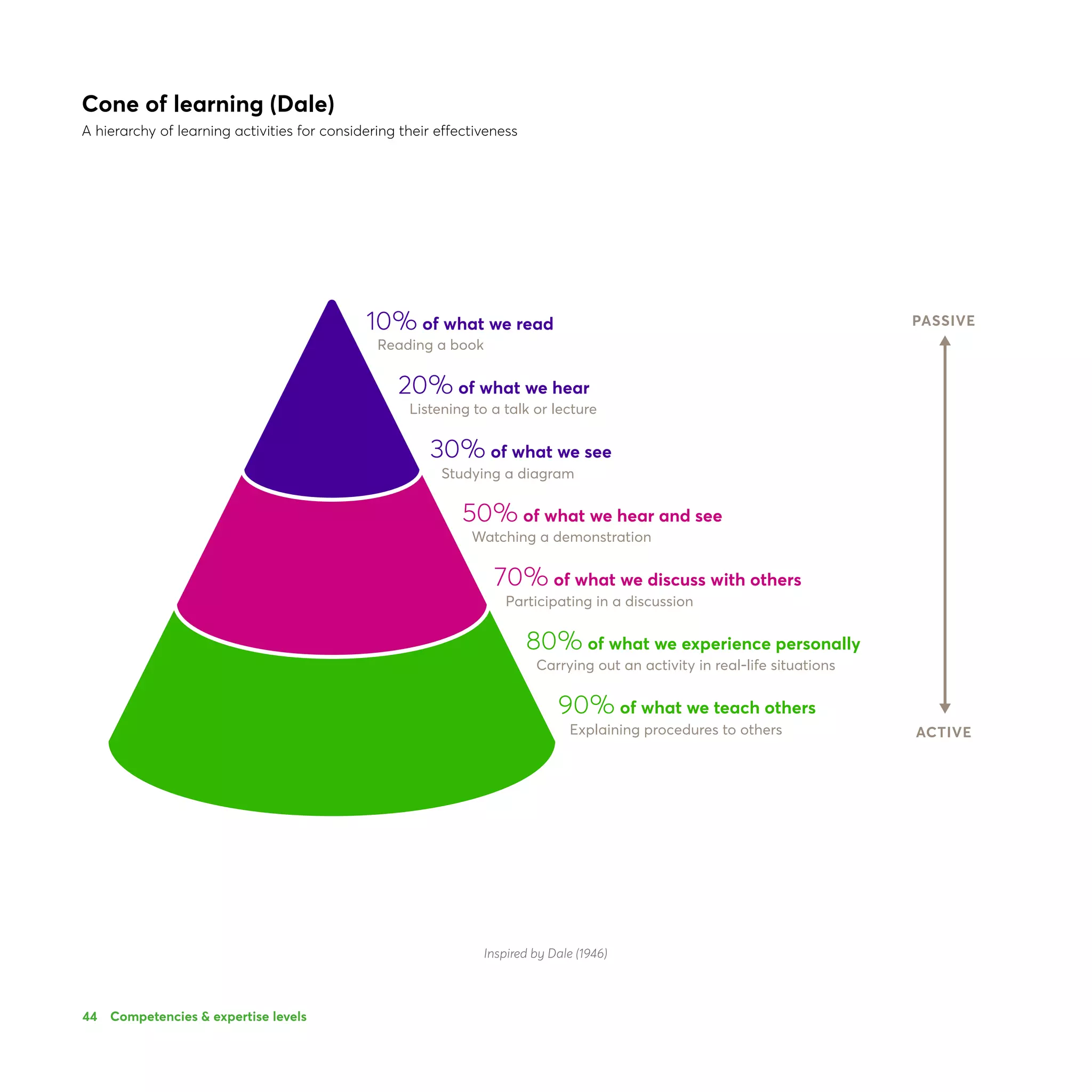
Carrying out the activity in real-life situations
Explaining procedures to others
10% of what we read
20% of what we hear
30% of what we see
50% of what we hear and see
70% of what we discuss with others
80% of what we experience personally
90% of what we teach others
Reading a book
Listening to a talk or lecture
Studying a diagram
Watching a demonstration
Participating in a discussion
PASSIVE
ACTIVE
RAISING
AWARENESS
MAKING IT
HAPPEN
SPREADING
SKILLS
Understand and be able to
articulate the benefits of
innovation.
Integrate innovation methods
and tools into the daily practice
of organisations and scale
innovation capacity.
Learn how to develop ideas
into action (set up pilots, create
prototypes).
LEARNERS’
PROFILE
When learners ‘walk into the
room’ what prior experiences,
skills and expectations do
they have?
LEARNING
ACTIVITIES
What are the key activities
that help learners achieve the
learning objectives?
LEARNING
OBJECTIVES
When learners ‘walk out of the
room’, what should be
different?
Curriculum
development
Learning
delivery
Learning
design
FACILITATION SKILLS
LEARNIN
G
DESIG
N
SKILLS
Strategic
Hands-on
Organisational
Strategy
SUBJECTMATTEREXPERTISE
OUTCOMES
Strategic intent,
learning objectives
Measurement and
assessment tools,
methods
Teaching methods
and learning
activities
Practices, methods,
philosophies,
theoriesFacilities, platforms,
social context
Literature, guides,
materials, toolkits
Segments and profiles
of learners
Expertise areas,
roles and functions
EVALUATION
MODALITIES
CONTENT
ENVIRONMENTS
RESOURCES
AUDIENCE
FACULTY
LEARNING
JOURNEYS &
EXPERIENCES
VISION ON LEARNING
ACTO
R
S
EN
A
BLERS
N
A
R
RATIVES
IM
PA
C
T
BIAS
TOWARDS
ACTION
OBJECTIVES
LEARNING
FOR ACTION
Formulating learning
objectives as actionable
goals to stimulate
people to do things in a
new way
ACTIVITIES
LEARNING
BY DOING
Learning through
reflection on doing
CONTEXT
LEARNING
BEYOND THE
CLASSROOM
Supporting learners to
learn whilst doing
innovation in their
daily work
ACTORS
LEARNING
WITH PEERS
AND FROM
EXPERTS
Learning from people who
have hands on experience
in doing innovation
MENTORING /
COACHING
INFORMAL
LEARNING
SELF DIRECTED
IN PRACTICE
LEARNABLE
TEACHABLE
Tacit knowledge and
implicit practice
Explicit knowledge and
codified practices
ABOUT PRACTICE
DIRECTED
SELF
STUDY
TRAINING &
SIMULATION
Self led learning activites
(e.g. reading, webinars)
and exercises
Involves learning in and
from everyday practice
(e.g. apprenticeship)
Reflecting on experiences
and given guidance by more
experienced others
Simulations and
(hands-on) exercises led by
expert instructors
Drives the development of
embodied knowledge,
complex skills, situational
awareness and reflexivity
Helps generate conceptual
understanding, develop basic
skills and build confidence
MOTIVATION OPPORTUNITYABILITY
PERFORMANCE
BEHAVIOUR
INDIVIDUAL
ORGANISATION
ECOSYSTEM
TEAM
THINKING
RE
FLECTING
C
ING
EXPERIMEN
CONC
E
PTUALISING
DOING
THINKING
RE
FLECTING
EXPERIENC
ING
EXPERIMEN
TING
CONC
E
PTUALISING
Contents
Opportunities
& challenges
Generating
ideas
1
2
3
5
4
6
7
Developing
& testing
Making
the case
Delivering &
implementing
Growing
& scaling
Changing
systems
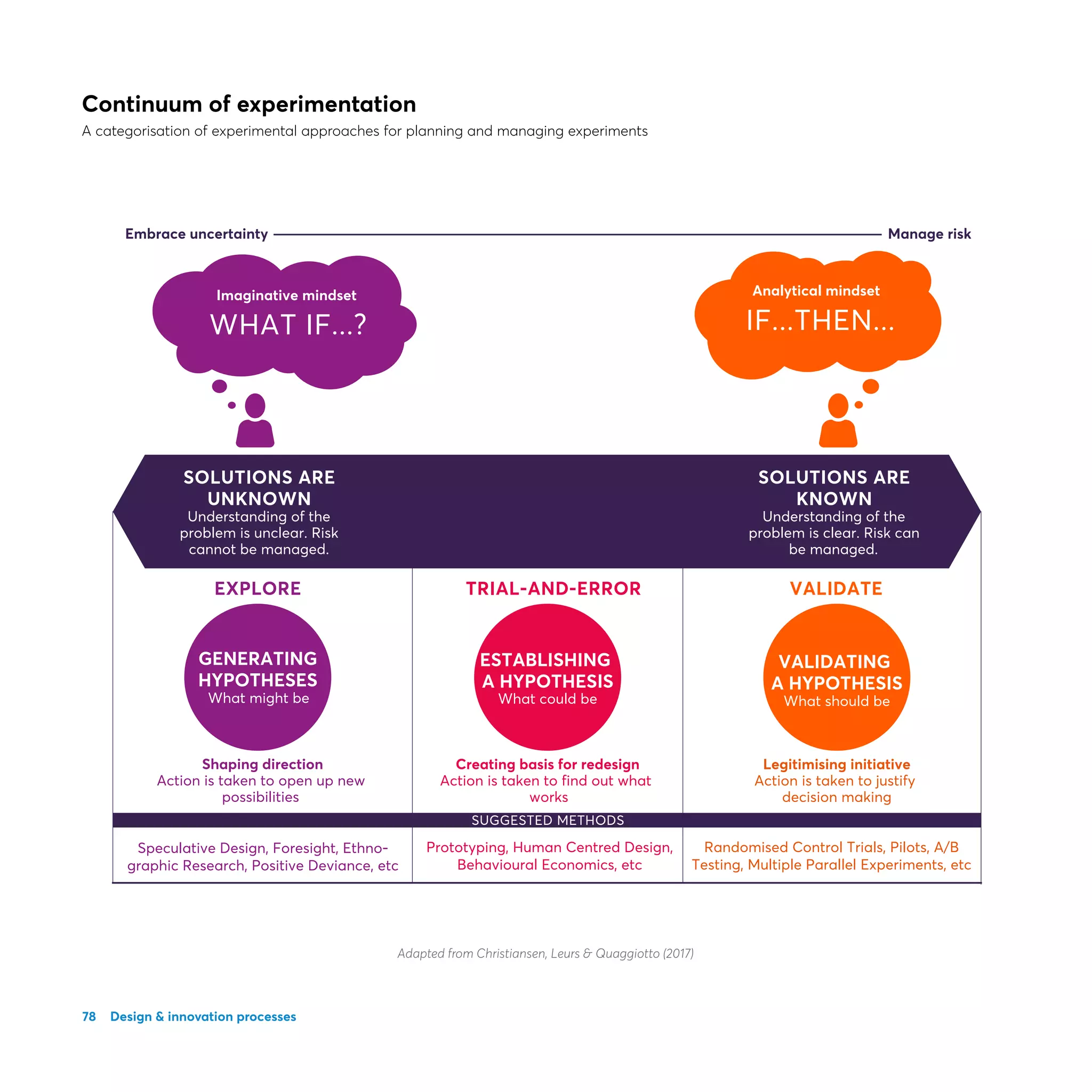
ESTABLISHING
A HYPOTHESIS
VALIDATING
A HYPOTHESIS
What could be What should be
Shaping direction
Action is taken to open up new
possibilities
Speculative Design, Foresight, Ethno-
graphic Research, Positive Deviance, etc
Prototyping, Human Centred Design,
Behavioural Economics, etc
Creating basis for redesign
Action is taken to find out what
works
Legitimising initiative
Action is taken to justify
decision making
SUGGESTED METHODS
GENERATING
HYPOTHESES
What might be
TRIAL-AND-ERROR VALIDATEEXPLORE
WHAT IF...? IF...THEN...
Imaginative mindset Analytical mindset
Embrace uncertainty Manage risk
Randomised Control Trials, Pilots, A/B
Testing, Multiple Parallel Experiments,
etc
SOLUTIONS ARE
UNKNOWN
Understanding of the
problem is unclear. Risk
cannot be managed.
SOLUTIONS ARE
KNOWN
Understanding of the
problem is clear. Risk can
be managed.
EXPLORATION EXPLORATION
MYSTERY HEURISTICS ALGORITHMS
Chaos
Looking for new
opportunities and
solutions
Optimising existing
solutions
Rules of thumb Formulas
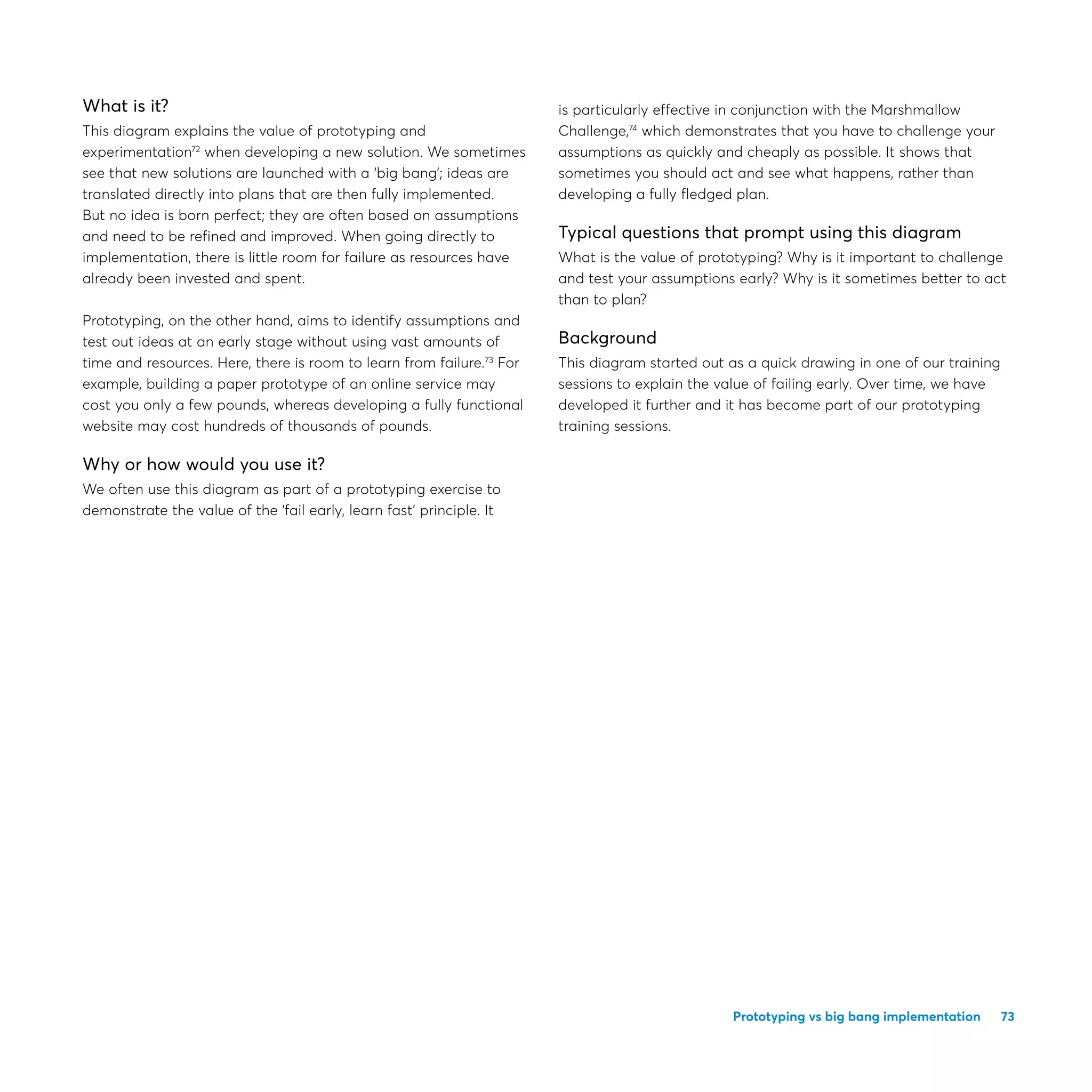
START END
ROOM FOR FAILURE
Find out what works, and what doesn’t
PROTOTYPING
BIG BANG
IMPLEMENTATION
PROJECT JOURNEY
Time, money, talent, materials invested to develop
and implement the solution
RESOURCES SPENT
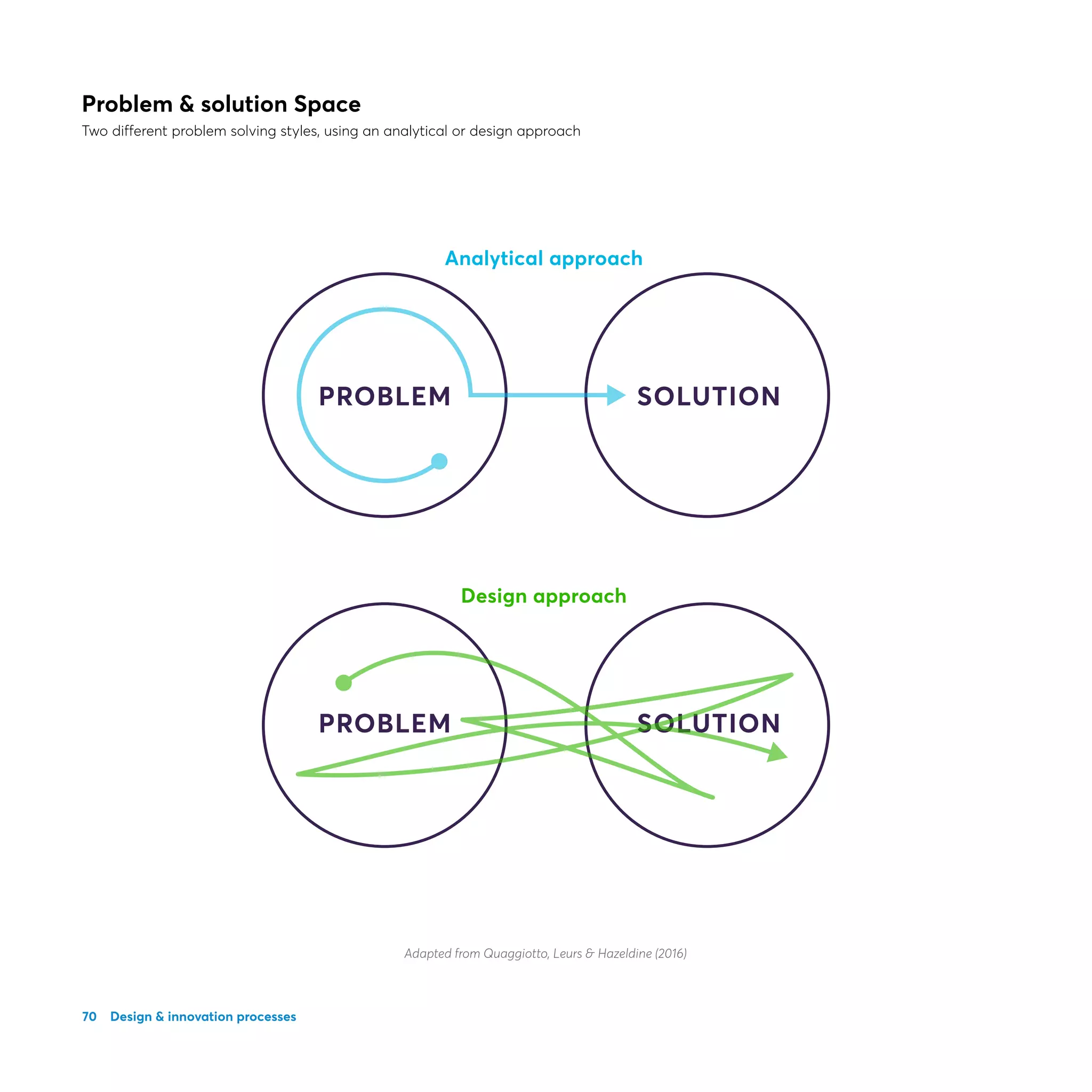
Analytical approach
PROBLEM SOLUTION
PROBLEM SOLUTION
Design approach
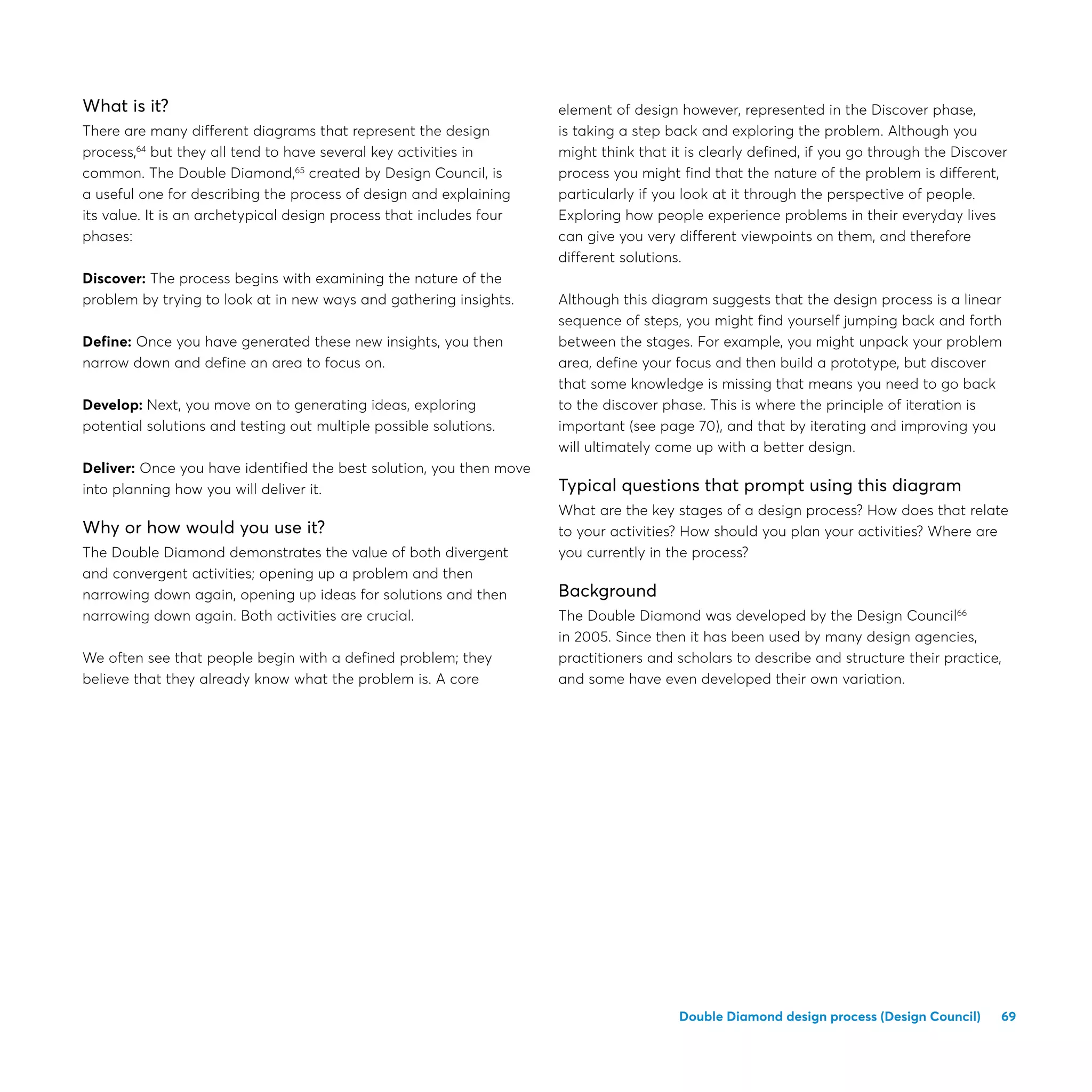
DISCOVER DEFINE DEVELOP DELIVER
the area to
focus upon
the nature of the
problem
PROBLEM
PROBLEM
DEFINITION SOLUTION
potential
solutions
solutions
that work
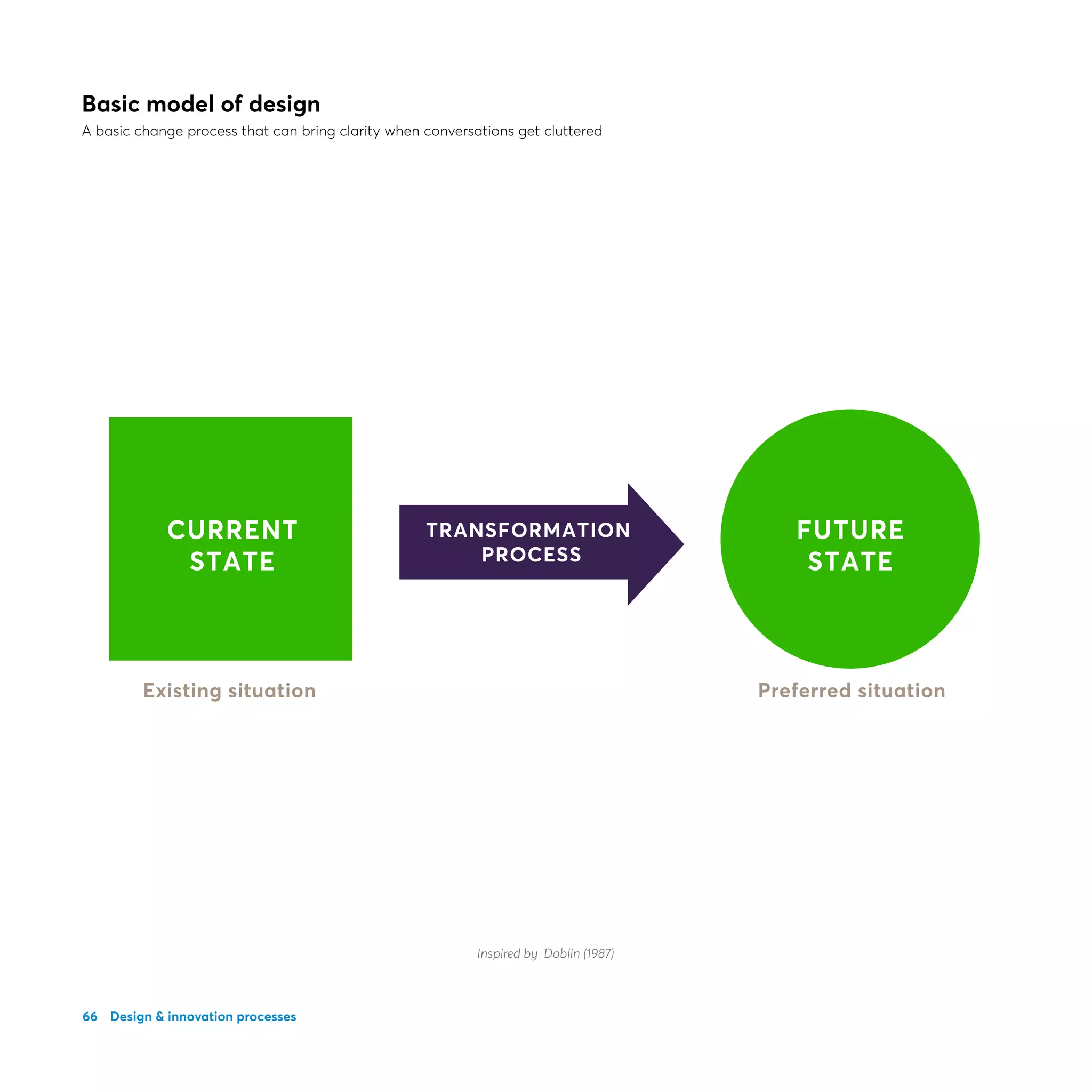
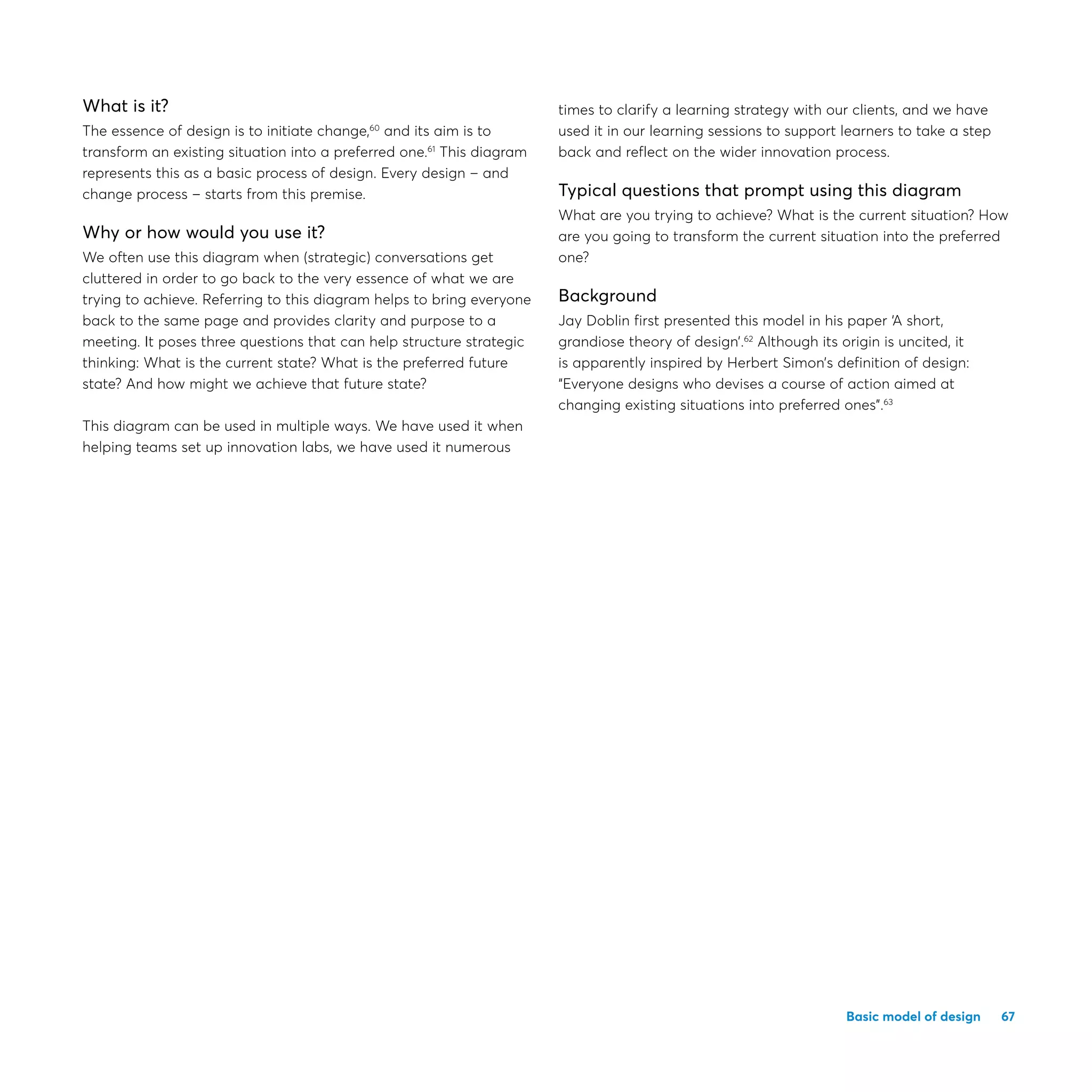
Existing situation Preferred situation
CURRENT
STATE
FUTURE
STATE
TRANSFORMATION
PROCESS
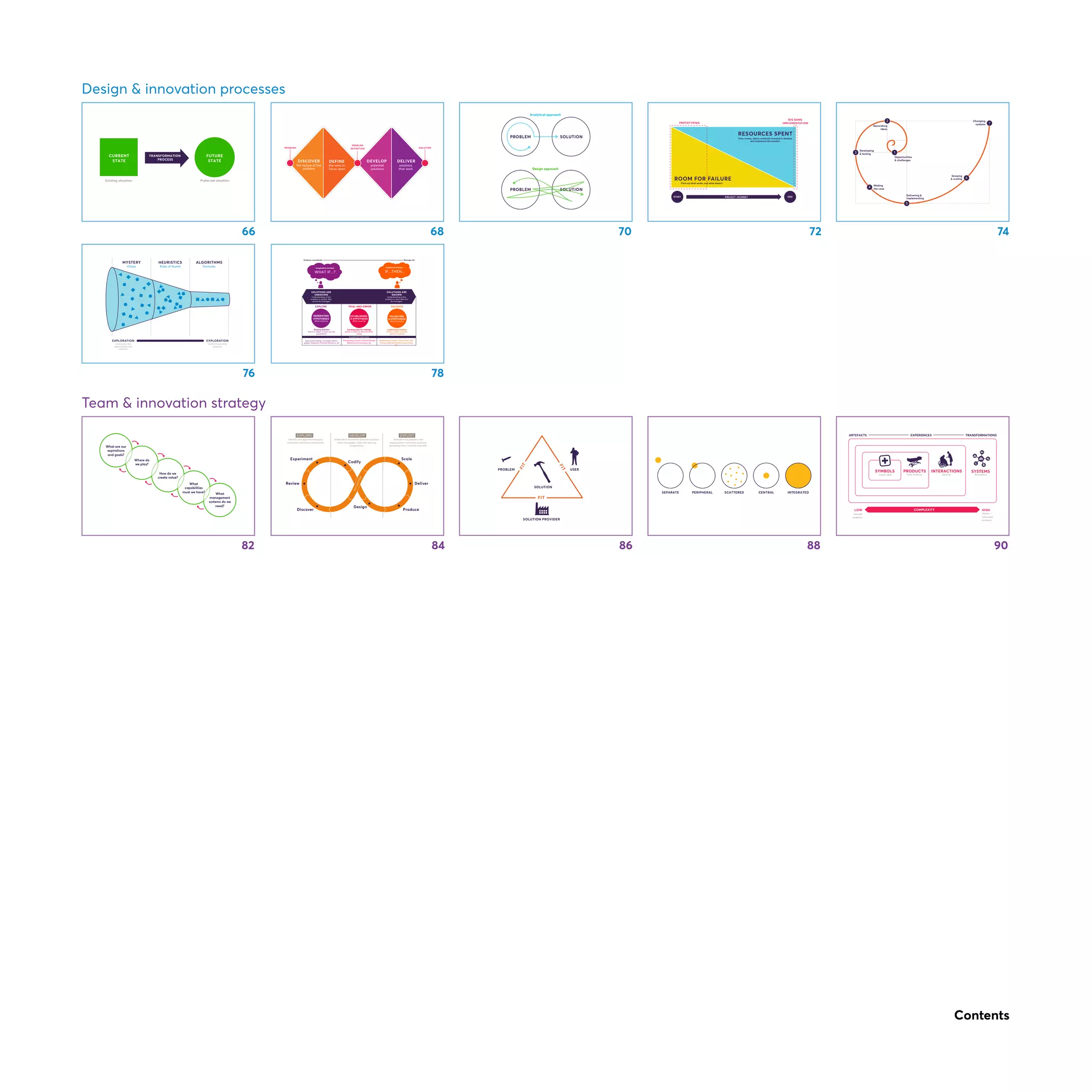
Design & innovation processes
Team & innovation strategy
66
82
70
86
68
84
72
88
74
90
76 78
ARTEFACTS EXPERIENCES TRANSFORMATIONS
LOW
Holistic /
networked
problems
Discrete
problems
COMPLEXITY HIGH
SYMBOLS PRODUCTS INTERACTIONS SYSTEMS
Logos, signs Tools, furniture Services Ecosystems
SEPARATE PERIPHERAL SCATTERED CENTRAL INTEGRATED
SOLUTION
PROBLEM
SOLUTION PROVIDER
FIT
USER
FIT
FIT
SOLUTION
PROBLEM
SOLUTION PROVIDER
FIT
USER
FIT
FIT
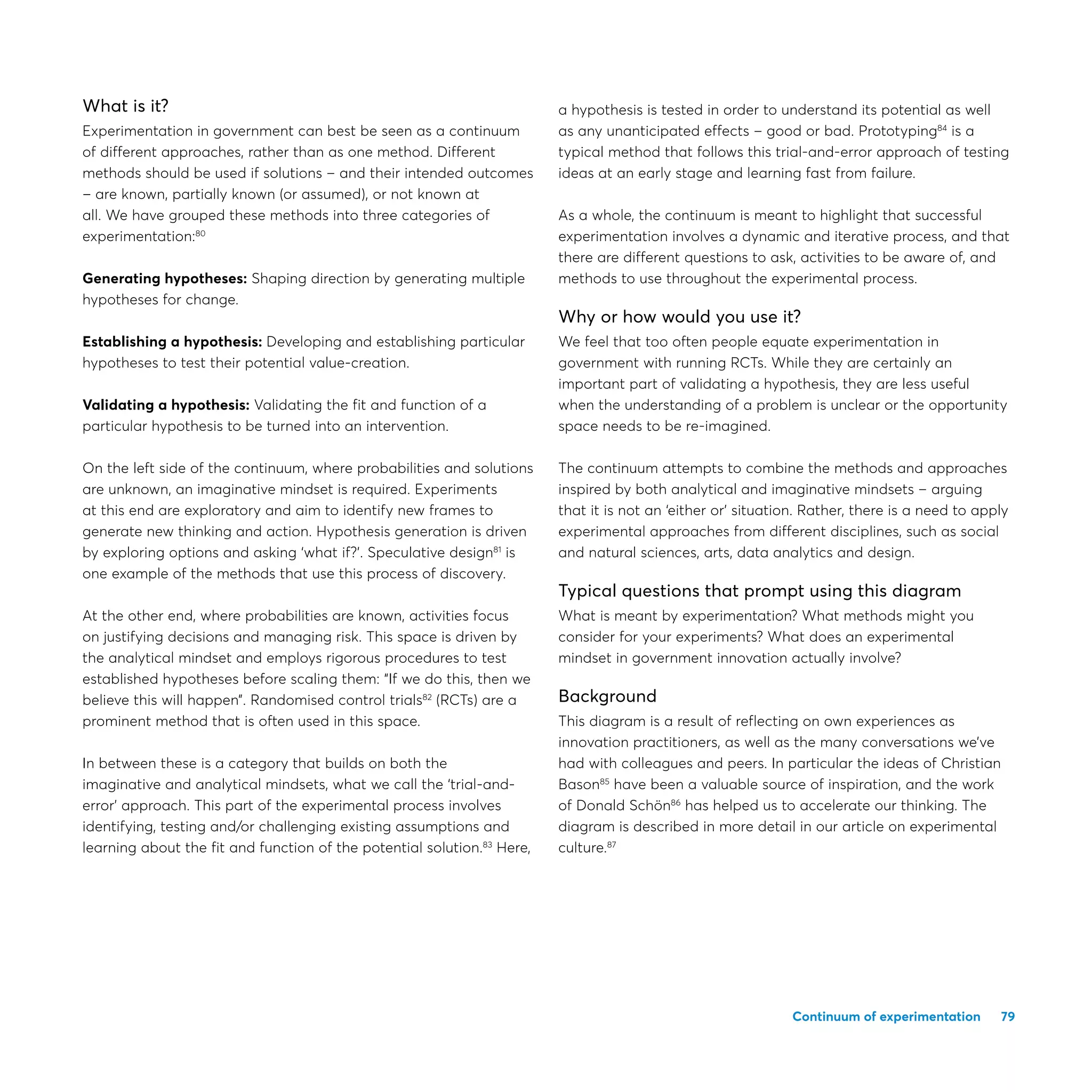
REFLECTION
Scale
Deliver
Produce
Design
Codify
Experiment
EXPLORE DEVELOP EXPLOIT
Review
Discover
Identify and appraise emerging
innovation methods and practices
Understand innovation practices and turn
them into guides, tools and learning
programmes
Strengthening people’s and
organisations’ innovation practice,
spreading tools, methods and skills
What are our
aspirations
and goals?
Where do
we play?
How do we
create value?
What
capabilities
must we have? What
management
systems do we
need?
Learning
processes &
strategy
Defining your approach to learning
and developing a learning strategy
12
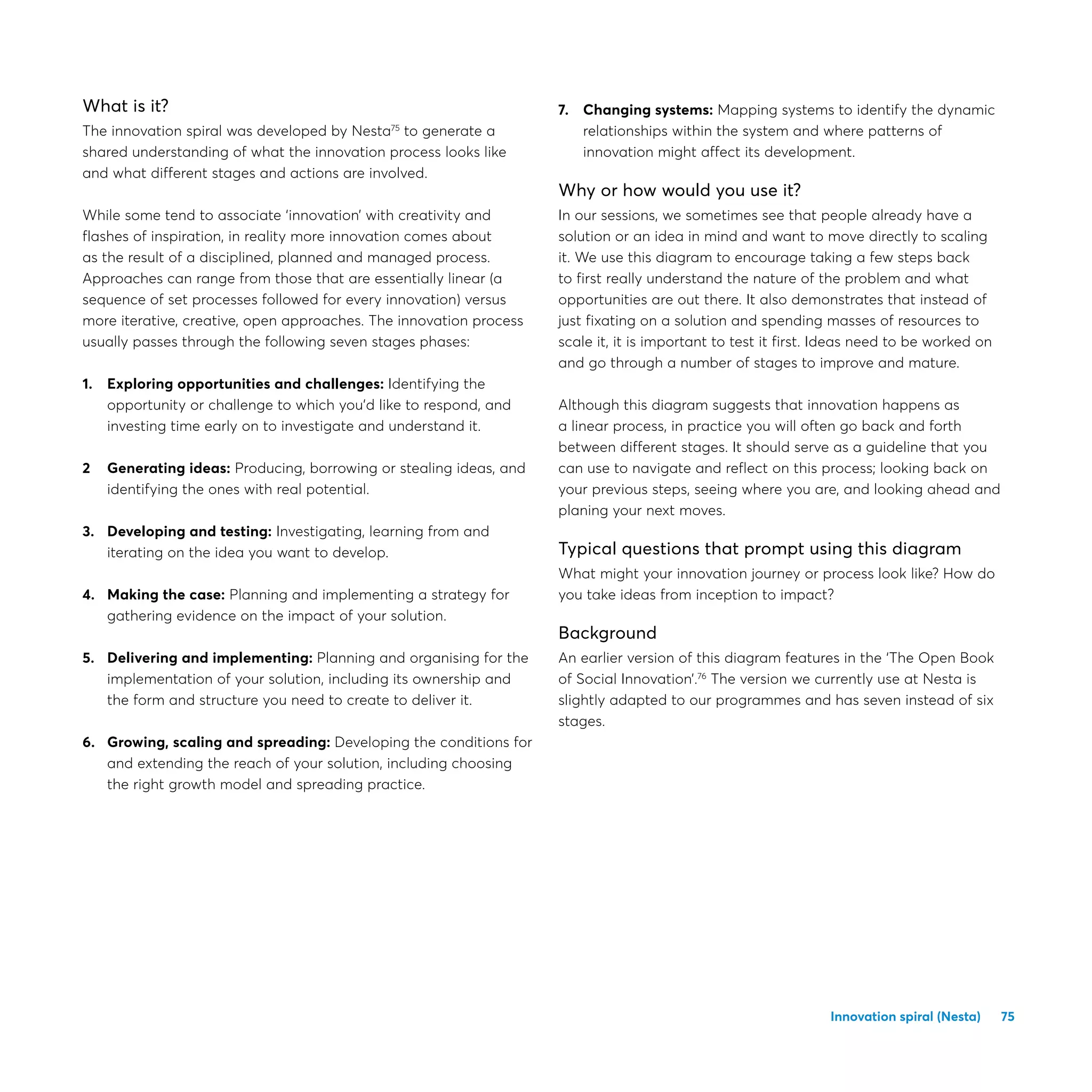
RAISING
AWARENESS
MAKING IT
HAPPEN
SPREADING
SKILLS
Understand and be able to
articulate the benefits of
innovation
Integrate innovation methods
and tools into the daily practice
of organisations and scale
innovation capacity
Learn how to develop ideas
into action (set up pilots, create
prototypes)
Innovation Skills learning journey
Three stages of learning for innovation to become part of daily practice
Learning processes & strategy
13
What is it?
The Innovation Skills learning journey is a high-level overview of
the stages that a learner goes through to become more proficient
at adopting new skills, putting them into practice and using them
to innovate. This journey has three key stages that ultimately aim
to create a sustainable change in behaviour: for innovation to
become a habit and for innovation methods and tools to be fully
embedded in daily practice.
The first stage focuses on raising awareness. A typical learning
session might include a one or two-hour taster session on a
specific method or principle, or could use case studies or examples
to contextualise and provide evidence for using innovation. In the
second stage, making it happen, learners develop skills to tackle a
social or public challenge. This involves a deeper dive, for example
a four-day masterclass, that helps learners to build confidence and
equips them with practical skills to use innovation methods and
tools in their own work. The third stage focuses on spreading these
skills, methods and tools, and integrating them into daily practice.
Typical learning activities might include a mentoring programme
or building advocacy to help learners increase organisational
readiness for innovation.
Why or how would you use it?
We find this diagram helpful for scoping briefings with our clients,
mapping out learning programmes2
or considering how to structure
our learning portfolio. It helps us to formulate learning objectives
for a session or programme (focusing on either understanding,
using or embedding), to identify learning needs, and to clarify our
aspirations and intended outcomes (behaviour change).
Typical questions that prompt using this diagram
How should you position your learning activities? What are you
trying to achieve with your learning session? What should you
focus on? What might a wider learning programme look like?
Background
Adopting innovation skills and using them in practice involves
a change in behaviours and habits. It will come as no surprise
that this diagram is based on a behaviour change model, ‘The
Transtheoretical Model’ (or ‘Stages of Change’), which was
developed by DiClemente and Prochaska in the late 1970s.3
This
model integrates various theories into one overarching theory of
change – hence, the name Transtheoretical – that can be applied
to a variety of behaviours and contexts.
Innovation Skills learning journey
14
DOING
THINKING
RE
FLECTING
EXPERIENC
ING
EXPERIMEN
TING
CONC
E
PTUALISING
Experiential learning cycle (Kolb)
A learning process that puts experience at the heart of learning and development
Based on Kolb (1984)
Learning processes & strategy
15
What is it?
The experiential learning cycle developed by Kolb4
describes
learning as a continuous process grounded in experience. The
cycle has four stages, or learning activities:
1.0 Experimenting with tools, methods and key concepts, or
testing hypotheses.
2.0 Experiencing how these work; what works and what doesn’t.
3.0 Reflecting on these experiences and identifying discrepancies
between experience and (conceptual) understanding.
4.0 Conceptualising by forming (new) concepts, developing broad
principles, general rules of thumb and ‘success models’ for what
works and how.
Why or how would you use it?
We believe that innovation skills cannot be learned purely from a
textbook; instead we believe that learners should experience how
innovation tools and methods help to solve problems by actively
engaging with them through real-life or simulated situations. In this
pedagogy of ‘learning by doing’, experience is seen as the source
of development, and it is particularly ‘reflection on doing’ that
catalyses learning.
Kolb’s learning cycle offers a practical framework to plan and
structure a learning session or programme. Ideally, for a learning
session to be effective, a learner should go through all four stages
of the cycle. However, we often see that learning design defaults
to conceptual learning (e.g. lectures, panel discussions) with no
practical component to help learners understand how things
work in practice. Or we see the contrary: training sessions with
only hands-on exercises and no reflection or conceptual learning
to help learners understand the bigger picture. For that reason
we suggest touching on all four stages of the cycle, starting with
any of them. You might go through the full cycle in less than an
hour for a quick taster session (taking at least 10 minutes for each
activity), or you might go through the cycle a few times over a
period of days, weeks or months.
Where to start might depend on the learning styles of your
audience. In his work Kolb described four learning styles – feeling
and watching, watching and thinking, doing and thinking, doing
and feeling – but these are often too granular to work with.
Instead, we condense them into two groups: people who think first
(reflect and conceptualise) and people who act first (experiment
and experience). You might start with an activity that matches
your learners’ natural inclination towards one of these styles, but
you might also choose to do the opposite and deliberately get
them out of their comfort zone. For example, for a group of ‘think
first’ learners, you could ask them to build a prototype before
explaining the key concepts of prototyping. For a group of ‘act first’
learners, you could start by reflecting on their previous experiences
of testing ideas, introducing key concepts of prototyping and then
letting them experiment and experience it.
Typical questions that prompt using this diagram
What learning activities should you consider for your session?
What learning activities constitute an effective learning
experience? How do you accelerate learning from experience?
Background
Kolb’s experiential learning theory builds largely on the work of
John Dewey, Kurt Lewin and Jean Piaget. His model has often
been used to study or describe various aspects of learning,
including the theory and practice of adult education, informal
education, vocational learning, competency based and lifelong
learning.
Experiential learning cycle (Kolb)
LEARNERS’
PROFILE
When learners ‘walk into the
room’ what prior experiences,
skills and expectations do
they have?
LEARNING
ACTIVITIES
What are the key activities
that help learners achieve the
learning objectives?
LEARNING
OBJECTIVES
When learners ‘walk out of the
room’, what should be
different?
16
The essentials of learning experience design
Key elements to consider when planning a learning course or activity
Learning processes  strategy
17
What is it?
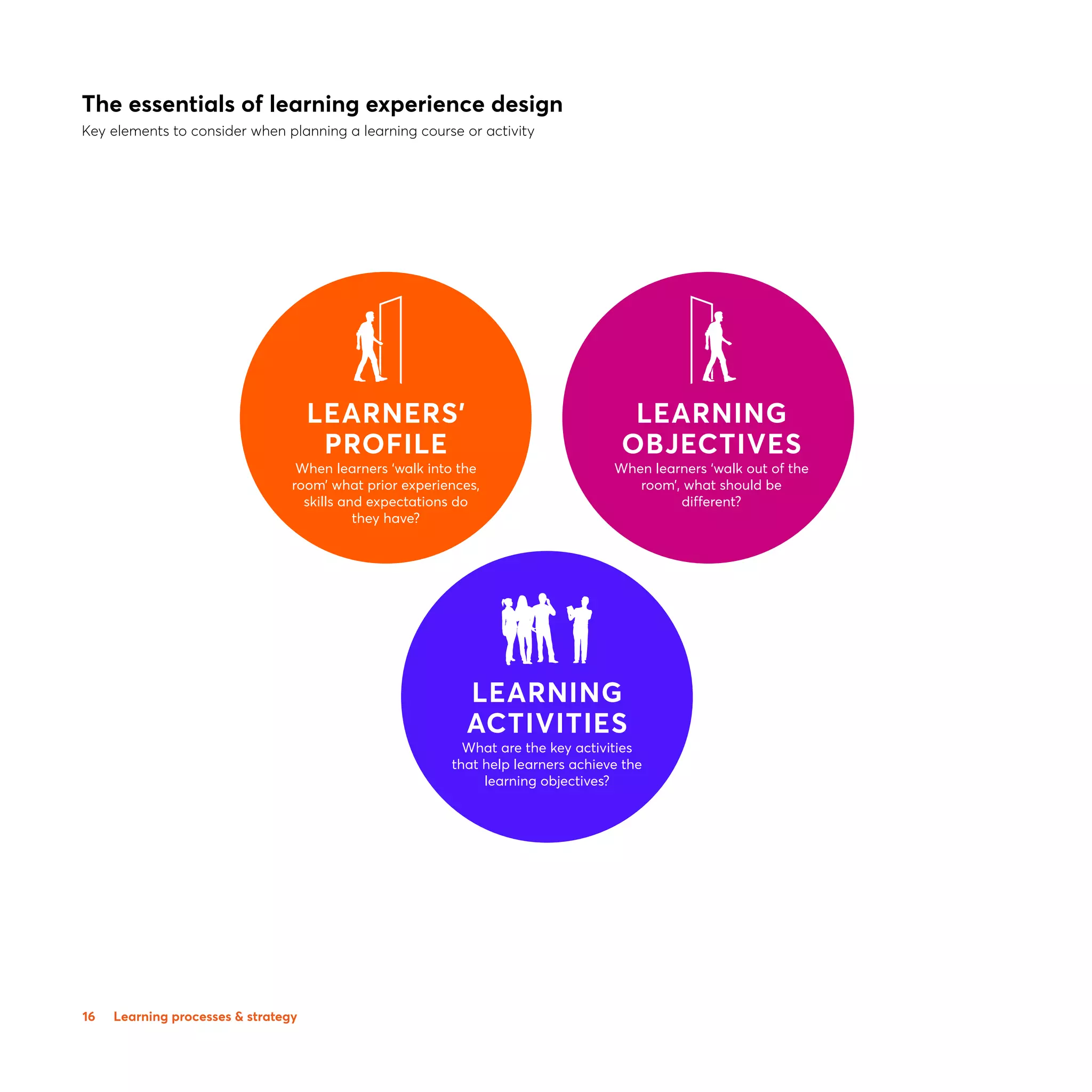
This diagram features the three most essential elements of
learning design: the learning objectives, the learner profile, and
the outline of the learning activities. These help you create a solid
foundation for your courses or programmes.
Why or how would you use it?
We often use this diagram in our initial conversations when we’re
asked to help with learning design. It shifts the conversation
from only activities to include learning objectives and learning
needs, helping people to get the ‘basics’ right and to design more
effective and engaging learning experiences.
To use this diagram, follow these three steps:
1.0 We suggest starting by defining the learning objectives. This
may feel counterintuitive, but it is easier to first define your end
goal and then work backwards. When starting with learning
activities, we often see that people lose sight of the intended
learning outcomes.
2.0 Next, focus on developing a profile of the learners: identify
their needs and existing expertise levels. Once you have the
learning objectives and the learners’ expertise level, you have
basically identified the learning gap.
3.0 Finally, outline the learning activities that you think will fill that
gap.
Below are some more tips to help with each stage:
Step 1: Defining learning objectives
Begin by envisaging when learners leave the room, what should
be different? Imagine this as a movie in your mind. Then try to
formulate your learning objectives as demonstrable behaviours.
It’s helpful to start with: “After the session, learners are able to…”.
A good example might be: “After the session, learners are able
to articulate the three key principles of HCD”, as this includes
a demonstrable behaviour that you can observe people doing:
articulating it. A less effective learning objective would be: “After
the session, learners know the three key principles of HCD”, as
knowing is an internal process that cannot be observed directly,
and thus it is unclear if the learner actually knows the three
principles.
Step 2: Developing the learner profile
In order to develop a profile of the learners, you need to find out
more about them by identifying their specific learning needs;
what prior knowledge and experience they have, their expertise
level, and their learning preferences and attitudes towards the
main subject. When they walk into the room, what exercises could
they do immediately and what might they struggle with? What
attitudes do they have towards the key subjects; are they skeptical,
interested or eager to learn? And what is their learning style; do
they ‘think first’ or ‘act first’? Some learners like to learn about key
concepts before they take action, whereas others prefer to try
things out and then reflect and conceptualise.5
Step 3: Outlining the learning activities
You should consider a variety of learning activities. For example,
using only lecturing would likely be uninspiring and wouldn’t allow
learners to experience how a method works in practice. Similarly,
doing just hands-on exercises wouldn’t help learners to understand
the underpinning principles of the method, which would allow them
to use it strategically and explain it to others. For that reason, it is
advisable that your session includes all four activities from Kolb’s
experiential learning cycle (see page 14): (1) actively experimenting
with the method, tools or materials to let learners (2) experience it
(e.g. through simulations); (3) reflecting on these experiences (e.g.
by discussing); and (4) conceptualising by developing principles/
models from the reflection and a supporting body of knowledge.
You can start with any of these activities, but you need to include
all of them to create an effective learning experience.
Typical questions that prompt using this diagram
How do you design a learning experience? Where should you start?
What are the essentials of learning experience design?
Background
This diagram is an extract of the ‘elements of learning experience
design’ (see page 20) featuring only the very essentials.
The essentials of learning experience design
18
Curriculum
development
Learning
delivery
Learning
design
FACILITATION SKILLS
LEARNING
DESIGN
SKILLS
Strategic
Hands-on
Organisational
Strategy
SUBJECTMATTEREXPERTISE
Elements of learning strategy
Key areas to consider when developing a learning strategy or setting up a learning design team
Learning processes  strategy
19
What is it?
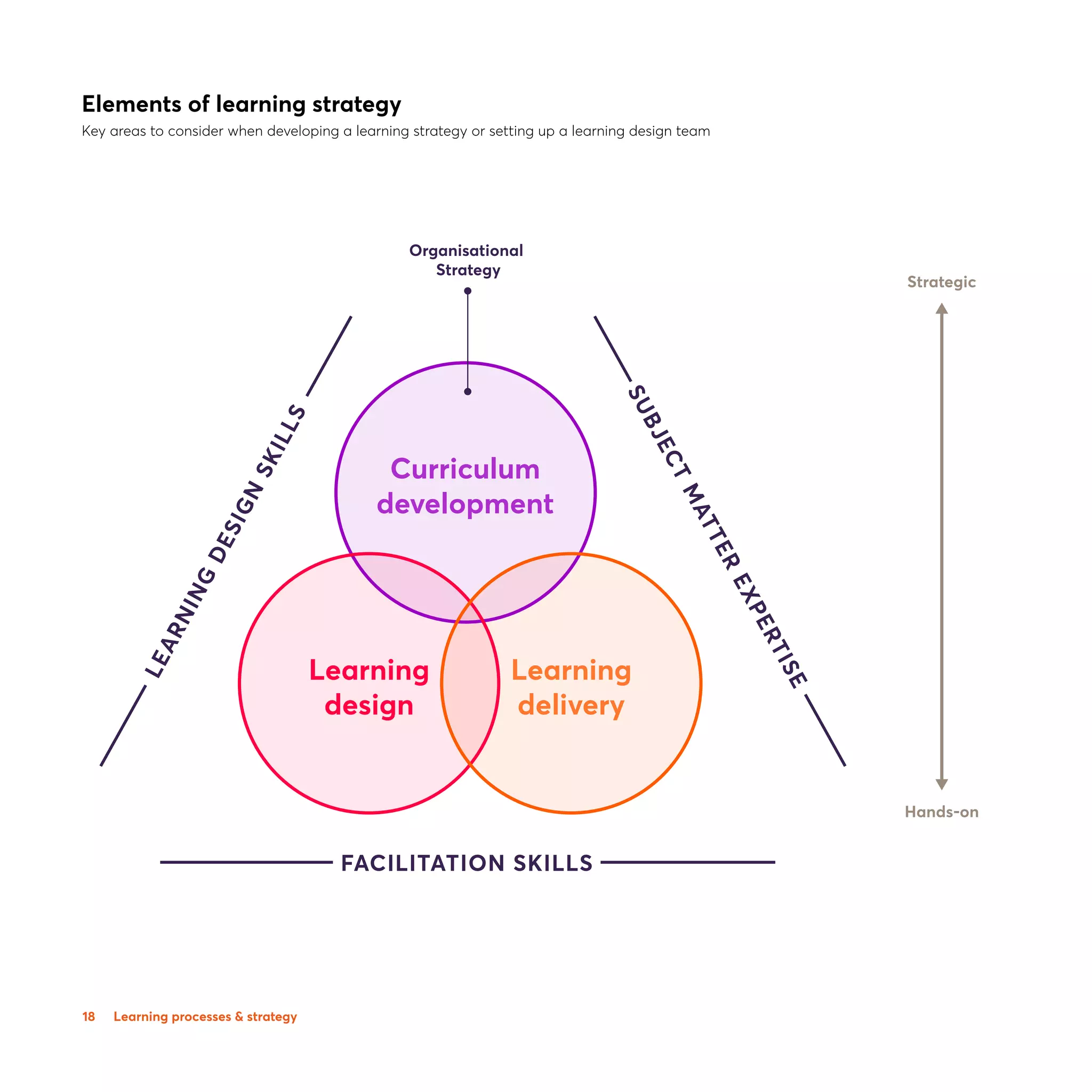
This diagram shows the three key areas that need to be
considered when developing a learning strategy or setting up a
capacity building function within your organisation. You need to:
•0 Develop a curriculum6
that is aligned with your team or
organisational strategy.
•0 Translate these overarching strategic objectives into a learning
journey, considering how learning objectives, activities, needs,
content and materials are aligned with this.
•	Set up structures and systems to make sure the learning
programmes are delivered.
In order to achieve these, there are three skillsets needed in your
team:
1.0 Learning design skills for developing the overarching narrative
of the curriculum and designing learning journeys, content and
materials.
2.0 Facilitation skills for making sure that learning programmes
are effectively delivered.
3.0 Subject matter expertise to add flesh to the bones.
Why or how would you use it?
This diagram is useful for going beyond designing an individual
learning experience and planning a fuller programme of learning,
looking at learning strategy and the skills needed to bring it to life.
To use the diagram, begin at the top by thinking about curriculum
development. What is the aim of the curriculum? This should be
connected to the overall strategy of the organisation, so think
about how this collection of learning experiences will help achieve
the strategic objectives of the organisation. This will help to define
the desired outcomes of the curriculum.
Within the curriculum itself, both the design and delivery of
the learning experiences – and the skills required to do them
well – need to be considered. How will they be designed? What
guidance will be given to the people creating them? What learning
objectives will be provided? For the design, it’s important to have
specific learning or instructional design skills in the team in order to
create effective and engaging sessions. Subject matter experts are
also essential to bring knowledge and credibility to the content,
and so that learners can hear from a ‘more knowledgeable other’
during the learning experiences themselves. For the delivery,
facilitation experience is necessary as those delivering the session
will need to think about the audience and how different groups
may respond to different prompts or activities.
Typical questions that prompt using this diagram
What areas should you take into account when developing a
learning strategy or capacity building programme? What skills do
you need in a learning design and delivery team?
Background
We developed this model while working with a client to help them
identify key areas they needed to look at, and what skills were
required for developing and delivering their learning offer.
Elements of learning strategy
20
OUTCOMES
Strategic intent,
learning objectives
Measurement and
assessment tools,
methods
Teaching methods
and learning
activities
Practices, methods,
philosophies,
theoriesFacilities, platforms,
social context
Literature, guides,
materials, toolkits
Segments and profiles
of learners
Expertise areas,
roles and functions
EVALUATION
MODALITIES
CONTENT
ENVIRONMENTS
RESOURCES
AUDIENCE
FACULTY
LEARNING
JOURNEYS 
EXPERIENCES
VISION ON LEARNING
ACTO
R
S
EN
A
BLERS
N
A
R
RATIVES
IM
PA
C
T
Elements of learning experience design
An interaction model for designing learning experiences and programmes
Learning processes  strategy
21Elements of learning experience design
What is it?
This diagram presents the different elements needed to create
a learning experience. It features eight elements that need to be
considered – and most importantly, aligned – to make a learning
experience effective. For each of these elements, the overall vision
on learning will form the basis for decision making.
Why or how would you use it?
We use this diagram to help support our thinking at two different
levels of learning design – the strategic level and the tactical level.
The strategic level involves the high-level design of a curriculum
or a learning programme. The tactical level usually focuses on the
the design of an individual learning session or specific activity. The
tables on the following page describe each of these elements from
both the strategic and tactical perspectives, and include prompt
questions to help guide your thinking.
Unlike linear learning design models, this model is interactive.
This means that for both the strategic and tactical levels, you can
start with any elements and then move back and forth between
them. We do suggest, however, to start with defining outcomes or
learning objectives and then working backwards through each of
the other elements. For each one, you should consider what they
require and how they are related to the other elements. You will
probably iterate multiple times between the elements to get their
alignment right.
Typical questions that prompt using this diagram
What aspects should you consider when designing a curriculum or
learning experience? What decisions need to be made, and how
are these decisions connected?
Background
This diagram is based on Hilda Taba’s Interaction model7
which
was developed in the 1960s. She was a curriculum theorist and
educator, and considered curriculum development as a non-
linear and dynamic decision making process. Her original models
comprised four elements: objectives, method, content and
evaluation. Over time we have adapted some of these labels and
extended her model with four other categories that we consider
crucial for learning design.
Learning processes  strategy22
Strategic
VISION ON
LEARNING
Principles
Describes the wider vision on learning and provides principles
underpinning the curriculum or programme design.
•	 What is your ‘philosophy of learning’ (i.e. pedagogy)?
•	 What are the fundamental beliefs about learning that
underpin your programmes?
OUTCOMES Strategic intent
Describes the strategic intent of a curriculum or programme
(e.g. performance improvements, cultural change, impact
generation).
•	 What is the change, value or impact you are trying to
create with your programme?
EVALUATION Outcome measurement
Describes evaluation methods and instruments for measuring
the outcomes of the wider curriculum.
•	 How do you measure outcomes?
•	 What actual value is created by the curriculum?
•	 How do you establish a baseline?
MODALITIES Methods
Describes the overarching narrative and methods or modes
through which learning happens (e.g. self study, or directed
learning; also see page 26).
•	 How are you going to achieve your outcomes?
•	 What does the mix of learning modes look like?
CONTENT Body of knowledge
Describes the body of knowledge or subject matter (e.g.
theories, philosophies, principles, processes, methods, toolkits)
underpinning a curriculum.
•	 What content is needed to achieve the learning
outcomes?
•	 What are the key subject areas?
•	 What principles are crucial for effective performance?
ENVIRONMENTS Enablers and requirements
Describes the social, technological and physical environments.
This may include learning management systems, as well as
requirements for the organisational or social environment (e.g.
permissive environment).
•	 What systems or platforms do you need to put in
place to enable learning?
•	 What is needed to create a permissive and enabling
learning environment?
RESOURCES Assets, media and networks
Describes the wider categories of assets, media and networks
(e.g. repositories, databases, knowledge systems, communities
of practice) needed to enable learning.
•	 What resources are needed to enable or support
learning?
•	 What resources are key to achieve the intended
outcomes?
AUDIENCES Segments
Describes segments of learners, based on, for example, needs,
motivations, experience or seniority.
•	 Who are your key audiences? How would you segment
them?
•	 What learning needs do these segments have?
•	 What enables them to learn? What are their barriers
to learning?
FACULTY Sections
Identifies different sections of the faculty based on expertise,
facilitation skills (e.g. instructing, mentoring, coaching) or
experience.
•	 How is the faculty structured?
•	 What should the faculty have in common? Where
should they differ?
•	 What roles does the faculty have?
23
Tactical
VISION ON
LEARNING
Guidelines and standards
Provides standards and concrete guidelines for designing a
learning session or activity.
•	 What guidelines and standards inform your decision
making around learning?
OUTCOMES Learning objectives
Sets out the learning objectives, specifying what learners are
able to do or demonstrate after completing a session.
•	 What should be different when learners leave the
room?
•	 What behaviours should learners be able to
demonstrate?
EVALUATION Skills assessment
Describes assessment tools and methods for evaluating the
learning objectives. These assessments can be summative or
formative.
•	 How do you assess learning outcomes?
•	 What is the purpose of assessment?
MODALITIES Activities
Describes the learning journey and the learning activities
needed to achieve the intended objectives.
•	 How are you going to achieve your learning objectives?
•	 What does the learning journey look and feel like?
•	 How do the learning activities align with the learners’
needs, experience and preferences?
CONTENT Key messages and examples
Specifies the key messages, examples, case studies, techniques
and tools that support the learning activities.
•	 What content is needed to achieve your learning
objectives?
•	 What are the key messages you want to get across?
•	 What metaphors or examples might you use to help
bring abstract ideas to life?
ENVIRONMENTS Configuration
Provides lists of books, articles, guides, tools or materials
needed to enable and support learning.
•	 What materials or information sources will support the
learning process?
•	 What references, tools or materials are needed to
achieve the learning outcomes?
RESOURCES Materials and literature
Describes the wider categories of assets, media and networks
(e.g. repositories, databases, knowledge systems, communities
of practice) needed to enable learning.
•	 What resources are needed to enable or support
learning?
•	 What resources are key to achieve the intended
outcomes?
AUDIENCES Profiles
Provides detailed learner profiles, describing their individual
learning needs, abilities and preferences.
•	 Who are the learners?
•	 What is their background?
•	 What are their needs, motivations and aspirations?
•	 What skills or knowledge do they already have?
•	 How can you build on their existing experience?
FACULTY Résumés
Provides detailed profiles of faculty members about their
background, experience, expertise and facilitation skills.
•	 Who is ‘teaching’ what and how?
•	 What strengths (and weaknesses) does each faculty
member have?
•	 What (facilitation) skills, experience or expertise is
essential?
Elements of learning experience design
BIAS
TOWARDS
ACTION
OBJECTIVES
LEARNING
FOR ACTION
Formulating learning
objectives as actionable
goals to stimulate
people to do things in a
new way
ACTIVITIES
LEARNING
BY DOING
Learning through
reflection on doing
CONTEXT
LEARNING
BEYOND THE
CLASSROOM
Supporting learners to
learn whilst doing
innovation in their
daily work
ACTORS
LEARNING
WITH PEERS
AND FROM
EXPERTS
Learning from people who
have hands on experience
in doing innovation
24
Nesta’s Innovation Skills team pedagogy
Our vision on learning for innovation
Learning processes  strategy
25
What is it?
This diagram presents the key principles of our approach to
learning and developing innovation skills. The pedagogy that
supports all our learning experiences has a ‘bias towards action’,
which is based on innovation being about taking action and
actually doing things.
Why or how would you use it?
This pedagogy has been developed specifically for our work, and
so you may want to ask yourself some typical prompt questions
to start thinking about your own vision on learning. If you are
interested in taking a bias towards action, you can use this model
to think through how this approach connects to different elements
of a learning experience:
Learning by doing: We believe that learning new skills is best
achieved by actually doing them, so we promote hands-on
exercises and immersing learners in real life situations. Letting
learners experience how to make decisions in the face of
ambiguity and complexity, and then letting them reflect on that
process, is far more effective than mere knowledge transfer.
Learning for action: The essence of innovation is doing things
differently to generate a better outcome. Impact is not created
through knowledge; it results from people doing things differently.
For that reason, learning objectives should be formulated as
actionable goals: how is the learner going to act after finishing a
course?
Learning beyond the classroom: A learning experience is more
than just a face-to-face workshop. We also consider leverage
points before and after the key learning activity to elongate the
learning experience, and how to support learners when they are
using their new skills in their daily practice.
Learning with peers, from experts: The instructors and trainers
who lead our courses are role models and should have hands-
on experience with the material they teach. Being confronted
with a new challenge without adequate skills to tackle it can be
daunting, so trainers should be able to play the role of the ‘more
knowledgeable other’ to support learners to step out of their
comfort zone.8
In addition to this, facilitating learners to learn from
their peers helps them to build each other’s confidence.
Typical questions that prompt using this diagram
What is your vision on learning? What should learning look
like? What are the key principles that guide you in shaping and
delivering learning experiences?
Background
We developed this diagram in the Innovation Skills team to
articulate our approach to learning. Our pedagogy is an ongoing
conversation, but we often come back to these principles.
Nesta’s innovation skills team pedagogy
26
MENTORING /
COACHING
INFORMAL
LEARNING
SELF DIRECTED
IN PRACTICE
LEARNABLE
TEACHABLE
Tacit knowledge and
implicit practice
Explicit knowledge and
codified practices
ABOUT PRACTICE
DIRECTED
SELF
STUDY
TRAINING 
SIMULATION
Self led learning activites
(e.g. reading, webinars)
and exercises
Involves learning in and
from everyday practice
(e.g. apprenticeship)
Reflecting on experiences
and given guidance by more
experienced others
Simulations and
(hands-on) exercises led by
expert instructors
Drives the development of
embodied knowledge,
complex skills, situational
awareness and reflexivity
Helps generate conceptual
understanding, develop basic
skills and build confidence
Modes of learning
A framework for choosing the right learning approach for your learning objectives
Learning processes  strategy
27
What is it?
When developing a curriculum or learning strategy, one of the key
challenges is to find the right learning mode to fit the learner’s
needs. This diagram features four key different learning modes
that can be used to develop a learning experience or programme
depending on the needs of the learner.
It’s first important to acknowledge the difference between what’s
teachable and what’s learnable. We sometimes assume that
everything is teachable, whereas in fact much learning happens
outside of training in the real world. This is particularly the
case with innovation, as it requires a set of complex skills and
in reality deals with a lot of uncertainty. Much of the decision
making is about the specific context, so there are often no pre-
defined solutions or methods for how things work. We believe
that innovation skills are typically skills that are best learned in
practice.9
How or why would you use it?
We usually draw a distinction between learning ’about practice’ for
the skills that we consider teachable, and learning ‘in practice’ for
the skills that we believe are only learnable:
Learning about practice: this focuses on using skills or methods
at a basic level, building confidence, and developing some
understanding of the value of a method or tool. It often involves
explicit knowledge, practices and methods that are well
understood and codified, and straightforward to train other people
in. Learning about practice often happens away from actual day-
to-day practice.
Learning in practice: this involves learning tricks of the trade
that are not well understood or codified; it is tacit or embodied
knowledge that learners develop through exposure to experience
with different situations. It needs to be learned through real-life
situations.
These categories of learning can be self-directed – initiated and
completed by the learner – or directed – stimulated or facilitated
by a teacher, mentor, etc. Combining these different elements
leads to the four modes of learning:
1.0 Self directed learning about practice: learning that people
can do at their own pace, such as online courses (e.g. DIY
Learn), practical guides (e.g. Nesta’s practice guide series),
toolkits (e.g. DIY Toolkit) or reading exercises.
2.0 Directed learning about practice: face-to-face learning,
where participants can learn about a tool or method from
a ‘more knowledgeable other’, often through a simulation
exercise.
3. 0 Directed learning in practice: learning in real life situations,
where learners are supported by a ‘more knowledgeable other’
through, for example, a mentoring programme or reflection
exercises.
4. 0 Self or undirected learning in practice: informal learning,
which is experience based learning that happens on the job.
The learner might not even be aware of the fact that they are
learning until they reflect on it. In this process, learners might
be supported by and learn from their peers.
Typical questions that prompt using this diagram
What different modes of learning should you consider and to what
purpose? What is teachable and what is learnable? What modes
of learning can happen within and beyond the classroom?
Background
We developed this diagram to support our decision making in
curriculum development. It is similar to the 70:20:10 model for
learning and development, which was developed by Michael
Lombardo and Robert Eichinger.10
These authors suggest that, as
a rule of thumb, 70% of learning is informal and happens on the
job, 20% is stimulated by social learning and 10% occurs through
formal training or learning interventions. These numbers are broad
indicators and not supported with robust evidence.11
However, for
developing innovation skills, embedding learning in practice seems
to be crucial.12
Modes of learning
28
MOTIVATION OPPORTUNITYABILITY
PERFORMANCE
BEHAVIOUR
AMO framework
The key requirements for people to be able to put innovation into action
Learning processes  strategy
Based on Hutchinson (2013) and Burd  Hallsworth (2016)
29
What is it?
This diagram describes the key elements to consider when thinking
about what is needed for people to innovate. As a Skills team we
often focus on ability, but it requires more than that. These three
elements are essential to make innovation happen in practice:
Ability: the skills required to use innovation skills and methods
Motivation: the intrinsic motives or extrinsic incentives to put these
skills into action
Opportunity: the mandate and conditions to put innovation into
practice and make change happen, for example having the space,
time, resources and support from colleagues and management
The final element is often overlooked, but if any of them are
missing it is very difficult for people to effectively innovate.
Why or how would you use it?
The diagram is useful for thinking beyond just teaching skills and
looking to see if the other elements required for innovation to
happen are in place. There are two ways to use this diagram. One
is to focus on ‘doing’ innovation, the other is to focus on ‘learning’
to innovate.
Particularly with the latter, we often assume that everyone has
the ability to learn how to innovate. However, innovation skills are
complex skills13
and they also require learning agility14
in order to
develop and continuously renew and improve them.
We can also assume that the motivation is already there, but
that’s not always the case – people can be ‘volun-told’ (being told
by your superior to volunteer). This means it’s important to verify
the learners’ motivations before tapping into them.
We also need to allow learners to use their ability and motivation
by creating the opportunity and space to actually put their
learning into practice. It is easy to enroll people on a course, but
as a lot of learning happens in practice.15
How can they use and
advance their skills when they are back in the office?
Typical questions that prompt using this diagram
What skills are needed to enable a certain behaviour? What
motivates learners? Can learners put their new skills, methods
or tools into practice? Is their organisation ready to make use of
them? What are the elements that influence behaviour change?
Background
The ‘AMO Theory’ is a popular model in performance
management.16
It describes performance as a function of ability,
motivation and opportunity. A similar model has also been used as
a framework for behaviour change.17
We tend to use both aspects
of this model, considering the behaviour change perspective as
a means (e.g. test ideas at an early stage of the process) and
performance management perspective as an end (e.g. creating
better public outcomes).
AMO framework
30
INDIVIDUAL
ORGANISATION
ECOSYSTEM
TEAM
Four levels of capacity building
A framework for considering different levels of intervention to enhance capacity building
Learning processes  strategy
31
What is it?
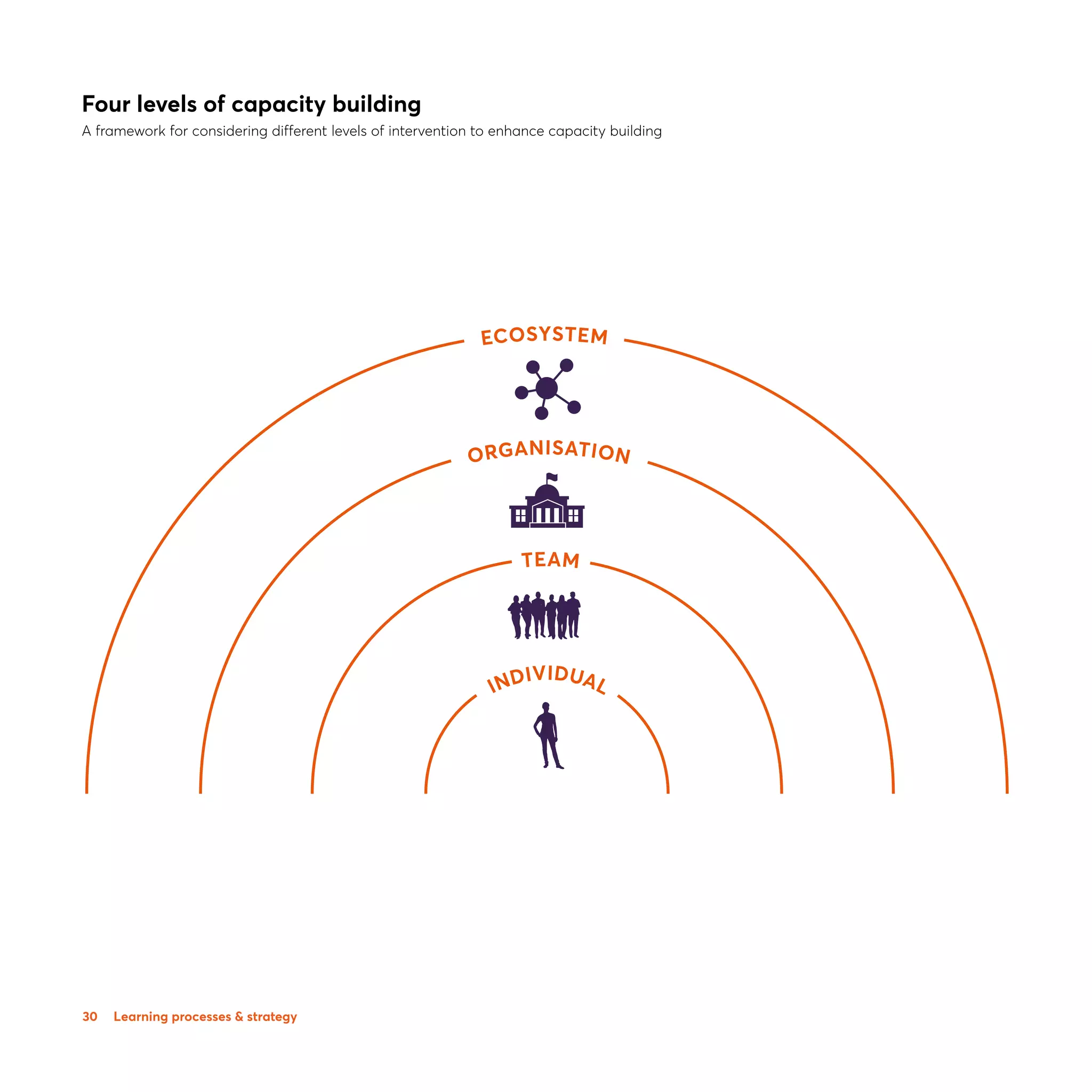
Developing innovation capacity involves multiple levels, ranging
from individual learning all the way up to the wider ecosystem.
Particularly when developing a curriculum or designing a learning
programme, we zoom in and out between the following four levels.
Each level comes with a specific focus area:
Individual: at this level we try to develop a profile of the individual
learner. What learning needs, motivations, aspirations, preferences
and prior experience does the learner have? What is their attitude
towards innovation? How does learning fit into the everyday life of
the learner, and what is relevant to them? Where does a learning
programme sit in the wider career path of the learner?
Team: at this level we look at what the entire team should be able
to achieve, and what they actually are currently able to achieve.
What are the strengths and weaknesses of the team, in terms
of innovation competencies? Does the team culture enable and
encourage social or peer learning?
Organisation: at this level the most important aspect is culture
and organisational readiness. Is an organisation ready to utilise
new skills? Does the organisation provide an enabling and
permissive environment for learning?
Ecosystem: at this level we look at the wider external environment
of an organisation and also consider the community of practice.
What external actors play a role in capacity building for an
organisation? How are learners or teams connected to the
community of practice? How do they become a member of this
community?
Why or how would you use it?
Traditionally learning programmes focus on the individual learner,
but in practice we see that individuals are part of a team and
wider organisation, and that innovation processes are often
embedded in complex networks of stakeholders. We also recognise
that the myth of an individual ‘super innovator’ doesn’t hold true.18
So we need to shift our focus from the individual learner to the
team, organisation19
and ecosystems, and include these levels in
our decisions when developing curricula and learning programmes.
Typical questions that prompt using this diagram
What different levels should you consider for developing capacity
building programmes? What does the wider context of the
individual learner look like?
Background
We developed this diagram to help us explain the scope of one
of our programmes20
and to manage its complexity. It helped us
define outcomes for each level and further develop our strategy.
Four levels of capacity building
Competencies 
expertise levels
Defining learning outcomes and pitching
your learning offers at the right level
34
RULE-BASED
THINKING
SITUATION-BASED
THINKING
STRATEGY-BASED
THINKING
Novice
Advanced
Beginner
Competent
Expert
Visionary
Levels of expertise
A classification of expertise levels for pitching a learning offer at the right level
Competencies  expertise levels
Inspired by Lawson  Dorst (2009)
35
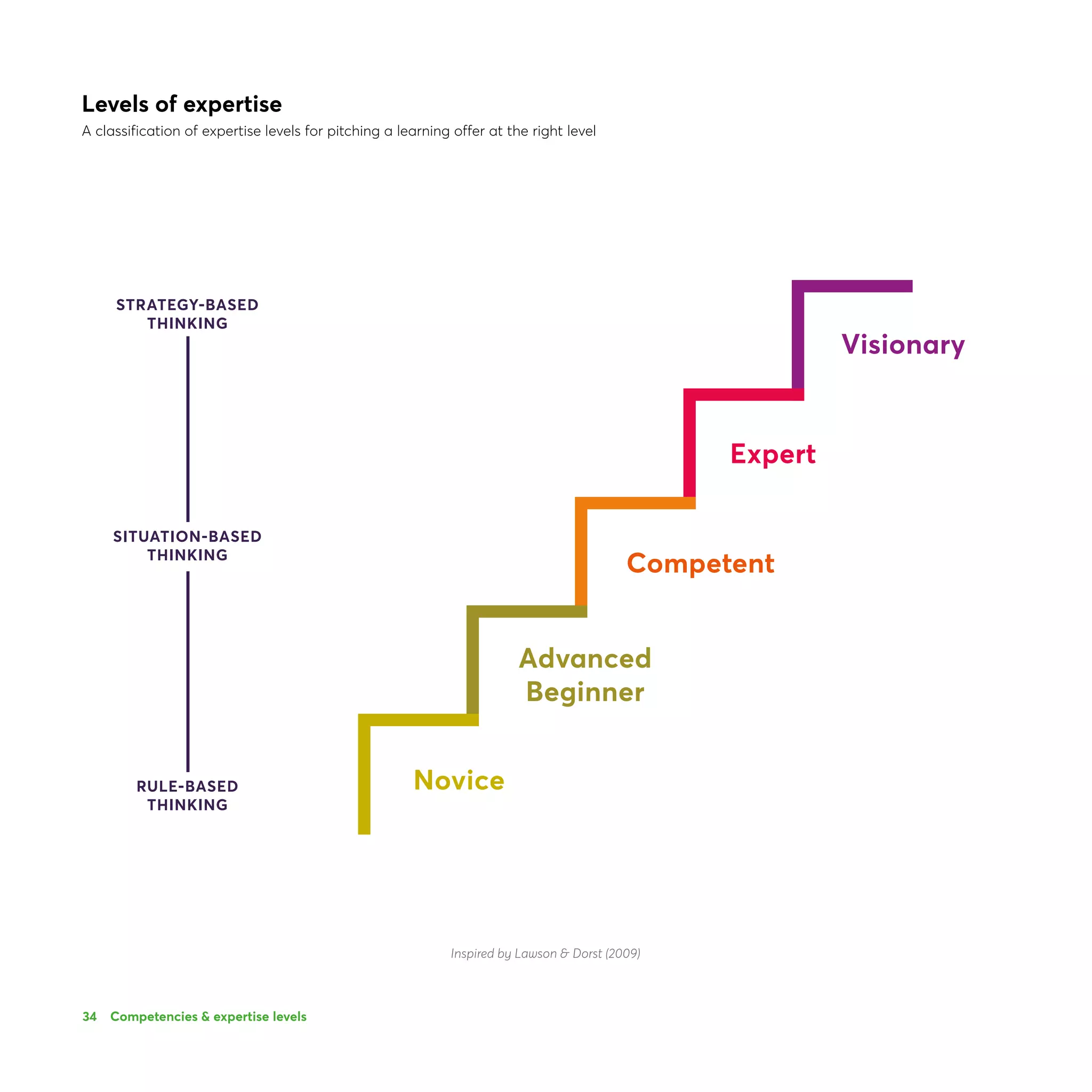
What is it?
This diagram demonstrates different levels of expertise, and
how you move from one level to the next. The words on the
right describe different classifications of expertise levels that
are commonly used. On the left are three broader categories
explaining the level of expertise by the guidance that you give –
i.e. how you instruct people.
Why or how would you use it?
This diagram is helpful for understanding what level your learners
are at, and so at what level to pitch your learning offer:
Rule-based thinking: At the novice level, learners often need
clear guidance on how to use something and how not to use it,
such as a tool or a method. Here, the learning approach provides
learners with a prescriptive process and clear instructions on how
to execute them in the right order. For teaching at this level, it is
essential to break the process down into distinct steps.
Situation-based thinking: As you move up the steps, you
encounter a higher level of complexity. This involves looking
beyond just the rules or following a strict step-by-step approach.
A descriptive process may still provide guidance to plan a course
of action, but it requires situational awareness and the ability to
respond accordingly. Learners at this level often demonstrate the
ability to improvise and find workarounds for limiting requirements
and other barriers, and come up with solutions that are
appropriate for the unique circumstances of the problem. At this
level learners learn best with the help of a mentor, who prompts
critical questions and offers new ways of looking and thinking.
With innovation skills, it may take up to three to five years to attain
this level of expertise.
Strategy-based thinking: This is the highest level, and focuses on
setting direction. At this level, experts are able to look beyond the
given problem space to come up with unexpected perspectives.
They are able to identify a core problem by reframing it. They
bring in their personality and personal commitment to the process.
As a result of that, they are able to formulate original strategies
and consciously design the process to solve a problem. Shaping
a learning offer for this advanced level can be hard as experts
will often provide their own learning. However, good coaching
might be helpful to help them reflect on their strategies and their
effectiveness. Alternatively, letting experts mentor others also
allows them to become aware of how they work by making the
tacit explicit.
There is sometimes a misconception that the end goal should
always be to become a visionary. This is highly unlikely, as
moving just from novice to advanced might take months or
years. Becoming an expert might even take a decade or more.
Often people don’t ever reach the expert or visionary levels, so be
realistic in what you’re aiming for.
Although the steps suggest progressing from one level to the next,
learning is a dynamic process so a learner might jump back and
forth between levels depending on their practice of the skill.21
Typical questions that prompt using this diagram
Where should you pitch the learning offer? What type of approach
works best for the level of learner expertise?
Background
The five levels of expertise were defined by Dreyfus.22
Based on
that, Bryan Lawson and Kees Dorst defined their wider categories
of expertise23
to provide a framework for assessing design
competency.
Levels of expertise
36
UNCONSCIOUS
INCOMPETENCE
COMPETENCE
CONSCIOUS
Not aware of skill
deficiencies
Aware of skill
deficiencies
So proficient
that skills are
applied without
thinking
Actively working
on developing
skills
(Un)concious - (in)competence
Four awareness and competency levels for developing learner profiles
Competencies  expertise levels
Inspired by Adams (2016) and Mullen (2016)
37
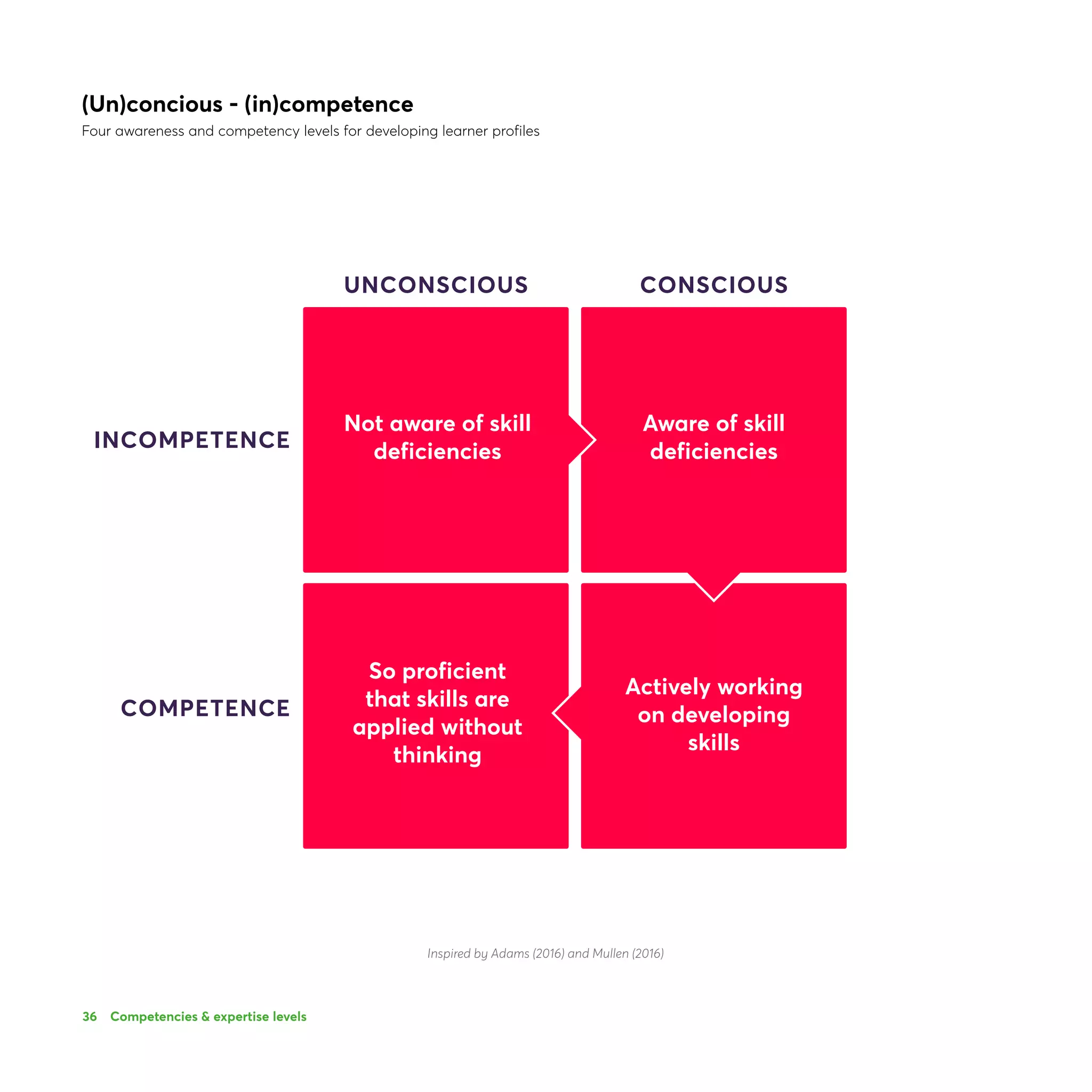
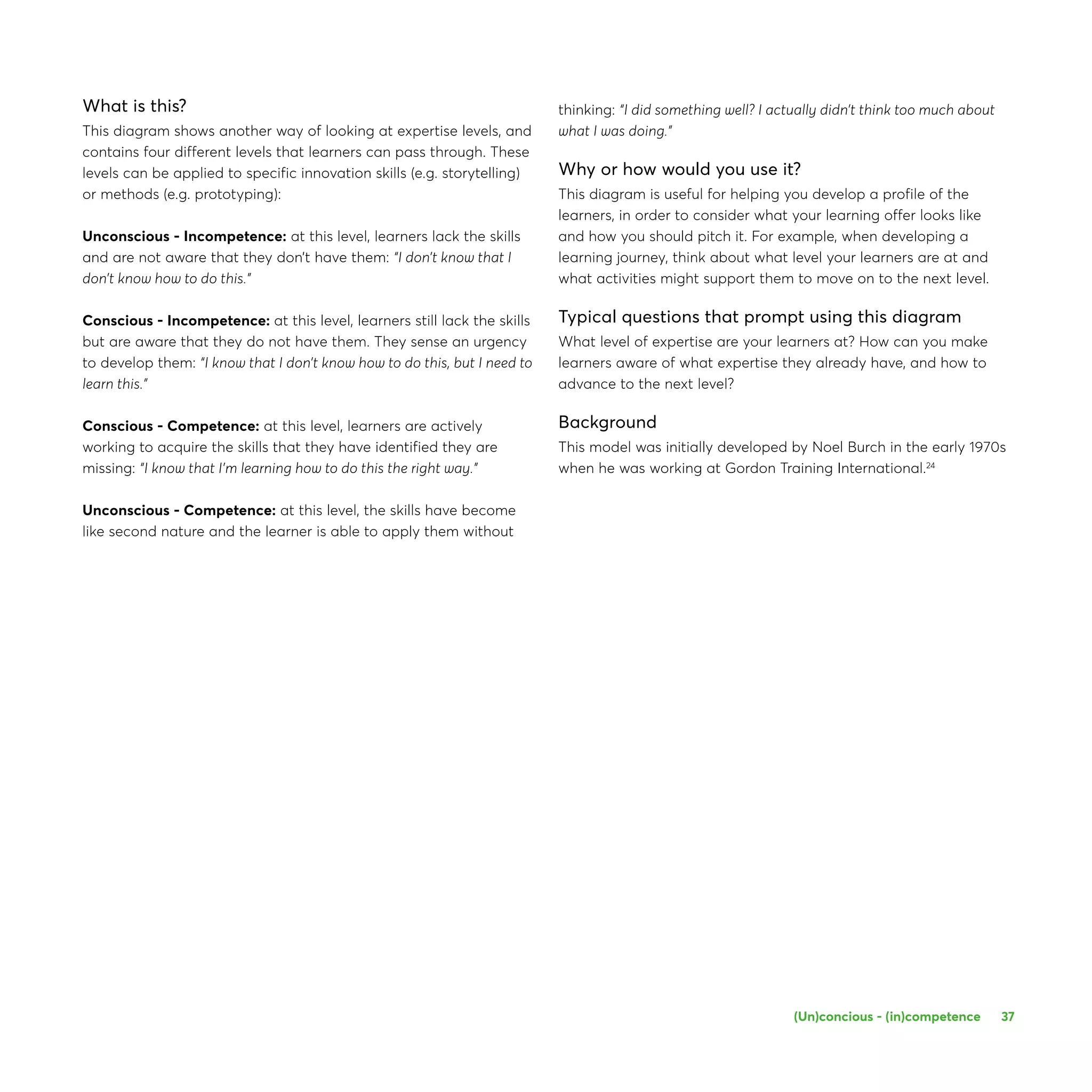
What is this?
This diagram shows another way of looking at expertise levels, and
contains four different levels that learners can pass through. These
levels can be applied to specific innovation skills (e.g. storytelling)
or methods (e.g. prototyping):
Unconscious - Incompetence: at this level, learners lack the skills
and are not aware that they don’t have them: “I don’t know that I
don’t know how to do this.”
Conscious - Incompetence: at this level, learners still lack the skills
but are aware that they do not have them. They sense an urgency
to develop them: “I know that I don’t know how to do this, but I need to
learn this.”
Conscious - Competence: at this level, learners are actively
working to acquire the skills that they have identified they are
missing: “I know that I’m learning how to do this the right way.”
Unconscious - Competence: at this level, the skills have become
like second nature and the learner is able to apply them without
thinking: “I did something well? I actually didn’t think too much about
what I was doing.”
Why or how would you use it?
This diagram is useful for helping you develop a profile of the
learners, in order to consider what your learning offer looks like
and how you should pitch it. For example, when developing a
learning journey, think about what level your learners are at and
what activities might support them to move on to the next level.
Typical questions that prompt using this diagram
What level of expertise are your learners at? How can you make
learners aware of what expertise they already have, and how to
advance to the next level?
Background
This model was initially developed by Noel Burch in the early 1970s
when he was working at Gordon Training International.24
(Un)concious - (in)competence
38
UNDERSTAND
Being able to articulate the potential
and value of a skill or method
APPLY
Being able to demonstrate that the
skill can be effectively used to
achieve specific outcomes
EMBED
Being able to effectively use the
skill in everyday practice, it has
become a habit
SPREAD
Being able to educate and
mentor others to develop the
skill
HIGH
Potential
to generate
impact
LOW
Innovation skills hierarchy
A classification of skills levels to help define learning objectives
Competencies  expertise levels
39
What is it?
This diagram features four skill levels that can be used to structure
your learning objectives and pitch your learning offer correctly.
There are four levels of attainment that learners should be able to
demonstrate. These levels are:
Understand: learners are able to articulate (e.g. by explaining to
others) the main concepts of a method or skill and are able to
point out its potential and value for a team or organisation.
Apply: learners are able to demonstrate the ability to effectively
use the skills or methods in order to achieve a certain output or
outcome (e.g. learners are able to create a persona based on
ethnographic research). At this level learners might still need some
support and guidance from a ‘more knowledgeable other’, or
the skill might be demonstrated in a controlled environment (e.g.
through a simulation).
Embed: learners are able to demonstrate the effective use of the
skill in everyday practice. They have successfully embodied the skill
and it has become a habit or part of key procedures (e.g. as part
of the policy cycle, actively engaging with citizens for consultation
or using co-creation to inform/drive decision making).
Spread: learners are able to spread a skill across a team,
organisation or network. They may use formal training methods as
well as mentoring to help others develop the skill.
Each level has a different purpose and potential to generate
impact. Learners will be less likely to create impact when they only
understand how a skill or method works, and therefore aiming for
higher levels increases the potential to generate impact.
Why or how would you use it?
When planning your learning outcomes, it’s helpful to think about
where you should pitch your learning offer. For example, a taster
session for a group of decision makers might concentrate on
‘understanding’ the principles and value of a method. Success
would be demonstrated by learners being able to articulate those
principles by explaining them to others. On the other hand, for a
training session with an innovation team aimed at building skills
they can ‘apply’, you need to move learners to the next level and
focus on doing. This may involve hands-on exercises that allow
learners to experience how skills work in practice.
We often see that people stick to a default learning activity
(e.g. a discussion panel) that is useful for developing conceptual
understanding, but is unlikely to equip the learner with the actual
ability to do innovation. This diagram helps to define the level of
ambition (i.e. what a learner should be able to do or demonstrate
after a session) and align that with the learning activities. It
is useful for emphasising that ‘understanding’ and ‘doing’ are
different things, and that learning activities need to be developed
differently for each. Rather than use it as a set of distinctive steps,
here in the Innovation Skills team we look at it as a spectrum that
helps us position what our learning offers should be aiming for.
Typical questions that prompt using this diagram
How should you define the learning objectives for your session? At
what level should you pitch your learning offer?
Background
This diagram is inspired by Bloom’s taxonomy,25
which was
developed in 1956 to promote more advanced forms of thinking
in education. It focused on moving beyond getting students
to just remember facts, and prioritised more complex skills like
applying, analysing, evaluating and creating. It was designed
to support educators and curriculum developers to develop a
common ground and help them structure their learning objectives,
assessment methods and learning activities. In 2001 a revised
version was presented by some of Bloom’s former students.26
This
version uses verbs for each level instead of nouns and swaps the
two top levels.
In practice we have found Bloom’s taxonomy doesn’t always
translate well to our domain of developing innovation skills. It can
be too granular and focuses too strongly on thinking skills, whereas
we have a bias towards action.27
We have therefore categorised
our skill levels into four broad categories and emphasised practical
application as the overall premise.
Innovation skills hierarchy
40
ZONE OF PROXIMAL
C
O
MFORT ZON
E
ANXIETY ZONE
DEVELOPMENT
Zone of proximal development (Vygotsky)
Pitching a learning offer at the right level; not too easy and not too hard
Competencies  expertise levels
Inspired by Vygotsky (1980)
41
What is it?
This diagram looks at how to pitch and deliver a learning
experience at the right level to help your learners get the most out
of it. We describe this using three different zones:
Comfort zone: what a learner can do without help
Proximal development zone: what a learner can do with help and
guidance, through the support of a ‘more knowledgeable other’28
Anxiety zone: where a learner is too far from their comfort zone
and therefore cannot learn or do
Why or how would you use it?
Learning happens when learners are outside their comfort zone
and they experience a certain level of friction. But you don’t want
to push your learners too far. Learning won’t happen if learners are
inside their comfort zone, but nor does it happen when they are
confronted with a daunting task and experience anxiety.
We often talk about innovation practice as a muscle, and that
you need frequent exercise to build it, similar to lifting weights in
a gym. If you stay in your comfort zone and don’t exercise it all,
you won’t strengthen it – but at the same time, overworking or
stretching it too far isn’t helpful either. Instead, learning happens
when it is pitched right in middle; getting learners out of their
comfort zone but not pushing them into their anxious zone. This is
the zone of proximal development.
This zone is dynamic; once learners have practiced and developed
a new skill, it will eventually become part of their comfort zone.
When that happens they are then ready to progress to the next
stage and advance their skills by tackling a slightly more complex
challenge or receiving less support.
Typical questions that prompt using this diagram
Where should you set the bar? How far should you push your
learners? What is the sweet spot between making an exercise too
easy or too hard?
Background
The concept of the zone of proximal development was first
introduced by Lev Vygotsky around 1920.29
Although its origin
is based in developmental psychology and focused on how
children learn, it is also helpful in adult learning to set out learning
strategies and journeys.
Zone of proximal development (Vygotsky)
42
FLO
W
C
HAN
N
EL
SKILLS
CHALLENGE
Boredom Flow
Apathy
easy
novice
expert
hard
Anxiety
Flow: balancing challenges  skills (Csíkszentmihályi)
Striking a balance between challenges and skills to create an immersive learning experience
Competencies  expertise levels
Based on Csikszentmihalyi (1990)
43
What is it?
This diagram illustrates how to achieve the right ‘flow’ when
designing a learning experience. Flow is the mental state in which
learners are fully immersed in the process of learning – also
referred to as ‘being in the zone’. This flow is created in learning
experiences by striking a balance between the skills a person has
and the challenges they are given.
Why or how would you use it?
To create an effective learning experience – an experience that is
neither too hard nor too easy – you have to consider current skill
levels and align them with the challenge that the learners need to
tackle.
If you give a learner with low skill levels a complex task, it is
likely to result in anxiety. On the other hand, simple challenges
for more skilled learners will likely create boredom. We often
use this diagram in conjunction with the concept of the ‘zone of
proximal development’ (see page 40) in order to develop the right
flow so that people can progress – moving from their proximal
development zone to their comfort zone as they become practised
at using a new skill. Within a curriculum, this becomes a dynamic
process where learners move through an ongoing cycle of skills
development.
Typical questions that prompt using this diagram
How do you make sure learners are energised and not bored or
distressed? How do you align learning activities with the skills that
learners already have?
Background
The concept of ‘flow’ was developed by Mihály Csíkszentmihályi.30
It can be observed in many activities, e.g. playing a music
instrument, doing sports, or playing a computer game.
Flow: balancing challenges  skills (Csíkszentmihályi)
44
Carrying out an activity in real-life situations
Explaining procedures to others
10% of what we read
20% of what we hear
30% of what we see
50% of what we hear and see
70% of what we discuss with others
80% of what we experience personally
90% of what we teach others
Reading a book
Listening to a talk or lecture
Studying a diagram
Watching a demonstration
Participating in a discussion
PASSIVE
ACTIVE
Cone of learning (Dale)
A hierarchy of learning activities for considering their effectiveness
Competencies  expertise levels
Inspired by Dale (1946)
45
What is it?
The cone of learning represents an order of learning activities
and indicates their effectiveness, ranging from conceptualisation
(through reading and listening) to concrete experience (through
doing). The model suggests that learning activities that build
upon real-life experiences are more effective, as opposed to using
text and (visual/verbal) symbols as the source of learning. It is
essentially a depiction of the old Confucian proverb: ‘I see and I
forget, I hear and I remember, I do and I understand’.
Why or how would you use it?
The diagram helps to explore different learning modes and shift
the focus to more action oriented learning methods. We believe
that active engagement with a subject is most effective to develop
innovation skills. Retention of learning is best when people are
actively engaged in a real situation. However, in our conversations
with clients and colleagues, we often notice a tendency towards
more conceptual learning; methods such as discussion panels or
talks are often mentioned first. We use this model to help them
consider a wider range of learning activities that are more fit to
purpose.
Typical questions that prompt using this diagram
What kind of learning experience do you want to provide? Are you
using the right learning method?
Background
The cone of learning31
was created by American educator Edgar
Dale32
in 1946 and first appeared in a textbook on audiovisual
methods in teaching. One of its main critiques is that it isn’t
grounded in robust evidence and it is often misinterpreted (e.g.
Dale’s original cone did not feature percentages). Despite this, we
still consider it a helpful tool to prompt discussions about learning
activities.
Cone of learning (Dale)
46
CORE SKILLS
EXPERIMENTING 
PUBLIC PROBLEM
SOLVING
Competencies for
KEY ATTITUDES
Political 
Bureaucratic
Awareness
Operating political
dynamics and bureaucratic
procedures to ensure
strategic support
Financing change
Understanding the many ways
to liberate and use financial
resources for innovation
Outcomes-
focused
Strong commitment
to real world effects
Courageous
Willingness to take
risks
Intrapreneurship
Being insurgent and use business
acumen to create opportunities
Storytelling
 Advocacy
Using narratives and media
to articulate vision and
information in compelling
ways
Resilient
The perseverance
to deal with
resistance
Imaginative
Exploring and
envisioning new
possible futures
Empathetic
Understanding
others’ experiences
and frames of
reference
Agile
Responding to changing
environments with
flexibility
Building Bridges
Orchestrating interaction to
find common ground and
create shared ownership
Creative Facilitation
Creatively processing different
perspectives and deliberating
multiple options
Brokering
Mediating contrasting
interests and reducing
friction between multiple
stakeholders
Demonstrating Value
Articulating the value of new
approaches and solutions for
decision-making purposes
Citizen
 Stakeholder
Engagement
Actively involving citizens,
stakeholders and unusual
suspects
Mobilising resources and
legitimacy to make
change happen
LEADING
CHANGE
Exploring and iterating
new ideas to inform and
validate solutions
ACCELERATING
LEARNING
Engaging with citizens and
stakeholders to create
shared ownership of new
solutions
WORKING
TOGETHER
Systems
Thinking
Combining micro and
macro perspectives to
grasp complexity
Tech Literacy
Understanding technologi-
cal developments and using
their potential
Data Literacy
 Evidence
Using different kinds of
data effectively to
accelerate sense-making
Prototyping
 Iterating
Testing ideas and
systematically improving
them
Action-
oriented
Biased towards
action and learning
by doing
Reflective
Habit of critically
reflecting on process
and results
Curious
The desire to
explore multiple
possibilities
Future Acumen
Connecting long-term
vision with short-term
achievable tasks
Competency framework for public problem solving33
Key skills and attitudes required for experimentation and public problem solving
Competencies  expertise levels
Christiansen, Leurs  Duggan (2017)
47
What is it?
This framework identifies the core skills and attitudes needed
by public servants in order to experiment and adopt a greater
range of innovative practices for public problem solving. We have
attempted to provide a combined view on what it takes to set up
and run explorative innovation processes, while also creating an
enabling environment for innovation within an administrative and
political context. The framework describes three core categories
that – from our experience and research – are crucial to form the
basis of successful experimental problem solving:
Accelerating learning: Exploring and experimenting to identify
knowledge gaps, create new understanding and inform decision-
making in new ways.
Working together: Engaging with citizens and multiple
stakeholders to ensure co-creation and collaborative ownership of
new solutions.
Leading change: Creating space for innovation and driving
change processes to mobilise people, inspire action and ensure
strategic outcomes.
Why or how would you use it?
We believe that problem solving is at the heart of how governments
operate, and so we need to demystify how innovation approaches
can be useful and what the relevant skills and competencies are in
relation to problem solving activities. By framing our competencies
around experimental problem solving, we try to emphasise how
core attitudes and characteristics, in combination with key skills
and competencies, enable behaviours that increase the likelihood
of successful problem solving activities and better improve
capacity.
We use this framework to explain what we mean by ‘innovation
skills’ and to highlight the attitudes and mindsets that are
needed for public innovation. We also use it to shift the focus
from an individual using or learning one innovation method (e.g.
human centred design) to a team using a wider spectrum of
skills to effectively tackle complex issues. Future iterations of this
framework should help to design innovation teams, shape HR
strategies and recruitment, define outcomes for immersive learning
programmes and develop tools for impact assessment.
Typical questions that prompt using this diagram
What skills and attitudes are essential for government innovation?
What attitudes should you look for when recruiting a team? What
skills should you develop?
Background
This framework is an initial overview and the first step in our
process of understanding, reflecting on and assessing the key
attitudes and skills that we consider crucial for public sector
innovation.34
In order to develop this framework, we have used the
experience of the Nesta Innovation Skills team, complemented
with our insights from a study on the experiences of 30+ leading
public sector innovation practitioners from around the world. These
insights were subsequently tested with selected governments and
innovation experts to ensure accurate representation, relevance
and usefulness. The framework is a work in progress and part of
our public innovation learning programme.
Competency framework for public problem solving
Content 
communicationExploring key content areas and communication
approaches for innovation learning
50 Content  communication
PEOPLE
PROBLEMS
SOLUTIONS
FACTS
FUTURES
SYSTEMS
Identifying and
framing an issue
Taking a holistic
view, identifying
intervention points
Exploring multiple
possible futures
Understanding
people’s experiences,
building empathy
Developing and testing
solutions, mapping existing
assets and solutions
Using evidence
and data
Principles of innovation
Shifting the focus from only methods to habits and mindsets
Leurs, Quaggiotto  Christiansen (2018)
51
What is it?
This diagram lays out our six principles of innovation. We see
these principles as habits and mindsets that are essential to
policy or programme design activities. They help change how we
perceive and frame reality, and prompt us to explore different
solution spaces and prepare for multiple futures. They offer various
perspectives on an issue, and help to identify knowledge gaps,
challenge assumptions and generate richer understanding35
in
order to make better informed decisions.
The principles cut across various innovation methods (e.g. design
thinking, systems thinking, futures and foresight, evidence based
policy making) and are used throughout the innovation process.
The challenge is to effectively manage the dynamics between
opposing mindsets,36
skillsets and ways of acting.37
This diagram
represents that dynamic, and illustrates the tensions between three
pairs of principles.38
These pairs are:
People and systems: these involve the dynamic of zooming in and
out between people’s needs, and the wider system to understand
problems and solutions from different perspectives and levels. This
dynamic builds on a range of activities, varying from ethnographic
techniques (e.g. interviewing, observations), to stakeholder analysis
and network mapping, to modeling and mapping systems.
Facts and futures: these draw on the tension between past,
present and future. Decision making is informed by toggling
between using evidence and data, and being imaginative and
exploring multiple possible futures. Activities vary from using
data analytics to identify trends, to using storytelling techniques
in order to generate new understanding. On one hand, rigorous
experimental methods such as RCTs are used to validate solutions
and to build a solid evidence base. On the other hand, foresight,
horizon scanning and speculative design are used to explore and
create visions of multiple possible futures.
Problems and solutions: these involve the interaction between
problems and solutions, and how switching between the two
helps to better understand the nature of a challenge, as well as
identifying opportunities for change. They build on a range of
activities, including: root cause analysis, problem framing and
reframing, prototyping, co-creation, and user or community led
approaches (e.g. solution/need pairing, positive deviance).
Why or how would you use it?
Every innovation method has both strengths and weaknesses.
Design thinking, for example, focuses largely on understanding
people, systems, and identifying problems and solutions. But it is
less strong on using data analytics to explore trends,39
setting up
trials to validate solutions,40
or exploring multiple possible future
scenarios.41
To compensate for such deficiencies, we often see
that innovation practitioners use a mix42
or hybrids43
of innovation
methods. The breadth and variety of these methods are brought
back to their bare essentials and captured in this diagram.
This diagram aims to challenge the natural inclination of
innovation practitioners towards a specific method, and to
stimulate discussion and reflection to look beyond mere methods,
shifting the focus to principles.44
We also use these principles as
the basis for our learning programmes (see page 56 - taxonomy of
innovation methods). They help us structure our learning activities
and make sure that learners are equipped with a well-rounded set
of competencies.
Typical questions that prompt using this diagram
How might you challenge personal biases or preferences towards
a specific innovation method? How might you point out the
strengths or weaknesses of a method? How might you shift the
focus from methods to principles?
Background
We have extracted these key principles from a range of methods
(see page 52 - landscape of innovation approaches) that we
consider essential for teams to do innovation projects in an
experimental way. An early version was developed for the work we
did with UNDP for the ‘Project Cycle Hackers Kit’45
and our thinking
around these principles was further shaped as we developed our
competency framework for experimenting and public problem
solving..46
Principles of innovation
52 Content  communication
INTELLIGENCE
SPACE
SOLUTION
SPACE
TALENT
SPACE
TECHNOLOGY
SPACE
Understanding reality Shaping reality
Enabling action
Empowering people
Lead User
Innovation
Collective
Intelligence
“Nowcasting”
Citizen
Generated Data
Sensors
Augmented
Reality
Virtual
Reality
Social Media
Analysis
Open
DataBig
DataAgent Based
Modelling
Artificial Intelligence /
Machine Learning
Digital Social
Innovation
Algorithmic
Governance
Blockchain
Open
Source
Open
Design
Design
Sprint
Internet of
Things
Smart
Cities
Gamification
Innovation/Creative
Spaces
HackathonsFabLabs
Social Innovation
Camps
Challenges 
Prizes
Prototyping
Minimal
Viable
Product
(MVP)
Riskiest
Assumption
Testing
Lean
Startup
Impact
InvestmentAlternative
Finance
Crowdfunding
Citizen
Engagement
(Community)
Asset Mapping
Frugal
Innovation
Jugaad
Reverse
Innovation
Transdisciplinary
Design
Design
Research
Data
Ethnography
Regulatory
Sandboxes
Crypto
Currencies
Adaptive
Leadership
Innovation
Learning /
Pedagogy
Ambidextrous
Leadership
System
Leadership
Experimental
Culture
Experimental
Leadership
Adaptive
ManagementTalent
Management
Change
Management
Team /
Organisational
Design
Innovation
Labs / Teams
Reality
labsCo-creation
GovJams /
Service Jams
Accelerators
Open Policy
Making
Open
Innovation
Action
Research
Design
Thinking
Systemic
Design
Systems
Thinking
Service
Design
Human
Centered
Design
User
Experience
DesignDigital
Transformation
Behavioural
InsightsSpeculative
DesignCritical
Design
Transition
Design
Positive
Deviance
Living
Labs
Democratic
Dialogue
Social
Innovation
Camps
Evidence-based
PolicyEthnographic
Research
Contextual
Inquiry
Sensemaking
Reverse
Engineering
Data
Visualisation
Foresight
Policy
Analysis
Randomised
Control Trials
Futures
Analysis
Landscape of innovation approaches
An overview for exploring different innovation methods when developing an innovation strategy
Leurs (2018)
53
What is it?
This diagram provides an overview of innovation methods
and approaches that help people make sense of reality, and
approaches that help develop solutions and interventions to create
change. These approaches are categorised into four spaces:
intelligence, solution, technology and talent.
The two most important of these spaces are the intelligence space
– which involves understanding context and reality – and the
solution space – which involves shaping that context and reality. In
terms of mindset, the intelligence space is more academic whereas
the solution space involves more of an entrepreneurial approach.
The activities in these spaces are supported by the technology
space, which includes approaches and technology that enable
action and change such as digital tools and data-related methods.
On the opposite side of the diagram, the talent space focuses on
how to mobilise talent and develop skills that will ultimately make
change happen.
Why or how would you use it?
We have found this overview helpful to support conversations
around setting up a lab, or when considering the content of a
learning programme. We have noticed that when a client or
innovation expert considers a certain innovation method, there
is often a personal bias. For example, designers are strong
advocates of design related methods like design thinking or
human centred design. When academics are involved in an
innovation process, they show a preference for more analytical
methods. But it’s important to challenge that bias and look beyond
our own disciplines at other methods. This helps us to think more
strategically.
In innovation labs we also see that practitioners often use more
than one tool or method, and that they have a diverse set of skills
and various methods to ‘get the job done’. For example, Nesta’s
report on Innovation Teams47
shows that, in practice, design
thinking is often used in conjunction with other methods like open
data, ethnographic research, challenge prizes or behavioural
insights. This diagram helps explore the different spaces and
informs decision making when developing a lab or innovation
strategy.
Typical questions that prompt using this diagram
What innovation approaches are out there? What topics and
themes should innovation learning cover?
Background
This diagram developed from our thinking around design and how
it fits with other innovation methods. We created this list from
many conversations with different lab practitioners, colleagues
and other innovation experts, and although it is not exhaustive it
offers an overview of commonly used and emerging innovation
approaches.
Landscape of innovation approaches
54 Content  communication
Learning the core mindset
and habits of government
innovation practice
Learning how to create
space for and strategically
support innovation
Learning how to embed
new approaches in
government operations
CONDITIONSPRINCIPLES
METHODS FUNCTIONS
Learning selected
government innovation
methods and tools
INNOVATION
CRAFT
Organisational
environment
Approaches
Culture
Innovation
processes
States of Change curriculum
The building blocks for a curriculum to develop and embed innovation craft in government
55
What is it?
The States of Change initiative aims to substantially improve
governments’ capacities to innovate48
and offers a practice-
oriented curriculum for government innovation. The curriculum
aims to embed innovation craft and improve problem-solving
abilities by focusing not only on innovation methods, but also
on the behaviours, mindset and culture that enable innovation
in government. In order to develop such a craft, we consider the
following four elements as essential building blocks.
Innovation principles: focuses on developing the core mindset
and habits of government innovation practice. This involves
mindsets and habits that cut across methods, and the ability
to effectively manage the dynamics between these opposing
mindsets. The principles include: people and systems, problems
and solutions, facts and futures (see page 50)..These principles
form the foundation of innovation craft and enable learning and
the effective application of new methods.
Innovation methods: focuses on learning selected government
innovation methods and tools. Generally these methods and tools
are well codified and established. Examples of such methods
include: human centred design, systems thinking, futures and
foresight, prototyping, to name a few (see page 52 - landscape of
innovation approaches).
Innovation conditions: focuses on learning how to create the
appropriate conditions and enabling environment to strategically
support innovation. This includes areas such as: organisational
readiness, competencies and skills, leadership, ecosystem
development and impact assessment.
Innovation functions: focuses on learning how to embed new
approaches in core government operations, structures and roles
(e.g. policy cycles, procurement or regulation practice) in order
to create space for innovation. Learning concentrates on how
to manage projects within bureaucratic and political contexts,
organise for innovation, run innovation labs/teams, and embed
new roles and tasks.
Why or how would you use it?
We often use this diagram to articulate our ambitions, or explain
the scope and structure of the States of Change curriculum. It
demonstrates the content areas that are needed to effectively
drive the innovation process, as well as to create the space and
mandate to innovate (also see page 28 - AMO framework). It
also illustrates the soft (i.e. cultural) and hard (i.e. methods and
approaches) aspects that are involved in building innovation
capacity.
We use this diagram as a navigational tool for curriculum
development. It provides a high level overview of the curriculum,
and helps us verify if we have included and considered all salient
aspects in our decisions. We also use it to help plan our RD
activities.
Typical questions that prompt using this diagram
What does the big picture of the States of Change curriculum look
like? What content areas are needed to enable innovation?
Background
The diagram was developed to structure content areas for the
States of Change curriculum. It was designed to address the need
for skills development that enables civil servants to drive the
innovation process, as well as create the space to effectively apply
their skills.
States of Change curriculum
56 Content  communication
PRINCIPLES
PROCESSES
TECHNIQUES  METHODS
TOOLS
Core beliefs that drive certain behaviours
Series of steps, or categories of actions
taken to achieve a certain outcome
Activities or tasks that generate
a certain output
Instruments or artefacts needed to
carry out a particular activitiy or task
Taxonomy of innovation methods
A structure for codifying innovation methods
57
What is it?
This diagram shows the breakdown of an innovation approach
or practice, looking at all the key elements - principles, process,
techniques and methods, and tools. Most innovation approaches
feature all of these elements, and below we use design as an
example:	
Principles: these form the fundamentals of a practice. They
encompass the core beliefs and drive certain behaviours displayed
by effective innovators. For design, ‘building empathy’, ‘iterating’
and ‘visual thinking’ form the key principles of its practice.49
Process: this describes the order of activities that are needed
to achieve a certain outcome. These activities are organised in
process steps or stages. The nature of these processes can be
linear, iterative or interactive. The Double Diamond (see page 68)
is often used as an archetypal design process and involves four
stages: discover, define, develop, deliver. Although it is presented
as a linear process, you might go through these stages in an
iterative way.
Techniques: these involve an activity that is necessary to achieve
a certain output or outcome. Specific techniques are usually linked
to a certain stage in the wider process. For example, interviews
with end-users are often used as a technique in the discover stage
of the design process to explore and understand people’s needs,
motivations and goals. They help to build empathy and define a
problem from a user perspective.
Tools: these are normally used to support a particular technique
or method. For example, personas can be used to capture and
communicate insights from user interviews and observations. Or
customer journey maps can be used to support interviews and
explore how people experience a service.
Why or how would you use it?
When teaching a new method, the most obvious approach might
seem like training learners to use specific tools, but we often
first begin with drilling down into a few key principles. To use the
words of architect and educator Frank Lloyd Wright: “Do not try to
teach design. Teach principles”. This diagram helps to take a bird’s
eye view of an innovation approach and break it down into its
constituent parts.
Exploring the principles of an innovation approach means you go
beyond solely the practical level to identify what really makes the
method effective and different from other ways of doing things.
This helps learners to understand why a method works, rather than
just blindly following a process. These principles can then be used
as the starting point for structuring your learning experience.
Typical questions that prompt using this diagram
How do you make sure you cover every salient aspect of a practice
in your learning offer? How do you make sure learners understand
the ‘why’ behind techniques and tools?
Background
This diagram was initially developed to clarify the content and
structure of one of our courses for the learners. Afterwards, we
noticed that it was also useful to shift the focus from purely tools
to the wider structure of an innovation approach.
Taxonomy of innovation methods
Content  communication58
CONCRETE
COMMON
UNCOMMON
ABSTRACT
Base
concept
Target
concept
M
A
PPIN
G
Structure of metaphors
Developing effective analogies to explain complex or abstract concepts and build common ground
Based on Goldschmidt (2001)
59
What is it?
Metaphors are part of our everyday language and we regularly use
them to create a shared understanding. Metaphors usually serve
as vehicles to build common ground. They help people to proceed
from the known (base concept) to the unknown (target concept)
by helping them to understand one conceptual domain in terms of
another conceptual domain.50
Good metaphors are an invitation to
see things anew.51
When used for learning they are powerful tools
that can explain complex or abstract concepts, and this model
demonstrates how they can be structured to do so.
Why or how would you use it?
There are different types of metaphors52
and two that are often
used are ‘mere-appearance’ matches and ‘analogies’. An example
of a mere-appearance match is a zebra crossing: a pedestrian
crossing, marked by alternating black and white stripes on the
pavement, which is named that as it resembles the patterned skin
of a zebra.
The way that analogies work can be illustrated by this example
from teaching physics.53
To explain the abstract concept of
electric current, the base concept of water flowing through pipes
is often used: electrical wires are presented as analogous to water
pipes in order to explain the concept of electrons behaving in
a comparable way to water. Analogies focus on similarities in
structure rather than appearance.
In our practice we often use analogies to explain the unknown and
more abstract concepts to others. We rarely use mere-appearance
metaphors. To use analogies effectively, the base concept should
be something that everyone is familiar with, and this then helps
learners to understand and remember the more abstract concept
– as opposed to being given an abstract description.
To create and test your own metaphors, you can take a trial and
error approach and see what sticks. Be aware of culturally specific
examples, as they may be unfamiliar to your learners and won’t
resonate. It can be helpful to use themes that most people are
familiar with e.g. nature. transportation, cooking or sports. For
example, we often use transportation as a base concept to explain
the structural difference between simple and complex problems. A
flat tyre is usually a simple problem as you can see the cause and
you know how to fix it. Traffic congestion, on the other hand, is a
complex problem as there are many interconnected elements and
actors involved all with different interests.
Typical questions that prompt using this diagram
How can you help learners to understand an abstract or complex
concept? How can you build a common ground between people
with different backgrounds?
Background
This diagram is based on the work of Gabriela Goldschmidt,54
who
describes the role of analogical reasoning in creative problem
solving.
Structure of metaphors
60 Content  communication
30
300
3KEY MESSAGE
ESSENTIAL
LESS
SIGNIFICANT
seconds
seconds
seconds
SUMMARY
DETAILS
3-30-300 second rule
Guidelines for structuring information and making communication more effective
613-30-300 second rule
What is it?
The 3-30-300 second rule diagram helps to prioritise and structure
information in order to make sharing it more effective. It gives
guidance on how to shape your messaging and it can be applied
to a variety of communication means e.g. designing your slides,
writing an article, sharing research results, designing a poster,
presenting a concept, etc.
The idea is to organise and present your information in three tiers.
Each tier represents the amount of time needed – as an estimate
or rule of thumb – to read or process that information.
3-second tier: the top level message or headline. This could
include a short sentence, statement, quote or even a diagram or
photograph. You should put this main message up front and draw
attention to it so that it’s the first thing people look at. Make it
captivating and punchy – less is more at this level.
30-second tier: the summary. This introduces the topic or main
point you want to make. It’s purpose is to quickly inform – like
with an elevator pitch. Your summary could be a few lines of text,
supported with visuals (e.g. diagrams, models, photographs). In
visual terms, this tier is less important than the 3-second tier but
should still be prominent. It should visually be the next logical step
to explore your information after the 3-second tier.
300-second tier: the details. This contains your data and evidence
to explain and underpin your main message. It might include tables
with data, quotes, photographs, diagrams or models to build your
argument. Consider this layer as a source of inspiration that helps
others to explore your ideas and findings. This tier will be the least
important visually, but should still be accessible and readable.
Why or how would you use it?
We often use this diagram in conversations with our clients to help
them shape their messages, or to prioritise information for learning
design. Using the 3-30-300 second rule as a constraint helps you
to make decisions about what is important and drill down to the
essentials.
The diagram is particularly helpful when you present research
results to senior leaders or other stakeholders. It helps share key
findings in a short amount of time, but offers the possibility to
explore more details when required.
We also use this approach to design slide decks. It stimulates you
to really consider what you want to say, and not to clutter your
slides with less relevant details. We often limit ourselves to the
3 and 30-second tiers, as the 300-second is adding too much
information for a slide.
Typical questions that prompt using this diagram
How might you structure your information and communication?
How do you prioritise your messages?
Background
The idea of the 3-30-300 second rule was developed by Pieter
Jan Stappers, a professor at Delft University. He recommended
it to his students as a guide for presenting back research
results in an oral presentation or as an academic poster. The
diagram has similarities with the ‘inverted pyramid’55
that is
often used by journalists to structure their articles, and the ‘Minto
pyramid’56
that is used by consultants to structure their thinking
and communication. It also has elements of the AIDA model57
(Attention, Interest, Desire and Action). What makes the 3-30-300
second rule slightly different from these models is that the time
constraint serves as a practical stimulus to shape your messages.
62 Content  communication
successful
IMPLEMENTATIONIDEA VALUE
One-minute definition of public sector innovation
A basic but easy-to-remember definition of innovation, shifting focus to implementation and value
Based on Bason (2010)
63One-minute definition of public sector innovation
What is it?
This diagram is a graphical representation of what we call the
‘one-minute definition of public sector innovation’. It highlights the
key elements and is easy to remember. We usually present it with
this explanation: “(public sector) innovation is: coming up with new
ideas that are successfully implemented to create value for citizens
and society”.
Why or how would you use it?
We often use this definition in our training sessions. Providing this
succinct definition enables learners to come up with their own
concise but comprehensive definition of innovation. It should help
them explain to their colleagues and superiors what innovation
is about, avoiding confusion and shifting focus away from
preconceived notions such as using the latest technology, mere
creative thinking, or doing something new for the sake of it. With
the help of this diagram, we emphasise that innovation is more
than just running a creative session and sticking post-its on walls.
The tricky bit is actually successfully implementing the (good)
ideas. We put extra emphasis on ‘successful’, as ideas need to be
tested, developed and improved before they can create public
benefit.58
Typical questions that prompt using this diagram
How would you define (public sector) innovation? How can you
explain that innovation is not (just) about technology and creating
ideas?
Background
This diagram was developed by Christian Bason before he joined
MindLab.59
There may be many more definitions around, and some
are probably more accurate. But we find this definition useful
because it is simple, comprehensive and easy to remember.
Design 
innovation
processes
Clarifying design and innovation processes
and putting them into practice
66
Existing situation Preferred situation
CURRENT
STATE
FUTURE
STATE
TRANSFORMATION
PROCESS
Basic model of design
A basic change process that can bring clarity when conversations get cluttered
Design  innovation processes
Inspired by Doblin (1987)
67Basic model of design
What is it?
The essence of design is to initiate change,60
and its aim is to
transform an existing situation into a preferred one.61
This diagram
represents this as a basic process of design. Every design – and
change process – starts from this premise.
Why or how would you use it?
We often use this diagram when (strategic) conversations get
cluttered in order to go back to the very essence of what we are
trying to achieve. Referring to this diagram helps to bring everyone
back to the same page and provides clarity and purpose to a
meeting. It poses three questions that can help structure strategic
thinking: What is the current state? What is the preferred future
state? And how might we achieve that future state?
This diagram can be used in multiple ways. We have used it when
helping teams set up innovation labs, we have used it numerous
times to clarify a learning strategy with our clients, and we have
used it in our learning sessions to support learners to take a step
back and reflect on the wider innovation process.
Typical questions that prompt using this diagram
What are you trying to achieve? What is the current situation? How
are you going to transform the current situation into the preferred
one?
Background
Jay Doblin first presented this model in his paper ‘A short,
grandiose theory of design’.62
Although its origin is uncited, it
is apparently inspired by Herbert Simon’s definition of design:
“Everyone designs who devises a course of action aimed at
changing existing situations into preferred ones”.63
68
DISCOVER DEFINE DEVELOP DELIVER
the area to
focus upon
the nature of the
problem
PROBLEM
PROBLEM
DEFINITION SOLUTION
potential
solutions
solutions
that work
Double Diamond design process (Design Council)
An archetypical design process that explains its practice and value
Design  innovation processes
Adapted from Design Council (2015)
69Double Diamond design process (Design Council)
What is it?
There are many different diagrams that represent the design
process,64
but they all tend to have several key activities in
common. The Double Diamond,65
created by Design Council, is
a useful one for describing the process of design and explaining
its value. It is an archetypical design process that includes four
phases:
Discover: The process begins with examining the nature of the
problem by trying to look at in new ways and gathering insights.
Define: Once you have generated these new insights, you then
narrow down and define an area to focus on.
Develop: Next, you move on to generating ideas, exploring
potential solutions and testing out multiple possible solutions.
Deliver: Once you have identified the best solution, you then move
into planning how you will deliver it.
Why or how would you use it?
The Double Diamond demonstrates the value of both divergent
and convergent activities; opening up a problem and then
narrowing down again, opening up ideas for solutions and then
narrowing down again. Both activities are crucial.
We often see that people begin with a defined problem; they
believe that they already know what the problem is. A core
element of design however, represented in the Discover phase,
is taking a step back and exploring the problem. Although you
might think that it is clearly defined, if you go through the Discover
process you might find that the nature of the problem is different,
particularly if you look at it through the perspective of people.
Exploring how people experience problems in their everyday lives
can give you very different viewpoints on them, and therefore
different solutions.
Although this diagram suggests that the design process is a linear
sequence of steps, you might find yourself jumping back and forth
between the stages. For example, you might unpack your problem
area, define your focus and then build a prototype, but discover
that some knowledge is missing that means you need to go back
to the discover phase. This is where the principle of iteration is
important (see page 70), and that by iterating and improving you
will ultimately come up with a better design.
Typical questions that prompt using this diagram
What are the key stages of a design process? How does that relate
to your activities? How should you plan your activities? Where are
you currently in the process?
Background
The Double Diamond was developed by the Design Council66
in 2005. Since then it has been used by many design agencies,
practitioners and scholars to describe and structure their practice,
and some have even developed their own variation.
70
Analytical approach
PROBLEM SOLUTION
PROBLEM SOLUTION
Design approach
Problem  solution Space
Two different problem solving styles, using an analytical or design approach
Design  innovation processes
Adapted from Quaggiotto, Leurs  Hazeldine (2016)
71Problem  solution space
What is it?
This diagram explains the relationship between problems and
solutions. In a traditional analytical approach, a lot of time and
energy is spent analysing the problem so that once the root cause
is understood a solution can be developed. Often this solution will
be launched with a one-off, ‘big bang’ implementation.67
With a design approach, you might start with the problem and
then quickly develop a solution. Instead of overanalysing the
problem, you start testing out solutions and take that first jump
from the problem space to solution space to see how the world
reacts to your idea. This helps to test your assumptions about what
works, and the real nature of a problem can often reveal itself
once it is put into a solution. You can then go back to redefine
the problem and create a new solution, moving back and forth
between the two. This is the essence of prototyping; accelerating
learning about the problem and solution at the same time.
Why or how would you use it?
This diagram can be used to explain the nature and value of
iteration and prototyping; whereas an analytical approach focuses
on defining the problem first, a design approach focuses on co-
evolving both the problem and solution space together.68
We
often find that people are more comfortable with an analytical
approach, whereas a design approach is unfamiliar, and at first
it can be quite difficult to get out of the analytical mode of
thinking.69
We also find this diagram helpful to demonstrate the value of
being agile – that your process doesn’t need to follow a linear
sequence of steps, and that by moving between the problem and
solution you can understand both better.
Typical questions that prompt using this diagram
What does iteration look like? What is the value of iteration?
Background
This diagram is a visualisation of the concept of ‘co-evolution of
problem-solution’, a process that was first described by Kees Dorst
and Nigel Cross70
and further explored by Dorst in his paper ‘The
Problem of Design Problems’.71
72
START END
ROOM FOR FAILURE
Find out what works, and what doesn’t
PROTOTYPING
BIG BANG
IMPLEMENTATION
PROJECT JOURNEY
Time, money, talent, materials invested to develop
and implement the solution
RESOURCES SPENT
Prototyping vs big bang implementation
Positioning prototyping as a risk management approach and explaining the value of iteration
Design  innovation processes
73Prototyping vs big bang implementation
What is it?
This diagram explains the value of prototyping and
experimentation72
when developing a new solution. We sometimes
see that new solutions are launched with a ‘big bang’; ideas are
translated directly into plans that are then fully implemented.
But no idea is born perfect; they are often based on assumptions
and need to be refined and improved. When going directly to
implementation, there is little room for failure as resources have
already been invested and spent.
Prototyping, on the other hand, aims to identify assumptions and
test out ideas at an early stage without using vast amounts of
time and resources. Here, there is room to learn from failure.73
For
example, building a paper prototype of an online service may
cost you only a few pounds, whereas developing a fully functional
website may cost hundreds of thousands of pounds.
Why or how would you use it?
We often use this diagram as part of a prototyping exercise to
demonstrate the value of the ‘fail early, learn fast’ principle. It
is particularly effective in conjunction with the Marshmallow
Challenge,74
which demonstrates that you have to challenge your
assumptions as quickly and cheaply as possible. It shows that
sometimes you should act and see what happens, rather than
developing a fully fledged plan.
Typical questions that prompt using this diagram
What is the value of prototyping? Why is it important to challenge
and test your assumptions early? Why is it sometimes better to act
than to plan?
Background
This diagram started out as a quick drawing in one of our training
sessions to explain the value of failing early. Over time, we have
developed it further and it has become part of our prototyping
training sessions.
74
Opportunities
 challenges
Generating
ideas
1
2
3
5
4
6
7
Developing
 testing
Making
the case
Delivering 
implementing
Growing
 scaling
Changing
systems
Innovation spiral (Nesta)
An innovation process for planning and navigating an innovation journey (from defining your challenge
to changing systems)
Design  innovation processes
Nesta (n.d.)
75
What is it?
The innovation spiral was developed by Nesta75
to generate a
shared understanding of what the innovation process looks like
and what different stages and actions are involved.
While some tend to associate ‘innovation’ with creativity and
flashes of inspiration, in reality more innovation comes about
as the result of a disciplined, planned and managed process.
Approaches can range from those that are essentially linear (a
sequence of set processes followed for every innovation) versus
more iterative, creative, open approaches. The innovation process
usually passes through the following seven stages phases:
1.	Exploring opportunities and challenges: Identifying the
opportunity or challenge to which you’d like to respond, and
investing time early on to investigate and understand it.
2	Generating ideas: Producing, borrowing or stealing ideas, and
identifying the ones with real potential.
3.	Developing and testing: Investigating, learning from and
iterating on the idea you want to develop.
4.	Making the case: Planning and implementing a strategy for
gathering evidence on the impact of your solution.
5.	Delivering and implementing: Planning and organising for the
implementation of your solution, including its ownership and
the form and structure you need to create to deliver it.
6.	Growing, scaling and spreading: Developing the conditions for
and extending the reach of your solution, including choosing
the right growth model and spreading practice.
7.	Changing systems: Mapping systems to identify the dynamic
relationships within the system and where patterns of
innovation might affect its development.
Why or how would you use it?
In our sessions, we sometimes see that people already have a
solution or an idea in mind and want to move directly to scaling
it. We use this diagram to encourage taking a few steps back
to first really understand the nature of the problem and what
opportunities are out there. It also demonstrates that instead of
just fixating on a solution and spending masses of resources to
scale it, it is important to test it first. Ideas need to be worked on
and go through a number of stages to improve and mature.
Although this diagram suggests that innovation happens as
a linear process, in practice you will often go back and forth
between different stages. It should serve as a guideline that you
can use to navigate and reflect on this process; looking back on
your previous steps, seeing where you are, and looking ahead and
planing your next moves.
Typical questions that prompt using this diagram
What might your innovation journey or process look like? How do
you take ideas from inception to impact?
Background
An earlier version of this diagram features in the ‘The Open Book
of Social Innovation’.76
The version we currently use at Nesta is
slightly adapted to our programmes and has seven instead of six
stages.
Innovation spiral (Nesta)
76
EXPLORATION EXPLOITATION
MYSTERY HEURISTICS ALGORITHMS
Chaos
Looking for new
opportunities and
solutions
Optimising existing
solutions
Rules of thumb Formulas
Knowledge funnel (Martin)
Three categories through which knowledge in innovation processes naturally develops
Design  innovation processes
Based on Martin (2009b; 2010)
77Knowledge funnel (Martin)
What is it?
The knowledge funnel developed by Roger Martin shows the three
categories through which knowledge in innovation processes
naturally develops:
Mystery stage: At this stage, what you’re looking at is often
unclear and the relationship between cause and effect is uncertain.
Heuristics stage: As understanding grows, rules of thumb about
what works and what doesn’t begin to emerge.
Algorithm stage: Eventually, these heuristics develop into success
formulas where processes are well understood and knowledge is
capitalised on.
Roger Martin uses the fast-food chain McDonald’s as an example77
to illustrate how the knowledge funnel works. When McDonald’s
was established in 1940, fast-food was in its infancy and it
was unclear – or a mystery – how to run a drive-in hamburger
restaurant successfully. After a decade of experimentation with
various menus and formats, they developed rules of thumb for
what worked well. And after that, with more trial and error, they
established success formulas – e.g. with very precise directions
for how to run the kitchen – allowing them to scale their business
globally as a franchise.
This example shows how a company can explore new possibilities
through experimentation, and how over time codifying operations
can help to systemise the business, resulting in the creation and
exploitation of a success formula.
Why or how would you use it?
We use this diagram to explain that there are different types of
knowledge, and to demonstrate the value of exploratory activities.
There is often a lot of focus on optimising existing solutions, which
are at the algorithm stage. This type of exploitation is essential
when running a public services or a business, but it is important
to also think about exploration – looking for new solutions. While
there doesn’t need to be an equal split, time and resources should
be allocated to exploring the mystery stage and keeping attuned
to outside environments.
We would describe exploitation and exploration as two different
mindsets. Some people are comfortable with formulas, but anxious
around the mystery stage, whereas others are more comfortable
in chaos and feel uninspired at the algorithm stage. Many
organisations try to achieve economy of scale by rushing quickly
through the three stages to get to success formulas without
investing a lot of time or energy. This diagram suggests that
instead you need an ambidexterity in your organisation, where you
combine exploitation with exploration to develop the best possible
solutions.78
Typical questions that prompt using this diagram
Why should you try to make sense of chaos? How do you strike
an effective balance between exploration and exploitation? Why
should you invest in both?
Background
This model was first described in Roger Martin’s book ‘The Design
of Business’.79
In his work, he describes how design thinking, as
an innovation method, reconciles different mindsets (exploration
versus exploitation) better business outcomes.
78
ESTABLISHING
A HYPOTHESIS
VALIDATING
A HYPOTHESIS
What could be What should be
Shaping direction
Action is taken to open up new
possibilities
Speculative Design, Foresight, Ethno-
graphic Research, Positive Deviance, etc
Prototyping, Human Centred Design,
Behavioural Economics, etc
Creating basis for redesign
Action is taken to find out what
works
Legitimising initiative
Action is taken to justify
decision making
SUGGESTED METHODS
GENERATING
HYPOTHESES
What might be
TRIAL-AND-ERROR VALIDATEEXPLORE
WHAT IF...? IF...THEN...
Imaginative mindset Analytical mindset
Embrace uncertainty Manage risk
Randomised Control Trials, Pilots, A/B
Testing, Multiple Parallel Experiments, etc
SOLUTIONS ARE
UNKNOWN
Understanding of the
problem is unclear. Risk
cannot be managed.
SOLUTIONS ARE
KNOWN
Understanding of the
problem is clear. Risk can
be managed.
Continuum of experimentation
A categorisation of experimental approaches for planning and managing experiments
Design  innovation processes
Adapted from Christiansen, Leurs  Quaggiotto (2017)
79Continuum of experimentation
What is it?
Experimentation in government can best be seen as a continuum
of different approaches, rather than as one method. Different
methods should be used if solutions – and their intended outcomes
– are known, partially known (or assumed), or not known at
all. We have grouped these methods into three categories of
experimentation:80
Generating hypotheses: Shaping direction by generating multiple
hypotheses for change.
Establishing a hypothesis: Developing and establishing particular
hypotheses to test their potential value-creation.
Validating a hypothesis: Validating the fit and function of a
particular hypothesis to be turned into an intervention.
On the left side of the continuum, where probabilities and solutions
are unknown, an imaginative mindset is required. Experiments
at this end are exploratory and aim to identify new frames to
generate new thinking and action. Hypothesis generation is driven
by exploring options and asking ‘what if?’. Speculative design81
is
one example of the methods that use this process of discovery.
At the other end, where probabilities are known, activities focus
on justifying decisions and managing risk. This space is driven by
the analytical mindset and employs rigorous procedures to test
established hypotheses before scaling them: “If we do this, then we
believe this will happen”. Randomised control trials82
(RCTs) are a
prominent method that is often used in this space.
In between these is a category that builds on both the
imaginative and analytical mindsets, what we call the ‘trial-and-
error’ approach. This part of the experimental process involves
identifying, testing and/or challenging existing assumptions and
learning about the fit and function of the potential solution.83
Here,
a hypothesis is tested in order to understand its potential as well
as any unanticipated effects – good or bad. Prototyping84
is a
typical method that follows this trial-and-error approach of testing
ideas at an early stage and learning fast from failure.
As a whole, the continuum is meant to highlight that successful
experimentation involves a dynamic and iterative process, and that
there are different questions to ask, activities to be aware of, and
methods to use throughout the experimental process.
Why or how would you use it?
We feel that too often people equate experimentation in
government with running RCTs. While they are certainly an
important part of validating a hypothesis, they are less useful
when the understanding of a problem is unclear or the opportunity
space needs to be re-imagined.
The continuum attempts to combine the methods and approaches
inspired by both analytical and imaginative mindsets – arguing
that it is not an ‘either or’ situation. Rather, there is a need to apply
experimental approaches from different disciplines, such as social
and natural sciences, arts, data analytics and design.
Typical questions that prompt using this diagram
What is meant by experimentation? What methods might you
consider for your experiments? What does an experimental
mindset in government innovation actually involve?
Background
This diagram is a result of reflecting on own experiences as
innovation practitioners, as well as the many conversations we’ve
had with colleagues and peers. In particular the ideas of Christian
Bason85
have been a valuable source of inspiration, and the work
of Donald Schön86
has helped us to accelerate our thinking. The
diagram is described in more detail in our article on experimental
culture.87
81
Team 
innovation
strategy
Thinking about and setting up a strategy
for your team or innovation approach
82
What are our
aspirations
and goals?
Where do
we play?
How do we
create value?
What
capabilities
must we have? What
management
systems do we
need?
Five strategic questions (Lafley  Martin)
A framework with five fundamental questions for strategic decision making
Team  innovation strategy
Based on Lafley  Martin (2013)
83
What is it?
This diagram presents a straightforward yet comprehensive
framework for developing a strategy for your (innovation)
team or organisation. It builds on the premise that strategy is
about making ‘choices’: what you will do, and what you will not
do.88
It involves five questions that prompt you to consider key
fundamental choices.
1.	 What are our aspiration and goals? What are we trying to
achieve? What does our desired future89
look like?
2.	 Where do we play? What problem areas, domains, audiences,
regions are we focusing on?
3.	 How do we create value? What public benefit are we creating?
And how do we create it?
4.	 What capabilities must we have? What do we need to create
value? What skills and capabilities do we need? What does our
team design look like?
5.	 What management systems do we need? What systems
enable the team to generate value? How do we assess impact?
How are we being held accountable?
The diagram is designed for developing strategic capability
throughout an organisation. It should enable strategic thinking at
all levels of an organisation90
– no matter the size, type or context
of an organisation.
Why or how would you use it?
Strategy often connotes planning,91
which can seem like a
straightforward process – at least on paper. When dealing with
complex issues or dynamic external environments, however, having
stringent plans means that a strategy can lack the agility to adapt
to new or unexpected situations. What is interesting about this
diagram is that it is an interactive model; it considers strategy as
a dynamic process where you continuously consider these five
aspects, and give ongoing direction to your team and organisation
in order to remain relevant and generate impact. This means that
you can move back and forth between the questions. And once
you have gone through them all, you will likely need to go through
them again to make sure they are still aligned.
We use this diagram in strategic conversations with clients, for
example when helping them to set up an innovation lab. It is
helpful to go through it and discuss a strategy over a few hours,
focusing on the very essentials. We also use it ourselves for our
own team strategy. We frequently – every six or twelve months
– reflect on these questions to verify if we are still on track, and
whether we need to revise our strategy or pay more attention to
executing it.
We have discovered some other uses for it too. As well as using it
for developing a team or organisational strategy, we also use it for
developing learning strategies. It requires some slight adjustments,
but most of the structure still holds.
Typical questions that prompt using this diagram
What are you trying to achieve, what change do you want to
create? What do you need to do to make that happen? What
shouldn’t you be doing?
Background
This diagram was originally developed by A.G. Lafley (former
CEO of Procter  Gamble) and Roger Martin (Professor of
Strategic Management at the Rotman School of Management)
and discussed in their book ‘Playing to Win: How Strategy
Really Works’.92
The book focuses on strategy development for
commercial enterprises – which explains the reference to ‘winning’
in the title. With some adaptations (e.g. changing ‘winning’ to
‘creating value’) it can be used by non-commercial and public
sector organisations as well.
Five strategic questions (Lafley  Martin)
84
REFLECTION
Scale
Deliver
Produce
Design
Codify
Experiment
EXPLORE DEVELOP EXPLOIT
Review
Discover
Identify and appraise emerging
innovation methods and practices
Understand innovation practices and turn
them into guides, tools and learning
programmes
Strengthening people’s and
organisations’ innovation practice,
spreading tools, methods and skills
Nesta’s Innovation Skills team operating model
An overview of our key activities to support team design and reflection
Team  innovation strategy
85
What is it?
Nesta’s Innovation Skills team aims to demystify innovation tools,
methods and skills, and to spread and embed them in everyday
practice. This diagram presents the key activities and functions
that help us to develop the knowledge required to deliver on
our mission. This operating model is structured into three main
activities: exploration, development and exploitation.93
Exploration focuses on identifying emerging innovation methods
and practices. The main activities are: discovering and identifying
emerging practices (e.g. horizon scanning); reviewing and selecting
the practices with most potential and value to the innovation
space; and experimenting to learn how a method or practice works.
Development focuses on analysing a practice or method to
understand its underpinning principles and mechanisms, and then
turning these insights into a learning offer (e.g. guides, tools or
programmes). The main activities are: identifying and codifying
principles, processes, methods and tools (also see the diagram
‘taxonomy of innovation methods’ on page 56); and then using
those as the basis for designing learning journeys and assets.
Exploitation focuses on spreading tools, methods and skills,
and embedding them in everyday practice. The main activities
are: producing learning materials and putting together learning
programmes; and then delivering the learning programmes. Lastly,
we aim to scale our offers when possible. This involves systemising
our learning programmes and managing networks of delivery
partners.
The activities are structured along a helix, illustrating an infinite
and dynamic process of continuous scanning, sensemaking,
developing, delivering, testing and reflecting.
Why or how would you use it?
We use this diagram to explain to internal and external
stakeholders how we work and what our main activities are. It
played a role when our team began to grow, as it helped us to
reflect on our team design and the processes that we use to
develop, deliver and scale our learning programmes. Visualising
it helped us to rethink the setup of our team (strengths, functions,
responsibilities and focus areas) and be more explicit about what
our key activities are and how they are aligned.
We have also used this diagram to design programmes like States
of Change and to reflect on our research, development and design
processes.
Typical questions that prompt using this diagram
How do you create value? What are your key activities? How do
you align them? What should be the focus areas of each team
member? What activities are needed to turn emerging practices
into learning offers?
Background
We developed this diagram when our team started to grow
in size and our projects became more complex, as we needed
a comprehensive framework for describing how we work. It is
inspired by Roger Martin’s knowledge funnel (see page 76).
Nesta’s Innovation Skills team operating model
86
SOLUTION
PROBLEM
SOLUTION PROVIDER
FIT
USER
FIT
FIT
SOLUTION
PROBLEM
SOLUTION PROVIDER
FIT
USER
FIT
FIT
Purpose of design: creating a more appropriate fit94
An overview of the key elements of design for explaining its essence and key principles
Team  innovation strategy
Leurs  Roberts (2017)
87
What is it?
There are many ways to describe design, but to understand its
value and principles it is helpful to look at its purpose. The concept
of ‘fit’ is key to design activity, as design attempts to generate a
fit across a number of different elements. This diagram illustrates
these connections, which include:
1.	Solution-problem fit: The solution should provide the right
fit for the problem. For example, if the problem is how to
drive a nail into a wall, then a hammer offers a good solution,
or ‘fit’. But if we want to put a screw into the wall, it’s a less
appropriate tool. In that case, a screwdriver would offer a
better fit.
2.	Solution-user fit: The solution should fit with the user’s physical
and cognitive capabilities, preferences and needs. For example,
a trained craftsman who regularly uses carpentry tools is likely
to have different requirements to a layman who may only use
them occasionally.
3.	Solution-provider fit: The solution should fit with those who
are going to provide it, the solution provider(s). A solution
that has a perfect fit with the problem and end user, but that
is costly to create or complicated to deliver, is unlikely to be
sustainable.
This diagram is, of course, a simplified representation and it
doesn’t take into account the complexity that surrounds these
elements in reality. But it is still useful for understanding the key
relations around the concept of ‘fit’.
Why or how would you use it?
We often use this diagram to help learners understand the
fundamentals of design. The metaphor of the hammer and nail
seems to resonate well with our audiences. The diagram also helps
learners to translate the idea of ‘fit’ to other areas that involve
design activity, such as policy making.95
Take, for example, the
problem of growing childhood obesity. A government might tax
sugar-sweetened drinks as a policy intervention to tackle this issue.
But how does this fit with the motivations and everyday routines
of children? Will it change their behaviour? And how does it fit with
government processes? How will this policy be enforced, and what
departments will need to collaborate on it? How much manpower
will it take?
Bear in mind that design doesn’t try to create a perfect fit
across all three dimensions; rather it aims to create a fit that’s
good enough.96
In order to do that, there are four principles that
help generate this fit and that everybody can learn and use:
empathising, iterating, collaborating and visualising.97
We often
use the ‘fit’ diagram as a segue to introduce these principles to our
learners.
Typical questions that prompt using this diagram
How would you describe the purpose of design in just a few words?
What makes a good design solution?
Background
The idea of fit was inspired by a blog post by Bret Victor on the
future of interaction design.98
He focuses on the fit between tools,
human capabilities and human needs. We expanded on this
concept and used it to explain the relationship between solutions
and problems (exploring the effectiveness of a solution), solutions
and users (exploring the suitability of a solution) and solutions and
the providers (exploring the viability of a solution).
Purpose of design: creating a more appropriate fit
88
SEPARATE PERIPHERAL SCATTERED CENTRAL INTEGRATED
Innovation functions in government organisations
Five possible configurations of innovation functions within government for reflection and design
Team  innovation strategy
Based on Junginger (2009)
89
What is it?
This diagram illustrates where innovation capabilities and methods
can be located in a government organisation in order to bring new
tools, methods and skills into it.
Separate: Innovation capabilities are located outside government.
In this configuration, external teams usually work on public issues
via a project basis. From this detached position, these teams are
able to demonstrate the value of innovation, but they may be too
separate to build innovation capacity inside government.
Peripheral: Innovation capabilities are a part of the organisation,
but might be considered too experimental to be fully integrated.
Teams in this configuration enable experimentation – finding
out what works and what doesn’t – in environments that are
usually risk averse. Such teams often receive seed funding from
government bodies, or work on a project basis. In the latter case,
procurement is often seen as a hurdle.
Scattered: Innovation capability is spread across an organisation
in small – and often disconnected – pockets of activity. These
initiatives are led by small teams or individuals, each working
on their own projects with their own funding or grants. In this
configuration, there is a risk that each team is (re)inventing the
same wheel or wasting energy by competing to secure resources.
Change may also never happen at a wider, more systemic level as
initiatives are too small and disjointed.
Central: Innovation capability is located at a central place in
an organisation, often at a strategic unit or executive agency
(e.g. Prime Minister’s Office), serving one or multiple ministries or
working across departments. Teams with direct access to executive
power help establish the mandate for change, but can risk being
seen as an elite group working on pet projects.
Integrated: Innovation capability is permeated throughout the
organisation and embedded in everyday practice. Achieving this
level is hard, and maintaining it is perhaps even harder.
Why or how would you use it?
When setting up a lab or innovation team, there are many possible
routes to take – but often with no certainty as to which is the right
way to go. There are often more questions than answers, and this
diagram helps to explore and identify those questions. It supports
strategic conversations when considering whether to position an
innovation team or function inside or outside of a government
agency. It is also helpful to explain how innovation teams are set
up and governed.99
Typical questions that prompt using this diagram
Where should you position your team? What might the relationship
between the (innovation) team and sponsor look like?
Background
Sabine Junginger developed the original version of this diagram100
to illustrate the distinct relationships between designing, changing
and organising, explaining how and why organisations tend to
employ design capabilities or activities. In this diagram, Junginger
focuses specifically on the relationship of design and change,
which has implications to innovation capabilities in general.
Junginger’s work originally mentions four categories: seperate,
peripheral, central and integrated. We have added ‘scattered’ as
an extra category to her diagram.
Innovation functions in government organisations
90
ARTEFACTS EXPERIENCES TRANSFORMATIONS
LOW
Holistic /
networked
problems
Discrete
problems
COMPLEXITY HIGH
SYMBOLS PRODUCTS INTERACTIONS SYSTEMS
Logos, signs Tools, furniture Services Ecosystems
Four levels of design (Buchanan)101
Clarifying the different levels of design and positioning strategic design
Team  innovation strategy
Inspired by Buchanan (2001)
91
What is it?
The tricky thing about defining design is that, by its very nature,
design exists on many levels. This diagram helps to bring clarity
by categorising design activity into four orders. It illustrates how
design as a discipline has moved from the traditional concept of
visual or tangible artefacts through to orchestrating interactions
and experiences, and to transforming systems.
For example, designing a symbol or a logo is relatively
straightforward, but designing for systems is much more complex
and multifaceted. It involves many actors, often with varying or
conflicting objectives, and is concerned with situations that might
change over time. Design thinking, in that sense, often refers to the
mindset and skills needed for the latter two orders – interactions
and systems.
Why or how would you use it?
This diagram demonstrates the scope and role design can play.
It also highlights how we are naturally drawn to the first two
orders – graphic design and product design – when asked to
consider what design is. Over the past couple of decades however,
design as a profession has been shifting into the other stages
where design takes on a more strategic function as complexity
increases.102
Different types of design focus on different categories
of problems varying in complexity, and this diagram is helpful to
clarify what order of design we are talking about.
This particularly applies when we talk about design in the field of
innovation, as our focus is more on what we might call ‘strategic
design’ or ‘design thinking’, which involves the third (interactions)
and fourth (systems) orders of design.
Typical questions that prompt using this diagram
What do you mean by design? What are the differences between
traditional forms of design (e.g. graphic design, product design,
architecture) and emerging forms of design (e.g. interaction design,
service design, strategic design)?
Background
Design professor Richard Buchanan originally described these ‘four
orders of design’ in his 1992 paper ‘Wicked Problems in Design
Thinking’.103
Although this categorisation104
was developed 25 years
ago, it still holds true today and has perhaps become even more
relevant. In a later paper, Buchanan presented these orders as a
diagram105
that has since been widely adopted and adapted by
the design community.
Four levels of design (Buchanan)
References
94
Endnotes
1.	 Formerly know as ‘Book of Models’.
2.	For example, this journey served as a blueprint to shape the learning
narrative of Design for Europe and to build an offer that identified
with the challenges of the programme’s key audiences.
3.	 See Prochaska  DiClemente (1982)
4.	 Kolb (1984)
5.	 Also see Kolb’s ‘experiential learning cycle’ in this document on page 14.
6.	There are many ways of describing what a curriculum entails. In our
practice we refer to a curriculum as a collection of related learning
programmes (i.e. courses).
7.	 Taba (1962)
8.	See page 40 for more on this and the zone of proximal development.
9.	 Mulgan (2015)
10.	 Lombardo  Eichinger (1996)
11.	 Kajewski  Madsen (2014)
12.	 Mulgan (2015)
13.	 Christiansen, Leurs  Duggan (2017)
14.	See for an introduction to learning agility the work of Amato 
Molokhia (2016) or the white paper from Mitchinson  Morris (2012).
15.	 See the diagram ‘modes of learning’ in this document, page 26.
16.	 Hutchinson (2013)
17.	 See Burd  Hallsworth (2016)
18.	 Meijer (2014)
19.	 Also see the ‘AMO framework’ in this document on page 28.
20.	 See Christiansen, Caffin  Leurs (2016)
21.	 See Mulgan (2015)
22.	 Based on the work of Dreyfus (2004)
23.	 Lawson  Dorst (2009)
24.	 See Adams (2016)
25.	 Bloom, Engelhart, Furst, Hill  Krathwohl (1956)
26.	 Krathwohl (2002)
27.	See the diagram ‘Nesta’s Innovation Skills team pedagogy’ on page
24.
28.	The support that is provided to the learners is often referred to as
“scaffolding”.
29.	 Vygotsky (1980)
30.	 Csíkszentmihályi (1990)
31.	Originally the cone was introduced as the ‘Cone of Experience’,
		 but we refer to it as the ‘Cone of Learning’ as it is more commonly
used.
32.	 Dale (1946)
33.	This text is an excerpt from our blog post ‘What are the skills and
attitudes for successful public problem solving?’ (Christiansen, Leurs 
Duggan, 2017)
34.	 Christiansen, Caffin  Leurs (2016)
35.	The nature of many innovation methods is to identify, challenge
and reduce our cognitive (e.g. assumptions), emotional (e.g.
overconfidence) and social (e.g. group think) biases that (mis)inform
and affect our decision making. See for example Liedtka (2015), in her
work she explores how design thinking addresses such biases.
36.	Such dynamics have been studied and described by Mihaly
Csíkszentmihályi’s work on creative personalities. He describes
creative personalities as ‘complex’, involving ten paradoxical traits
(e.g. being smart yet naive at the same time, being playful as well
as disciplined, being both extroverted and introverted). Creative
personalities alter their traits as the situation requires. In that sense
they embody ‘multitudes’ of personalities, rather than adhering to
one personality type. Roger Martin (2009a) also describes a similar
dynamic in his book ‘The Opposable Mind’. Instead of an innate trait
or talent, he considers the ability to hold opposing ideas and mindsets
as a habit of thought. He describes this ability as ‘integrative thinking’
that can be consciously developed and nurtured.
37.	 Christiansen, Leurs  Duggan (2017)
38.	Note, these pairs don’t represent a linear process (e.g. moving from
people to systems) but instead represent the interactions between
two principles and other pairs of principles.
39.	 Sinder (2017), also see Wang (2013)
40.	See Geoff Mulgan’s (2014) critical remarks on design as an innovation
method. Also consider that the logic of design thinking is often
described as abductive reasoning (see Cross, 1990, 2011; Dorst, 2010,
2011; March, 1976; Kolko, 2010a, 2010b; Roozenburg, 1993; Roozenburg
 Eekels, 1995). Decisions are driven by “what might be” (Martin, 2009)
which means that decisions are based on taking a “best guess” (Kolko,
2010a, 2010b). This logic is different from deductive and inductive
reasoning which generally form the basis of scientific methods. Such
logic adds rigour to a process and helps develop an evidence base for
what works. This doesn’t mean however that either one of these types
of logic is bad; instead they serve different purposes.
41.	 Roumiantseva (2016)
42.	 See for example Puttick, Baeck  Colligan (2014) and Quaggiotto
(2016)
43.	 See for example Ryan (2016)
44.	 Christiansen, Caffin  Leurs (2016)
45.	 UNDP (2017)
46.	 Christiansen, Leurs  Duggan (2017)
47.	 Puttick, Baeck  Colligan (2014)
48.	 Christiansen, Caffin  Leurs (2016)
49.	 Leurs  Roberts (2017)
50.	 Kövecses (2002, p.4)
51.	 Barrett  Cooperrider (1990)
95Endnotes
52.	 Gentner  Markman (1997)
53.	 See Gentner  Gentner (1983)
54.	 Goldschmidt (2001)
55.	 See en.wikipedia.org/wiki/Inverted_pyramid_(journalism)
56.	 Minto (2009)
57.	 See en.wikipedia.org/wiki/AIDA_(marketing)
58.	 Mulgan (2014)
59.	 Bason (2010)
60.	 Jones (1970/1992)
61.	 Simon (1969/1996)
62.	 Doblin (1987)
63.	 Simon (1969/1996)
64.	See the compendium of design processes compiled by Hugh
Dubberly (2005)
65.	 Design Council (2015)
66.	 Design Council (2007)
67.	 Also see the diagram ‘prototyping vs big bang implementation’ in this
document, page 72.
68.	 See Dorst (2003)
69.	 Our blog ‘Fall in love with the solution, not the problem’ (Quaggiotto,
Leurs  Hazeldine, 2016) explores this further and describes even a
third – slightly more uncommon – strategy that takes solutions that
already exist as a starting point of the innovation process.	
70.	 Dorst  Cross (2001)
71.	 Dorst (2003)
72.	 Christiansen, Leurs  Quaggiotto (2017)
73.	 Also see the ‘problem  solution space’ diagram in this document,
page 68.
74.	 Wujec (2015)
75.	 See http://www.nesta.org.uk/resources/understand-how-innovation-
works
76.	 Murray, Caulier-Grice  Mulgan (2010)
77.	 See Martin (2010)
78.	 O’Reilly and Tushman (2004) describe this as the ambidextrous
organisation.
79.	 Martin (2009b); also see Martin (2010) for a short explanation of the
key concepts.	
80.	 Based on the work of Donald Schön’s Reflective Practitioner (1984)
and Christian Bason (2016)
81.	 Kolehmainen (2016)
82.	 Haynes, Service, Goldacre  Torgerson (2012)
83.	 Leurs  Roberts (2017)
84.	 See Nesta’s (2013) Prototyping Framework
85.	 Bason (2016)
86.	 See Donald Schön’s Reflective Practitioner (1984)
87.	 Christiansen, Leurs  Quaggiotto (2017)
88.	 Lafley, Martin  Riel (2013)
89.	 See page 66 for the diagram ‘basic model of design’ in this
document.
90.	 Lafley  Martin (2013)
91.	 Mintzberg (1994)
92.	 Lafley  Martin (2013). For a short but comprehensive introduction
to the framework see the paper ‘A Playbook for Strategy: The Five
Essential Questions at the Heart of any Winning Strategy’ (Lafley,
Martin  Riel, 2013).
93.	 This diagram is loosely based on Roger Martin’s knowledge funnel,
see page 76.
94.	 This is an excerpt of our blog post ‘What do we mean by design?’
(Leurs  Roberts, 2017).
95.	 See Junginger (2013)
96.	 This is also referred to as ‘satisficing’ (Simon, 1969/1996), which is a
combination of satisfy and suffice. It is a decision making strategy
that does not search for the ‘optimal’ solution, but builds on the
assumption that the first option that meets an acceptable threshold,
or addresses most needs, is good enough.	
97.	 For a more detailed description of these principles, see the original
blog post ‘What do we mean by design?’ (Leurs  Roberts, 2017).
98.	 Victor (2011)
99.	 See our practice guide (Puttick et al., 2014) for a practical
introduction on establishing an innovation team or lab.
100.	 Junginger (2009)
101.	 This is an excerpt from our blog post ‘What do we mean by design?’
(Leurs  Roberts, 2017).
102.	 Sangiorgi (2015)
103.	 Buchanan (1992)
104.	 Also see Jay Doblin’s (1987) paper ‘A short, grandiose theory of design’.	
In this paper he describes three similar levels of design: products,
unisystems (i.e. organisations) and multi-systems (i.e. ecosystems).
Each level comes with a higher degree of complexity as the number
of parts involved increases.
105.	 Buchanan (2001)
96
Adams, L. (2016) Learning a new skill is easier said than done. Retreived
from http://www.gordontraining.com/free-workplace-articles/learning-a-
new-skill-is--said-than-done/
Amato, M.A.  Molokhia, D. (2016) How to cultivate learning agility. Harvard
Business Publishing
Barrett, F. J.  Cooperrider, D. L. (1990) Generative metaphor intervention:
A new approach for working with systems divided by con ict and caught
in defensive perception. The Journal of Applied Behavioral Science, 26(2),
219–239
Bason, C. (2016) Designing policy experimentation: How to identify,
design, run and learn from innovative policy interventions. Retreived July
15, 2017 from https://www.slideshare.net/Designcentret/designing-policy-
experimentation
Bason, C. (2010) Leading public sector innovation: Co-creating for a better
society. Bristol: Policy Press
Bloom, B. S., Engelhart, M. D., Furst, E. J., Hill, W. H.  Krathwohl, D. R.
(1956) Taxonomy of educational objectives: The classification of educational
goals. Handbook 1: Cognitive domain. New York: David McKay Company
Buchanan, R. (1992) Wicked problems in design thinking. Design Issues, 8(2),
5–21
Buchanan, R. (2001) Design research and the new learning. Design Issues,
17(4), 3–23
Burd, H.  Hallsworth, M. (2016) Making the change: Behavioural factors
in person- and community-centred approaches for health and wellbeing.
Retreived July 17, 2017 from http://www.nesta.org.uk/publications/making-
change-behavioural-factors-person-and-community-centred-approaches-
health-and-wellbeing
Christiansen, J., Caffin, B.  Leurs, B. (2016, October 4) Public innovation
learning: what’s next? Retreived July 17, 2017 from http://www.nesta.org.uk/
blog/public-innovation-learning-whats-next
Christiansen, J., Leurs, B.  Duggan, K. (2017, June 19) What are the skills
and attitudes for successful public problem solving? Retreived from http://
www.nesta.org.uk/blog/what-are-skills-and-attitudes-successful-public-
problem-solving
Christiansen, J., Leurs, B.  Quaggiotto, G. (2017, March 7) Towards an
experimental culture in government: reflections on and from practice.
Retreived July 17, 2017 from http://www.nesta.org.uk/blog/towards-
experimental-culture-government-reflections-and-practice
Cross, N. (1990) The nature and nurture of design ability. Design Studies,
11(3), 127–140
Cross, N. (2011) Design thinking: Understanding how designers think and
work. Oxford, UK: Berg
Csíkszentmihályi, M. (1990) Flow: the psychology of optimal experience.
New York, NY: Harper  Row
Csikszentmihalyi, M. (1996) Creativity: The work and lives of 91 eminent
people. New York, NY: HarperCollins
Dale, E. (1946) The cone of experience. In audio-visual methods in teaching.
New York, NY: Dryden Press. 37-51
Design Council (2007) A study of the design process: Eleven lessons –
managing design in eleven global brands. Retreived July 17, 2017 from http://
www.designcouncil.org.uk/resources/report/11-lessons-managing-design-
global-brands
Design Council (2015) The design process: What is the double diamond?
Retreived July 17, 2017 from http://www.designcouncil.org.uk/news-opinion/
design-process-what-double-diamond
Haynes, L., Service, O., Goldacre, B.  Torgerson, D. (2012) Test, learn,
adapt: Developing public policy with randomised controlled trials. Cabinet
Office Behavioural Insights Team, Retreived from https://www.gov.uk/
government/uploads/system/uploads/attachment_data/file/62529/TLA-
1906126.pdf
Doblin, J. (1987) A short, grandiose theory of design. STA Design Journal:
Analysis and Intuition, 6-15
Dorst, K. (2003) The problem of design problems. In Cross, N.  Edmonds, E.
(Eds.) Expertise in design: 6th design thinking research Symposium. Sydney:
Creativity and Cognition Studios Press. 135–147
Dorst, K. (2010) The nature of design thinking. In Dorst, K., Stewart, S.,
Staudinger, I., Paton, B.  Dong, A. (Eds.), Proceedings of DTRS8: Interpreting
Design Thinking. Sydney. 243–254.
Dorst, K. (2011) The core of ‘design thinking’ and its application. Design
Studies, 32(6), 521–532
Dorst, K.  Cross, N. (2001) Creativity in the design process: co-evolution of
problem–solution. Design Studies, 22(5), 425–437
Dreyfus, S. E. (2004) The five-stage model of adult skill acquisition. Bulletin
of Science, Technology  Society, 24(3), 177-181
Bibliography
97Bibliography
Dubberly, H. (2005) How do you design? A compendium of models. Retreived
July 17, 2017 from http://www.dubberly.com/articles/how-do-you-design.html
Gentner, D.  Gentner, D. R. (1983) Flowing waters or teeming crowds:
Mental models of Electricity. In Gentner, D.  Stevens, A. L. (Eds.) Mental
models. Hillsdale, New Jersey: Lawrence Erlbaum Associates. 99–129
Gentner, D.  Markman, A. B. (1997) Structure mapping in analogy and
similarity. American Psychologist, 52(1), 45–56
Goldschmidt, G. (2001) Visual analogy: A strategy for design reasoning and
learning. Design knowing and learning: Cognition in design education, 199-
220
Hutchinson, S. (2013) Performance management: Theory and practice.
London, UK: CIPD
Jones, J. C. (1970/1992) Design methods: Seeds of human futures. New York:
John Wiley  Sons
Junginger, S. (2009) Design in the Organization: Parts and Wholes. Design
Research Journal (2/09). The Swedish Design Council (SVID). 23-29.
Junginger, S. (2013) Design and innovation in the public sector: Matters of
design in policy-making and policy implementation. Annual Review of Policy
Design, 1(1)
Kajewski, K.  Madsen, V. (2014) Demystifying 70:20:10. Retrieved July 17,
2017 from http://deakinprime. com/media/47821/002978_dpw_70-20-10wp_
v01_fa.pdf
Kolb, D. A. (1984) Experiential learning: Experience as the source of learning
and development (Vol. 1). Englewood Cliffs, NJ: Prentice-Hall
Kolehmainen, I. (2016, April 5) Speculative design: A design niche or a new
tool for government innovation? Retreived from http://www.nesta.org.uk/
blog/speculative-design-design-niche-or-new-tool-government-innovation
Kolko, J. (2010a) Abductive thinking and sensemaking: The drivers of design
synthesis. Design Issues, 26(1), 15–28
Kolko, J. (2010b) Exposing the magic of design: A practitioner’s guide to the
methods and theory of synthesis. Oxford University Press.
Kövecses, Z. (2002) Metaphor: A practical introduction. Oxford University
Press.
Krathwohl, D. R. (2002) A revision of Bloom’s taxonomy: An overview. Theory
into Practice, 41(4), 212-218
Lafley, A. G., Martin, R.  Riel, J. (2013) A playbook for strategy: The five
essential questions at the heart of any winning strategy. Rotman Magazine,
4–9.
Lafley, A.G.  Martin, R. (2013) Playing to win: How strategy really works.
Harvard Business Review Press
Lawson, B.  Dorst, K (2009) Design Expertise. Architectural Press.
Leurs, B. (2018, February 6) Landscape of innovation approaches. Retreived
February 14, 2018 from https://www.nesta.org.uk/blog/landscape-innovation-
approaches
Leurs, B.  Roberts, I. (2017, February 10) What do we mean by design?
Retreived July 17, 2017 from http://www.nesta.org.uk/blog/what-do-we-
mean-design
Leurs, B., Quaggiotto, G.  Christiansen, J. (2018, 4 February) Exploring
the unobvious: six principles to establish experimental practices. Retreived
February 14, 2018 from https://www.nesta.org.uk/blog/exploring-unobvious-
six-principles-establish-experimental-practices
Liedtka, J. (2015) Perspective: Linking design thinking with innovation
outcomes through cognitive bias reduction. Journal of Product Innovation
Management, 32(6), 925-938
Lombardo, M. M.  Eichinger, R. W. (1996) The Career Architect
Development Planner. Minneapolis, MN: Lominger
March, L. J. (1976) The Logic of Design, in March, L. J (Ed.), The architecture
of form. Cambridge, UK: Cambridge University Press
Martin, R. (2009a) The opposable mind: Winning through integrative
thinking. Harvard Business Press
Martin, R. (2009b) The design of business: Why design thinking is the next
competitive advantage. Harvard Business Press
Martin, R. (2010) Design thinking: achieving insights via the ‘knowledge
funnel’. Strategy  Leadership, 38(2), 37–41
Meijer, A. J. (2014) From hero-innovators to distributed heroism: An in-
depth analysis of the role of individuals in public sector innovation. Public
Management Review. 16(2) 199-216
Minto, B. (2009) The pyramid principle: logic in writing and thinking. Pearson
Education
Mintzberg, H. (1994) The Fall and Rise of Strategic Planning (Vol. 72, 107–114).
Harvard Business Review
Mitchinson, A.  Morris, R. (2012) Learning about learning agility. Retreived
July 17, 2017 from http://www.ipa.udel.edu/pldp/resources/LearningAgility.pdf
Mulgan, G. (2014, January 8) Design in public and social innovation: What
works and what could work better? Retreived from http://www.nesta.org.uk/
publications/design-public-and-social-innovation
98
Mulgan, G. (2014) Innovation in the public sector: How can public
organisations better create, improve and adapt? Retreived July 6, 2017
from http://www.nesta.org.uk/sites/default/files/innovation_in_the_public_
sector-_how_can_public_organisations_better_create_improve_and_
adapt_0.pdf
Mulgan, G. (2015, May 26) Capacity building, gyms and ‘just doing it’.
Retreived from http://www.nesta.org.uk/blog/capacity-building-gyms-and-
just-doing-it
Mullen, M. (2016, May 23) The Four Stages for Learning Jiu-jitsu. Retreived
from https://jiujitsutimes.com/four-stages-learning-jiu-jitsu/
Murray, R., Caulier-Grice, J.  Mulgan, G. (2010) The open book of social
innovation. Retreived July 17, 2017 from https://youngfoundation.org/
publications/the-open-book-of-social-innovation/
Nesta (2013) Prototyping framework: A guide to prototyping new Iideas.
Retreived July 17, 2017 from http://www.nesta.org.uk/publications/
prototyping-framework
Nesta (n.d.) Understand how innovation works. Retreived July 17, 2017 from
https://www.nesta.org.uk/resources/understand-how-innovation-works
O’Reilly, C. A. III  Tushman, M. L. (2004) The ambidextrous organization.
Harvard Business Review, 82(4), 74–81
Prochaska, J. O.  DiClemente, C. C. (1982) Transtheoretical therapy:
Toward a more integrative model of change. Psychotherapy: Theory,
research  practice, 19(3), 276-288
Puttick, R. (2014) Innovation teams and labs: A practice guide. Retreived
from http://www.nesta.org.uk/publications/innovation-teams-and-labs-
practice-guide
Puttick, R., Baeck, P.  Colligan, P. (2014) i-Teams: The teams and funds
making innovation happen in governments around the world. Retreived
June 21, 2017 from http://www.theiteams.org/resources/read-i-teams-
report-0
Quaggiotto, G. (2016, April 11) The era of development mutants. Retrieved
from http://www.nesta.org.uk/blog/era-development-mutants
Quaggiotto, G., Leurs, B.  Hazeldine, S. (2016, July 5) Fall in love with the
solution, not the problem. Retreived from http://www.nesta.org.uk/blog/fall-
love-solution-not-problem
Roozenburg, N. (1993) On the pattern of reasoning in innovative design.
Design Studies, 14(1), 4–18
Roozenburg, N. F. M.  Eekels, J. (1995) Product design: Fundamentals and
methods. Chichester, UK: Wiley
Roumiantseva, A. (2016, October 19) The fourth way: Design thinking meets
futures thinking. Retreived from https://www.linkedin.com/pulse/fourth-way-
design-thinking-meets-futures-anna-roumiantseva
Ryan, A. (2016, February 3) What is systemic design? Retrieved from https://
medium.com/the-overlap/what-is-systemic-design-f1cb07d3d837
Sangiorgi, D. (2015) We need new ways to discuss design. Retreived July
6, 2017 from http://designforeurope.eu/news-opinion/we-need-new-ways-
discuss-design-0
Schön, D. A. (1984) The reflective practitioner: How professionals think in
action. Basic Books.
Simon, H. A. (1969/1996) The sciences of the artificial. Cambridge, MA: MIT
Press
Sinder, C. (2017, July 24) The most crucial design job of the future: What is a
data ethnographer, and why is it poised to become so important? Retrieved
from https://www.fastcodesign.com/90134155/the-most-crucial-design-job-
of-the-future
Taba, H. (1962) Curriculum development: theory and practice. New York, NY:
Harcourt, Brace  World
UNDP (2017, March 8) Project cycle hackers kit. Retreived from http://www.
eurasia.undp.org/content/rbec/en/home/library/innovation/hackers-toolkit.
html
Victor, B. (2011, November 8) A brief rant on the future of interaction
design. Retrieved July 4, 2017 from http://worrydream.com/#!/
ABriefRantOnTheFutureOfInteractionDesign
Vygotsky, L.V. (1980) Mind in society: The development of higher
psychological processes. Harvard University Press
Wang, T. (2013, May 13) Big data needs thick data. Retrieved from http://
ethnographymatters.net/blog/2013/05/13/big-data-needs-thick-data/
Wujec, T. (2015, February 4) Marshmallow challenge. Retreived from https://
www.tomwujec.com/design-projects/marshmallow-challenge/
58 Victoria Embankment
London EC4Y 0DS
+44 (0)20 7438 2500
information@nesta.org.uk
@nesta_uk
www.facebook.com/nesta.uk
www.nesta.org.uk
Nesta is a registered charity in England and Wales with company numer 7706036 and charity number 1144091.
Registered as a charity in Scotland number SCO42833. Registered office: 58 Victoria Embankment, London, EC4Y 0DS.
Playbook for Innovation Learning - NESTA

Playbook for Innovation Learning - NESTA

  • 1.
    1 Playbook for innovation learning 35 diagramsto support talking and thinking about learning for innovation
  • 2.
    Acknowledgements This playbook waswritten by Bas Leurs and Isobel Roberts, and produced by Nesta’s Innovation Skills team. Thank you to the following colleagues for their contributions, suggestions and help: Brenton Caffin, Diana Hidalgo, Jesper Christiansen, Sonja Dahl, Giulio Quaggiotto, Kelly Duggan, Glen Mehn, Geoff Mulgan, Paulina Gonzalez-Ortega and Zosia Poulter. We also would like to thank our friends, partners, colleagues and clients that we have worked with. This book is for you! Millie, Stéphane, Gianncarlo, Aisha, George, Magali, Ramya, Sophie, Katalina, Shatha, Francoise, Beatriz, Nadège, Nick, Juan Felipe, Huda, Georgina, Behzad, Kimberly, Alex, Marina, Mary, Peter, Louise, Christina, Dom, Ulzi, Jess, Daniel, Andres, Sam, Roman, Saskia, Jill, Rob, Ella, Josh, Cath, Nicolás, Lou, Gazbia, Jasper, Seema, Zevae, Sam, Keano, Sandy, Madeleine, Rob, Naguib, Jennyfer, Gabriela, James, Sherif, Tom, Fadhil, Adam, Jasmina, Elena, Andrew, Julia, Celia, Kathy, Oliver, Shaun, Deb, Khatuna, Rui, Sarah, Eli, Melanie, Jorge, Nicole, Ingrid, Paulo, Elisa, Harry, Benjamin, João, Bruno, Joaquin, Andrew, Majken, Carrie, Roshan, Jens, Filipa, Komal, Triin, Asaf, Maree, Sid, Suzannah, Teo, Christian, Valerie, Marco, Eva, Ben, Maesy, Gabriella, Grace, Jakob, Lea, Layla, Emilia, Amal, Nourhan, Jennifer, Rebecca, Jonathan and the many other change-makers out there who are building innovation capacity for the common good. About Nesta Nesta is a global innovation foundation. We back new ideas to tackle the big challenges of our time. We use our knowledge, networks, funding and skills - working in partnership with others, including governments, businesses and charities. We are a UK charity but work all over the world, supported by a financial endowment. About Nesta’s Innovation Skills team We help people become better innovators for the common good. We know there is a lot of hot air when it comes to talking about innovation, so we want to cut through this and help people in simple, practical ways. We do this by providing content, learning experiences and strategic support to improve innovation skills and embed them into everyday practice. To find out more visit www.nesta.org.uk
  • 3.
    Playbook for innovation learning 35 diagramsto support talking and thinking about learning for innovation Bas Leurs & Isobel Roberts, April 2018
  • 4.
    Preface Background Over the pastthree years, in Nesta’s Innovation Skills team we’ve had numerous conversations with colleagues, partners, participants and practitioners about building innovation capacity for the public and development sector. Whether in a design workshop, briefing or strategy session – or just an informal conversation – we often found ourselves quickly sketching a model, or pulling out a diagram from a slide deck, or a printed copy of a deck (as shown in the photo) to support the conversation, stimulate discussion or challenge thinking on learning for innovation. We have been collecting these frequently used diagrams, models and frameworks, and are now publishing them in this ‘Playbook for innovation learning’1 . Alongside each of the 35 diagrams, we’ve added a short description explaining their purpose and background and how we use them to help others think about and discuss learning for innovation. Who might find this book useful? This is a practitioners book, it is written for innovation practitioners who want to spread innovation skills, methods and tools. When we wrote this book we had practitioners with several years of experience in mind, but we believe that newcomers may also find it useful. We see that innovation practitioners, at some point in time, get involved in – or tasked with – the design and delivery of a learning offer or capacity building programme, but might not have a background or training in learning design. We made this book to provide them with a foundation and structure for making innovation learning decisions – including designing more effective learning experiences, identifying and articulating learning needs, pitching a learning offer at the right level, connecting a team or innovation strategy with learning and development, etc. This book is not meant as an introduction to learning or instructional design, but instead we see it more as a toolkit. If you are looking for an introduction to learning design, we highly recommend Julie Dirksen’s book Design for How People Learn. How to use this book We often use these diagrams in a non-linear, interactive way, going back and forth between them, or combining them, and we suggest you might use them in a similar way. While there isn’t a comprehensive narrative that connects all these diagrams in a linear way, we have grouped them into five categories to make browsing easier, although you may notice that some diagrams fit into more than one category. These categories are: •0 Learning processes & strategy •0 Competencies & expertise levels •0 Content & communication •0 Design & innovation processes •0 Team & innovation strategy Please bear in mind that this book is not an exhaustive list of diagrams. We are conscious that there are many more models, concepts and frameworks on learning and innovation out there, and we are also well aware that some models included here are not supported by rigorous academic research. Instead, we have selected those that in our experience have prompted reflective conversations and inspired action. These models alone are not recipes for success, instead consider them as the seasoning to add flavour and depth to your discussions. This is also not a static document; as our thinking on learning for innovation develops, we may add or revise diagrams and publish updated versions of this book. We also invite you – particularly the visual thinkers among us – to customise these diagrams to your own needs. You may even generate your own diagrams whilst in discussion, and over time create your own playbook. If you’d like to know more, or send us feedback and suggestions, please contact us on: skills@nesta.org.uk
  • 5.
    Preface Nesta’s Brenton Caffinshares Lafley and Martin’s five strategic questions in a session with the Portuguese government’s LabX team.
  • 6.
    Contents Learning processes & strategy Definingyour approach to learning and developing a learning strategy Innovation Skills learning 12 journey Three stages of learning for innovation to become part of daily practice Experiential learning 14 cycle (Kolb) A learning process that puts experience at the heart of learning and development The essentials of learning 16 experience design Key elements to consider when planning a learning course or activity Elements of learning strategy 18 Key areas to consider when developing a learning strategy or setting up a learning design team Elements of learning experience 20 design An interaction model for designing learning experiences and programmes Nesta’s Innovation Skills team 24 pedagogy Our vision on learning for innovation Modes of learning 26 A framework for choosing the right learning approach for your learning objectives AMO framework 28 The key requirements for people to be able to put innovation into action Four levels of capacity building 30 A framework for considering different levels of intervention to enhance capacity building Competencies & expertise levels Defining learning outcomes and pitching your learning offer at the right level Levels of expertise 34 A classification of expertise levels for pitching a learning offer at the right level (Un)concious - (in)competence 36 Four awareness and competency levels for developing learner profiles Innovation skills hierarchy 38 A classification of skills levels to help define learning objectives Zone of proximal development 40 (Vygotsky) Pitching a learning offer at the right level; not too easy and not too hard Flow: balancing challenges & 42 skills (Csíkszentmihályi) Striking a balance between challenges and skills to create an immersive learning experience Cone of learning (Dale) 44 A hierarchy of learning activities for considering their effectiveness Competency framework for 46 public problem solving Key skills and attitudes required for experimentation and public problem solving Content & communication Exploring key content areas and communica- tion approaches for innovation learning Principles of innovation 50 Shifting the focus from only methods to habits and mindsets Landscape of innovation 52 approaches An overview for exploring different innovation methods when developing an innovation strategy States of Change curriculum 54 The building blocks for a curriculum to develop and embed innovation craft in government Taxonomy of innovation 56 methods A structure for codifying innovation methods Structure of metaphors 58 Developing effective analogies to explain complex or abstract concepts and build common ground 3-30-300 second rule 60 Guidelines for structuring information and making communication more effective One-minute definition of 62 public sector innovation A basic but easy-to-remember definition of innovation, shifting focus to implementation and value
  • 7.
    Design & innovation processes Clarifyingdesign and innovation processes and putting them into practice Basic model of design 66 A basic change process that can bring clarity when conversations get cluttered Double Diamond design 68 process (Design Council) An archetypical design process that explains its practice and value Problem & solution space 70 Two different problem solving styles, using an analytical or design approach Prototyping vs big bang 72 implementation Positioning prototyping as a risk management approach and explaining the value of iteration Innovation spiral (Nesta) 74 An innovation process for planning and navigating an innovation journey (from defining your challenge to changing systems) Knowledge funnel (Martin) 76 Three categories through which knowledge in innovation processes naturally develops Continuum of experimentation 78 A categorisation of experimental approaches for planning and managing experiments Team & innovation strategy Thinking about and setting up a strategy for your team or innovation approach Five strategic questions 82 (Lafley & Martin) A framework with five fundamental questions for strategic decision making Nesta’s Innovation Skills 84 team operating model An overview of our key activities to support team design and reflection Purpose of design: creating 86 a more appropriate fit An overview of the key elements of design for explaining its essence and key principles Innovation functions in 88 government organisations Five possible configurations of innovation functions within government for reflection and design Four levels of design 90 (Buchanan) Clarifying the different levels of design and positioning strategic design References Endnotes 94 Bibliography 96 Contents
  • 8.
    PEOPLE PROBLEMS SOLUTIONS FACTS FUTURES SYSTEMS Identifying and framing anissue Taking a holistic view, identifying intervention points Exploring multiple possible futures Understanding people’s experiences, building empathy Developing and testing solutions, mapping existing solutions Using evidence and data successful IMPLEMENTATIONIDEA VALUE30 300 3KEY MESSAGE ESSENTIAL LESS SIGNIFICANT seconds seconds seconds SUMMARY DETAILS CONCRETE COMMON UNCOMMON ABSTRACT Base concept Target concept M A PPIN G PRINCIPLES PROCESS TECHNIQUES & METHODS TOOLS Core beliefs that drive certain behaviours Series of steps, or categories of actions taken to achieve a certain outcome Activities or tasks that generate a certain output Instruments or artefacts needed to carry out a particular activitiy or task Learning the core mindset and habits of government innovation practice Learning how to create space for and strategically support innovation Learning how to embed new approaches in government operations CONDITIONSPRINCIPLES METHODS FUNCTIONS Learning selected government innovation methods and tools INNOVATION CRAFT Organisational environment Approaches Culture Innovation processes INTELLIGENCE SPACE SOLUTION SPACE TALENT SPACE TECHNOLOGY SPACE Understanding reality Shaping reality Enabling action Empowering people Lead User Innovation Collective Intelligence “Nowcasting” Citizen Generated Data Sensors Augmented Reality Virtual Reality Social Media Analysis Open DataBig DataAgent Based Modelling Artificial Intelligence / Machine Learning Digital Social Innovation Algorithmic Governance Blockchain Open Source Open Design Design Sprint Internet of Things Smart Cities Gamification Innovation/Creative Spaces HackathonsFabLabs Social Innovation Camps Challenges & Prizes Prototyping Minimal Viable Product (MVP) Riskiest Assumption Testing Lean Startup Impact InvestmentAlternative Finance Crowdfunding Citizen Engagement (Community) Asset Mapping Frugal Innovation Jugaad Reverse Innovation Transdisciplinary Design Design Research Data Ethnography Regulatory Sandboxes Crypto Currencies Adaptive Leadership Innovation Learning / Pedagogy Ambidextrous Leadership System Leadership Experimental culture Adaptive Management Talent Management Change Management Team / Organisational Design Innovation Labs / Teams Reality labsCo-creation GovJams / Service Jams Accelerators Open Policy Making Open Innovation Action Research Design Thinking Systemic Design Systems Thinking Service Design Human Centered Design User Experience DesignDigital Transformation Behavioural InsightsSpeculative DesignCrticial Design Transition Design Positive Deviance Living Labs Democratic Dialogue Social Innovation Camps Evidence-based PolicyEthnographic Research Contextual Inquiry Sensemaking Reverse Engineering Data Visualisation Foresight Policy Analysis Randomised Control Trials Futures Analysis CORE SKILLS EXPERIMENTING & PUBLIC PROBLEM SOLVING Competencies for KEY ATTITUDES Political & Bureaucratic Awareness Operating political dynamics and bureaucratic procedures to ensure strategic support Financing change Understanding the many ways to liberate and use financial resources for innovation Outcomes- focused Strong commitment to real world effects Courageous Willingness to take risks Intrapreneurship Being insurgent and use business acumen to create opportunities Storytelling & Advocacy Using narratives and media to articulate vision and information in compelling ways Resilient The persever- ance to deal with resistance Imaginative Exploring and envisioning new possible futures Empathetic Understanding others’ experiences and frames of reference Agile Responding to changing environ- ments with flexibility Building Bridges Orchestrating interaction to find common ground and create shared ownership Creative Facilitation Creatively processing different perspectives and deliberating multiple options Brokering Mediating contrasting interests and reducing friction between multiple stakeholders Demonstrating Value Articulating the value of new approaches and solutions for decision-making purposes Citizen & Stakeholder Engagement Actively involving citizens, stakeholders and unusual suspects Mobilising resources and legitimacy to make change happen LEADING CHANGE Exploring and iterating new ideas to inform and validate solutions ACCELERATING LEARNING Engaging with citizens and stakeholders to create shared ownership of new solutions WORKING TOGETHER Systems Thinking Combining micro and macro perspectives to grasp complexity Tech Literacy Understanding technological developments and use their potential Data Literacy & Evidence Using different kinds of data effectively to accelerate sense-making Prototyping & Iterating Testing ideas and systematically improving them Action- oriented Biased towards action and learning by doing Reflective Habit of critically reflecting on process and results Curious The desire to explore multiple possibilities Future Acumen Connecting long-term vision with short-term achievable tasks Learning processes & strategy Competencies & expertise levels Content & communication 12 34 50 16 38 54 14 36 52 18 40 56 20 42 58 24 44 60 2826 46 62 30 RULE-BASED THINKING SITUATION-BASED THINKING STRATEG-BASED THINKING Novice Advanced Beginner Competent Expert Visionary UNCONSCIOUS INCOMPETENCE COMPETENCE CONSCIOUS Not aware of skill deficiencies Aware of skill deficiencies So proficient that skills are applied without thinking Actively working on developing skills UNDERSTAND Being able to articulate the potential and value of a skill or method APPLY Being able to demonstrate that the skill can be effectively used to achieve specific outcomes EMBED Being able to effectively use the skill in everyday practice, it has become a habit SPREAD Being able to educate and mentor others to develop the skill HIGH Potential to generate impact LOW ZONE OF PROXIMAL C O MFORT ZON E ANXIETY ZONE DEVELOPMENT FLO W C HAN N EL SKILLS CHALLENGE Boredom Flow Apathy easy novice expert hard Anxiety Carrying out the activity in real-life situations Explaining procedures to others 10% of what we read 20% of what we hear 30% of what we see 50% of what we hear and see 70% of what we discuss with others 80% of what we experience personally 90% of what we teach others Reading a book Listening to a talk or lecture Studying a diagram Watching a demonstration Participating in a discussion PASSIVE ACTIVE RAISING AWARENESS MAKING IT HAPPEN SPREADING SKILLS Understand and be able to articulate the benefits of innovation. Integrate innovation methods and tools into the daily practice of organisations and scale innovation capacity. Learn how to develop ideas into action (set up pilots, create prototypes). LEARNERS’ PROFILE When learners ‘walk into the room’ what prior experiences, skills and expectations do they have? LEARNING ACTIVITIES What are the key activities that help learners achieve the learning objectives? LEARNING OBJECTIVES When learners ‘walk out of the room’, what should be different? Curriculum development Learning delivery Learning design FACILITATION SKILLS LEARNIN G DESIG N SKILLS Strategic Hands-on Organisational Strategy SUBJECTMATTEREXPERTISE OUTCOMES Strategic intent, learning objectives Measurement and assessment tools, methods Teaching methods and learning activities Practices, methods, philosophies, theoriesFacilities, platforms, social context Literature, guides, materials, toolkits Segments and profiles of learners Expertise areas, roles and functions EVALUATION MODALITIES CONTENT ENVIRONMENTS RESOURCES AUDIENCE FACULTY LEARNING JOURNEYS & EXPERIENCES VISION ON LEARNING ACTO R S EN A BLERS N A R RATIVES IM PA C T BIAS TOWARDS ACTION OBJECTIVES LEARNING FOR ACTION Formulating learning objectives as actionable goals to stimulate people to do things in a new way ACTIVITIES LEARNING BY DOING Learning through reflection on doing CONTEXT LEARNING BEYOND THE CLASSROOM Supporting learners to learn whilst doing innovation in their daily work ACTORS LEARNING WITH PEERS AND FROM EXPERTS Learning from people who have hands on experience in doing innovation MENTORING / COACHING INFORMAL LEARNING SELF DIRECTED IN PRACTICE LEARNABLE TEACHABLE Tacit knowledge and implicit practice Explicit knowledge and codified practices ABOUT PRACTICE DIRECTED SELF STUDY TRAINING & SIMULATION Self led learning activites (e.g. reading, webinars) and exercises Involves learning in and from everyday practice (e.g. apprenticeship) Reflecting on experiences and given guidance by more experienced others Simulations and (hands-on) exercises led by expert instructors Drives the development of embodied knowledge, complex skills, situational awareness and reflexivity Helps generate conceptual understanding, develop basic skills and build confidence MOTIVATION OPPORTUNITYABILITY PERFORMANCE BEHAVIOUR INDIVIDUAL ORGANISATION ECOSYSTEM TEAM THINKING RE FLECTING C ING EXPERIMEN CONC E PTUALISING DOING THINKING RE FLECTING EXPERIENC ING EXPERIMEN TING CONC E PTUALISING
  • 9.
    Contents Opportunities & challenges Generating ideas 1 2 3 5 4 6 7 Developing & testing Making thecase Delivering & implementing Growing & scaling Changing systems ESTABLISHING A HYPOTHESIS VALIDATING A HYPOTHESIS What could be What should be Shaping direction Action is taken to open up new possibilities Speculative Design, Foresight, Ethno- graphic Research, Positive Deviance, etc Prototyping, Human Centred Design, Behavioural Economics, etc Creating basis for redesign Action is taken to find out what works Legitimising initiative Action is taken to justify decision making SUGGESTED METHODS GENERATING HYPOTHESES What might be TRIAL-AND-ERROR VALIDATEEXPLORE WHAT IF...? IF...THEN... Imaginative mindset Analytical mindset Embrace uncertainty Manage risk Randomised Control Trials, Pilots, A/B Testing, Multiple Parallel Experiments, etc SOLUTIONS ARE UNKNOWN Understanding of the problem is unclear. Risk cannot be managed. SOLUTIONS ARE KNOWN Understanding of the problem is clear. Risk can be managed. EXPLORATION EXPLORATION MYSTERY HEURISTICS ALGORITHMS Chaos Looking for new opportunities and solutions Optimising existing solutions Rules of thumb Formulas START END ROOM FOR FAILURE Find out what works, and what doesn’t PROTOTYPING BIG BANG IMPLEMENTATION PROJECT JOURNEY Time, money, talent, materials invested to develop and implement the solution RESOURCES SPENT Analytical approach PROBLEM SOLUTION PROBLEM SOLUTION Design approach DISCOVER DEFINE DEVELOP DELIVER the area to focus upon the nature of the problem PROBLEM PROBLEM DEFINITION SOLUTION potential solutions solutions that work Existing situation Preferred situation CURRENT STATE FUTURE STATE TRANSFORMATION PROCESS Design & innovation processes Team & innovation strategy 66 82 70 86 68 84 72 88 74 90 76 78 ARTEFACTS EXPERIENCES TRANSFORMATIONS LOW Holistic / networked problems Discrete problems COMPLEXITY HIGH SYMBOLS PRODUCTS INTERACTIONS SYSTEMS Logos, signs Tools, furniture Services Ecosystems SEPARATE PERIPHERAL SCATTERED CENTRAL INTEGRATED SOLUTION PROBLEM SOLUTION PROVIDER FIT USER FIT FIT SOLUTION PROBLEM SOLUTION PROVIDER FIT USER FIT FIT REFLECTION Scale Deliver Produce Design Codify Experiment EXPLORE DEVELOP EXPLOIT Review Discover Identify and appraise emerging innovation methods and practices Understand innovation practices and turn them into guides, tools and learning programmes Strengthening people’s and organisations’ innovation practice, spreading tools, methods and skills What are our aspirations and goals? Where do we play? How do we create value? What capabilities must we have? What management systems do we need?
  • 11.
    Learning processes & strategy Defining yourapproach to learning and developing a learning strategy
  • 12.
    12 RAISING AWARENESS MAKING IT HAPPEN SPREADING SKILLS Understand andbe able to articulate the benefits of innovation Integrate innovation methods and tools into the daily practice of organisations and scale innovation capacity Learn how to develop ideas into action (set up pilots, create prototypes) Innovation Skills learning journey Three stages of learning for innovation to become part of daily practice Learning processes & strategy
  • 13.
    13 What is it? TheInnovation Skills learning journey is a high-level overview of the stages that a learner goes through to become more proficient at adopting new skills, putting them into practice and using them to innovate. This journey has three key stages that ultimately aim to create a sustainable change in behaviour: for innovation to become a habit and for innovation methods and tools to be fully embedded in daily practice. The first stage focuses on raising awareness. A typical learning session might include a one or two-hour taster session on a specific method or principle, or could use case studies or examples to contextualise and provide evidence for using innovation. In the second stage, making it happen, learners develop skills to tackle a social or public challenge. This involves a deeper dive, for example a four-day masterclass, that helps learners to build confidence and equips them with practical skills to use innovation methods and tools in their own work. The third stage focuses on spreading these skills, methods and tools, and integrating them into daily practice. Typical learning activities might include a mentoring programme or building advocacy to help learners increase organisational readiness for innovation. Why or how would you use it? We find this diagram helpful for scoping briefings with our clients, mapping out learning programmes2 or considering how to structure our learning portfolio. It helps us to formulate learning objectives for a session or programme (focusing on either understanding, using or embedding), to identify learning needs, and to clarify our aspirations and intended outcomes (behaviour change). Typical questions that prompt using this diagram How should you position your learning activities? What are you trying to achieve with your learning session? What should you focus on? What might a wider learning programme look like? Background Adopting innovation skills and using them in practice involves a change in behaviours and habits. It will come as no surprise that this diagram is based on a behaviour change model, ‘The Transtheoretical Model’ (or ‘Stages of Change’), which was developed by DiClemente and Prochaska in the late 1970s.3 This model integrates various theories into one overarching theory of change – hence, the name Transtheoretical – that can be applied to a variety of behaviours and contexts. Innovation Skills learning journey
  • 14.
    14 DOING THINKING RE FLECTING EXPERIENC ING EXPERIMEN TING CONC E PTUALISING Experiential learning cycle(Kolb) A learning process that puts experience at the heart of learning and development Based on Kolb (1984) Learning processes & strategy
  • 15.
    15 What is it? Theexperiential learning cycle developed by Kolb4 describes learning as a continuous process grounded in experience. The cycle has four stages, or learning activities: 1.0 Experimenting with tools, methods and key concepts, or testing hypotheses. 2.0 Experiencing how these work; what works and what doesn’t. 3.0 Reflecting on these experiences and identifying discrepancies between experience and (conceptual) understanding. 4.0 Conceptualising by forming (new) concepts, developing broad principles, general rules of thumb and ‘success models’ for what works and how. Why or how would you use it? We believe that innovation skills cannot be learned purely from a textbook; instead we believe that learners should experience how innovation tools and methods help to solve problems by actively engaging with them through real-life or simulated situations. In this pedagogy of ‘learning by doing’, experience is seen as the source of development, and it is particularly ‘reflection on doing’ that catalyses learning. Kolb’s learning cycle offers a practical framework to plan and structure a learning session or programme. Ideally, for a learning session to be effective, a learner should go through all four stages of the cycle. However, we often see that learning design defaults to conceptual learning (e.g. lectures, panel discussions) with no practical component to help learners understand how things work in practice. Or we see the contrary: training sessions with only hands-on exercises and no reflection or conceptual learning to help learners understand the bigger picture. For that reason we suggest touching on all four stages of the cycle, starting with any of them. You might go through the full cycle in less than an hour for a quick taster session (taking at least 10 minutes for each activity), or you might go through the cycle a few times over a period of days, weeks or months. Where to start might depend on the learning styles of your audience. In his work Kolb described four learning styles – feeling and watching, watching and thinking, doing and thinking, doing and feeling – but these are often too granular to work with. Instead, we condense them into two groups: people who think first (reflect and conceptualise) and people who act first (experiment and experience). You might start with an activity that matches your learners’ natural inclination towards one of these styles, but you might also choose to do the opposite and deliberately get them out of their comfort zone. For example, for a group of ‘think first’ learners, you could ask them to build a prototype before explaining the key concepts of prototyping. For a group of ‘act first’ learners, you could start by reflecting on their previous experiences of testing ideas, introducing key concepts of prototyping and then letting them experiment and experience it. Typical questions that prompt using this diagram What learning activities should you consider for your session? What learning activities constitute an effective learning experience? How do you accelerate learning from experience? Background Kolb’s experiential learning theory builds largely on the work of John Dewey, Kurt Lewin and Jean Piaget. His model has often been used to study or describe various aspects of learning, including the theory and practice of adult education, informal education, vocational learning, competency based and lifelong learning. Experiential learning cycle (Kolb)
  • 16.
    LEARNERS’ PROFILE When learners ‘walkinto the room’ what prior experiences, skills and expectations do they have? LEARNING ACTIVITIES What are the key activities that help learners achieve the learning objectives? LEARNING OBJECTIVES When learners ‘walk out of the room’, what should be different? 16 The essentials of learning experience design Key elements to consider when planning a learning course or activity Learning processes strategy
  • 17.
    17 What is it? Thisdiagram features the three most essential elements of learning design: the learning objectives, the learner profile, and the outline of the learning activities. These help you create a solid foundation for your courses or programmes. Why or how would you use it? We often use this diagram in our initial conversations when we’re asked to help with learning design. It shifts the conversation from only activities to include learning objectives and learning needs, helping people to get the ‘basics’ right and to design more effective and engaging learning experiences. To use this diagram, follow these three steps: 1.0 We suggest starting by defining the learning objectives. This may feel counterintuitive, but it is easier to first define your end goal and then work backwards. When starting with learning activities, we often see that people lose sight of the intended learning outcomes. 2.0 Next, focus on developing a profile of the learners: identify their needs and existing expertise levels. Once you have the learning objectives and the learners’ expertise level, you have basically identified the learning gap. 3.0 Finally, outline the learning activities that you think will fill that gap. Below are some more tips to help with each stage: Step 1: Defining learning objectives Begin by envisaging when learners leave the room, what should be different? Imagine this as a movie in your mind. Then try to formulate your learning objectives as demonstrable behaviours. It’s helpful to start with: “After the session, learners are able to…”. A good example might be: “After the session, learners are able to articulate the three key principles of HCD”, as this includes a demonstrable behaviour that you can observe people doing: articulating it. A less effective learning objective would be: “After the session, learners know the three key principles of HCD”, as knowing is an internal process that cannot be observed directly, and thus it is unclear if the learner actually knows the three principles. Step 2: Developing the learner profile In order to develop a profile of the learners, you need to find out more about them by identifying their specific learning needs; what prior knowledge and experience they have, their expertise level, and their learning preferences and attitudes towards the main subject. When they walk into the room, what exercises could they do immediately and what might they struggle with? What attitudes do they have towards the key subjects; are they skeptical, interested or eager to learn? And what is their learning style; do they ‘think first’ or ‘act first’? Some learners like to learn about key concepts before they take action, whereas others prefer to try things out and then reflect and conceptualise.5 Step 3: Outlining the learning activities You should consider a variety of learning activities. For example, using only lecturing would likely be uninspiring and wouldn’t allow learners to experience how a method works in practice. Similarly, doing just hands-on exercises wouldn’t help learners to understand the underpinning principles of the method, which would allow them to use it strategically and explain it to others. For that reason, it is advisable that your session includes all four activities from Kolb’s experiential learning cycle (see page 14): (1) actively experimenting with the method, tools or materials to let learners (2) experience it (e.g. through simulations); (3) reflecting on these experiences (e.g. by discussing); and (4) conceptualising by developing principles/ models from the reflection and a supporting body of knowledge. You can start with any of these activities, but you need to include all of them to create an effective learning experience. Typical questions that prompt using this diagram How do you design a learning experience? Where should you start? What are the essentials of learning experience design? Background This diagram is an extract of the ‘elements of learning experience design’ (see page 20) featuring only the very essentials. The essentials of learning experience design
  • 18.
    18 Curriculum development Learning delivery Learning design FACILITATION SKILLS LEARNING DESIGN SKILLS Strategic Hands-on Organisational Strategy SUBJECTMATTEREXPERTISE Elements oflearning strategy Key areas to consider when developing a learning strategy or setting up a learning design team Learning processes strategy
  • 19.
    19 What is it? Thisdiagram shows the three key areas that need to be considered when developing a learning strategy or setting up a capacity building function within your organisation. You need to: •0 Develop a curriculum6 that is aligned with your team or organisational strategy. •0 Translate these overarching strategic objectives into a learning journey, considering how learning objectives, activities, needs, content and materials are aligned with this. • Set up structures and systems to make sure the learning programmes are delivered. In order to achieve these, there are three skillsets needed in your team: 1.0 Learning design skills for developing the overarching narrative of the curriculum and designing learning journeys, content and materials. 2.0 Facilitation skills for making sure that learning programmes are effectively delivered. 3.0 Subject matter expertise to add flesh to the bones. Why or how would you use it? This diagram is useful for going beyond designing an individual learning experience and planning a fuller programme of learning, looking at learning strategy and the skills needed to bring it to life. To use the diagram, begin at the top by thinking about curriculum development. What is the aim of the curriculum? This should be connected to the overall strategy of the organisation, so think about how this collection of learning experiences will help achieve the strategic objectives of the organisation. This will help to define the desired outcomes of the curriculum. Within the curriculum itself, both the design and delivery of the learning experiences – and the skills required to do them well – need to be considered. How will they be designed? What guidance will be given to the people creating them? What learning objectives will be provided? For the design, it’s important to have specific learning or instructional design skills in the team in order to create effective and engaging sessions. Subject matter experts are also essential to bring knowledge and credibility to the content, and so that learners can hear from a ‘more knowledgeable other’ during the learning experiences themselves. For the delivery, facilitation experience is necessary as those delivering the session will need to think about the audience and how different groups may respond to different prompts or activities. Typical questions that prompt using this diagram What areas should you take into account when developing a learning strategy or capacity building programme? What skills do you need in a learning design and delivery team? Background We developed this model while working with a client to help them identify key areas they needed to look at, and what skills were required for developing and delivering their learning offer. Elements of learning strategy
  • 20.
    20 OUTCOMES Strategic intent, learning objectives Measurementand assessment tools, methods Teaching methods and learning activities Practices, methods, philosophies, theoriesFacilities, platforms, social context Literature, guides, materials, toolkits Segments and profiles of learners Expertise areas, roles and functions EVALUATION MODALITIES CONTENT ENVIRONMENTS RESOURCES AUDIENCE FACULTY LEARNING JOURNEYS EXPERIENCES VISION ON LEARNING ACTO R S EN A BLERS N A R RATIVES IM PA C T Elements of learning experience design An interaction model for designing learning experiences and programmes Learning processes strategy
  • 21.
    21Elements of learningexperience design What is it? This diagram presents the different elements needed to create a learning experience. It features eight elements that need to be considered – and most importantly, aligned – to make a learning experience effective. For each of these elements, the overall vision on learning will form the basis for decision making. Why or how would you use it? We use this diagram to help support our thinking at two different levels of learning design – the strategic level and the tactical level. The strategic level involves the high-level design of a curriculum or a learning programme. The tactical level usually focuses on the the design of an individual learning session or specific activity. The tables on the following page describe each of these elements from both the strategic and tactical perspectives, and include prompt questions to help guide your thinking. Unlike linear learning design models, this model is interactive. This means that for both the strategic and tactical levels, you can start with any elements and then move back and forth between them. We do suggest, however, to start with defining outcomes or learning objectives and then working backwards through each of the other elements. For each one, you should consider what they require and how they are related to the other elements. You will probably iterate multiple times between the elements to get their alignment right. Typical questions that prompt using this diagram What aspects should you consider when designing a curriculum or learning experience? What decisions need to be made, and how are these decisions connected? Background This diagram is based on Hilda Taba’s Interaction model7 which was developed in the 1960s. She was a curriculum theorist and educator, and considered curriculum development as a non- linear and dynamic decision making process. Her original models comprised four elements: objectives, method, content and evaluation. Over time we have adapted some of these labels and extended her model with four other categories that we consider crucial for learning design.
  • 22.
    Learning processes strategy22 Strategic VISION ON LEARNING Principles Describes the wider vision on learning and provides principles underpinning the curriculum or programme design. • What is your ‘philosophy of learning’ (i.e. pedagogy)? • What are the fundamental beliefs about learning that underpin your programmes? OUTCOMES Strategic intent Describes the strategic intent of a curriculum or programme (e.g. performance improvements, cultural change, impact generation). • What is the change, value or impact you are trying to create with your programme? EVALUATION Outcome measurement Describes evaluation methods and instruments for measuring the outcomes of the wider curriculum. • How do you measure outcomes? • What actual value is created by the curriculum? • How do you establish a baseline? MODALITIES Methods Describes the overarching narrative and methods or modes through which learning happens (e.g. self study, or directed learning; also see page 26). • How are you going to achieve your outcomes? • What does the mix of learning modes look like? CONTENT Body of knowledge Describes the body of knowledge or subject matter (e.g. theories, philosophies, principles, processes, methods, toolkits) underpinning a curriculum. • What content is needed to achieve the learning outcomes? • What are the key subject areas? • What principles are crucial for effective performance? ENVIRONMENTS Enablers and requirements Describes the social, technological and physical environments. This may include learning management systems, as well as requirements for the organisational or social environment (e.g. permissive environment). • What systems or platforms do you need to put in place to enable learning? • What is needed to create a permissive and enabling learning environment? RESOURCES Assets, media and networks Describes the wider categories of assets, media and networks (e.g. repositories, databases, knowledge systems, communities of practice) needed to enable learning. • What resources are needed to enable or support learning? • What resources are key to achieve the intended outcomes? AUDIENCES Segments Describes segments of learners, based on, for example, needs, motivations, experience or seniority. • Who are your key audiences? How would you segment them? • What learning needs do these segments have? • What enables them to learn? What are their barriers to learning? FACULTY Sections Identifies different sections of the faculty based on expertise, facilitation skills (e.g. instructing, mentoring, coaching) or experience. • How is the faculty structured? • What should the faculty have in common? Where should they differ? • What roles does the faculty have?
  • 23.
    23 Tactical VISION ON LEARNING Guidelines andstandards Provides standards and concrete guidelines for designing a learning session or activity. • What guidelines and standards inform your decision making around learning? OUTCOMES Learning objectives Sets out the learning objectives, specifying what learners are able to do or demonstrate after completing a session. • What should be different when learners leave the room? • What behaviours should learners be able to demonstrate? EVALUATION Skills assessment Describes assessment tools and methods for evaluating the learning objectives. These assessments can be summative or formative. • How do you assess learning outcomes? • What is the purpose of assessment? MODALITIES Activities Describes the learning journey and the learning activities needed to achieve the intended objectives. • How are you going to achieve your learning objectives? • What does the learning journey look and feel like? • How do the learning activities align with the learners’ needs, experience and preferences? CONTENT Key messages and examples Specifies the key messages, examples, case studies, techniques and tools that support the learning activities. • What content is needed to achieve your learning objectives? • What are the key messages you want to get across? • What metaphors or examples might you use to help bring abstract ideas to life? ENVIRONMENTS Configuration Provides lists of books, articles, guides, tools or materials needed to enable and support learning. • What materials or information sources will support the learning process? • What references, tools or materials are needed to achieve the learning outcomes? RESOURCES Materials and literature Describes the wider categories of assets, media and networks (e.g. repositories, databases, knowledge systems, communities of practice) needed to enable learning. • What resources are needed to enable or support learning? • What resources are key to achieve the intended outcomes? AUDIENCES Profiles Provides detailed learner profiles, describing their individual learning needs, abilities and preferences. • Who are the learners? • What is their background? • What are their needs, motivations and aspirations? • What skills or knowledge do they already have? • How can you build on their existing experience? FACULTY Résumés Provides detailed profiles of faculty members about their background, experience, expertise and facilitation skills. • Who is ‘teaching’ what and how? • What strengths (and weaknesses) does each faculty member have? • What (facilitation) skills, experience or expertise is essential? Elements of learning experience design
  • 24.
    BIAS TOWARDS ACTION OBJECTIVES LEARNING FOR ACTION Formulating learning objectivesas actionable goals to stimulate people to do things in a new way ACTIVITIES LEARNING BY DOING Learning through reflection on doing CONTEXT LEARNING BEYOND THE CLASSROOM Supporting learners to learn whilst doing innovation in their daily work ACTORS LEARNING WITH PEERS AND FROM EXPERTS Learning from people who have hands on experience in doing innovation 24 Nesta’s Innovation Skills team pedagogy Our vision on learning for innovation Learning processes strategy
  • 25.
    25 What is it? Thisdiagram presents the key principles of our approach to learning and developing innovation skills. The pedagogy that supports all our learning experiences has a ‘bias towards action’, which is based on innovation being about taking action and actually doing things. Why or how would you use it? This pedagogy has been developed specifically for our work, and so you may want to ask yourself some typical prompt questions to start thinking about your own vision on learning. If you are interested in taking a bias towards action, you can use this model to think through how this approach connects to different elements of a learning experience: Learning by doing: We believe that learning new skills is best achieved by actually doing them, so we promote hands-on exercises and immersing learners in real life situations. Letting learners experience how to make decisions in the face of ambiguity and complexity, and then letting them reflect on that process, is far more effective than mere knowledge transfer. Learning for action: The essence of innovation is doing things differently to generate a better outcome. Impact is not created through knowledge; it results from people doing things differently. For that reason, learning objectives should be formulated as actionable goals: how is the learner going to act after finishing a course? Learning beyond the classroom: A learning experience is more than just a face-to-face workshop. We also consider leverage points before and after the key learning activity to elongate the learning experience, and how to support learners when they are using their new skills in their daily practice. Learning with peers, from experts: The instructors and trainers who lead our courses are role models and should have hands- on experience with the material they teach. Being confronted with a new challenge without adequate skills to tackle it can be daunting, so trainers should be able to play the role of the ‘more knowledgeable other’ to support learners to step out of their comfort zone.8 In addition to this, facilitating learners to learn from their peers helps them to build each other’s confidence. Typical questions that prompt using this diagram What is your vision on learning? What should learning look like? What are the key principles that guide you in shaping and delivering learning experiences? Background We developed this diagram in the Innovation Skills team to articulate our approach to learning. Our pedagogy is an ongoing conversation, but we often come back to these principles. Nesta’s innovation skills team pedagogy
  • 26.
    26 MENTORING / COACHING INFORMAL LEARNING SELF DIRECTED INPRACTICE LEARNABLE TEACHABLE Tacit knowledge and implicit practice Explicit knowledge and codified practices ABOUT PRACTICE DIRECTED SELF STUDY TRAINING SIMULATION Self led learning activites (e.g. reading, webinars) and exercises Involves learning in and from everyday practice (e.g. apprenticeship) Reflecting on experiences and given guidance by more experienced others Simulations and (hands-on) exercises led by expert instructors Drives the development of embodied knowledge, complex skills, situational awareness and reflexivity Helps generate conceptual understanding, develop basic skills and build confidence Modes of learning A framework for choosing the right learning approach for your learning objectives Learning processes strategy
  • 27.
    27 What is it? Whendeveloping a curriculum or learning strategy, one of the key challenges is to find the right learning mode to fit the learner’s needs. This diagram features four key different learning modes that can be used to develop a learning experience or programme depending on the needs of the learner. It’s first important to acknowledge the difference between what’s teachable and what’s learnable. We sometimes assume that everything is teachable, whereas in fact much learning happens outside of training in the real world. This is particularly the case with innovation, as it requires a set of complex skills and in reality deals with a lot of uncertainty. Much of the decision making is about the specific context, so there are often no pre- defined solutions or methods for how things work. We believe that innovation skills are typically skills that are best learned in practice.9 How or why would you use it? We usually draw a distinction between learning ’about practice’ for the skills that we consider teachable, and learning ‘in practice’ for the skills that we believe are only learnable: Learning about practice: this focuses on using skills or methods at a basic level, building confidence, and developing some understanding of the value of a method or tool. It often involves explicit knowledge, practices and methods that are well understood and codified, and straightforward to train other people in. Learning about practice often happens away from actual day- to-day practice. Learning in practice: this involves learning tricks of the trade that are not well understood or codified; it is tacit or embodied knowledge that learners develop through exposure to experience with different situations. It needs to be learned through real-life situations. These categories of learning can be self-directed – initiated and completed by the learner – or directed – stimulated or facilitated by a teacher, mentor, etc. Combining these different elements leads to the four modes of learning: 1.0 Self directed learning about practice: learning that people can do at their own pace, such as online courses (e.g. DIY Learn), practical guides (e.g. Nesta’s practice guide series), toolkits (e.g. DIY Toolkit) or reading exercises. 2.0 Directed learning about practice: face-to-face learning, where participants can learn about a tool or method from a ‘more knowledgeable other’, often through a simulation exercise. 3. 0 Directed learning in practice: learning in real life situations, where learners are supported by a ‘more knowledgeable other’ through, for example, a mentoring programme or reflection exercises. 4. 0 Self or undirected learning in practice: informal learning, which is experience based learning that happens on the job. The learner might not even be aware of the fact that they are learning until they reflect on it. In this process, learners might be supported by and learn from their peers. Typical questions that prompt using this diagram What different modes of learning should you consider and to what purpose? What is teachable and what is learnable? What modes of learning can happen within and beyond the classroom? Background We developed this diagram to support our decision making in curriculum development. It is similar to the 70:20:10 model for learning and development, which was developed by Michael Lombardo and Robert Eichinger.10 These authors suggest that, as a rule of thumb, 70% of learning is informal and happens on the job, 20% is stimulated by social learning and 10% occurs through formal training or learning interventions. These numbers are broad indicators and not supported with robust evidence.11 However, for developing innovation skills, embedding learning in practice seems to be crucial.12 Modes of learning
  • 28.
    28 MOTIVATION OPPORTUNITYABILITY PERFORMANCE BEHAVIOUR AMO framework Thekey requirements for people to be able to put innovation into action Learning processes strategy Based on Hutchinson (2013) and Burd Hallsworth (2016)
  • 29.
    29 What is it? Thisdiagram describes the key elements to consider when thinking about what is needed for people to innovate. As a Skills team we often focus on ability, but it requires more than that. These three elements are essential to make innovation happen in practice: Ability: the skills required to use innovation skills and methods Motivation: the intrinsic motives or extrinsic incentives to put these skills into action Opportunity: the mandate and conditions to put innovation into practice and make change happen, for example having the space, time, resources and support from colleagues and management The final element is often overlooked, but if any of them are missing it is very difficult for people to effectively innovate. Why or how would you use it? The diagram is useful for thinking beyond just teaching skills and looking to see if the other elements required for innovation to happen are in place. There are two ways to use this diagram. One is to focus on ‘doing’ innovation, the other is to focus on ‘learning’ to innovate. Particularly with the latter, we often assume that everyone has the ability to learn how to innovate. However, innovation skills are complex skills13 and they also require learning agility14 in order to develop and continuously renew and improve them. We can also assume that the motivation is already there, but that’s not always the case – people can be ‘volun-told’ (being told by your superior to volunteer). This means it’s important to verify the learners’ motivations before tapping into them. We also need to allow learners to use their ability and motivation by creating the opportunity and space to actually put their learning into practice. It is easy to enroll people on a course, but as a lot of learning happens in practice.15 How can they use and advance their skills when they are back in the office? Typical questions that prompt using this diagram What skills are needed to enable a certain behaviour? What motivates learners? Can learners put their new skills, methods or tools into practice? Is their organisation ready to make use of them? What are the elements that influence behaviour change? Background The ‘AMO Theory’ is a popular model in performance management.16 It describes performance as a function of ability, motivation and opportunity. A similar model has also been used as a framework for behaviour change.17 We tend to use both aspects of this model, considering the behaviour change perspective as a means (e.g. test ideas at an early stage of the process) and performance management perspective as an end (e.g. creating better public outcomes). AMO framework
  • 30.
    30 INDIVIDUAL ORGANISATION ECOSYSTEM TEAM Four levels ofcapacity building A framework for considering different levels of intervention to enhance capacity building Learning processes strategy
  • 31.
    31 What is it? Developinginnovation capacity involves multiple levels, ranging from individual learning all the way up to the wider ecosystem. Particularly when developing a curriculum or designing a learning programme, we zoom in and out between the following four levels. Each level comes with a specific focus area: Individual: at this level we try to develop a profile of the individual learner. What learning needs, motivations, aspirations, preferences and prior experience does the learner have? What is their attitude towards innovation? How does learning fit into the everyday life of the learner, and what is relevant to them? Where does a learning programme sit in the wider career path of the learner? Team: at this level we look at what the entire team should be able to achieve, and what they actually are currently able to achieve. What are the strengths and weaknesses of the team, in terms of innovation competencies? Does the team culture enable and encourage social or peer learning? Organisation: at this level the most important aspect is culture and organisational readiness. Is an organisation ready to utilise new skills? Does the organisation provide an enabling and permissive environment for learning? Ecosystem: at this level we look at the wider external environment of an organisation and also consider the community of practice. What external actors play a role in capacity building for an organisation? How are learners or teams connected to the community of practice? How do they become a member of this community? Why or how would you use it? Traditionally learning programmes focus on the individual learner, but in practice we see that individuals are part of a team and wider organisation, and that innovation processes are often embedded in complex networks of stakeholders. We also recognise that the myth of an individual ‘super innovator’ doesn’t hold true.18 So we need to shift our focus from the individual learner to the team, organisation19 and ecosystems, and include these levels in our decisions when developing curricula and learning programmes. Typical questions that prompt using this diagram What different levels should you consider for developing capacity building programmes? What does the wider context of the individual learner look like? Background We developed this diagram to help us explain the scope of one of our programmes20 and to manage its complexity. It helped us define outcomes for each level and further develop our strategy. Four levels of capacity building
  • 33.
    Competencies expertise levels Defininglearning outcomes and pitching your learning offers at the right level
  • 34.
    34 RULE-BASED THINKING SITUATION-BASED THINKING STRATEGY-BASED THINKING Novice Advanced Beginner Competent Expert Visionary Levels of expertise Aclassification of expertise levels for pitching a learning offer at the right level Competencies expertise levels Inspired by Lawson Dorst (2009)
  • 35.
    35 What is it? Thisdiagram demonstrates different levels of expertise, and how you move from one level to the next. The words on the right describe different classifications of expertise levels that are commonly used. On the left are three broader categories explaining the level of expertise by the guidance that you give – i.e. how you instruct people. Why or how would you use it? This diagram is helpful for understanding what level your learners are at, and so at what level to pitch your learning offer: Rule-based thinking: At the novice level, learners often need clear guidance on how to use something and how not to use it, such as a tool or a method. Here, the learning approach provides learners with a prescriptive process and clear instructions on how to execute them in the right order. For teaching at this level, it is essential to break the process down into distinct steps. Situation-based thinking: As you move up the steps, you encounter a higher level of complexity. This involves looking beyond just the rules or following a strict step-by-step approach. A descriptive process may still provide guidance to plan a course of action, but it requires situational awareness and the ability to respond accordingly. Learners at this level often demonstrate the ability to improvise and find workarounds for limiting requirements and other barriers, and come up with solutions that are appropriate for the unique circumstances of the problem. At this level learners learn best with the help of a mentor, who prompts critical questions and offers new ways of looking and thinking. With innovation skills, it may take up to three to five years to attain this level of expertise. Strategy-based thinking: This is the highest level, and focuses on setting direction. At this level, experts are able to look beyond the given problem space to come up with unexpected perspectives. They are able to identify a core problem by reframing it. They bring in their personality and personal commitment to the process. As a result of that, they are able to formulate original strategies and consciously design the process to solve a problem. Shaping a learning offer for this advanced level can be hard as experts will often provide their own learning. However, good coaching might be helpful to help them reflect on their strategies and their effectiveness. Alternatively, letting experts mentor others also allows them to become aware of how they work by making the tacit explicit. There is sometimes a misconception that the end goal should always be to become a visionary. This is highly unlikely, as moving just from novice to advanced might take months or years. Becoming an expert might even take a decade or more. Often people don’t ever reach the expert or visionary levels, so be realistic in what you’re aiming for. Although the steps suggest progressing from one level to the next, learning is a dynamic process so a learner might jump back and forth between levels depending on their practice of the skill.21 Typical questions that prompt using this diagram Where should you pitch the learning offer? What type of approach works best for the level of learner expertise? Background The five levels of expertise were defined by Dreyfus.22 Based on that, Bryan Lawson and Kees Dorst defined their wider categories of expertise23 to provide a framework for assessing design competency. Levels of expertise
  • 36.
    36 UNCONSCIOUS INCOMPETENCE COMPETENCE CONSCIOUS Not aware ofskill deficiencies Aware of skill deficiencies So proficient that skills are applied without thinking Actively working on developing skills (Un)concious - (in)competence Four awareness and competency levels for developing learner profiles Competencies expertise levels Inspired by Adams (2016) and Mullen (2016)
  • 37.
    37 What is this? Thisdiagram shows another way of looking at expertise levels, and contains four different levels that learners can pass through. These levels can be applied to specific innovation skills (e.g. storytelling) or methods (e.g. prototyping): Unconscious - Incompetence: at this level, learners lack the skills and are not aware that they don’t have them: “I don’t know that I don’t know how to do this.” Conscious - Incompetence: at this level, learners still lack the skills but are aware that they do not have them. They sense an urgency to develop them: “I know that I don’t know how to do this, but I need to learn this.” Conscious - Competence: at this level, learners are actively working to acquire the skills that they have identified they are missing: “I know that I’m learning how to do this the right way.” Unconscious - Competence: at this level, the skills have become like second nature and the learner is able to apply them without thinking: “I did something well? I actually didn’t think too much about what I was doing.” Why or how would you use it? This diagram is useful for helping you develop a profile of the learners, in order to consider what your learning offer looks like and how you should pitch it. For example, when developing a learning journey, think about what level your learners are at and what activities might support them to move on to the next level. Typical questions that prompt using this diagram What level of expertise are your learners at? How can you make learners aware of what expertise they already have, and how to advance to the next level? Background This model was initially developed by Noel Burch in the early 1970s when he was working at Gordon Training International.24 (Un)concious - (in)competence
  • 38.
    38 UNDERSTAND Being able toarticulate the potential and value of a skill or method APPLY Being able to demonstrate that the skill can be effectively used to achieve specific outcomes EMBED Being able to effectively use the skill in everyday practice, it has become a habit SPREAD Being able to educate and mentor others to develop the skill HIGH Potential to generate impact LOW Innovation skills hierarchy A classification of skills levels to help define learning objectives Competencies expertise levels
  • 39.
    39 What is it? Thisdiagram features four skill levels that can be used to structure your learning objectives and pitch your learning offer correctly. There are four levels of attainment that learners should be able to demonstrate. These levels are: Understand: learners are able to articulate (e.g. by explaining to others) the main concepts of a method or skill and are able to point out its potential and value for a team or organisation. Apply: learners are able to demonstrate the ability to effectively use the skills or methods in order to achieve a certain output or outcome (e.g. learners are able to create a persona based on ethnographic research). At this level learners might still need some support and guidance from a ‘more knowledgeable other’, or the skill might be demonstrated in a controlled environment (e.g. through a simulation). Embed: learners are able to demonstrate the effective use of the skill in everyday practice. They have successfully embodied the skill and it has become a habit or part of key procedures (e.g. as part of the policy cycle, actively engaging with citizens for consultation or using co-creation to inform/drive decision making). Spread: learners are able to spread a skill across a team, organisation or network. They may use formal training methods as well as mentoring to help others develop the skill. Each level has a different purpose and potential to generate impact. Learners will be less likely to create impact when they only understand how a skill or method works, and therefore aiming for higher levels increases the potential to generate impact. Why or how would you use it? When planning your learning outcomes, it’s helpful to think about where you should pitch your learning offer. For example, a taster session for a group of decision makers might concentrate on ‘understanding’ the principles and value of a method. Success would be demonstrated by learners being able to articulate those principles by explaining them to others. On the other hand, for a training session with an innovation team aimed at building skills they can ‘apply’, you need to move learners to the next level and focus on doing. This may involve hands-on exercises that allow learners to experience how skills work in practice. We often see that people stick to a default learning activity (e.g. a discussion panel) that is useful for developing conceptual understanding, but is unlikely to equip the learner with the actual ability to do innovation. This diagram helps to define the level of ambition (i.e. what a learner should be able to do or demonstrate after a session) and align that with the learning activities. It is useful for emphasising that ‘understanding’ and ‘doing’ are different things, and that learning activities need to be developed differently for each. Rather than use it as a set of distinctive steps, here in the Innovation Skills team we look at it as a spectrum that helps us position what our learning offers should be aiming for. Typical questions that prompt using this diagram How should you define the learning objectives for your session? At what level should you pitch your learning offer? Background This diagram is inspired by Bloom’s taxonomy,25 which was developed in 1956 to promote more advanced forms of thinking in education. It focused on moving beyond getting students to just remember facts, and prioritised more complex skills like applying, analysing, evaluating and creating. It was designed to support educators and curriculum developers to develop a common ground and help them structure their learning objectives, assessment methods and learning activities. In 2001 a revised version was presented by some of Bloom’s former students.26 This version uses verbs for each level instead of nouns and swaps the two top levels. In practice we have found Bloom’s taxonomy doesn’t always translate well to our domain of developing innovation skills. It can be too granular and focuses too strongly on thinking skills, whereas we have a bias towards action.27 We have therefore categorised our skill levels into four broad categories and emphasised practical application as the overall premise. Innovation skills hierarchy
  • 40.
    40 ZONE OF PROXIMAL C O MFORTZON E ANXIETY ZONE DEVELOPMENT Zone of proximal development (Vygotsky) Pitching a learning offer at the right level; not too easy and not too hard Competencies expertise levels Inspired by Vygotsky (1980)
  • 41.
    41 What is it? Thisdiagram looks at how to pitch and deliver a learning experience at the right level to help your learners get the most out of it. We describe this using three different zones: Comfort zone: what a learner can do without help Proximal development zone: what a learner can do with help and guidance, through the support of a ‘more knowledgeable other’28 Anxiety zone: where a learner is too far from their comfort zone and therefore cannot learn or do Why or how would you use it? Learning happens when learners are outside their comfort zone and they experience a certain level of friction. But you don’t want to push your learners too far. Learning won’t happen if learners are inside their comfort zone, but nor does it happen when they are confronted with a daunting task and experience anxiety. We often talk about innovation practice as a muscle, and that you need frequent exercise to build it, similar to lifting weights in a gym. If you stay in your comfort zone and don’t exercise it all, you won’t strengthen it – but at the same time, overworking or stretching it too far isn’t helpful either. Instead, learning happens when it is pitched right in middle; getting learners out of their comfort zone but not pushing them into their anxious zone. This is the zone of proximal development. This zone is dynamic; once learners have practiced and developed a new skill, it will eventually become part of their comfort zone. When that happens they are then ready to progress to the next stage and advance their skills by tackling a slightly more complex challenge or receiving less support. Typical questions that prompt using this diagram Where should you set the bar? How far should you push your learners? What is the sweet spot between making an exercise too easy or too hard? Background The concept of the zone of proximal development was first introduced by Lev Vygotsky around 1920.29 Although its origin is based in developmental psychology and focused on how children learn, it is also helpful in adult learning to set out learning strategies and journeys. Zone of proximal development (Vygotsky)
  • 42.
    42 FLO W C HAN N EL SKILLS CHALLENGE Boredom Flow Apathy easy novice expert hard Anxiety Flow: balancingchallenges skills (Csíkszentmihályi) Striking a balance between challenges and skills to create an immersive learning experience Competencies expertise levels Based on Csikszentmihalyi (1990)
  • 43.
    43 What is it? Thisdiagram illustrates how to achieve the right ‘flow’ when designing a learning experience. Flow is the mental state in which learners are fully immersed in the process of learning – also referred to as ‘being in the zone’. This flow is created in learning experiences by striking a balance between the skills a person has and the challenges they are given. Why or how would you use it? To create an effective learning experience – an experience that is neither too hard nor too easy – you have to consider current skill levels and align them with the challenge that the learners need to tackle. If you give a learner with low skill levels a complex task, it is likely to result in anxiety. On the other hand, simple challenges for more skilled learners will likely create boredom. We often use this diagram in conjunction with the concept of the ‘zone of proximal development’ (see page 40) in order to develop the right flow so that people can progress – moving from their proximal development zone to their comfort zone as they become practised at using a new skill. Within a curriculum, this becomes a dynamic process where learners move through an ongoing cycle of skills development. Typical questions that prompt using this diagram How do you make sure learners are energised and not bored or distressed? How do you align learning activities with the skills that learners already have? Background The concept of ‘flow’ was developed by Mihály Csíkszentmihályi.30 It can be observed in many activities, e.g. playing a music instrument, doing sports, or playing a computer game. Flow: balancing challenges skills (Csíkszentmihályi)
  • 44.
    44 Carrying out anactivity in real-life situations Explaining procedures to others 10% of what we read 20% of what we hear 30% of what we see 50% of what we hear and see 70% of what we discuss with others 80% of what we experience personally 90% of what we teach others Reading a book Listening to a talk or lecture Studying a diagram Watching a demonstration Participating in a discussion PASSIVE ACTIVE Cone of learning (Dale) A hierarchy of learning activities for considering their effectiveness Competencies expertise levels Inspired by Dale (1946)
  • 45.
    45 What is it? Thecone of learning represents an order of learning activities and indicates their effectiveness, ranging from conceptualisation (through reading and listening) to concrete experience (through doing). The model suggests that learning activities that build upon real-life experiences are more effective, as opposed to using text and (visual/verbal) symbols as the source of learning. It is essentially a depiction of the old Confucian proverb: ‘I see and I forget, I hear and I remember, I do and I understand’. Why or how would you use it? The diagram helps to explore different learning modes and shift the focus to more action oriented learning methods. We believe that active engagement with a subject is most effective to develop innovation skills. Retention of learning is best when people are actively engaged in a real situation. However, in our conversations with clients and colleagues, we often notice a tendency towards more conceptual learning; methods such as discussion panels or talks are often mentioned first. We use this model to help them consider a wider range of learning activities that are more fit to purpose. Typical questions that prompt using this diagram What kind of learning experience do you want to provide? Are you using the right learning method? Background The cone of learning31 was created by American educator Edgar Dale32 in 1946 and first appeared in a textbook on audiovisual methods in teaching. One of its main critiques is that it isn’t grounded in robust evidence and it is often misinterpreted (e.g. Dale’s original cone did not feature percentages). Despite this, we still consider it a helpful tool to prompt discussions about learning activities. Cone of learning (Dale)
  • 46.
    46 CORE SKILLS EXPERIMENTING PUBLICPROBLEM SOLVING Competencies for KEY ATTITUDES Political Bureaucratic Awareness Operating political dynamics and bureaucratic procedures to ensure strategic support Financing change Understanding the many ways to liberate and use financial resources for innovation Outcomes- focused Strong commitment to real world effects Courageous Willingness to take risks Intrapreneurship Being insurgent and use business acumen to create opportunities Storytelling Advocacy Using narratives and media to articulate vision and information in compelling ways Resilient The perseverance to deal with resistance Imaginative Exploring and envisioning new possible futures Empathetic Understanding others’ experiences and frames of reference Agile Responding to changing environments with flexibility Building Bridges Orchestrating interaction to find common ground and create shared ownership Creative Facilitation Creatively processing different perspectives and deliberating multiple options Brokering Mediating contrasting interests and reducing friction between multiple stakeholders Demonstrating Value Articulating the value of new approaches and solutions for decision-making purposes Citizen Stakeholder Engagement Actively involving citizens, stakeholders and unusual suspects Mobilising resources and legitimacy to make change happen LEADING CHANGE Exploring and iterating new ideas to inform and validate solutions ACCELERATING LEARNING Engaging with citizens and stakeholders to create shared ownership of new solutions WORKING TOGETHER Systems Thinking Combining micro and macro perspectives to grasp complexity Tech Literacy Understanding technologi- cal developments and using their potential Data Literacy Evidence Using different kinds of data effectively to accelerate sense-making Prototyping Iterating Testing ideas and systematically improving them Action- oriented Biased towards action and learning by doing Reflective Habit of critically reflecting on process and results Curious The desire to explore multiple possibilities Future Acumen Connecting long-term vision with short-term achievable tasks Competency framework for public problem solving33 Key skills and attitudes required for experimentation and public problem solving Competencies expertise levels Christiansen, Leurs Duggan (2017)
  • 47.
    47 What is it? Thisframework identifies the core skills and attitudes needed by public servants in order to experiment and adopt a greater range of innovative practices for public problem solving. We have attempted to provide a combined view on what it takes to set up and run explorative innovation processes, while also creating an enabling environment for innovation within an administrative and political context. The framework describes three core categories that – from our experience and research – are crucial to form the basis of successful experimental problem solving: Accelerating learning: Exploring and experimenting to identify knowledge gaps, create new understanding and inform decision- making in new ways. Working together: Engaging with citizens and multiple stakeholders to ensure co-creation and collaborative ownership of new solutions. Leading change: Creating space for innovation and driving change processes to mobilise people, inspire action and ensure strategic outcomes. Why or how would you use it? We believe that problem solving is at the heart of how governments operate, and so we need to demystify how innovation approaches can be useful and what the relevant skills and competencies are in relation to problem solving activities. By framing our competencies around experimental problem solving, we try to emphasise how core attitudes and characteristics, in combination with key skills and competencies, enable behaviours that increase the likelihood of successful problem solving activities and better improve capacity. We use this framework to explain what we mean by ‘innovation skills’ and to highlight the attitudes and mindsets that are needed for public innovation. We also use it to shift the focus from an individual using or learning one innovation method (e.g. human centred design) to a team using a wider spectrum of skills to effectively tackle complex issues. Future iterations of this framework should help to design innovation teams, shape HR strategies and recruitment, define outcomes for immersive learning programmes and develop tools for impact assessment. Typical questions that prompt using this diagram What skills and attitudes are essential for government innovation? What attitudes should you look for when recruiting a team? What skills should you develop? Background This framework is an initial overview and the first step in our process of understanding, reflecting on and assessing the key attitudes and skills that we consider crucial for public sector innovation.34 In order to develop this framework, we have used the experience of the Nesta Innovation Skills team, complemented with our insights from a study on the experiences of 30+ leading public sector innovation practitioners from around the world. These insights were subsequently tested with selected governments and innovation experts to ensure accurate representation, relevance and usefulness. The framework is a work in progress and part of our public innovation learning programme. Competency framework for public problem solving
  • 49.
    Content communicationExploring keycontent areas and communication approaches for innovation learning
  • 50.
    50 Content communication PEOPLE PROBLEMS SOLUTIONS FACTS FUTURES SYSTEMS Identifying and framing an issue Taking a holistic view, identifying intervention points Exploring multiple possible futures Understanding people’s experiences, building empathy Developing and testing solutions, mapping existing assets and solutions Using evidence and data Principles of innovation Shifting the focus from only methods to habits and mindsets Leurs, Quaggiotto Christiansen (2018)
  • 51.
    51 What is it? Thisdiagram lays out our six principles of innovation. We see these principles as habits and mindsets that are essential to policy or programme design activities. They help change how we perceive and frame reality, and prompt us to explore different solution spaces and prepare for multiple futures. They offer various perspectives on an issue, and help to identify knowledge gaps, challenge assumptions and generate richer understanding35 in order to make better informed decisions. The principles cut across various innovation methods (e.g. design thinking, systems thinking, futures and foresight, evidence based policy making) and are used throughout the innovation process. The challenge is to effectively manage the dynamics between opposing mindsets,36 skillsets and ways of acting.37 This diagram represents that dynamic, and illustrates the tensions between three pairs of principles.38 These pairs are: People and systems: these involve the dynamic of zooming in and out between people’s needs, and the wider system to understand problems and solutions from different perspectives and levels. This dynamic builds on a range of activities, varying from ethnographic techniques (e.g. interviewing, observations), to stakeholder analysis and network mapping, to modeling and mapping systems. Facts and futures: these draw on the tension between past, present and future. Decision making is informed by toggling between using evidence and data, and being imaginative and exploring multiple possible futures. Activities vary from using data analytics to identify trends, to using storytelling techniques in order to generate new understanding. On one hand, rigorous experimental methods such as RCTs are used to validate solutions and to build a solid evidence base. On the other hand, foresight, horizon scanning and speculative design are used to explore and create visions of multiple possible futures. Problems and solutions: these involve the interaction between problems and solutions, and how switching between the two helps to better understand the nature of a challenge, as well as identifying opportunities for change. They build on a range of activities, including: root cause analysis, problem framing and reframing, prototyping, co-creation, and user or community led approaches (e.g. solution/need pairing, positive deviance). Why or how would you use it? Every innovation method has both strengths and weaknesses. Design thinking, for example, focuses largely on understanding people, systems, and identifying problems and solutions. But it is less strong on using data analytics to explore trends,39 setting up trials to validate solutions,40 or exploring multiple possible future scenarios.41 To compensate for such deficiencies, we often see that innovation practitioners use a mix42 or hybrids43 of innovation methods. The breadth and variety of these methods are brought back to their bare essentials and captured in this diagram. This diagram aims to challenge the natural inclination of innovation practitioners towards a specific method, and to stimulate discussion and reflection to look beyond mere methods, shifting the focus to principles.44 We also use these principles as the basis for our learning programmes (see page 56 - taxonomy of innovation methods). They help us structure our learning activities and make sure that learners are equipped with a well-rounded set of competencies. Typical questions that prompt using this diagram How might you challenge personal biases or preferences towards a specific innovation method? How might you point out the strengths or weaknesses of a method? How might you shift the focus from methods to principles? Background We have extracted these key principles from a range of methods (see page 52 - landscape of innovation approaches) that we consider essential for teams to do innovation projects in an experimental way. An early version was developed for the work we did with UNDP for the ‘Project Cycle Hackers Kit’45 and our thinking around these principles was further shaped as we developed our competency framework for experimenting and public problem solving..46 Principles of innovation
  • 52.
    52 Content communication INTELLIGENCE SPACE SOLUTION SPACE TALENT SPACE TECHNOLOGY SPACE Understanding reality Shaping reality Enabling action Empowering people Lead User Innovation Collective Intelligence “Nowcasting” Citizen Generated Data Sensors Augmented Reality Virtual Reality Social Media Analysis Open DataBig DataAgent Based Modelling Artificial Intelligence / Machine Learning Digital Social Innovation Algorithmic Governance Blockchain Open Source Open Design Design Sprint Internet of Things Smart Cities Gamification Innovation/Creative Spaces HackathonsFabLabs Social Innovation Camps Challenges Prizes Prototyping Minimal Viable Product (MVP) Riskiest Assumption Testing Lean Startup Impact InvestmentAlternative Finance Crowdfunding Citizen Engagement (Community) Asset Mapping Frugal Innovation Jugaad Reverse Innovation Transdisciplinary Design Design Research Data Ethnography Regulatory Sandboxes Crypto Currencies Adaptive Leadership Innovation Learning / Pedagogy Ambidextrous Leadership System Leadership Experimental Culture Experimental Leadership Adaptive ManagementTalent Management Change Management Team / Organisational Design Innovation Labs / Teams Reality labsCo-creation GovJams / Service Jams Accelerators Open Policy Making Open Innovation Action Research Design Thinking Systemic Design Systems Thinking Service Design Human Centered Design User Experience DesignDigital Transformation Behavioural InsightsSpeculative DesignCritical Design Transition Design Positive Deviance Living Labs Democratic Dialogue Social Innovation Camps Evidence-based PolicyEthnographic Research Contextual Inquiry Sensemaking Reverse Engineering Data Visualisation Foresight Policy Analysis Randomised Control Trials Futures Analysis Landscape of innovation approaches An overview for exploring different innovation methods when developing an innovation strategy Leurs (2018)
  • 53.
    53 What is it? Thisdiagram provides an overview of innovation methods and approaches that help people make sense of reality, and approaches that help develop solutions and interventions to create change. These approaches are categorised into four spaces: intelligence, solution, technology and talent. The two most important of these spaces are the intelligence space – which involves understanding context and reality – and the solution space – which involves shaping that context and reality. In terms of mindset, the intelligence space is more academic whereas the solution space involves more of an entrepreneurial approach. The activities in these spaces are supported by the technology space, which includes approaches and technology that enable action and change such as digital tools and data-related methods. On the opposite side of the diagram, the talent space focuses on how to mobilise talent and develop skills that will ultimately make change happen. Why or how would you use it? We have found this overview helpful to support conversations around setting up a lab, or when considering the content of a learning programme. We have noticed that when a client or innovation expert considers a certain innovation method, there is often a personal bias. For example, designers are strong advocates of design related methods like design thinking or human centred design. When academics are involved in an innovation process, they show a preference for more analytical methods. But it’s important to challenge that bias and look beyond our own disciplines at other methods. This helps us to think more strategically. In innovation labs we also see that practitioners often use more than one tool or method, and that they have a diverse set of skills and various methods to ‘get the job done’. For example, Nesta’s report on Innovation Teams47 shows that, in practice, design thinking is often used in conjunction with other methods like open data, ethnographic research, challenge prizes or behavioural insights. This diagram helps explore the different spaces and informs decision making when developing a lab or innovation strategy. Typical questions that prompt using this diagram What innovation approaches are out there? What topics and themes should innovation learning cover? Background This diagram developed from our thinking around design and how it fits with other innovation methods. We created this list from many conversations with different lab practitioners, colleagues and other innovation experts, and although it is not exhaustive it offers an overview of commonly used and emerging innovation approaches. Landscape of innovation approaches
  • 54.
    54 Content communication Learning the core mindset and habits of government innovation practice Learning how to create space for and strategically support innovation Learning how to embed new approaches in government operations CONDITIONSPRINCIPLES METHODS FUNCTIONS Learning selected government innovation methods and tools INNOVATION CRAFT Organisational environment Approaches Culture Innovation processes States of Change curriculum The building blocks for a curriculum to develop and embed innovation craft in government
  • 55.
    55 What is it? TheStates of Change initiative aims to substantially improve governments’ capacities to innovate48 and offers a practice- oriented curriculum for government innovation. The curriculum aims to embed innovation craft and improve problem-solving abilities by focusing not only on innovation methods, but also on the behaviours, mindset and culture that enable innovation in government. In order to develop such a craft, we consider the following four elements as essential building blocks. Innovation principles: focuses on developing the core mindset and habits of government innovation practice. This involves mindsets and habits that cut across methods, and the ability to effectively manage the dynamics between these opposing mindsets. The principles include: people and systems, problems and solutions, facts and futures (see page 50)..These principles form the foundation of innovation craft and enable learning and the effective application of new methods. Innovation methods: focuses on learning selected government innovation methods and tools. Generally these methods and tools are well codified and established. Examples of such methods include: human centred design, systems thinking, futures and foresight, prototyping, to name a few (see page 52 - landscape of innovation approaches). Innovation conditions: focuses on learning how to create the appropriate conditions and enabling environment to strategically support innovation. This includes areas such as: organisational readiness, competencies and skills, leadership, ecosystem development and impact assessment. Innovation functions: focuses on learning how to embed new approaches in core government operations, structures and roles (e.g. policy cycles, procurement or regulation practice) in order to create space for innovation. Learning concentrates on how to manage projects within bureaucratic and political contexts, organise for innovation, run innovation labs/teams, and embed new roles and tasks. Why or how would you use it? We often use this diagram to articulate our ambitions, or explain the scope and structure of the States of Change curriculum. It demonstrates the content areas that are needed to effectively drive the innovation process, as well as to create the space and mandate to innovate (also see page 28 - AMO framework). It also illustrates the soft (i.e. cultural) and hard (i.e. methods and approaches) aspects that are involved in building innovation capacity. We use this diagram as a navigational tool for curriculum development. It provides a high level overview of the curriculum, and helps us verify if we have included and considered all salient aspects in our decisions. We also use it to help plan our RD activities. Typical questions that prompt using this diagram What does the big picture of the States of Change curriculum look like? What content areas are needed to enable innovation? Background The diagram was developed to structure content areas for the States of Change curriculum. It was designed to address the need for skills development that enables civil servants to drive the innovation process, as well as create the space to effectively apply their skills. States of Change curriculum
  • 56.
    56 Content communication PRINCIPLES PROCESSES TECHNIQUES METHODS TOOLS Core beliefs that drive certain behaviours Series of steps, or categories of actions taken to achieve a certain outcome Activities or tasks that generate a certain output Instruments or artefacts needed to carry out a particular activitiy or task Taxonomy of innovation methods A structure for codifying innovation methods
  • 57.
    57 What is it? Thisdiagram shows the breakdown of an innovation approach or practice, looking at all the key elements - principles, process, techniques and methods, and tools. Most innovation approaches feature all of these elements, and below we use design as an example: Principles: these form the fundamentals of a practice. They encompass the core beliefs and drive certain behaviours displayed by effective innovators. For design, ‘building empathy’, ‘iterating’ and ‘visual thinking’ form the key principles of its practice.49 Process: this describes the order of activities that are needed to achieve a certain outcome. These activities are organised in process steps or stages. The nature of these processes can be linear, iterative or interactive. The Double Diamond (see page 68) is often used as an archetypal design process and involves four stages: discover, define, develop, deliver. Although it is presented as a linear process, you might go through these stages in an iterative way. Techniques: these involve an activity that is necessary to achieve a certain output or outcome. Specific techniques are usually linked to a certain stage in the wider process. For example, interviews with end-users are often used as a technique in the discover stage of the design process to explore and understand people’s needs, motivations and goals. They help to build empathy and define a problem from a user perspective. Tools: these are normally used to support a particular technique or method. For example, personas can be used to capture and communicate insights from user interviews and observations. Or customer journey maps can be used to support interviews and explore how people experience a service. Why or how would you use it? When teaching a new method, the most obvious approach might seem like training learners to use specific tools, but we often first begin with drilling down into a few key principles. To use the words of architect and educator Frank Lloyd Wright: “Do not try to teach design. Teach principles”. This diagram helps to take a bird’s eye view of an innovation approach and break it down into its constituent parts. Exploring the principles of an innovation approach means you go beyond solely the practical level to identify what really makes the method effective and different from other ways of doing things. This helps learners to understand why a method works, rather than just blindly following a process. These principles can then be used as the starting point for structuring your learning experience. Typical questions that prompt using this diagram How do you make sure you cover every salient aspect of a practice in your learning offer? How do you make sure learners understand the ‘why’ behind techniques and tools? Background This diagram was initially developed to clarify the content and structure of one of our courses for the learners. Afterwards, we noticed that it was also useful to shift the focus from purely tools to the wider structure of an innovation approach. Taxonomy of innovation methods
  • 58.
    Content communication58 CONCRETE COMMON UNCOMMON ABSTRACT Base concept Target concept M A PPIN G Structureof metaphors Developing effective analogies to explain complex or abstract concepts and build common ground Based on Goldschmidt (2001)
  • 59.
    59 What is it? Metaphorsare part of our everyday language and we regularly use them to create a shared understanding. Metaphors usually serve as vehicles to build common ground. They help people to proceed from the known (base concept) to the unknown (target concept) by helping them to understand one conceptual domain in terms of another conceptual domain.50 Good metaphors are an invitation to see things anew.51 When used for learning they are powerful tools that can explain complex or abstract concepts, and this model demonstrates how they can be structured to do so. Why or how would you use it? There are different types of metaphors52 and two that are often used are ‘mere-appearance’ matches and ‘analogies’. An example of a mere-appearance match is a zebra crossing: a pedestrian crossing, marked by alternating black and white stripes on the pavement, which is named that as it resembles the patterned skin of a zebra. The way that analogies work can be illustrated by this example from teaching physics.53 To explain the abstract concept of electric current, the base concept of water flowing through pipes is often used: electrical wires are presented as analogous to water pipes in order to explain the concept of electrons behaving in a comparable way to water. Analogies focus on similarities in structure rather than appearance. In our practice we often use analogies to explain the unknown and more abstract concepts to others. We rarely use mere-appearance metaphors. To use analogies effectively, the base concept should be something that everyone is familiar with, and this then helps learners to understand and remember the more abstract concept – as opposed to being given an abstract description. To create and test your own metaphors, you can take a trial and error approach and see what sticks. Be aware of culturally specific examples, as they may be unfamiliar to your learners and won’t resonate. It can be helpful to use themes that most people are familiar with e.g. nature. transportation, cooking or sports. For example, we often use transportation as a base concept to explain the structural difference between simple and complex problems. A flat tyre is usually a simple problem as you can see the cause and you know how to fix it. Traffic congestion, on the other hand, is a complex problem as there are many interconnected elements and actors involved all with different interests. Typical questions that prompt using this diagram How can you help learners to understand an abstract or complex concept? How can you build a common ground between people with different backgrounds? Background This diagram is based on the work of Gabriela Goldschmidt,54 who describes the role of analogical reasoning in creative problem solving. Structure of metaphors
  • 60.
    60 Content communication 30 300 3KEY MESSAGE ESSENTIAL LESS SIGNIFICANT seconds seconds seconds SUMMARY DETAILS 3-30-300 second rule Guidelines for structuring information and making communication more effective
  • 61.
    613-30-300 second rule Whatis it? The 3-30-300 second rule diagram helps to prioritise and structure information in order to make sharing it more effective. It gives guidance on how to shape your messaging and it can be applied to a variety of communication means e.g. designing your slides, writing an article, sharing research results, designing a poster, presenting a concept, etc. The idea is to organise and present your information in three tiers. Each tier represents the amount of time needed – as an estimate or rule of thumb – to read or process that information. 3-second tier: the top level message or headline. This could include a short sentence, statement, quote or even a diagram or photograph. You should put this main message up front and draw attention to it so that it’s the first thing people look at. Make it captivating and punchy – less is more at this level. 30-second tier: the summary. This introduces the topic or main point you want to make. It’s purpose is to quickly inform – like with an elevator pitch. Your summary could be a few lines of text, supported with visuals (e.g. diagrams, models, photographs). In visual terms, this tier is less important than the 3-second tier but should still be prominent. It should visually be the next logical step to explore your information after the 3-second tier. 300-second tier: the details. This contains your data and evidence to explain and underpin your main message. It might include tables with data, quotes, photographs, diagrams or models to build your argument. Consider this layer as a source of inspiration that helps others to explore your ideas and findings. This tier will be the least important visually, but should still be accessible and readable. Why or how would you use it? We often use this diagram in conversations with our clients to help them shape their messages, or to prioritise information for learning design. Using the 3-30-300 second rule as a constraint helps you to make decisions about what is important and drill down to the essentials. The diagram is particularly helpful when you present research results to senior leaders or other stakeholders. It helps share key findings in a short amount of time, but offers the possibility to explore more details when required. We also use this approach to design slide decks. It stimulates you to really consider what you want to say, and not to clutter your slides with less relevant details. We often limit ourselves to the 3 and 30-second tiers, as the 300-second is adding too much information for a slide. Typical questions that prompt using this diagram How might you structure your information and communication? How do you prioritise your messages? Background The idea of the 3-30-300 second rule was developed by Pieter Jan Stappers, a professor at Delft University. He recommended it to his students as a guide for presenting back research results in an oral presentation or as an academic poster. The diagram has similarities with the ‘inverted pyramid’55 that is often used by journalists to structure their articles, and the ‘Minto pyramid’56 that is used by consultants to structure their thinking and communication. It also has elements of the AIDA model57 (Attention, Interest, Desire and Action). What makes the 3-30-300 second rule slightly different from these models is that the time constraint serves as a practical stimulus to shape your messages.
  • 62.
    62 Content communication successful IMPLEMENTATIONIDEA VALUE One-minute definition of public sector innovation A basic but easy-to-remember definition of innovation, shifting focus to implementation and value Based on Bason (2010)
  • 63.
    63One-minute definition ofpublic sector innovation What is it? This diagram is a graphical representation of what we call the ‘one-minute definition of public sector innovation’. It highlights the key elements and is easy to remember. We usually present it with this explanation: “(public sector) innovation is: coming up with new ideas that are successfully implemented to create value for citizens and society”. Why or how would you use it? We often use this definition in our training sessions. Providing this succinct definition enables learners to come up with their own concise but comprehensive definition of innovation. It should help them explain to their colleagues and superiors what innovation is about, avoiding confusion and shifting focus away from preconceived notions such as using the latest technology, mere creative thinking, or doing something new for the sake of it. With the help of this diagram, we emphasise that innovation is more than just running a creative session and sticking post-its on walls. The tricky bit is actually successfully implementing the (good) ideas. We put extra emphasis on ‘successful’, as ideas need to be tested, developed and improved before they can create public benefit.58 Typical questions that prompt using this diagram How would you define (public sector) innovation? How can you explain that innovation is not (just) about technology and creating ideas? Background This diagram was developed by Christian Bason before he joined MindLab.59 There may be many more definitions around, and some are probably more accurate. But we find this definition useful because it is simple, comprehensive and easy to remember.
  • 65.
    Design innovation processes Clarifying designand innovation processes and putting them into practice
  • 66.
    66 Existing situation Preferredsituation CURRENT STATE FUTURE STATE TRANSFORMATION PROCESS Basic model of design A basic change process that can bring clarity when conversations get cluttered Design innovation processes Inspired by Doblin (1987)
  • 67.
    67Basic model ofdesign What is it? The essence of design is to initiate change,60 and its aim is to transform an existing situation into a preferred one.61 This diagram represents this as a basic process of design. Every design – and change process – starts from this premise. Why or how would you use it? We often use this diagram when (strategic) conversations get cluttered in order to go back to the very essence of what we are trying to achieve. Referring to this diagram helps to bring everyone back to the same page and provides clarity and purpose to a meeting. It poses three questions that can help structure strategic thinking: What is the current state? What is the preferred future state? And how might we achieve that future state? This diagram can be used in multiple ways. We have used it when helping teams set up innovation labs, we have used it numerous times to clarify a learning strategy with our clients, and we have used it in our learning sessions to support learners to take a step back and reflect on the wider innovation process. Typical questions that prompt using this diagram What are you trying to achieve? What is the current situation? How are you going to transform the current situation into the preferred one? Background Jay Doblin first presented this model in his paper ‘A short, grandiose theory of design’.62 Although its origin is uncited, it is apparently inspired by Herbert Simon’s definition of design: “Everyone designs who devises a course of action aimed at changing existing situations into preferred ones”.63
  • 68.
    68 DISCOVER DEFINE DEVELOPDELIVER the area to focus upon the nature of the problem PROBLEM PROBLEM DEFINITION SOLUTION potential solutions solutions that work Double Diamond design process (Design Council) An archetypical design process that explains its practice and value Design innovation processes Adapted from Design Council (2015)
  • 69.
    69Double Diamond designprocess (Design Council) What is it? There are many different diagrams that represent the design process,64 but they all tend to have several key activities in common. The Double Diamond,65 created by Design Council, is a useful one for describing the process of design and explaining its value. It is an archetypical design process that includes four phases: Discover: The process begins with examining the nature of the problem by trying to look at in new ways and gathering insights. Define: Once you have generated these new insights, you then narrow down and define an area to focus on. Develop: Next, you move on to generating ideas, exploring potential solutions and testing out multiple possible solutions. Deliver: Once you have identified the best solution, you then move into planning how you will deliver it. Why or how would you use it? The Double Diamond demonstrates the value of both divergent and convergent activities; opening up a problem and then narrowing down again, opening up ideas for solutions and then narrowing down again. Both activities are crucial. We often see that people begin with a defined problem; they believe that they already know what the problem is. A core element of design however, represented in the Discover phase, is taking a step back and exploring the problem. Although you might think that it is clearly defined, if you go through the Discover process you might find that the nature of the problem is different, particularly if you look at it through the perspective of people. Exploring how people experience problems in their everyday lives can give you very different viewpoints on them, and therefore different solutions. Although this diagram suggests that the design process is a linear sequence of steps, you might find yourself jumping back and forth between the stages. For example, you might unpack your problem area, define your focus and then build a prototype, but discover that some knowledge is missing that means you need to go back to the discover phase. This is where the principle of iteration is important (see page 70), and that by iterating and improving you will ultimately come up with a better design. Typical questions that prompt using this diagram What are the key stages of a design process? How does that relate to your activities? How should you plan your activities? Where are you currently in the process? Background The Double Diamond was developed by the Design Council66 in 2005. Since then it has been used by many design agencies, practitioners and scholars to describe and structure their practice, and some have even developed their own variation.
  • 70.
    70 Analytical approach PROBLEM SOLUTION PROBLEMSOLUTION Design approach Problem solution Space Two different problem solving styles, using an analytical or design approach Design innovation processes Adapted from Quaggiotto, Leurs Hazeldine (2016)
  • 71.
    71Problem solutionspace What is it? This diagram explains the relationship between problems and solutions. In a traditional analytical approach, a lot of time and energy is spent analysing the problem so that once the root cause is understood a solution can be developed. Often this solution will be launched with a one-off, ‘big bang’ implementation.67 With a design approach, you might start with the problem and then quickly develop a solution. Instead of overanalysing the problem, you start testing out solutions and take that first jump from the problem space to solution space to see how the world reacts to your idea. This helps to test your assumptions about what works, and the real nature of a problem can often reveal itself once it is put into a solution. You can then go back to redefine the problem and create a new solution, moving back and forth between the two. This is the essence of prototyping; accelerating learning about the problem and solution at the same time. Why or how would you use it? This diagram can be used to explain the nature and value of iteration and prototyping; whereas an analytical approach focuses on defining the problem first, a design approach focuses on co- evolving both the problem and solution space together.68 We often find that people are more comfortable with an analytical approach, whereas a design approach is unfamiliar, and at first it can be quite difficult to get out of the analytical mode of thinking.69 We also find this diagram helpful to demonstrate the value of being agile – that your process doesn’t need to follow a linear sequence of steps, and that by moving between the problem and solution you can understand both better. Typical questions that prompt using this diagram What does iteration look like? What is the value of iteration? Background This diagram is a visualisation of the concept of ‘co-evolution of problem-solution’, a process that was first described by Kees Dorst and Nigel Cross70 and further explored by Dorst in his paper ‘The Problem of Design Problems’.71
  • 72.
    72 START END ROOM FORFAILURE Find out what works, and what doesn’t PROTOTYPING BIG BANG IMPLEMENTATION PROJECT JOURNEY Time, money, talent, materials invested to develop and implement the solution RESOURCES SPENT Prototyping vs big bang implementation Positioning prototyping as a risk management approach and explaining the value of iteration Design innovation processes
  • 73.
    73Prototyping vs bigbang implementation What is it? This diagram explains the value of prototyping and experimentation72 when developing a new solution. We sometimes see that new solutions are launched with a ‘big bang’; ideas are translated directly into plans that are then fully implemented. But no idea is born perfect; they are often based on assumptions and need to be refined and improved. When going directly to implementation, there is little room for failure as resources have already been invested and spent. Prototyping, on the other hand, aims to identify assumptions and test out ideas at an early stage without using vast amounts of time and resources. Here, there is room to learn from failure.73 For example, building a paper prototype of an online service may cost you only a few pounds, whereas developing a fully functional website may cost hundreds of thousands of pounds. Why or how would you use it? We often use this diagram as part of a prototyping exercise to demonstrate the value of the ‘fail early, learn fast’ principle. It is particularly effective in conjunction with the Marshmallow Challenge,74 which demonstrates that you have to challenge your assumptions as quickly and cheaply as possible. It shows that sometimes you should act and see what happens, rather than developing a fully fledged plan. Typical questions that prompt using this diagram What is the value of prototyping? Why is it important to challenge and test your assumptions early? Why is it sometimes better to act than to plan? Background This diagram started out as a quick drawing in one of our training sessions to explain the value of failing early. Over time, we have developed it further and it has become part of our prototyping training sessions.
  • 74.
    74 Opportunities challenges Generating ideas 1 2 3 5 4 6 7 Developing testing Making thecase Delivering implementing Growing scaling Changing systems Innovation spiral (Nesta) An innovation process for planning and navigating an innovation journey (from defining your challenge to changing systems) Design innovation processes Nesta (n.d.)
  • 75.
    75 What is it? Theinnovation spiral was developed by Nesta75 to generate a shared understanding of what the innovation process looks like and what different stages and actions are involved. While some tend to associate ‘innovation’ with creativity and flashes of inspiration, in reality more innovation comes about as the result of a disciplined, planned and managed process. Approaches can range from those that are essentially linear (a sequence of set processes followed for every innovation) versus more iterative, creative, open approaches. The innovation process usually passes through the following seven stages phases: 1. Exploring opportunities and challenges: Identifying the opportunity or challenge to which you’d like to respond, and investing time early on to investigate and understand it. 2 Generating ideas: Producing, borrowing or stealing ideas, and identifying the ones with real potential. 3. Developing and testing: Investigating, learning from and iterating on the idea you want to develop. 4. Making the case: Planning and implementing a strategy for gathering evidence on the impact of your solution. 5. Delivering and implementing: Planning and organising for the implementation of your solution, including its ownership and the form and structure you need to create to deliver it. 6. Growing, scaling and spreading: Developing the conditions for and extending the reach of your solution, including choosing the right growth model and spreading practice. 7. Changing systems: Mapping systems to identify the dynamic relationships within the system and where patterns of innovation might affect its development. Why or how would you use it? In our sessions, we sometimes see that people already have a solution or an idea in mind and want to move directly to scaling it. We use this diagram to encourage taking a few steps back to first really understand the nature of the problem and what opportunities are out there. It also demonstrates that instead of just fixating on a solution and spending masses of resources to scale it, it is important to test it first. Ideas need to be worked on and go through a number of stages to improve and mature. Although this diagram suggests that innovation happens as a linear process, in practice you will often go back and forth between different stages. It should serve as a guideline that you can use to navigate and reflect on this process; looking back on your previous steps, seeing where you are, and looking ahead and planing your next moves. Typical questions that prompt using this diagram What might your innovation journey or process look like? How do you take ideas from inception to impact? Background An earlier version of this diagram features in the ‘The Open Book of Social Innovation’.76 The version we currently use at Nesta is slightly adapted to our programmes and has seven instead of six stages. Innovation spiral (Nesta)
  • 76.
    76 EXPLORATION EXPLOITATION MYSTERY HEURISTICSALGORITHMS Chaos Looking for new opportunities and solutions Optimising existing solutions Rules of thumb Formulas Knowledge funnel (Martin) Three categories through which knowledge in innovation processes naturally develops Design innovation processes Based on Martin (2009b; 2010)
  • 77.
    77Knowledge funnel (Martin) Whatis it? The knowledge funnel developed by Roger Martin shows the three categories through which knowledge in innovation processes naturally develops: Mystery stage: At this stage, what you’re looking at is often unclear and the relationship between cause and effect is uncertain. Heuristics stage: As understanding grows, rules of thumb about what works and what doesn’t begin to emerge. Algorithm stage: Eventually, these heuristics develop into success formulas where processes are well understood and knowledge is capitalised on. Roger Martin uses the fast-food chain McDonald’s as an example77 to illustrate how the knowledge funnel works. When McDonald’s was established in 1940, fast-food was in its infancy and it was unclear – or a mystery – how to run a drive-in hamburger restaurant successfully. After a decade of experimentation with various menus and formats, they developed rules of thumb for what worked well. And after that, with more trial and error, they established success formulas – e.g. with very precise directions for how to run the kitchen – allowing them to scale their business globally as a franchise. This example shows how a company can explore new possibilities through experimentation, and how over time codifying operations can help to systemise the business, resulting in the creation and exploitation of a success formula. Why or how would you use it? We use this diagram to explain that there are different types of knowledge, and to demonstrate the value of exploratory activities. There is often a lot of focus on optimising existing solutions, which are at the algorithm stage. This type of exploitation is essential when running a public services or a business, but it is important to also think about exploration – looking for new solutions. While there doesn’t need to be an equal split, time and resources should be allocated to exploring the mystery stage and keeping attuned to outside environments. We would describe exploitation and exploration as two different mindsets. Some people are comfortable with formulas, but anxious around the mystery stage, whereas others are more comfortable in chaos and feel uninspired at the algorithm stage. Many organisations try to achieve economy of scale by rushing quickly through the three stages to get to success formulas without investing a lot of time or energy. This diagram suggests that instead you need an ambidexterity in your organisation, where you combine exploitation with exploration to develop the best possible solutions.78 Typical questions that prompt using this diagram Why should you try to make sense of chaos? How do you strike an effective balance between exploration and exploitation? Why should you invest in both? Background This model was first described in Roger Martin’s book ‘The Design of Business’.79 In his work, he describes how design thinking, as an innovation method, reconciles different mindsets (exploration versus exploitation) better business outcomes.
  • 78.
    78 ESTABLISHING A HYPOTHESIS VALIDATING A HYPOTHESIS Whatcould be What should be Shaping direction Action is taken to open up new possibilities Speculative Design, Foresight, Ethno- graphic Research, Positive Deviance, etc Prototyping, Human Centred Design, Behavioural Economics, etc Creating basis for redesign Action is taken to find out what works Legitimising initiative Action is taken to justify decision making SUGGESTED METHODS GENERATING HYPOTHESES What might be TRIAL-AND-ERROR VALIDATEEXPLORE WHAT IF...? IF...THEN... Imaginative mindset Analytical mindset Embrace uncertainty Manage risk Randomised Control Trials, Pilots, A/B Testing, Multiple Parallel Experiments, etc SOLUTIONS ARE UNKNOWN Understanding of the problem is unclear. Risk cannot be managed. SOLUTIONS ARE KNOWN Understanding of the problem is clear. Risk can be managed. Continuum of experimentation A categorisation of experimental approaches for planning and managing experiments Design innovation processes Adapted from Christiansen, Leurs Quaggiotto (2017)
  • 79.
    79Continuum of experimentation Whatis it? Experimentation in government can best be seen as a continuum of different approaches, rather than as one method. Different methods should be used if solutions – and their intended outcomes – are known, partially known (or assumed), or not known at all. We have grouped these methods into three categories of experimentation:80 Generating hypotheses: Shaping direction by generating multiple hypotheses for change. Establishing a hypothesis: Developing and establishing particular hypotheses to test their potential value-creation. Validating a hypothesis: Validating the fit and function of a particular hypothesis to be turned into an intervention. On the left side of the continuum, where probabilities and solutions are unknown, an imaginative mindset is required. Experiments at this end are exploratory and aim to identify new frames to generate new thinking and action. Hypothesis generation is driven by exploring options and asking ‘what if?’. Speculative design81 is one example of the methods that use this process of discovery. At the other end, where probabilities are known, activities focus on justifying decisions and managing risk. This space is driven by the analytical mindset and employs rigorous procedures to test established hypotheses before scaling them: “If we do this, then we believe this will happen”. Randomised control trials82 (RCTs) are a prominent method that is often used in this space. In between these is a category that builds on both the imaginative and analytical mindsets, what we call the ‘trial-and- error’ approach. This part of the experimental process involves identifying, testing and/or challenging existing assumptions and learning about the fit and function of the potential solution.83 Here, a hypothesis is tested in order to understand its potential as well as any unanticipated effects – good or bad. Prototyping84 is a typical method that follows this trial-and-error approach of testing ideas at an early stage and learning fast from failure. As a whole, the continuum is meant to highlight that successful experimentation involves a dynamic and iterative process, and that there are different questions to ask, activities to be aware of, and methods to use throughout the experimental process. Why or how would you use it? We feel that too often people equate experimentation in government with running RCTs. While they are certainly an important part of validating a hypothesis, they are less useful when the understanding of a problem is unclear or the opportunity space needs to be re-imagined. The continuum attempts to combine the methods and approaches inspired by both analytical and imaginative mindsets – arguing that it is not an ‘either or’ situation. Rather, there is a need to apply experimental approaches from different disciplines, such as social and natural sciences, arts, data analytics and design. Typical questions that prompt using this diagram What is meant by experimentation? What methods might you consider for your experiments? What does an experimental mindset in government innovation actually involve? Background This diagram is a result of reflecting on own experiences as innovation practitioners, as well as the many conversations we’ve had with colleagues and peers. In particular the ideas of Christian Bason85 have been a valuable source of inspiration, and the work of Donald Schön86 has helped us to accelerate our thinking. The diagram is described in more detail in our article on experimental culture.87
  • 81.
    81 Team innovation strategy Thinking aboutand setting up a strategy for your team or innovation approach
  • 82.
    82 What are our aspirations andgoals? Where do we play? How do we create value? What capabilities must we have? What management systems do we need? Five strategic questions (Lafley Martin) A framework with five fundamental questions for strategic decision making Team innovation strategy Based on Lafley Martin (2013)
  • 83.
    83 What is it? Thisdiagram presents a straightforward yet comprehensive framework for developing a strategy for your (innovation) team or organisation. It builds on the premise that strategy is about making ‘choices’: what you will do, and what you will not do.88 It involves five questions that prompt you to consider key fundamental choices. 1. What are our aspiration and goals? What are we trying to achieve? What does our desired future89 look like? 2. Where do we play? What problem areas, domains, audiences, regions are we focusing on? 3. How do we create value? What public benefit are we creating? And how do we create it? 4. What capabilities must we have? What do we need to create value? What skills and capabilities do we need? What does our team design look like? 5. What management systems do we need? What systems enable the team to generate value? How do we assess impact? How are we being held accountable? The diagram is designed for developing strategic capability throughout an organisation. It should enable strategic thinking at all levels of an organisation90 – no matter the size, type or context of an organisation. Why or how would you use it? Strategy often connotes planning,91 which can seem like a straightforward process – at least on paper. When dealing with complex issues or dynamic external environments, however, having stringent plans means that a strategy can lack the agility to adapt to new or unexpected situations. What is interesting about this diagram is that it is an interactive model; it considers strategy as a dynamic process where you continuously consider these five aspects, and give ongoing direction to your team and organisation in order to remain relevant and generate impact. This means that you can move back and forth between the questions. And once you have gone through them all, you will likely need to go through them again to make sure they are still aligned. We use this diagram in strategic conversations with clients, for example when helping them to set up an innovation lab. It is helpful to go through it and discuss a strategy over a few hours, focusing on the very essentials. We also use it ourselves for our own team strategy. We frequently – every six or twelve months – reflect on these questions to verify if we are still on track, and whether we need to revise our strategy or pay more attention to executing it. We have discovered some other uses for it too. As well as using it for developing a team or organisational strategy, we also use it for developing learning strategies. It requires some slight adjustments, but most of the structure still holds. Typical questions that prompt using this diagram What are you trying to achieve, what change do you want to create? What do you need to do to make that happen? What shouldn’t you be doing? Background This diagram was originally developed by A.G. Lafley (former CEO of Procter Gamble) and Roger Martin (Professor of Strategic Management at the Rotman School of Management) and discussed in their book ‘Playing to Win: How Strategy Really Works’.92 The book focuses on strategy development for commercial enterprises – which explains the reference to ‘winning’ in the title. With some adaptations (e.g. changing ‘winning’ to ‘creating value’) it can be used by non-commercial and public sector organisations as well. Five strategic questions (Lafley Martin)
  • 84.
    84 REFLECTION Scale Deliver Produce Design Codify Experiment EXPLORE DEVELOP EXPLOIT Review Discover Identifyand appraise emerging innovation methods and practices Understand innovation practices and turn them into guides, tools and learning programmes Strengthening people’s and organisations’ innovation practice, spreading tools, methods and skills Nesta’s Innovation Skills team operating model An overview of our key activities to support team design and reflection Team innovation strategy
  • 85.
    85 What is it? Nesta’sInnovation Skills team aims to demystify innovation tools, methods and skills, and to spread and embed them in everyday practice. This diagram presents the key activities and functions that help us to develop the knowledge required to deliver on our mission. This operating model is structured into three main activities: exploration, development and exploitation.93 Exploration focuses on identifying emerging innovation methods and practices. The main activities are: discovering and identifying emerging practices (e.g. horizon scanning); reviewing and selecting the practices with most potential and value to the innovation space; and experimenting to learn how a method or practice works. Development focuses on analysing a practice or method to understand its underpinning principles and mechanisms, and then turning these insights into a learning offer (e.g. guides, tools or programmes). The main activities are: identifying and codifying principles, processes, methods and tools (also see the diagram ‘taxonomy of innovation methods’ on page 56); and then using those as the basis for designing learning journeys and assets. Exploitation focuses on spreading tools, methods and skills, and embedding them in everyday practice. The main activities are: producing learning materials and putting together learning programmes; and then delivering the learning programmes. Lastly, we aim to scale our offers when possible. This involves systemising our learning programmes and managing networks of delivery partners. The activities are structured along a helix, illustrating an infinite and dynamic process of continuous scanning, sensemaking, developing, delivering, testing and reflecting. Why or how would you use it? We use this diagram to explain to internal and external stakeholders how we work and what our main activities are. It played a role when our team began to grow, as it helped us to reflect on our team design and the processes that we use to develop, deliver and scale our learning programmes. Visualising it helped us to rethink the setup of our team (strengths, functions, responsibilities and focus areas) and be more explicit about what our key activities are and how they are aligned. We have also used this diagram to design programmes like States of Change and to reflect on our research, development and design processes. Typical questions that prompt using this diagram How do you create value? What are your key activities? How do you align them? What should be the focus areas of each team member? What activities are needed to turn emerging practices into learning offers? Background We developed this diagram when our team started to grow in size and our projects became more complex, as we needed a comprehensive framework for describing how we work. It is inspired by Roger Martin’s knowledge funnel (see page 76). Nesta’s Innovation Skills team operating model
  • 86.
    86 SOLUTION PROBLEM SOLUTION PROVIDER FIT USER FIT FIT SOLUTION PROBLEM SOLUTION PROVIDER FIT USER FIT FIT Purposeof design: creating a more appropriate fit94 An overview of the key elements of design for explaining its essence and key principles Team innovation strategy Leurs Roberts (2017)
  • 87.
    87 What is it? Thereare many ways to describe design, but to understand its value and principles it is helpful to look at its purpose. The concept of ‘fit’ is key to design activity, as design attempts to generate a fit across a number of different elements. This diagram illustrates these connections, which include: 1. Solution-problem fit: The solution should provide the right fit for the problem. For example, if the problem is how to drive a nail into a wall, then a hammer offers a good solution, or ‘fit’. But if we want to put a screw into the wall, it’s a less appropriate tool. In that case, a screwdriver would offer a better fit. 2. Solution-user fit: The solution should fit with the user’s physical and cognitive capabilities, preferences and needs. For example, a trained craftsman who regularly uses carpentry tools is likely to have different requirements to a layman who may only use them occasionally. 3. Solution-provider fit: The solution should fit with those who are going to provide it, the solution provider(s). A solution that has a perfect fit with the problem and end user, but that is costly to create or complicated to deliver, is unlikely to be sustainable. This diagram is, of course, a simplified representation and it doesn’t take into account the complexity that surrounds these elements in reality. But it is still useful for understanding the key relations around the concept of ‘fit’. Why or how would you use it? We often use this diagram to help learners understand the fundamentals of design. The metaphor of the hammer and nail seems to resonate well with our audiences. The diagram also helps learners to translate the idea of ‘fit’ to other areas that involve design activity, such as policy making.95 Take, for example, the problem of growing childhood obesity. A government might tax sugar-sweetened drinks as a policy intervention to tackle this issue. But how does this fit with the motivations and everyday routines of children? Will it change their behaviour? And how does it fit with government processes? How will this policy be enforced, and what departments will need to collaborate on it? How much manpower will it take? Bear in mind that design doesn’t try to create a perfect fit across all three dimensions; rather it aims to create a fit that’s good enough.96 In order to do that, there are four principles that help generate this fit and that everybody can learn and use: empathising, iterating, collaborating and visualising.97 We often use the ‘fit’ diagram as a segue to introduce these principles to our learners. Typical questions that prompt using this diagram How would you describe the purpose of design in just a few words? What makes a good design solution? Background The idea of fit was inspired by a blog post by Bret Victor on the future of interaction design.98 He focuses on the fit between tools, human capabilities and human needs. We expanded on this concept and used it to explain the relationship between solutions and problems (exploring the effectiveness of a solution), solutions and users (exploring the suitability of a solution) and solutions and the providers (exploring the viability of a solution). Purpose of design: creating a more appropriate fit
  • 88.
    88 SEPARATE PERIPHERAL SCATTEREDCENTRAL INTEGRATED Innovation functions in government organisations Five possible configurations of innovation functions within government for reflection and design Team innovation strategy Based on Junginger (2009)
  • 89.
    89 What is it? Thisdiagram illustrates where innovation capabilities and methods can be located in a government organisation in order to bring new tools, methods and skills into it. Separate: Innovation capabilities are located outside government. In this configuration, external teams usually work on public issues via a project basis. From this detached position, these teams are able to demonstrate the value of innovation, but they may be too separate to build innovation capacity inside government. Peripheral: Innovation capabilities are a part of the organisation, but might be considered too experimental to be fully integrated. Teams in this configuration enable experimentation – finding out what works and what doesn’t – in environments that are usually risk averse. Such teams often receive seed funding from government bodies, or work on a project basis. In the latter case, procurement is often seen as a hurdle. Scattered: Innovation capability is spread across an organisation in small – and often disconnected – pockets of activity. These initiatives are led by small teams or individuals, each working on their own projects with their own funding or grants. In this configuration, there is a risk that each team is (re)inventing the same wheel or wasting energy by competing to secure resources. Change may also never happen at a wider, more systemic level as initiatives are too small and disjointed. Central: Innovation capability is located at a central place in an organisation, often at a strategic unit or executive agency (e.g. Prime Minister’s Office), serving one or multiple ministries or working across departments. Teams with direct access to executive power help establish the mandate for change, but can risk being seen as an elite group working on pet projects. Integrated: Innovation capability is permeated throughout the organisation and embedded in everyday practice. Achieving this level is hard, and maintaining it is perhaps even harder. Why or how would you use it? When setting up a lab or innovation team, there are many possible routes to take – but often with no certainty as to which is the right way to go. There are often more questions than answers, and this diagram helps to explore and identify those questions. It supports strategic conversations when considering whether to position an innovation team or function inside or outside of a government agency. It is also helpful to explain how innovation teams are set up and governed.99 Typical questions that prompt using this diagram Where should you position your team? What might the relationship between the (innovation) team and sponsor look like? Background Sabine Junginger developed the original version of this diagram100 to illustrate the distinct relationships between designing, changing and organising, explaining how and why organisations tend to employ design capabilities or activities. In this diagram, Junginger focuses specifically on the relationship of design and change, which has implications to innovation capabilities in general. Junginger’s work originally mentions four categories: seperate, peripheral, central and integrated. We have added ‘scattered’ as an extra category to her diagram. Innovation functions in government organisations
  • 90.
    90 ARTEFACTS EXPERIENCES TRANSFORMATIONS LOW Holistic/ networked problems Discrete problems COMPLEXITY HIGH SYMBOLS PRODUCTS INTERACTIONS SYSTEMS Logos, signs Tools, furniture Services Ecosystems Four levels of design (Buchanan)101 Clarifying the different levels of design and positioning strategic design Team innovation strategy Inspired by Buchanan (2001)
  • 91.
    91 What is it? Thetricky thing about defining design is that, by its very nature, design exists on many levels. This diagram helps to bring clarity by categorising design activity into four orders. It illustrates how design as a discipline has moved from the traditional concept of visual or tangible artefacts through to orchestrating interactions and experiences, and to transforming systems. For example, designing a symbol or a logo is relatively straightforward, but designing for systems is much more complex and multifaceted. It involves many actors, often with varying or conflicting objectives, and is concerned with situations that might change over time. Design thinking, in that sense, often refers to the mindset and skills needed for the latter two orders – interactions and systems. Why or how would you use it? This diagram demonstrates the scope and role design can play. It also highlights how we are naturally drawn to the first two orders – graphic design and product design – when asked to consider what design is. Over the past couple of decades however, design as a profession has been shifting into the other stages where design takes on a more strategic function as complexity increases.102 Different types of design focus on different categories of problems varying in complexity, and this diagram is helpful to clarify what order of design we are talking about. This particularly applies when we talk about design in the field of innovation, as our focus is more on what we might call ‘strategic design’ or ‘design thinking’, which involves the third (interactions) and fourth (systems) orders of design. Typical questions that prompt using this diagram What do you mean by design? What are the differences between traditional forms of design (e.g. graphic design, product design, architecture) and emerging forms of design (e.g. interaction design, service design, strategic design)? Background Design professor Richard Buchanan originally described these ‘four orders of design’ in his 1992 paper ‘Wicked Problems in Design Thinking’.103 Although this categorisation104 was developed 25 years ago, it still holds true today and has perhaps become even more relevant. In a later paper, Buchanan presented these orders as a diagram105 that has since been widely adopted and adapted by the design community. Four levels of design (Buchanan)
  • 93.
  • 94.
    94 Endnotes 1. Formerly knowas ‘Book of Models’. 2. For example, this journey served as a blueprint to shape the learning narrative of Design for Europe and to build an offer that identified with the challenges of the programme’s key audiences. 3. See Prochaska DiClemente (1982) 4. Kolb (1984) 5. Also see Kolb’s ‘experiential learning cycle’ in this document on page 14. 6. There are many ways of describing what a curriculum entails. In our practice we refer to a curriculum as a collection of related learning programmes (i.e. courses). 7. Taba (1962) 8. See page 40 for more on this and the zone of proximal development. 9. Mulgan (2015) 10. Lombardo Eichinger (1996) 11. Kajewski Madsen (2014) 12. Mulgan (2015) 13. Christiansen, Leurs Duggan (2017) 14. See for an introduction to learning agility the work of Amato Molokhia (2016) or the white paper from Mitchinson Morris (2012). 15. See the diagram ‘modes of learning’ in this document, page 26. 16. Hutchinson (2013) 17. See Burd Hallsworth (2016) 18. Meijer (2014) 19. Also see the ‘AMO framework’ in this document on page 28. 20. See Christiansen, Caffin Leurs (2016) 21. See Mulgan (2015) 22. Based on the work of Dreyfus (2004) 23. Lawson Dorst (2009) 24. See Adams (2016) 25. Bloom, Engelhart, Furst, Hill Krathwohl (1956) 26. Krathwohl (2002) 27. See the diagram ‘Nesta’s Innovation Skills team pedagogy’ on page 24. 28. The support that is provided to the learners is often referred to as “scaffolding”. 29. Vygotsky (1980) 30. Csíkszentmihályi (1990) 31. Originally the cone was introduced as the ‘Cone of Experience’, but we refer to it as the ‘Cone of Learning’ as it is more commonly used. 32. Dale (1946) 33. This text is an excerpt from our blog post ‘What are the skills and attitudes for successful public problem solving?’ (Christiansen, Leurs Duggan, 2017) 34. Christiansen, Caffin Leurs (2016) 35. The nature of many innovation methods is to identify, challenge and reduce our cognitive (e.g. assumptions), emotional (e.g. overconfidence) and social (e.g. group think) biases that (mis)inform and affect our decision making. See for example Liedtka (2015), in her work she explores how design thinking addresses such biases. 36. Such dynamics have been studied and described by Mihaly Csíkszentmihályi’s work on creative personalities. He describes creative personalities as ‘complex’, involving ten paradoxical traits (e.g. being smart yet naive at the same time, being playful as well as disciplined, being both extroverted and introverted). Creative personalities alter their traits as the situation requires. In that sense they embody ‘multitudes’ of personalities, rather than adhering to one personality type. Roger Martin (2009a) also describes a similar dynamic in his book ‘The Opposable Mind’. Instead of an innate trait or talent, he considers the ability to hold opposing ideas and mindsets as a habit of thought. He describes this ability as ‘integrative thinking’ that can be consciously developed and nurtured. 37. Christiansen, Leurs Duggan (2017) 38. Note, these pairs don’t represent a linear process (e.g. moving from people to systems) but instead represent the interactions between two principles and other pairs of principles. 39. Sinder (2017), also see Wang (2013) 40. See Geoff Mulgan’s (2014) critical remarks on design as an innovation method. Also consider that the logic of design thinking is often described as abductive reasoning (see Cross, 1990, 2011; Dorst, 2010, 2011; March, 1976; Kolko, 2010a, 2010b; Roozenburg, 1993; Roozenburg Eekels, 1995). Decisions are driven by “what might be” (Martin, 2009) which means that decisions are based on taking a “best guess” (Kolko, 2010a, 2010b). This logic is different from deductive and inductive reasoning which generally form the basis of scientific methods. Such logic adds rigour to a process and helps develop an evidence base for what works. This doesn’t mean however that either one of these types of logic is bad; instead they serve different purposes. 41. Roumiantseva (2016) 42. See for example Puttick, Baeck Colligan (2014) and Quaggiotto (2016) 43. See for example Ryan (2016) 44. Christiansen, Caffin Leurs (2016) 45. UNDP (2017) 46. Christiansen, Leurs Duggan (2017) 47. Puttick, Baeck Colligan (2014) 48. Christiansen, Caffin Leurs (2016) 49. Leurs Roberts (2017) 50. Kövecses (2002, p.4) 51. Barrett Cooperrider (1990)
  • 95.
    95Endnotes 52. Gentner Markman (1997) 53. See Gentner Gentner (1983) 54. Goldschmidt (2001) 55. See en.wikipedia.org/wiki/Inverted_pyramid_(journalism) 56. Minto (2009) 57. See en.wikipedia.org/wiki/AIDA_(marketing) 58. Mulgan (2014) 59. Bason (2010) 60. Jones (1970/1992) 61. Simon (1969/1996) 62. Doblin (1987) 63. Simon (1969/1996) 64. See the compendium of design processes compiled by Hugh Dubberly (2005) 65. Design Council (2015) 66. Design Council (2007) 67. Also see the diagram ‘prototyping vs big bang implementation’ in this document, page 72. 68. See Dorst (2003) 69. Our blog ‘Fall in love with the solution, not the problem’ (Quaggiotto, Leurs Hazeldine, 2016) explores this further and describes even a third – slightly more uncommon – strategy that takes solutions that already exist as a starting point of the innovation process. 70. Dorst Cross (2001) 71. Dorst (2003) 72. Christiansen, Leurs Quaggiotto (2017) 73. Also see the ‘problem solution space’ diagram in this document, page 68. 74. Wujec (2015) 75. See http://www.nesta.org.uk/resources/understand-how-innovation- works 76. Murray, Caulier-Grice Mulgan (2010) 77. See Martin (2010) 78. O’Reilly and Tushman (2004) describe this as the ambidextrous organisation. 79. Martin (2009b); also see Martin (2010) for a short explanation of the key concepts. 80. Based on the work of Donald Schön’s Reflective Practitioner (1984) and Christian Bason (2016) 81. Kolehmainen (2016) 82. Haynes, Service, Goldacre Torgerson (2012) 83. Leurs Roberts (2017) 84. See Nesta’s (2013) Prototyping Framework 85. Bason (2016) 86. See Donald Schön’s Reflective Practitioner (1984) 87. Christiansen, Leurs Quaggiotto (2017) 88. Lafley, Martin Riel (2013) 89. See page 66 for the diagram ‘basic model of design’ in this document. 90. Lafley Martin (2013) 91. Mintzberg (1994) 92. Lafley Martin (2013). For a short but comprehensive introduction to the framework see the paper ‘A Playbook for Strategy: The Five Essential Questions at the Heart of any Winning Strategy’ (Lafley, Martin Riel, 2013). 93. This diagram is loosely based on Roger Martin’s knowledge funnel, see page 76. 94. This is an excerpt of our blog post ‘What do we mean by design?’ (Leurs Roberts, 2017). 95. See Junginger (2013) 96. This is also referred to as ‘satisficing’ (Simon, 1969/1996), which is a combination of satisfy and suffice. It is a decision making strategy that does not search for the ‘optimal’ solution, but builds on the assumption that the first option that meets an acceptable threshold, or addresses most needs, is good enough. 97. For a more detailed description of these principles, see the original blog post ‘What do we mean by design?’ (Leurs Roberts, 2017). 98. Victor (2011) 99. See our practice guide (Puttick et al., 2014) for a practical introduction on establishing an innovation team or lab. 100. Junginger (2009) 101. This is an excerpt from our blog post ‘What do we mean by design?’ (Leurs Roberts, 2017). 102. Sangiorgi (2015) 103. Buchanan (1992) 104. Also see Jay Doblin’s (1987) paper ‘A short, grandiose theory of design’. In this paper he describes three similar levels of design: products, unisystems (i.e. organisations) and multi-systems (i.e. ecosystems). Each level comes with a higher degree of complexity as the number of parts involved increases. 105. Buchanan (2001)
  • 96.
    96 Adams, L. (2016)Learning a new skill is easier said than done. Retreived from http://www.gordontraining.com/free-workplace-articles/learning-a- new-skill-is--said-than-done/ Amato, M.A. Molokhia, D. (2016) How to cultivate learning agility. Harvard Business Publishing Barrett, F. J. Cooperrider, D. L. (1990) Generative metaphor intervention: A new approach for working with systems divided by con ict and caught in defensive perception. The Journal of Applied Behavioral Science, 26(2), 219–239 Bason, C. (2016) Designing policy experimentation: How to identify, design, run and learn from innovative policy interventions. Retreived July 15, 2017 from https://www.slideshare.net/Designcentret/designing-policy- experimentation Bason, C. (2010) Leading public sector innovation: Co-creating for a better society. Bristol: Policy Press Bloom, B. S., Engelhart, M. D., Furst, E. J., Hill, W. H. Krathwohl, D. R. (1956) Taxonomy of educational objectives: The classification of educational goals. Handbook 1: Cognitive domain. New York: David McKay Company Buchanan, R. (1992) Wicked problems in design thinking. Design Issues, 8(2), 5–21 Buchanan, R. (2001) Design research and the new learning. Design Issues, 17(4), 3–23 Burd, H. Hallsworth, M. (2016) Making the change: Behavioural factors in person- and community-centred approaches for health and wellbeing. Retreived July 17, 2017 from http://www.nesta.org.uk/publications/making- change-behavioural-factors-person-and-community-centred-approaches- health-and-wellbeing Christiansen, J., Caffin, B. Leurs, B. (2016, October 4) Public innovation learning: what’s next? Retreived July 17, 2017 from http://www.nesta.org.uk/ blog/public-innovation-learning-whats-next Christiansen, J., Leurs, B. Duggan, K. (2017, June 19) What are the skills and attitudes for successful public problem solving? Retreived from http:// www.nesta.org.uk/blog/what-are-skills-and-attitudes-successful-public- problem-solving Christiansen, J., Leurs, B. Quaggiotto, G. (2017, March 7) Towards an experimental culture in government: reflections on and from practice. Retreived July 17, 2017 from http://www.nesta.org.uk/blog/towards- experimental-culture-government-reflections-and-practice Cross, N. (1990) The nature and nurture of design ability. Design Studies, 11(3), 127–140 Cross, N. (2011) Design thinking: Understanding how designers think and work. Oxford, UK: Berg Csíkszentmihályi, M. (1990) Flow: the psychology of optimal experience. New York, NY: Harper Row Csikszentmihalyi, M. (1996) Creativity: The work and lives of 91 eminent people. New York, NY: HarperCollins Dale, E. (1946) The cone of experience. In audio-visual methods in teaching. New York, NY: Dryden Press. 37-51 Design Council (2007) A study of the design process: Eleven lessons – managing design in eleven global brands. Retreived July 17, 2017 from http:// www.designcouncil.org.uk/resources/report/11-lessons-managing-design- global-brands Design Council (2015) The design process: What is the double diamond? Retreived July 17, 2017 from http://www.designcouncil.org.uk/news-opinion/ design-process-what-double-diamond Haynes, L., Service, O., Goldacre, B. Torgerson, D. (2012) Test, learn, adapt: Developing public policy with randomised controlled trials. Cabinet Office Behavioural Insights Team, Retreived from https://www.gov.uk/ government/uploads/system/uploads/attachment_data/file/62529/TLA- 1906126.pdf Doblin, J. (1987) A short, grandiose theory of design. STA Design Journal: Analysis and Intuition, 6-15 Dorst, K. (2003) The problem of design problems. In Cross, N. Edmonds, E. (Eds.) Expertise in design: 6th design thinking research Symposium. Sydney: Creativity and Cognition Studios Press. 135–147 Dorst, K. (2010) The nature of design thinking. In Dorst, K., Stewart, S., Staudinger, I., Paton, B. Dong, A. (Eds.), Proceedings of DTRS8: Interpreting Design Thinking. Sydney. 243–254. Dorst, K. (2011) The core of ‘design thinking’ and its application. Design Studies, 32(6), 521–532 Dorst, K. Cross, N. (2001) Creativity in the design process: co-evolution of problem–solution. Design Studies, 22(5), 425–437 Dreyfus, S. E. (2004) The five-stage model of adult skill acquisition. Bulletin of Science, Technology Society, 24(3), 177-181 Bibliography
  • 97.
    97Bibliography Dubberly, H. (2005)How do you design? A compendium of models. Retreived July 17, 2017 from http://www.dubberly.com/articles/how-do-you-design.html Gentner, D. Gentner, D. R. (1983) Flowing waters or teeming crowds: Mental models of Electricity. In Gentner, D. Stevens, A. L. (Eds.) Mental models. Hillsdale, New Jersey: Lawrence Erlbaum Associates. 99–129 Gentner, D. Markman, A. B. (1997) Structure mapping in analogy and similarity. American Psychologist, 52(1), 45–56 Goldschmidt, G. (2001) Visual analogy: A strategy for design reasoning and learning. Design knowing and learning: Cognition in design education, 199- 220 Hutchinson, S. (2013) Performance management: Theory and practice. London, UK: CIPD Jones, J. C. (1970/1992) Design methods: Seeds of human futures. New York: John Wiley Sons Junginger, S. (2009) Design in the Organization: Parts and Wholes. Design Research Journal (2/09). The Swedish Design Council (SVID). 23-29. Junginger, S. (2013) Design and innovation in the public sector: Matters of design in policy-making and policy implementation. Annual Review of Policy Design, 1(1) Kajewski, K. Madsen, V. (2014) Demystifying 70:20:10. Retrieved July 17, 2017 from http://deakinprime. com/media/47821/002978_dpw_70-20-10wp_ v01_fa.pdf Kolb, D. A. (1984) Experiential learning: Experience as the source of learning and development (Vol. 1). Englewood Cliffs, NJ: Prentice-Hall Kolehmainen, I. (2016, April 5) Speculative design: A design niche or a new tool for government innovation? Retreived from http://www.nesta.org.uk/ blog/speculative-design-design-niche-or-new-tool-government-innovation Kolko, J. (2010a) Abductive thinking and sensemaking: The drivers of design synthesis. Design Issues, 26(1), 15–28 Kolko, J. (2010b) Exposing the magic of design: A practitioner’s guide to the methods and theory of synthesis. Oxford University Press. Kövecses, Z. (2002) Metaphor: A practical introduction. Oxford University Press. Krathwohl, D. R. (2002) A revision of Bloom’s taxonomy: An overview. Theory into Practice, 41(4), 212-218 Lafley, A. G., Martin, R. Riel, J. (2013) A playbook for strategy: The five essential questions at the heart of any winning strategy. Rotman Magazine, 4–9. Lafley, A.G. Martin, R. (2013) Playing to win: How strategy really works. Harvard Business Review Press Lawson, B. Dorst, K (2009) Design Expertise. Architectural Press. Leurs, B. (2018, February 6) Landscape of innovation approaches. Retreived February 14, 2018 from https://www.nesta.org.uk/blog/landscape-innovation- approaches Leurs, B. Roberts, I. (2017, February 10) What do we mean by design? Retreived July 17, 2017 from http://www.nesta.org.uk/blog/what-do-we- mean-design Leurs, B., Quaggiotto, G. Christiansen, J. (2018, 4 February) Exploring the unobvious: six principles to establish experimental practices. Retreived February 14, 2018 from https://www.nesta.org.uk/blog/exploring-unobvious- six-principles-establish-experimental-practices Liedtka, J. (2015) Perspective: Linking design thinking with innovation outcomes through cognitive bias reduction. Journal of Product Innovation Management, 32(6), 925-938 Lombardo, M. M. Eichinger, R. W. (1996) The Career Architect Development Planner. Minneapolis, MN: Lominger March, L. J. (1976) The Logic of Design, in March, L. J (Ed.), The architecture of form. Cambridge, UK: Cambridge University Press Martin, R. (2009a) The opposable mind: Winning through integrative thinking. Harvard Business Press Martin, R. (2009b) The design of business: Why design thinking is the next competitive advantage. Harvard Business Press Martin, R. (2010) Design thinking: achieving insights via the ‘knowledge funnel’. Strategy Leadership, 38(2), 37–41 Meijer, A. J. (2014) From hero-innovators to distributed heroism: An in- depth analysis of the role of individuals in public sector innovation. Public Management Review. 16(2) 199-216 Minto, B. (2009) The pyramid principle: logic in writing and thinking. Pearson Education Mintzberg, H. (1994) The Fall and Rise of Strategic Planning (Vol. 72, 107–114). Harvard Business Review Mitchinson, A. Morris, R. (2012) Learning about learning agility. Retreived July 17, 2017 from http://www.ipa.udel.edu/pldp/resources/LearningAgility.pdf Mulgan, G. (2014, January 8) Design in public and social innovation: What works and what could work better? Retreived from http://www.nesta.org.uk/ publications/design-public-and-social-innovation
  • 98.
    98 Mulgan, G. (2014)Innovation in the public sector: How can public organisations better create, improve and adapt? Retreived July 6, 2017 from http://www.nesta.org.uk/sites/default/files/innovation_in_the_public_ sector-_how_can_public_organisations_better_create_improve_and_ adapt_0.pdf Mulgan, G. (2015, May 26) Capacity building, gyms and ‘just doing it’. Retreived from http://www.nesta.org.uk/blog/capacity-building-gyms-and- just-doing-it Mullen, M. (2016, May 23) The Four Stages for Learning Jiu-jitsu. Retreived from https://jiujitsutimes.com/four-stages-learning-jiu-jitsu/ Murray, R., Caulier-Grice, J. Mulgan, G. (2010) The open book of social innovation. Retreived July 17, 2017 from https://youngfoundation.org/ publications/the-open-book-of-social-innovation/ Nesta (2013) Prototyping framework: A guide to prototyping new Iideas. Retreived July 17, 2017 from http://www.nesta.org.uk/publications/ prototyping-framework Nesta (n.d.) Understand how innovation works. Retreived July 17, 2017 from https://www.nesta.org.uk/resources/understand-how-innovation-works O’Reilly, C. A. III Tushman, M. L. (2004) The ambidextrous organization. Harvard Business Review, 82(4), 74–81 Prochaska, J. O. DiClemente, C. C. (1982) Transtheoretical therapy: Toward a more integrative model of change. Psychotherapy: Theory, research practice, 19(3), 276-288 Puttick, R. (2014) Innovation teams and labs: A practice guide. Retreived from http://www.nesta.org.uk/publications/innovation-teams-and-labs- practice-guide Puttick, R., Baeck, P. Colligan, P. (2014) i-Teams: The teams and funds making innovation happen in governments around the world. Retreived June 21, 2017 from http://www.theiteams.org/resources/read-i-teams- report-0 Quaggiotto, G. (2016, April 11) The era of development mutants. Retrieved from http://www.nesta.org.uk/blog/era-development-mutants Quaggiotto, G., Leurs, B. Hazeldine, S. (2016, July 5) Fall in love with the solution, not the problem. Retreived from http://www.nesta.org.uk/blog/fall- love-solution-not-problem Roozenburg, N. (1993) On the pattern of reasoning in innovative design. Design Studies, 14(1), 4–18 Roozenburg, N. F. M. Eekels, J. (1995) Product design: Fundamentals and methods. Chichester, UK: Wiley Roumiantseva, A. (2016, October 19) The fourth way: Design thinking meets futures thinking. Retreived from https://www.linkedin.com/pulse/fourth-way- design-thinking-meets-futures-anna-roumiantseva Ryan, A. (2016, February 3) What is systemic design? Retrieved from https:// medium.com/the-overlap/what-is-systemic-design-f1cb07d3d837 Sangiorgi, D. (2015) We need new ways to discuss design. Retreived July 6, 2017 from http://designforeurope.eu/news-opinion/we-need-new-ways- discuss-design-0 Schön, D. A. (1984) The reflective practitioner: How professionals think in action. Basic Books. Simon, H. A. (1969/1996) The sciences of the artificial. Cambridge, MA: MIT Press Sinder, C. (2017, July 24) The most crucial design job of the future: What is a data ethnographer, and why is it poised to become so important? Retrieved from https://www.fastcodesign.com/90134155/the-most-crucial-design-job- of-the-future Taba, H. (1962) Curriculum development: theory and practice. New York, NY: Harcourt, Brace World UNDP (2017, March 8) Project cycle hackers kit. Retreived from http://www. eurasia.undp.org/content/rbec/en/home/library/innovation/hackers-toolkit. html Victor, B. (2011, November 8) A brief rant on the future of interaction design. Retrieved July 4, 2017 from http://worrydream.com/#!/ ABriefRantOnTheFutureOfInteractionDesign Vygotsky, L.V. (1980) Mind in society: The development of higher psychological processes. Harvard University Press Wang, T. (2013, May 13) Big data needs thick data. Retrieved from http:// ethnographymatters.net/blog/2013/05/13/big-data-needs-thick-data/ Wujec, T. (2015, February 4) Marshmallow challenge. Retreived from https:// www.tomwujec.com/design-projects/marshmallow-challenge/
  • 99.
    58 Victoria Embankment LondonEC4Y 0DS +44 (0)20 7438 2500 information@nesta.org.uk @nesta_uk www.facebook.com/nesta.uk www.nesta.org.uk Nesta is a registered charity in England and Wales with company numer 7706036 and charity number 1144091. Registered as a charity in Scotland number SCO42833. Registered office: 58 Victoria Embankment, London, EC4Y 0DS.