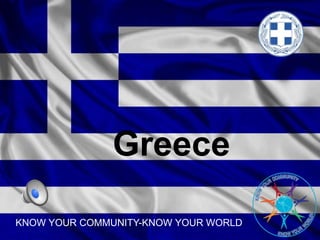
Greece
KNOW YOUR COMMUNITY-KNOW YOUR WORLD
Speaker:
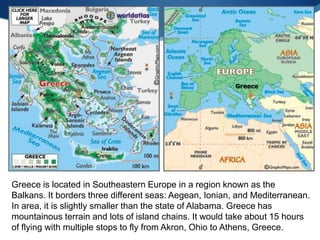
Greece is located in Southeastern Europe in a region known as the
Balkans. It borders three different seas: Aegean, Ionian, and Mediterranean.
In area, it is slightly smaller than the state of Alabama. Greece has
mountainous terrain and lots of island chains. It would take about 15 hours
of flying with multiple stops to fly from Akron, Ohio to Athens, Greece.
Country Quick Facts
 Full name: Hellenic Republic
 Population: 10,775,642 (July 2015)
 Capital: Athens
 Largest City: Athens
 Official language: Greek
 Major religion: Greek Orthodox (official)
 Life expectancy: male-77.83, female-83.2
 Monetary unit: Euro
 Main exports: food & beverages, manufactured goods, petroleum products,
chemicals, textiles
 GNI per capita: $25,700 (2013)
Greek History in Brief
 Greek civilization began around 3,000 BC with the Minoans, who were
followed by the Myceneans, who lasted until 1100 BC
 After this, Ancient Greece entered a “Dark Age” that lasted until 800 BC,
when Greeks began to explore the sea
 Around 480 BC, a golden age began that became known as Classic
Greece, which is when it earned the name of “the birthplace of western
civilization”
 In 146 BC the Romans conquered the Greek Empire
 Around 300 AD Greece became part of the Byzantine Empire
 Early 16th century- came under Ottoman Turk rule
 Gained independence from the Turks in 1830
 In WWI, Greece fought on the side of the Allies, but communism and fascism
Greek History continued
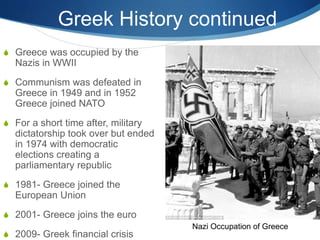
 Greece was occupied by the
Nazis in WWII
 Communism was defeated in
Greece in 1949 and in 1952
Greece joined NATO
 For a short time after, military
dictatorship took over but ended
in 1974 with democratic
elections creating a
parliamentary republic
 1981- Greece joined the
European Union
 2001- Greece joins the euro
 2009- Greek financial crisis
Nazi Occupation of Greece
Language
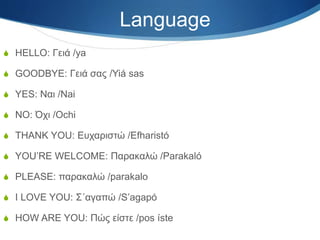
 HELLO: Γειά /ya
 GOODBYE: Γειά σας /Yiá sas
 YES: Ναι /Nai
 NO: Όχι /Ochi
 THANK YOU: Ευχαριστώ /Efharistó
 YOU’RE WELCOME: Παρακαλώ /Parakaló
 PLEASE: παρακαλώ /parakalo
 I LOVE YOU: Σ΄αγαπώ /S’agapó
 HOW ARE YOU: Πώς είστε /pos íste
Government
 Voting age- 18 (mandatory)
 Parliamentary republic
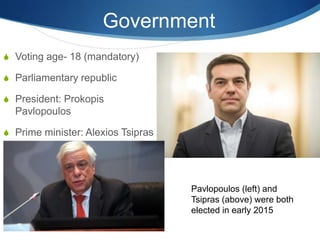
 President: Prokopis
Pavlopoulos
 Prime minister: Alexios Tsipras
Pavlopoulos (left) and
Tsipras (above) were both
elected in early 2015
Current Issues
 Debt crisis (see slide on Greek Debt Crisis)
 Boundary disputes with Turkey in the Aegean Sea
 Greece rejects the use of the name Macedonia or Republic of
Macedonia
 Air and water pollution
 High unemployment, poverty, human rights crisis?
 Unstable politics
Economy
 Joined the European Union in
1981
 Joined the Eurozone in 2001
 Tourism provides 18% of GDP
 Economy went into recession in
2009 (see Greek Debt Crisis
slide)
 Industries: tourism, food and
tobacco processing, textiles,
chemicals, metal products,
mining, petroleum
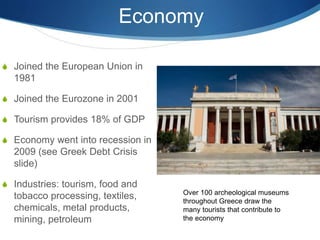
Over 100 archeological museums
throughout Greece draw the
many tourists that contribute to
the economy
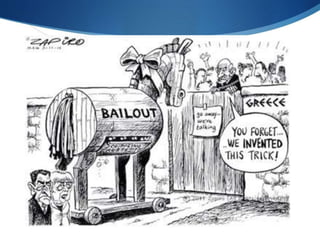
The Greek Debt Crisis
 Greece had been spending way more money than it had to spend,
wasn’t enforcing tax collection
 Government admitted it had been lying about national deficit for years
in 2009 after the Global Financial Crisis hit
 Financial lending in Greece was cut off and it was heading toward
bankruptcy
 110 billion euro bailout in 2010 by the EU and International Monetary
Fund but with austerity measures like large government spending
cuts, tax increases, and wage lowering
 A second bailout brought the bailout total to 240 billion euros
 Bailout money mostly goes towards paying back loans instead of into
the economy so Greece continues to struggle
Debt Crisis Continued
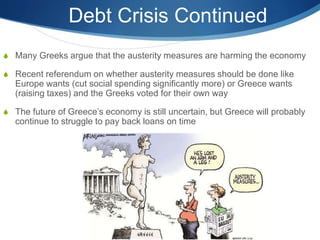
 Many Greeks argue that the austerity measures are harming the economy
 Recent referendum on whether austerity measures should be done like
Europe wants (cut social spending significantly more) or Greece wants
(raising taxes) and the Greeks voted for their own way
 The future of Greece’s economy is still uncertain, but Greece will probably
continue to struggle to pay back loans on time
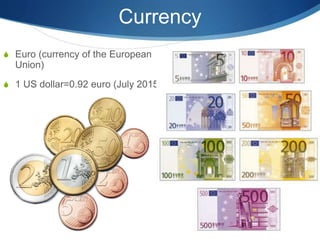
Currency
 Euro (currency of the European
Union)
 1 US dollar=0.92 euro (July 2015)
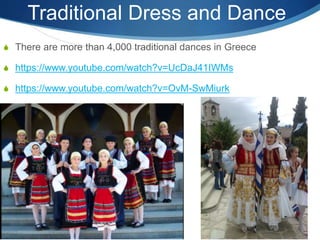
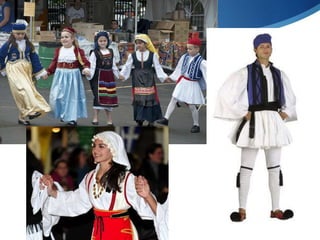
Traditional Dress and Dance
 There are more than 4,000 traditional dances in Greece
 https://www.youtube.com/watch?v=UcDaJ41IWMs
 https://www.youtube.com/watch?v=OvM-SwMiurk
Traditional Food
 Moussaka-layered casserole with eggplant, minced meat, potatoes and
veggies
 Pastitsio-pasta and meat filling layered and baked
 In Greece they eat lots of fresh fish because they are surround by seas
 Tzatziki- creamy, cucumber yogurt dip
 Spanakopita- Spinach pie with feta cheese
 Souvlaki- meat skewer with lamb, pork, chicken, etc.
 Kebabs- minced meat wrapped in pita bread with various toppings
 Baklava- flaky pastry with cinnamon-spice nut filling covered in syrup
 Galaktoboureko- custard-filled pie
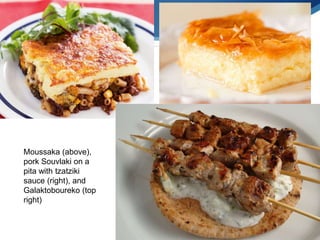
Moussaka (above),
pork Souvlaki on a
pita with tzatziki
sauce (right), and
Galaktoboureko (top
right)
Fun Facts
 Greece has 15 UNESCO World Heritage Sites in its borders
 Greece has about 2,000 islands of various sizes!
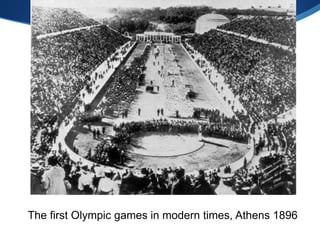
 The first modern Olympics were held in Athens, Greece in 1896, as
well as the first ever Olympics during ancient times (776 BC)
 Greece is the third largest producer of olives in the entire world and
Greeks consumer more olive oil per capita than any other group of
people
 Mount Olympus is the highest point in Greece and was thought to be
the home of the gods and goddesses in ancient times
 Greece is the only country in the world that receives double its
population in tourists
 Greeks celebrate name days more than birthdays- a name day is the
day of the saint that a person is named after
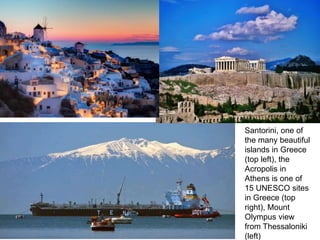
Santorini, one of
the many beautiful
islands in Greece
(top left), the
Acropolis in
Athens is one of
15 UNESCO sites
in Greece (top
right), Mount
Olympus view
from Thessaloniki
(left)
The first Olympic games in modern times, Athens 1896
Links
 https://www.cia.gov/library/publications/the-world-
factbook/geos/gr.html
 http://www.worldatlas.com/webimage/countrys/europe/gr.
htm

Greece

  • 1.
  • 2.
  • 3.
    Greece is locatedin Southeastern Europe in a region known as the Balkans. It borders three different seas: Aegean, Ionian, and Mediterranean. In area, it is slightly smaller than the state of Alabama. Greece has mountainous terrain and lots of island chains. It would take about 15 hours of flying with multiple stops to fly from Akron, Ohio to Athens, Greece.
  • 4.
    Country Quick Facts Full name: Hellenic Republic  Population: 10,775,642 (July 2015)  Capital: Athens  Largest City: Athens  Official language: Greek  Major religion: Greek Orthodox (official)  Life expectancy: male-77.83, female-83.2  Monetary unit: Euro  Main exports: food & beverages, manufactured goods, petroleum products, chemicals, textiles  GNI per capita: $25,700 (2013)
  • 5.
    Greek History inBrief  Greek civilization began around 3,000 BC with the Minoans, who were followed by the Myceneans, who lasted until 1100 BC  After this, Ancient Greece entered a “Dark Age” that lasted until 800 BC, when Greeks began to explore the sea  Around 480 BC, a golden age began that became known as Classic Greece, which is when it earned the name of “the birthplace of western civilization”  In 146 BC the Romans conquered the Greek Empire  Around 300 AD Greece became part of the Byzantine Empire  Early 16th century- came under Ottoman Turk rule  Gained independence from the Turks in 1830  In WWI, Greece fought on the side of the Allies, but communism and fascism
  • 6.
    Greek History continued Greece was occupied by the Nazis in WWII  Communism was defeated in Greece in 1949 and in 1952 Greece joined NATO  For a short time after, military dictatorship took over but ended in 1974 with democratic elections creating a parliamentary republic  1981- Greece joined the European Union  2001- Greece joins the euro  2009- Greek financial crisis Nazi Occupation of Greece
  • 7.
    Language  HELLO: Γειά/ya  GOODBYE: Γειά σας /Yiá sas  YES: Ναι /Nai  NO: Όχι /Ochi  THANK YOU: Ευχαριστώ /Efharistó  YOU’RE WELCOME: Παρακαλώ /Parakaló  PLEASE: παρακαλώ /parakalo  I LOVE YOU: Σ΄αγαπώ /S’agapó  HOW ARE YOU: Πώς είστε /pos íste
  • 8.
    Government  Voting age-18 (mandatory)  Parliamentary republic  President: Prokopis Pavlopoulos  Prime minister: Alexios Tsipras Pavlopoulos (left) and Tsipras (above) were both elected in early 2015
  • 9.
    Current Issues  Debtcrisis (see slide on Greek Debt Crisis)  Boundary disputes with Turkey in the Aegean Sea  Greece rejects the use of the name Macedonia or Republic of Macedonia  Air and water pollution  High unemployment, poverty, human rights crisis?  Unstable politics
  • 10.
    Economy  Joined theEuropean Union in 1981  Joined the Eurozone in 2001  Tourism provides 18% of GDP  Economy went into recession in 2009 (see Greek Debt Crisis slide)  Industries: tourism, food and tobacco processing, textiles, chemicals, metal products, mining, petroleum Over 100 archeological museums throughout Greece draw the many tourists that contribute to the economy
  • 11.
    The Greek DebtCrisis  Greece had been spending way more money than it had to spend, wasn’t enforcing tax collection  Government admitted it had been lying about national deficit for years in 2009 after the Global Financial Crisis hit  Financial lending in Greece was cut off and it was heading toward bankruptcy  110 billion euro bailout in 2010 by the EU and International Monetary Fund but with austerity measures like large government spending cuts, tax increases, and wage lowering  A second bailout brought the bailout total to 240 billion euros  Bailout money mostly goes towards paying back loans instead of into the economy so Greece continues to struggle
  • 12.
    Debt Crisis Continued Many Greeks argue that the austerity measures are harming the economy  Recent referendum on whether austerity measures should be done like Europe wants (cut social spending significantly more) or Greece wants (raising taxes) and the Greeks voted for their own way  The future of Greece’s economy is still uncertain, but Greece will probably continue to struggle to pay back loans on time
  • 14.
    Currency  Euro (currencyof the European Union)  1 US dollar=0.92 euro (July 2015)
  • 15.
    Traditional Dress andDance  There are more than 4,000 traditional dances in Greece  https://www.youtube.com/watch?v=UcDaJ41IWMs  https://www.youtube.com/watch?v=OvM-SwMiurk
  • 17.
    Traditional Food  Moussaka-layeredcasserole with eggplant, minced meat, potatoes and veggies  Pastitsio-pasta and meat filling layered and baked  In Greece they eat lots of fresh fish because they are surround by seas  Tzatziki- creamy, cucumber yogurt dip  Spanakopita- Spinach pie with feta cheese  Souvlaki- meat skewer with lamb, pork, chicken, etc.  Kebabs- minced meat wrapped in pita bread with various toppings  Baklava- flaky pastry with cinnamon-spice nut filling covered in syrup  Galaktoboureko- custard-filled pie
  • 18.
    Moussaka (above), pork Souvlakion a pita with tzatziki sauce (right), and Galaktoboureko (top right)
  • 19.
    Fun Facts  Greecehas 15 UNESCO World Heritage Sites in its borders  Greece has about 2,000 islands of various sizes!  The first modern Olympics were held in Athens, Greece in 1896, as well as the first ever Olympics during ancient times (776 BC)  Greece is the third largest producer of olives in the entire world and Greeks consumer more olive oil per capita than any other group of people  Mount Olympus is the highest point in Greece and was thought to be the home of the gods and goddesses in ancient times  Greece is the only country in the world that receives double its population in tourists  Greeks celebrate name days more than birthdays- a name day is the day of the saint that a person is named after
  • 20.
    Santorini, one of themany beautiful islands in Greece (top left), the Acropolis in Athens is one of 15 UNESCO sites in Greece (top right), Mount Olympus view from Thessaloniki (left)
  • 21.
    The first Olympicgames in modern times, Athens 1896
  • 22.