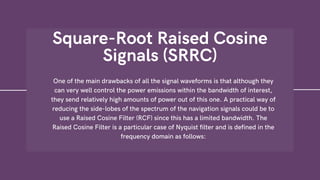
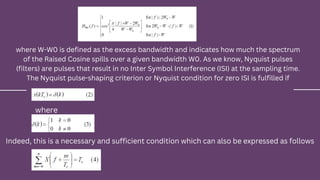
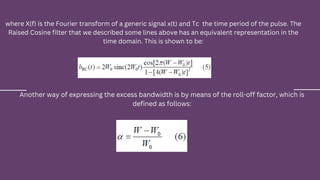
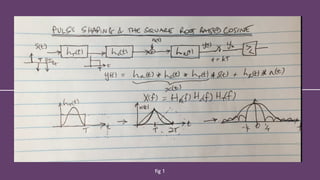
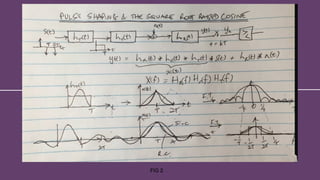
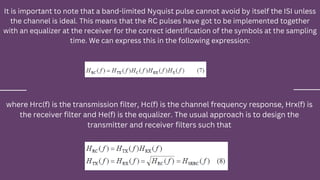
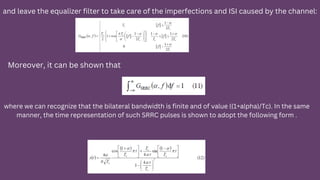
The document discusses square root raised cosine (SRRC) pulse shaping, which is used in digital communication systems to control spectral characteristics and minimize inter-symbol interference. SRRC pulse shaping involves using a raised cosine filter to shape pulses before transmission. This filter reduces side lobes in the signal's spectrum within the bandwidth. At the receiver, an equalizer is needed along with the transmission filter to correctly identify symbols and account for any interference caused by channel imperfections. SRRC pulse shaping is widely applied in technologies like QAM and PSK due to its ability to improve bandwidth efficiency and reduce interference between symbols.





![Multiband Transceivers - [Chapter 4] Design Parameters of Wireless Radios](https://cdn.slidesharecdn.com/ss_thumbnails/ch4-150613070934-lva1-app6892-thumbnail.jpg?width=640&height=640&fit=bounds)


