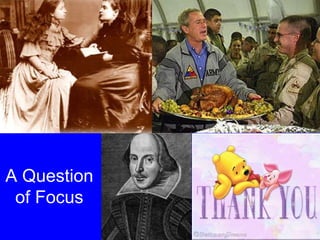
A Question of Focus
“ It appears that the way people perceive the world is much more important to happiness than objective circumstances.” Ed Diener Emotions determined by external  and  internal Choice of focus “ To the different minds, the same world is a hell, and a heaven.” Ralph Waldo Emerson   “ Nothing is good or bad but thinking makes it so.” William Shakespeare
 
Two Archetypes The Fault-Finder “ The fault-finder will find faults even in paradise” Henry David Thoreau Could lead to resignation The Benefit-Finder (Bower, 2007) Could lead to detachment The need to respect reality “ The invariable mark of wisdom is to see the miraculous in the common.” Ralph Waldo Emerson
We Co-Create Our Reality “ Now however fixed these elements of reality may be, we still have a certain freedom in our dealings with them.  Take our sensations.  That  they are is undoubtedly beyond our control; but  which  we attend to, note, and make emphatic in our conclusions depends on our own interests; and, according as we lay the emphasis here or there, quite different formulations of truth result.  We read the same facts differently.  ‘Waterloo,’ with the same fixed details, spells a ‘victory’ for an englishman; for a frenchman it spells a ‘defeat.’  So, for an optimist philosopher the universe spells victory, for a pessimist, defeat.  What we say about reality thus depends on the perspective into which we throw it.” William James
We Co-Create Our Reality Isn’t it strange how princes and kings, and clowns that caper in sawdust rings, and common people, like you and me, are builders for eternity? Each is given a list of rules; a shapeless mass; a bag of tools. And each must fashion, ere life is flown, A stumbling block, or a Stepping-Stone. R. L. Sharp
A Matter of Interpretation “ Never let a good crisis go to waste.”   Anne Harbison “ Things don’t necessarily happen for the best, but some people are able to make the best of things that happen.”
 
A Matter of Interpretation “ A pessimist sees the difficulty in every opportunity;  an optimist sees the opportunity in every difficulty.”   Winston Churchill
A Question of Interpretation The world according to the fault-finder The (same) world according to the benefit-finder
The Benefits of Being a Benefit Finder Well-being (Thompson, 1985) Health Affleck et al. (1987) Bower (1998) King & Miner (2000) Longevity “ The joyfulness of a man prolongeth his days.” Ecclesiastes
The Nun Study (Danner et al., 2001) Only positive feelings predicted longevity
“ God started my life off well by bestowing upon me grace of inestimable value... The past year which I spent as a candidate studying at Notre Dame has been a very happy one.  Now I look forward with eager joy to receiving the Holy Habit of Our Lady and to a life of union with Love Divine.” Celia O’Payne “ I was born on September 26, 1909, the eldest of seven children, five girls and two boys... My candidate year was spent in the mother-house, teaching chemistry and second year Latin at Notre Dame Institute.  With God’s grace, I intend to do my best for our Order, for the spread of religion and for my personal sanctification.”   Marguerite Donnelly
The Nun Study (Danner et al., 2001) Only positive feelings predicted longevity Age 85: 90% of most cheerful quartile alive;    34% of least cheerful quartile alive. Age 94:  54% of most cheerful quartile alive;  11% of least cheerful quartile alive
Get Real! The world according to the media


Get Real! The world according to the media Media bias magnifying glass rather than looking glass accentuating the negative (magnifying) under-representing the positive (minimizing)


Get Real! The world according to the media Media bias magnifying glass rather than looking glass accentuating the negative under-representing the positive Who is really detached? Focusing on the 90% full part of the glass Focus creates reality
Appreciating Appreciation Creating a growth spiral Genuine appreciation! There is always something to appreciate Ap-pre’ci-ate v.,  1. Valuing; the act of recognizing the best in people or the world around us, affirming past and present strengths and potentials; to perceive those things that give life (health, vitality, excellence) to living systems.  2. To increase in value, e.g., the economy has appreciated in value.
“ What you focus on expands, and when you focus on the goodness in your life, you create more of it.  Opportunities, relationships, even money flowed my way when I learned to be grateful no matter what happened in my life.” Oprah Winfrey
 
Correcting the False Schema: News
 
 
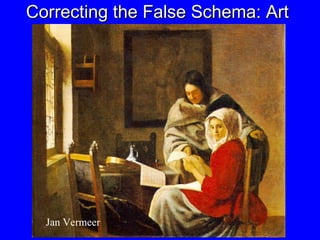
Correcting the False Schema: Art Jan Vermeer
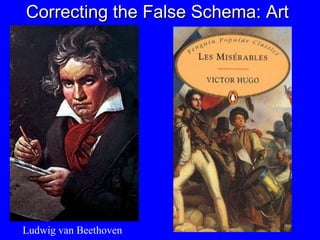
Correcting the False Schema: Art Ludwig van Beethoven
Correcting the False Schema: Art
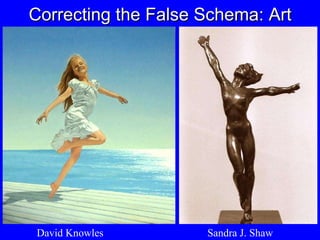
Correcting the False Schema: Art David Knowles Sandra J. Shaw
Correcting the False Schema: Studies
Adaptation We are change detectors Change detection helpful in case of danger Adaptation helps to overcome difficulties Taking things for granted Eating the cake and leaving it whole?
Must something external and extraordinary happen before we learn to appreciate the ordinary?
Learning to be Grateful “ You say grace before meals.  All right.  But I say grace before the concert and the opera, and grace before the play and pantomime, and grace before I open a book, and grace before sketching, painting, swimming, fencing, boxing, walking, playing, dancing, and grace before I dip the pen in the ink.” “ Gratitude produced the most purely joyful moments that have been known to man.” G. K. Chesterton
“ Why not start by surveying a typical day?  What is it you tend to tackle with spontaneous mindfulness, so that without an effort your whole heart is in it?  Maybe it’s that first cup of coffee in the morning, the way it warms you and wakes you up, or taking your dog for a walk, or giving a little child a piggyback ride.... [It is] a matter of practice, of doing it over and over again, till it becomes second nature.” “ Gratefulness is the measure of our aliveness.  Are we not dead to whatever we take for granted?  Surely to be numb is to be dead.”
Research on Gratitude Emmons and McCullough (2002) Four groups: gratitude, hassles, superior, control Psychological and health benefits Physiological benefits (McCraty & Childre 2004) Benefits of trait gratefulness Maintaining freshness Weekly? (Lyubomirsky, 2008) Variety Minfulness (Langer, 1989) Visualize (Kosslyn, 2005)
Try It! Becoming a benefit-finder 21 days or your money back Chipping away negativity Thanks for reminding me… Co-creating reality with questions
Gratitude to Others (Seligman, 2005) Take time to reflect Letter, phone, or in-person Largest boost in wellbeing Regularly (weekly, bi-weekly or monthly) Writing helps even if letter not sent
Worst and Happiest Experiences  (Lyubomirsky et al. 2006) Writing, Talking, or Thinking Mental and physical health measures Analyzing versus replaying (study 3) Positive Outcome Negative Outcome Thinking Negative Outcome Positive Outcome Talking Negative Outcome Positive Outcome Writing Happiest (Study 2) Worst (Study 1)
“ We live in a ‘given’ world...  What brings fulfillment is gratefulness, the simple response of our heart to this given life in all its fullness.” Brother David Steindl-Rast “ To live and die in gratefulness, if in no other virtue.” Galway Kinnel “ Gratitude is not only the greatest of virtues, but the parent of all others”. Cicero The Morality of Gratitude
 
“ I wondered how it was possible to walk for an hour through the woods and see nothing of note.  I who cannot see find hundreds of things: the delicate symmetry of a leaf, the smooth skin of a silver birch, the rough, shaggy bark of a pine.  I who am blind can give one hint to those who see: use your eyes as if tomorrow you will have been stricken blind.  Hear the music of voices, the songs of a bird, the mighty strains of an orchestra as if you would be stricken deaf tomorrow.  Touch each object as if tomorrow your tactile sense would fail.  Smell the perfume of flowers,  taste with relish each morsel, as if tomorrow you could never taste or smell again.  Make the most of every sense.  Glory in all the facets and pleasures and beauty which the world reveals to you.” Hellen Keller
 
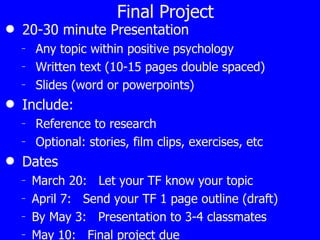
Final Project 20-30 minute Presentation Any topic within positive psychology Written text (10-15 pages double spaced) Slides (word or powerpoints) Include: Reference to research Optional: stories, film clips, exercises, etc Dates March 20:  Let your TF know your topic April 7:  Send your TF 1 page outline (draft) By May 3:  Presentation to 3-4 classmates May 10:  Final project due
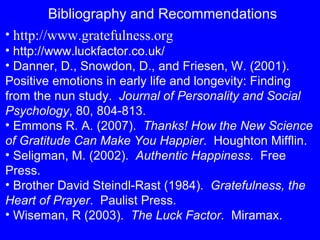
http://www.gratefulness.org http://www.luckfactor.co.uk/ Danner, D., Snowdon, D., and Friesen, W. (2001).  Positive emotions in early life and longevity: Finding from the nun study.  Journal of Personality and Social Psychology , 80, 804-813. Emmons R. A. (2007).  Thanks! How the New Science of Gratitude Can Make You Happier .  Houghton Mifflin. Seligman, M. (2002).  Authentic Happiness .  Free Press. Brother David Steindl-Rast (1984).  Gratefulness, the Heart of Prayer .  Paulist Press. Wiseman, R (2003).  The Luck Factor .  Miramax. Bibliography and Recommendations

1504 04-focus

  • 1.
  • 2.
    “ It appearsthat the way people perceive the world is much more important to happiness than objective circumstances.” Ed Diener Emotions determined by external and internal Choice of focus “ To the different minds, the same world is a hell, and a heaven.” Ralph Waldo Emerson “ Nothing is good or bad but thinking makes it so.” William Shakespeare
  • 3.
  • 4.
    Two Archetypes TheFault-Finder “ The fault-finder will find faults even in paradise” Henry David Thoreau Could lead to resignation The Benefit-Finder (Bower, 2007) Could lead to detachment The need to respect reality “ The invariable mark of wisdom is to see the miraculous in the common.” Ralph Waldo Emerson
  • 5.
    We Co-Create OurReality “ Now however fixed these elements of reality may be, we still have a certain freedom in our dealings with them. Take our sensations. That they are is undoubtedly beyond our control; but which we attend to, note, and make emphatic in our conclusions depends on our own interests; and, according as we lay the emphasis here or there, quite different formulations of truth result. We read the same facts differently. ‘Waterloo,’ with the same fixed details, spells a ‘victory’ for an englishman; for a frenchman it spells a ‘defeat.’ So, for an optimist philosopher the universe spells victory, for a pessimist, defeat. What we say about reality thus depends on the perspective into which we throw it.” William James
  • 6.
    We Co-Create OurReality Isn’t it strange how princes and kings, and clowns that caper in sawdust rings, and common people, like you and me, are builders for eternity? Each is given a list of rules; a shapeless mass; a bag of tools. And each must fashion, ere life is flown, A stumbling block, or a Stepping-Stone. R. L. Sharp
  • 7.
    A Matter ofInterpretation “ Never let a good crisis go to waste.” Anne Harbison “ Things don’t necessarily happen for the best, but some people are able to make the best of things that happen.”
  • 8.
  • 9.
    A Matter ofInterpretation “ A pessimist sees the difficulty in every opportunity; an optimist sees the opportunity in every difficulty.” Winston Churchill
  • 10.
    A Question ofInterpretation The world according to the fault-finder The (same) world according to the benefit-finder
  • 11.
    The Benefits ofBeing a Benefit Finder Well-being (Thompson, 1985) Health Affleck et al. (1987) Bower (1998) King & Miner (2000) Longevity “ The joyfulness of a man prolongeth his days.” Ecclesiastes
  • 12.
    The Nun Study(Danner et al., 2001) Only positive feelings predicted longevity
  • 13.
    “ God startedmy life off well by bestowing upon me grace of inestimable value... The past year which I spent as a candidate studying at Notre Dame has been a very happy one. Now I look forward with eager joy to receiving the Holy Habit of Our Lady and to a life of union with Love Divine.” Celia O’Payne “ I was born on September 26, 1909, the eldest of seven children, five girls and two boys... My candidate year was spent in the mother-house, teaching chemistry and second year Latin at Notre Dame Institute. With God’s grace, I intend to do my best for our Order, for the spread of religion and for my personal sanctification.” Marguerite Donnelly
  • 14.
    The Nun Study(Danner et al., 2001) Only positive feelings predicted longevity Age 85: 90% of most cheerful quartile alive; 34% of least cheerful quartile alive. Age 94: 54% of most cheerful quartile alive; 11% of least cheerful quartile alive
  • 15.
    Get Real! Theworld according to the media
  • 16.
  • 17.
  • 18.
  • 19.
  • 20.
    Get Real! Theworld according to the media Media bias magnifying glass rather than looking glass accentuating the negative (magnifying) under-representing the positive (minimizing)
  • 21.
  • 22.
  • 23.
  • 24.
  • 25.
  • 26.
  • 27.
  • 28.
  • 29.
  • 30.
  • 31.
  • 32.
  • 33.
    Get Real! Theworld according to the media Media bias magnifying glass rather than looking glass accentuating the negative under-representing the positive Who is really detached? Focusing on the 90% full part of the glass Focus creates reality
  • 34.
    Appreciating Appreciation Creatinga growth spiral Genuine appreciation! There is always something to appreciate Ap-pre’ci-ate v., 1. Valuing; the act of recognizing the best in people or the world around us, affirming past and present strengths and potentials; to perceive those things that give life (health, vitality, excellence) to living systems. 2. To increase in value, e.g., the economy has appreciated in value.
  • 35.
    “ What youfocus on expands, and when you focus on the goodness in your life, you create more of it. Opportunities, relationships, even money flowed my way when I learned to be grateful no matter what happened in my life.” Oprah Winfrey
  • 36.
  • 37.
  • 38.
  • 39.
  • 40.
    Correcting the FalseSchema: Art Jan Vermeer
  • 41.
    Correcting the FalseSchema: Art Ludwig van Beethoven
  • 42.
  • 43.
    Correcting the FalseSchema: Art David Knowles Sandra J. Shaw
  • 44.
    Correcting the FalseSchema: Studies
  • 45.
    Adaptation We arechange detectors Change detection helpful in case of danger Adaptation helps to overcome difficulties Taking things for granted Eating the cake and leaving it whole?
  • 46.
    Must something externaland extraordinary happen before we learn to appreciate the ordinary?
  • 47.
    Learning to beGrateful “ You say grace before meals. All right. But I say grace before the concert and the opera, and grace before the play and pantomime, and grace before I open a book, and grace before sketching, painting, swimming, fencing, boxing, walking, playing, dancing, and grace before I dip the pen in the ink.” “ Gratitude produced the most purely joyful moments that have been known to man.” G. K. Chesterton
  • 48.
    “ Why notstart by surveying a typical day? What is it you tend to tackle with spontaneous mindfulness, so that without an effort your whole heart is in it? Maybe it’s that first cup of coffee in the morning, the way it warms you and wakes you up, or taking your dog for a walk, or giving a little child a piggyback ride.... [It is] a matter of practice, of doing it over and over again, till it becomes second nature.” “ Gratefulness is the measure of our aliveness. Are we not dead to whatever we take for granted? Surely to be numb is to be dead.”
  • 49.
    Research on GratitudeEmmons and McCullough (2002) Four groups: gratitude, hassles, superior, control Psychological and health benefits Physiological benefits (McCraty & Childre 2004) Benefits of trait gratefulness Maintaining freshness Weekly? (Lyubomirsky, 2008) Variety Minfulness (Langer, 1989) Visualize (Kosslyn, 2005)
  • 50.
    Try It! Becominga benefit-finder 21 days or your money back Chipping away negativity Thanks for reminding me… Co-creating reality with questions
  • 51.
    Gratitude to Others(Seligman, 2005) Take time to reflect Letter, phone, or in-person Largest boost in wellbeing Regularly (weekly, bi-weekly or monthly) Writing helps even if letter not sent
  • 52.
    Worst and HappiestExperiences (Lyubomirsky et al. 2006) Writing, Talking, or Thinking Mental and physical health measures Analyzing versus replaying (study 3) Positive Outcome Negative Outcome Thinking Negative Outcome Positive Outcome Talking Negative Outcome Positive Outcome Writing Happiest (Study 2) Worst (Study 1)
  • 53.
    “ We livein a ‘given’ world... What brings fulfillment is gratefulness, the simple response of our heart to this given life in all its fullness.” Brother David Steindl-Rast “ To live and die in gratefulness, if in no other virtue.” Galway Kinnel “ Gratitude is not only the greatest of virtues, but the parent of all others”. Cicero The Morality of Gratitude
  • 54.
  • 55.
    “ I wonderedhow it was possible to walk for an hour through the woods and see nothing of note. I who cannot see find hundreds of things: the delicate symmetry of a leaf, the smooth skin of a silver birch, the rough, shaggy bark of a pine. I who am blind can give one hint to those who see: use your eyes as if tomorrow you will have been stricken blind. Hear the music of voices, the songs of a bird, the mighty strains of an orchestra as if you would be stricken deaf tomorrow. Touch each object as if tomorrow your tactile sense would fail. Smell the perfume of flowers, taste with relish each morsel, as if tomorrow you could never taste or smell again. Make the most of every sense. Glory in all the facets and pleasures and beauty which the world reveals to you.” Hellen Keller
  • 56.
  • 57.
    Final Project 20-30minute Presentation Any topic within positive psychology Written text (10-15 pages double spaced) Slides (word or powerpoints) Include: Reference to research Optional: stories, film clips, exercises, etc Dates March 20: Let your TF know your topic April 7: Send your TF 1 page outline (draft) By May 3: Presentation to 3-4 classmates May 10: Final project due
  • 58.
    http://www.gratefulness.org http://www.luckfactor.co.uk/ Danner,D., Snowdon, D., and Friesen, W. (2001). Positive emotions in early life and longevity: Finding from the nun study. Journal of Personality and Social Psychology , 80, 804-813. Emmons R. A. (2007). Thanks! How the New Science of Gratitude Can Make You Happier . Houghton Mifflin. Seligman, M. (2002). Authentic Happiness . Free Press. Brother David Steindl-Rast (1984). Gratefulness, the Heart of Prayer . Paulist Press. Wiseman, R (2003). The Luck Factor . Miramax. Bibliography and Recommendations